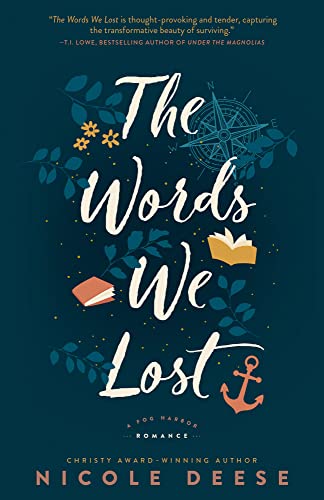
In The Words We Lost by Nicole Deese, Ingrid Erikson moved to western Washington state with her father and became friends with cousins Cece and Joel Campbell when they were all teenagers.
Cece grew up to write a novel, which Ingrid, as an intern at a publishing house, sneaked to her editor. The editor loved the manuscript, bought it, and Cece’s series became runaway best-sellers.
But then Cece tragically died on the operating table during surgery to remove a brain tumor.
Besides losing Cece, Ingrid’s father died several years before. Ingrid blamed Joel and broke contact with him. So she lost all the people and the place she loved most and moved hundreds of miles away.
Ingrid is now a senior acquisitions editor, but she has a hard time functioning due to her grief. She relies heavily on her own intern, Chip. But her new boss can see she’s faltering.
Then Joel suddenly shows up unannounced. The family lawyer discovered a sealed letter addressed to him and Ingrid from Cece. She wanted them to come back home together to retrieve a package.
Ingrid’s boss gives her an ultimatum: find the rumored missing fourth manuscript to Cece’s series, or lose her job.
Ingrid isn’t sure she can go back to the area that she loves, but that brought her so much pain—and do so with Joel. But she doesn’t have a choice if she wants to keep her job.
I bought this book because I loved two of Nicole’s other books I had read. I got the audiobook at first, but the narrator just hit me wrong somehow. So I returned the book and got the Kindle version.
Then the first few pages held one of my pet peeves in writing. 🙂
But once we got past all that and I settled into the story, I loved it just as much as the others.
Some of the quotes I liked:
Success is a slow, long process of repetition (p. 90, Kindle version).
No heartache has ever gone unseen, and no darkness is ever too solid for light to overcome (p. 156).
God is often made visible by the hands and feet of the people He places in our lives (p. 177).
We can’t change the time we’ve spent, just how we choose to spend the time we have left (p. 228).
Even though there are still things to talk and sing and laugh about in this life, there are also things to miss and lament and grieve, too. Both are welcome and both are necessary (p. 367).
I enjoyed the depth of the characters and was pulled into their heartaches. The last few chapters unravel a bit of mystery. After the first few pages, I loved how the story developed and then concluded. I also loved the double meaning in the title. I’m happy to recommend this book to you.
In Dreams of Savannah by Roseanna M. White, Cordelia Owens is a pampered Southern belle who loves to dream and write stories. She also loves Phineas Dunn, a lifelong friend newly recruited to the Confederate Navy, and promises to wait for him forever.
When she learns Phineas has been lost at sea, she weaves heroic tales for his mother and sister to help them keep up hope.
When Phineas was shot and fell overboard, he thought he was done for. But somehow he washes up on an island near Cuba. He’s rescued by a person he never imagined existed: an educated free black man from England. He has no way to let his family or his commanding officer know what has happened to him. All he can do is try to get well as fast as possible and get home. But his injuries are severe.
As the weeks drag by, a distant cousin of Cordelia’s comes to Savannah, assigned to the Confederate regiment there. Her parents are impressed by his manners, standing, and wealth. They like Phineas well enough, but his family’s credentials just don’t compare. They put pressure on Cordelia to turn her attention to her cousin. But even if she had not promised Phin she would wait forever, she would not have her cousin. There’s a predatory gleam in his eyes when her parents aren’t around.
When Phineas finally returns, he is still suffering from his injury. Worse, he has fallen in his own estimation. He wanted to be the hero of Cordelia’s stories. He doesn’t feel worthy of her, but he still vies for her hand. Her parents keep pushing her toward her cousin.
Both Cordelia and Phineas are from good families who are known to be kind to their slaves. Phineas’ father was, in fact, planning to free his slaves until doing so became illegal in Georgia.
But different experiences and people begin to change their perspectives. The question now is what to do. Is it enough just to be good to one’s slaves? Could they be mocked, scorned, or even arrested if their views on slavery changed? And how could their views change without changing their actions as well?
At the beginning of this book, Cordelia came across to me as young and somewhat silly (one of her fears for Phineas was that he might be attacked by a giant squid. . . ). I’m not sure how old she was, something hard to go back and find in an audiobook. Also, the Southern belle vibe came across a little too thick, replete with “fiddale-faddle” and “fiddel-dee-dee” (making me wonder for the first time why “fiddle’ was in so many expressions then).
But after I settled into the story, I began to enjoy it more. Cordelia is immature at the beginning. But the circumstances of the story cause her to grow. Even her story-telling matures over time.
It would be hard to write a book of changing viewpoints towards slavery and black people set in the 1861 South without attributing to the characters twenty-first century sensibilities. But Roseanna avoided that and had beliefs change and grow in the context of what was going on at the time.
A couple of my favorite quotes:
She certainly shouldn’t be refused happiness because of your convoluted ideas about your precious blood making her better than her mother . . . Because let me just tell you . . . your blood doesn’t have that power. There’s only one Man’s blood in all of history that can make us better than we are—and your are not Him.
She didn’t need to be a heroine in some fantastic tale of derring-do. That wasn’t what the Lord had given her. No, He’d given her words. Words to live by. Words to create with. Words that maybe, just maybe, could change the world beyond her house as surely as they had changed the one within.
I listened to the audiobook nicely narrated by Sarah Zimmerman.
So far, I have loved every book of Roseanna’s that I have read, including this one.
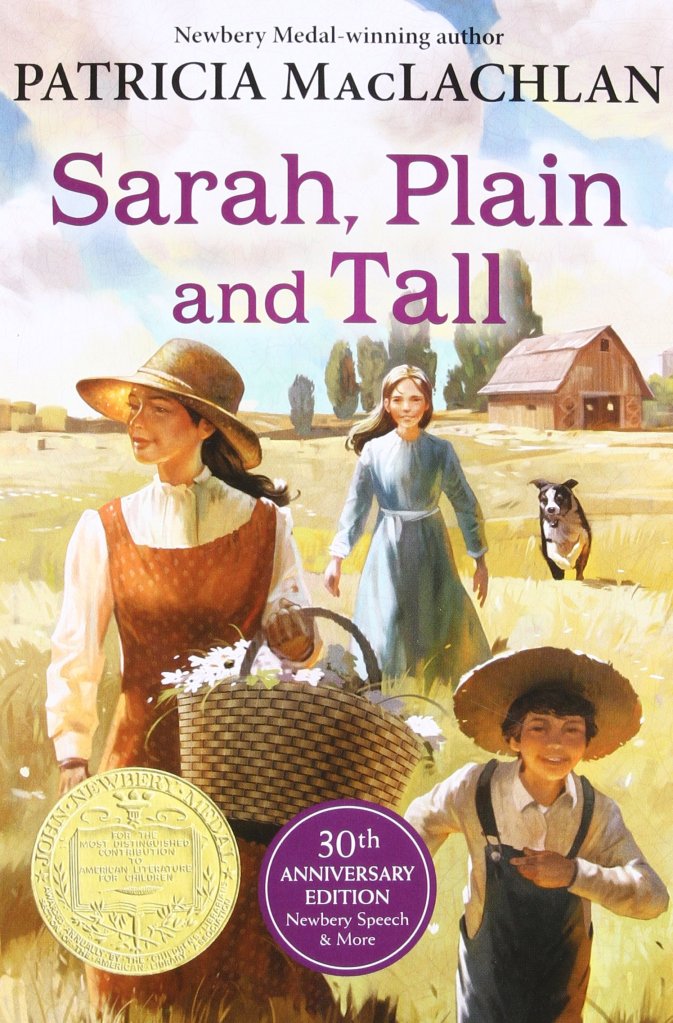
I saw the film version of Sarah, Plain and Tall with Glenn Close several years ago and loved it. I hadn’t known then that it was based on a children’s book by Patricia MacLachlan. I just recently read the Kindle version.
The story opens with Anna, her younger brother Caleb, and their widowed father living on the prairie in the late 19th century. Written from Anna’s point of view, she notes that her parents used to sing all the time, but her Papa never does any more.
Papa tells the children he has placed an advertisement for a wife and received a reply from Sarah, a woman in Maine. She lives with her brother, but he is getting married. She’s concerned she will miss the sea, but she’s willing to come out by train to the prairie and meet the family.
Sarah exchanges letters with papa, Anna, and Caleb until she arrives. Sarah is different and does unusual things. They all like each other, but the children are afraid Sarah misses the sea too much to stay.
This was a lovely story written in a simple yet beautiful style.
A few of my favorite quotes:
Outside, the prairie reached out and touched the places where the sky came down.
My brother William is a fisherman, and he tells me that when he is in the middle of a fog-bound sea the water is a color for which there is no name.
There is no sea here. But the land rolls a little like the sea.
I shook my head, turning the white stone over and over in my hand. I wished everything was as perfect as the stone. I wished that Papa and Caleb and I were perfect for Sarah. I wished we had a sea of our own.
This book won a Newberry Medal, and the Kindle version I read included the author’s speech upon receiving it. She said the story was based on a real Sarah from Maine who had traveled to the prairie to become the wife and mother of a friend of the author’s mother. This speech contained a couple more favorite quotes:
Every writer should have a loving reader who has the courage to write both “I love this” and “Ugh” on the same page.
When Julius Lester praises children’s literature as the “literature that gives full attention to the ordinary,” he echoes my parents’ belief that it is the daily grace and dignity with which we survive that children most need and wish to know about in books.
My parents believed in the truths of literature, and it was my mother who urged me to “read a book and find out who you are,” for there are those of us who read or write to slip happily into the characters of those we’d like to be. It is, I believe, our way of getting to know the good and bad of us, rehearsing to be more humane, “revising our lives in our books,” as John Gardner wrote, “so that we won’t have to make the same mistakes again.”
I knew there was one sequel to the book, Skylark. But I hadn’t known there were three more. The Kindle version contains the first chapter of each of the books. Someday I hope to read the rest.
I wanted to rewatch the videos of both Sarah, Plain and Tall and Skylark, but they don’t appear to be available to stream from anywhere. I might see if the library has the DVDs.
Have you read or watched Sarah, Plain and Tall? What did you think?
When the Day Comes by Gabrielle Meyer has an intriguing and unique premise for a novel.
Libby Conant is a time crosser. She lives in 1774 Williamsburg with her widowed mother and two sisters. She and her mother took over the printing of the Virginia Gazette after her father died, but they are barely making ends meet. Creditors threaten prison. Then the Conants are awarded the public printing contract from the House of Burgesses. They print Thomas Jefferson’s pamphlets as well as public notices. The Revolutionary War is about to break out, and tensions run high between rebels and loyalists.
Libby has loved Henry Montgomery since they were both children. She thinks he has feelings for her as well, but they move in different social circles. Plus he has secrets of his own. Whose side is he really on?
When Libby goes to sleep in Williamsburg, she wakes up as Anna Elisabeth Wells, only daughter to a prominent, wealthy family in 1914 New York. Her father’s fortune was self-made, which is not enough for her mother’s ambition for rank which values “old money.” Her mother has paraded Libby around for two seasons in New York, and now they are going to London to see what the titled male population is like there.
Libby does not want to marry, at least not before her twenty-first birthday. She enjoys working with the suffragette movement, which her mother disdains. Mother Wells is one of the most manipulative women ever and overrides Libby’s wishes and protests in her pursuit of the right suitor.
War is looming on this timeline as well, though no one knows it yet. Libby only knows because her mother in 1774 was a time crosser as well who lived in the twenty-first century.
When Libby goes to sleep in New York, she wakes up in Williamsburg again, with no loss of time in either place. Thus has it been since she was born and thus it will be until she turns twenty-one. Then she will have to choose which path she wants to live in permanently. Her body will die in the path she does not choose, but she will retain her memories of that time. If she tries to knowingly alter history in either path, she’ll forfeit her life in that path.
Libby is sure which path she will choose. She likes the conveniences of the Gilded Age in 1914, but she’s not interested in status and wealth. She’s needed in 1774 to help her family and the cause of freedom. And even if her love for Henry can never come to fruition, she wants to be where he is.
But unexpected circumstances may force her into a different choice.
This book came out last year, and I kept seeing it favorably mentioned among bloggers I follow. I still wasn’t quite sure I’d be interested, but I decided to give the audiobook a try. And . . . wow. This book was fascinating. The characters are well-drawn. It was fun seeing a few historical figures in the story. The plot kept a good pace, even with the intricacies of two timelines. I loved the eventual emphasis on the need to trust God rather than strive after our own way. I didn’t see the ending coming at all, but it was supremely satisfying.
As usual, the audiobook did not contain the author’s notes. I was curious about how she got and developed the idea for this book and found an interview with her about it here.
I enjoyed this book so much, I immediately started the sequel, In this Moment. Highly recommended.
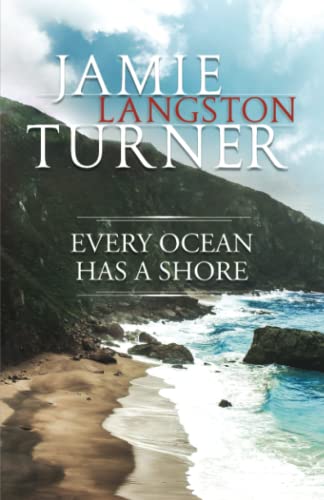
Every Ocean Has a Shore, a novel by Jamie Langston Turner, opens with a few people in a small diner in Chicago. Suddenly a young man with a gun comes in, locks the door, and starts barking orders.
Tragedy is averted, but everyone is shaken. The three adults in the main dining room don’t know it yet, but they are bonded together even after they go their separate ways.
The only customers in the diner at the time were an older woman, Alice, and a young boy. Alice had been estranged from her daughter for years before her daughter died. Alice just found out that her daughter left behind a young son, Ian, who had been cared or by his father. But now the father is dying, and someone finds Alice’s contact information. Alice flew from South Carolina to Chicago to pick up five-year-old Ian, who doesn’t speak. They’ve just stopped at the diner for lunch when the incident occurred.
Gary is the owner of the diner. He was always a quiet man, but became quieter still after his wife died. He’s intelligent, but it takes him a while to think through things. His loneliness and the crime in the city cause him to consider moving, but he doesn’t know where or what he would do with himself. He has a sister in Vermont who needs help fixing up her home. Maybe he’ll start there.
Fawna is the waitress, a college dropout with a birthmark on her cheek in the shape of Borneo and a penchant for saying weird things. She rents a room from a crotchety old woman named Mrs. Welborn and helps her out. Her parents died, leaving her with money to live on. She’s drifted around for the past eight or nine years, but thinks she might like to settle down somewhere. The problem is, she doesn’t know where to go or what she wants to do.
The point of view switches between these three as they go on with their lives but keep in touch. We learn some of their background and issues. Fawna discovers C. S. Lewis and begins to wonder if, as Lewis suggests, someone has been orchestrating all the events of their lives.
Fans of Jamie Langston Turner will welcome this, her first new book in nine years. A few characters from her earlier books make an appearance, particularly Eldeen, the larger-than-life older woman from Jamie’s first book, Suncatchers. But this is a stand-alone novel that can be enjoyed even if you haven’t read the previous books.
Jamie’s books are character-driven, not plot-driven. This isn’t an edge-of-your-seat kind of story. In fact, the story seems pretty slow in places. But as we learn more about each character and see how everything is woven together, we find great depth. I’ve seen many people who don’t normally like Christian fiction say that they like Jamie’s books.
If people think about humility at all these days, they usually envision self-deprecation, playing down one’s attributes, talents, or accomplishments, or, at the very least, not bragging.
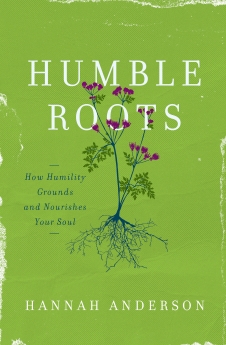
In Humble Roots: How Humility Grounds and Nourishes Your Soul, Hannah Anderson explores humility from a Biblical angle. Instead of viewing humility as a club or prod when we’re feeling too proud, humility frees us and leads us to rest.
I defined humility as a correct sense of self, as understanding where you come from and where you belong in this world (p. 64, Kindle version).
Theologically speaking, humility is a proper understanding of who God is and who we are as a result (p. 102).
I would describe it as a creaturely dependence. We’re “made in His image, but we are made nonetheless (p. 11)—made originally from dirt, to which our bodies return. As Paul reminds Timothy, “we brought nothing into the world, and we cannot take anything out of the world” (1 Timothy 6:7). Everything we are and everything we have comes from God.
The problem is our obsession with ourselves. With our need to fix things, our need to make ourselves better, our need to be approved by God and others, our need to “count for something.”
But this is also why Jesus calls us to come to Him. By coming to Jesus, we remember who we are and who we are not. By coming to Him, we come face to face with God and with ourselves. “It is only in our encounter with a personal God,” writes philosopher Dietrich von Hildebrand, “that we become fully aware of our condition as creatures, and fling from us the last particle of self-glory” (p. 55).
If I can’t handle little things, what can I handle? Failure at small things reminds us of how helpless we are in this great, wide world. When little things spiral out of control, they remind us that even they were never within our control in the first place (p. 26).
Humility, instead of being a negative concept, frees us:
to be the people God created us to be (p. 11).
from the cycle of stress, performance, and competition (p. 12).
from our burdens . . . by calling us to rely less on ourselves and more on Him (p. 32).
to redirect our energies toward God and those whom He has given us to love (p. 3).
from the condemnation of others, . . . from self-condemnation and unnecessary guilt (p. 108).
to hear God’s call and leads you to a place of both rest and flourishing (p. 110).
from the oppression of our emotions, when we finally learn that “God is greater than our heart (p. 114).
from the responsibility of feeling like you have to “do it all.” You are free to do only what you have been made to do (p. 163)
. . . and so much more.
Hannah follows Jesus’ admonition to consider birds and flowers by grounding each chapter in something from the garden or nature. For instance, the chapter “Vine-Ripened” begins with all the work that goes into growing garden tomatoes, then being fooled every year into thinking the ones gassed for redness in stores will be the same. That leads into a discussion of wisdom being rooted not in acquiring facts, but in submitting to the source of wisdom–the fear of the Lord. Then an 1800 court case over whether tomatoes are vegetables or fruit is tied in, along with our relentless desire to be “right.” “Humility simply leaves room that my understanding of a situation could be wrong” (p. 124). We may not have all the facts or may be influenced by culture. Because we’re limited, “my faith cannot rest on my own knowledge . . . or ability to understand . . . humility leaves room for grace” (p. 124). How unlike most social media discussions, where everyone is right in their own eyes. Hannah then refers to an Isaac Watts book which discusses a “dogmatical spirit.” Our wisdom and safety come not from our being right, but from Jesus being right. Then the chapter goes back to the process of creating store-bought tomatoes, compares that with our search for wisdom, and extols the wisdom of waiting: “Humility teaches us to let knowledge ripen on the vine” (p. 129). The chapter is much more beautifully woven together than my cobbled summation here.
Hannah points us to Jesus, “who, though he was in the form of God, did not count equality with God a thing to be grasped, but emptied himself, by taking the form of a servant, being born in the likeness of men.And being found in human form, he humbled himself by becoming obedient to the point of death, even death on a cross (Philippians 2:6-8) and who invites us to “Take my yoke upon you, and learn from me, for I am gentle and lowly in heart, and you will find rest for your souls” (Matthew 11:20).
Besides benefiting from the truths Hannah shares, I marvel at the way she is able to weave together facts from nature, literature, Scripture, and personal example seamlessly into each chapter. I don’t know how she accomplishes this without time to just sit and think, but as a busy pastor’s wife and mom, I’m sure such time is at a premium. I first read one of her books during Advent and have been working my way through her others. She has quickly become one of my favorite authors.
Even though I just finished this book, reading one chapter a week, I am thinking about going through it again. I need to soak in its truths more.
In A Place to Hang the Moon by Kate Albus, William, 12, Edmund, 11, and Anna, 9, live in 1940 England. Their parents died when William was 5. “The grandmother” had charge of them since, but she sent them off to boarding school and was cold and aloof when they were home.
Now the grandmother has died as well. The family solicitor, Mr. Engersoll, explains that the children have been left a lot of money, but no one has been named as their guardian. Apparently there is no one to ask. The children plead to stay with the family’s housekeeper, Mrs. Collins, but she’s too old to take them in.
Mr. Engersoll suggests that the children join evacuees being sent to the country. Perhaps the foster parents they find might take them in permanently. The children are advised not to tell anyone that they are alone in the world or that their family has money, so they don’t get taken advantage of.
The children agree with what Mrs. Collins calls “the preposterous plan,” as there seems to be no other option.
The children are billeted together first with one family, then another. I don’t want to spoil the story by telling what went on in those places, but neither is suitable.
The children spend many afternoons in the town library. Books have always been their friends, and the warmth and quietness of the library provide a refuge. The kind interest of the librarian, Mrs. Muller, makes the place even more welcome.
It’s not long, however, before they discern Mrs. Muller is something of an outcast. She’s married to a German man who has disappeared.
The children wish they could stay with Mrs. Muller, despite her husband’s possible Nazi leanings.
This story starts out like a classic fairy tale, with children alone in the world having to overcome various difficulties. I had thought it was a young adult book, but Amazon recommends it for grades 4-7.
I don’t often read secular books for this age group, but the Story Warren and Hope both spoke well of this story, piquing my interest. I agree with C. S. Lewis that a good children’s book can be enjoyed by adults as well. When the title came up temporarily free from Audible. I gave it a try.
I’m so glad I did. I loved this book. The story is well-told and the characters are beautifully drawn. Descriptions of both warm and cozy and difficult scenes make you feel you are experiencing them along with the children. References to beloved classic children’s books are scattered throughout. Polly Lee’s British accent enhanced the audiobook. I didn’t want the book to end.
Some of my favorite quotes:
The first words of a new book are so delicious—like the first taste of a cookie fresh from the oven and not yet properly cooled.
The librarian took this all in, standing by the fire and observing the children for a while, letting the silence be. Somehow, it didn’t feel awkward, the way silences often do. Perhaps librarians are more used to quiet than most.
William, Edmund, and Anna knew, somewhere deep in the place where we know things that we cannot say aloud, that they had never lived in the sort of home one reads about in stories – one of warmth and affection and certainty in the knowledge that someone believes you hung the moon.
Edmund took in the boy’s mended jacket, the eyes underlined in shadows, the skin above his upper lip chapped raw from a dripping nose gone unattended, and saw the sort of hunger whose endlessness digs a pit in a person. Being eleven, Edmund wouldn’t have put it quite in those words, but he recognized it nonetheless.
While she wasn’t sure of the precise definition of the word “bibliophile,” Anna was certain it meant something that she wanted to be.
The stealing of sweets, after all, is an act committed only by those with unspeakably black souls.
The smell of the cookies filled the children with a warmth that can only come from the magnificent alchemy of butter and sugar.
Truth be told, Anna was rather giving away the ending, but sometimes one cannot help oneself.
Anna thought of offering up a hearty platter of I told you so, but she didn’t. Why foul perfection with such a sharp thing as bitterness?
This is a lovely book. Not fluffy bunny and serene landscape lovely, but a wonderful tale beautifully told.
In The Shenandoah Road: A Novel of the Great Awakeningby Lynne Basham Tagawa, John Russell is a widower in need of a wife to mother his four-year-old daughter. Leaving his daughter in his sister’s care, John travels back to Boston, where his father lives, to do some trading and hopefully find a wife as well.
Abigail Williams is the daughter of a Boston merchant. Her father approaches her with a proposition. His bookkeeper’s son is looking for a woman to marry and accompany back to a settlement in Shenandoah. The two men are coming to dinner tonight. Would she think about the possibility?
The settlement in Shenandoah is smaller and much rougher than what Abigail is used to. But John Russell seems to be a kind man. She decides to marry him and go.
Abigail has dutifully kept the commandments all her life. But when John shares with her part of a sermon by George Whitfield, her heart is troubled. Is keeping the commandments not enough? How can she be sure she’s right with God?
As the Russells travel the long road back to the settlement by the Shenandoah River, they face dangers in roving buffalo, Indians, and a dangerous ruffian. Abigail wonders how she will adjust to life when she gets to John’s home. She feels her lack of knowledge about everyday housewifery. She wonders if John’s daughter will accept her. But most of all, she struggles to understand the words from Whitfield and the Bible that her husband shares with her.
I don’t know that I have ever read a novel from this time period, though I was familiar with Whitfield and Jonathan Edwards and such. It seems like every believer would have been thankful for the “Great Awakening.” But just like in our times, people had different opinions about the various proponents and points of doctrine. It was interesting to see some of that discussed.
I enjoyed the historical aspects of daily life, as well. Abigail loved botany, especially the medicine use of plants. It’s unfortunate that we’ve gotten away from such knowledge today.
I enjoyed getting to know John and Abigail as hey got to know and appreciate each other.
Still, I wasn’t swept into the story and characters as often happens with fiction. I can’t quite put my finger on why. But even though I wasn’t spellbound, the book is still a good one.
For readers, nothing sounds more cozy than curling up with a good book, a throw blanket, and a cup of coffee and a cookie or two within reach. Add in a warm fire, a rainy day, and just the right lamp, and we’re in reading heaven.
Or perhaps your ideal reading environment is on the beach under an umbrella, or on your back deck during a cool evening.
In any of those scenarios, we probably picture a physical book. In fact, friends have told me that they don’t like the idea of e-books because they like the feel of an actual ink-and-paper book in their hands.
I understand that. I can’t imagine reading Little Women, for instance, without my favorite old-fashioned illustrated version.
I first started using the Kindle app on my iPad mini for traveling purposes. Otherwise, I’d bring at least two, and possibly three, books with me anywhere I went. I also wanted to take advantage of the occasional Kindle sale or free book. But I never thought the Kindle app would become my main source of reading.
However, once I got used to the Kindle app and discovered many of its features, I grew to love it. When I talked with a paper-book-only friend about some of these Kindle features, she had been totally unaware of them. So I thought I’d share some of these features with you in case you had not heard of them, either. This is not a paid or affiliate post.
All of these features are on the Kindle app. I assume they are all on the Kindle device as well, but I don’t know.
By the way, I’m avoiding the term “real book.” Paper, digital and audio books are all real books.
The Kindle app:
Saves space. It’s nice to “pack” a whole library rather than trying to fit three books into my baggage when traveling. But even at home, I don’t have any space for more books. We have three full-size bookcases, one half-size, and at least three boxes of books in closets. I’ve culled books to give away several times, but my bookcases are still full. There’s no room in the house to add any more.
Adjustment of text size. The print in some books is tiny. I can set the text in the Kindle app to the size that’s best for me.
Easier to hold, especially while lying down. If you’ve ever read in bed, I’m sure you’ve experienced your book falling in your face or your hand cramping after a while.
Can be used on Apple devices as well as many Android. The iPad mini is the perfect size for me, but if you prefer reading on a regular iPad or other device, you can.
Built-in dictionary. If I come across an unfamiliar word while reading, I don’t usually take the time to stop and look it up. I get the gist of it from the context and keep going. But in the Kindle app, you can highlight the word, then a dictionary definition will pop up. I’ve gotten so used to that feature, I’ve wished it was available on everything I read online as well as in ink-and-paper books!
Translations.You can also highlight phrases in another language and get the translation instantly.
Highlighting. You can highlight passages in the book in five different colors. I usually just use the standard yellow for quotes I want to remember. But sometimes I’ve used blue for main points so I can see them at a glance.
Add notes. When you highlight a section, an icon will show up at the top that looks like a paper and pencil. You can tap that and add your own notes–like writing in the margin of a paper book.
Search function. When you tap on a page in the Kindle app, a magnifying glass icon appears at the top. You can search for a particular word or name or phase. Sometimes I forget who a particular character is, so this feature is like looking back several pages to refresh your memory. Or if I remember a snatch of a sentence but didn’t highlight it, I can look it up.
List of notes. That same list of icons that appears at the top of the page when you tap it also shows an icon that looks like page or notebook. Tap that, and you’ll see a list of all the quotes you’ve highlighted from the book as well as notes you’ve added. This is a great help to me when I just want to review the book for my own memory or when writing a review for the blog. I can tap on a highlighted quote, email it to myself, then copy and paste it into a blog post.
Kindle sales. I’ve mentioned before that I check Kindle sales from Inspired Reads and Gospel eBooks lists. Though these are Christian sites, I would not endorse everything they list. But I’ve gotten scores of books trough them. A $1.99 e-book is a great way to try an new author or stock up on books from a favorite author. Plus I get a weekly email from Iron Stream Media offering some of their books free or for 99 cents.
Advance readers or launch teams. Most authors use e-versions rather than an ink-and-paper book to send to readers who agree to review an upcoming book or serve on an author’s launch team. So having Kindle access affords you that opportunity.
Syncs to any device that supports a Kindle app. I mentioned that I usually read e-books on my iPad mini. But I have the Kindle app on my iPhone as well. So if I find myself with an unexpected wait time while I’m out, I can read a bit. It’s not as easy to read a book on a phone, but it can be done, and it’s a good way to pass the time waiting.
Whispersync. If you get the same book via Amazon for the Kindle and Audible for an audiobook, if they are set up to “Whispersync,” you can pick up with one from where you left off on the other. I don’t usually do this–I usually have one or the other. But occasionally, usually due to sales, I’ll have both. It’s nice to be able to go back and forth.
As with anything else, there are a few disadvantages to using the Kindle app. Here are a few:
It’s harder to share books. I believe Amazon lets you share Kindle books with another person for two weeks. But it’s easier to hand them a book for however long they need it. Of course, if your friend doesn’t live near you, sharing electronically is an advantage.
You can’t see what others are reading. I liked the idea that I was “advertising” a book by reading it in public. Or I’d see what someone else was reading and ask about it. You can’t really do that with an e-book without feeling intrusive.
Your device needs charging. But we’re so used to charging devices, that’s not much of a hardship. Unless the power is out.
You don’t really own Kindle books. This is the biggest disadvantage to me. If an author or publisher decides to take their books down, and they are not downloaded on your device, they’ll just disappear from your library. Thankfully, that doesn’t happen often.
You can’t give or sell your read e-books like you can ink-and-paper books.
If you’re trying to reduce screen time due to eye strain or other reasons, you might prefer a physical book.
By and large, I’ve found the advantages to using the Kindle app outweigh the advantages.
Do you use the Kindle or Kindle app? What do you like or dislike about it?
In D. E. Stevenson’s novel, Miss Buncle’s Book (linked to my review), Barbara Buncle is a quiet single lady in 1930s England who needs to make some money. So she writes a book about what she knows–her neighbors. She changes their names and some of their activities. Her book becomes a best-seller. But some of her neighbors recognize themselves and their town. And some of them are determined to find out who is behind the pseudonym “John Smith.”
At the end of that book (spoiler alert), Miss Buncle marries her publisher, Arthur Abbott. They move to Hampstead Heath, away from the heat caused by Barbara’s book.
Miss Buncle Married opens with the newlywed couple enjoying married life, but not the city. They’re expected to be out almost every night, playing bridge with friends and attending events. They long for a quieter home life. So Barbara starts looking at houses in the country.
Barbara finds the house of her dreams in Wandlebury. Arthur isn’t sure about the fixer-upper. But Barbara has everything redone nicely, and they love their new home.
It’s not long before they meet their new neighbors. The pastor’s wife who loves to gossip, thinking it gives her and “in” with her neighbors, when really they hold her at arm’s length because they don’t want to become her subjects. A large, temperamental artist, his languid wife, and their three children, two of whom have claimed Barbara’s back yard as their playground. Mrs. Chevis-Cobb, the society matron who changes her will when her relatives displease her. Jerry, a young woman who supports herself by caring for horses.
Arthur’s nephew, Sam, comes to visit the Abbotts regularly and begins to mature nicely.
Of course, the reader wonders, “Will Barbara write another book? And will it get her into as much trouble as last time?” I’ll leave that for you to discover.
Barbara is presented in both books as somewhat naive and innocent, yet with amazing insight in some ways. She doesn’t mean to meddle, but her attempts to help people present some quite funny episodes in the book.
Some of my favorite quotes from the book:
He . . . looked at his wife, and, as he looked at her, he smiled because she was nice to look at, and because he loved her, and because she amused and interested him enormously. They had been married for nine months now, and sometimes he thought he knew her through and through, and sometimes he thought he didn’t know the first thing about her—theirs was a most satisfactory marriage.
Jerry found Barbara very soothing and comforting during this difficult time. It was not necessary to confide in Barbara to gain her sympathy—you just talked to Barbara about odds and ends of things, and you came away feeling a different creature.
“It’s turned out all right after all,” she said contentedly. “Things usually do, somehow. You worry and fuss and try to make things go the way you think they should, and then you find that the other way was best. I’m going to try not to worry about things anymore.”
As with the first book, this is a secular work, and thus I wouldn’t agree with everything here, like many classics. It’s a clean story, but there are some oddities, especially with the strange family next door.
But all in all, this was a sweet, funny story. I listened to the audiobook superbly read by Patricia Gallimore. The picture above is from the audiobook cover as well, which I like much better than the book cover.