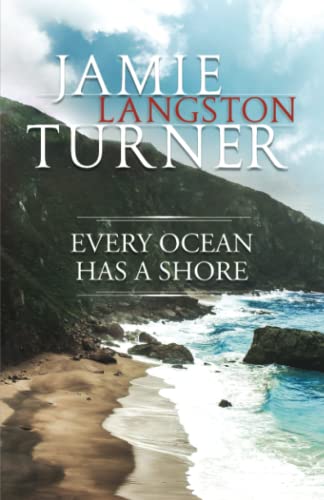
Every Ocean Has a Shore, a novel by Jamie Langston Turner, opens with a few people in a small diner in Chicago. Suddenly a young man with a gun comes in, locks the door, and starts barking orders.
Tragedy is averted, but everyone is shaken. The three adults in the main dining room don’t know it yet, but they are bonded together even after they go their separate ways.
The only customers in the diner at the time were an older woman, Alice, and a young boy. Alice had been estranged from her daughter for years before her daughter died. Alice just found out that her daughter left behind a young son, Ian, who had been cared or by his father. But now the father is dying, and someone finds Alice’s contact information. Alice flew from South Carolina to Chicago to pick up five-year-old Ian, who doesn’t speak. They’ve just stopped at the diner for lunch when the incident occurred.
Gary is the owner of the diner. He was always a quiet man, but became quieter still after his wife died. He’s intelligent, but it takes him a while to think through things. His loneliness and the crime in the city cause him to consider moving, but he doesn’t know where or what he would do with himself. He has a sister in Vermont who needs help fixing up her home. Maybe he’ll start there.
Fawna is the waitress, a college dropout with a birthmark on her cheek in the shape of Borneo and a penchant for saying weird things. She rents a room from a crotchety old woman named Mrs. Welborn and helps her out. Her parents died, leaving her with money to live on. She’s drifted around for the past eight or nine years, but thinks she might like to settle down somewhere. The problem is, she doesn’t know where to go or what she wants to do.
The point of view switches between these three as they go on with their lives but keep in touch. We learn some of their background and issues. Fawna discovers C. S. Lewis and begins to wonder if, as Lewis suggests, someone has been orchestrating all the events of their lives.
Fans of Jamie Langston Turner will welcome this, her first new book in nine years. A few characters from her earlier books make an appearance, particularly Eldeen, the larger-than-life older woman from Jamie’s first book, Suncatchers. But this is a stand-alone novel that can be enjoyed even if you haven’t read the previous books.
Jamie’s books are character-driven, not plot-driven. This isn’t an edge-of-your-seat kind of story. In fact, the story seems pretty slow in places. But as we learn more about each character and see how everything is woven together, we find great depth. I’ve seen many people who don’t normally like Christian fiction say that they like Jamie’s books.
If people think about humility at all these days, they usually envision self-deprecation, playing down one’s attributes, talents, or accomplishments, or, at the very least, not bragging.
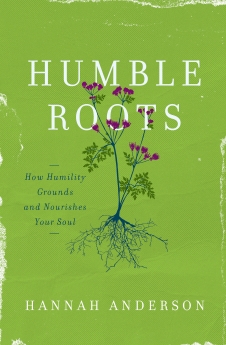
In Humble Roots: How Humility Grounds and Nourishes Your Soul, Hannah Anderson explores humility from a Biblical angle. Instead of viewing humility as a club or prod when we’re feeling too proud, humility frees us and leads us to rest.
I defined humility as a correct sense of self, as understanding where you come from and where you belong in this world (p. 64, Kindle version).
Theologically speaking, humility is a proper understanding of who God is and who we are as a result (p. 102).
I would describe it as a creaturely dependence. We’re “made in His image, but we are made nonetheless (p. 11)—made originally from dirt, to which our bodies return. As Paul reminds Timothy, “we brought nothing into the world, and we cannot take anything out of the world” (1 Timothy 6:7). Everything we are and everything we have comes from God.
The problem is our obsession with ourselves. With our need to fix things, our need to make ourselves better, our need to be approved by God and others, our need to “count for something.”
But this is also why Jesus calls us to come to Him. By coming to Jesus, we remember who we are and who we are not. By coming to Him, we come face to face with God and with ourselves. “It is only in our encounter with a personal God,” writes philosopher Dietrich von Hildebrand, “that we become fully aware of our condition as creatures, and fling from us the last particle of self-glory” (p. 55).
If I can’t handle little things, what can I handle? Failure at small things reminds us of how helpless we are in this great, wide world. When little things spiral out of control, they remind us that even they were never within our control in the first place (p. 26).
Humility, instead of being a negative concept, frees us:
to be the people God created us to be (p. 11).
from the cycle of stress, performance, and competition (p. 12).
from our burdens . . . by calling us to rely less on ourselves and more on Him (p. 32).
to redirect our energies toward God and those whom He has given us to love (p. 3).
from the condemnation of others, . . . from self-condemnation and unnecessary guilt (p. 108).
to hear God’s call and leads you to a place of both rest and flourishing (p. 110).
from the oppression of our emotions, when we finally learn that “God is greater than our heart (p. 114).
from the responsibility of feeling like you have to “do it all.” You are free to do only what you have been made to do (p. 163)
. . . and so much more.
Hannah follows Jesus’ admonition to consider birds and flowers by grounding each chapter in something from the garden or nature. For instance, the chapter “Vine-Ripened” begins with all the work that goes into growing garden tomatoes, then being fooled every year into thinking the ones gassed for redness in stores will be the same. That leads into a discussion of wisdom being rooted not in acquiring facts, but in submitting to the source of wisdom–the fear of the Lord. Then an 1800 court case over whether tomatoes are vegetables or fruit is tied in, along with our relentless desire to be “right.” “Humility simply leaves room that my understanding of a situation could be wrong” (p. 124). We may not have all the facts or may be influenced by culture. Because we’re limited, “my faith cannot rest on my own knowledge . . . or ability to understand . . . humility leaves room for grace” (p. 124). How unlike most social media discussions, where everyone is right in their own eyes. Hannah then refers to an Isaac Watts book which discusses a “dogmatical spirit.” Our wisdom and safety come not from our being right, but from Jesus being right. Then the chapter goes back to the process of creating store-bought tomatoes, compares that with our search for wisdom, and extols the wisdom of waiting: “Humility teaches us to let knowledge ripen on the vine” (p. 129). The chapter is much more beautifully woven together than my cobbled summation here.
Hannah points us to Jesus, “who, though he was in the form of God, did not count equality with God a thing to be grasped, but emptied himself, by taking the form of a servant, being born in the likeness of men.And being found in human form, he humbled himself by becoming obedient to the point of death, even death on a cross (Philippians 2:6-8) and who invites us to “Take my yoke upon you, and learn from me, for I am gentle and lowly in heart, and you will find rest for your souls” (Matthew 11:20).
Besides benefiting from the truths Hannah shares, I marvel at the way she is able to weave together facts from nature, literature, Scripture, and personal example seamlessly into each chapter. I don’t know how she accomplishes this without time to just sit and think, but as a busy pastor’s wife and mom, I’m sure such time is at a premium. I first read one of her books during Advent and have been working my way through her others. She has quickly become one of my favorite authors.
Even though I just finished this book, reading one chapter a week, I am thinking about going through it again. I need to soak in its truths more.
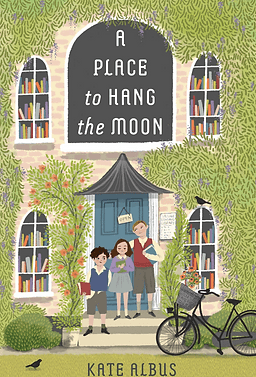
In A Place to Hang the Moon by Kate Albus, William, 12, Edmund, 11, and Anna, 9, live in 1940 England. Their parents died when William was 5. “The grandmother” had charge of them since, but she sent them off to boarding school and was cold and aloof when they were home.
Now the grandmother has died as well. The family solicitor, Mr. Engersoll, explains that the children have been left a lot of money, but no one has been named as their guardian. Apparently there is no one to ask. The children plead to stay with the family’s housekeeper, Mrs. Collins, but she’s too old to take them in.
Mr. Engersoll suggests that the children join evacuees being sent to the country. Perhaps the foster parents they find might take them in permanently. The children are advised not to tell anyone that they are alone in the world or that their family has money, so they don’t get taken advantage of.
The children agree with what Mrs. Collins calls “the preposterous plan,” as there seems to be no other option.
The children are billeted together first with one family, then another. I don’t want to spoil the story by telling what went on in those places, but neither is suitable.
The children spend many afternoons in the town library. Books have always been their friends, and the warmth and quietness of the library provide a refuge. The kind interest of the librarian, Mrs. Muller, makes the place even more welcome.
It’s not long, however, before they discern Mrs. Muller is something of an outcast. She’s married to a German man who has disappeared.
The children wish they could stay with Mrs. Muller, despite her husband’s possible Nazi leanings.
This story starts out like a classic fairy tale, with children alone in the world having to overcome various difficulties. I had thought it was a young adult book, but Amazon recommends it for grades 4-7.
I don’t often read secular books for this age group, but the Story Warren and Hope both spoke well of this story, piquing my interest. I agree with C. S. Lewis that a good children’s book can be enjoyed by adults as well. When the title came up temporarily free from Audible. I gave it a try.
I’m so glad I did. I loved this book. The story is well-told and the characters are beautifully drawn. Descriptions of both warm and cozy and difficult scenes make you feel you are experiencing them along with the children. References to beloved classic children’s books are scattered throughout. Polly Lee’s British accent enhanced the audiobook. I didn’t want the book to end.
Some of my favorite quotes:
The first words of a new book are so delicious—like the first taste of a cookie fresh from the oven and not yet properly cooled.
The librarian took this all in, standing by the fire and observing the children for a while, letting the silence be. Somehow, it didn’t feel awkward, the way silences often do. Perhaps librarians are more used to quiet than most.
William, Edmund, and Anna knew, somewhere deep in the place where we know things that we cannot say aloud, that they had never lived in the sort of home one reads about in stories – one of warmth and affection and certainty in the knowledge that someone believes you hung the moon.
Edmund took in the boy’s mended jacket, the eyes underlined in shadows, the skin above his upper lip chapped raw from a dripping nose gone unattended, and saw the sort of hunger whose endlessness digs a pit in a person. Being eleven, Edmund wouldn’t have put it quite in those words, but he recognized it nonetheless.
While she wasn’t sure of the precise definition of the word “bibliophile,” Anna was certain it meant something that she wanted to be.
The stealing of sweets, after all, is an act committed only by those with unspeakably black souls.
The smell of the cookies filled the children with a warmth that can only come from the magnificent alchemy of butter and sugar.
Truth be told, Anna was rather giving away the ending, but sometimes one cannot help oneself.
Anna thought of offering up a hearty platter of I told you so, but she didn’t. Why foul perfection with such a sharp thing as bitterness?
This is a lovely book. Not fluffy bunny and serene landscape lovely, but a wonderful tale beautifully told.
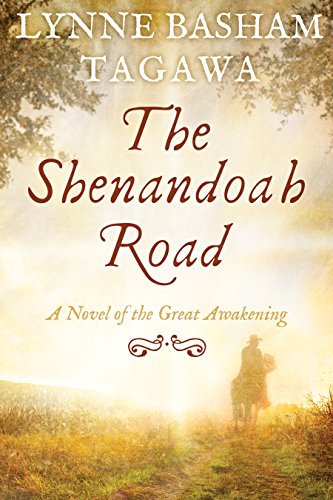
In The Shenandoah Road: A Novel of the Great Awakeningby Lynne Basham Tagawa, John Russell is a widower in need of a wife to mother his four-year-old daughter. Leaving his daughter in his sister’s care, John travels back to Boston, where his father lives, to do some trading and hopefully find a wife as well.
Abigail Williams is the daughter of a Boston merchant. Her father approaches her with a proposition. His bookkeeper’s son is looking for a woman to marry and accompany back to a settlement in Shenandoah. The two men are coming to dinner tonight. Would she think about the possibility?
The settlement in Shenandoah is smaller and much rougher than what Abigail is used to. But John Russell seems to be a kind man. She decides to marry him and go.
Abigail has dutifully kept the commandments all her life. But when John shares with her part of a sermon by George Whitfield, her heart is troubled. Is keeping the commandments not enough? How can she be sure she’s right with God?
As the Russells travel the long road back to the settlement by the Shenandoah River, they face dangers in roving buffalo, Indians, and a dangerous ruffian. Abigail wonders how she will adjust to life when she gets to John’s home. She feels her lack of knowledge about everyday housewifery. She wonders if John’s daughter will accept her. But most of all, she struggles to understand the words from Whitfield and the Bible that her husband shares with her.
I don’t know that I have ever read a novel from this time period, though I was familiar with Whitfield and Jonathan Edwards and such. It seems like every believer would have been thankful for the “Great Awakening.” But just like in our times, people had different opinions about the various proponents and points of doctrine. It was interesting to see some of that discussed.
I enjoyed the historical aspects of daily life, as well. Abigail loved botany, especially the medicine use of plants. It’s unfortunate that we’ve gotten away from such knowledge today.
I enjoyed getting to know John and Abigail as hey got to know and appreciate each other.
Still, I wasn’t swept into the story and characters as often happens with fiction. I can’t quite put my finger on why. But even though I wasn’t spellbound, the book is still a good one.
For readers, nothing sounds more cozy than curling up with a good book, a throw blanket, and a cup of coffee and a cookie or two within reach. Add in a warm fire, a rainy day, and just the right lamp, and we’re in reading heaven.
Or perhaps your ideal reading environment is on the beach under an umbrella, or on your back deck during a cool evening.
In any of those scenarios, we probably picture a physical book. In fact, friends have told me that they don’t like the idea of e-books because they like the feel of an actual ink-and-paper book in their hands.
I understand that. I can’t imagine reading Little Women, for instance, without my favorite old-fashioned illustrated version.
I first started using the Kindle app on my iPad mini for traveling purposes. Otherwise, I’d bring at least two, and possibly three, books with me anywhere I went. I also wanted to take advantage of the occasional Kindle sale or free book. But I never thought the Kindle app would become my main source of reading.
However, once I got used to the Kindle app and discovered many of its features, I grew to love it. When I talked with a paper-book-only friend about some of these Kindle features, she had been totally unaware of them. So I thought I’d share some of these features with you in case you had not heard of them, either. This is not a paid or affiliate post.
All of these features are on the Kindle app. I assume they are all on the Kindle device as well, but I don’t know.
By the way, I’m avoiding the term “real book.” Paper, digital and audio books are all real books.
The Kindle app:
Saves space. It’s nice to “pack” a whole library rather than trying to fit three books into my baggage when traveling. But even at home, I don’t have any space for more books. We have three full-size bookcases, one half-size, and at least three boxes of books in closets. I’ve culled books to give away several times, but my bookcases are still full. There’s no room in the house to add any more.
Adjustment of text size. The print in some books is tiny. I can set the text in the Kindle app to the size that’s best for me.
Easier to hold, especially while lying down. If you’ve ever read in bed, I’m sure you’ve experienced your book falling in your face or your hand cramping after a while.
Can be used on Apple devices as well as many Android. The iPad mini is the perfect size for me, but if you prefer reading on a regular iPad or other device, you can.
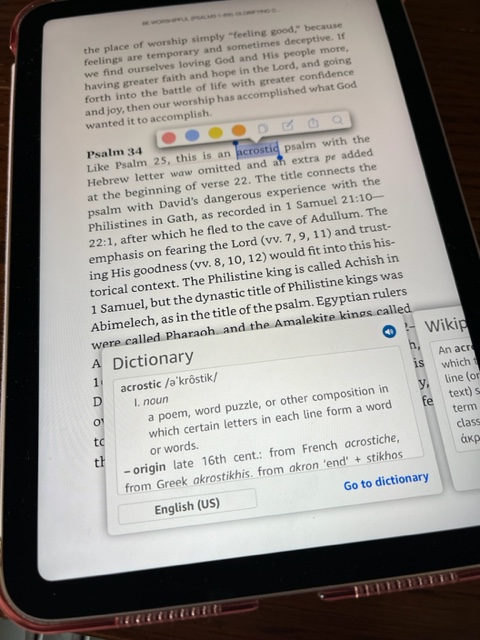
Built-in dictionary. If I come across an unfamiliar word while reading, I don’t usually take the time to stop and look it up. I get the gist of it from the context and keep going. But in the Kindle app, you can highlight the word, then a dictionary definition will pop up. I’ve gotten so used to that feature, I’ve wished it was available on everything I read online as well as in ink-and-paper books!
Translations.You can also highlight phrases in another language and get the translation instantly.
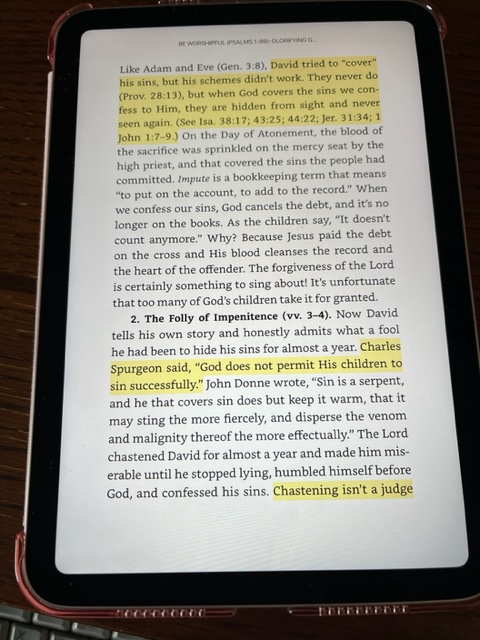
Highlighting. You can highlight passages in the book in five different colors. I usually just use the standard yellow for quotes I want to remember. But sometimes I’ve used blue for main points so I can see them at a glance.
Add notes. When you highlight a section, an icon will show up at the top that looks like a paper and pencil. You can tap that and add your own notes–like writing in the margin of a paper book.
Search function. When you tap on a page in the Kindle app, a magnifying glass icon appears at the top. You can search for a particular word or name or phase. Sometimes I forget who a particular character is, so this feature is like looking back several pages to refresh your memory. Or if I remember a snatch of a sentence but didn’t highlight it, I can look it up.
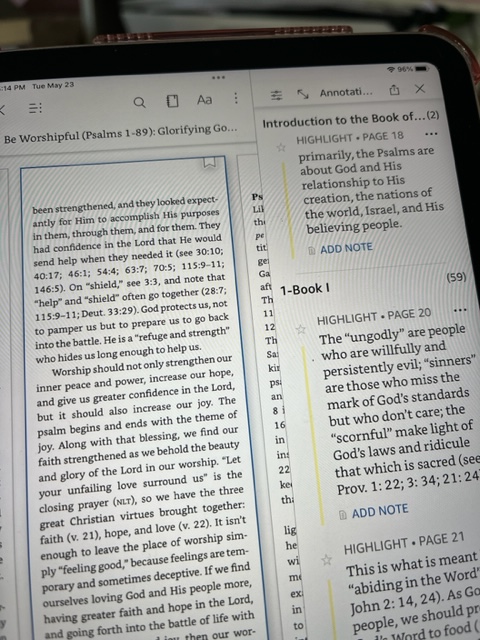
List of notes. That same list of icons that appears at the top of the page when you tap it also shows an icon that looks like page or notebook. Tap that, and you’ll see a list of all the quotes you’ve highlighted from the book as well as notes you’ve added. This is a great help to me when I just want to review the book for my own memory or when writing a review for the blog. I can tap on a highlighted quote, email it to myself, then copy and paste it into a blog post.
Kindle sales. I’ve mentioned before that I check Kindle sales from Inspired Reads and Gospel eBooks lists. Though these are Christian sites, I would not endorse everything they list. But I’ve gotten scores of books trough them. A $1.99 e-book is a great way to try an new author or stock up on books from a favorite author. Plus I get a weekly email from Iron Stream Media offering some of their books free or for 99 cents.
Advance readers or launch teams. Most authors use e-versions rather than an ink-and-paper book to send to readers who agree to review an upcoming book or serve on an author’s launch team. So having Kindle access affords you that opportunity.
Syncs to any device that supports a Kindle app. I mentioned that I usually read e-books on my iPad mini. But I have the Kindle app on my iPhone as well. So if I find myself with an unexpected wait time while I’m out, I can read a bit. It’s not as easy to read a book on a phone, but it can be done, and it’s a good way to pass the time waiting.
Whispersync. If you get the same book via Amazon for the Kindle and Audible for an audiobook, if they are set up to “Whispersync,” you can pick up with one from where you left off on the other. I don’t usually do this–I usually have one or the other. But occasionally, usually due to sales, I’ll have both. It’s nice to be able to go back and forth.
As with anything else, there are a few disadvantages to using the Kindle app. Here are a few:
It’s harder to share books. I believe Amazon lets you share Kindle books with another person for two weeks. But it’s easier to hand them a book for however long they need it. Of course, if your friend doesn’t live near you, sharing electronically is an advantage.
You can’t see what others are reading. I liked the idea that I was “advertising” a book by reading it in public. Or I’d see what someone else was reading and ask about it. You can’t really do that with an e-book without feeling intrusive.
Your device needs charging. But we’re so used to charging devices, that’s not much of a hardship. Unless the power is out.
You don’t really own Kindle books. This is the biggest disadvantage to me. If an author or publisher decides to take their books down, and they are not downloaded on your device, they’ll just disappear from your library. Thankfully, that doesn’t happen often.
You can’t give or sell your read e-books like you can ink-and-paper books.
If you’re trying to reduce screen time due to eye strain or other reasons, you might prefer a physical book.
By and large, I’ve found the advantages to using the Kindle app outweigh the advantages.
Do you use the Kindle or Kindle app? What do you like or dislike about it?
In D. E. Stevenson’s novel, Miss Buncle’s Book (linked to my review), Barbara Buncle is a quiet single lady in 1930s England who needs to make some money. So she writes a book about what she knows–her neighbors. She changes their names and some of their activities. Her book becomes a best-seller. But some of her neighbors recognize themselves and their town. And some of them are determined to find out who is behind the pseudonym “John Smith.”
At the end of that book (spoiler alert), Miss Buncle marries her publisher, Arthur Abbott. They move to Hampstead Heath, away from the heat caused by Barbara’s book.
Miss Buncle Married opens with the newlywed couple enjoying married life, but not the city. They’re expected to be out almost every night, playing bridge with friends and attending events. They long for a quieter home life. So Barbara starts looking at houses in the country.
Barbara finds the house of her dreams in Wandlebury. Arthur isn’t sure about the fixer-upper. But Barbara has everything redone nicely, and they love their new home.
It’s not long before they meet their new neighbors. The pastor’s wife who loves to gossip, thinking it gives her and “in” with her neighbors, when really they hold her at arm’s length because they don’t want to become her subjects. A large, temperamental artist, his languid wife, and their three children, two of whom have claimed Barbara’s back yard as their playground. Mrs. Chevis-Cobb, the society matron who changes her will when her relatives displease her. Jerry, a young woman who supports herself by caring for horses.
Arthur’s nephew, Sam, comes to visit the Abbotts regularly and begins to mature nicely.
Of course, the reader wonders, “Will Barbara write another book? And will it get her into as much trouble as last time?” I’ll leave that for you to discover.
Barbara is presented in both books as somewhat naive and innocent, yet with amazing insight in some ways. She doesn’t mean to meddle, but her attempts to help people present some quite funny episodes in the book.
Some of my favorite quotes from the book:
He . . . looked at his wife, and, as he looked at her, he smiled because she was nice to look at, and because he loved her, and because she amused and interested him enormously. They had been married for nine months now, and sometimes he thought he knew her through and through, and sometimes he thought he didn’t know the first thing about her—theirs was a most satisfactory marriage.
Jerry found Barbara very soothing and comforting during this difficult time. It was not necessary to confide in Barbara to gain her sympathy—you just talked to Barbara about odds and ends of things, and you came away feeling a different creature.
“It’s turned out all right after all,” she said contentedly. “Things usually do, somehow. You worry and fuss and try to make things go the way you think they should, and then you find that the other way was best. I’m going to try not to worry about things anymore.”
As with the first book, this is a secular work, and thus I wouldn’t agree with everything here, like many classics. It’s a clean story, but there are some oddities, especially with the strange family next door.
But all in all, this was a sweet, funny story. I listened to the audiobook superbly read by Patricia Gallimore. The picture above is from the audiobook cover as well, which I like much better than the book cover.
. . . you’d like authors to be able to keep writing books, right?
You may not be aware of some ways publishing has changed over the last few years. These changes put different pressures and requirements on new and published authors. I’ll discuss some of those changes as I go.
But here are ways you can help authors keep books coming:
Buy their books. Sometimes I hear people say they never buy books. Some can’t; that’s understandable. I’ll get to some other ways we can help that don’t cost money.
But buying a book isn’t just an investment for the author. If you were going to a concert, a professional ball game, or even a movie, you’d pay a high price for just 2-3 hours of entertainment. The price of a book can give you 10+ hours of entertainment.
For many of us, though, our book appetite is bigger than our wallet.
If you can’t pay full price, books are frequently on sale. I often get Kindle books for less than $2. Inspired Reads lists half a dozen or so and Gospel eBooks lists several, but you need discernment with these two: I wouldn’t recommend everything they list. Tim Challies lists a Kindle sales most days, usually Christian nonfiction and classics.
If you pre-order books, you often get a lower price. Audible.com frequently has “two books for one credit” and other audiobooks sales. Then there are library sales, thrift store sales, garage sales. Even though the author does not get much money from these purchases, they still help his sale numbers (which publishers look at when considering whether to publish his future books).
I have not tried these, but I’ve heard recommendations for Chirp (audiobooks), BookBub, and CelebrateLit.
Ask for books for gifts. I usually let my family know of a few books I’d like for birthday and Christmas ideas.
Write a review. Amazon reviews carry great weight with publishers, plus they are helpful to other buyers considering the book. The reviews don’t have to all be 5-stars to help. In fact, it looks a little suspicious if all the reviews are 5-star. Reviews don’t have to be long and shouldn’t “spoil” the plot.
One of the ways publishing has changed over recent years is that authors have to do as much as 80% of their own marketing, even if they’re traditionally published. With the closure of so many brick-and-mortar bookstores, publishers don’t have the opportunity to advertise there via posters, end-caps displays, author events, etc. They have always depended on word of mouth, but much more so now.
Besides Amazon, reviews on Goodreads or one’s blog help get the word out as well.
Mention a book on Instagram with the hash tag #bookstagram. You can add additional hashtags like #amreading, #historicalfiction or whatever the genre is, and the author’s name (#roseannamwhite, for example). You can add a picture of the book cover, a picture of you holding the book, a picture of the book cover on your Kindle app, etc.
Get the book for free. Even though an author doesn’t get the revenue from free books, if you review them, they get the word of mouth publicity. Some authors and publishers will give free copies of their book in exchange for an honest review. NetGalley offers digital Advanced Reader Copies of books to reviewers. Revell is a Christian book publisher with a program to offer free books for review. Audible.com includes some titles for free for its members.
Check books out of the library. Libraries don’t keep books that don’t get checked out. So keeping an author’s book active helps, and reviewing helps even more. Plus libraries are likely to buy more books by authors whose books are frequently checked out.
Request a book be added to the library. Most libraries have ways to do this online.
Suggest your favorite book or author for a book club suggestion.
Follow your favorite author. Publishers and agents want writers to have a “platform” before they risk putting time and money into them. Many a debut author has been turned down, sadly, because of a low platform. I’ve read that the primary following publishers look at is a writer’s email list numbers. That’s why you so see many authors asking you to subscribe to their newsletter. I have to confess I don’t subscribe to many myself just because I don’t have time to read them all and I don’t want lots of extraneous email. Plus I disagree with the thought that an author’s biggest fans and promoters are going to come from their email lists. But that’s how the system stands today. So if you really want to support a particular writer, following them primarily through an email list, but also on Facebook, Twitter, and/or Instagram will help their platform numbers. As a bonus, most writers will offer freebies via extra chapters or resources to email subscribers.
Be on an author’s launch team. The first few days after a book comes out are critical to the book’s success in the eyes of publishers. Authors will ask for volunteers for launch teams to help when the book comes out. Being on a launch team usually involves receiving an advanced copy of the book, reading it before publication, and having a review ready for Amazon within the first day or two after the book is released. Some authors will also ask for posts on Facebook about the book. Some will offer material for blog posts, like interview questions and answers.
You may not be able to do all of these, but helping an author in any of these ways will be much appreciated and will help keep good books coming.
Which of these most resonates with you? Do you have any other ideas for ways to support authors and help promote good books?
Ring of Secrets by Roseanna M. White is the first in her Culper Ring series, fiction based on the real-life spy network set in motion during the Revolutionary War.
When Winter Reeves’ mother died while her father was fighting with the Patriots, her grandparents came to take her to their home in New York City. Her grandparents had never forgiven her mother for marrying outside their station and political affiliations, and they took their anger out on Winter. They instructed that she would say her father was dead, that she would not express any Patriot leanings, and she would marry the man of their choosing as soon as possible so they could get her out of their responsibilities and home.
Since Winter could not be who she really was, she played the part of a beautiful but witless society lady. Her persona gave her a great cover, though, for overhearing information from the Loyalist officers in their social circles. She passed along any useful information to her childhood friend, Robbie Townsend, a mercantile owner who was a vital link in the Culper Ring network.
Bennet Lane was a new arrival in the city. He would not have been considered a catch among the highest society there due to his professorship at Yale, teaching chemistry. But now he was set to inherit a large English estate, making all the tittering mamas in town set their sites on him as a potential son-in-law. Though Bennet usually got tongue-tied and awkward around women, he thought the apparent pursuit of a wife would be a good cover for his real mission: to discover information about a hidden Patriot spy ring.
When Bennet met Winter, he perceived that there was intelligence and spunk underneath the silly exterior she presented to the public. He wanted to know more.
Roseanna has become one of my favorite authors over the last few years, and this novel lived up to the others I read. There are so many layers to this story: the political intrigue and danger, the growing attraction between Winter and Bennet despite their differences, the pursuit of Winter by a Loyalist officer, Isaac Fairchild, Winter’s deep faith and Bennet’s lack of belief in anything he can’t see and test. As I read, I thought, “There is only one way I can see this working out.” The plot did go that direction, but with some surprises along the way.
I thought all the characters were well-drawn. I especially loved Freeman, a free Black man who had been one of Winter’s father’s closest friends and who pledged to protect Winter, and Viney, a poor but faith-filled woman Winter encounters.
Even though I love Roseanna’s writing and knew I’d get to this series eventually, I didn’t like the covers, which put me off the series a bit. It looks like this series was first published in 2019 and then the second edition in 2021. There are two covers for each book. I had this one in my Kindle library. But Audible currently has the books for free with an Audible subscription. I’m thankful they did and I finally got to them. I’ve already started the sequel.
I had not realized when I got the audiobooks that there were novellas in-between the books, not on audio. They are currently packaged together here. The first one, Fairchild’s Lady, takes place just before the French Revolution breaks out. General Fairchild from the first book is in France on two missions: to gather information and to locate a countess and her daughter and bring them to England before the Revolution makes travel impossible. He meets a beauitful woman, Julienne, at a masquerade ball, only to discover later that she is the young woman he is looking for. A dangerous French courtier has laid claim to Julienne, though.
This novella was just as good as the first book. Fairchild was a likeable, honorable character, even though he was on the other side, politically. It was fun to see his story continue.
Roseanna notes in her afterword of Ring of Secrets that the Culper Ring members were not professional spies. They were everyday people seeking to promote the cause of the fledgling United States of America. There were women in their ranks as well as men. The main characters in these books are fictional, but historical characters are mentioned as well.
I’m looking forward to see what else happens with the Culper Ring.
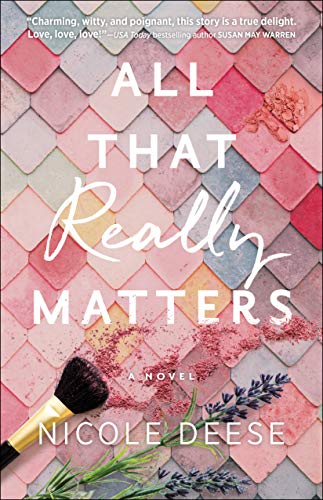
In Nicole Deese’s novel All That Really Matters, Molly McKenzie’s video channel about makeup and fashion has over half a million followers. She has corporate sponsors, a virtual assistant, and a manager who became her boyfriend.
Her manager shares an opportunity to host a makeover show. But first, she needs to increase her followers even more. And she needs a cause to show her compassionate, involved side.
Molly seeks advice from her pastor brother, and he directs her to a mentor program for kids transitioning out of the foster care program.
But the program director, Silas, is not impressed by Molly at their first interview. His kids are dealing with serious, real-life problems Molly knows nothing about. How could she help them?
When Molly comes back to him with a well-thought-out plan for classes, Silas decides to give her a chance. And his life and program are never the same.
At first, Molly is motivated to simply get this requirement out of the way. But as she gets involved with the kids, especially Wren, a quiet outsider of the group, Molly begins to really care about them.
Just as Silas begins to appreciate that there’s more to Molly than her sparkling online presence, a series of crises come that cause Molly to question her identity and purpose.
The first part of this book was just delightful. Molly is not the kind of character I’d normally connect with, but Nicole took care not to make Molly a caricature. She’s enthusiastic, but not overly bubbly. And, as Silas discovered, she’s not empty and vain.
Silas is a serious, caring, but by-the-book director. I like how Molly’s influence loosened him up a little. One reviewer thought they had something like the Maria/Captain Von Trapp vibe in The Sounds of Music.
When the crises came, my heart went out to Molly and the other people involved. Nicole drew all the characters so well and infused the plot with both humor and pathos.
Here are a few of the quotes I loved:
Of helping without overstepping. It’s difficult to see real needs and not want to rush the process to appease our own desire for restoration (p. 125, Kindle version).
But more often than not, the best rescue plan we can offer someone we care about is our support for each step they take forward (p. 209).
I think we first have to understand just how deeply we are already loved that way—by God. Then we can love each other out of the response to His love for us (p. 247).
You don’t honor God with your life by changing your personality and tossing out everything that is unique about who you are. You honor Him by offering those very gifts back to Him (p. 331).
This is the first book I’ve read by Nicole, but it won’t be the last. In fact, I loved this book so much, I already started the sequel, All That It Takes.
When I was a child, my siblings and I would sometimes get scolded for coming in and out of the house too often. We didn’t have central air conditioning until I was halfway through high school, so my parents weren’t concerned about letting cool air out or hot air in. But the frequently open door let in mosquitos and flies. Plus it was probably irritating when the door banged shut so often. We were told to decide what we were going to do and do it–either stay in or stay out for longer than a few minutes.
The entrance of spring reminds me of my childhood self. It’s as if the season can’t quite decide whether to settle in or retreat for a while. Or maybe winter is the culprit, setting out to leave, but coming back with, “Oh, and one more thing . . . “
We have a few more nights in the mid-30s coming up next week. But hopefully after that winter will stay out and spring will stay put a while.
March has been a pretty balanced month—not overly busy, but with a few fun things on the calendar. We celebrated my husband’s birthday early in the month. One Saturday we visited Fort Loudoun, a pre-Revolutionary War settlement, and the Sequoyah Birthplace Museum. We enjoyed several family times with dinner and games or just chatting.
Our church search has finally brought us to one that seems very promising. Over the next weeks we’ll explore Sunday School and some of the other get-togethers. I have high hopes.
I can’t recall watching or listening to much of interest this month that I’d want to recommend, so I’ll skip that section this time.
Creating
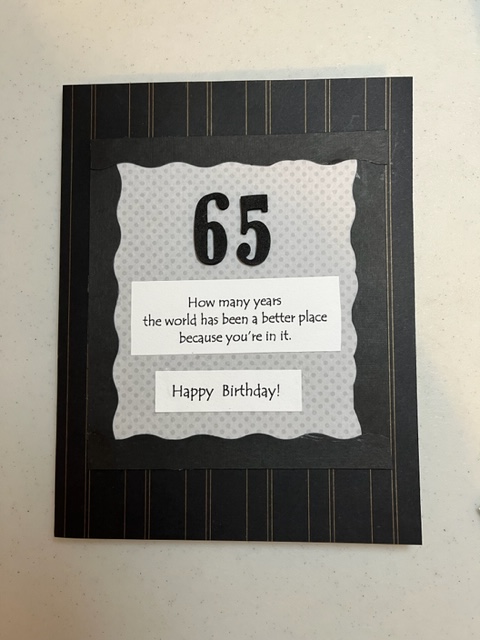
I just made one card this month, for Jim’s birthday.
The numbers are puffy foam stickers.
Reading
Last time, I had just finished Dakota Dawn, Dakota Dream, and Dakota Duskby Lauraine Snelling, a novella series about Norwegian immigrants who settle in North Dakota in the early 1900s, but hadn’t had a chance to review them yet. They were packaged together in one audiobook.
Since last time, I finished (titles link to my reviews):
Becoming Free Indeed: My Story of Disentangling Faith from Fearby Jinger Duggar Vuolo. The sixth child of the reality-TV Duggar family, Jinger wrestled with some of the teachings her family grew up under. Here she details disentangling herself from what was not Biblical while holding on to truth.
Wrestling with an Angel: A Story of Love, Disability and the Lessons of Grace by Greg Lucas, audiobook. Greg’s adopted son ended up having a host of developmental diagnoses which made caring for him a challenge. Greg saw parallels between his son and our spiritual condition before the Father who loves and cares for us often despite ourselves. Greg’s writing is heartbreaking, yet hopeful and beautiful.
Surprised by Joy by C. S. Lewis, audiobook, his autobiographical journey of faith.
All That’s Good: Recovering the Lost Art of Discernmentby Hannah Anderson. Hannah proposes that instead of thinking as discernment as looking out for the bad, we employ it to find and follow the good. Excellent. This will probably be one of my top ten books of the year.
The Space Between Words, a novelby Michele Phoenix. A young woman recovering from a trauma finds some notes from another young woman in the 1600s suffering persecution for being of the Huguenot faith. Excellent.
The Lady and the Lionheart by Joanne Bischof, fiction audiobook. An aspiring nurse helps a circus performer with a sick daughter. They each learn there is so much more to the other beyond the surface. Very good.
I’m currently reading:
Be Joyful (Philippians): Even When Things Go Wrong, You Can Have Joy by Warren Wiersbe
Humble Roots: How Humility Grounds and Nourishes Your Soul by Hannah Anderson
Murder Your Darlings: And Other Gentle Writing Advice from Aristotle to Zinsser by Roy Peter Clark
The Forgotten Life of Eva Gordon by Linda MacKillop
Finally, after a lot of prayer, motivated writing time in order to present to my critique group, and their very helpful and encouraging feedback, I’ve made major headway with my “problem chapter.” I wish I could stop everything and just write for a week. I guess most writers feel that way.
As we turn the calendar page to April, we look forward to Timothy’s birthday, Easter, warmer weather, and more blooms.
How was your March? What are you looking forward to in April?




 Stray Thoughts