If You Like to Read Books . . .

How to support writers and keep good books coming.

. . . you’d like authors to be able to keep writing books, right?

You may not be aware of some ways publishing has changed over the last few years. These changes put different pressures and requirements on new and published authors. I’ll discuss some of those changes as I go.

But here are ways you can help authors keep books coming:

Buy their books. Sometimes I hear people say they never buy books. Some can’t; that’s understandable. I’ll get to some other ways we can help that don’t cost money.

But frugality doesn’t mean never paying full price for a quality item. “The laborer is worthy of his hire,” Jesus said (Luke 10:7). Writers work for months, sometimes years, to produce a book. According to this article, an author might get only $1.50 from a $20 book. Few authors can live off their book sales.

But buying a book isn’t just an investment for the author. If you were going to a concert, a professional ball game, or even a movie, you’d pay a high price for just 2-3 hours of entertainment. The price of a book can give you 10+ hours of entertainment.

For many of us, though, our book appetite is bigger than our wallet.

If you can’t pay full price, books are frequently on sale. I often get Kindle books for less than $2. Inspired Reads lists half a dozen or so and Gospel eBooks lists several, but you need discernment with these two: I wouldn’t recommend everything they list. Tim Challies lists a Kindle sales most days, usually Christian nonfiction and classics.

If you pre-order books, you often get a lower price. Audible.com frequently has “two books for one credit” and other audiobooks sales. Then there are library sales, thrift store sales, garage sales. Even though the author does not get much money from these purchases, they still help his sale numbers (which publishers look at when considering whether to publish his future books).

I have not tried these, but I’ve heard recommendations for Chirp (audiobooks), BookBub, and CelebrateLit.

Ask for books for gifts. I usually let my family know of a few books I’d like for birthday and Christmas ideas.

Write a review. Amazon reviews carry great weight with publishers, plus they are helpful to other buyers considering the book. The reviews don’t have to all be 5-stars to help. In fact, it looks a little suspicious if all the reviews are 5-star. Reviews don’t have to be long and shouldn’t “spoil” the plot.

One of the ways publishing has changed over recent years is that authors have to do as much as 80% of their own marketing, even if they’re traditionally published. With the closure of so many brick-and-mortar bookstores, publishers don’t have the opportunity to advertise there via posters, end-caps displays, author events, etc. They have always depended on word of mouth, but much more so now.

Besides Amazon, reviews on Goodreads or one’s blog help get the word out as well.

Mention a book on Instagram with the hash tag #bookstagram. You can add additional hashtags like #amreading, #historicalfiction or whatever the genre is, and the author’s name (#roseannamwhite, for example). You can add a picture of the book cover, a picture of you holding the book, a picture of the book cover on your Kindle app, etc.

Get the book for free. Even though an author doesn’t get the revenue from free books, if you review them, they get the word of mouth publicity. Some authors and publishers will give free copies of their book in exchange for an honest review. NetGalley offers digital Advanced Reader Copies of books to reviewers. Revell is a Christian book publisher with a program to offer free books for review. Audible.com includes some titles for free for its members.

Check books out of the library. Libraries don’t keep books that don’t get checked out. So keeping an author’s book active helps, and reviewing helps even more. Plus libraries are likely to buy more books by authors whose books are frequently checked out.

Request a book be added to the library. Most libraries have ways to do this online.

Suggest your favorite book or author for a book club suggestion.

Follow your favorite author. Publishers and agents want writers to have a “platform” before they risk putting time and money into them. Many a debut author has been turned down, sadly, because of a low platform. I’ve read that the primary following publishers look at is a writer’s email list numbers. That’s why you so see many authors asking you to subscribe to their newsletter. I have to confess I don’t subscribe to many myself just because I don’t have time to read them all and I don’t want lots of extraneous email. Plus I disagree with the thought that an author’s biggest fans and promoters are going to come from their email lists. But that’s how the system stands today. So if you really want to support a particular writer, following them primarily through an email list, but also on Facebook, Twitter, and/or Instagram will help their platform numbers. As a bonus, most writers will offer freebies via extra chapters or resources to email subscribers.

Be on an author’s launch team. The first few days after a book comes out are critical to the book’s success in the eyes of publishers. Authors will ask for volunteers for launch teams to help when the book comes out. Being on a launch team usually involves receiving an advanced copy of the book, reading it before publication, and having a review ready for Amazon within the first day or two after the book is released. Some authors will also ask for posts on Facebook about the book. Some will offer material for blog posts, like interview questions and answers.

You may not be able to do all of these, but helping an author in any of these ways will be much appreciated and will help keep good books coming.

Which of these most resonates with you? Do you have any other ideas for ways to support authors and help promote good books?

(I often link up with some of these bloggers.)

Ring of Secrets

Ring of Secrets by Roseanna M. White is the first in her Culper Ring series, fiction based on the real-life spy network set in motion during the Revolutionary War.

When Winter Reeves’ mother died while her father was fighting with the Patriots, her grandparents came to take her to their home in New York City. Her grandparents had never forgiven her mother for marrying outside their station and political affiliations, and they took their anger out on Winter. They instructed that she would say her father was dead, that she would not express any Patriot leanings, and she would marry the man of their choosing as soon as possible so they could get her out of their responsibilities and home.

Since Winter could not be who she really was, she played the part of a beautiful but witless society lady. Her persona gave her a great cover, though, for overhearing information from the Loyalist officers in their social circles. She passed along any useful information to her childhood friend, Robbie Townsend, a mercantile owner who was a vital link in the Culper Ring network.

Bennet Lane was a new arrival in the city. He would not have been considered a catch among the highest society there due to his professorship at Yale, teaching chemistry. But now he was set to inherit a large English estate, making all the tittering mamas in town set their sites on him as a potential son-in-law. Though Bennet usually got tongue-tied and awkward around women, he thought the apparent pursuit of a wife would be a good cover for his real mission: to discover information about a hidden Patriot spy ring.

When Bennet met Winter, he perceived that there was intelligence and spunk underneath the silly exterior she presented to the public. He wanted to know more.

Roseanna has become one of my favorite authors over the last few years, and this novel lived up to the others I read. There are so many layers to this story: the political intrigue and danger, the growing attraction between Winter and Bennet despite their differences, the pursuit of Winter by a Loyalist officer, Isaac Fairchild, Winter’s deep faith and Bennet’s lack of belief in anything he can’t see and test. As I read, I thought, “There is only one way I can see this working out.” The plot did go that direction, but with some surprises along the way.

I thought all the characters were well-drawn. I especially loved Freeman, a free Black man who had been one of Winter’s father’s closest friends and who pledged to protect Winter, and Viney, a poor but faith-filled woman Winter encounters.

Even though I love Roseanna’s writing and knew I’d get to this series eventually, I didn’t like the covers, which put me off the series a bit. It looks like this series was first published in 2019 and then the second edition in 2021. There are two covers for each book. I had this one in my Kindle library. But Audible currently has the books for free with an Audible subscription. I’m thankful they did and I finally got to them. I’ve already started the sequel.

I had not realized when I got the audiobooks that there were novellas in-between the books, not on audio. They are currently packaged together here. The first one, Fairchild’s Lady, takes place just before the French Revolution breaks out. General Fairchild from the first book is in France on two missions: to gather information and to locate a countess and her daughter and bring them to England before the Revolution makes travel impossible. He meets a beauitful woman, Julienne, at a masquerade ball, only to discover later that she is the young woman he is looking for. A dangerous French courtier has laid claim to Julienne, though.

This novella was just as good as the first book. Fairchild was a likeable, honorable character, even though he was on the other side, politically. It was fun to see his story continue.

Roseanna notes in her afterword of Ring of Secrets that the Culper Ring members were not professional spies. They were everyday people seeking to promote the cause of the fledgling United States of America. There were women in their ranks as well as men. The main characters in these books are fictional, but historical characters are mentioned as well.

I’m looking forward to see what else happens with the Culper Ring.

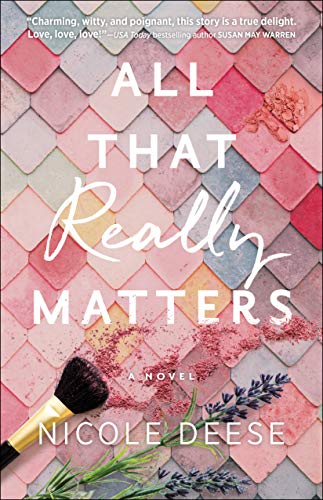
All That Really Matters

In Nicole Deese’s novel All That Really Matters, Molly McKenzie’s video channel about makeup and fashion has over half a million followers. She has corporate sponsors, a virtual assistant, and a manager who became her boyfriend.

Her manager shares an opportunity to host a makeover show. But first, she needs to increase her followers even more. And she needs a cause to show her compassionate, involved side.

Molly seeks advice from her pastor brother, and he directs her to a mentor program for kids transitioning out of the foster care program.

But the program director, Silas, is not impressed by Molly at their first interview. His kids are dealing with serious, real-life problems Molly knows nothing about. How could she help them?

When Molly comes back to him with a well-thought-out plan for classes, Silas decides to give her a chance. And his life and program are never the same.

At first, Molly is motivated to simply get this requirement out of the way. But as she gets involved with the kids, especially Wren, a quiet outsider of the group, Molly begins to really care about them.

Just as Silas begins to appreciate that there’s more to Molly than her sparkling online presence, a series of crises come that cause Molly to question her identity and purpose.

The first part of this book was just delightful. Molly is not the kind of character I’d normally connect with, but Nicole took care not to make Molly a caricature. She’s enthusiastic, but not overly bubbly. And, as Silas discovered, she’s not empty and vain.

Silas is a serious, caring, but by-the-book director. I like how Molly’s influence loosened him up a little. One reviewer thought they had something like the Maria/Captain Von Trapp vibe in The Sounds of Music.

When the crises came, my heart went out to Molly and the other people involved. Nicole drew all the characters so well and infused the plot with both humor and pathos.

Here are a few of the quotes I loved:

Of helping without overstepping. It’s difficult to see real needs and not want to rush the process to appease our own desire for restoration (p. 125, Kindle version).

But more often than not, the best rescue plan we can offer someone we care about is our support for each step they take forward (p. 209).

I think we first have to understand just how deeply we are already loved that way—by God. Then we can love each other out of the response to His love for us (p. 247).

You don’t honor God with your life by changing your personality and tossing out everything that is unique about who you are. You honor Him by offering those very gifts back to Him (p. 331).

This is the first book I’ve read by Nicole, but it won’t be the last. In fact, I loved this book so much, I already started the sequel, All That It Takes.

March Reflections

When I was a child, my siblings and I would sometimes get scolded for coming in and out of the house too often. We didn’t have central air conditioning until I was halfway through high school, so my parents weren’t concerned about letting cool air out or hot air in. But the frequently open door let in mosquitos and flies. Plus it was probably irritating when the door banged shut so often. We were told to decide what we were going to do and do it–either stay in or stay out for longer than a few minutes.

The entrance of spring reminds me of my childhood self. It’s as if the season can’t quite decide whether to settle in or retreat for a while. Or maybe winter is the culprit, setting out to leave, but coming back with, “Oh, and one more thing . . . “

We have a few more nights in the mid-30s coming up next week. But hopefully after that winter will stay out and spring will stay put a while.

March has been a pretty balanced month—not overly busy, but with a few fun things on the calendar. We celebrated my husband’s birthday early in the month. One Saturday we visited Fort Loudoun, a pre-Revolutionary War settlement, and the Sequoyah Birthplace Museum. We enjoyed several family times with dinner and games or just chatting.

Our church search has finally brought us to one that seems very promising. Over the next weeks we’ll explore Sunday School and some of the other get-togethers. I have high hopes.

I can’t recall watching or listening to much of interest this month that I’d want to recommend, so I’ll skip that section this time.

Creating

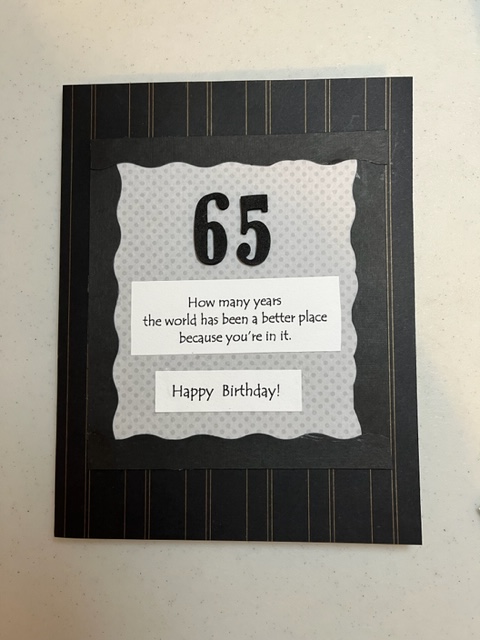
I just made one card this month, for Jim’s birthday.

The numbers are puffy foam stickers.

Reading

Last time, I had just finished Dakota Dawn, Dakota Dream, and Dakota Dusk by Lauraine Snelling, a novella series about Norwegian immigrants who settle in North Dakota in the early 1900s, but hadn’t had a chance to review them yet. They were packaged together in one audiobook.

Since last time, I finished (titles link to my reviews):

I’m currently reading:

  • Be Joyful (Philippians): Even When Things Go Wrong, You Can Have Joy by Warren Wiersbe
  • Humble Roots: How Humility Grounds and Nourishes Your Soul by Hannah Anderson
  • Murder Your Darlings: And Other Gentle Writing Advice from Aristotle to Zinsser by Roy Peter Clark
  • The Forgotten Life of Eva Gordon by Linda MacKillop
  • All That Really Matters by Nicole Deese
  • Ring of Secrets by Roseanna M. White, audiobook

Blogging

Besides the weekly Friday Fave Fives, Saturday Laudable Linkage, and book reviews, I’ve posted these since last time:

Writing

Finally, after a lot of prayer, motivated writing time in order to present to my critique group, and their very helpful and encouraging feedback, I’ve made major headway with my “problem chapter.” I wish I could stop everything and just write for a week. I guess most writers feel that way.

As we turn the calendar page to April, we look forward to Timothy’s birthday, Easter, warmer weather, and more blooms.

How was your March? What are you looking forward to in April?

The Lost Art of Discernment

Most of think of discernment from the negative side. We want to discern good from bad so we can avoid the bad. We want to teach our families to avoid the bad as well. And that’s necessary. There is a lot of bad to avoid.

But constantly looking out for the potential bad can warp our thinking. Hannah Anderson says, “Facing so many variables, with good and bad so quickly blurring, most of us find it easier to retreat to safe spaces, cluster in like-minded tribes, and let someone else do our thinking for us” (p. 11). She goes on to share:

For a long time, I didn’t think very clearly at all because my actions and choices were shaped more by the brokenness around me than the reality of God’s goodness and nearness. When faced with a decision, I played defense: What will keep me safe? What are other people expecting me to do? What will happen if I make a mistake?

But in trying to keep myself safe, in obsessing over making the “right” choices, I found myself making a whole lot of wrong ones. Because I lacked a vision for goodness, I also lacked discernment. And without discernment, I had little chance of finding the security and happiness that I wanted—that I think we all want (pp. 11-12).

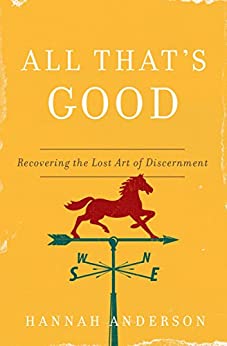
Hannah suggests a different approach. Why not discern good from bad in order to pursue the good? That’s just what she proposes and demonstrates in All That’s Good: Recovering the Lost Art of Discernment.

But what if there were a way to see clearly once again? What if we could see the world as God sees it—in all its brokenness and beauty—and in seeing, be able to do more than endure this life? What if we could flourish in it? I think we can. In fact, I’m convinced of this good news: Despite all the pain, all the sorrow, all the questions, goodness still exists because God still exists. And because He does, He has not left us to sort through the mess alone (p. 11).

God created the world and the people in it and pronounced them good (Genesis 1). But sin marred the world and our hearts (Genesis 3). Yet God has promised to restore goodness some day. And for now, even in spite of a marred visage, we can still trace God’s goodness in what He created. As we believe in and follow Him, “He is busy transforming you, renewing your mind ‘so that you may discern what is [His] good, pleasing, and perfect will'” (Romans 12:2) (pp. 12-13).

Hannah explains what discernment is and isn’t, what hinders “our ability to experience His goodness,” how “simply reacting to established culture is not enough, why naïveté and isolationism can cause us to misstep just as quickly,” how discernment and virtue intertwine,  what habits we can employ, and how God walks with us (p. 12).

Then Hannah devotes a chapter apiece to the things Paul told us in Philippians 4:8 to think on: “whatever is true, whatever is honorable, whatever is just, whatever is pure, whatever is lovely, whatever is commendable, if there is any excellence, if there is anything worthy of praise.”

Hannah weaves each of these truths with observations from everyday life: detective stories, vacations, pearls, art museums, making pies.

I took this book slowly, just reading one chapter a week and letting it sink in. I appreciated so much not only what Hannah said, but how she said it. I marveled at how she wove different elements together in her chapters.

I’ve got dozens of quotes marked, but here are just a few more:

There are no hacks to discernment. No three easy steps to follow, no lists or tricks or tips to ensure that you’ll be able to make good decisions when you need to. In order to make good decisions, you must become a discerning person, a person skilled in wisdom and goodness itself. And to be these kinds of people, we must be humble enough to be willing to learn (p. 27).

What Solomon realizes is that our life on earth, all the things we experience, all the work we do, all the good things we enjoy, aren’t simply a hurdle to the next life. They are designed by God to lead us to the next life. They are designed to lead us to Him. Like the grooves on a record, God’s good gifts are designed to draw us closer and closer to the center, to draw us closer and closer to eternity and Him (p. 53).

At its essence, worldliness is a disposition of the heart—the belief that goodness comes from the immediate satisfaction of temporal desire. But because worldliness is a disposition of the heart, we can’t simply retreat into religious contexts to escape it. We also can’t rely on adopting certain positions or practices to avoid it—especially if we use them to avoid the more difficult task of examining our own heart motives. As long as we’ve picked the “right” education for our children, go to the “right” church, watch the “right” movies, and vote for the “right” candidate, we won’t have to face the deeper truth about how easily our hearts are led astray. We could be consumerist, pragmatic, and completely worldly but never know it because we see our choices as “right” and thus are convinced that we are as well (pp. 53-54).

You develop discernment by becoming a person who knows how, not simply what, to think (p. 57).

In order to become discerning people, we also must separate our need for approval from our decision making. But to do that we’ll need a source of honor that is not dependent on how people perceive us. We’ll need a source of honor that doesn’t rest on presenting just the right look at just the right moment. And we find that honor, not in image crafting, but in the One who first crafted us in His own image (p. 84).

I didn’t realize until I was almost finished with the book that the last chapter contained review points and discussion questions for each chapter. That would have been helpful to know and use.

Hannah hosts a podcast called Persuasion along with Erin Straza.

If you are a member of Audible.com, the audiobook of All That’s Good is currently free with your subscription. They shuffle their free titles around at intervals, so I am not sure how long this one will be free. I did not listen to the audiobook—I can’t listen to books like this and get as much out of them as I can when highlighting and occasionally rereading parts. But I know some of you prefer nonfiction via audio.

But I encourage you to get and partake of this book. I can’t recommend it highly enough.

(I often link up with some of these bloggers.)


Laudable Linkage

Here are some of the posts that especially resonated with me this week:

If God Would Outsource His Sovereignty. “I want you to imagine that, at least for a time, the Lord would see fit to involve us in selecting the providences we would receive from his hand. I want you to imagine that through one of his deputies—an angel perhaps—he would approach us to ask how we would prefer to serve him.”

Struggling with the Struggle. “The main feeling that is overwhelming me right now is guilt. After all, shouldn’t I be overjoyed that God is teaching me intense lessons right now? And then I judge myself harshly for thinking that hard times are actually hard and not much fun.”

There Is Something Better Than Never Suffering, HT to Challies. “To suffer, with Christ, is a vastly superior to a life of comfort without him. And if he has saved you through his death, manifesting all his divine power in his own human weakness unto death, do you not think he can be your power in your suffering?”

It All Holds True, HT to Challies. “We want to shield our kids from pain. We want them to learn perseverance and endurance and real, personal faith without having to go through anything hard. That’s not quite how it works in the Christian life. Perseverance is cultivated in adversity.”

He Is Not an It: Understanding the Person of the Holy Spirit. “The Holy Spirit is not a force, feeling, or phenomenon. He is not a ghost or an “it.” He is a Person that we should know and love.”

On Being the Main Character in Your Own Sermon. I can identify with this, even though I am not a preacher. “I pray for the humility to go unseen, unacknowledged, and unremembered, so long as Christ is seen, acknowledged, and remembered. In fact, I pray that Christ would be so present and so visible that people would fail to think of me at all.”

Where Do You Get That From the Text? HT to Knowable Word. “This matters because not every comment in every bible study is of equal worth. Not every application of scripture is a valid application of scripture.”

Why Read If You Forget Most Everything Anyway? HT to Challies. “If you can’t remember most of what you read, why even bother? Aren’t there better ways to use your time?”

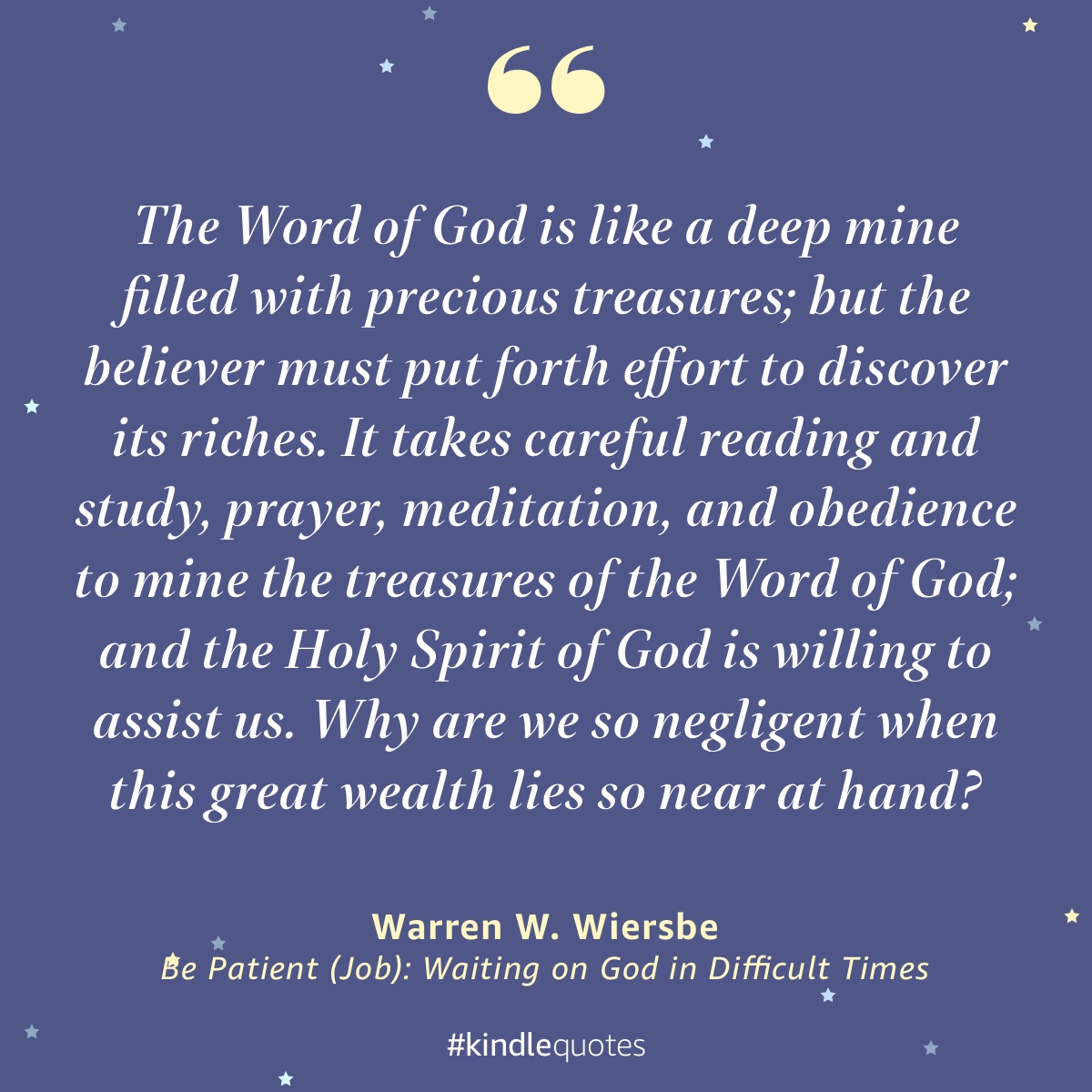
God's Word is a treasure

Is It Wrong to Read Romance Novels?

Recently I visited an old Christian message board that I used to frequent to see if it was still active. I came across a conversation where someone asked if reading romance novels was wrong. The only respondents were men. One said he thought they weren’t wrong, but they were a silly waste of time. Another said he thought they could be wrong.

I didn’t want to take the time to find my log-in information and wasn’t inclined to get into the discussion anyway. But I thought about the question for a few days.

So, do I think it’s wrong to read a romance novel?

It depends.

“Romance” covers a wide territory. Many books outside of the romance genre will contain a love interest. But in a romance, the main point of the plot is two people coming to realize and declare their love for each other.

Is there anything wrong with that as a basic plot? No. The Bible contains romances (Song of Solomon, Ruth and Boaz, Jacob and Rachel). Ephesians 5 tells us marriage is a picture of Christ and the church.

When I’m getting to know a couple, one of the first things I want to know is how they met. That usually leads into a longer story of how they knew they were right for each other. It’s always neat to see the Lord’s hand in bringing them together.

But that’s real life. Isn’t a fictional romance a waste of time?

No, a story isn’t a waste just because it’s imaginary. Jesus used fictional stories to make a point. So did OT prophets.

Fiction fleshes out truth. When I’m listening to a sermon, I might get the pastor’s point but wonder what it looks like in real life. Then he shares a sermon illustration so I see the truth in action.

Randy Alcorn said, “Some Christians view fiction as the opposite of truth. But sometimes it opens eyes to the truth more effectively than nonfiction.”

We read fiction for a number of reasons: to see life through another’s eyes, to get to know how other people think, to develop empathy, to experience other cultures, to stimulate thinking, to learn discernment, gain information, to broaden our horizons.

Can we do all that with romances? Sure.

Some of the classics are romances: Romeo and Juliet, Jane Eyre, Wuthering Heights, all of Jane Austen’s novels.

But the best romances have something going on besides falling in love. One or both characters will need to grow or overcome something. In Pride and Prejudice, for example, the two main characters need to get past their titular characteristics before they can come together. In Sense and Sensibility, one sister needs to learn the value of restraint and appreciating more about a potential husband than good looks, charm, and excitement. All of Austen’s romances involve a whole lot more than just the love story. They are commentary on the times and culture in the setting as well.

The same things can happen in a modern romance.

So how can romances be wrong?

When they produce longings that can’t be fulfilled now. If you’re struggling with being single, a romance might encourage you that God could do the same for you. Or it might discourage you because He hasn’t done so yet. If you’re in a long engagement before you can be married, you’ll have discern whether reading romances makes waiting harder for you.

When they focus too much on the physical. I avoid most modern secular fiction, especially romances, for this reason. I only pick one up after carefully researching reviews or receiving a good report from a trusted friend. But even Christian romances can go too far here. And even if a romance avoids bedroom scenes, there can be an overemphasis on her seeing his bulging muscles under his shirt, wondering what it would be like to kiss him, feeling an electric jolt when they accidentally touch. Do such things happen when people are becoming attracted to each other? Sure. But in real life or fiction, the physical shouldn’t be the main thing.

When they make you discontent with everyday life. Lisa-Jo Baker shared in The Middle Matters that a teenager quoted in the Huffington Post felt her love life would never be adequate “until someone runs through an airport to stop me from getting on a flight.” The girl probably saw that in a movie somewhere. Her romantic life is going to be difficult if she sets up a test scenario in an airport every time she thinks she’s in love. Real love is usually shown in everyday ways more than the grand gesture.

When you long for a perfect “Mr Right.” There is no perfect Mr. or Mrs. Right. The best writers write flawed, realistic characters. But sometimes a character can seem so exquisitely attractive that no one in real life could measure up. If you find yourself looking down on your husband (or potential husband, if you’re not yet married) because he falls short of a fictional hero, it might be time to lay aside the book.

I sometimes see romance writers talking about writing swoon-worthy characters, especially male characters. A character having admirable qualities is one thing. But I don’t want to swoon for anyone other than my husband.

Personally, romances aren’t my favorite genre. I read some. But I don’t want the story to stop with a wedding and a promise of happily ever after. To me, the wedding is a beginning, not an ending. I prefer women’s fiction or historical fiction, where there is more going on than an initial romance, though there may be romance in the story.

But thankfully, there are romances that are good stories, where the characters grow and learn, where we learn about the culture or setting of the book, where we can connect with human growth and experience.

“It is only a novel… or, in short, only some work in which the greatest powers of the mind are displayed, in which the most thorough knowledge of human nature, the happiest delineation of its varieties, the liveliest effusions of wit and humour, are conveyed to the world in the best-chosen language” ― Jane Austen, Northanger Abbey

Quotes about Reading

Reading is one of my favorite pastimes, and for years I’ve collected quotes about reading and books that rang true for me. Here are a few:

“And indeed, what is better than to sit by one’s fireside in the evening with a book, while the wind beats against the window and the lamp is burning?”
~ Gustave Flaubert

“…and to all this she must yet add something more substantial, in the improvement of her mind by extensive reading.”
~Jane Austen, Pride and Prejudice

“I declare after all there is no enjoyment like reading! How much sooner one tires of any thing than of a book! — When I have a house of my own, I shall be miserable if I have not an excellent library.”
~ Jane Austen, Pride and Prejudice

“When I am king, they shall not have bread and shelter only, but also teachings out of books, for a full belly is little worth where the mind is starved.”
~ Mark Twain, The Prince and the Pauper

“Words can be like X-rays if you use them properly — they’ll go through anything. You read and you’re pierced.”
~ Aldous Huxley, Brave New World

“A classic is a book that has never finished saying what it has to say.”
~ Italo Calvino, The Uses of Literature

“The author who benefits you most is not the one who tells you something you did not know before, but the one who gives expression to the truth that has been dumbly struggling in you for utterance.”
~ Oswald Chambers, My Utmost for His Highest, Dec. 15

“Far from being an escape from reality, good literature is a window into reality.”
~ Gladys Hunt, Honey for a Woman’s Heart

Which of these resonates with you? Do you have any other good quotes about books or reading?

(I often link up with some of these bloggers.)

Laudable Linkage

I’m finally caught up on my blog reading! For now. Here are some of the best posts discovered in the last week.

More Than Jumper Cable Christianity, HT to Challies. “We use jumper cables when our car’s battery is depleted, dead, and in need of a jump from another battery to get going. We connect jumper cables to another car, get some juice, and then go about our day and way. I fear far too many of us approach “abiding” in Christ this way. We do some Bible reading, read a devotional book, get some spiritual voltage and roll out.”

Feeding our Longing, HT to Challies. “Have you ever felt like there was more to life than this? Known some sense of longing for the future?”

How to Think About God Promoting His Own Glory, HT to Challies. “Many people misinterpret God’s character when looking at his demands and actions in history because they imagine what they would think of a fallen human being who did the things God has done, and they recoil. Failing to picture God as he is, they picture instead what they’re familiar with—a sinful, human tyrant imposing his preferred laws on people by force, destroying nations, or demanding worship.”

Units of Thought in Narrative Scripture. “One of the most important observations to make in a passage is the structure. And the way to observe structure is to first identify the parts of the passage (the units of thought) so that you can figure out how those parts relate to one another. In this post I’ll show you some of the ways to recognize the units of thought in a narrative.”

Flaunting Your Faithfulness: The Dangers of Conspicuous Christianity. “Conspicuous Christianity is the practice of seeking to appear more godly, not out of devotion to Christ or the love of others, but purely for the sake of winning the approval of other people. Conspicuous Christianity can come in many different forms, but it usually has some of the following characteristics . . .”

Keep Doing the Small Things, HT to Challies. “What if your greatest spiritual growth does not come through some cataclysmic event. What if the most important spiritual breakthroughs in your life are slow and methodical? Are you going to be OK with that?”

All My Not-Enoughness, HT to Challies. “I’m confronted with my not-enoughness a lot lately. As I get dressed, as I parent, as I’m faced with yet another important thing I’ve forgotten. When I try to write and the words won’t come. When I feel so tired that every inch of me longs to slink to the floor and crawl back into bed.”

The Hidden Super-Stars of Missions, HT to Challies. “I coach new missionaries as they prepare to go overseas. I’ve found I can often predict how quickly they’ll be able to raise support based on one crucial factor: whether they have an advocate who will come alongside them.”

Words That Lead, HT to Challies. Loved this post on the myths and responsibilities of writing.

On Reading Widely: Are You Stuck on One Shelf? “Root your thinking in the Word of God first, but be informed about the world around you. Resist being spoon fed by others. Do your own reading and research to form your own opinions.”

Wrapping Up Two Christmas Reads

I just finished my last two Christmas novels and thought I’d review them together.

In Hope for Christmas: A Small Town Christmas Romance Novella by Malissa Chapin, Merry Noel (who insists her last name is pronounced Knoll, not No-el) is trying to close one last deal before Christmas Day. If she can’t get everything together for it, the client will call the deal off. But her office is in the midst of a Christmas party and she can’t get anyone to make copies or do the things needed to close the deal.

Even without the pressure of this last deal, though, Merry hated Christmas and wouldn’t be celebrating.

After a disastrous series of events, Merry ends up losing her job. She didn’t want to go home to Wisconsin, but she has nowhere else to turn.

Having gotten used to city life in Atlanta, Merry chafes at going back to the farm. And how crazy was it to come back when the whole town was in the throes of their annual community Christmas celebration.

But her mother’s new neighbor, time with her mother, a blizzard, and an unexpected visitor in need all help Merry face her issues.

When I first started reading this, I thought it was going to be a modern retelling of A Christmas Carol. A couple of Merry’s coworkers even call her Ms. Scrooge. But Merry’s motivations aren’t related to business or finance.

I very much enjoyed Merry’s journey and this story, which were both heart-warming and faith-filled.

Malissa is the author of a book I read and loved last year, The Road Home (linked to my review). She also wrote Murder Goes Solo: A Piper Haydn Piano Mystery, which I have not read yet. Cozy mysteries are not my favorite fare, but I do read them sometimes, so I probably will check this out at some point.

I had not heard of Beth Moran before. But I had finished my audiobook a few days before Christmas and wouldn’t get another Audible credit until the end of the month. So I looked around Audible’s “free with a subscription” selection, and Beth’s Christmas Every Day caught my eye. I’m wary of modern secular fiction because usually it has bad language or bedroom scenes. But I figured this was low risk–if I came across something objectionable, I could just delete it from my library.

Jenny is another Christmas-hater, but for different reasons. Since her parents’ divorce, she usually spent holidays alone. But in light of her impending engagement, she has every hope that she’ll spend Christmas in a lovely place with a real family this year.

But then her boss/secret boyfriend announces an engagement not with Jenny, but with her beautiful, popular twin sister.

Jenny leaves for an old cottage in Sherwood Forest that she inherited from her grandmother, who passed away six years earlier. She expected the place to need a little clean-up. But she hadn’t known her grandmother had become a hoarder or that the house would need so much.

She gets off on the wrong foot with her curmudgeonly neighbor, Mack. But slowly, she begins to form friendships with other people in the village and gets a job.

Then she’s invited to an unusual book club. A couple of the participants are so cantankerous that they can’t agree on what books to read. So the group decides to shift focus and work on a personal challenge for the coming year, reporting on their progress at the monthly meetings instead of books. A private investigator wants to learn to bake. A dying older woman has a list of daring feats she wants to accomplish. A single mom wants to find a good man with whom she can have a real relationship. A super-fan wants to find the location of a reclusive author said to live in their area and invite her to the book club.

As Jenny deals with the house, her new job of minding a lively family of five children, her neighbor, and her new friends, she finally learns what belonging and family are all about.

This story is funny in places and heart-warming in others. Jenny’s series of comedic disasters got a little old at one point—but I guess I got used to them, or maybe they just toned down a bit. They kept happening but didn’t seem so outlandish as at first.

Even though this is written from a secular standpoint, there was a really good section on forgiveness.

There was a smattering of bad words, but otherwise the story was very clean.

Helen Keely did a superb job narrating the audiobook. I had to slow down the narration just a tad, as the British accent spoken very quickly was hard to understand in places.

I liked this books so well that I am willing to try more from this author. And I hope Helen Keely narrates them all.