Laudable Linkage

It has been a few weeks since I have been able to share with you some interesting things found around the internet. Perhaps you’ll find something of interest in the following:

3 Things to Tell Yourself When Others Prosper While You Suffer.

Thank God for Your Normal, Boring Life.

Grieving Over the Holidays – What You Need to Know.

14 Reasons to Memorize an Entire Book of the Bible. Though some of this addressed to preachers, other parts of it are applicable to us all.

“Mama, What Does $*@#%! Mean?” Wise advice for how to handle those times when, no matter how protective you’ve been, your child overhears a bad word.

Why I Show Children Hospitality (Even Though I Am Not a Parent), HT to The Story Warren.

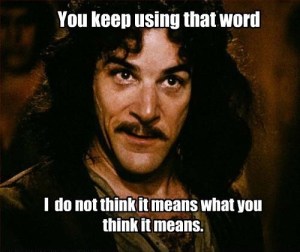
Please Don’t Be Intolerant. As Inigo Montoya says, I think many people use that word without knowing what it really means.

You keep using that word...

Why Readers Are Skipping Crucial Parts of Your Story.

The Most Instagrammed Location In Every State.

12 Ridiculously Warm Products For People Who Are Always Ridiculously Cold. I am usually warmer than everyone else, but I know people who are always cold and could use some of these.

There were so many more Write 31 Days series than I could possibly read, and I dipped in here and there with quite a few, but a few I kept up with almost daily were:

Tools to Memorize a Bible Chapter.

31 Days of Hope for Caregivers.

31 Glimpses Into the Unquiet Mind. A mother and daughter share the daughter’s journey with bipolar disorder and the long journey to diagnosis and treatment.

31 Uplifting Quote Graphics.

31 Ways to Snag a Literary Agent.

Happy Saturday!

31 Days With Elisabeth Elliot: The Hand That Hurts and the Hand That Heals

Elisabeth Elliot2
This is titled “A Dog’s Thanksgiving” and appears in the November/December 1988 Elisabeth Elliot Newsletter:

“I remember fixing the wounded leg of my dog. There was some struggle and a hurt crying but he kept licking my hand. The hand of the one who was hurting him and the hand of the one who was healing him were the same, and his endurance of the one rested in his trust in the other. Out of the depths have I cried unto Thee, O Lord.” From This Cup, by Addison Leitch (my second husband, who died in 1973).

There are many lessons for us in the mysterious animal world. Have we ears to hear, eyes to see, hearts to learn those sweet lessons?

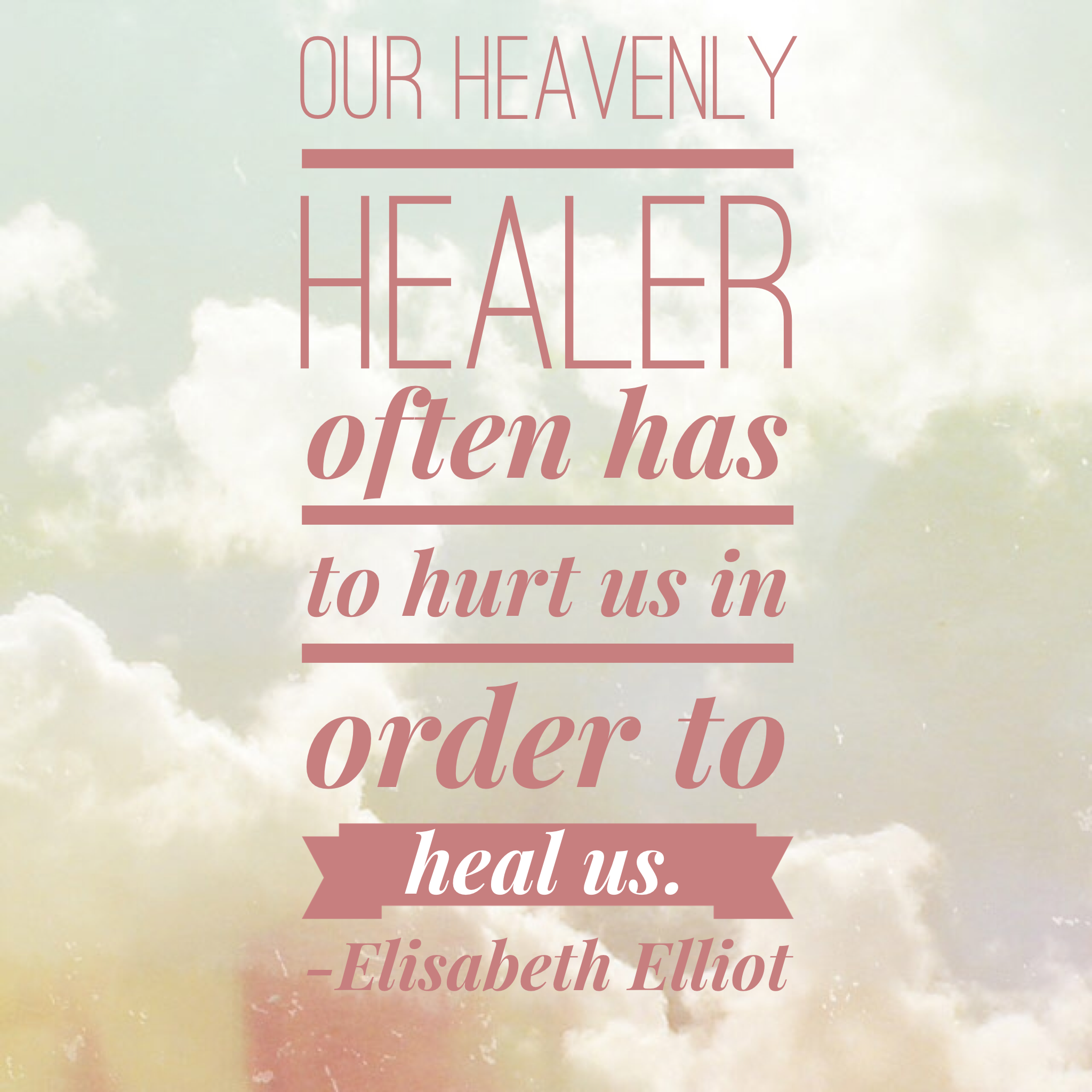
Our Heavenly Healer often has to hurt us in order to heal us. We sometimes fail to recognize His mighty love in this, yet we are firmly held always in the Everlasting Arms. The dog’s leg was hurting. Add’s ministrations were as delicate as possible, yet they hurt too, and the loyal dog accepted them and thanked him with his eyes. Have we the humility to thank our Father for the gift of pain?

“No discipline seems pleasant at the time, but painful. Later on, however, it produces a harvest of righteousness and peace for those who have been trained by it” (Hebrews 12:11). Let us give thanks!

IMG_1388

See all the posts in this series here.

31 Days With Elisabeth Elliot: The World Must Be Shown

Elisabeth Elliot2This is from Elisabeth’s book Keep A Quiet Heart:

When Jesus was speaking with His disciples before His crucifixion, He gave them His parting gift: peace such as the world can never give. But He went on immediately to say, “Set your troubled hearts at rest and banish your fears…. I shall not talk much longer with you, for the Prince of this world approaches. He has no rights over me, but the world must be shown that I love the Father and do exactly as he commands” (John 14:27, 30-31, NEB).

A young mother called to ask for “something that will help me to trust in the Lord.” She explained that she had several small children, she herself was thirty years old, and she had cancer. Chemotherapy had done its hideous work of making her totally bald. The prognosis was not good. Could I say to her, “Set your troubled heart at rest. God is going to heal you”? Certainly not. Jesus did not tell His disciples that He would not be killed. How do I know whether God would heal this young woman? I could, however, remind her that He would not for a moment let go of her, that His love enfolded her and her precious children every minute of every day and every night, and that underneath are the Everlasting Arms.

But is that enough? The terrible things in the world seem to make a mockery of the love of God, and the question always arises: Why!

There are important clues in the words of Jesus. The disciples’ worst fears were about to be realized, yet He commanded (yes, commanded) them to be at peace. All would be well, all manner of things would be well–in the end. In a short time, however, the Prince of this world, Satan himself, was to be permitted to have his way. Not that Satan had any rights over Jesus. Far from it. Nor has he “rights” over any of God’s children, including that dear mother. But Satan is permitted to approach. He challenges God, we know from the Book of Job, as to the validity of His children’s faith.

God allows him to make a test case from time to time. It had to be proved to Satan, in Job’s case, that there is such a thing as obedient faith which does not depend on receiving only benefits. Jesus had to show the world that He loved the Father and would, no matter what happened, do exactly what He said. The servant is not greater than his Lord. When we cry “Why, Lord?” we should ask instead, “Why not, Lord? Shall I not follow my Master in suffering as in everything else?”

Does our faith depend on having every prayer answered as we think it should be answered, or does it rest rather on the character of a sovereign Lord? We can’t really tell, can we, until we’re in real trouble.

I never heard more from the young woman. I neglected to ask her address. But I prayed for her, asking God to enable her to show the world what genuine faith is–the kind of faith that overcomes the world because it trusts and obeys, no matter what the circumstances. The world does not want to be told. The world must be shown. Isn’t that part of the answer to the great question of why Christians suffer?

I started to just share the paragraphs with the sentences I highlighted, but then as I reread through the whole piece, I couldn’t leave any of it out. My tendency in any trial is to ask for it to stop, now please. But God not only works in and through the trial in my own life, it is also a testimony to others…and not just to others on Earth. Ephesians 3:10 says, “ so that through the church the manifold wisdom of God might now be made known to the rulers and authorities in the heavenly places.” God shows His wisdom in His dealings with us even to creatures “in heavenly places!” When I think of it, I try now to pray not just for quick deliverance (though in my flesh that would still be my desire), but that others may see Jesus through it all.

IMG_1380

See all the posts in this series here.

_____________________________________________________

DaySpring.com is celebrating all of the amazing Write 31 Days readers who are supporting nearly 2,000 writers this October! To enter to win a $500 DaySpring shopping spree, just click on this link & follow the giveaway widget instructions by October 30. Best wishes, and thanks for reading!

Book Review: The Problem of Pain

Problem of PainIn The Problem of Pain, C. S. Lewis sets out truths and speculations about why a wise, loving, kind, and omnipotent God would allow so much evil, suffering and pain in the world. It’s a question that troubles believers and unbelievers alike and one which was a major hindrance to Lewis’s own conversion.

Chapter 1, “Introductory,” traces three threads through human philosophy and development that lead to religion: an awe or dread of unseen beings, which Lewis calls the Numinous; a sense of some kind of morality; and the connection between the Numinous and morality. The Numinous is either “a mere twist in the human mind…or else it is a direct experience of the really supernatural, to which the name Revelation might properly be given” (p. 10). In Christianity there is one more thread: the historical event of the death and resurrection of Christ. Either Christ was “a raving lunatic of an unusually abominable type, or else He was, and is, precisely what He said. There is no middle way” (p. 13).

To ask whether the universe as we see it looks more like the work of a wise and good Creator or the work of chance, indifference, or malevolence, is to omit from the outset all the relevant factors in the religious problem. Christianity is not the conclusion of a philosophical debate on the origins of the universe: it is a catastrophic historical event following on the long spiritual preparation of humanity which I have described. It is not a system into which we have to fit the awkward fact of pain: it is itself one of the awkward facts which have to be fitted into any system we make. In a sense, it creates, rather than solves, the problem of pain, for pain would be no problem unless, side by side with our daily experience of this painful world, we had received what we think a good assurance that ultimate reality is righteous and loving (p. 14).

Mankind tends to think that “If God were good, He would wish to make His creatures perfectly happy, and if God were almighty He would be able to do what He wished. But the creatures are not happy. Therefore God lacks either goodness, or power, or both” (p. 16). Lewis spends the next couple of chapters talking about God’s omnipotence and goodness. Some pain is inherent in nature: fire warms when used rightly but burns when one gets too close to it. Some pain arises when individual beings assert their own wills which then clash with each other. God in His omnipotence could have made it impossible for people to sin against each other, but He made man with a free will and the ability to choose his actions.

You may attribute miracles to Him, but not nonsense. This is no limit to His power. If you choose to say ‘God can give a creature free will and at the same time withhold free will from it’, you have not succeeded in saying anything about God: meaningless combinations of words do not suddenly acquire meaning simply because we prefix to them the two other words ‘God can’. It remains true that all things are possible with God: the intrinsic impossibilities are not things but nonentities. It is no more possible for God than for the weakest of His creatures to carry out both of two mutually exclusive alternatives; not because His power meets an obstacle, but because nonsense remains nonsense even when we talk it about God (p. 18).

But “if the universe must, from the outset, admit the possibility of suffering, then” wouldn’t “absolute goodness…have left the universe uncreated”? Lewis “warn[s] the reader that I shall not attempt to prove that to create was better than not to create: I am aware of no human scales in which such a portentous question can be weighed” (p. 27). But he goes on to offer some thoughts about “how, perceiving a suffering world, and being assured, on quite different grounds, that God is good, we are to conceive that goodness and that suffering without contradiction” (p. 27).

What we mean by goodness is not always what true goodness actually is:

By the goodness of God we mean nowadays almost exclusively His lovingness; and in this we may be right. And by Love, in this context, most of us mean kindness – the desire to see others than the self happy; not happy in this way or in that, but just happy. What would really satisfy us would be a God who said of anything we happened to like doing, ‘What does it matter so long as they are contented?’ We want, in fact, not so much a Father in Heaven as a grandfather in heaven – a senile benevolence who, as they say, ‘liked to see young people enjoying themselves’, and whose plan for the universe was simply that it might be truly said at the end of each day, ‘a good time was had by all’. Not many people, I admit, would formulate a theology in precisely those terms: but a conception not very different lurks at the back of many minds. I do not claim to be an exception: I should very much like to live in a universe which was governed on such lines. But since it is abundantly clear that I don’t, and since I have reason to believe, nevertheless, that God is Love, I conclude that my conception of love needs correction (pp. 31-32).

Even humans don’t want friends and loved ones to continue in a course that makes them happy but is hurtful or destructive to themselves and others, so we can understand that Divine love, so much above ours, will need to correct, halt, or discipline individuals and attempt to bring them to repentance, which will involve some degree of pain.

“We are, not metaphorically but in very truth, a Divine work of art, something that God is making, and therefore something with which He will not be satisfied until it has a certain character.” As an artist erases and reworks a drawing until it becomes as perfect as possible, “One can imagine a sentient picture, after being rubbed and scraped and recommenced for the tenth time, wishing that it were only a thumbnail sketch whose making was over in a minute. In the same way, it is natural for us to wish that God had designed for us a less glorious and less arduous destiny; but then we are wishing not for more love but for less” (pp. 34-35).

Similarly, when a man has a dog, “man interferes with the dog and makes it more lovable than it was in mere nature. In it’s state of nature it has a smell, and habit’s, which frustrate man’s love: he washes it, house-trains it, teaches it not to steal, and is so enabled to love it completely. To the puppy the whole proceeding would seem, if it were a theologian, to cast grave doubts on the ‘goodness’ of man: but the full-grown and full-trained dog, larger, healthier, and longer-lived than the wild dog, and admitted, as it were by Grace, to a whole world of affections, loyalties, interests, and comforts entirely beyond it’s animal destiny, would have no such doubts” (p. 36). Man cares for animals he loves: he “does not house-train the earwig or give baths to centipedes. We may wish, indeed, that we were of so little account to God that He left us alone to follow our natural impulses – that He would give over trying to train us into something so unlike our natural selves: but once again, we are asking not for more love, but for less” (p. 36).

The parent-child analogy is a closer one to spiritual truth than man and art or man and dog, but no loving father says, “I love my son but don’t care how great a blackguard he is provided he has a good time” (p. 37).

When we want to be something other than the thing God wants us to be, we must be wanting what, in fact, will not make us happy. Those Divine demands which sound to our natural ears most like those of a despot and least like those of a lover, in fact marshal us where we should want to go if we knew what we wanted. He demands our worship, our obedience, our prostration. Do we suppose that they can do Him any good, or fear, like the chorus in Milton, that human irreverence can bring about ‘His glory’s diminution’? A man can no more diminish God’s glory by refusing to worship Him than a lunatic can put out the sun by scribbling the word ‘darkness’ on the walls of his cell. But God wills our good, and our good is to love Him (with that responsive love proper to creatures) and to love Him we must know Him: and if we know Him, we shall in fact fall on our faces (p. 46).

Lewis then goes on to explain why mankind needs such alteration in the first place. He asserts this is necessary because in his time there was not so much a sense of sin as people would have had in the times when the Bible was written, against which the gospel appeared as very good news indeed. He gives various reasons for that to show that “Christianity now has to preach the diagnosis – in itself very bad news – before it can win a hearing for the cure” (p. 48) and then goes on to show how pervasive and deceptive sin is in our hearts.

It’s when he discusses how man became sinful in the first place in his chapter on the fall of man that I have my first serious problems. He regards the first few books of the Bible (at least, maybe more of it) as mythic. He believes in the evolutionary view of man’s development and as such believes that the “first man” could not have sinned as Adam did because he would not have had the intelligence, self-awareness, or conscience to, since he was what we commonly think of as a prehistoric cave man. At some point in man’s continued evolution, mankind as whole sinned against God by somehow preferring its own way rather than His, of somehow rejecting His reign, and thus the rest of human race was born in sin. He rejects the idea that we are responsible or accountable for or being punished for Adam’s sin. He has problems coming to terms with the statement that “as in Adam all die, even so in Christ shall all be made alive” (1 Corinthians 15:22). Now, I don’t believe that believing in evolution disqualifies a man from salvation or heaven, but I think taking a great deal of the Bible as mythic is not only wrong, but creates new problems. It makes more sense to me that since Adam sinned and was corrupted, every ancestor of his was also corrupted, and thus we are all born sinners, than to try to imagine that the sin of a group of people somehow plunged the entire human race ever after into sin. I think it is quite dangerous to take plain statements of Scripture as mythic and symbolic. I have X marks (which I sometimes put next to statements I disagree with in a book) and question marks all through this chapter and can’t take the time or space here to delineate them all. I do understand that Lewis was speaking from the intellectual viewpoint of his day. He’s not afraid to contradict prevailing viewpoints with Scriptural truth where he see it clearly, but I assume he must not have heard a convincing argument in regard to creation and a literal interpretation of Genesis. He comes out at the right place in the end: “that man, as a species, spoiled himself, and that good, to us in our present state, must therefore mean primarily a remedial or corrective good” (p. 85), but the way he gets there is convoluted.

The next two chapters on human pain are the best, in my opinion. Lewis proposes that about four-fifths of the pain in the world arises from our own sinfulness, our bent as people created with choice and free will to use that will to sin against others.

“We are not merely imperfect creatures who must be improved: we are, as Newman said, rebels who must lay down our arms” (p. 88).

But there are other kinds of pain that do not come directly from other people’s sins against us.

The first answer, then, to the question why our cure should be painful, is that to render back the will which we have so long claimed for our own, is in itself, wherever and however it is done, a grievous pain… to surrender a self-will inflamed and swollen with years of usurpation is a kind of death (p. 89).

Hence the necessity to die daily: however often we think we have broken the rebellious self we shall still find it alive. That this process cannot be without pain is sufficiently witnessed by the very history of the word ‘Mortification’ (p. 89).

The human spirit will not even begin to try to surrender self-will as long as all seems to be well with it (p. 90).

If the first and lowest operation of pain shatters the illusion that all is well, the second shatters the illusion that what we have, whether good or bad in itself, is our own and enough for us. Everyone has noticed how hard it is to turn our thoughts to God when everything is going well with us. We ‘have all we want’ is a terrible saying when ‘all’ does not include God. We find God an interruption. As St Augustine says somewhere, ‘God wants to give us something, but cannot, because our hands are full – there’s nowhere for Him to put it.’ Or as a friend of mine said, ‘We regard God as an airman regards his parachute; it’s there for emergencies but he hopes he’ll never have to use it.’ Now God, who has made us, knows what we are and that our happiness lies in Him. Yet we will not seek it in Him as long as He leaves us any other resort where it can even plausibly be looked for. While what we call ‘our own life’ remains agreeable we will not surrender it to Him. What then can God do in our interests but make ‘our own life’ less agreeable to us, and take away the plausible source of false happiness? It is just here, where God’s providence seems at first to be most cruel, that the Divine humility, the stooping down of the Highest, most deserves praise (p. 94).

God, who made these deserving people, may really be right when He thinks that their modest prosperity and the happiness of their children are not enough to make them blessed: that all this must fall from them in the end, and that if they have not learned to know Him they will be wretched. And therefore He troubles them, warning them in advance of an insufficiency that one day they will have to discover. The life to themselves and their families stands between them and the recognition of their need; He makes that life less sweet to them. I call this a Divine humility because it is a poor thing to strike our colours to God when the ship is going down under us; a poor thing to come to Him as a last resort, to offer up ‘our own’ when it is no longer worth keeping. If God were proud He would hardly have us on such terms: but He is not proud, He stoops to conquer, He will have us even though we have shown that we prefer everything else to Him, and come to Him because there is ‘nothing better’ now to be had. The same humility is shown by all those Divine appeals to our fears which trouble high-minded readers of Scripture. It is hardly complimentary to God that we should choose Him as an alternative to Hell: yet even this He accepts. The creature’s illusion of self-sufficiency must, for the creature’s sake, be shattered; and by trouble or fear of trouble on earth, by crude fear of the eternal flames, God shatters it ‘unmindful of His glory’s diminution’ (pp 95-96).

Sometimes pain also serves as a reminder that this world is not all there is and isn’t meant to satisfy: when something painful happens – illness, bad news, etc. – “At first I am overwhelmed, and all my little happinesses look like broken toys. Then, slowly and reluctantly, bit by bit, I try to bring myself into the frame of mind that I should be in at all times. I remind myself that all these toys were never intended to possess my heart, that my true good is in another world and my only real treasure is Christ” (pp. 106-107). “Our Father refreshes us on the journey with some pleasant inns, but will not encourage us to mistake them for home” (p. 116).

And though he doesn’t mention Romans 5:3-5 (“And not only so, but we glory in tribulations also: knowing that tribulation worketh patience; And patience, experience; and experience, hope: And hope maketh not ashamed; because the love of God is shed abroad in our hearts by the Holy Ghost which is given unto us”), he does discuss the principle that suffering develops these things in us.

Lewis said near the beginning that he was writing merely to explain the problem of pain, not to necessarily tell how to deal with it. Yet he does say, “If pain sometimes shatters the creature’s false self-sufficiency, yet in supreme ‘Trial’ or ‘Sacrifice’ it teaches him the self-sufficiency which really ought to be his – the ‘strength, which, if Heaven gave it, may be called his own’: for then, in the absence of all merely natural motives and supports, he acts in that strength, and that alone, which God confers upon him through his subjected will. Human will becomes truly creative and truly our own when it is wholly God’s, and this is one of the many senses in which he that loses his soul shall find it.”

He discusses the moral objection to hell in another chapter and makes several good points. I’ll just share this one:

In the long run the answer to all those who object to the doctrine of hell, is itself a question: ‘What are you asking God to do?’ To wipe out their past sins and, at all costs, to give them a fresh start, smoothing every difficulty and offering every miraculous help? But He has done so, on Calvary. To forgive them? They will not be forgiven. To leave them alone? Alas, I am afraid that is what He does (p. 130).

Lewis has a chapter on animal pain, which he confesses is primarily speculation since the Bible says nothing about what animals feel and they can’t tell us. But here is another place where his evolutionary thought comes in and contradicts clear Biblical truth. He says earlier generations felt that suffering of animals and all creation came about as a result of Adam’s fall. We get that from a few places, among them that Genesis 3:17-19, where God said told Adam: “cursed is the ground for thy sake; in sorrow shalt thou eat of it all the days of thy life; Thorns also and thistles shall it bring forth to thee; and thou shalt eat the herb of the field; In the sweat of thy face shalt thou eat bread, till thou return unto the ground; for out of it wast thou taken: for dust thou art, and unto dust shalt thou return.” So apparently before this time there were no thorns and thistles and it wasn’t hard work to get something to eat. Then in the millennial kingdom, when Christ rules the earth, it is prophesied in Isaiah 11 that in that time:

The wolf also shall dwell with the lamb, and the leopard shall lie down with the kid; and the calf and the young lion and the fatling together; and a little child shall lead them.

And the cow and the bear shall feed; their young ones shall lie down together: and the lion shall eat straw like the ox.

And the sucking child shall play on the hole of the asp, and the weaned child shall put his hand on the cockatrice’ den.

They shall not hurt nor destroy in all my holy mountain: for the earth shall be full of the knowledge of the Lord, as the waters cover the sea.

So we assume from this that the harmful behaviors which shall no longer be were a part of the original fall and not part of animal’s original creation, since they are set right here. But Lewis says this “is now impossible, for we have good reason to believe that animals existed long before man. Carnivorousness, with all that it entails, is older than humanity (p. 137). I have an X by that statement as well as a few others in this chapter.

Even more alarming to me is his thought that “it might be argued that when He emptied Himself of His glory He also humbled Himself to share, as man, the current superstitions of His time. And I certainly think that Christ, in the flesh, was not omniscient – if only because a human brain could not, presumably, be the vehicle of omniscient consciousness, and to say that Our Lord’s thinking was not really conditioned by the size and shape of His brain might be to deny the real incarnation and become a Docetist. Thus, if Our Lord had committed Himself to any scientific or historical statement which we knew to be untrue, this would not disturb my faith in His deity” (p. 137). It would disturb mine, and I don’t believe for a moment that Christ believed “superstitions of His time”! There were multiple incidences of His displaying omniscience even while in human form. I just discussed this recently in a chapter from J. I. Packer’s book Knowing God in this post.

Lewis closes with a short chapter on pain which is mostly speculative but does include the theme present in The Last Battle in the Narnia series, that it’s the place we’ve been longing for our whole lives.

If you’ve read this far, you deserve a pat on the back. I am sorry this is so long, but when I write about a book, I want to convey not only a glimpse of what it is about to those reading, but I want to record the salient points as well as my own thoughts and impressions to remind myself of in the future.

I was a bit frustrated that Lewis didn’t go into more of the Biblical reasons for suffering, but then I reminded myself that it wasn’t his purpose to write such a treatise: he was merely wanting to address the problem of pain from a philosophical viewpoint couched mostly in Scripture. I remember reading somewhere which I can’t trace now that someone who read this book then approached Lewis about making the talks which eventually became Mere Christianity.

There are a lot of really good nuggets in this book. But there are enough questionable things that this would not be my first choice to recommend to someone on this topic. That would be When God Weeps by Joni Eareckson Tada and Steve Estes. But I would still recommend this with caution about some of the problem areas.

(This review will also be linked to Semicolon‘s Saturday Review of Books.)

It’s ok to say it hurts

Its-okay-to-say-it-hurts

Recently a friend shared a painful incident that had occurred in her life, and when a couple of us who were listening tried to express sympathy, her tone changed to one of upbeat cheeriness while she tried to assure us everything was ok and she was rejoicing in the Lord.

It’s not the first time that kind of thing has happened.

As Christians, when we face some kind of trial, we remind ourselves of Biblical truth: God is in control, this has not taken Him by surprise, He has a purpose for it, something to teach us in it; He wants to grow our faith by it; He will give us the grace and strength to deal with it. Those are comforting and do help us as we work through the situation.

On top of that, we’re conscious that other people are watching, and we want to be a good testimony and to glorify God in our responses. So sometimes we translate that into putting on a happy face before others and dealing with our confusion and pain in private.

I’ve mentioned that I used to do this after contracting transverse myelitis and finding an online support group of TM patients and caregivers. Honestly, at first I didn’t join them with the idea of trying to be a good testimony. I was just looking for answers in an era when I couldn’t find information anywhere else (thankfully there is a great amount of information available now). But as I interacted with the group, I did realize that I couldn’t help but share God’s grace in dealing with me and helping me cope. I wanted to represent Him well, so I shared only the positive and kept to myself the hard days and frustrations. Later on another Christian joined the group, and she was refreshingly honest and real about her struggles, yet still expressed faith and reliance on God. That was one incident that helped me realize that having joy in the Lord is not the same thing as grinning and bearing it or keeping a stiff upper lip.

The Bible is full of God’s people speaking honestly about their pain and trouble. The Psalms especially are balm for a weary soul. Lamentations shares the full emotion resulting from God’s judgment even while acknowledging God’s justice in His actions. Paul says, “ We are troubled on every side, yet not distressed; we are perplexed, but not in despair; Persecuted, but not forsaken; cast down, but not destroyed; Always bearing about in the body the dying of the Lord Jesus, that the life also of Jesus might be made manifest in our body” (2 Corinthians 4:8-10). He admits to being troubled, perplexed, and cast down while still testifying to God’s keeping him from being distressed, in despair, forsaken, and destroyed. Even our Lord Jesus “offered up prayers and supplications with strong crying and tears unto him that was able to save him from death” (Hebrews 5:7).

I admit it’s hard sometimes to find the balance. We do want to honor the Lord in our trials and not sound like we’re complaining. But I think it helps people more to see us apply Biblical truth to our painful situation rather than acting like we’re above it all and unaffected. Thus, I’d rather hear, “It hurts that so many special things were stolen in the break-in, but it’s a reminder to us that thieves do break through and steal in this world, and we’re to store up treasures in heaven” than an attempt to brush it off. Or, “God, this disease really hurts today. I so wish and pray you’d take it from me. In the meantime, please give me the grace to deal with it.” Or, “I don’t understand why God took my wife home so early, and it hurts like crazy, but I depend on His grace moment by moment.” In one of Elisabeth Elliot’s writings, she said that even with knowing so many wonderful things God did as a result of her husband’s death, that still didn’t satisfy. God can save people and draw them to a closer walk with Him or into service for Him without taking someone’s life to do so. Yet she accepted it and trusted Him in the midst of it. The “peace that passes understanding” that God gives when we take our requests to Him with prayer and thanksgiving doesn’t deny the pain or problems: in fact, it’s all the more marvelous because it occurs in the midst of the pain and problems.

It doesn’t dishonor God to say that something hurts or confuses us. It might dishonor Him to wallow in it without looking to Him. But when we look to Him, honor Him, rejoice in Him, and trust Him even while acknowledging painful or frustrating situations, people see His grace is sufficient for any need.

For this thing I besought the Lord thrice, that it might depart from me. And he said unto me, My grace is sufficient for thee: for my strength is made perfect in weakness. Most gladly therefore will I rather glory in my infirmities, that the power of Christ may rest upon me. Therefore I take pleasure in infirmities, in reproaches, in necessities, in persecutions, in distresses for Christ’s sake: for when I am weak, then am I strong. 2 Corinthians 12:8-10

Sharing at Thought-Provoking Thursday.

Book Review: My Emily

My EmilyMy Emily by Matt Patterson is a family’s story of a young daughter born with Down’s Syndrome who is then diagnosed with leukemia at the age of two.

After the joy of Emily’s birth, the Pattersons were shocked to learn that she had Down’s Syndrome. Once they had a chance to absorb that, though, they found it didn’t really change anything. Emily was a little behind other children in her development, but she was developing, and “she did possess two characteristics many Down’s children are blessed with – a never-ending smile and a heart so very full of love.”

But a late-night run to the ER for a fever when Emily was two, and a question about some dots on her leg, led to blood tests which revealed Emily had acute lymphoblastic leukemia.

Matt relates what Emily and the family went through as she underwent a 100-day course of chemotherapy with its attendant side effects, went into remission, relapsed, and had a bone marrow transplant.

A major part of a journey like this is wrestling with God about why He allowed it, especially for a little child, and Matt shares some of that as well.

Perhaps He sent this little, unassuming angel to instruct me and many others about what’s truly important in life. I believe she taught us not to take one single day for granted, showing a greater appreciation for family, faith, and friends and all that we have been given and blessed with.

…Some would look at Emily’s life and think that a child born with Down’s syndrome has little hope for a meaningful life. Throw in the diagnosis of leukemia and that little hope turns into no hope whatsoever.

I disagree.

Emily’s life, with all its imperfections, had great meaning. Because of how many people she touched, I realize that we are far more than what we can accomplish. We are the very thumbprints of God.

Matt goes on to say:

Incidents in our lives – big or small – develop our character. The Bible says, “We know these troubles produce patience. And patience produces character.”

Our lives, as short as they may be, are a test. And one of the biggest tests we can endure is how we respond to those moments when we don’t feel the presence of God in our lives. I believe deeply that one of God’s greatest gifts is to teach us there is a purpose behind every single one of our trials and problems.

Treat them as a gift, an opportunity to to move forward and draw closer to God. Problems often times compel us to look to God and count on Him rather than ourselves.

This is a very short book at 98 pages and at the moment is available for free for the Kindle app. I was touched at many points in the book and the quote about every life with its imperfections having meaning and purpose and that we “are more than what we can accomplish” particularly spoke to me.

(This review will also be linked to Semicolon‘s Saturday Review of Books.)

Book Review: Better To Be Broken

Better_to_Be_BrokenBetter to Be Broken is the testimony of Rick Huntress. The book opens with a horrific accident: while on a training mission on an Air Reserve base in GA, the locking system for the two-ton cargo bay door of an airplane where Rick was supervising a cargo load failed, and the door came crashing onto his head, shattering three vertebrae which severed his spinal cord, leaving him a paraplegic.

The next chapter goes back to Rick’s previous life. He had accepted Christ as his Savior at a young age, but early on he loved “praise and accolades.” “Because I had no understanding at that age where my gifts came from, the deadly sin of pride thrived in fertile soil…It made me think I was something special, and that attitude only served later to alienate me from my peers.” He developed a drive to be on top, out front, well thought of, and so he hid his personal weaknesses and his real self. He served in the Air Force, married, attended college, and started a good job all with the same mentality. After a while things began to deteriorate, especially in his marriage.

The next chapter picks back up to the time right after the accident and the ensuing weeks in a hospital. Between pain, drugs, confusion, and fear, finally his walls started breaking down. He tells not only of the progress in his condition but also the progress in his soul as he began to face reality.

I wouldn’t say that God caused my accident to happen, but He did allow it to happen. During the weeks after my surgery, as my body was physically healing, God knew that what I needed most was spiritual healing. That could only be accomplished by His direct hand. He brought me to a place in which rescue was possible only by complete trust in Him. It had been so long since I had trusted in Him that I had forgotten how. But from the moment of the accident, the journey had begun.

Verse 17 of Psalm 51 says, “The sacrifices of God are a broken spirit: a broken and a contrite heart, O God, thou with not despise.” I, too, was broken, and it was the best thing that ever happened to me. My broken back is a blessing from God. He used it to bring me back to Himself. I have heard it said, “God sometimes puts us flat on our back, so we can learn to look up at Him.” That certainly was true for me.

Rick continues to tell of physical and mental adjustments once he was well enough to go home, adjustments to the house, to life in a wheelchair, to not being able to do what he always did. It was hard to navigate the “new normal.” But eventually he came to peace with the differences and found new ways to serve, especially ministering to others in similar circumstances. He once even organized a memorable trip to Israel for several disabled people.

Rick concludes, “If it took a wheelchair for me to have a close relationship with my heavenly Father, then I would choose it all again” and “This is not a sob story about my broken body, it is my sincere attempt to give God the glory for breaking my stubborn will. It is the best thing that ever happened to me.”

Though I winced at several of the things Rick had to go through, I was greatly blessed and challenged by his story, and I highly recommend it to you.

(This review will also be linked to Semicolon‘s Saturday Review of Books.)
31 Days of Inspirational Biography: Bill Maher, “Missionary to the Handicapped”

photo 3(2)

Beyond My DreamsWhen Bill Maher was born in 1928, the midwife assisting his mother thought he was dead. He was laid in the crib while the midwife and doctor turned their attentions to his mother, who was having severe complications. Bill was not dead, however, he was diagnosed with severe cerebral palsy. His parents were advised to put him away in an institution and forget they had him. The shocked mother refused. His parents sought any help and advice they could find to help their son while trying to treat him as normally as possible. His neck muscles were too weak to hold up his head, his arm and leg and tongue muscles were contracted and had to be stretched out daily. The therapy had both mother and son in tears, but it worked.

When Bill was two, he developed mumps and measles at the same time and lost his hearing. Yet he somehow learned to lip read. By the age of five he still could not talk.

Other children and even adults would taunt and tease Bill if his family was not around. Sadly, some of those people were even Christians — who would then ask Bill if he wanted to become a Christian! Neither he nor his parents did. Bill writes later in his autobiography, Beyond My Dreams, “Apparently these people had never read Leviticus 19:14: ‘Thou shalt not curse the deaf, not put a stumblingblock before the blind, but shalt fear thy God: I am the Lord.’ In other words, Christians should realize that God made the afflicted the way they are for a purpose and no one should take advantage of them because of their afflictions.”

One Christian lady knocked him down into the mud to get him out of her way and then told his mother he should not be allowed to walk where other civilized people did; he should instead be taken into the woods where the other animals were. Bill did not want to walk outside any more after that, but his mother told him, “Giving up is not in our vocabulary.”

Bill’s parents made him do chores and work hard. One time when he got out of a job his grandfather paid him to do by paying another child a lesser amount to do it, his mother was angry, but his grandfather realized he had to use his brains to figure that out. Bill had a wonderful sense of humor, manifested throughout his book.

Bill attended a regular school until fifth grade, when he failed because he could not keep up. The school felt they had taken him as far as they could, but the principal recommended a school for the deaf 30 miles away. His family made the daily commute, and Bill began to learn more.

When Bill was about 12, one family that was kind to him invited him to their church. There he saw many of the kids who picked on him, as well as the lady who had pushed him down. Yet he enjoyed the service and came back that evening. He misunderstood something the pastor said, and asked to speak to him afterward. Bill was ignorant of what the Bible said, and the pastor patiently explained Bill’s need for a Savior. Thankfully he did not let the failures of some of God’s people keep him from the one and only Savior who could meet his deepest needs. He accepted Christ and experienced immediate changes. He writes, “When I had walked into church that night, I had seen people I hated. When I left, I couldn’t hate them any more.”

When Bill completed the tenth grade at the school for the deaf, he was told he needed to face the “real world” and go to the public high school. He did passing work, got involved in extracurricular activities, held down part time jobs, got his driver’s license. But on graduation night, as he walked across the stage to receive his diploma, the man handing them out said, “It is amazing that you’ve graduated. You work hard, but you will still not amount to anything. If you can get a job, all you’ll ever be is maybe a janitor.” Bill was stunned, his mother was in tears, his dad was angry. Yet Bill was more determined that ever to prove this kind of thinking wrong.

Bill got a good job, but began getting into some of the activities of the unsaved coworkers and backslid. One day at work he had a heart attack, at the age of 22, and was told he only had a month to live. He asked his parents if he could stay with the pastor who had led him to the Lord at the camp where the pastor now ministered. They agreed, and over time Bill confessed his sins to the Lord and surrendered to do anything the Lord wanted him to do. The pastor felt Bill was called to preach. Bill didn’t think so because of his impediments. As he studied his Bible, he came across II Cor. 1:3-4 about comforting others with the comfort wherewith God comforted us, II Cor. 12 about God’s grace being sufficient, Phil. 4:13, and God’s answers to Moses’ objections. He surrendered to preach. His parents were upset and his dad told him not to come home.

Eventually his father did overcome his objections, Bill became a preacher, married, had two children, traveled all over the United States and then the world, preaching, ministering to the handicapped and afflicted, helped to start Christian schools for them, became a police chaplain, and received a honorary doctorate. He went home to be with the Lord in 2002.

In Dr. John Vaughn’s forward to Dr. Bill Maher’s book, he writes, “God is to be praised for the wonderful way he has worked in and through this man’s life. Bill Maher is to be commended for the wonderful way he has served the Lord under circumstances that would have discouraged most others from the start. As you read, you will probably ask yourself the question that comes to me so often when I am with this man who is like a father to me, ‘If he has done this with the Lord’s help, what could I do if I would really trust Him myself?’”

Luke 14: 13-14: But when thou makest a feast, call the poor, the maimed, the lame, the blind: And thou shalt be blessed; for they cannot recompense thee: for thou shalt be recompensed at the resurrection of the just.

For the 31 Days writing challenge, I am sharing 31 Days of Inspirational Biography. You can find others in the series here.

(This will also be linked to Semicolon‘s Saturday Review of Books.)

“But if not…”

Since our pastor has been diagnosed with cancer and given only 6 months or so to live, he has had a couple of sessions of combined adult Sunday School classes in order to discuss with us some issues and some of his vision and burden for us. A couple of weeks ago he was feeling poorly enough not to be able to make it for Sunday School for one of these sessions. Our assistant pastors took that opportunity to share a bit of their perspective and then a few men prayed for the family. That time was greatly beneficial and therapeutic for me: outside of our own family and sharing of thoughts on blogs or Facebook with other members, I hadn’t really had a chance to partake of that kind of sharing and praying together. Though I’m sorry our pastor was feeling so sick that day, I think the time was very well spent.

Though those who prayed aloud mentioned varying aspects – the pastor’s physical needs, grace for his wife and family, his two daughters who were getting married in what was supposed to have been one of the best summers of their lives, direction for the youngest daughter scheduled for college in the fall, and many others – there was a recurring theme in several of them. They prayed for the miracle of healing (and it would take a true miracle) and promised to give God the glory for it, but, acknowledging that might not be God’s will, prayed for His grace for the family and our church.

I’ve known some who belittle the Christian faith to point to this kind of praying as a lack of faith, as providing an “out” if God doesn’t answer prayer the way we ask, or even a lack of evidence for God since we can explain away the lack of an answer with it’s not being God’s will. But that’s not why we pray that way. We have good Biblical precedent.

In Daniel 3, Shadrach, Meshach, and Abednego were threatened with being thrown in a fiery furnace if they did not bow down and worship the king’s golden image. They refused and replied, “Our God whom we serve is able to deliver us from the burning fiery furnace, and he will deliver us out of thine hand, O king.  But if not, be it known unto thee, O king, that we will not serve thy gods, nor worship the golden image which thou hast set up” (verses 17-18).

Jesus, in the garden of Gethsemane the night before He was crucified, prayed, “Father, if thou be willing, remove this cup from me: nevertheless not my will, but thine, be done” “Luke 22:42).

Someone once said, “Prayer is asking God to align you with His will rather than asking Him to be aligned with yours.”

Can God heal someone diagnosed with cancer and only months to live? Sure. Why doesn’t He do so every time we ask Him to? I don’t know.

In Goforth of China when Rosalind recounted their miraculous deliverance during the Boxer rebellion, she had been asked why God didn’t deliver all the missionaries in China at that time. Some were horribly murdered. She responded:

Truly a vital question, which could not lightly be set aside! Humbly and prayerfully we pondered this “Why” in the light of Scripture. In the twelfth chapter of Acts, we read of Herod’s succeeding in putting James to death by the sword, and directly after comes the story of how Herod was hindered in carrying out his intention to kill Peter who was delivered by a miracle. Then who could read that marvelous eleventh chapter of Hebrews with its record of glorious martyrdom and miraculous deliverances without being thrilled? In face of these and many other passages, while still unable to answer the “why” we saw our Almighty God used His own prerogative to glorify His name whether in the glorious martyrdom of some or in the miraculous deliverance of others (p. 129-130).

James was killed while Peter was delivered. Uriah was killed while David lived. Many Hebrew babies died while Moses was rescued. Not only was Moses answered “no” to his request to see the Promised Land, but God admonished him not to speak about it any more. Jesus escaped Herod while the rest of the children under 2 in Bethlehem were slaughtered. Many people were healed, but God answered Paul’s request for deliverance with a “No” and a promise of His grace instead. The people in the first part of Hebrews 11 experienced glorious deliverance: the people at the end experienced trials, mocking, imprisonment, stoning, being sawn asunder, homelessness, “being destitute, afflicted, tormented” – yet these were included with the rest as “having obtained a good report through faith” (verse 39) even though they weren’t delivered.

Sometimes there are reasons why prayer isn’t answered, or at least isn’t answered the way we’d like. God has many reasons for allowing suffering, but we can’t know all the reasons or see the big picture of what He is doing in the world or even in the life of any one person and his or her sphere of influence. But those who know Him can trust Him as a father. Even the best of fathers has to sometimes say “no.”

Why does God have to use such means to accomplish His purposes? Somewhere I read that Elisabeth Elliot wrote that, though she had heard many wonderful stories of how God used her husband Jim’s death in many people’s lives, that knowledge still didn’t really satisfy. Didn’t God save people and call them to His service through other means than someone’s death? Sure, all the time. Why was that required this time? She didn’t know, but she trusted that God had His reasons. In “Thy Calvary Still All Our Questions” in the book Rose From Brier, Any Carmichael wrestled with this:

This is a Why? of a different order from that of the little mosquito. It is immeasurable greater. It strikes at the root of things. Why is pain at all, and such pain? Why did God ask Satan the question which (apparently) suggested to the Evil One to deal so cruelly with an innocent man? Why do the innocent so often suffer? Such questions generally choose a time when we are in keen physical or mental suffering, and may (the questioner hopes will) forget our comfort. They seize us like fierce living things and claw at our very souls.

Between us and a sense of the pain of the world there is usually a gate, a kind of sluice gate. In our unsuffering hours it may be shut fast. Thank God, it is shut fast for tens of millions. But let severe pain come, and it is as though the torture in us touched a secret spring, and the door opens suddenly, and straight upon us pour the lava floods of the woe of a Creation that groans and travails together….

O Lord, why?

After considering several answers which did not really satisfy her, she wrote,

But, though, indeed, we know that pain nobly born strengthens the soul, knits hearts together, leads to unselfish sacrifice (and we could not spare from our lives the Christ of the Cross), yet, when the raw nerve in our own flesh is touched, we know, with a knowledge that penetrates to a place which these words cannot reach, that our question is not answered. It is only pushed farther back, for why should that be the way of strength, and why need hearts be knit together by such sharp knitting needles, and who would not willingly choose relief rather than the pity of the pitiful?

…What, then, is the answer? I do not know. I believe that it is one of the secret things of the Lord, which will not be opened to us till we see Him who endured the Cross, see the scars in His hands and feet and side, see Him, our Beloved, face to face. I believe that in that revelation of love, which is far past our understanding now, we shall “understand even as all along we have been understood.”

And till then? What does a child do whose mother or father allows something to be done which it cannot understand? There is only one way of peace. It is the child’s way. The loving child trusts.

I believe that we who know our God, and have proved Him good past telling, will find rest there. The faith of the child rests on the character it knows. So may ours, so shall ours. Our Father does not explain, nor does He assure us as we long to be assured… But we know our Father. We know His character. Somehow, somewhere, the wrong must be put right; how we do not know, only we know that, because He is what He is, anything else is inconceivable. For the word sent to the man whose soul was among lions and who was soon to be done to death, unsuccored, though the Lord of Daniel was so near, is fathomless: “And blessed is he whosoever shall not be offended in me.”

There is only one place we can receive, not an answer to our questions, but peace — that place is Calvary. An hour at the foot of the Cross steadies the soul as nothing else can. “O Christ beloved, Thy Calvary stills all our questions.” Love that loves like that can be trusted about this.

There are many strong and positive verses about prayer that we can rely on, yet we have to include “if it be Thy will” and trust that even if God doesn’t heal or deliver or provide like we wanted Him to, He is still good and wise and accomplishing His purpose.

God is doing good things in our own church and across the country through our pastor’s situation. One of our church members has shared some of those things. If you feel led, I’m sure all involved would appreciate your prayers. In addition, some are attempting to help raise funds for the family’s needs through https://www.idoitfor.org/Tom/.

tom

Is This the Right Road Home?

dark_forest_path_shadows_m44453

Is this the right road home, O Lord?
The clouds are dark and still,
The stony path is hard to tread,
Each step brings some fresh ill.
I thought the way would brighter grow,
And that the sun with warmth would glow,
And joyous songs from free hearts flow.
Is this the right road home?

Yes, child, this very path I trod,
The clouds were dark for Me,
The stony path was sharp and hard.
Not sight but faith, could see
That at the end the sun shines bright,
Forever where there is no night,
And glad hearts rest from earth’s fierce fight,
It IS the Right Road Home!

I don’t know the author to this little poem. I rediscovered it in a devotional book yesterday, and when I looked it up online today, found this neat story of God’s using it in the life of Rosalind Goforth. That’s probably where I had seen it before, in one of her books.  That link goes on to tell about its inspiring a song, which I’ve not heard.

But we have this treasure in earthen vessels, that the excellency of the power may be of God, and not of us. We are troubled on every side, yet not distressed; we are perplexed, but not in despair; Persecuted, but not forsaken; cast down, but not destroyed; Always bearing about in the body the dying of the Lord Jesus, that the life also of Jesus might be made manifest in our body. For we which live are always delivered unto death for Jesus’ sake, that the life also of Jesus might be made manifest in our mortal flesh…

For which cause we faint not; but though our outward man perish, yet the inward man is renewed day by day. For our light affliction, which is but for a moment, worketh for us a far more exceeding and eternal weight of glory; While we look not at the things which are seen, but at the things which are not seen: for the things which are seen are temporal; but the things which are not seen are eternal. II Corinthians 4:7-11, 16-18.