Laudable Linkage

Laudable Linkage

I have not had much time for blog reading this week. I’m trying to get the gift-wrapping, card-making, and housecleaning done before my oldest son comes next week. But here are a few thought-provoking and helpful posts seen this week:

Encouragement for Moms During the Busy Holiday Season, HT to the Story Warren. “The holidays. The smell of cinnamon wafts through the air. Families gather around our tables. Smiles, laughter, and music. Our hearts fill with excitement and, and…. Oh, let’s just admit it! Our hearts fill with a sense of panic!”

You Better Believe in Certain Vengeance. “He’s talking about the same thing he talked about in Hebrews 6. He’s talking about those who give up on Jesus. Those who decide it’s not worth it to keep going with him. Those who believe they can find something better than Jesus in this world and in the acceptance of those who are in this world.”

Don’t Lose Hope—God’s Writing a Story of Redemption in Your Life, HT to Challies. “Ever since the plan of redemption through Christ was set into motion, we have all been on the continuum of that redemption at work. And redemption in this life will often not look like our problems going away, our desires being made a reality, or our kingdoms being built. It may look like being hidden by the Lord, stripped of that which hinders us from truly experiencing peace, rest, and joy in him.”

The Virgin Birth of Christ in Matthew 1. “Matthew is writing to Jews. They are reading the genealogy of their Messiah. Any of those who had read carefully would have noted this aberration. That’s why Matthew then says, ‘Now the birth of Jesus Christ was on this wise’ (1:18). He is going to do something he didn’t do with anyone else in the genealogy. Matthew will explain this one. In verses 18 through 24 Matthew gives six indications that this was definitely a virgin conception.”

Immanuel: The Dramatic Backstory to This Name of Jesus. “Every Bible-savvy Christian knows the prophecy of Immanuel. An angel appeared to Joseph in a dream and said, “’Behold, the virgin shall be with child, and bear a Son, and they shall call His name Immanuel,’ which is translated, ‘God with us’” (Matthew 1:23). We all understand that the virgin was Mary, and the Son was Jesus. But few know the dramatic backstory to this descriptive name of our Savior—Immanuel.”

You Don’t Have to Choose a Word for the Year. This is one of mine from last year. I don’t want to “laud” my own links, but this time of year, we start seeing posts about choosing one particular word for the next. There’s nothing wrong with the practice, and many find it beneficial. But we’re not obligated to do it just because “everybody” seems to be. There’s nothing in the Bible or church history about it. “What’s more vital than a word for the year is daily seeking God in His Word. Whether or not one chooses a word for a year, it’s good to read the Word of God every day.”
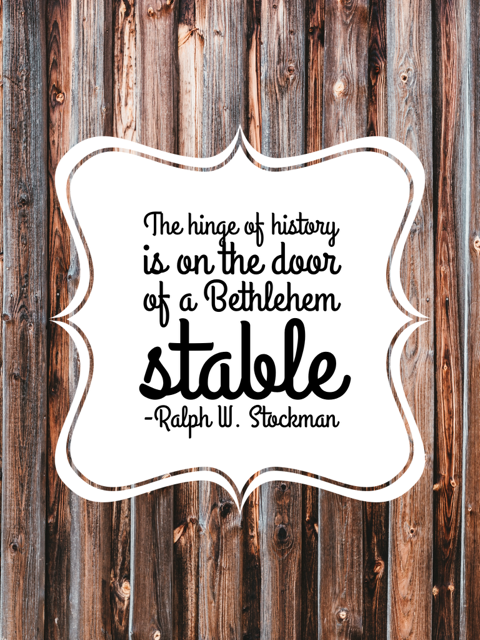

"The hinge of history is on the door of a Bethlehem stable." Ralph W. Stockman

You Don’t Have to Choose a Word for the Year

We’re almost at the time of year when bloggers start considering their word for the next year.

For many, choosing a word for the year replaces a list of resolutions. That one word gives them focus for the year. Christians who do this usually pray about it leading up to the new year and feel this word has been given to them or impressed on them by God. They often plan activities, reading, or Bible study around their word.

I’ve read wonderful testimonies about how God has worked in someone’s heart through meditating on their word for the year.

It’s a fine practice.

I’ve never felt particularly led to do it myself. I’ve studied or focused on one topic for a while, but not necessarily from Jan. 1 to Dec. 31.

Perhaps you’ve never felt led to choose a word for the year and you wonder if you’re missing out. Or perhaps you’ve chosen one in the past but, like a forgotten New Year’s resolution, it soon faded out of memory.

I just want to emphasize a few truths:

God never tells anyone in the Bible to choose a word, a theme, or a verse for the year. He never tells anyone not to do any of those things, either. It’s just one method of studying and applying God’s Word.

God may lay on your heart to study a certain topic, truth, characteristic, etc. from the Bible, and that may or may not coincide with January 1 and may or may not last a year.

Psalm 119:105 says “Your word is a lamp to my feet and a light to my path.” Commentary I’ve read for that verse said that the lighting they had in Bible times only shone a step or two ahead. God often guides that way–day by day, just enough for the next step. Of course, He knows what is ahead and may well prepare people for it through a word for the year. But I have found that to happen through my daily Bible reading or sermons or Sunday School lessons I hear. It’s amazing how often God’s truth intersects my experience through a book I picked up seemingly randomly.

What’s more vital than a word for the year is daily seeking God in His Word.

Whether or not one chooses a word for a year, it’s good to read the Word of God every day. God can teach us through an extended focus on one word or concept. But He promises to give us guidance, hope, encouragement, and so much more as we meet with Him daily.

Granted, most people who choose a word for the year don’t do so at the exclusion of other Bible reading. Their main focus might be that one word, but they probably also follow a Bible reading plan and attend a Bible study group or church where they hear other parts of the Bible taught.

There’s value in reading large chunks of the Bible to keep the big picture in mind, and there’s value in camping out in a smaller section for a while. We need the panoramic lens to take in the beauty and wonder of the big picture of God’s Word and to place everything in context. We also need the macro lens for close-ups, for camping out with a verse at a time and mining its truths. I wrote about reasons and ways to do both here. For many, their one word is that close scrutiny.

While many people find great value in choosing a word for the year, those who don’t use that method shouldn’t feel they’re missing out or somehow not as spiritual. People have gotten by for millennia without a word for the year. On the other hand, just because this practice is relatively new doesn’t mean there is anything wrong with it. If choosing a word for the year has been a great blessing for you, or you think it might be, or you think it’s something God wants you to do, go for it, and may God bless you in it.

Jesus said, “Man shall not live by bread alone, but by every word that comes from the mouth of God” (Matthew 4:4). Let’s be faithful to partake of that bread in some way every day.

(Revised from the archives)

(I often link up with some of these bloggers.)

You don’t have to choose a word for the year

If you read many blogs, you’ll find a lot of people writing about a word they’ve chosen for the year. I don’t know how long this has been a thing, but I’ve been reading about it for several years now.

For many, choosing a word for the year replaces a list of resolutions. That one word gives them focus for the year. Christians who do this usually pray about it leading up to the new year and feel this word has been given them or impressed on them by God. They often plan their Bible study around their word.

Many share that this emphasis has been a great blessing to them. Some have been amazed at how God intersects their study and circumstances around their word. Some, like my friend Lisa, purposefully read several books involving their word over the course of a year. Others, like Crystal, plan activities to incorporate their word.

But perhaps you’ve never felt led to choose a word for the year and you wonder if you’re missing out. Or perhaps you’ve chosen one in the past but, like a soon-forgotten New Year’s resolution, it faded out of memory.

I just want to assure you of a few truths.

God never tells anyone in the Bible to choose a word, a theme, or even a verse for the year. That doesn’t mean the practice is wrong. It’s just one method of focus and of studying and applying God’s Word.

God may lay on your heart to study a certain topic, truth, characteristic, etc. from the Bible, and that may or may not coincide with January 1 and may or may not last a year.

Psalm 119:105 says “Your word is a lamp to my feet and a light to my path.” Commentary I’ve read for that verse said that with the lighting they had in Bible times, they could only see a step or two ahead. God may well prepare you for something that only He knows is ahead through a word for the year. But often you don’t have that much notice. God’s guidance and provision is often moment by moment, day by day.

What’s more vital than a word for the year is daily seeking God in His Word.

I’ve never felt led to choose a word for the year. I’ve often said that God usually has more to say to me than one word. And, to be fair, those who choose a word for the year don’t claim that’s the only thing God wants them to deal with. They do read other books and other parts of God’s Word as well.

A topical Bible study on a certain word or concept can be highly valuable. But we also need the daily reading of Bible passages in context. Drew Hunter says:

If you received a three-page letter from a distant friend, you wouldn’t just read page 2. You could spend all day “studying” that page, but until you read pages 1 and 3, you will not fully (or perhaps even rightly) understand your friend’s message.

The human authors of the Bible organized their books intentionally. So, we step back and think through the author’s flow of thought. Studying the Bible involves thinking paragraph-by-paragraph, section-by-section, and seeing how everything fits into the overall structure and flow of the book.

We need the panoramic lens to take in the beauty and wonder of the big picture of God’s Word. We also need the macro lens for close-ups, for camping out with a verse at a time and mining its truths. Tim Challies calls these reading for familiarity (reading longer passages in a sitting) or intimacy (slowing down and meditating on or studying shorter passages) and says we need both approaches. Kelly Collier calls these two methods plow work (which “moves through large portions of Scripture more quickly,” like reading the Bible in a year or two) and trowel work (“taking a passage or verse of Scripture and settling in to dig for a long time,” like inductive Bible Study).

Choosing a word for the year shouldn’t replace contextual Bible study.

There are many who choose and study a word for the year and employ both these other methods of studying the Bible in context. That’s ideal. For some, the word for the year is their close-up, slowed-down study. That’s fine.

While many people find great value in choosing a word for the year, those who don’t use that method shouldn’t feel they’re missing out or somehow not as spiritual.

Jesus said, “Man shall not live by bread alone, but by every word that comes from the mouth of God” (Matthew 4:4). Let’s be faithful to partake of that bread every day.

Morning by morning he awakens; he awakens my ear to hear as those who are taught (Isaiah 50:4).

Your words were found, and I ate them, and your words became to me a joy and the delight of my heart, for I am called by your name, O LORD, God of hosts.  (Jeremiah 15:16)

____________________________________________

(Sharing with Inspire Me Monday, Global Blogging, BOSS Blog Share, Hearth and Soul, Happy Now, Tell His Story, InstaEncouragement, Anchored Abode,
Recharge Wednesday, Worth Beyond Rubies, Share a Link Wednesday,
Let’s Have Coffee, HeartEncouragement, Grace and Truth, Faith on Fire)