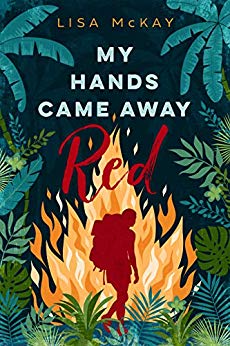
 In the novel My Hands Came Away Red by Lisa McKay, eighteen-year-old Cori decides to spend her summer on a backpacking mission trip in Indonesia. Though she has a vague desire to do good, to help people, to “spread the love of Jesus,” her main purpose for going is to get some time away from Scott, her boyfriend. Cori is a Christian, but her relationship with God isn’t as close as it once was. Scott is not a believer, but he wants to marry Cori. So Cori needs time away to think, to sort things out.
After meeting the mission leader and the five other teens who will be going on the trip, they spend several days in a grueling boot camp. Then they travel on to Indonesia where they will help build a church as well as performing puppet shows and such. They meet Mani, the son of the local pastor, whose English is best and who acts as an unofficial liaison between the mission group and the church folks.
The group learns there is a tenuous peace between the Christian and Muslim villages. The Muslims view those who convert from Islam to Christianity as traitors, and Mani’s father is such a convert. But, though they are advised to be careful, no serious trouble is expected.
After several weeks of work and getting to know each other in the process, when the thatched-roof church is nearly finished, the mission group leader’s wife falls suddenly and dangerously ill. As the leader, Gary, makes hasty plans to get the group ready to leave, the kids protest. They can finish the church in the next couple of days and catch the next boat to meet up with Gary. Reluctantly, Gary agrees.
When the church is finished, the teens decide it needs a cross on top, so they go into the woods to find a suitable log. Nearing the village on their return, they hear angry voices. Mani stops the group close enough to listen, but far away enough not to be seen. Men from a neighboring Muslim village are angry that Christians have attacked their village, and, grouping all Christians together, they call on this village to answer for it. Mani’s father tries to explain and calm, but tempers flare and fighting breaks out. Mani’s parents are killed before the group’s eyes. One of the teen guys rescues Mani’s younger sister, Tina, while Cori tries to help Mani’s father. But it’s too late. The horrified and shaken teens head back into the woods. Mani says it would be no use to try to go back to the village. Their best bet would be to hike through the mountains to a neighboring village and then to the airport.
Thus begins a harrowing three-week journey in which the teens are tested in almost every imaginable way.
My thoughts:
Though teens are the main characters, and this book would be good for teens to read, it’s not just teen or young-adult fare. I found the story riveting. First, from my own standpoint, I don’t think I could have survived what the teens went through. And secondly, as a parent of young people, I can imagine what the parents went through with news of fighting in the area and no word from their kids.
On top of the physical hardships and mental and emotional strain they all face, some of them, especially Cori, wrestle with their faith. Reading Bible passages about God’s protection seem hollow after what they witnessed. Yet, to whom else can they turn?
Before this summer those words [Romans 8:28] were part of whole set of trusty beliefs that defined my life. I knew they were true the same way I knew it really was good for me to eat my green vegetables. God is good, and everything works out for the best . . . and we all live happily ever after. I was so naïve. It’s not that I don’t want to trust those promises I’ve always believed in, but I just don’t understand
_____
If God didn’t see fit to save them, who’s to say that we weren’t all going to end up dead in this whole mess? And I hardly saw how that might produce a rich crop of faith, hope, and peace in my life. Unless it was in my heavenly life. Which, as much as I believed in heaven, was hardly a comforting thought.
In some ways I wish Cori’s faith struggles were more resolved by the end, but then I think part of the author’s point is that there are some things we can never resolve. One of the other teens tells Cori, after everything is over physically, but not mentally, emotionally, and spiritually, that sometimes you “just have to make a choice based on what you know about God. And relax and trust for the rest of what you don’t know” and “You know, life’s a journey…Some questions get answered later. You can’t stop traveling just because that’s not now.”
Besides the story itself, I loved the clearly-drawn characters. And I love the Jip and Kiki story game that started back in boot camp and helped distract the kids on their trek. One of the teens would start with, “Once there was a boy named Jip,” who loved chocolate and had a pet monkey named Kiki, and each one would add a few sentences, often based on what the kids themselves were going through.
In the author’s afterword, she shares that though the people in the story are fictitious, the circumstances, the fighting in the villages she named, were very real. The author’s own international and even inter-continental upbringing informs her writing, making it even more realistic.
I had heard this book highly recommended years ago and have had it on my TBR list since then. Somewhere recently I read that someone bought the rights to the book for a movie, and the book was being re-released. That brought it to the forefront of my attention again, so I decided now was a good time to read it. I am glad I did. I hope the film does it justice.
(Sharing with Semicolon‘s Saturday Review of Books, Literary Musing Monday, Carole’s Book’s You Loved)


 Stray Thoughts