Book Review: Every Now and Then

Every Now and Then Every Now and Then is the third in Karen Kingsbury’s 911 series dealing with various people affected by the tragedy of 9/11. Though the major characters from the previous books are also in this story, it can be read and enjoyed as a stand-alone book as well.

Alex Brady’s father was a firefighter who died on the job when the Twin Towers collapsed on 9/11. Alex had been a teen-ager with everything going for him — good grades, good family, sweet girlfriend — but he shut down after 9/11. He closed himself off to everyone else in his life and moved away to California. Since he felt God had failed him in allowing the bad guys this horrendous victory, he made it his mission to take as many of them off the street as he could and to prevent tragedies from happening to others. He became a sheriff’s deputy with the K-9 unit, establishing a reputation for courage, bravery and dedication — almost to the point of recklessness and danger. Alex was totally unaware that his boss’s family and circle of friends, who were trying to include Alex, had also been personally affected by 9/11, nor that the girl he loved and turned away now lived in the area.

Eco-terrorists  targeted some of the higher-end residential building sites for arson to make their point that excess and affluence was taking a toll on the environment. Alex decided to infiltrate the organization on his own time to try to find the leaders and stop them.

Though I could tell fairly early where the plot was going to lead, the climax still had me riveted, on the edge of my seat. The plot line seemed more realistic to me than the previous two books, and Alex’s struggles in regard to the evil God allows in the world are some that every thinking Christian wrestles with. Karen brings up some points in that regard that are new to me and very helpful.

There were just a few problems I had with the book. The most minor one I’ve mentioned before when reviewing Karen’s books, and that is her penchant for ending chapters with a sentence fragment, as well as sprinkling them throughout. It can be done every now and then for effect, but when it becomes a noticeable habit, it loses its effect. Secondly, it seems odd that a group concerned about the environment would make a point with arson, which is bad for the environment, especially during California’s windy season. That point is made several times in the story, and I suppose the idea is that the terrorist group is not really interested in the environment at all. My last “issue” is a theological and therefore more major one: at the beginning of the book it seems that Alex is a believer, but he turns his back on God in bitterness and grief. Yet in the midst of a fire, he “wondered… if this was what hell felt like…maybe he was about to find out” (p. 263). If he was a true believer, he wouldn’t be facing hell.

Karen’s books are always easy to read, her characters likable and easy to relate to, and her plot lines easily draw one in, while she deals effectively with issues of the heart. This was my favorite of the books in this series.

(This review will be linked to Semicolon‘s Saturday Review of books and Callapidder Days’ Spring Reading Thing Reviews.)

Friday’s Fave Five

friday-fave-five-spring

Susanne at Living to Tell the Story hosts a “Friday Fave Five” in which we share our five favorite things from the past week. Click on the button to read more of the details, and you can visit Susanne to see the list of others’ favorites.

1. This was our first week of summer vacation! Whoo hoo! I enjoyed not setting the alarm clock at all for a couple of days, but found it would get to be about noon by the time I got up, ate, had devotions, showererd, and messed around on the computer a little. I didn’t like getting going that late, so I have set the alarm the last several days — but still two hours later than on school days. 7 is a much better wake-up time than 5!

2. Great American Cookie Company peanut butter cookies. My oldest two went to the mall to look around and brought me some cookies!

3. Root beer…from Jack in the Box. I have to drink decaf because of a heart rhythm problem, and I just don’t care much for Sprite or 7-Up.  We have an A&W here, but their root beer tastes to me like it has vanilla added. I discovered Jack sold it, and I often will stop there for one while out running errands — so often that now they know me there. After I ordered at the drive-through Thursday, when I pulled to the window the girl said, “I knew it was you!” Oddly enough I’m not really crazy about it from a can or bottle at home. There’s just something about the fountain root beer at Jack in the Box that’s just right to me. (And no, this isn’t a commercial. 🙂 )

4. Getting caught up with some errands and housekeeping chores that have been piling up and waiting for me the last couple of weeks. Not that I haven’t cleaned in that time, but I was behind on a few tasks, and am glad to have more or less caught up.

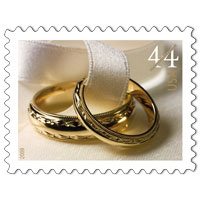
5. The first class wedding stamp used on my son’s wedding invitations:

weddingstamp

Isn’t that lovely?

Though I didn’t want to list THREE food items — that would be a little embarrassing — I probably could have done a whole fave five listing foods this week. But I did want to mention one more. I had made creamed chicken and biscuits (didn’t make the biscuits from scratch, though) one night earlier this week, and when making the white sauce, I had a temporary memory lapse and forgot that a whole stick of margarine was 1/2 a cup instead of 1/4 a cup. Unfortunately I didn’t realize that until after I’d already melted it and added 1/4 flour and wondered why it still looked so liquidy. There was nothing else I could do but add another 1/4 cup of flour and double the milk, as well, to make a double portion. I separated out about half the white sauce, wondering what I was going to do with it, when later on the idea came that I could get some sausage and brown it, mix it with the leftover white sauce, and voila — sausage gravy over the leftover biscuits. Just had that for breakfast — scrumptious! I don’t think I have ever made that at home and only rarely have it eating out.

You can find more fave fives or join in on the fun at Susanne‘s.

Booking Through Thursday: Memorable Books Meme

btt button

The weekly Booking Through Thursday question for today is

I saw this over at Shelley’s, and thought it sounded like a great question for all of you:

“This can be a quick one. Don’t take too long to think about it. Fifteen books you’ve read that will always stick with you. First fifteen you can recall in no more than 15 minutes.”

1. The Bible
2. By Searching by Isobel Kuhn
3. In the Arena by Isobel Kuhn
4. Climbing by Rosalind Goforth
5. Amy Carmichael of Dohnavur by Frank Houghton
6. Changed Into His Image by Jim Berg
7. David Copperfield by Charles Dickens
8. A Tale of Two Cities by Charles Dickens
9. A Path Through Suffering by Elisabeth Elliot
10. Little House on the Prairie series by Laura Ingalls Wilder
11. Anne of Green Gables series by Lucy Maud Montgomery
12. Lord of the Rings series by J. R. R. Tolkien
13. Narnia series by C. S. Lewis
14. Rose From Brier by Amy Carmichael
15. Through Gates of Splendor by Elisabeth Elliot

It was hard to stop at 15, and on another day the list would vary a little, but overall these are books that have deeply influenced my thinking and that I go back to time and time again, either rereading or thinking about something I read there.

Feel free to join in and use this as a meme whether you particpate in Booking Through Thursday or not, but if you’d like to see what others listed, check today’s post there.

Odds ‘n ends

  • The colors in the dress I am wearing today…

CIMG2824

…remind me of sherbet.

  • I am up to almost a half-hour at a time on the Wii Fit. When I started I was doing good to last ten minutes.
  • I told Jason and Mittu that if they wanted me to I would address the wedding invitations to our church folks and our side of the family. Then I decided I wanted to print the envelopes on the computer because my handwriting, I’m sorry to say, is awful. I’ve printed envelopes before. but these were a non-standard size, and though I configured all the dimensions, the printer kept saying there was a size or type misfeed. I got lost in the online “help” instructions that popped up and called my computer expert, Jeremy, and he did everything he knew to do, and it still wouldn’t work. So he tried it on my husband’s computer and printer and finally got it to work there. Somewhere in that hour’s wasted time and frustration, the thought occurred to me, “You know, all of these people have seen your handwriting before.” Oh, well…once I finally got going, it clipped along fine, and they do look nice, I think.
  • A couple of weeks ago at the post office I saw a sign for wedding stamps. How timely! There were two designs, one with wedding rings and one with wedding cake. I thought it would be cute to put one style on the outside and one on the RSVP envelope, so I bought accordingly. I didn’t notice until I got ready to stamp the first one that the cake stamps were 61 cents. So I determined to exchange them during my errands this morning. As I dug the receipt out of my purse, I saw that it said at the bottom, “All sales of stamps are final.” “Uh oh — what am I going to do with 61 cents stamps?” I decided to make a try for it anyway (and if you knew me twenty years ago, you’d know I have come a long way to think that. I used to get intimidated when trying to return things, especially if they gave me any trouble about it. One such incident resulted in tears and my poor husband having to return it for me). But I’m familiar with the folks at the local P.O., having been up there repeatedly with ladies’ group packages to missionaries and students. The friendly neighborhood postman did indeed exchange them for me, bless his heart. I asked what the 61 cent ones were used for: he said they were for over-sized envelopes.
  • Upon returning to the house, I saw our friendly neighborhood garbage truck had once again left our garbage can in the driveway. I don’t know how, when the truck is automated with arms that lift the can straight up, dump it, and then put it straight back down, the can lands a couple of feet from the corner, where we leave it, to the driveway itself. Nevertheless I sent one son, who shall remain nameless, out to remedy the situation. Instead of returning the can back to its place behind the house, since it was now empty, he put it back in front of the corner of the yard, where we place it for pick-up, and he could not understand my incredulity that he would walk all the way out to the curb, move the empty can two feet, and leave it there instead of bringing it back up to the house. Obviously, my work is not yet done…

Book Review: In Trouble and In Joy

In trouble and in joy_dpThe first part of the title of In Trouble and In Joy: Four Women Who Lived for God by Sharon James comes from a line in a hymn by Nahum Tate and Nicholas Brady:

Through all the changing scenes of life,
In trouble and in joy,
The praises of my God shall still
My heart and tongue employ.

The four women Sharon James writes about in this book exemplify that truth: in varying degrees of trouble and joy, they lived for God.

Margaret Baxter was a rebellious, glamorous, well-to-do teen-ager who became a Christian under the preaching of her Puritan pastor, Richard Baxter. Though he was twice her age, Margaret fell in love with him, and in time her feelings were reciprocated, and they married. The union was a step down for Margaret financially (Richard took care to arrange their finances in such a way that he did not have access to her money so it would not be thought he married her for her money) and socially, but  she had found her purpose in life and blossomed. This was a time when “Non-conformists” were persecuted, and when Richard was imprisoned for a while, Margaret voluntarily joined him. Both were, like all the rest of us, very human. Margaret was known for being generous, cheerful (Mrs. James notes, “It is simply not true that the Puritans went around looking miserable. Indeed, Richard Baxter wrote, “Keep company with the more cheerful sort of the godly; there is no mirth like the mirth of believers'” [p. 49]), industrious, competent, capable, patient, supportive — and anxious, fearful, perfectionist, and over-zealous. Yet she was aware of and grieved by her faults, and it was her desire to live a holy life for God.

Sarah Edwards had eleven children as the wife of Jonathan Edwards in the early 1700s. The Edwards were known for their “uncommon union,” their great love and respect for each other, and Sarah’s hospitality. Sarah thrived as a wife and mother, but the Edwards’ faced their share of difficulty as well when Jonathan was dismissed from the church where he pastored and some of their children died.

Anne Steele lived in a small English village in the 1700s, never married, suffered from poor health most of her life (with what is thought now to have been malaria), published two volumes of hymns and poems, and was known for her cheerfulness and faith. It was expected at that time that young women would marry and have a family, and there is some correspondence of teasing between Anne and her sister about Anne’s unmarried state even though the sister admitted her life was not all rosy.

Frances Ridley Havergal lived in the Victorian 1800s and is best known as the writer of hymns such as “Take My Life and Let It Be” and “Like a River Glorious.” Her father was a pastor and she was very active in the ministry of the church, thriving in personal work, one-on-one discussions with others about the gospel and spiritual truth. When her father died, her step-mother made unusual demands and seemed to even be mentally unstable, but Frances did her best to honor her. She did travel a lot and kept running, amusing accounts of her experiences: letters from her travels to Switzerland were gathered together in a book titled Swiss Letters.  She turned down several proposals of marriage, though she “once wrote of the sense of ‘general heart-loneliness and need of a one and special love…and the belief that my life is to be a lonely one in that respect…I do so long for the love of Jesus to be poured in, as a real and satisfying compensation'” (pp. 193-194). She was a prolific writer of hymns and books. She “loved life, enjoyed people, revelled in nature, and laughed a lot” (p. 200).

The book deals with each woman individually, detailing her historical setting, the story of her life, her character and significance, and excerpts from her writing. Mrs. James’ style of writing is somewhat academic, more like teaching a class than telling a story: that’s not a bad thing, but I had picked up this book because I had read and enjoyed her earlier one, My Heart In His Hands about Ann Judson, and I don’t remember it being quite that way, though it has been years since I read it.

I didn’t agree with all of Mrs. James’ conclusions about why the women did what they did or the few things for which she criticized them: for example, she faults some of the women for not being more socially active. She wrote of Frances: “Although she was always ready to give benevolent help on an individual level, there is little evidence that Frances had strong feelings about the blatant social and political inequalities of that time” (p. 201). Some of us feel that dealing with individual hearts, resulting in a true heart change, will take care of the larger issues, and that Christians are called to share the gospel and make disciples, not necessarily battle the culture itself (though it’s not wrong to fight social ills). Mrs. James does go on to say of Frances, “And yet the ‘limiting’ of her vision to gospel issues meant that she was extraordinarily focused. Her mental and spiritual energies were not diffused into many different areas,” allowing a greater concentration on vital issues of “salvation, consecration, and worship” (p. 201). These women had their hands full enough with what they did do to warrant criticism for what they didn’t do.

I did appreciate Mrs. James research, insight, and masterful compilation of the details of these women’s lives. There is much about each woman’s  life to instruct Christian women. To give just one example, one of Frances’s letters tells of the hostility and “appalling service” she received at an inn in Switzerland. Where most of us would be fuming and calling for the manager, Frances reacted patiently and finally said to the angry, spiteful woman, “You are not happy. I know that you’re not.” the woman was startled, “tamed…made a desperate effort not to cry” and listened while Frances spoke to her “quite plainly and solemnly about Jesus.” She received a tract, promised to read it, and thanked Frances over and over. Frances concluded, “Was it not worth getting out of the groove of one’s usual comforts and civilities?” (pp. 250-251). I have to confess that was a rebuke to me: I rarely think of such situations as a means of service to others.

Mrs. James concludes:

They had different personalities and varied situations, but each of these four women lived focused lives, wanting to praise God through days of trouble as well as joy. As is true of many women, they had to juggle all sorts of responsibilities. Pursuing holiness did not mean running away from these responsibilities: it involved living every day wholeheartedly for God (p. 253).

(This review will be linked to Semicolon’s Saturday Review of books and Callapidder Days’ Spring Reading Thing Reviews.)


Preaching personalities

Last night we had a guest speaker at church. He wasn’t new to our assembly — he had married one of our girls — but we had never heard him speak publicly before. For various reasons both my husband and I thought this man was going to be a bombastic, in-your-face type of preacher, but we were pleasantly surprised. He wasn’t that way at all. Of course, he was mainly just sharing his testimony and the mission God had called him to rather than preaching a message, but, still, we enjoyed what he had to say and the way he said it.

That reminded me of another time I had misjudged a preacher. Well, actually, I hadn’t misjudged in this case: this man was a bombastic, in-your-face, ranting and raving type of preacher. There was a Christian radio broadcast I used to listen to while cleaning up the kitchen after dinner, and this preacher’s program came on afterward. As soon as he came on I would turn the radio off in disgust. I did that for months, if not years. Then I got convicted that that was a bad attitude. This man did preach truth. I didn’t have to like his style or listen to him, necessarily, but I shouldn’t have that negative attitude toward him. His style wasn’t wrong just because it didn’t appeal to me: God had used him to reach many people — evidently some people like that style. (This doesn’t mean that the end justifies the means and as long as he’s getting “results” it’s all good. I don’t agree with that principle. But there was nothing unbiblical in his doctrine or even in his style.) The Bible teaches that, while preachers are to be held accountable for their doctrine and their lifestyles (whether or not their lives match up to what they preach), we’re supposed to respect them as men of God. So I began to leave his broadcast on while I was finishing up in the kitchen. And on one particular day God used something he said to help me in an area I had been struggling with for years.

One former pastor we had said, while speaking about the Old Testament prophets, that many of them were contemporary with each other (in my ignorance as a young Christian reading the Bible through for the first time, I had thought all the books were chronological), but God had sent the same message out through different men because they each had different personalities that would appeal to different people.

The pastor I had while in the last year of high school and in college and then the one my husband and I were under during the first fourteen years we were married definitely had the gift of teaching. They rarely raised their voices except occasionally for emphasis, they spoke to people and not at people, they taught logically and delibrately through a passage, they didn’t often move around much. That is still the type of preaching I long for and respond to best. I don’t like shouting, ranting, using a verse as a jumping-off point only to express one’s opinions, walking back and forth across the stage (and down the stage and up the aisles — that’s very distracting to me), shooting from the hip rather than logically proceeding through a passage. We’ve had speakers who have done all of those things, and I have to be careful lest my dislike (and criticalness) of those things distract me from the message. There have been times I’ve heard other people talk about how blessed they were by a message, and I think, “Where was I?” Other times I’ve been blessed by a more ordinary talking speaker (or writer) who had perhaps a more intellectual approach, and other people’s response seems to be, “Well, that was…nice.”

The bottom line is I am responsible for receiving the truth I hear despite how it is conveyed.