Welcome to Friday’s Fave Five, hosted by Susanne at Living to Tell the Story, in which we can share five of our favorite things from the last week, a wonderful exercise in looking for and appreciating the good things God blesses us with. Click on the button to learn more, then go to Susanne’s to read others’ faves and link up your own.
It has been a full, good, productive week! Here are some favorite parts of it:
1. Time with family. Jim and Jeremy were both off through Monday, when we had to take Jeremy back to the airport, so we had the entire weekend to just hang out, play games, and…
2. Decorate the Christmas tree. It’s up earlier than usual for us — Thanksgiving was the earliest it could be, but I love doing this all together while Jeremy is here. And now I feel like we have an extra week for Christmas activities. 🙂
3. Getting the bulk of the Christmas shopping done, most of it online– first time ever that’s happened before it’s even December. And I have a great deal of it wrapped already, mainly because I didn’t want bags and boxes cluttering up the closet or sewing room.
4. A lunch date at Cracker Barrel. After we dropped Jeremy off at the airport, Jim took me to lunch at Cracker Barrel, one of my favorite places, but one he’s not crazy about, so it meant a lot to me. ♥ They had a special on chicken and dressing that was really good (except for a few loose bones…), and their Coca-Cola cake is luscious.
5. Mini pink-decorated Christmas tree on my desk. I got this at a little shop where we used to live, and I don’t remember where I used to put it in the old house, but here it fits just right on the side of my desk.
Most of us have a vision in our minds of the perfect Christmas: family gathered around, a clean and sparkling house, a beautifully adorned Christmas tree with piles of lovingly chosen presents underneath, a feast for the eyes and the table, scents of roasting turkey or ham, pumpkin pies, apple cider, everyone marvelously getting along like the end of a made-for-TV movie.
But what if that’s not reality this year?
What if one member is in prison? Or overseas or across the country? Or in heaven?
What if a lost job or a major medical expense has led to a depleted bank account and bare cupboards?
Is Christmas then ruined?
Let’s go back to that first Christmas.
Mary and Joseph were alone and away from home and family in a strange city. They did not have a beautifully decorated house: they did not even have a hotel room. The only place someone had available for them was a stable. The only scents of the season were those of animals in a barn. Mary, as a young, first-time mother, did not have the blessing of a modern hospital and sanitary conditions, a skilled nursing staff and childbirth training. Giving birth was painful and messy. Joseph would have been out of his element helping a woman deliver a baby, and perhaps he was dismayed or frustrated that he could not provide better for her in general, especially in her moment of need. And after the blessed relief of a healthy child safely born, there was little acknowledgment of who this Child was besides the shepherds, Simeon and Anna, and, later on, the wise men. Soon they would face the danger of a king bent on killing the Child in their care and the loss of reputation Mary would endure her whole life as many thought her Child was illegitimate, and soon the ominous promise that a sword would pierce through Mary’s own soul.
What did they have then, that lonely, uncomfortable, smelly night? They had the Child of promise. A Child whom they were told to name Jesus, which means “Jehovah saves,” whose very name is a promise, who would reconcile them to God by taking care of their greatest need, who would “save His people from their sins.” They had the realization that, as the angel told Mary when first delivering the news that she would bear a child though she was a virgin, this Child was the long-awaited and longed-for Messiah, the King, the Son of the Highest. What cause for joy and wonder! They had no idea how it would all work out. But they had the promise, and because of the promise, they had hope.
It’s certainly not wrong to enjoy a decorated tree, presents, wonderful food, and family gathered. But we can celebrate Christmas even all of those elements are missing or less than ideal…because we can celebrate in our own hearts and with those around us that same promise, that same hope. If that’s all we have this Christmas…that’s more than enough.
The folks at 5 Minutes For Books host What’s On Your Nightstand? the fourth Tuesday of each month in which we can share about the books we have been reading and/or plan to read.
It seems so long since the last Nightstand, though it has only been the usual time frame. It’s been a busy month.
Here’s what I finished since last time:
The Discipline of Grace by Jerry Bridges with Challies‘ “Reading Classics Together” group. I didn’t review the book as a whole since I discussed it chapter by chapter (you can find those discussions here if you like.) Overall a great book. I appreciated the balance.
Wildflowers of Terezin by Robert Elmer, reviewed here. Loved this one. A WWII story set in Denmark, involving a secular Jewish nurse and a Lutheran priest reluctant to fight against oppression until he sees its human face.
A Christmas Carol by Charles Dickens for Carrie‘s Book Club December pick. I have a whole book of Dickens’ Christmas stories…I may or may not peruse more of them if I have time.
I also have my last Fall Into Reading book, The Christian Imagination by Leland Ryken. I’m not sure I will get to it between Christmas activities and wanting to get a couple of Christmas reads in. I should know better than to leave nonfiction last. I want to — I like to complete my lists! — but if I don’t read it this month it will still be there in January. It’s not something I want to rush through just to complete by a deadline.
What are you reading? Got any special books lined up for December?
Thriving at College: Make Great Friends, Keep Your Faith, and Get Ready for the Real World! by Alex Chediak is styled as something like a chat over coffee sharing what the author wished someone had told him when he was in college. The goal is to help students make the best of their college years and then be ready to go forth as responsible Christian adults. He covers a great variety of topics, including:
How high school is different from college
Assuming responsibility
Considerations in choosing secular or Christian, large or small schools
What you will likely have to deal with as a Christian in a secular college
Good sleep and eating habits in college
Being busy vs. being diligent and fruitful
Considerations in making a schedule
Extracurricular activities that enhance your college experience
Friendships and dating
How to best interact with professors
Becoming independent from parents
Personal finances
Work ethic
Balancing work and play
Recognizing your calling and choosing a major
Getting the most out of your classes
Studying
Preparing for tests
Internships
Owning your faith
Here are some of the standout quotes:
“Real tolerance [is] vigorous disagreement combined with a gracious demeanor, respect, and kindness” (p. 17).
Re the charge that Christians want to force their beliefs on others: “True Christianity cannot be spread by force because it requires individuals voluntarily declaring their allegiance to Jesus Christ” (p. 17).
“Many of the deepest joys require saying no to lesser pleasures that would only kill your ability to enjoy the real deal” (p. 18).
“Every one of [God’s commandments] was meant to help us avoid destroying our capacity to enjoy the greatest pleasures” (p. 20).
“Resolve now not to go there. But don’t just say no; say yes to something better. Decide now to form strong friendships with like-minded peers who share your ideas of a good time” (p. 20).
“Is God going to occupy a compartment of my life, or will He be central?…Don’t squeeze God into your plans; find your place in His plan” (p. 26).
“College is a temporary season of academic preparation and growth so that you can serve God effectively with the rest of your adult life…a springboard into all that goes with responsible Christian adulthood” (p. 26-27).
“Those afraid to risk failure seldom have to face success” (p. 75).
Re time management: “Whatever you don’t rule will rule you” (p. 124).
“While recreation is the purposeful attempt to restore or refresh creative energy, entertainment is often more on the mind-numbing end of the spectrum, possibly failing to rekindle mental energy” (p. 188-189).
I appreciate the emphasis and balance in this book as well as the plethora of useful information. I like very much that he reviewed information at the end of each chapter and at the end of the book. Nonfiction books are getting away from that, but it’s very helpful in pulling the basic points together, especially when you’ve read a chapter in pieces over several days.
I might disagree just a smidgen with a couple of nuances in a couple of discussions (not worth mentioning but for those who would wonder, one was whether God has “a” will for your life as opposed your choosing what you think best under His guidance; the other was in the discussion about becoming independent from parents. Overall he made valuable points in both discussions). But I can highly recommend this as an excellent resource.
(This review will also be linked to Semicolon‘s Saturday Review of Books.)
Whew! It’s been a very full but very fun holiday weekend for us. We just took our oldest back to the airport this morning — always a little sad to see him walking into the airport alone. But this time he’ll be back in a month for Christmas.
Carrie suggested some “getting to know you” questions for a post today, so I’ll jump in to answer a few..probably most of them.
Do you attend church and, if so, what denomination are you a part of?
Yes. We’re members of an independent Baptist church.
What social issue are you the most passionate about?
Right to life issues, on both ends of the spectrum: the unborn and the elderly or disabled. It’s God who gives life and should be God who says when it ends. Life is a gift that is not ours to take away from anyone else. God has a purpose in every life He allows.
There are some thorny issues when it comes to turning off machines, etc., that are keeping a person alive. I’d highly recommend Joni Eareckson Tada’s When Is It Right To Die? for thoughtful treatment of the difference between sustaining life and prolonging death.
Do you home school/use the public system or enroll your kids in private school? Any particular reason why?
My oldest two went to a private Christian school except for four years when we home-schooled. They both went to a Christian college. My youngest went all through school in a private Christian school but is now attending a state community college.
My husband and I both loved school and thrived there so we saw no need to home school. The four years we did so were when we lived in an area that had a couple of Christian schools, but for various reasons we weren’t comfortable with them. I read a lot about home schooling at the time and there is much I liked about it: knowing exactly what my kids were learning and experiencing during the day, shared experiences and increased family time, opportunities to pursue other interests, etc. But it was also overwhelming to me, and they didn’t much enjoy it. I had a one year old when we started and the older two were beginning 5th and 2nd grades. I think if we had started when they started school or kept with it longer I would have eventually found my footing. For instance, because I was insecure and didn’t want to “mess up” their schooling and wanted to prepare them for eventually going back into the classroom, I was very classroomish and kept closely to the teacher’s manual. But if I were teaching them now, it wouldn’t matter to me whether capitalization was in chapter 3 for one of them and chapter 7 for the other — I’d teach them together, rearrange the coursework to what best fit our family, do more with unit studies, etc.
We also tried video school for a while the A Beka curriculum. It was adequate, but, frankly, boring. It did free me up to be involved as little or as much as I wanted to be, but I don’t think it was the best choice for us: it would have been better for just one or two courses, like Algebra, that I wasn’t comfortable with.
We’ve been pleased with Christian schools. They are not perfect, but nothing is. My kids have been blessed with some very good teachers and great friends. Yes, a couple of times we ran into situations with less than ideal peers, but we ran into that at church occasionally, too, and at some point in time it is something they need to learn to deal with before they are launched out into the world. It provided good conversations about why we do and don’t do certain things.
I could not in good conscience put my children in public schools. I was in public schools from 3rd-10th grade, heard dirty jokes as early as 3rd grade, was subjected to other unwholesome influences in older grades. Yes, we need to train children to be salt and light in the world, but in their formative years we need to protect them and give them a good foundation.
How long have you been married? How many kids do you have, or want to have? Have you ever thought of adopting, or have you?
We’re coming up on our 33rd anniversary in December. We have three kids, all young adults now, only one still at home and one is married. I only briefly considered adoption when we were waiting for our first child: we were married for five years before he came along and were just beginning to wonder if there was a problem. I wasn’t really ready to think about adoption yet: at the time I felt I would only consider it if there were no possibility we could have children biologically. Nowadays I know people who have biological children but still consider adoption as a ministry, and that is wonderful, but it is not something we have felt called to pursue.
What is your greatest personality strength? Weakest?
Hmmm. That may be something I should ask my husband. Off the top of my head I’d say maybe that I am detailed and analytical. If I have a job or ministry to do, the details and the fulfillment of it are very important to me and I won’t do a slipshod job. On the other hand that drives me crazy sometimes.
Biggest personality weakness? Either cowardliness or struggling with self-control.
What is your favorite Bible verse or passage? Why?
There are far too many excellent ones to have just one favorite, but one that has ministered to me often through my life is Isaiah 41:10: “Fear thou not; for I am with thee: be not dismayed; for I am thy God: I will strengthen thee; yea, I will help thee; yea, I will uphold thee with the right hand of my righteousness.”
What is your real name? What does it mean?
My real name is Barbara and it means “stranger.” Whenever this topic would come up when I was growing up. I’d always hear lame responses like, “Well, you’re the strangest friend I’ve ever had!” 🙄 I was named after my mom’s sister (and my middle name is after one of my dad’s sisters). I didn’t really like it until my pastor preached a message on Christians being “strangers and pilgrims” in this world, and that infused it with new meaning. Then I came across Deuteronomy 10:18-19: “[God] doth execute the judgment of the fatherless and widow, and loveth the stranger, in giving him food and raiment. Love ye therefore the stranger: for ye were strangers in the land of Egypt,” which helped, too. 🙂
Just please don’t call me “Barb.” One meaning of Barb is sharp, mean things people say to one another, and I know people aren’t thinking of that when they call me Barb, but it still makes me cringe. And “Babs” makes me nauseated – no offense to any Babses out there. I knew a very nice and capable woman called Babs, but when I first knew her it was almost more than I could do to say her name.
Are you a bold and trendy dresser, or are clothes “not your thing?”
I’m somewhere in the middle. I’m definitely not bold, and I see no need to follow after all the latest fashions, but I don’t want to look several decades behind the times, either. I do like nice clothes, but what I think of as nice and what the modern world deems nice may not always match up.
If you were to write a book, what genre would it be?
What is your favorite thing about where you live (country, neighborhood, etc.)? Least?
Eastern TN is beautiful country, especially during autumn. And I love seeing mountains from different vantage points. The Knoxville area is a nice size — not as big and busy as Atlanta or Houston, but big enough to have some shopping and diversions close by. The thing I like least is the false idea the rest of the world seems to have that TN is full of “hick” or dumb people.
Bonus question of my own: what is your favorite hymn and why?
This is almost as hard to choose from as a favorite Scripture, but one of my all-time favorites is “Before the Throne of God Above“, especially the stanza:
When Satan tempts me to despair
And tells me of the guilt within,
Upward I look and see Him there
Who made an end of all my sin.
Because the sinless Savior died
My sinful soul is counted free.
For God the just is satisfied
To look on Him and pardon me.
Set to this melody:
But I also like “Beneath the Cross of Jesus” (both the old version and the new), “The Sands of Time Are Sinking,” “His Robes For Mine,” “How Deep the Father’s Love For Us,” and many, many more.
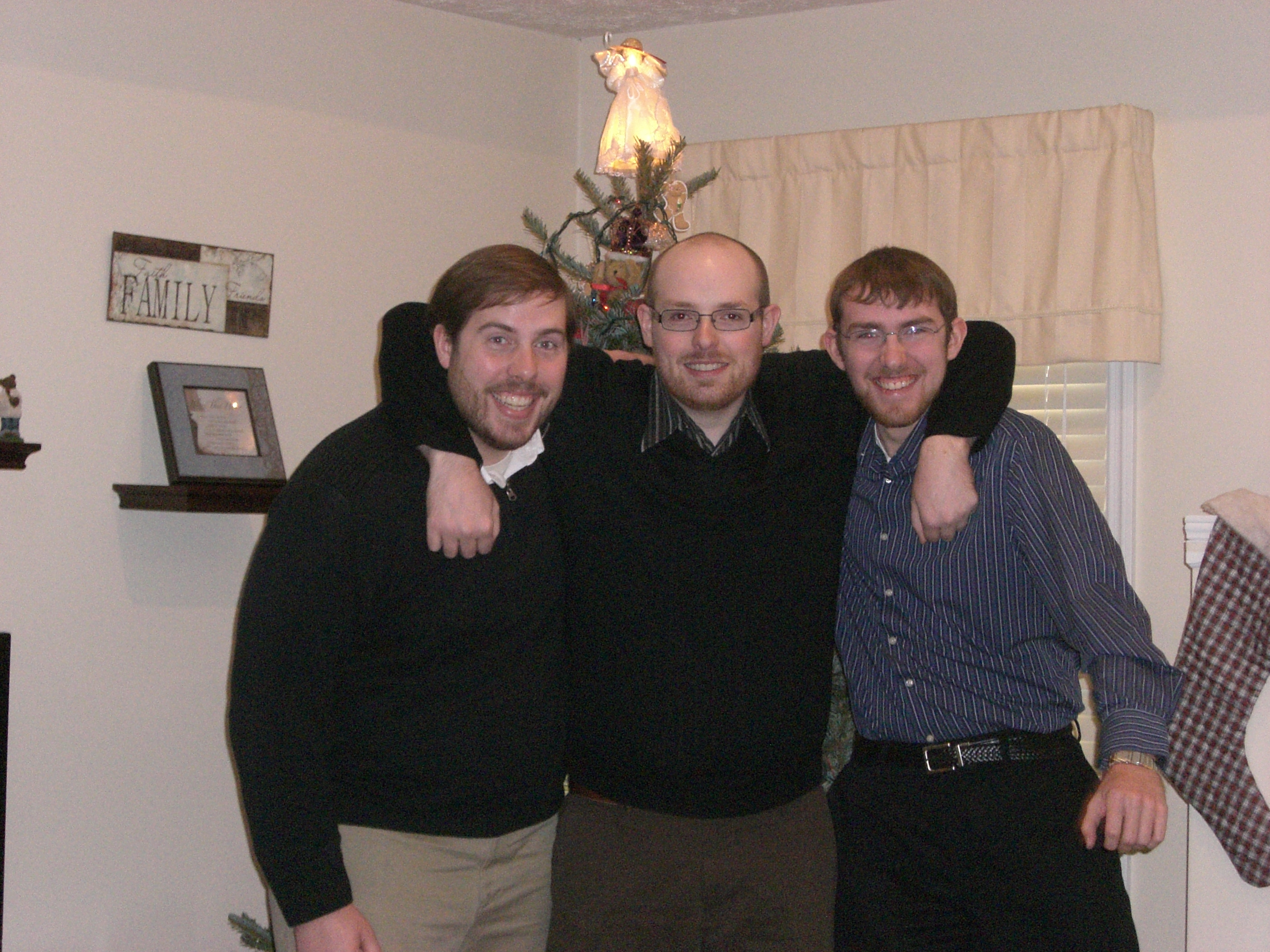
I’ll close with a couple of photos that probably won’t make it into the Christmas cards but that were fun anyway — I almost enjoy these as much as the nicely posed ones.
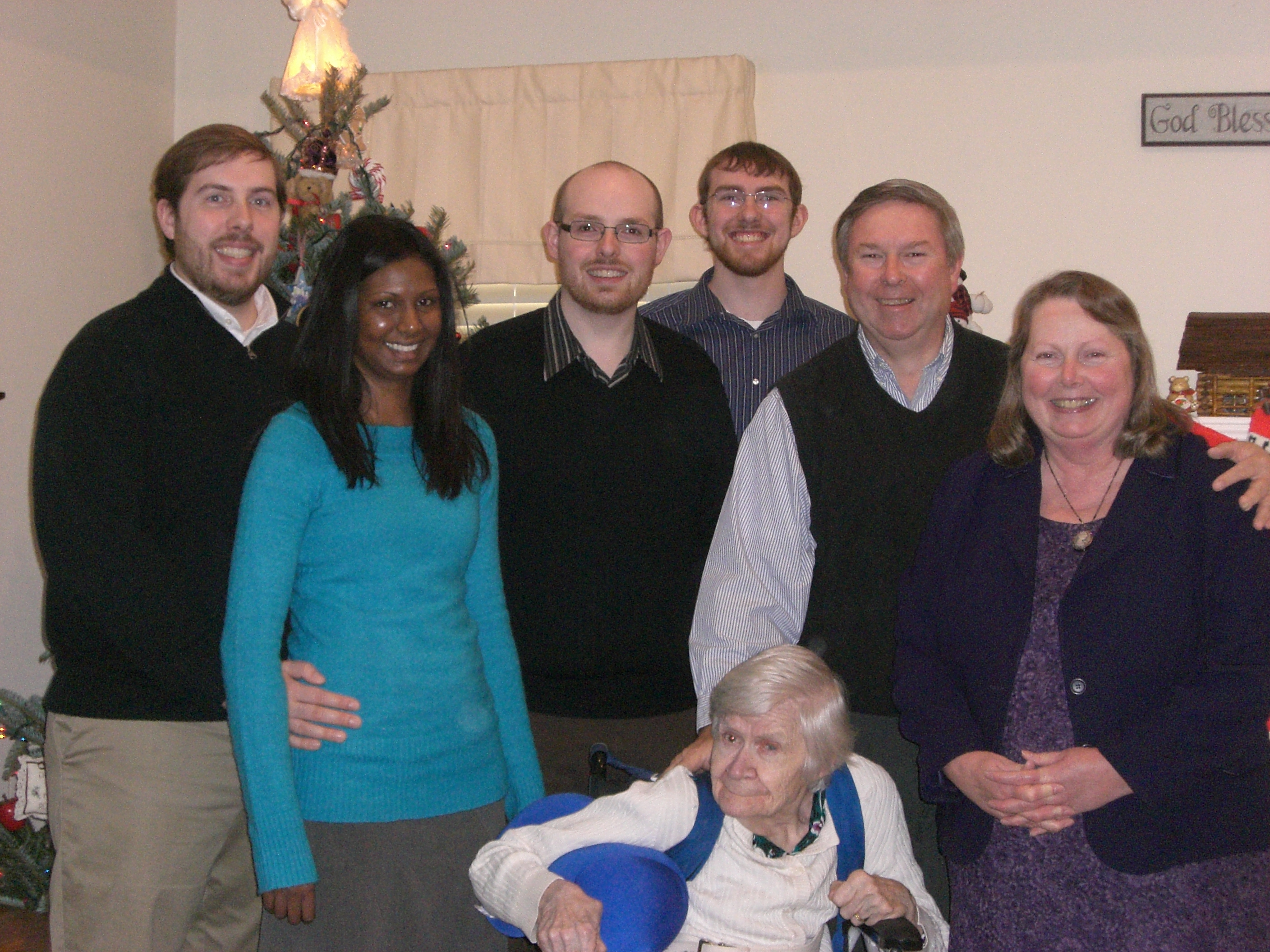
This one will probably make it into the cards, though we had a hard time getting Grandma to look up, much less smile at the camera:
Welcome to Friday’s Fave Five, hosted by Susanne at Living to Tell the Story, in which we can share five of our favorite things from the last week, a wonderful exercise in looking for and appreciating the good things God blesses us with. Click on the button to learn more, then go to Susanne’s to read others’ faves and link up your own.
It has been a wonderful week! Here are some favorite parts of it:
1. Having all the family home.
2. An on-time flight. Jeremy’s flight here always seems to get delayed until the wee hours of the morning, but this time it came in a smidgen early.
3. Thanksgiving and everything involved with it.
4. Special foods for the holidays.
5. Our church’s fall festival – chili cook-off, soups, pies, a variety show, and testimonies.
Short and sweet this week — family’s here, shopping to be done, decorating tomorrow. Have a great weekend!
God, all of His wonderful attributes, His lovingkindness towards us in making us, providing for us, sending His Son to die for us, loving us still when we fail..
His Word to instruct, guide, encourage us
Family near and far
Friends old and new
The fellowship of believers
Food, shelter, safety, necessities of life
“Extra” blessings of books, music, chocolate, the Internet, senses, useful occupations and enjoyable diversions
More blessings than we can count…
Though we are to give thanks every day in all things, it’s nice to have a special time of emphasis to remind us of it and revive thankfulness in our lives.
I hope you have a wonderful day with loved ones and good food and a time of pondering and thanking God for all He has provided.
I’ve gone back and forth with myself about whether to review the books in The Space Trilogy by C. S. Lewis (sometimes called the Ransom Trilogy after the main character) all together or separately. But I think I’ll review them together since there are comments I want to make about the series as a whole, despite the fact that this post may end up somewhat lengthy.
In the first book, Out of the Silent Plant, Professor Ransom is on a walking tour in the English countryside when he runs into an old classmate named Devine. Shortly thereafter he finds himself drugged, kidnapped, and waking up in a moving space ship with Devine and his partner, Weston. In bits and pieces of overheard conversation, he learns that they are intending to hand him over to some creatures known as sorn on a planet called Malacandra, evidently, they all think, for some kind of sacrifice. So naturally at the first possible opportunity on the planet, he runs away, even though he has no idea where to go or how to survive and thinks he will most likely never make it back to Earth.
This foreign planet is nothing like what he thought it would be. He eventually sees another creature that he thinks is a beast until he hears it speak. They begin to communicate by gesture at first and then gradually Ransom, whose specialty is languages, learns that this being is a hross, one of three species, sorn being another and the third, pfifltriggi (I do wonder how Lewis came up with that one), each with different characteristics and talents. These are, at least, the thinking, speaking, reasoning species: there are others who are more animalistic, and then the eldila are invisible except when they appear as light, something like what we would think of as angels. Ransom at first thinks of the planets inhabitants as primitive but soon finds they know and do much more than he would have thought, even having an understanding of astronomy. They call earth Thulcandra, the silent planet, because the Oyarsa (which seems something like an archangel) from that planet is “bent” (their closest term for “bad”) and no longer communicates with the others. When they hear that Ransom’s companions are bent ones, they tell him he needs to see the Oyarsa of Malecandra. As he learns more of their theology, he begins to recognize some elements, though the words describing them are different.
Finally tragedy leads him to seek the Oyarsa and find out why he was sent for in the first place.
In Perelandra, Lewis himself is a character, as he was also at the end of Out of the Silent Planet, Ransom’s friend, colleague, confidante, and the narrator of the story. Ransom and the Oyarsa of Malacandra have kept in contact and Ransom has been asked to go to Perelandra. He is not told why but is willing to help. He discovers a water-based world, meets one green woman who understands the “Old Solar” language he learned on Malacandra, learns that her mate is on the world somewhere and they are the only humanoid inhabitants. He realizes this world has not yet been touched by sin. But an Unman has arrived to introduce it into this world and Ransom has almost more than he can do to keep what happened to our world from happening to theirs. There is quite a lot of very interesting philosophizing (to put it mildly) between Ransom, the Unman, and the woman. I don’t agree with the way Ransom finally had to deal with the Unman, for reasons which I can’t explain without giving away the plot, but going over that section a second time I did understand better the reasoning for it within the storyline.
That Hideous Strength almost seems unrelated to the series at first, but eventually Ransom and the Oyarsa come into play and we see how the events of the first two books lead to what is going in in this one. This story centers on a young married couple, Mark and Jane Studdock. Mark is a Senior Fellow in sociology at Bracton College in the University of Edgestow, and his penchant for wanting to be included in the inner circle makes him susceptible to being duped and drawn into a dangerous situation which he is blind to. The N.I.C.E. (National Institute for Coordinated Experiments) has come to town: indeed, it is taking over the town under promises of help and improvements. Several of Bracton’s professors are in its employ and they invite Mark into their fold, which he is all too eager to accept. Jane has been having very troubling dreams which prove to be of great interest to a couple of friends in whom she confides. They invite her into an inner circle of their own, on the opposite side of N.I.C.E. Jane is more wary, though, and resists until circumstances compel her to seek their aid and protection. Jane finds that she has not been dreaming per se but seeing visions of actual events.
Thus Mark and Jane end up going different directions, without really communicating to each other about them, and end up on opposite sides in a coming war against good and evil. And another, a greater one, is also being vied for by the two different forces.
These books are sometimes classified as science fiction, but the emphasis is more on the story than the science. I don’t know how much was known about space travel in Lewis’s time, but he was clearly writing an imaginative and speculative story rather than a scientific treatise. Yet the story showcases great theological truth and philosophy.
If you’ve read much of Lewis you may have learned that he felt that the old Greek, Roman, and Norse myths wove together with Christianity, maybe a pre-Christian manifestation (he says in Perelandra, “Ransom at last understood why mythology was what it was – gleams of celestial strength and beauty falling on a jungle of filth and imbecility. His cheeks burned on behalf of our race when he looked on the true Mars and Venus and remembered the follies that have been talked of them on Earth.”) I don’t think I’d agree with him on that point, but it’s quite interesting how he ties all those elements together here, along with Arthurian legend and the Pendragon, especially in the last book.
I listened to these via audiobooks, and though I enjoy audiobooks and thought this would be a good venue since I had read these books before, it turned out to be a poor choice. The same narrator for all three books had sort of a droning voice which made it hard to listen to and easy to drift from except in the most exciting parts of the story. Unfortunately, some of the most important parts of the philosophizing got lost in the shuffle. But that may have happened no matter what the voice: I think these books’ most valuable sections need to be read and reread and pondered over, which audiobooks don’t allow for (unless one wants to keep hitting ‘rewind.”) I ended up getting the books from the library and looking up certain parts, and reading them was a whole different experience from listening to them. I’d definitely recommend reading these.
Lewis is a master at language, at characterization, and at creating fantasy worlds. At first I would have said this series is not as charming as Narnia, but it does have its own charm, especially in the first two books and felt when Ransom longs to go back to the worlds he has visited.
But Lewis is first and foremost a thinker, and all of these books ponder great truths on the nature of man, the wiles of the evil one, and God’s grace. He also touches on feminism, love, childbirth, false intellectualism, false spirituality (much of that in Perelandra sounds very much like New Ageism of our day), emergent evolution, and much more. These are not cozy bedside fairy tales, especially the last two: these are best read with minds fully engaged.
I can’t close without sharing a couple of favorite quotes. I have more marked in Perelandra than the other two, so I’ll share a few from it.
This first one I loved not for any philosophy behind it but just for the humorous reaction in a conversation between two beings who are new to each other, the Green Lady and Ransom (whom she calls Piebald, for reasons you’ll discover in the book): “And why, O Piebald, are you making little hills and valleys in your forehead and why do you give a little lift of your shoulders? Are these signs of something in your world?”
From one Oyarsa to another about Ransom: “Look on him, beloved, and love him. He is but breathing dust and a careless touch would unmake him. And in his best thoughts there are such things mingled as, if we thought them, our light would perish. But he is in the body of Maleldil [God] and his sins are forgiven.”
When Ransom, before the Oyarsa, realizing the enormity of what he has done to rid the planet of evil, falls to the ground, he is told, “Be comforted. It is no doing of yours. You are not great, though you could have prevented a thing so great that Deep Heaven sees it with amazement. Be comforted, small one, in your smallness. He lays no merit on you. Receive and be glad. Have no fear lest your shoulders be bearing this world. Look! it is beneath your head and carries you.”
Speaking of parts of worlds that God created for His own glory and no man has seen or experienced: “Be comforted, small immortals. You are not the voice that all things utter, nor is there eternal silence in the places where you cannot come.”
Rising Above Familiarity With the Sublime, Part 1 and Part 2. Though written to preachers, it contains good advice for anyone who is in the Word of God regularly and is so familiar with parts of it that we can tend to lose sight of its wonder. Bonus, it’s written by our beloved former pastor.
True Womanhood Is Not About You and Me. “True womanhood is not wrapped in a sparkly white box tied up in the red, satin ribbon of our good behavior or correct conduct. True womanhood is a reflection of the very heart of God; the very character that we can rely on day-in and day-out.”
Author Adam Blumer (Fatal Illusions, linked to my review) has been writing a series In Defense of Clean Speech, arguing against the increasing practice of some Christian fiction authors to use vulgar or crude language or cursing in their work for “realism.” Part 4: What Is Unclean Speech? and Part 5: Flawed Arguments are especially good (you’ll find links to the other parts there.)
Another review of A Year of Biblical Womanhood, this one by Mary Kassian, one of the coiners of the word “complementarian,” who feels the author misrepresented the position and the movement.
Years ago while in college I saw the movie and years later read and reread the book Peace Child about the Richardson family who went to minister to the Sawi tribe of Papua, New Guinea. The Sawi were headhunters who valued deception and thought Judas was the hero of the gospel. Finally one of their rites of a peace child gave an opening to present what the gospel truly meant. This video shows Richardson and his sons going back 50 years after their first visit. Amazing what God can do in people’s hearts!
Welcome to Friday’s Fave Five, hosted by Susanne at Living to Tell the Story, in which we can share five of our favorite things from the last week, a wonderful exercise in looking for and appreciating the good things God blesses us with. Click on the button to learn more, then go to Susanne’s to read others’ faves and link up your own.
I was thinking I didn’t really have anything to share this week: it hasn’t been a bad week but it has just been fairly ordinary with nothing in particular standing out (And that’s not all bad. I like weeks like that. 🙂 ) But as usual, just a little thought and reflection brought to mind a few favorite parts, one reason I love this meme.
1. A minor earthquake — not having an earthquake but the fact that it was a minor one. We’re not prone to them here in the Southeast, so when the floors started vibrating and windows rattling I didn’t think much of it at first…but when it kept on for several moments, I began to wonder. Turns out there was a 4.3 magnitude earthquake in eastern Kentucky that we felt here in TN. I mentioned an ordinary week above — this was definitely not ordinary but since it happened Saturday I had forgotten to include it in the happenings since the last FFF at first.
2. Cooking and baking brightening up a dreary day. Monday was one of those grey, rainy days that can be a little depressing if I focus on it. My son and daughter-in-law were coming over for dinner and laundry, and as I got to working on dinner and even baked a small batch of cookies (nothing fancy, just something from a pre-made mix) while listening to music, I forgot all about the day outside and felt quite cozy. And having them over and catching up on news with them was fun, too.
3. Sunny days after rainy ones.
4. Finding a new recipe that everyone likes. I tried a new recipe I saw on Pinterest, and it’s a keeper: Poppy Seed Chicken.
Bonus. This — an airline flight briefing with a Middle Earth flavor.
We are looking forward to Thanksgiving this week! Though it seems like it came up more quickly than usual! Both my oldest son and Mittu’s mom are coming!








 Stray Thoughts