Book Review: His Last Bow: Some Reminiscences of Sherlock Holmes

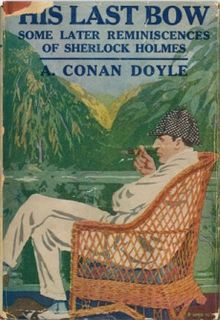
HisLastBowHis Last Bow: Some Reminiscences of Sherlock Holmes by Sir Arthur Conan Doyle is another collection of his Sherlock Holmes short stories, most originally published in magazines. One story, “The Cardboard Box,” was originally in another volume and added to this one in later printings.

The book opens with a preface from Dr. Watson saying that Holmes was retired and doing well except for occasional bouts of rheumatism. He had refused many offers to take up cases until called into service by his government on the eve of war with Germany. Watson states that the last story in this collection contains the details of that incident, and the other stories are some that he has had on hand for some time but not used in his other collections, but added them here to supplement the last story.

There are eight stories all together, covering various time periods (some when Watson was married, some when he was rooming with Holmes. Most contain trademarks of the other Holmes stories. A few are different, however.

In “The Adventure of Wisteria Lodge” (sometimes published as two stories, “The Singular Experience of Mr. John Scott Eccles” and “The Tiger of San Pedro”), the inspector on this case, Inspector Baynes, is the only police official that Holmes has thought well of and thought almost as competent as himself. He had learned to work with Lestrade and Grayson and others, though he usually figured out the case long before they did. But Baynes he admired and predicted he would go far in his profession.

Some of the other cases involve assumed identities, stolen naval plans, a woman receiving severed ears in the mail, an incident that kills one sister and drives two brothers mad, a kidnapped woman, and Holmes’ seemingly fatal illness.

The last story, “His Last Bow,” is different in a few ways. It opens with someone other than Holmes or Watson, is told in the third rather than the first person, and is a spy story more than a detective story. It’s set after Holmes has retired but has been asked to help his government, and when it’s over, he and Watson reminisce as if they haven’t seen each other in a while and are catching up. I wonder if Doyle wasn’t planning to write more Holmes stories after this. There is one Holmes novel whose writing overlaps the time period when these stories were published, and one more collection of stories after this one. If all the stories were laid our chronologically, this one would be the last in the time frame though it’s not the last one written. It was published during WWI, and this quote was probably meant to encourage Doyle’s fellow countrymen:

“There’s an east wind coming, Watson.”

“I think not, Holmes. It is very warm.”

“Good old Watson! You are the one fixed point in a changing age. There’s an east wind coming all the same, such a wind as never blew on England yet. It will be cold and bitter, Watson, and a good many of us may wither before its blast. But it’s God’s own wind none the less, and a cleaner, better, stronger land will lie in the sunshine when the storm has cleared.”

In many of the stories, Holmes makes reference to Watson’s writings and even offers suggestions about what to include, even though he doesn’t like the way Watson tells the stories.

I found further evidence that Holmes was neither always rude nor antisocial or even autistic, as some modern portrayals seen to suggest. When interrupted from a project when asked to take on a case he is not interested in at first, Watson notes that  “Holmes was accessible upon the side of flattery, and also, to do him justice, upon the side of kindliness. The two forces made him lay down his gum-brush with a sigh of resignation and push back his chair.” In another case,

Holmes leaned forward and laid his long, thin fingers upon the woman’s shoulder. He had an almost hypnotic power of soothing when he wished. The scared look faded from her eyes, and her agitated features smoothed into their usual commonplace. She sat down in the chair which he had indicated.

In another place he said, “[The landlady] was fond of him, too, for he had a remarkable gentleness and courtesy in his dealings with women. He disliked and distrusted the sex, but he was always a chivalrous opponent.”

Watson does admit, though, in another case that, “It was one of my friend’s most obvious weaknesses that he was impatient with less alert intelligences than his own,” in this case Lestrade’s.

Holmes also doesn’t misuse Watson, as some modern depictions portray. In one case here he sends Watson on a mission when he can’t leave the case he is currently involved with, and when he does catch up with Watson, he exclaims,

“I cannot at the moment recall any possible blunder which you have omitted. The total effect of your proceeding has been to give the alarm everywhere and yet to discover nothing.”

“Perhaps you would have done no better,” I answered bitterly.

“There is no ‘perhaps’ about it. I HAVE done better. Here is the Hon. Philip Green, who is a fellow-lodger with you in this hotel, and we may find him the starting-point for a more successful investigation.”

The only time that he seems genuinely rude was when he was ill but did not want Watson to examine him, saying, “After all, you are only a general practitioner with very limited experience and mediocre qualifications. It is painful to have to say these things, but you leave me no choice.” Watson “was bitterly hurt.” But later Holmes discloses that he did not want Watson near him because he was on a case to try and catch someone, and Watson’s “astute judgment” would determine on a close examination that Holmes was well, and Holmes needed him to believe in the urgency of the situation in order to convince the man Holmes wanted to come. He assures Watson of his high “respect for your medical talents.”

In one unguarded moment after Watson saves both their lives, Holmes declares,

“Upon my word, Watson!” said Holmes at last with an unsteady voice, “I owe you both my thanks and an apology. It was an unjustifiable experiment even for one’s self, and doubly so for a friend. I am really very sorry.”

“You know,” I answered with some emotion, for I have never seen so much of Holmes’s heart before, “that it is my greatest joy and privilege to help you.”

He relapsed at once into the half-humorous, half-cynical vein which was his habitual attitude to those about him.

There was one other glimpse in Holmes’ heart when, in a case where someone avenged the death of his loved one, Holmes said, “I have never loved, Watson, but if I did and if the woman I loved had met such an end, I might act even as [he] has done.” That also seems further proof of something I asserted in an earlier book, that Irene Adler was not the love interest many thought her to be, but rather just a woman he admired for being one of the few people to ever outsmart him.

I listened to the audiobook read by Simon Vance, who did a great job with the different accents and inflections. Overall I enjoyed these continuing adventures of Holmes and Watson and and discovering more of their personalities. I look forward to the last two books.

(This review will also be linked to Semicolon‘s Saturday Review of Books.)

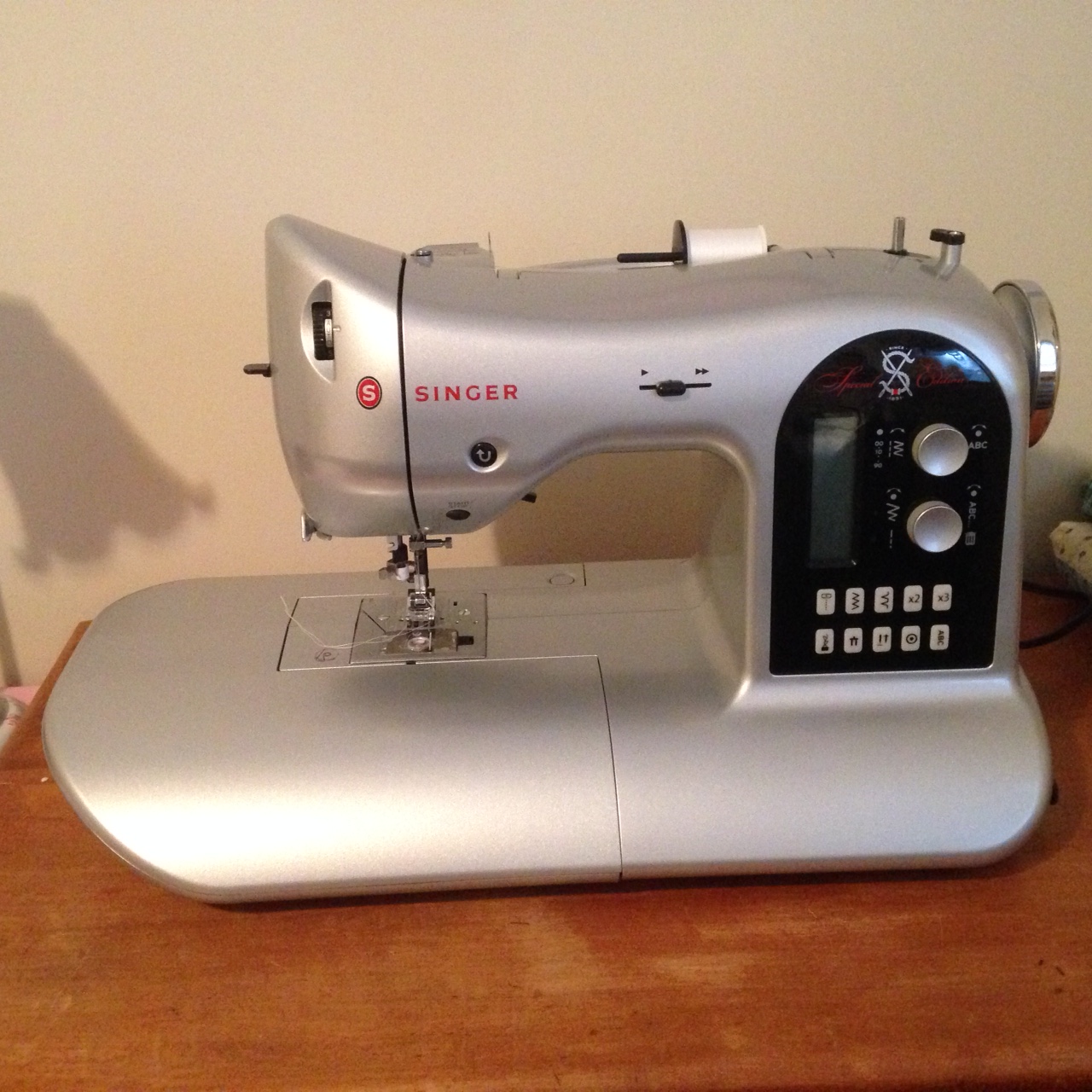
A new gadget!

One evening while my husband perused some of the “deal of the day” sites he follows while I was making dinner, he asked me if I wanted a new sewing machine.

No, I replied. My little faithful, uncomplicated Kenmore had served me well for 30+ years now, and I figured I’d just keep using it until it gave out. Besides, those newfangled computerized ones would probably require a significant learning curve to become comfortable with, whereas I knew my Kenmore so well I could operate it almost without thinking.

But he began to read some of the features of the one on sale, and the more he read, the more attractive it sounded. And, I began to reason, when my machine does give out, there might not be a deal like this readily available. So I said, “Sure, if you want to get it for me.” 🙂 So he did.

It arrived last Saturday, and thankfully he was here to help me get it out of the box and figure out some of the diagrams to get started with it.

IMG_1181

This photograph with the light on isn’t as good, but you can see the screen display:

IMG_1180

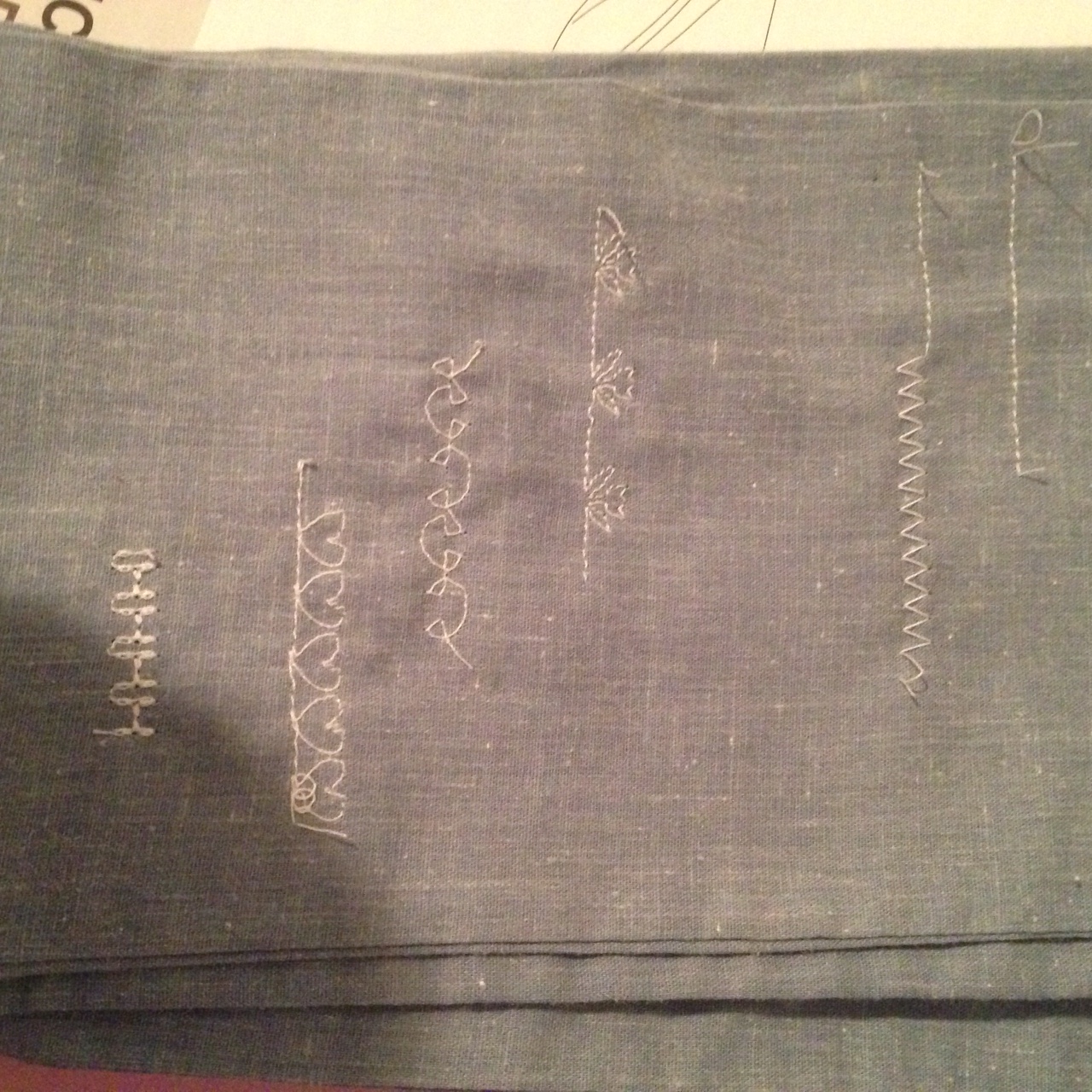
Some of the basics like threading it and the bobbin were a little hard to figure out: some of the specialty stitches were easy, and I had fun playing with those a bit.

IMG_1182

It will take a while to feel “at home” with it, but that should come with use. It’s supposed to have an automatic needle threader which I haven’t figure out yet but which should come in really handy: I keep a little magnifying glass in the desk drawer for help with threading now. One feature I really like is that there is a little push button on the side that opens a little drawer for all the extra presser feet, bobbins, etc., thus freeing up crowded drawer space.

And, as an added bonus, the sewing machine cover I made for my old sewing machine last year came out a bit too big for it, but – you guessed it, it fits this one nicely. It’s a bit snug, but it still covers it.

As I moved my old sewing machine and began gathering all its attachments, I felt like I should give it a hug for all its good work through the years and pat it and tell it what a good job it has done. But when I feel sentimental about appliances, this video comes to mind:

So even though I am a little intimidated at figuring out things with the new machine, I am looking forward to it as well, and I am thankful for my husband’s love and generosity.

What’s On Your Nightstand: April 2015

 What's On Your NightstandThe folks at 5 Minutes For Books host What’s On Your Nightstand? the fourth Tuesday of each month in which we can share about the books we have been reading and/or plan to read.

Wow – it’s hard to believe we’re in the last week of April. Where did it go so fast?

Since last time I have completed:

A Million Little Ways: Uncover the Art You Were Made to Live by Emily Freeman, reviewed here. Had some issues with parts of it but overall it’s a good message.

He Is There and He Is Not Silent by Francis Schaeffer, reviewed here. A short book about philosophy, apologetics, metaphysics, epistemology – good but stretches one’s brain to the limit.

Being Mortal: Medicine and What Matters In the End by Atul Gawande. As I said in my review, if you’re planning on getting old, dying, or helping a parent as they age, you need to read this book.

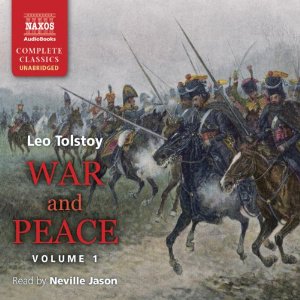
War and Peace by Leo Tolstoy, audiobook, reviewed here. Glad to be know the story now but glad to be done with it finally. 🙂

The Swan House by Elizabeth Musser, reviewed here. Loved.

Songs of the Morning: Stories and Poems for Easter compiled by Pat Alexander, including excerpts from C. S. Lewis, E. B. White, and others, reviewed here.

I’m currently reading:

The Monday Morning Club: You’re Not Alone — Encouragement For Women in Ministry by Claudia Barba.

Feeding Your Appetites: Taking Control of What’s Controlling You by Stephen Arterburn

His Last Bow: Some Later Reminiscences of Sherlock Holmes by Sir Arthur Conan Doyle, audiobook

A pre-reading of a friend’s novel – will be happy to share more with you when the time comes! 🙂

Gentle Savage Still Seeking the End of the Spear: The Autobiography of a Killer and the Oral History of the Waorani by Menkaye Aenkaedi with Kemo and Dyowe. Just  started this one. These men were among the Waorani (or Aucas, as they were then known) who killed the five men who came to share the gospel with them (Jim Elliot, Nate Saint, and the others) and who later became Christians, Menkaye becoming like a grandfather to Steve Saint’s children. I am very curious to read their story in their own words.

Next Up:

Walking With God in the Season of Motherhood by Melissa B. Kruger

Christy by Catherine Marshall for Carrie‘s Reading to Know Classics Book Club for May. Read this years ago and am eager to revisit it.

Taken, the latest by Dee Henderson. Just got word it’s on it’s way!!! Can’t wait!

The Valley of Fear and The Case-Book of Sherlock Holmes by Sir Arthur Conan Doyle, audiobooks, to finish off the good detective’s stories.

Pioneer Girl: The Annotated Autobiography by Laura Ingalls Wilder, edited by Pamela Smith Hill. I don’t know if I will actually get to this in the coming month: I hope so.

That should keep me busy for a while. 🙂 What are you reading?

Book Review: The Swan House

Swan HouseI picked up The Swan House by Elizabeth Musser when it came through as a Kindle deal because I liked her Words Unspoken so much (in fact, it was one of my top ten books from 2010.)

This story is told from the vantage point of 16-year-old Mary Swan Middleton, daughter of a wealthy Atlanta family in the 1960s. Tragedy strikes early in the book as her mother dies in an airplane accident along with a number of other Atlantans. The accident wounds her family and community deeply.

There are a number of threads in this book which Elizabeth weaves together nicely:

– Mary’s family and community dealing with their grief

– Mary’s (or Swan, as she’s called most often, or Swannee) quest to determine what happened to some missing paintings, one of them her mother’s, which were lost before they were to be debuted at the High Museum of Art

– Her black maid, Ella Mae, inviting her to come to her church to help with the weekly food distribution to the needy as a way to take her mind off her grief, where her eyes are opened to a whole different world and where she meets Miss Abigail, a white lady who has made it her mission to live and minister in the area.

– Her getting to know and becoming interested in a black teenage boy named Carl.

– The volatile racial tensions 0f the 1960s South and burgeoning civil rights movement

– Mary’s discovering clues that what was thought to be her mother’s artistic temperament might have been something deeper, something worse.

– Mary’s school life and activities, best friend Rachel, and budding interest in a boy named Robbie

– Mary’s spiritual development and crisis of faith.

In a sense it’s a coming-of-age story, but it’s so much more than that. It’s a book of rich depths. One of its themes is that there is often more going on behind the surface of a person’s life that we’re aware of.

Some of my favorite quotes from the book:

We were transported by that music in a ethereal way that later we would try to explain and couldn’t. But it was the first time I really felt what I had long understood: that something could be extremely beautiful and intensely painful at the same time.

She thought every church should be…a place where you could go without no makeup or fancy dress to hide behind and you could jus’ hug yore friends and cry and tell the Lawd how bad you’d messed up and ask Him to forgive ya and let ya git up and keep goin’.

It’s been through the hard times that I been able to he’p someone else. It’s been through believin’ that the Lawd somehow gonna git me through that the others done wanted to hear about my Jesus.

Guess I ain’t got no business tellin’ the good Lawd that He put me in the wrong place. He done shown me ’nuff times that He knows exactly what He is doing.

I mentioned in Why Read Christian Fiction that you would expect to find Christian conversations in Christian fiction but that some authors make it more subtle or only mention Christian truths in an offhand way so as not to be accused of being too heavy-handed with it. While some stories would call for subtlety, I am glad Elizabeth felt the freedom to have her characters have full-fledged conversations about what it means to really be a Christian and how Christianity should impact a life.

Elizabeth is a native Atlantan, and I enjoyed her afterword where she explained that many points of the story came from real life (even the airplane crash was a real one that impacted the Atlanta community). We lived just outside Atlanta for four years, and even though we didn’t go into the city that much, I felt like I was not only revisiting it but getting to know it better while reading this book.

I also enjoyed reading a little more about Elizabeth after reading this book. She and her family are missionaries in France, and she writes in a refurbished tool shed. She tells some of her writing journey here and photos of her writing place are here. I was exciting to see on Goodreads that this book “was named one of Amazon’s Top Christian Books of the Year and one of Georgia’s Top Ten Novels of the Past 100 Years.”

I enjoyed Words Unspoken so much, I am not sure why I waited so long to read another of Elizabeth’s books. But now that I have, I am looking forward to reading more of them.

(This review will also be linked to Semicolon‘s Saturday Review of Books.)
Laudable Linkage

Here are just a few commendable links from the last week:

Borrowed Lights: Inspiration for Christian Living. Benefits of reading about the lives of other Christians who follow the Lord closely. Loved this that Robert Murray McCheyne said of Jonathan Edwards: “How feeble does my spark of Christianity appear beside such a sun! But even his was a borrowed light, and the same source is still open to enlighten me.” I liked it so much I added it to my previous post Why Read Biographies.

Are You a Mentoring Momma? “Most likely if you asked them, not one [of these women] would say she mentored me. Yet her life influenced mine in profound ways. The common thread among each of these unique women is that she was further along in the journey, loved me, loved Christ more, and modeled how to treasure Him above all else.” To me that’s the best mentoring – not an official program, not a formal set-up mentor-mentee relationship, but just this.

When Motherhood Drains Your Happiness. The truths here of what to do when you feel drained ministered to me even though I wasn’t feeling that way with regard to motherhood at this point.

My Mother Practiced the Piano. “There’s nothing selfish about working toward your artistic interests as God allows the time. In fact, your children can benefit from watching you model discipline and discovery.”

And, for a smile – I’ve watched this several times and love the look on this cat’s face – although it wouldn’t really be funny to live with a cat who does this:

Happy Saturday!

Friday’s Fave Five

FFF spring2

It’s Friday, time to look back over the blessings of the week with Susanne at Living to Tell the Story and other friends.

It’s been a nice week in many respects. Here are the highlights:

1. A Ladies’ Tea at our church. The best part is that my daughter-in-law was able to go with me. I think this is only the second or third tea I have ever been to, the first one at this church. I loved the cute little sandwiches and desserts as well –  not only attractive, but it was nice to be able to have a small sample of a number of things.

2. Getting a haircut. I always tend to put off it too long, so I am usually quite relieved when I finally get it done. My hair is not very cooperative in the first place, but less so the longer it gets. I went just a bit shorter than usual this time and like it much better.

3. Sunday dinner. For various reasons, my daughter-in-law and grandson were at our house Sunday morning, and when we got home she had made dinner. Always nice but especially on a Sunday – it provides a little more time to relax in the afternoon.

4. Spending gift cards. I’d had to return a Christmas gift to the local Christian bookstore and got a gift certificate for store credit since I didn’t have a receipt. I don’t shop there often (love them, but they’re very expensive, even with coupons), so I kept forgetting to go look around and spend my certificate. Then they sent me a postcard that our local branch of the store was going out of business, so I went in to see if I could find anything to use my certificate before it was too late. With several going-out-of-business markdowns, I was able to get a few books and a pretty pink scarf (why there were scarves at a bookstore, I don’t know…). I also have some gift cards to JoAnn’s from last year and was able to get things for a couple of projects.  I enjoyed the outings and “free” shopping.

5. Finishing a few “heavy” books, one in length and two in subject matter. They were all beneficial, but it’s nice to move on to something lighter and shorter for a bit.

Hope you have a great weekend!

Book Review: He Is There and He Is Not Silent

SchaefferWhen I first saw the title of He Is There and He Is Not Silent by Francis Schaeffer, I thought it sounded like something from the Psalms, a response to a deep heart-cry of someone who needed God and found Him.

It’s not that, at least not like the Psalmist’s expressions. It’s a book of philosophy and apologetics. It’s actually the third book in a trilogy, The God Who Is There and Escape From Reason being the first two.

Elisabeth Elliot once said of some of C. S. Lewis’s writing that she could follow it, but it took several careful rereadings to grasp it well enough to be able to express what he said to someone else. That’s how I feel about this book. I could follow the thread of his arguments, but I couldn’t possibly reproduce any of them for you. You can get a brief overview of one chapter at Wikipedia and probably other places. Wikipedia’s overview sums it up nicely: “He Is There and He Is Not Silent is divided into four chapters, followed by two appendices. The first of these chapters deals with metaphysics; the second, morals; and the third and fourth, epistemology. The first appendix concerns revelation and the second the concept of faith.”

Honestly, reading sentences like, “The reason for the modern dilemma is that men have moved from uniformity of natural causes in an open system — open to reordering by God and man — into the uniformity of natural causes in a closed system” makes my head feels like it is about to explode (and some of the comments on Goodreads reassure me that others felt the same way). But it is good to stretch one’s brain sometimes, and I am glad for such masterfully written books because I do know people who think like this about these things, and it is good to know that Christianity not only stands up to scrutiny, but, as Schaeffer shows, it is the only reasonable answer to the many issues that he brings up. He and his wife hosted a lot of people, many of them students, in the 60s and 70s, and I am sure these kinds of things came up in their discussions.

I admit I am an intensely practical person, so when someone asks, “How do we know we are really here?” I am liable to think, “Maybe look in the mirror? Or pinch yourself. Hard.” This was written in 1972, well before The Matrix, but I guess some people really do wonder if reality is close to that kind of scenario.

It wasn’t until the fourth chapter, “The Epistemological Necessity: The Answer,” that the clouds began to clear. It’s the only chapter where I marked any quotes. Here are a couple:

The Bible teaches in two different ways: first, it teaches things in didactic statements, in verbalizations, in propositions…Second, the Bible teaches by showing how God works in the world that He Himself made. We should read the Bible for various reasons. It should be read for facts, and it should also be read devotionally. But reading the Bible every day of one’s life does something else — it gives one a different mentality…Do not minimize the fact that in reading the Bible we are living in a mentality which is the right one, opposed to the great wall of this other mentality which is forced upon us on every side — in education, in literature, in the arts, and in the mass media.

When I read the Bible, I find that when the infinite-personal God Himself works in history and in the cosmos, He works in a way which confirms what He has said about the external world (p. 78).

The strength of the Christian system — the acid test of it —  is that everything fits under the apex of the existent, infinite-personal God, and it is the only system in the world where this is true. No other system has an apex under which everything fits.That is why I am a Christian and no longer an agnostic. In all the other systems, something “sticks out,” something cannot be included; and it has to be mutilated or ignored. But without losing his own integrity, the Christian can see everything fitting into place beneath the Christian apex of the existence of the infinite-personal God who is there (p. 81).

The Christian should be the man with the flaming imagination and the beauty of creation (p. 87).

I’ve had this book on my shelf for something like 30 years. I am thankful for the TBR Challenge, which encouraged me to scour my shelves for unread books and finally get to them. If you like philosophizing, this book is for you.

(This review will also be linked to Semicolon‘s Saturday Review of Books.)

Book Review: War and Peace

I did not grow up reading many classics. Louisa May Alcott, Laura Ingalls Wilder, and Charles Dickens were my most-read classic authors. I don’t remember coming into contact with many classics even in school, though I must have and probably just can’t remember most of them. But because of this, over the last few years I’ve determined to read more classics.

War and PeaceWhenever I’ve perused lists of classics or “books everyone should read,” War and Peace by Leo Tolstoy is almost always mentioned. Whenever I read a short description of it, I never could get a clear idea of what it was about. After reading my first Dostoyevsky last year and finding him not as difficult as I’d thought, I determined one day to read War and Peace. Over the last few months I’ve listened to the audiobook version with occasional forays into the library’s paper and ink version.

And now I know why the descriptions of the book didn’t really give much substance. It’s such a massive book with so many characters, it’s hard to sum up in a few sentences what it’s all about.

It covers the period from the time Napoleon is first seen as a threat in Russia in 1805 to his invasion of Russia in 1812 during the reign of Tsar Alexander and is basically about the lives and interactions of five aristocratic families and how the war affects them.

Pierre Bezukhov is one of many illegitimate sons of a crusty old count. He is kind-hearted and sincere but socially inept and awkward. He’s not afraid to speak his mind, even on controversial issues, but is too naive to realize when it is not socially appropriate to do so. Surprisingly, when his father comes to his death he has Pierre legitimized and leaves the bulk of his fortune to him. But Pierre is ill-prepared for the responsibility and doesn’t realize that everyone’s being nice to him now is because of his new wealth, not because they finally got to know him well enough to like him. He makes a disastrous marriage and spends much of the book searching for the meaning of life.

The Bolkonsky family consists of a cantankerous father and two adult children. Andrei is tolerant of his father, intelligent, ambitious, cynical, married and expecting a child but dissatisfied with his wife and indeed much of life. His sister, Marya, is very religious and tries to show her father love though he takes out the bulk of his eccentricities and bad moods on her.

The Rostov family, with children Nikolai, Natasha, and Petya, are a loving, fairly normal family whose finances are constantly a problem. An orphaned cousin, Sonya, lives with them. Sonya is quiet and dependable, but the three Rostov children are impetuous and immature at the beginning.

Prince Vasili Kuragin is crafty and wily, and his two adult children, Helene and Anatole, are good-looking but immoral.

Anna Drubetskaya has great ambitions for her son, Boris, and doesn’t mind asking for consideration and favors for him. Boris, in turn, has great ambitions for himself and learns quickly how to work the system to move ahead in life.

Tolstoy takes us from the ballroom to home scenes to the battlefield and back again. The lives of these characters intertwine and intersect with each other and historical figures. Some fall in love and marry; some don’t make it to the end of the book.

He also intersperses his story with essays about a number of things: his view of a particular historical event, his disagreement with the general consensus, his low opinion of Napoleon, the belief that great men and great events do not make history but rather there are innumerable small issues that work together to direct the course of history. The last is one of his major themes. In fact, the Encyclopaedia Britannica entry for War and Peace says:

As Tolstoy explains, to presume that grand events make history is like concluding from a view of a distant region where only treetops are visible that the region contains nothing but trees. Therefore Tolstoy’s novel gives its readers countless examples of small incidents that each exert a tiny influence—which is one reason that War and Peace is so long. Tolstoy’s belief in the efficacy of the ordinary and the futility of system-building set him in opposition to the thinkers of his day.

One of the main ways this is shown is on the battlefield. It’s hard to see how anything got done on the battlefield when the information relayed to the commander would have changed by the time he got it, when his orders were disobeyed or not received or when someone acted of their own accord without waiting for orders.

Tolstoy said of this book that it “is not a novel, even less is it an epic poem, and still less an historical chronicle.” He doesn’t say what he does call it, but it is kind of an amalgam of the three.

I had heard that Tolstoy was a Christian, so I was surprised that at first the religion in the book was mixed up with icons, superstition, and freemasonry. I read in various places that after his religious conversion, he renounced his earlier works. But reading about his conversion was confusing as well: it seemed to center primarily in non-resistance to evil (which led to pacifism) and in trying to divest himself of his property (which his family resisted and resented). There are nuggets of spiritual truth in this book, but it’s not where I’d send someone who was seeking to look for answers.

I wondered why so many Russians were speaking French at the beginning of the book. Wikipedia explains that it was the fashion of the day and for some years before in the upper class. But when Napoleon started attacking Russian territory, speaking French fell out of favor.

There is so much I feel I am leaving out, but with a book of 1,316 pages, it would be hard to include everything. I am indebted to SparkNotes, Wikipedia, the online Encyclopaedia Britannica, and the introduction and notes of the library copy I had for giving me more insight into the book that I would have gleaned on my own. I enjoyed the audiobook version narrated by Neville Jason in two parts over 60 hours. It did take a while to settle into it and get the characters straight. I do admit that my mind wandered a bit during the essays, especially the last appendix – I have a harder time listening to nonfiction and usually need to reread it parts of it a number of times to truly “get” it.

As with many older classics, there were parts that were a little dry, and due to the different time period and nationality there were ways people acted that didn’t always make sense to me. But I liked following the characters on their journey, especially Pierre, Natasha, and Marya and one minor character, a peasant named Karataev whom Pierre meets while in captivity. I liked where the ones mentioned at the end of the book ended up.  There were moments of great pathos in the book, moments of truly feeling a character’s pain and joy. Though not a “keep you on the edge of your seat” type of book, there were a few of those moments, such as when Andrei is waking up from surgery in a battlefield hospital and in his hazy state sees someone who looks familiar and is trying to figure out who it is. When I realized who it was, I think I gasped out loud. One of my favorite moments was during beloved oldest son Nikolai’s first battlefield experience when he is astonished that people are shooting at him, thinking, “Me, whom everyone loves!”

Years ago I read a couple of Richard Wurmbrand books about persecution behind the Iron Curtain, and he pleaded then that people not be prejudiced against the whole Soviet Union because of the Communists, remarking that the average Russians were big-hearted people. That came back to mind while reading this book, especially in the characters of Pierre and Count Rostov.

There is a 1970s BBC miniseries starring a young Anthony Hopkins as Pierre that I’d love to see sometime, but it would be quite an investment of time. I just learned that another BBC miniseries is in the works to be shown in six parts this year. Now I am even more glad I read this now!

I was dismayed when I saw a ballet segment from War and Peace in the opening ceremony at the Sochi Olympics that I didn’t know what was going on in it. I was delighted to find that segment on YouTube and watch it again after reading the book. This is Natasha’s first ball and the first time to dance with Andrei. The video quality isn’t great and there is an annoying sound like a rocking chair squeaking, but I was just glad to be able to see it again and understand it this time:

(This review will also be linked to Semicolon‘s Saturday Review of Books.)
Book Review: Being Mortal

Being MortalI could wrap up my comments on Being Mortal by Atul Gawande succinctly by saying that if you plan on getting old or dying or helping a parent as they age, you need to read this book. But I’ll try to give you a bit more to go on.

I don’t know that I would have noticed this book at all except that Lisa and Joyful Reader both mentioned it. I knew they had dealt with deaths of parents and grandparents, Lisa’s mom had been in assisted living and Joyful’s grandmother lives with her, so with their experience, their praise for this book meant a lot.

I ended up marking many more pages than I can possibly share, but it’s safe to say that much in this book resonated with me.

IMG_1174

The subtitle of the book is Medicine and What Matters in the End, and it’s a frank treatment of end-of-life issues. Medicine, Dr. Gawande asserts, is geared to fix things. But in some cases the treatment is worse than the disease itself. And this tendency is part of what had led to institutionalizing people as they age and making it a medical matter rather than trying to give people in such situations the best days they can have in the time they have left.

Gawande notes that until fairly recently, most deaths occurred at home. Now most occur in hospitals and nursing homes “where regimented, anonymous routines cut us off from all the things that matter to us in life” (p. 9). In addition, it used to be that, unless you had a long, wasting illness like consumption, most deaths came suddenly like a thunderstorm. Modern medicine has been a marvel and a gift from God: many things that used to be fatal can now be treated. But like any gift, there are good ways and not so good ways to use it.

“The simple view is that medicine exists to fight death and disease, and that is, of course, its most basic task. Death is the enemy. But the enemy has superior forces. Eventually, it wins. And, in a war that you cannot win, you don’t want a general who fights to the point of total annihilation. You don’t want Custer. You want Robert E. Lee, someone who knew how to fight for territory when he could and how to surrender when he couldn’t, someone who understood that the damage is greatest if all you do is fight to the bitter end.”

I appreciated his explanation of how the style of doctoring has changed over the years, from the authoritative “Dr. Knows-Best” who made all the decisions for you, to “Dr. Informative,” who merely laid out all the options and let you decide. The problem with the latter is that we don’t always know how to process the options. When the author’s own father faced a tumor in his spine, he, his father, and his mother were all doctors yet felt overwhelmed by the information and options they were receiving. A third kind of doctor is called “interpretive” and gives information as well as guidance after asking what’s most important to you and what your concerns are (pp. 100-102).

Gawande proposes a series of questions to consider when the diagnosis is terminal, questions concerning what’s most important, what one’s goals and fears are in facing the time they have left. One man said he wanted to continue to eat ice cream and watch football on TV, and he wasn’t interested in any treatment that interfered with those activities: life wasn’t worth living without them. Some are willing to live with different degrees of disability and pain: some don’t want to suffer at all. It’s good for a family to have these discussions so they have some idea what would be the most important to their loved one. Sometimes it requires more than one hard discussion: “Arriving at acceptance of one’s mortality and a clear understanding of the limits and the possibilities of medicine is a process, not an epiphany” (p. 182), and your preferences might change over time as well. But these discussions are necessary to find the best means of “living for the best possible day today instead of sacrificing time now for time later” (p. 229).

Gawande also details the journey from being independent to needing assistance to needing full time care that elderly and their families face. We’ve faced much of this with my mother-in-law over the last few years. I especially appreciated the history of nursing homes and assisted living facilities and the goals and purposes that Keren Brown Wilson, who “invented” assisted living, had when she started, and how those were originally implemented and maintained and then encroached upon to the point that she had to resign from her own board. Nursing homes themselves “were never created to help people facing dependency in old age. They were created to clear out hospital beds” (p. 71).

Many of the problems he lists in assisted living and nursing homes were the same as what we had found: loss of autonomy and privacy, loss of purpose, “tasks [coming] to matter more than the people” (p. 105), “safe but empty of anything they care about” (p. 109). “Making life meaningful in old age…requires more imagination and invention than making them merely safe does” (p. 137).

In older history and in other countries, the old are revered as having great knowledge and wisdom: “Now we consult Google, and if we have any trouble with the computer we ask a teenager” (p. 18). At least one sibling used to stay with the elderly parent(s) and help care for them, and then got a larger portion of the inheritance or perhaps the family home in place of what they gave up. Now both parents and adult children value their independence. But “our reverence for independence takes no account of the reality of what happens in life: sooner or later, independence will become impossible” (p. 22). Yet the author researched and visited several creative ways for an older adult to retain as much independence and autonomy as long as possible.

One problem is that even though geriatric specialists have been shown to enhance the lives of the elderly, geriatric units are shrinking or being closed rather than growing. “97 percent of medical students take no course in geriatrics” (p. 52). One reason is that it doesn’t pay well; another is that insurance doesn’t see the need for it. It remains for those of us who deal with the elderly or who look ahead to our own old age to be aware of issues.

When I was first looking at information about the book, I was wary that the author might promote assisted suicide for those with terminal illnesses. He does not promote it, but he would support legislation to enable giving people lethal prescriptions if asked, noting that half of them don’t use them: they just like the assurance that they could. He does note, though, that in countries where it is legal, use has grown: “But the fact that, by 2012, one in thirty-five Dutch people sought assisted suicide at their death is not a measure of success. It is a measure of failure. Our ultimate goal, after all, is not a good death but a good life to the very end. The Dutch have been slower than others to develop palliative care programs that might provide for it….We damage entire societies if we let this capability [assisted suicide] divert us from improving the lives of the ill. Assisted living is far harder than assisted death, but its possibilities are far greater, as well” (p. 245). (A good Christian source on some of these thorny issues is When Is It Right to Die: Suicide, Euthanasia, Suffering, Mercy by Joni Earacekson Tada.)

He also points out that it is difficult to know exactly where the lines are sometimes. “We also recognize the necessity of allowing doses of narcotics and sedatives that reduce pain and discomfort even if they may knowingly speed death” (pp. 243-244). Sometimes it is wrong to turn off a ventilator: sometimes it is right. If a 20-tyear-old was diagnosed with Type 2 diabetes and wanted to let “nature take its course” rather than treating the illness, we’d try to convince her that the quality of life she could have with treatment would be well worth it despite the complications: it would be ridiculous to die of diabetes when there is treatment available and the possibility of a long, productive, and happy life. On the other hand, when my father was dying of various other issues and they suspected he had colon cancer, they decided not to put him through what would be involved in diagnosing, much less treating it, because in the long run it would not make a difference in how long he would live and would only make his last months miserable.

The author writes from a secular viewpoint. As a Christian, I thought a lot about how a Christian worldview would affect this topic. As Christians we know where we and our believing loved ones are going, which takes some of the sting out of death. But we don’t take it lightly or flippantly, either. Death is still called an enemy. We hold life as a gift from God and believe He is the only one with the right to end it. It is to be given back to Him and used for His purposes. Sometimes that includes suffering, yet we’re also called to alleviate suffering if possible. While there are fears about loss of independence and abilities in older age, we can trust God to help us through that time: And even to your old age I am he; and even to hoar hairs will I carry you: I have made, and I will bear; even I will carry, and will deliver you.  Isaiah 46:4. But issues and question the author brings up are needful to consider, preferably before crises hit. In some cases there is no one right answer for what kind of treatment to pursue: the answer will vary depending on a number of factors.

I like this summation near the end of the book:

I am leery of suggesting that endings are controllable. No one ever really has control. Physics and biology and accident ultimately have their way in our lives. But the point is that we are not helpless either. Courage is the strength to recognize both realities. We have room to act, to shape our stories, though as time goes on it is within narrower and narrower confines. A few conclusions become clear when we understand this: that our most cruel failure in how we treat the sick and aged is the failure to recognize that they have priorities beyond merely being safe and living longer; that the chance to shape one’s story is essential to sustaining meaning in life; that we have the opportunity to refashion our institutions, our culture, and our conversations in ways that transform the possibilities for the last chapters of everyone’s lives (p. 243).

(This review will also be linked to Semicolon‘s Saturday Review of Books.)

Laudable Linkage

Here are some posts I found worth reading and sharing over the last couple of weeks:

The Dead End of Sexual Sin along with some advice from John Owen about overcoming sin of any kind.

Providential Dullness: An Easter Meditation. We give the disciples a hard time for missing that Jesus said He would rise again, but Luke 18:34 says, “this saying was hid from them.” Why would that be? Some good answers in this piece.

The Ones in the Front Row.“I cannot control the reception my children’s God-given callings receive out there in the wide world. But I can raise them to be appreciators of beauty, loveliness, and skill. Then, maybe they will be the ones in the front row, clapping their hearts out, whistling, standing and cheering at all the beauty the world holds for them.”

Thanks For Raising the Man of My Dreams! I hate mother-in-law jokes and did long before I became a m-i-l. I did have  relatively good relationship with mine. Here are some good thoughts to enhance that relationship.

10 Ways to Create a Home of Warmth and Grace.

How to Get Published.

For those who like Christian fiction, especially free Christian fiction, there’s a Christian Fiction Scavenger Hunt going on this weekend with a possibility of winning 17-34 books from 30+ authors. Some of the individual authors are hosting their own giveaways as well.

Happy Saturday!