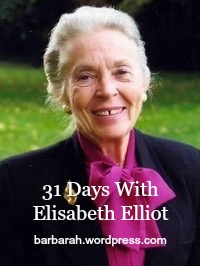
31 Days With Elisabeth Elliot: A Quiet Heart

Elisabeth Elliot2This is an excerpt from Elisabeth Elliot’s book Keep A Quiet Heart:

A Quiet Heart

Jesus slept on a pillow in the midst of a raging storm. How could He? The terrified disciples, sure that the next wave would send them straight to the bottom, shook Him awake with rebuke. How could He be so careless of their fate?

He could because He slept in the calm assurance that His Father was in control. His was a quiet heart. We see Him move serenely through all the events of His life–when He was reviled, He did not revile in return. When He knew that He would suffer many things and be killed in Jerusalem, He never deviated from His course. He had set His face like flint. He sat at supper with one who would deny Him and another who would betray Him, yet He was able to eat with them, willing even to wash their feet. Jesus in the unbroken intimacy of His Father’s love, kept a quiet heart.

None of us possesses a heart so perfectly at rest, for none lives in such divine unity, but we can learn a little more each day of what Jesus knew…

Jesus, because His will was one with His Father’s, could be free from care. He had the blessed assurance of knowing that His Father would do the caring, would be attentive to His Son’s need. Was Jesus indolent? No, never lazy, sluggish, or slothful, but He knew when to take action and when to leave things up to His Father. He taught us to work and watch but never to worry, to do gladly whatever we are given to do, and to leave all else with God.

Purity of heart, said Kierkegaard, is to will one thing. The Son willed only one thing: the will of His Father. That’s what He came to earth to do. Nothing else. One whose aim is as pure as that can have a completely quiet heart, knowing what the psalmist knew: “Lord, You have assigned me my portion and my cup, and have made my lot secure” (Psalm 16:5 NIV). I know of no greater simplifier for all of life. Whatever happens is assigned. Does the intellect balk at that? Can we say that there are things which happen to us which do not belong to our lovingly assigned “portion” (This belongs to it, that does not”)? Are some things, then, out of the control of the Almighty?

Every assignment is measured and controlled for my eternal good. As I accept the given portion other options are cancelled. Decisions become much easier, directions clearer, and hence my heart becomes inexpressibly quieter.

What do we really want in life? Sometimes I have the chance to ask this question of high school or college students. I am surprised at how few have a ready answer. Oh, they could come up with quite a long list of things, but is there one thing above all others that they desire? “One thing have I desired of the Lord,” said David, “this is what I seek: that I may dwell in the house of the Lord all the days of my life…” (Psalm 27:4 KJV). To the rich young man who wanted eternal life Jesus said, “One thing you lack. Go, sell everything” (Mark 10:21 NIV). In the Parable of the Sower, Jesus tells us that the seed which is choked by thorns has fallen into a heart full of the worries of this life, the deceitfulness of riches, and the desire for other things. The apostle Paul said, “One thing I do: forgetting what is behind and straining towards what is ahead, I press on toward the goal to win the prize for which God has called me heavenward in Christ Jesus” (Phil 3:13-14 NIV).

A quiet heart is content with what God gives. It is enough. All is grace. One morning my computer simply would not obey me. What a nuisance. I had my work laid out, my timing figured, my mind all set. My work was delayed, my timing thrown off, my thinking interrupted. Then I remembered. It was not for nothing. This was part of the Plan (not mine, His). “Lord, You have assigned me my portion and my cup.”

Now if the interruption had been a human being instead of an infuriating mechanism, it would not have been so hard to see it as the most important part of the work of the day. But all is under my Father’s control: yes, recalcitrant computers, faulty transmissions, drawbridges which happen to be up when one is in a hurry. My portion. My cup. My lot is secure. My heart can be at peace. My Father is in charge. How simple!

My assignment entails my willing acceptance of my portion-in matters far beyond comparison with the trivialities just mentioned, such as the death of a precious baby. A mother wrote to me of losing her son when he was just one month old. A widow writes of the long agony of watching her husband die. The number of years given them in marriage seemed too few. We can only know that Eternal Love is wiser than we, and we bow in adoration of that loving wisdom.

Response is what matters. Remember that our forefathers were all guided by the pillar of cloud, all passed through the sea, all ate and drank the same spiritual food and drink, but God was not pleased with most of them. Their response was all wrong. Bitter about the portions allotted they indulged in idolatry, gluttony, and sexual sin. And God killed them by snakes and by a destroying angel.

The same almighty God apportioned their experience. All events serve His will. Some responded in faith. Most did not.

“No temptation has seized you except what is common to man. And God is faithful; he will not let you be tempted beyond what you can bear. But when you are tempted, he will also provide a way out so that you can stand up under it” (1 Corinthians 10:13 NIV).

Think of that promise and keep a quiet heart! Our enemy delights in disquieting us. Our Savior and Helper delights in quieting us. “As a mother comforts her child, so will I comfort you” is His promise (Is 66:13, NIV). The choice is ours. It depends on our willingness to see everything in God, receive all from His hand, accept with gratitude just the portion and the cup He offers. Shall I charge Him with a mistake in His measurements or with misjudging the sphere in which I can best learn to trust Him? Has He misplaced me? Is He ignorant of things or people which,in my view, hinder my doing His will?

God came down and lived in this same world as a man. He showed us how to live in this world, subject to its vicissitudes and necessities, that we might be changed-not into an angel or a storybook princess, not wafted into another world, but changed into saints in this world. The secret is Christ in me, not me in a different set of circumstances.

He whose heart is kind beyond all measure
Gives unto each day what He deems best,
Lovingly its part of pain and pleasure,
Mingling toil with peace and rest.
–Lina Sandell, Swedish

I seem to be able to trust in the Lord’s wisdom and control more for the major trials of life than for the little everyday irritations like getting stuck in traffic or dealing with malfunctioning technology. Even though on one level I know the Lord is in control and has a reason for everything He does and allows, there is still part of me that chafes under certain circumstances that seem like such a waste of time and energy. But even those He allows, and I need to rest and trust in Him. “The secret is Christ in me, not me in a different set of circumstances.”

See all the posts in this series here.

The-secret-is-Christ-in

31 Days With Elisabeth Elliot: Nothing Is Lost If Offered to Christ

Elisabeth Elliot2This comes from the July/August 1987 edition of Elisabeth’s newsletter and is in Keep a Quiet Heart as well:

A pastor’s wife asked, “When one witnesses a work he has poured his life into ‘go up in flames’ (especially if he is not culpable), is it the work of Satan or the hand of God?”

Often it is the former, always it is under the control of the latter. In the biographies of the Bible we find men whose work for God seemed to be a flop at the time–Moses’ repeated efforts to persuade Pharaoh, Jeremiah’s pleas for repentance, the good king Josiah’s reforms, rewarded in the end by his being slain by a pagan king. Sin had plenty to do with the seeming failures, but God was then, as He is now, the “blessed controller of all things” (1 Timothy 6:15, PHILLIPS). He has granted to us human beings responsibility to make choices and to live with the consequences. This means that everybody suffers–sometimes for his or her own sins, sometimes for those of others.

There are paradoxes here which we cannot plumb. But we can always look at the experiences of our own lives in the light of the life of our Lord Jesus. How shall we learn to “abide” (stay put) in Christ, enter into the fellowship of His sufferings, let Him transform our own? There is only one way. It is by living each event, including having things “go up in flames,” as Christ lived: in the peace of the Father’s will. Did His earthly work appear to be a thundering success? He met with argument, unbelief, scorn in Pharisees and others. Crowds followed Him–not because they wanted His Truth, but because they liked handouts such as bread and fish and physical healing. His own disciples were “fools and slow of heart to believe.” (Why didn’t Jesus make them believe? For the reason given above.) These men who had lived intimately with Him, heard His teaching for three years, watched His life and miracles, still had little idea what He was talking about on the evening before His death. Judas betrayed Him, Peter denied Him. The rest of them went to sleep when He asked them to stay awake. In the end they all forsook Him and fled. Peter repented with tears and later saw clearly what had taken place. In his sermon to the Jews of Jerusalem (Acts 2:23, PHILLIPS) he said, “This man, who was put into your power by the predetermined plan and foreknowledge of God, you nailed up and murdered…. But God would not allow the bitter pains of death to touch him. He raised him to life again–and there was nothing by which death could hold such a man.”

There is nothing by which death can hold any of His faithful servants, either. Settle it, once and for all–YOU CAN NEVER LOSE WHAT YOU HAVE OFFERED TO CHRIST. It’s the man who tries to save himself (or his reputation or his work or his dreams of success or fulfillment) who loses. Jesus gave us His word that if we’d lose our lives for His sake, we’d find them.

I just learned recently, or was reminded, that all of Elisabeth’s language work that she had spent years on in Ecuador was lost down a mountainside. There was no retrieving it: there were no computer files with back-ups in those days. She knew whereof she spoke. We can trust that whatever we have done for God with a right heart is accepted by Him, even if we have “nothing to show for it.” Elisabeth says in A Lamp For My Feet:

Paul was a man who suffered the loss of everything, according to his own claim. Yet any loss he counted pure gain. The key to this transforming of earthly losses into heavenly gains is love. What do we love? If our hearts are set on people and possessions and position, the loss of those will indeed be irreparable. To the man or woman whose heart is set on Christ no loss on earth can be irreparable.

It may shock us for the moment. We may feel hurt, outraged, desolate, helpless. That is our humanity. But the Lord can show us the “long view,” the incalculable gain in spiritual and eternal terms, if we love Him above all. Everything that belongs to us belongs also to Him. Everything that belongs to Him belongs also to us. What, then, can we finally lose? If we lose not Christ Himself, we have finally lost nothing, for He is our treasure and He has our hearts.

See all the posts in this series here.

31 Days With Elisabeth Elliot: Do the Next Thing

Elisabeth Elliot2

If you’ve read or listened to Elisabeth Elliot much, you have probably heard her use the phrase “Do the Next Thing.” Here she explains the rationale behind it. I believe this is part of a transcript from one of her “Gateway to Joy” radio programs, the transcripts of which used to be published on the Back to the Bible site, but sadly, are no more. I don’t know if this was included exactly like this in any of her books.

When I went back to my jungle station after the death of my first husband, Jim Elliot, I was faced with many confusions and uncertainties. I had a good many new roles, besides that of being a single parent and a widow. I was alone on a jungle station that Jim and I had manned together. I had to learn to do all kinds of things, which I was not trained or prepared in any way to do. It was a great help to me simply to do the next thing.

Have you had the experience of feeling as if you’ve got far too many burdens to bear, far too many people to take care of, far too many things on your list to do? You just can’t possibly do it, and you get in a panic and you just want to sit down and collapse in a pile and feel sorry for yourself.

Well, I’ve felt that way a good many times in my life, and I go back over and over again to an old Saxon legend, which I’m told is carved in an old English parson somewhere by the sea. I don’t know where this is. But this is a poem which was written about that legend. The legend is “Do the next thing.” And it’s spelled in what I suppose is Saxon spelling. “D-O-E” for “do,” “the,” and then next, “N-E-X-T.” “Thing”-“T-H-Y-N-G-E.”

The poem says, “Do it immediately, do it with prayer, do it reliantly, casting all care. Do it with reverence, tracing His hand who placed it before thee with earnest command. Stayed on omnipotence, safe ‘neath His wing, leave all resultings, do the next thing.” That is a wonderfully saving truth. Just do the next thing.

She goes on to tell about applying this in her missionary work, and then asks the listener:

What is the next thing for you to do? Small duties, perhaps? Jobs that nobody will notice as long as you do them? A dirty job that you would get out of if you could have your own preferences? Are you asked to take some great responsibility, which you really don’t feel qualified to do? You don’t have to do the whole thing right this minute, do you? I can tell you one thing that you do have to do right this minute. It’s the one thing that is required of all of us every minute of every day. Trust in the living God.

Now what is the next thing? Well, perhaps it’s to get yourself organized. Maybe you need to clean off your desk, if you have a desk job that needs to be done. Maybe you need to clean out your kitchen drawers, if you’re going to do your kitchen work more efficiently. Maybe you need to organize the children’s clothes.

Then she tells about baby-sitting her grandchildren for a few days and finding the constant demands and needs of multiple children daunting. When she asked her daughter how she managed, especially with a nursing baby, “She laughed and she said, “Well, Mama, I’ll tell you how. I do what you told me years ago to do. Do the next thing. Don’t sit down and think of all the things you have to do. That will kill you. It’s overwhelming. It’s daunting if you think of all the things that are involved in a task. Just pick up the next thing.”

Wise advice, indeed. We don’t often know the whole big picture, but we can tend to the immediate needs of the moment, and God will sustain and guide those individual moments as He leads us along the path of His will.

You can see the full transcript here.

See all the posts in this series here.

Do-the-Next-Thing

Friday’s Fave Five

FFF tamara'sIt’s Friday, time to look back over the blessings of the week with Susanne at Living to Tell the Story and other friends.

Here are some highlights of the past week or so:

1. Sunny days after nearly a week of rainy ones.

2. Cracker Barrel take out. I love their sampler platter, with smaller portions of meat loaf, chicken and dumplings, and ham. The first two are my favorite entrees there, so it is nice to get a bit of both. And, of course, a slice of Coca Cola cake nicely rounds it off. 🙂

3. Winning two books, one from Susan Braun which I forgot to mention a couple of weeks ago, and one from author Deborah Raney’s Facebook page. I haven’t read any of Deborah’s books yet, so I am excited to have one in hand.

4. Grace. I think we all have people whose personalities just rub us the wrong way. After one encounter with such a person (one of Great-Grandma’s new hospice people) on the phone where I came off as somewhat harsh, I was really praying that I would respond better when she actually came to the house, and, God helping me, we ended up having a nice visit.

5. Safe travels and wellness. Jim had to go out of town again this week, driving this time, and made it there and back safely, and Jason and Timothy had a stomach bug which seems to be pretty much over now. Hopefully it won’t spread to anyone else – it hasn’t seemed to so far.

Happy Friday!

31 Days With Elisabeth Elliot: Imperfections


Elisabeth Elliot2This comes from Elisabeth’s book Keep a Quiet Heart:

The leader of a women’s conference asked me if I would be able to talk privately with a young woman who was in deep sorrow. This woman didn’t want to “bother” me, the leader said, didn’t feel she ought to take my time when there were hundreds of others who needed it. In fact, she was scared of me. Of course I said I’d be very glad to talk with her, and please to tell her I was not fierce.

After the talk, the young woman went to report to the leader.

“Oh, it wasn’t bad after all! I walked in–I was shaking. I looked into her eyes, and I knew that she, too, had suffered. Then she gave me this beautiful smile. When I saw that huge space between her front teeth, I said to myself, ‘it’s OK–she’s not perfect!'”

My daughter Valerie once taught a women’s Bible class in Laurel, Mississippi. It happened that she lost her place in her notes as she was speaking. She tried to find it while continuing to speak, realized she couldn’t, apologized and paused to search the page. The pause grew agonizingly long. At last she gave up and adlibbed through the rest of the lesson. She couldn’t find the application, couldn’t find the conclusion. Leaving the platform afterwards, she was on the point of tears because of what seemed an abysmal failure. A lady came to her to say it was the best class so far. Later someone called to thank Val for things which had helped her.

“Mama,” she told me on the phone, “I couldn’t understand why this had happened. I had prepared faithfully, done the best I could. But then I remembered a prayer I’d prayed that week (Walt told me it was a ridiculous prayer!)–asking the Lord to make those women know that I’m just an ordinary woman like the rest of them and I need His help. I guess this was His answer, don’t you think?”

I think so. It helps to know that others are “only human,” and yet to see how God uses them inspires us that He can use with all our imperfections as well.

See all the posts in this series here.
Knowing God, Chapters 15 and 16: God’s Wrath, Goodness, and Severity

Knowing GodWe’re continuing to read Knowing God by J. I. Packer along with Tim Challies’ Reading Classics Together Series. This week we are in chapters 15 and 16.

Chapter 16 deals with “The Wrath of God,” not the most popular subject today. As mentioned from a previous chapter, people like to think of God as grandfatherly and benign. But the Bible presents wrath as a part of God’s character, so it is wise to see what it has to say about it.

Packer defines terms and then sketches out some of the Biblical references, noting that there are more verses about God’s “anger, fury, and wrath than there are about His love and tenderness” (p. 149). “The Bible labors the point that just as God is good to those who trust Him, so He is terrible to those who do not” (p. 149).

Some object to God as displaying wrath because it seems “unworthy” of Him, or like a loss of control. But His wrath is not like human wrath. “God’s wrath in the Bible is never the capricious, self-indulgent, irritable, morally ignoble thing that human anger so often is. It is, instead, a right and necessary reaction to objective moral evil. God is only angry when anger is called for…Would a God who took as much pleasure in evil as He did in good be a good God? Would a God who did not react adversely to evil in His world be morally perfect?” (p. 151).

“God’s wrath in the Bible is always judicial–that is, it is the wrath of the Judge, administering justice” (p. 151). It isn’t arbitrary or capricious. It’s also “something which people choose for themselves. Before hell is an experience inflicted by God, it is a state for which a person opts by retreating from the light which God shines in his heart to lead him to Himself…(John 3:18-19)” (p. 152).

Packer then traces the wrath of God through the book of Romans, discussing the meaning and revelation of it as well as deliverance from it. Thankfully God has made provision for us to be delivered from His wrath by repenting of our sins and trusting in Christ, who took our sins on Himself at the cross, for salvation. “Much more then, being now justified by his blood, we shall be saved from wrath through him” (Romans 5:9).

The title of Chapter 16 comes from Romans 11:22a: “Behold therefore the goodness and severity of God.” Packer begins by discussing how some of the “muddle-headedness” about God and what it means to have faith in Him have come about: people follow their own ideas instead of seeking what God reveals in His Word; people think all religions are equal and “draw their ideas about God from pagan as well as Christian sources” (p. 159); personal sinfulness has been downplayed, so people don’t see the need and aren’t open to correction; and, as has been mentioned on the chapters dealing with God’s justice and wrath, people “disassociate the thought of God’s goodness from that of His severity” (p. 159).

Packer then does one of the things I believe he is best at: presenting in distilled form an overview of of both God’s goodness and severity, which I could not begin to reproduce here without quoting half the chapter. But he says God’s severity “denotes God’s decisive withdrawal of His goodness from those who have spurned it (p. 163). “But God is not impatient in His severity; just the reverse. He is ‘slow to anger’… and ‘longsuffering'” patient and forbearing (p. 165). And he has done everything possible to bring people to Himself: “The Bible shows you a Savior who suffered and died in order that we sinners might be reconciled to God; Calvary is the measure of the goodness of God” (p. 165).

31 Days With Elisabeth Elliot: Treading Alone

Elisabeth Elliot2

The Savage My Kinsman by Elisabeth Elliot tells of her time with the Auca (now known as Waorani) Indians after they had speared to death her husband and four of his missionary friends. It picks up just after the men’s deaths but before the invitation to Elisabeth and Rachel, sister of one of the other men, to come and live with the Aucas. Elisabeth writes:

I knew that if life was to go on, it must go on meaningfully. I was forced back to the real reasons for missionary work–indeed, the real reasons for living at all. My husband Jim and the four men who had gone into Auca territory had one reason: they believed it was what God wanted them to do. They took quite literally the words “the world passeth away and the lust thereof, but he that doeth the will of God abideth forever.” It is only in obeying God that we may know Him. Obedience, if it is a good reason for dying, is just as good a reason for living. I knew that there was no other answer for me. The “whys” that screamed themselves at me ay and night could not be silenced, but I could live with them if I simply went on and did the next thing.

Jim and I had been working among the Quichua Indians in a place called Shandia. I returned to Shandia. I did the things that presented themselves as duties to me each day, and in the doing of these I learned to know God a little better. To obey is to know. To know is to be at peace. I had know idea what the future might hold. It seemed impossible that I could continue the entire mangemnet of the Quichua station alone, but there was no use concerning myself with the next day. I was confident that, as in the case of the waterfowl,

There is a Power whose care
Teaches thy way along that pathless coast,–
The desert and illimitable air,–
Lone wandering, but not lost….

He, who, from zone to zone,
Guides through the boundless sky thy certain flight,
In the long way that I must tread alone,
Will lead my steps aright.

The poem she quoted from is “To a Waterfowl” by William Cullen Bryant. I think probably nearly every wife fears at some time the prospect of widowhood, and single people can fear being alone. Elisabeth’s words and experience helped assure me that if that time ever came, though it would be painful and difficult, I could trust God to be with me and guide me “In the long way that I must tread alone.” These thought also helped a great deal in the years when my husband had to travel more frequently than I liked, which I shared a bit about in Coping when husband is away, one of my most oft-viewed posts.

See all the posts in this series here.

31 Days With Elisabeth Elliot: Writing By Faith

Elisabeth-Elliot-on

Elisabeth Elliot2

Today I am just taking excerpts from a chapter titled “One Difference Between Me and Sparrows” from Elisabeth’s book Love Has a Price Tag. It has always meant a lot to me as an aspiring writer:

The Bible says the just shall live by faith. The “just” is not a special category of specially gifted or inspired saints. It is the people whose hearts are turned toward God. The people who know that their own righteousness doesn’t count for much and who therefore have accepted God’s. I belong in that category. Therefore the rule for me is the rule for all the rest: live by faith. So I have been pondering, up here in this quiet room, what it means for a writer to live by faith. It was easy enough to come up with some things it doesn’t mean. It does not mean that my intellect need not be hard at work. It does not mean that I trust God to do my work for me, any more than for a housewife to live by faith means she expects God to do her dishes or make her beds. It does not mean that I have a corner on inspiration that Norman Mailer, say, or Truman Capote don’t claim. (I don’t know whether Mr. Mailer or Mr. Capote live by faith–I haven’t come across any comments by either on the subject.)

The great prophets of the Old Testament lived by faith, but they were certainly divinely inspired. Does this mean that God alone and not they, too–was responsible for the work they did? Even though they were acted upon in a special sense by the Spirit of God as I don’t ever expect to be acted upon, they had to pay a price. Each of them had to make the individual commitment when he was called, and to offer up then and there his own plans and hopes (and surely his reputation) in order that his personality, his temperament, his intellect, his peculiar gifts and experience might be the instruments through which the Spirit did his work, or the console upon which he played. All this, even though I am no prophet, I must take seriously.

But there is one other thing that living by faith does not mean. This is the thing that makes me furrow my brow and sigh, because I can’t help wishing that it did mean this. If in fact I have sided with the “just,” if I am willing to work as hard as I can, if I arrange things physically to contribute to the highest concentration and if I discipline myself to sit down at the typewriter for X number of hours per day (even when the fresh perfume of the balsams comes through the windows, calling me to the woods; even when the lake glitters in the sunshine and says, “Come on!”), may I then expect that what I turn out will stop the world, bring the public panting to the bookstores, shine as the brightness of the firmament?

I may not. There are no promises to cover anything of the kind.

…And here’s comfort. Abel’s name is listed in the Hall of Fame of Hebrews 11. Like the others in that list (and a motley assortment it is), he is there for one thing, and only one thing: the exercise of faith. The demonstration of his faith was his offering. The thing that made his offering acceptable while Cain’s was unacceptable was faith. Faith did not guarantee the “success” of the sacrifice. In human terms it was no help at all. Abel ended up dead as a result of it. But the manner in which he offered his gift–“by faith”–made it, the Bible says, “a more excellent sacrifice” than Cain’s, and qualified him for the roster of Hebrews.

For me, then, for whom writing happens to be the task, living by faith means several things.

It means accepting the task from God…Here is a thing to be done. It appears to be a thing to be done by me, so I’ll do it, and I’ll do it for God.

It means coming at the task trustingly. That’s the way Abel brought his sacrifice, I’m sure. Not with fear, not with a false humility that it wasn’t “good enough.” What would ever be good enough, when it comes right down to it? “All things come of Thee, O Lord, and of Thine own have we given Thee.” All that distinguishes one thing from another is the manner of its offering. I must remember that the God to whom I bring it has promised to receive. That’s all I need to know.

It means doing the job with courage to face the consequences. I might, of course, write a bestseller. Most of us feel we could handle that kind of consequence. (God knows we couldn’t, and doesn’t suffer us to be tempted above that we are able.) On the other hand, I might fail. Abel was murdered. Jeremiah was dropped into a pit of slime. John the Baptist got his head chopped off. These were much worse fates than being delivered into the hands of one’s literary critics… Is the faith that gives me the courage I need based on former literary success? Not for a moment. For each time I sit down to begin a new book I’m aware that I may have used up my allotment of creativity. It’s another kind of faith I need, faith in God.

It means giving it everything I’ve got. Now I have to acknowledge that I’ve never done this. I’ve never finished any job in my life and been able to survey it proudly and say, “Look at that! I certainly did my best that time!” I look at the job and say, “Why didn’t I do such and such? This really ought to be done over.” But “giving it everything I’ve got” is my goal. I cannot claim to be living by faith unless I’m living in obedience. Even the miracles Jesus performed were contingent on somebody’s obedience, on somebody’s doing some little thing such as filling up water pots, stretching out a hand, giving up a lunch. The work I do needs to be transformed. I know that very well. But there has to be something there to be transformed. It’s my responsibility to see that it’s there.

See all the posts in this series here.

Book Review: Things We Once Held Dear

things-we-once-held-dearIn Things We Once Held Dear by Ann Tatlock, Neil Sadler has come back to his home town of Mason, OH, after an almost 30-year absence. He had left somewhat disillusioned after a family tragedy, settled in New York to teach art, married, and had just recently lost his wife. Now he is coming back to spend the summer helping his cousin transform an old family house, which she has come to inherit, into a bed and breakfast. He had held himself apart from much of his large family for many years, and at first he dreads reestablishing relationships, answering questions, accepting condolences for his loss. But as he does, he’s reminded of the love they’ve shared in the past, and slowly his heart begins to settle.

One of those family members who was related by marriage and not by blood was Mary. They had shared a special relationship growing up, and he had even loved her, but he had not told her so. Now she is married with two children and her husband is a policeman who is being investigated after a shooting in which his story and the dead man’s wife’s viewpoint do not agree.

The family tragedy of so many years ago is told in flashbacks. Mary’s father, Cal, had been accused of killing his invalid wife. He maintained his innocence until the end, but everything seemed to point to his guilt. This situation comes to bear on the current family in many ways.

Neil and Mary both start out kind of in a fog about what they should do next in life, but as the story goes on they both experience clarity and discover that “You don’t have to understand something completely to know it’s true.”

At first the story started off kind of slowly for me. There is a natural sympathy for someone who has lost a spouse, but there is a different sympathy for an acquaintance versus a personal friend, so in a sense it is a little risky to start off with a character in grief when we don’t really “know” him or care about him that much at first. And the multitude of relatives and back-and-forth time periods were all a little confusing at first. There was a direction I thought the story might be going that I was relieved to find was not the case, but I can’t expound on that without giving away too much. Mary’s friend, Peg, really bugged me – though later in the book it is said that she is known for her “blunt and irregular remarks,” if I had a friend like that…well, I couldn’t stand to have a friend like that for long.

But for all that,  I did enjoy the story and Neil and Mary’s journeys toward clarity and faith. I especially liked Uncle Bernie’s statement that “truth isn’t invented; it’s revealed…The one who knows the truth has to tell us what it is.” That was true both in the case with Cal and spiritually as well.

And another favorite spot was when Neil lamented to Uncle Bernie that God was invisible and it would help if He would “put in an appearance and tell us what the truth is.” Bernie answers:

But, Neil, don’t you know? That’s what God did. That’s exactly what he did. He wrapped himself in skin…to tell us what the truth is…His first coming was only the opening act. He’s been relentless in His pursuit of us ever since. He’s on your heels right now.”

(This review will also be linked to Semicolon‘s Saturday Review of Books.)

31 Days With Elisabeth Elliot: How to Do the Job You Don’t Really Want To Do

How-To-Do-the-Job-You

Elisabeth Elliot2

This has helped me many times. There are some things we joy in doing, but a great many of life’s responsibilities are things we wouldn’t do if we didn’t have to and things we might come to resent. We hear a lot about assessing our personality and finding what our spiritual gifts are, but even in a dream job or ministry situation, there are always going to be aspects of it we wish we could avoid. This has helped me to face those with the right attitude – or at least working on it. 🙂

How to Do the Job You Don’t Really Want To Do

Certain aspects of the job the Lord has given me to do are very easy to postpone. I make excuses, find other things that take precedence, and, when I finally get down to business to do it, it is not always with much grace. A new perspective has helped me recently:

The job has been given to me to do.
Therefore it is a gift.
Therefore it is a privilege.
Therefore it is an offering I may make to God.
Therefore it is to be done gladly, if it is done for Him.
Therefore it is the route to sanctity.

Here, not somewhere else, I may learn God’s way. In this job, not in some other, God looks for faithfulness. The discipline of this job is, in fact, the chisel God has chosen to shape me with–into the image of Christ.

Thank you, Lord, for the work You have assigned me. I take it as your gift; I offer it back to you. With your help I will do it gladly, faithfully, and I will trust You to make me holy.

From A Lamp For My Feet

See all the posts in this series here.