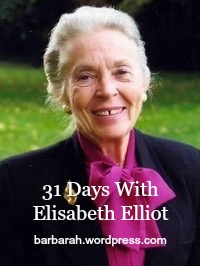
 It might seem odd to start off this series with this quote, but it is one that has ministered to me often. We are all under limitations of some kind: season of life, physical abilities, obligations, etc. And it seems whatever situation we are in, we find ourselves wishing we could do something that we can’t. Sometimes God does reveal His power and grace by overriding whatever the limitations are, or seem to be, as was the case with Moses telling God that he couldn’t speak, so it is important to pray and consider whether the issue is really a limitation or an obstacle God wants to remove. But other times the limitations are from His hand for His purposes.
The following is from Elisabeth’s book A Lamp For My Feet:
Yesterday as I was reading my brother Tom’s book, The Achievement of C.S. Lewis, I was admiring again the scope of his knowledge, his ability to comprehend another’s genius, and his wonderful command of English. By contrast my own limitations seemed severe indeed. They are of many kinds–analytical, critical, articulatory, not to mention educational. But my limitations, placing me in a different category from Tom Howard’s or anyone else’s, become, in the sovereignty of God, gifts. For it is with the equipment that I have been given that I am to glorify God. It is this job, not that one, that He gave me.
For some, the limitations are not intellectual but physical. The same truth applies. Within the context of their suffering, with whatever strength they have, be it ever so small, they are to glorify God. The apostle Paul actually claimed that he “gloried” in infirmities, because it was there that the power of Christ was made known to him.
If we regard each limitation which we are conscious of today as a gift–that is, as one of the terms of our particular service to the Master–we won’t complain or pity or excuse ourselves. We will rather offer up those gifts as a sacrifice, with thanksgiving.
And this is from a section titled “Apportioned Limitations” from the same book:
The God who determined the measurements of the foundations of the earth sets limitations to the scope of our work. It is always tempting to measure ourselves by one another, but this easily leads to boasting or despair. It is our business to find the sphere of service allotted to us, and do all that He has appointed us to do within that sphere, not “commending ourselves.”
Paul said, “We will keep to the limits God has apportioned us” (2 Cor. 10:13 RSV). Jesus did that–willing to become a helpless, newborn baby, to be a growing child, an adolescent, a man, each stage bounded by its peculiar strictures, yet each offering adequate scope in which to glorify his Father.
Lord, glorify yourself through me and in the place You’ve set me. Let me not covet another’s place or work or glory.
I have thought often in regard to dealing with the after-effects of transverse myelitis, “Lord, I could serve you so much better without this.” But it’s as if He were saying, “No, this is what I am using to shape your service for Me.” Most people who have gone through any type of trial or affliction in life would say that, although they didn’t welcome the trial itself, they were drawn closer to the Lord, and the lessons learned were invaluable.
Our current circumstances may be temporary or permanent. We need not lament what we can’t do. We can seek God’s will for what to do now. As long as the Lord has left us here on earth, He has some way for us to bless others, perhaps by prayer, perhaps by being willing for others to minister to us. Sometimes we can be dismayed by our limitations, but as Elisabeth said, limitations just define our ministry: “For it is with the equipment that I have been given that I am to glorify God. It is this job, not that one, that He gave me.”
“God hath chosen the weak things of the world to confound the things which are mighty” (I Cor. 1:27) and to showcase His strength (II Cor. 12:8-10).

Save


 Stray Thoughts