Should I Really Honor an Ungodly Politician? “If you chose one word to describe the most prominent attitude in today’s society, there is one I am sure you would not immediately select. The word is ‘honor.’ Nor is this a primary descriptor of many Christians in our day. Rather, on a variety of fronts, American Christians are divided, combative, and even angry.”
It Is a Weakness of Faith to Refuse to Mourn the Death of Loved Ones, HT to Challies. “I am often troubled when I attend a funeral, and the leader refuses to let the people mourn. Those in charge of funeral arrangements, and often the families themselves, put so much effort into making the occasion a celebration of life, a graduation to heaven, that those in attendance might feel like their faith is weak if they were to shed tears of sorrow, but the opposite is true.”
On Fridays I like to pause for a few moments with Susanne and friends to reflect on some of the blessings of the week.
Here we are at another Friday already! And here are my five favorites from the week:
1. A Zoom call. A friend and I had our own Zoom meeting so we could catch up by seeing as well as hearing each other.
2. Haircuts. My dear daughter-in-law cut my and my husband’s hair for us again—second time for me since the pandemic started, third time for my husband. We so appreciate this! And then she fed us lunch afterward.
3. My husband’s head for business and finances. We recently refinanced our mortgage to take advantage of lower interest rates and to borrow a little extra to take care of paying off our solar panels, one of our sons’ school loans, etc. As my husband and the loan officer were discussing the papers we were signing, I was thankful he knew what questions to ask and what it all meant—not just for closing, but for the whole process.
4. An excellent customer service experience after a couple of bad ones. My husband had to deal with a situation with a company that involved several hours on the phone over two days, being on hold and transferred multiple times, then going to the store for three hours—and the issue is still not resolved. By contrast, we went to another business this week to take care of a few things. The two people we dealt with were knowledgeable, efficient, and friendly. So refreshing.
5. Attending a funeral virtually. The pastor of the church where I was saved as a teenager passed away at the age of 91. He was a kind, faithful, godly man, and his preaching and teaching gave me a good foundation for the rest of my Christian life. He conducted the funerals of both my parents even though I had moved away and no one from the family attended church there any more. Though sad for the loss, I was thankful the service was live-streamed and recorded so those of us who couldn’t be there could participate. It was a blessing to hear of his history, character, and personality (most of it I knew, but some was new to me). It was also fun to see people I knew from my time in Houston who participated in the service. “The memory of the just is blessed” (Proverbs 10:7a).
Bonus: We don’t have any particular rites or traditions to observe Veteran’s Day, but I like to take a moment to be thankful for the veterans in my own family and all those who are serving and have served. It’s amazing that anyone would sacrifice so much for others, and it’s much appreciated.
Happy Friday! What is something good from your week?
In Chris Fabry’s novel, Under a Cloudless Sky, two girls from widely different circumstances become friends in 1933 West Virginia. Bean, short for Beatrice, is the daughter of a coal miner. Ruby’s father is one of the coal mine’s owners. The other owner, Mr. Coleman, employs some shady practices, and the conflict between him and Ruby’s father comes to a head.
Fast forward to 2004. The community wants to make the old coal mine’s company store a tourist attraction. They invite Ruby, now in her eighties, to be their special guest for the opening. But she had never returned and never planned to. There were too many painful memories and hidden secrets.
But Ruby’s grown children are pressuring her to give up her keys and her independence. So she decides she’ll go back to that little coal mining community on her own without telling her children where she’s going. Maybe that will teach them that she’s perfectly capable of handling herself.
Hollis Beasley is one of the last holdouts who refuses to sell his land to Coleman Coal and Energy. But with his neighbors succumbing to CCE one by one and his wife’s illness, he’s not sure if he’ll be able to keep the promise he made his parents to keep the land. “It was in a man to fight and it was in a woman to nest, and those desires competed and wore both down until they became one flesh.”
As the story goes back and forth between timelines, secrets come to light and provide unexpected connections between characters.
Chris Fabry’s stories always contain a lot of warmth and heart, and this one is no exception. He shares in his afterword the people and stories the book is based on. He skillfully brought them together in a compelling way.
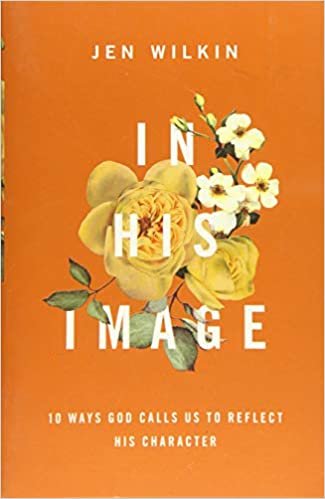
But there are ways we are supposed to be like God. We will never become deity and we’ll never exercise these in perfection, at least until heaven. But we’re supposed to grow in them now. Jen discusses ten of these in In His Image: 10 Ways God Calls Us to Reflect His Character.: holiness, love, goodness, justice, mercy, graciousness, faithfulness, patience, truthfulness, and wisdom.
Jesus held all these traits in perfection. We’re called “to be conformed to [His] image” (Romans 8:29).
Our inclination is to discern God’s will by asking, “What should I do?” But God’s will concerns itself primarily with who we are and only secondarily with what we do. By changing the question and asking, “Who should I be?” we see that God’s will is not concealed in his Word, but is plainly revealed.
The Bible plainly answers the question “Who should I be?” with “Be like Jesus Christ, who perfectty images God in human form.” God’s will for our lives is that we conform to the image of Christ, whose incarnation shows us humanity perfectly conformed to the image of God (pp. 20-21).
In each chapter, Jen discusses what these traits look like in God, and then explains how we can best put them to practice in our own lives. The chapters end with verses and discussion questions.
I have multiple places marked in the book. But here are a few quotes that convicted me:
If we focus on our actions without addressing our hearts, we may end up merely as better behaved lovers of self.
As with the Ten Commandments, the Great Commandment begins with the vertical relationship and moves to horizontal relationships. Unless we love God with all of our heart, soul, mind, and strength, we will love ourselves and our neighbors inadequately. Right love of God is what enables right love of self and others (p. 38).
And what does right vertical relationship look like? It looks like the full deployment of our heart, soul, mind and strength—the totality of our being—in the active love of God (p. 39).
Right now, there is much that we witness or endure that is clearly not good. But under the sovereign governance of an eternally good God, we can trust that all that is not now good will ultimately be used for our good. Like Joseph we will one day, in this life or the next, look over our had pasts and acknowledge with him that what our enemies meant for evil God has used for good (Gen. 50:20) (p. 48).
Generosity is the hallmark of those who are determined to be lights in the darkness as children of their heavenly Father. It is the calling card of all who are recipients of the generous good news of salvation through Christ (p. 52).
We are familiar with the maxim that patience is a virtue, but it is a virtue rarely sought. The world’s solution to the problem of impatience is not to develop patience, but to eliminate as many situations that require it as possible (p. 110).
It is not coincidental that a lack of discernment and a neglected Bible are so often found in company (p. 144).
I wish there was a way to retain everything we read from books. Since there is not, I will have to revisit this and None Like Him again in the future. I appreciate Jen’s clear and skillful discussion of biblical concepts.
A blog friend was once reading a book about Bible study. She lamented that, as good as the book was, it didn’t mentioned how to find the time to employ all that instruction.
I guess the authors feel that once we are assured of the importance of Bible reading and study, we’ll make it a priority and make time. And I think that’s pretty much what it comes down to. If we are waiting until time magically opens up with the solitude and inclination we need without a dozen other things crowding in…I just don’t think that’s going to happen, at least not regularly.
Years ago our assistant pastor spoke of struggling to make time for reading his Bible. He said to our senior pastor, an older, godly man, “I guess you don’t have trouble making time for Bible reading any more, do you?” The older man just laughed.
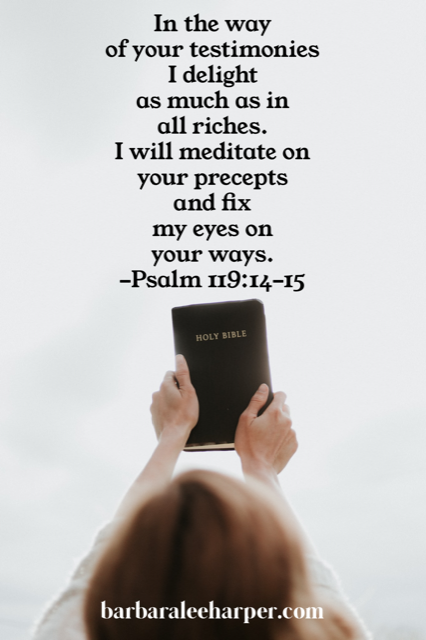
Finding the time is always going to be a struggle. There are always duties, distractions, and people clamoring for that time. The Enemy of our souls fights against our spending time in the Bible. Instead of getting discouraged about it, we can just accept that it is a common problem and prayerfully seek ways to deal with it. Perhaps reminding ourselves of reasons to read the Bible will renew our motivation.
We need to remember, too, that making time to read the Bible isn’t just about ticking off another duty. Every relationship thrives on communication. If we went for days without talking with our husbands except in the briefest necessary exchanges, we’d feel the effects pretty soon and realize we need some time alone together. Though sometimes we need to set up routines to establish good habits, taking time to read the Bible shouldn’t be a matter of rigid schedules, but rather of taking time to meet with the One Who loves us best.
So with these things in mind, here are some suggestions for carving time out to meet with the Lord:
1. Get up earlier or stay up later. I can hear you groaning. But for many of us, that’s the only way to get some time alone.
2. Keep the Bible handy. One friend with three small children close in age kept her Bible out in her kitchen. She couldn’t set aside a longer period of solitude, but she could read in smaller snatches through the day.
3. Bible apps. There are a number of apps with Bible reading plans, reminders, etc. Since we usually have our phones nearby all day, we have easy access to the Scriptures all the time.
4. Listen. Some people like to listen to recorded versions of the Bible while driving, exercising, making dinner, etc.
5. Plan for it after a natural break in the day. It’s hard for to stop in the middle of a morning or afternoon and put everything aside to read. But a break in the routine, when we’re shifting gears anyway, can help us work in some time for reading, like after a meal, after taking the kids to school, etc.
6. Meal time, especially if you eat alone.
7. Waiting time. We usually check social media or open a book if we have to wait at a doctor’s office or in car line at school, but that can be a good time for some Bible reading.
9. Establish a routine. Once we get used to setting aside a certain time for Bible reading, it’s not such a scramble to look for that time every day.
9. Don’t wait for perfection. One problem with a routine is that we can’t always figure out how to function when the routine is disrupted, like when we’re traveling or someone is sick or we have small children at home. I wrote a post some time back called Encouragement for mothers of young children about trying to find time for devotions with little ones in the house. Though I normally like getting up early and having solitude and quietness for Bible reading, that just didn’t work with little ones. Yet God enabled me to read and profit from it while they kept me company or played near me, even though usually I couldn’t concentrate under those circumstances.
10. Anything is better than nothing. You may not have time on a given day to work out your full Bible reading routine. But you can usually read something. I’ve found that when I truly only had a few moments, God often gave me just what I needed in a verse or two.
11. Talk with your husband, roommates, siblings, whoever you live with. Years ago I caught part of a radio program where the preacher was scolding women who wanted to spend early morning time to have devotions. He said the husband as the leader should have that time, since the wife had “all day” in which she could have devotions. The man obviously had not spent a whole day at home alone with kids. That mentality is wrong on many levels. Not long after that a missionary speaking at our church mentioned protecting that time for his wife, a much better example of servant leadership and love. If the only way either parent can have devotions is for one of them to watch the children, then they can do that for each other. If a particular time of day is the best time for two people in a house, they can work out different locations if they get too distracted in the same room. Whatever conflict there might be about time and place preferences, talk with each other to work out the best solution for both and be willing to compromise.
12. Pray. In the blog post I referred to earlier, I mentioned that sometimes I’d get to the end of the day and lament to the Lord that I had no idea when I could have read my Bible that day. I began instead to pray at the beginning of the day for wisdom and alertness for those moments when I could, and that made a profound difference.
13. Set something aside. If we have times to read other books, peruse Facebook, watch TV, or play games on our phones, we have time to read the Bible. I admit, if I sit down to relax for a few minutes with a book and realize I haven’t read my Bible yet that day, I don’t always have the best attitude about laying down my book and picking up my Bible. But when I confess that to the Lord and then go ahead, He graciously speaks to me through His Word. We do need time to relax as well, but that shouldn’t come at the expense of time in God’s Word. He knows our needs, and we can ask Him for both time to spend in His Word and for some down time.
What about you? What ways have you found to make time for Bible reading?
Don’t Fall For It, HT to Challies. “Satan is clever. He’s happy to distract you with global disturbances while he chips away at the foundations of your devotion to Christ.”
Loving Difficult Neighbors Isn’t Optional, HT to Challies. “Imagine standing before God with this logic: ‘Yes Lord, they were made in your image and starved for gospel hope, but their dog’s barking always woke us up at 2 a.m., so we shut them out.'”
Catching Our Reflections in the Lives of Our Children, HT to The Story Warren. “What can we do when confronted with the sin of our children, sin that turns out to be ours as well? The discouragement can be crippling, preventing us from seeing any fruitful way forward. Even in the midst of this discouragement, God invites us to move forward in hope, pressing into the gospel of grace.”
On Fridays I like to pause for a few moments with Susanne and friends to reflect on some of the blessings of the week.
The first week of November has flown by. I want to hold it in hand just a few moments before it vanishes completely by remembering the best parts.
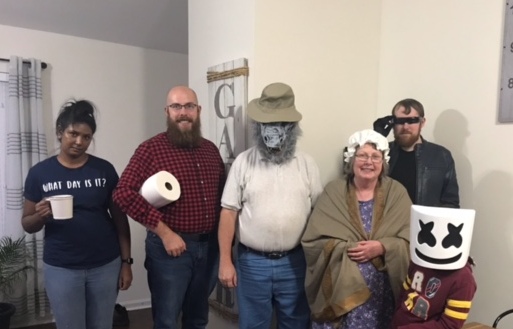
1. Dressing up. Because my son and daughter-in-law couldn’t take my grandson trick-or-treating, they had a family get-together Halloween night and asked us all to dress up. Even though I tried to think of something with minimal work, it was fun.
Mittu potrays a tired stay-at-home mom with her coffee (love the shirt!). Jason is the Brawny paper towel guy. Jim is a wolf. I’m a fairy-tale Grandma. Jesse is Cyclops, an X-men character. Timothy is Marshmellow. (They don’t endorse all that the singer Marshmellow puts out, but they let Timothy watch a couple of his videos).
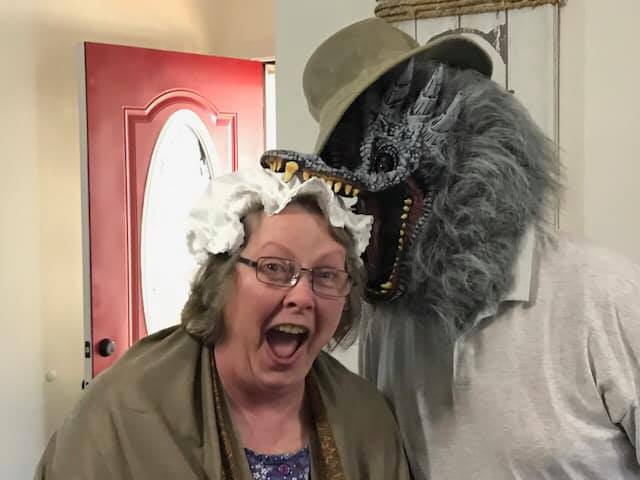
And here’s an encounter between Grandma and the Big Bad Wolf. 🙂
We enjoyed spaghetti and a wonderful chocolate swirl cake, and then played some games.
2. An extra hour. I sure hate to give that hour up in the spring for Daylight Savings Time, but I love getting it back in the fall.
3. The election. I was hoping and praying the results would be more definitive. At the time of this writing, we still don’t have a final result. But I am thankful we have the opportunity to make a choice.
4. At-home sleep study. That’s been on the horizon for six weeks now, and it was nice to get it over with. It will be 7-10 days before I hear the results.
5. Winning a book. I received notice that I won a book in a contest I had forgotten about entering! A nice surprise.
We’re having a cold snap this week, making us finally turn the central heat on. I think I say this every year, but I am so thankful we can heat the whole house with the push of a button. We had a fireplace in our last house that we used just for ambience sometimes or when the power was out. It was cozy, but a lot of work to keep adding wood and clearing ashes. I’m glad we don’t have to do that to keep warm.
The cold has made it seem like we had a short autumn and skipped ahead to winter. But it’s supposed to be a bit warmer next week. We hadn’t been out and around to see the fall color this year, but I drank in what was left on my way back from the sleep center.
And that wraps up this week! How was your first week of November?
Margot De Wilde thinks in numbers. Numerals line up differently in her head when all is well or something is off. Her father developed a system of cryptography before WWI with young Margot as his main pupil. After his death, Margot and her mother were rescued from Belgium (in A Song Unheard) to be with her brother, famous violinist Lucas De Wilde, in London. Though a teenager, Margot is recruited to work in the admiralty’s secret Room 40 deciphering Germany’s coded messages.
Margot had one good friend back in Belgium, but she’s not interested in the silly things most girls are. She’s content to be alone, but when she notices Dot, another young woman at the admiralty seemingly on the outskirts of society, they strike up a satisfying friendship.
Dot thinks her brother, Drake, is in the Navy. Their grandfather in Spain thinks Drake is a student. Neither suspects Drake actually works undercover.
Drake finds Margot fascinating and loves her sarcastic sense of humor. But Margot has no time for or interest in romance.
Then Margot suffers a tragic loss that turns her well-ordered world upside-down. Not only do the numbers in her mind stop, but God seems silent.
And Drake returns from Spain wounded with an enemy who may pursue him all the way to London.
The Number of Love is the first in Roseanna M. White’s Codebreakers series, which follows the Shadows Over England series. A few of the characters carry over. This novel is every bit as captivating as the first three. It may be my favorite of Roseanna’s so far.
A couple of quotes from the book:
Faith isn’t just feeling. We have to know He’s still there, unchanged, even when we can’t feel Him. When the grief’s too loud to let us hear His voice.
There were never any guarantees. Even being sure God wanted him to do this didn’t mean he’d come home safely. Sometimes God’s will meant bullets searing flesh. Death coming too soon. Sometimes God’s will was to let man taste the consequences of his folly and his hatred and his supposed self-sufficiency. Sometimes God let people die. Let His children break. And then pieced them back together into something new. Something that He could use for His glory instead of theirs
I enjoyed the suspense provided by the intrigue and mystery concerning Drake’s pursuer and the historical detail. At the end of the book, Roseanna differentiates between the actual historical facts she used and the details she made up.There was an actual Room 40 of codebreakers during WWI that few knew about.
I love that Margot is an imperfect heroine. Even though she’s smart, she’s also young and a bit immature. And she can come across as a little arrogant sometimes. But her experiences help mature and humble her and teach her to rely not on her abilities or systems, but on God.
I’m so glad Roseanna continued this series. I look forward to the next book!
Vitriol and mud-slinging are not new to politics, but the last two presidential elections have been the worst in my memory. Emotions and tension are high on both sides.
But no matter what the outcome is on Tuesday, several things will still be true.
God reigns. “God reigns over the nations; God sits on his holy throne” (Psalm 47:8). Our church has read through large chunks of the Old Testament over the last year. No matter who was in charge of what earthly kingdom, God was always at work, sometimes overtly, sometimes “behind the scenes.” “The Lord has established his throne in the heavens, and his kingdom rules over all” (Psalm 103:19).
This doesn’t mean we don’t vote. God often uses means and circumstances, and voting is the means by which rulers are elected here
Authorities come from God, even when they are not godly, even when we don’t agree with everything they do.
For there is no authority except from God, and those that exist have been instituted by God. Therefore whoever resists the authorities resists what God has appointed, and those who resist will incur judgment. (Romans 13:1b-2)
He changes times and seasons; he removes kings and sets up kings; he gives wisdom to the wise and knowledge to those who have understanding. (Daniel 2:21)
The Most High rules the kingdom of men and gives it to whom he will and sets over it the lowliest of men. (Daniel 4:17b)
We’re responsible to pray. “First of all, then, I urge that supplications, prayers, intercessions, and thanksgivings be made for all people, for kings and all who are in high positions, that we may lead a peaceful and quiet life, godly and dignified in every way” (1 Timothy 2:1-2).
We’re to respect our leaders. Peter instructed, “Honor everyone. Love the brotherhood. Fear God. Honor the emperor” 1 Peter 2:17). He wrote that, inspired by the Holy Spirit, when one of the worst rulers ever was on the throne: Nero. That doesn’t mean he obeyed authorities who told him not to do what God told him to do. That doesn’t mean we never speak up when a ruler is in the wrong: John the Baptist did, as did Daniel and many of the OT prophets (though they also faced consequences for speaking out and disobeying). Paul said the same thing: “Pay to all what is owed to them: taxes to whom taxes are owed, revenue to whom revenue is owed, respect to whom respect is owed, honor to whom honor is owed” (Romans 13:7), echoing what Jesus said: “Render to Caesar the things that are Caesar’s, and to God the things that are God’s” (Mark 12:17).
We’re to be subject to authorities. “Be subject for the Lord’s sake to every human institution, whether it be to the emperor as supreme,or to governors as sent by him to punish those who do evil and to praise those who do good. For this is the will of God, that by doing good you should put to silence the ignorance of foolish people” (1 Peter 2:13-15). The only exception is when the government tells us to do something wrong. The Hebrew midwives didn’t kill Jewish babies as instructed. The disciples still preached in the name of Jesus when told not to. People hid and helped Jews during WWII. People still printed Bibles behind the Iron Curtain.
Our responsibilities are not over. Very early in my first voting forays, some people seemed to breathe a sigh of relief and then sit back when their candidate was elected, as if to say, “Whew! That’s done. We’re okay for four more years.” But, we still need to be aware and use the voice we have, because . . .
No ruler is perfect. Some are better than others, but we can’t put our total hope in any of them. They may not see all sides of an issue or may be getting bad advice, so it’s important to be aware of issues and communicate our concerns and preferences.
We still have a voice. In this country, we have the right and responsibility to let our voice be heard, to vote, to write our representatives. No ruler has carte blanche.
Government can’t meet all our needs. It was never meant to. It has taken on responsibilities the church and others are supposed to bear. And while we need it to do what it’s designed for, ultimately our hope is in God. “Put not your trust in princes, in a son of man, in whom there is no salvation. When his breath departs, he returns to the earth; on that very day his plans perish. Blessed is he whose help is the God of Jacob, whose hope is in the Lord his God, who made heaven and earth, the sea, and all that is in them, who keeps faith forever” (Psalm 146:3-6).
God’s promises are still true. He has promised to supply our needs, answer prayer, never leave us or forsake us. God’s power and wisdom and love are not limited by earthly rulers.
I have preferences, hopes, and fears for this election. I know God doesn’t always answer prayer the way we think is best, but I am sure hoping He does this time. I’m praying, and I’ve voted. My responsibilities are the same: pray, trust, do His will moment by moment, love my neighbor, let my light shine. But ultimately, He is on the throne working out His perfect will. My hope is in Him.
This is my Father’s world: O let me ne’er forget That though the wrong seems oft so strong, God is the Ruler yet. This is my Father’s world: Why should my heart be sad? The Lord is King: let the heavens ring! God reigns; let earth be glad!










 Stray Thoughts