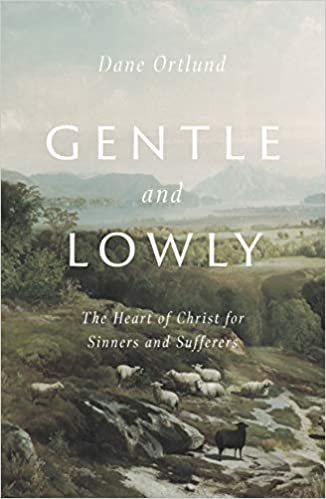
Gentle and Lowly

When I first saw Dane Ortlund’s book, Gentle and Lowly, I thought the subject would be encouraging Christians to be humble and kind in their dealings.

But then I learned that the book explores the gently and lowly aspect of Jesus. Jesus described himself this way, but often when people emphasize His gentleness, they deemphasize His holiness, His righteousness, His anger at sin, etc. I wasn’t familiar with Dane Ortlund, so I wasn’t sure how he would handle this topic. I began the book warily.

I need not have worried. Ortlund takes great care to keep in mind the whole picture of who Jesus is.

Yes, he is the fulfillment of the Old Testament hopes and longings (Matt. 5: 17). Yes, he is one whose holiness causes even his friends to fall down in fear, aware of their sinfulness (Luke 5: 8). Yes, he is a mighty teacher, one whose authority outstripped even that of the religious PhDs of the day (Mark 1: 22). To diminish any of these is to step outside of vital historic orthodoxy. But the dominant note left ringing in our ears after reading the Gospels, the most vivid and arresting element of the portrait, is the way the Holy Son of God moves toward, touches, heals, embraces, and forgives those who least deserve it yet truly desire it (p. 27. All page numbers are from the Kindle version).

As we zero in on the affectionate heart of Christ, how do we ensure that we are growing in a healthy understanding of the whole counsel of God and a comprehensive and therefore proportionate vision of who Christ is? Three comments are needed here. First, the wrath of Christ and the mercy of Christ are not at odds with one another, like a see-saw, one diminishing to the degree that the other is held up. Rather, the two rise and fall together. The more robust one’s felt understanding of the just wrath of Christ against all that is evil both around us and within us, the more robust our felt understanding of his mercy (pp. 28-29).

In fact, Jesus’ holiness and righteousness makes it all the more a marvel that “The point in saying that Jesus is lowly is that he is accessible. For all his resplendent glory and dazzling holiness, his supreme uniqueness and otherness, no one in human history has ever been more approachable than Jesus Christ” p. 20). “This is deeper than saying Jesus is loving or merciful or gracious. The cumulative testimony of the four Gospels is that when Jesus Christ sees the fallenness of the world all about him, his deepest impulse, his most natural instinct, is to move toward that sin and suffering, not away from it” (p. 29). “His holiness finds evil revolting, more revolting than any of us ever could feel. But it is that very holiness that also draws his heart out to help and relieve and protect and comfort” (pp. 69-70).

Ortlund reminds us that “’Gentle and lowly’ does not mean ‘mushy and frothy,’” and “This is not who he is to everyone, indiscriminately. This is who he is for those who come to him, who take his yoke upon them, who cry to him for help” (p. 21).

What elicits tenderness from Jesus is not the severity of the sin but whether the sinner comes to him. Whatever our offense, he deals gently with us. If we never come to him, we will experience a judgment so fierce it will be like a double-edged sword coming out of his mouth at us (Rev. 1: 16; 2: 12; 19: 15, 21). If we do come to him, as fierce as his lion-like judgment would have been against us, so deep will be his lamb-like tenderness for us (cf. Rev. 5: 5–6; Isa. 40: 10–11). We will be enveloped in one or the other. To no one will Jesus be neutral (p. 53).

Even after so many years of walking with the Lord, we can feel that He gets tired of us falling, failing, begging for mercy again and again. But “He does not get flustered and frustrated when we come to him for fresh forgiveness, for renewed pardon, with distress and need and emptiness. That’s the whole point. It’s what he came to heal. He went down into the horror of death and plunged out through the other side in order to provide a limitless supply of mercy and grace to his people” (p. 36).

For those united to him, the heart of Jesus is not a rental; it is your new permanent residence. You are not a tenant; you are a child. His heart is not a ticking time bomb; his heart is the green pastures and still waters of endless reassurances of his presence and comfort, whatever our present spiritual accomplishments. It is who he is (p. 66).

These qualities of mercy and accessibility and readiness to forgive come from the whole Trinity, the Father and Holy Spirit as well as the Son. ““Our redemption is not a matter of a gracious Son trying to calm down an uncontrollably angry Father. The Father himself ordains our deliverance. He takes the loving initiative” (p. 60).

A few more quotes:

Your salvation is not merely a matter of a saving formula, but of a saving person (p. 91)

The mercy of God reaches down and rinses clean not only obviously bad people but fraudulently good people, both of whom equally stand in need of resurrection (p. 177).

Do not minimize your sin or excuse it away. Raise no defense. Simply take it to the one who is already at the right hand of the Father, advocating for you on the basis of his own wounds. Let your own unrighteousness, in all your darkness and despair, drive you to Jesus Christ, the righteous, in all his brightness and sufficiency (p. 94).

Nothing can now un-child you. Not even you (p.196).

I’m so thankful for Linda sponsoring a book club to read through this book together the last few weeks. I had seen the book mentioned and thought, “Hmm, I might look into that some time.” But the opportunity to read and discuss the book with others spurred me on to read it now. It will stay with me for a long time.

(I often link up with some of these bloggers.)

Anne Askew, Reformation Martyr

Only Glory Awaits: The Story of Anne Askew, Reformation Martyr by Leslie S. Nuernberg is historical fiction. Anne Askew was a real person, but the book is written in story form with conversations imagined by the author based on what she knew of the people and situations involved.

Anne lived during the time of King Henry VIII and was even friends with one of his wives, Catherine Parr. Anne was bright and well-educated, especially for a women of her time.

The Reformation was sweeping across Great Britain, with Catholics strongly opposing it. Anne and two of her brothers, Francis and Edward, embraced the opportunity to read Scripture on their own, which Catholicism discouraged. Anne came to believe on the Lord alone for salvation at age eleven. Their father was tolerant but not interested himself. He didn’t want to change his way of life. Francis would bring Reformation literature home to Anne privately.

When Anne was fifteen, her sister was engaged to marry a local Catholic farmer, Thomas Kyme. But her sister, Martha, passed away before the wedding. Thomas and Anne’s father arranged that she should take her sister’s place. Anne pleaded and begged to be released from this obligation: not only did she have no love or interest in Kyme, she was Protestant and he was Catholic. She knew they would never agree about matters closest to her heart.

But Anne was married anyway. The book posits that Anne’s brother, Francis, persuaded her that she was to be subject to her parents and marry Thomas. He later came to regret his influence in this matter.

The marriage was a disaster from the start. Thomas and Anne were different in just about every way possible. If the book is correct, I felt Anne failed here. She treated Thomas as a heretic and argued with him instead of viewing him as a soul who needed Christ.

When Thomas was not home, Anne would meet with other women in the area to try to bring them to the Lord. Thomas forbade her “gospeling” and took her Bible away.

Anne wanted a divorce, and Thomas eventually sent her back home. But, according to the book, Thomas’s priest urged him to bring his wife home and convert her to Catholicism. Anne would not go.

Wikipedia says Anne had two children with Kyme, but the book doesn’t mention them.

She was eventually arrested and imprisoned. She was intelligent and well-versed in Scripture and stunned her questioners by her answers, especially about her views of transubstantiation (the idea that the bread and drink of communion actually become the body and blood of Christ. Catholics believe it does; Protestants believe the food and drink is merely symbolic). Her examiners also wanted her to give names of other women who believed as she did, but she refused.

She was one of only two women tortured in the Tower of London. When the torturer refused to continue and left to ask the king’s permission to stop, Anne’s questioners used the rack on her themselves, tearing muscle and pulling bones out of sockets. Anne was condemned to be burned at the stake at the age of 25. She was so broken and in such pain, she had to be carried in a chair to her execution.

This book doesn’t present Anne as a perfect heroine. She came across as proud and stubborn at times. But her loyalty to her Savior and to truth and her hunger for the Word of God are exemplary.

I thought the author did a fair job. Somehow the Kindle version’s editing fell through in the last 20% of the book, with several obvious mistakes. I hope this isn’t the case for the print version and can be corrected.

Thoughts From a Memorial Service

Last Friday, my husband and I attended the memorial service of one of his primary mentors.

We didn’t really use the word “mentor” back in the day. Pastor Bob was the pastor of Jim’s family’s church and also the father of his best friend. Jim said at the memorial service that he had spent almost more time at this family’s home than his own during his teen years, not counting sleep time.

Three of Pastor Bob’s children were in college when we were, so I got to know them when Jim and I started dating. The youngest came to the university later, but we were living nearby at the time. We saw her sometimes on campus and had her over occasionally. She began attending our church, and when she married, her husband became one of our assistant pastors. So we got to know them well, too.

We had hoped to have time to visit with the family before and after the memorial service, but we also didn’t want to intrude. We knew this was a special time for them when they needed each other, plus they had other friends and relatives there. But we did get to catch up with them during the visitation and at a lunch afterward that they graciously invited us to. Then Jim’s friend invited us to his house afterward, where all the family would be visiting the rest of the afternoon until different ones needed to head back to their homes. It felt something like a family reunion, and we were blessed to be a part of it.

Memorial services are good and sad at the same time. The whole reason for such a service was due to a beloved person’s absence. But it was a joy to hear of his life, his humor, the sayings he was known for, his heart for people, his integrity and work ethic. After each of his children spoke, the mic was open for anyone in the congregation to share a memory or something they appreciated about Pastor Bob. It’s amazing to consider the ripples that spread from one life to so many others.

Ecclesiastes 7:12 tells us, “It is better to go to the house of mourning than to go to the house of feasting, for this is the end of all mankind, and the living will lay it to heart.”

The “house of mourning” reminds us that

  • Our lives will come to an end, and we need to be ready. “Yet you do not know what tomorrow will bring. What is your life? For you are a mist that appears for a little time and then vanishes” (James 4:14).
  • Our lives will influence others for better or for worse. “A good name is better than precious ointment” (Ecclesiastes 7:1a).
  • “Death is swallowed up in victory. O death, where is your victory? O death, where is your sting?” The sting of death is sin, and the power of sin is the law. But thanks be to God, who gives us the victory through our Lord Jesus Christ” 1 Corinthians 15:54-57).
  • Jesus is preparing a place for us (John 14:1-6), a place where He dwells, a place with no sorrow, crying, pain, sin (Revelation 21:1-4).
  • Believers will see their believing loved ones again after death (1 Thessalonians 4:13-18).

I’ve also pondered this last week that what I think of as the “old guard” —the faithful people who were major influences in our lives—is almost gone. They weren’t all old in years, though many were. Both my parents and my husband’s have passed away. The woman who was the greatest influence of my life next to my mom passed away a few years ago. The pastor of my early formative years went to heaven just last year. Now Pastor Bob. Other pastors, teachers, aunts, friends have gone on ahead.

Some of these were the ones I most counted on for prayer and counsel. What am I supposed to do without them?

Well, God is faithful and supplies all our needs. He counsels us through His Word and brings others in our lives to strengthen and support us.

But I’m humbled and stunned that I am supposed to be the “old guard” in others’ lives now. Who is sufficient for these things? Not me. But He is. Memorial services also encourage me to give my one brief life to Him and to others.

Are you ready for heaven? If not please, please, read here.

Two songs have been on my mind the last few days. This first one, Ron Hamilton’s “Goodnight,” came to mind because it was the reality of my husband’s friend, Steve, who took care of his father the last several years. The first stanza tells of a dad tucking his kids in bed and telling them good night. In the second stanza, the son now tucks the father in with the same message. In the third, the father has passed away, and the son looks forward to seeing him “in the morning.”

This one was sung at one of our former churches often and was sung at another former pastor’s funeral. Then I saw it on my friend Kim’s blog just before attending Pastor Bob’s memorial.

(I often link up with some of these bloggers.)

Laudable Linkage

I was sorry to miss Friday’s Fave Five yesterday. We were out of town for a memorial service for the man who was my husband’s pastor in his teens and college years. His son is my husband’s best friend, and the whole family is like second family to us.

I thought we’d arrive early enough Thursday evening to write an FFF post for Friday, but that didn’t work out. We just got home this morning and had a nap, with more to come, I am sure.

Since I post these links in a draft as I find them, this post was nearly ready to go, minus a video or photo at the end this time.

Carry a Candle. “Because it’s increasingly debilitatingly possible, with the rise of instant global communications and now virtual social outlets, to spend – not just whole afternoons – but whole years of our lives torturing ourselves over the state of nations. Cursing the night.”

I Searched for the Key to Discipleship. “Over time, it became painfully clear to me that the answer to the question of discipleship isn’t as easy as finding the right program. This is something that I learned from our church members by watching them live it out: discipleship isn’t nice, crisp books or carefully planned mission trips. It’s something altogether more intimate, more demanding, and more sacrificial.”

God Is Frustrating, but not in the sense we usually mean the word. HT to Challies.

The Early Christians Were Odd, Too. “It can be disheartening, not to mention frightening, when our culture rejects aspects of Christianity as strange or offensive. When Christians feel isolated and alone, it’s helpful to remember this experience is nothing new for God’s people.”

Is There Such a Thing as Righteous Anger? HT to Challies. “Technically, of course, there is such a thing as an empty gun. But if you think it’s empty and you’re wrong, the consequences can be so tragic it’s better to just pretend that no gun is ever empty, except in very specific situations like cleaning or repairing it. I’m beginning to think we should have a similar attitude towards so-called ‘righteous anger.'”

Do Not Trust Your Anger, HT to the article above. “But unlike our Lord, when we get angry, we can corrupt it. We can complicate our anger with selfishness, wounded pride, impatience, lust for revenge, plus a lot more — and without even realizing it. But surely we can all agree on this: our anger can be good, and it can be bad, and it can even mingle good and bad together. So, we must weigh our anger carefully (and continue to weigh it throughout our lives).”

Happy Saturday!