Unknown's avatar

About Barbara Harper

https://barbarah.wordpress.com

The Good Portion

Most of us don’t get terribly excited about doctrine. We don’t rub our hands together before opening the Bible eagerly, anticipating what doctrine we’ll encounter this time. We think of doctrine as dry and dusty, full of highfalutin polysyllabic words that go over our heads.

We think doctrine is boring.

But right doctrine is our bedrock. Knowing what we believe and why comforts us and keeps us on course.

If we’re feeling insignificant, lonely, unloved, we might be inspired by an Instagram meme or a friend’s compliment—for a little while. But what truly ministers to our hearts is the foundational truths that God is with us even if we don’t “feel” Him, that He loves us even when we feel most unlovable, that we matter to Him because He created us and redeemed us.

Almost every NT book encourages right doctrine and warns against false doctrine. Doctrine determines and directs our thinking and actions.

With that in mind, Keri Folmar wrote The Good Portion: Scripture: The Doctrine of Scripture for Every Woman “to shed light on the treasure and sweetness of the sacred Scriptures. The book attempts to summarize the doctrine of the Word of God in a way that keeps the relational nature of the Bible at the forefront. After all, the Bible is God speaking to us. It is God revealing Himself with words and calling us into relationship with Him.” The title comes from the example of Mary of Bethany, who chose “the good portion, which will not be taken away from her” (Luke 10:42) by sitting at Jesus’ feet and listening to His teaching.

The eight chapters cover how we can know God through His Word, the Bible’s inspiration, trustworthiness, authority, clarity (ability to be understood), necessity, and sufficiency. Keri does a wonderful job keeping ” the relational nature of the Bible at the forefront.” The chapters are not “dry” at all, and each feeds into knowing God better and developing our relationship with Him.

A few of the quotes I noted in the book:

God is not silent. He has revealed Himself. He will speak to us if we will take our Bibles off the shelf and taste and see His goodness. It is through regularly hearing God speak that we can know Him and enjoy relationship with Him.

Churches want ‘customers’, so they work hard not to offend. Pretty soon the cross is bloodless, and Jesus becomes merely a good example for some to follow. It all starts with sidelining the Bible. We are told, “Let’s not put God in a box or a ‘book.”’ The Bible may remain a “participa[nt] in all our conversations,” but it loses its authority as the Word of God—all in an attempt to make Christianity more palatable to modern sensibilities. But the apostle Paul would not have agreed. He preached to pagan peoples, using the pure Word of God, declaring, ‘We refuse to practice cunning or to tamper with God’s word’ (2 Cor. 4: 2). We should also refuse to tamper with God’s Word, not judging it to be obsolete, but letting it sit in judgment over us.

If we believe the Bible is universal truth, we should use it to interpret our experiences and circumstances, not the other way around.

God has communicated to us in a clear way, yet Paul tells Timothy to ‘rightly handl[e] the word of truth’ (2 Tim. 2: 15), implying that we can wrongly handle it. Our goal in reading, studying or teaching the Bible is to understand the author’s intended meaning. Hermeneutics can help us in this endeavor. Let’s look at several overarching principles or guidelines to interpreting the Bible.

Mary has chosen Jesus over completing her tasks. Mary has chosen Jesus over pleasing or impressing others with her clean house and good food. She has chosen Jesus over everything else that is tugging at her heart and her time. Mary knows what’s necessary. She wants to know Jesus.

Don’t miss the impact of this passage: Jesus was commending a woman, 2,000 years ago in the Middle East, for sitting under His teaching. He wants women to know Him and be grounded in the Scriptures. He wants women to be serious students of the Bible, studying it and hearing it taught. Godly women choose the good portion by going to Jesus in His Word. And Jesus says this good portion will not be taken away.

Keri writes as a pastor’s wife in Dubai. Her experience sharing God’s Word in another culture and dealing with people from other religions helps to illustrate the truths she shares.

This book is the first in a series of three. “This series of books on doctrine for women is an attempt to fuel your enjoyment of God by encouraging a greater knowledge of Him.” I’ve not read the others, but I greatly enjoyed and highly recommend this one.

(I often link up with some of these bloggers.)

Don’t Forget the Hope

The church we attended when my sons were teens wanted to emphasize the need for modesty among the young women. Speakers shared that women displaying too much flesh or too-tight clothes could cause men to lust. Men are aroused visually, we were told, and therefore women and girls should take care how they present themselves visually.

I didn’t realize until years later that this information created a problem for one of my sons. If he was aroused visually, how was he supposed to respond when immodesty came into view through no fault of his own? It’s not that he had an extraordinary problem with lust, but he felt bombarded by what he saw constantly on billboards, in stores and public venues, and yes, even at church. He felt like he was at the mercy of temptation in a world that didn’t value modesty. The battle seemed impossible to win.

He spent his college summers volunteering at a Christian camp. One year the camp had a new director who had previously been an evangelist. At one meeting with the counselors and staff, the director happened to share about a time when his plane landed in a tropical country. Women surrounded the disembarking passengers and placed leis around their necks. To this man’s astonishment, the women were topless.

One of his listeners asked, “What did you do?”

The evangelist replied, “I looked in their eyes.”

That one statement was a watershed moment for my son. When faced with temptation, there was a way out—just as the Bible said. “No temptation has overtaken you that is not common to man. God is faithful, and he will not let you be tempted beyond your ability, but with the temptation he will also provide the way of escape, that you may be able to endure it” (1 Corinthians 10:13).

Evidently previous youth leaders and pastors were so intensely concerned about modesty that they forgot to present the other side of the issue: that God can give men victory even when women are immodest.

It’s true that women should be modest. The Bible tells us so. The problem comes in defining exactly what that looks like. But women shouldn’t have the attitude, “I should be able to wear whatever I want, and men shouldn’t look.” If we had a friend we knew was trying to lose weight, we wouldn’t serve her doughnuts, would we? Or if a friend had credit card debt and spent money too easily, we probably shouldn’t invite them to a mall shopping spree. Yes, people are responsible for their own sin, but we don’t have to make it harder for them.

And there is a higher principle for women’s dress than not tempting others. We are daughters of the king. We should honor Him in how we dress. I’ve often thought that if our young people were encouraged more in their inner walk with the Lord, getting to know Him better in His Word, the outer standards would take care of themselves.

But this post isn’t primarily about modesty. It’s about remembering to share hope with our children, students, readers, those whom we’re discipling. Sometimes we’re so passionate about whatever we’re warning against that we forget to offer the hope that God extends to His people.

I attended church only sporadically until I was about sixteen. Then God led me to a Christian school and a good church where we were encouraged to read through the whole Bible.

I was not taught a works-based salvation or a performance-based Christian life or the eradication of our sin nature. But somehow I didn’t understand sanctification, though I’d heard the term. I was grieved to the core when I sinned. I knew I could confess my sin to God (1 John 1:9) and be forgiven. But then I’d sin again, either the same way or in a different way. I despaired of ever living a Christian life without “messing up.” I was almost afraid to step out and serve in some ways, because I knew I’d fail.

Maybe it just took a while before everything I was learning about the Christian life coalesced. But one year in college, a guest speaker preached a sermon on grace. Of course, I knew about grace: we were saved by grace and lived by grace. I don’t remember the details of the message, but I remember being so relieved. God knew I would “mess up.” He expected growth, but He knew I would continue to fall short until I reached heaven. “As a father shows compassion to his children, so the Lord shows compassion to those who fear him. For he knows our frame; he remembers that we are dust” (Psalm 103:13-14).

Sometimes the very weight of God’s requirements is what drives us to His grace. We realize we can never live the Christian life on our own, and we need His help. Some years later, I was praying for forgiveness for something, and told the Lord I didn’t deserve His forgiveness and was asking for His grace. Then the light dawned—my Christian life was dependent on His grace all along.

Another pastor taught the truth that we’ll always have a sin nature because what the Bible calls the flesh or the “old man” is still with us and will be until we get to heaven. I remember feeling deflated. You mean I am going to have to battle this all my life? This was a godly, balanced preacher, so I am sure he went on to share how to have victory. But I think I missed it because I was stuck on this point.

Then some time later, I came across 2 Peter 1:3-4:

His divine power has granted to us all things that pertain to life and godliness, through the knowledge of him who called us to his own glory and excellence, by which he has granted to us his precious and very great promises, so that through them you may become partakers of the divine nature, having escaped from the corruption that is in the world because of sinful desire.

All things that pertain to life and godliness. All things! It was then that I realized I could truly live for the Lord. Not a sinless life. But a victorious one.

I wish I had taught these things more to my children. I was still learning them myself. The big emphasis in Christian parenting books when I was a young mom was on teaching obedience. And that’s good and necessary. If children don’t learn obedience to their parents, they’ll never learn to obey God and other authorities. If they never learn to rein themselves in, they’ll be a slave to their own desires and will. But I wish I had talked more about God’s grace not only for forgiveness, but enabling. I know we taught them to ask God for forgiveness. I’m pretty sure we encouraged them to ask Jesus to help them. But I wish I had shared grace more.

Elisabeth Elliot wrote, “Choices will continually be necessary and — let us not forget — possible. Obedience to God is always possible. It is a deadly error to fall into the notion that when feelings are extremely strong we can do nothing but act on them” (from The Glad Surrender). Obedience is not always easy. But it’s possible, through His power and grace, by way of His Word and His Spirit.

The Bible is permeated with hope. Some of the sternest warnings of the OT prophets were accompanied by some of the tenderest expressions of God’s love and longsuffering and readiness to forgive. The New Testament is filled with encouragement to look to and depend on God’s promises to equip and supply us with everything we need to live for Him.

One of my college professors was known for encouraging a “positive faith attitude.” Not just a baseless positive thinking or a Pollyanna-ish optimism, but a positive trust in God’s presence, Word, grace, strength, and provision.

There’s every indication that life might get harder for Christians. The world is ebbing ever further away from a Judaeo-Christian ethic. Our flesh isn’t getting any weaker, and the enemy of our souls is ever persistent. But God is greater than them all.

And God is able to make all grace abound to you, so that having all sufficiency in all things at all times, you may abound in every good work (2 Corinthians 9:8).

(I often link up with some of these bloggers.)

Laudable Linkage

Here’s another list of good reads I cam across recently.

Gentle and Lowly Book Club. Linda is hosting weekly discussions of Dane Ortlund’s Gentle and Lowly: the Heart of Christ for Sinners and Sufferers from September 12 through October 3. I haven’t read the book yet, but I have heard many good things about it. Reading with others always enhances the experience and brings out more than I gleaned on my own.

Afghan Pastors Ask for Prayer, HT to Challies. “As Taliban forces have swallowed up Afghanistan and even now the capital city of Kabul, pastors in the country have been emailing and messaging me over the last few days, even hours, anxious for prayer.” See also Pray for Afghanistan.

The Situation in Afghanistan, and Ways to Pray and Help, HT to Challies. “Jesus is literally all they have left.”

What Does It Mean to Be Filled with the Spirit? It’s interesting that this post came up just after reading about the same topic in the ESV Study Bible notes and Warren Wiersbe’s “Be” commentary on Acts and a Bible study discussion at church on the first five chapters of Acts—and they all agreed.

Perfect Courtesy Toward All in the Worst of Times, HT to Challies. “Paul tells Titus to remind his flocks of seven important Christian virtues. Their need to be reminded implies a tendency to forget. Apparently, top-to-bottom cultural corruption creates a need for repeated conscience re-calibration.”

How to Experience Peace in Spite of Unsafe People. “We think if we can escape their presence and any reminders of them, we’ll have peace. My experience in Switzerland reminded me peace doesn’t come from distance from them but from closeness with Jesus.”

5 Ways to Reflect Christ’s Character in Contentious Conversations. “God tells us that we are to seek peace, not contention. Peace isn’t simply the absence of conflict, and it isn’t a passive act. We have to pursue it with an active and committed determination, searching for ways to maintain peace with others.” 

Mom Guilt and the God Who Sees, HT to Challies. “Mom guilt. Moms today are well acquainted with the term. We use it as a kind of shorthand to express an all-too-common feeling we face in the everyday events of mothering.”

Dear Next Generation. Though this is addressed to young people, the advise is good for any age. “I didn’t really think about the gospel all that much. At a young age, I believed that Jesus died on the cross for my sin, but that’s where the story ended for me. I had never considered that the gospel should impact my everyday life. Why would I need to hear the gospel anymore?”

This is interesting: four cellists play Ravel’s “Bolero”—on one cello. I wonder how many practices it took to coordinate without bumping into each other. I like the first comment on YouTube: “When everyone except the cellist forgets their instruments: It’s ok guys, we can make it work.”

Friday’s Fave Five

It’s Friday, time to look back over the blessings of the week
with Susanne at Living to Tell the Story and other friends.

It’s good to be back for a Friday’s Fave Five after last week’s break. We’ve had a full and busy couple of weeks with an overflow of blessings.

1. My oldest son’s visit and birthday. This was his first time to fly here since the pandemic: he had come by train the last couple of times. It’s wonderful to see him in person and not just on a screen.

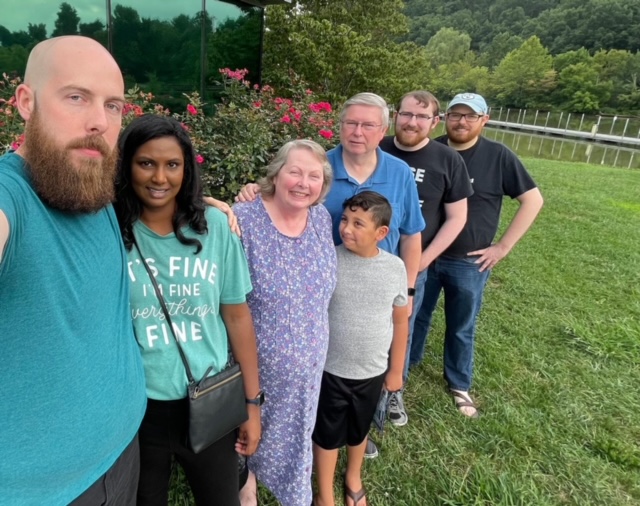
2. Family time. My husband took the week of the 16th-20th off so we had something of a “stay-cation.” while Jeremy was here. Jesse and Jason had to work but took off that Friday and came over several evenings. So we had a lot of family time, visiting, laughing, eating, and playing games. Mittu made great dinners a couple of nights, once at their place and once at ours. Jesse had us all over to his place one night for honey garlic salmon–his first time to host all of us.

3. My birthday was last weekend. It’s nice when the dates work out that Jeremy can be here for both his birthday and mine. My daughter-in-law made lunch for us. We went out for dinner to one of my favorite restaurants on a lake. Then we went home for my annual Texas Sheet Cake that Mittu made and decorated and opened presents.

4. Safety and and new plans. Jeremy was due to fly back to RI on the 22nd, but the day before, Hurricane Henri was heading straight for RI. What we didn’t want to happen was for Jeremy to leave here on the first leg of his flight and then get stranded if the last flight was canceled. So Jim and Jeremy called the airline and got a very competent and friendly person and changed his flights to Wednesday. It turned out to be a good thing, because the second leg of his flight did indeed get canceled. He worked from our home Monday and Tuesday. The storm weakened and avoided a direct hit to his area after all, but we were happy to have a few more days with him here rather than having him have to hang out out an airport until it was safe.

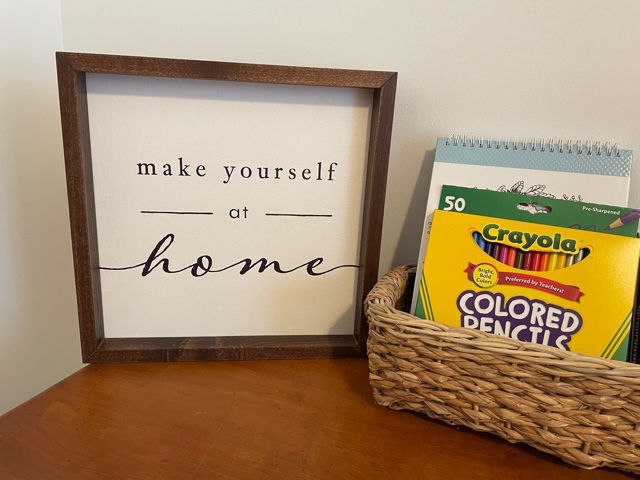
5. A new sign for the guest room. Jason gets a few credits every year for products from the place where he works and he generously let me use some for this sign for the guest room.

I hope you’ve had a good week, too!

Call of a Coward

As Marcia Moston worked on laying slate stones for a patio outside her comfortable New Jersey home, a sudden thought came to mind. Her husband, Bob, was on a mission trip to Guatemala. What if he returned home saying their entire family should go back? Marcia brushed the thought off as absurd.

But two days later, that’s exactly what happened. The mission Bob had helped needed a couple to oversee a home for widows and orphans, and he felt God was calling his family to the job.

Marcia tells of her family’s experiences following God’s call in Call of a Coward: The God of Moses and the Middle-Class Housewife.

Marcia didn’t eagerly jump at the chance to go to a Central American country.

Years earlier we had pledged to follow the Lord wherever he led, but after ten years of marriage, my fervor had settled around me like a cozy comforter on a winter’s night. Zealous promises made on a beach under a starry sky lay buried under the security of paychecks and health insurance. Bob’s return from his mission trip with the conviction that we go to Guatemala unleashed a torrent of fears that shattered my tidily defined world (p. 17).

They were already heavily involved in Christian work. Guatemala was dangerous with rebel activity. What about their ten-year-old daughter, Lily?

Adamant as I was about not going, a glaring contradiction in my theology nagged me. I wondered how I could so easily believe in Someone who created the universe, parted the Red Sea, and rose from the dead, but not trust him to take care of my daughter (p. 18).

God kept working on Marcia’s heart until she finally surrendered. Then the family prepared to drive all the way from New Jersey to a Mayan village in Guatemala. Marcia tells the story of their journey, time in Guatemala, call to a small pastorate in Vermont, and the joy of leading several mission trips back to Guatemala. She writes with with both humor and conviction that God calls and works in and through His people today.

Marcia’s writing first came to my attention in columns for The Write Conversation. I enjoyed what she had to say and her style, and I loved the title of her book. So I bought it and finally read it.

Here are a few of my favorite quotes from the book:

Those kicking and screaming death-throes moments when you realize you aren’t and you can’t are God’s opportunities to show you he is and he can (p. 34).

Saying grace before eating took on a whole new importance for me. A blithely spoken, “Lord, bless this food” came to mean a seriously earnest, “Kill it, purify it, and give me the grace to eat it” (p. 36).

It’s a noble thing to say you would lay down your life for a loved one. It’s quite another if you are called upon unexpectedly to share your last bit of chocolate (p. 90).

The hepatitis had left us with about as much energy as a sloth on sedatives (p. 121).

Later, I found out that my sister in New York, who had no idea where we were at the time, had woken up that same night we were in the town of the sorcerers, with an urgency to pray for us (p. 133).

The downside of a miracle is the predicament required to precipitate it. That’s also the very place where faith grows (p. 155).

Reflecting on the biblical admonition that any works not built on Christ would be burned, I imagined the glow filling the eastern horizon of heaven as my works went up in a bonfire if I didn’t stop throwing myself pity parties (p. 162).

I looked at the engrossed, saucer-eyed faces and breathed a silent prayer of thanks for being witness to this “first” in someone’s life, for the privilege of bearing words of life (p. 181).

You can find an interview with Marcia here.

I’ve always identified with Moses’s list of excuses why he couldn’t possibly answer God’s call to lead the Israelites out of Egypt. And I identified with Marcia’s trepidation as well, and was encouraged by how God answered and enabled her. 

(I often link up with some of these bloggers)

Be Equipped: Acquiring the Tools for Spiritual Success

When we’re about to step into a new phase of life, we stop and reflect about where we’ve been so far, how we got to this place and time, and what we need to do for the future. We even do this at the end of one calendar year and the beginning of another.

So it’s not surprising that Moses and the children of Israel stopped to review their history and look ahead just before they entered Canaan, their promised land.

This was not just a moment of nostalgia, though. Israel had been wandering in the wilderness for 40 years because the previous generation balked right at this point. And Moses knew he could not go in with them: God had told him he would die beforehand. So Moses wanted both to encourage the people that God would keep all His promises to their forefathers to lead and care for them plus instruct them as to what God required of them.

The book of Deuteronomy covers these reminders and instruction. Warren Wiersbe’s Be Equipped (Deuteronomy): Acquiring the Tools for Spiritual Success shares some helpful insights on each chapter.

It’s when we forget our high calling that we descend into low living (p. 29).

The verb “to hear” is used nearly one hundred times in the book of Deuteronomy. . . . hearing the Word of God involves much more than sound waves impacting the human ear. Hearing God’s Word is a matter of focusing our whole being—mind, heart, and will—on the Lord, receiving what He says to us and obeying it. The Word of God must penetrate our hearts and become a part of our inner beings if it is to change our lives (p. 34).

“His commandments are not burdensome” (I John 5:3, NKJV). Obeying the Lord becomes a joyful privilege when you realize that His commandments are expressions of His love, assurances of His strength, invitations to His blessing, opportunities to grow and bring Him glory, and occasions to enjoy His love and fellowship as we seek to please Him. God’s Word is the open door into the treasury of His grace (p. 35).

Most people find it easier to handle adversity than prosperity (see Phil. 4: 10–20), because adversity usually drives us closer to God as we seek His wisdom and help. When things are going well, we’re prone to relax our spiritual disciplines, take our blessings for granted, and forget to “praise God from whom all blessings flow.” The material things that we wait for and sacrifice for seem to mean much more to us than the gifts that fall in our laps without our help (p. 58).

In this part of his farewell address, Moses painted the people of Israel as they really were, “warts and all.” It was important for their spiritual lives that Moses do this, for one of the first steps toward maturity is accepting reality and doing something about it (p. 73).

I enjoyed and learned from our time In Deuteronomy and was helped by Wiersbe’s comments.

When the World Weighs Heavy

I don’t watch the evening news, but I’m still flooded with the sometimes unspeakable suffering across our globe.

Haiti is suffering the aftereffects of a major earthquake. Japan has experienced an earthquake, floods, landslides. Potentially devastating storms from tropical depressions and hurricanes hit our coasts. Horrible stories are coming out of Afghanistan, with more to come as the Taliban takes over.

And these are all on top of the long-term worldwide pandemic we’re still dealing with, made worse by the division over how to respond to it. Several friends have had COVID, some severely. A nurse friend tells of staff exhaustion and patient suffering in the COVID ward of her hospital.

As Christians, we’re concerned that our country and world are ebbing ever further away from biblical truth. We wonder what kind of world our children and grandchildren will face.

Plus we have personal concerns. A friend is taking care of a loved one with Alzheimer’s alone. A dear older lady is in the hospital with severe pain from an old hip replacement. Others have varying issues to deal with.

All these things weigh heavily. How are we supposed to go about everyday life with so much suffering and wrong in the world?

Well, maybe we aren’t.

There are times in life to stop everything, pray, fast, mourn. The 9/11 attacks here were like that. Everything stopped as we watched the news coverage, grieved, and prayed for those affected and those helping.

But at some point, the needs of life intrude. Laundry must be done, the family must be fed, family members must go to work.

Perhaps our concerns can guide how we do our tasks and how we think while we do them.

The world’s news can:

Inform our perspective. Disappointment over an activity canceled due to weather pales when I learn that Afghani Christians are being killed if a Bible app is found on their cell phones.

Remind us how small we are and how much we need God.

Remind us to pray. We can’t save the world. The sheer magnitude of suffering and sorrow in the world is overwhelming to us, but not to God. Some years ago I received this prayer guide from Voice of the Martyrs:

Remind us to weep with those who weep. Particularly concerning those believers undergoing persecution, Hebrews 13:3 says, “Remember those who are in prison, as though in prison with them, and those who are mistreated, since you also are in the body.”

Remind us this life is not the end. The world isn’t getting better and better until we reach utopia. Jesus said there would be wars, earthquakes, famine, pestilence, persecution. Heaven will be a place of no tears, pain, or sorrows, but on earth we’ll have plenty of each.

Remind us God cares for our sorrows. He “doth not afflict willingly nor grieve the children of men” (Lamentations 3:33, KJV). Jesus was “a man of sorrows and acquainted with grief” (Isaiah 53:3) and wept with those who grieved.

Remind us to cast our cares on Him. “Humble yourselves, therefore, under the mighty hand of God so that at the proper time he may exalt you, casting all your anxieties on him, because he cares for you” (1 Peter 5:6-7). I love Octavius Winslow’s phrasing in his poem: “Nor fear to impose it on a shoulder which upholds the government of worlds.”

We need to remind ourselves as well that though it sometimes looks like the world is in chaos, God is still in control. As the old hymn says, “Though the wrong seems oft so strong, God is the Ruler yet.” Olympic runner Eric Liddell became a missionary in China. As the Japanese army committed atrocities leading up to WWII, Liddell wrote, “Circumstances may appear to wreck our lives and God’s plans, but God is not helpless among the ruins. God’s love is still working. He comes in and takes the calamity and uses it victoriously, working out His wonderful plan of love” (Eric Liddell, The Disciplines of the Christian Life [London: Society for Promoting Christian Knowledge, 1985], 121–122).

Why does God allow these things then? That would be a question for another post. He has many reasons for allowing suffering, and we can trust that He has a purpose. As Joni Eareckson Tada has often said, “God permits what he hates to accomplish what He loves.” Sometimes God is not as concerned about removing calamity or persecution as He is about accomplishing His will in people’s hearts through them.

While we wait for His purposes, timing, and help, everyday life can be wonderfully grounding. Elisabeth Elliot wrote that in the aftermath of her husband’s death, she would sometimes feel overwhelmed not only with grief, but with new decisions and tasks she had to take on as a jungle missionary without her partner. She was helped by an old English poem which said, “Do the next thing.”

The poem says, “Do it immediately, do it with prayer, do it reliantly, casting all care. Do it with reverence, tracing His hand who placed it before thee with earnest command. Stayed on omnipotence, safe ‘neath His wing, leave all resultings, do the next thing.” That is a wonderfully saving truth. Just do the next thing.

There may be tangible ways we can help those suffering. James reminds us not to just wish people well, but to give what they need. (I would caution great care, however, about the charities that seem to spring up overnight to help the most recent calamity victims. Research organizations or ask for recommendations from people you trust.) Sometimes even our small everyday tasks help towards meeting someone’s need.

But sometimes there’s nothing we can physically do to help someone. We can pray along with Jehoshaphat, “We are powerless . . . We do not know what to do, but our eyes are on you.” (2 Chronicles 20:12).

(I often link up with some of these bloggers)

Laudable Linkage

A collection of good reading online

Once again I’m way behind in my blog reading, but here are a few that spoke to me this week:

Success Beyond What We Can Handle. “Their success outpaced their sanctification. The level of their accomplishments rose faster than the growth of their character. Their vocational achievements came at the cost of spiritual achievements. They gained more success than they could handle and it led to great harm.”

I Need You to Read Your Bible, HT to Challies. “I need what is true and biblical and dependable. Maybe it’s just me, but ‘God’s got this!’ doesn’t have the same effect on my heart as ‘Hezekiah prayed and turned his face to the wall.’ The first is a plucky, optimistic but neutral response that flies from the mouth with good intention but little thought to the weightiness of a person’s struggle. The latter laments the person’s struggle, points them to Scripture, and says, ‘This is hard and God hears your prayers.'”

A Church Only Explained by the Gospel, HT to Challies. “When outsiders look in, they should struggle a bit to explain what makes us gather together. If they can say, “Well, it makes sense that those people would share the same church — they look alike, think alike, etc.,” we do not give confront them with the stupefying power of the gospel. The grace of God unites like no other force. Not even our natural friendships work this way.”

Your Work Is Worthy, HT to Linda. “We’re word people, we know language matters! And yet writers have generally terrible habits when it comes to how they talk about their work.”

I was looking up a song recently and found these old recordings by Bill Pearce and Dick Anthony. Bill Pearce’s “Night Sounds” programs ministered to my heart in my early Christian life. I’m glad someone put these old recordings online.

Happy Saturday!

Checking In

There’s not an official Friday’s Fave Five this week, because our hostess, Susanne, has family visiting and wants to spend as much time as possible with them.

I’m in the same situation. My oldest son came in late last Friday night, and we celebrated his birthday Saturday. My husband took off this week, so we’re enjoying a stay-cation. Due to COVID and rainy weather, we haven’t been able to do any activities in the area. But we’re enjoying hanging out, resting, and chatting.

My two sons who live nearby have to work but are both taking today off. They’ve come over for dinner and games most evenings. Jason and Mittu had us over there a couple of times, and Jesse is cooking for us tonight.

My favorites from this week are:

  • Family
  • Food
  • Fun and games
  • Fellowship
  • Free time

And we’re looking to continue this weekend!

Hope you are having a good week!

Why Aren’t Christians More Loving?

A friend asked a question recently that I have been pondering ever since I read it: Jesus said His disciples would be known by their love. So why are some non-Christian people more loving than Christians?

It’s not a new question. It’s one I have considered before.

And it’s a general question. Many Christians are very loving and kind and put me to shame. And there are unbelievers who are most definitely unloving and unkind.

But the observation still stands, especially if you spend much time on social media. Christians, who should know better, can be just as vitriolic as anyone else. Worse, they would probably not describe themselves as hateful. So how do they miss the total lack of love in their responses?

The fact that people who don’t know God in a personal way can be kind hearkens back to our being made in the image of God. The fact that we have a distinction between kindness and hatefulness even before becoming Christians points to God putting that in our hearts. He made us like Himself, but that image has been marred by the fall of humankind into sin.

C. S. Lewis pointed out that people can be nice and still be rebels against God. In Mere Christianity, Lewis brings up a placid Dick Firkin and a nasty Miss Bates. You would think by their personalities that he is the Christian and she is not, but it’s the other way around.

You cannot expect God to look at Dick’s placid temper and friendly disposition exactly as we do. They result from natural causes which God Himself creates. Being merely temperamental, they will all disappear if Dick’s digestion alters. The niceness, in fact, is God’s gift to Dick, not Dick’s gift to God. In the same way, God has allowed natural causes, working in a world spoiled by centuries of sin, to produce in Miss Bates the narrow mind and jangled nerves which account for most of her nastiness. He intends, in His own good time, to set that part of her right.

The question is what Miss Bates’s tongue would be like if she were not a Christian and what Dick’s would be like if he became one. Miss Bates and Dick, as a result of natural causes and early upbringing, have certain temperaments: Christianity professes to put both temperaments under new management if they will allow it to do so.

But it does seem like, especially with redeemed temperaments, Christians should be more loving than they often appear to be. Jesus said, “A new commandment I give to you, that you love one another: just as I have loved you, you also are to love one another. By this all people will know that you are my disciples, if you have love for one another” (John 13:34-35).

So why aren’t we more loving?

I don’t know all the reasons, but here are a few possibilities:

We feel “safe.” We know we’re saved by grace through faith, not by our good works (Ephesians 2:8-9). But we forget we’re saved unto good works (verse 10). Because we expend no effort in order to be saved, we forget there is effort involved in living the Christian life. The Bible describes Christian life sometimes as a battle or a race. We don’t become Christians and then coast our way to heaven without paying any attention to our words and actions. We should be continually growing in grace and the knowledge of Christ and bringing our words and actions more in line with His.

We know Biblical love is not just a feeling. One of my former professors defined agape love as a “self-sacrificing desire to meet the needs of the cherish object.” But that, even more than warm feelings, should spur us on to be careful of our words and actions, to sacrifice that desire to lash out.

We stand for truth. Sure, love involves telling the truth, and the truth can be hard to hear. But we’re to speak the truth in love. If love is a self-sacrificing desire to meet the loved one’s needs, how loving is it to club them over the heads with truth? How is that meeting their needs? It seems, rather, that it’s driving them further away from the very truth they need.

We misread Biblical examples. One man with a harsh demeanor felt he was following the example of the OT prophets. But who were the prophets preaching to? Israelites who were worshiping false gods and showing marked injustice to their neighbors. Some point to Jesus’ stern words to the Pharisees as an excuse to speak that way generally. But the Pharisees were those who added to God’s requirements and led people astray. These were serious issues that could lead people to a devastating end. We don’t need to address every disagreement in these ways. Somehow people who want to be as fiery as OT prophets miss the compassion and pleading those same prophets express. They also miss the NT admonition to “Have nothing to do with foolish, ignorant controversies; you know that they breed quarrels. And the Lord’s servant must not be quarrelsome but kind to everyone, able to teach, patiently enduring evil, correcting his opponents with gentleness” (2 Timothy 2:23-25).

There are different tiers of differences in our beliefs and practices. At the very top are things one must believe in order to be a Christian. If you don’t believe that Jesus is the Son of God or that you’re a sinner, you don’t understand true salvation yet. Doctrines like the virgin birth of Christ are vital, but people probably wouldn’t be able to articulate them or understand why they are important before becoming a Christian. (There’s a difference, of course, between not understanding something and rejecting it.) People have a variety of interpretations about end-time events or styles of worship, but can still fellowship together. Further down are differences that are not clearly spelled out in Scripture but that we derive from Scriptural principles. Some people don’t have television or Netflix in order to avoid setting worldly images before their eyes, but they shouldn’t insist that no one should have those things.

The problem is, some Christians treat everything as a tier one issue. I’ve seen Christians argue for their choice of a lower tier issue with more vehemence than they would a more crucial doctrine. Romans 14 tells us to allow for differences on these lower-tier issues without despising or passing judgement, even when our choices are better or wiser in our own eyes..

We’re not listening. We’re instructed to be “quick to listen, slow to speak, and slow to get angry” (James 1:19). We’re warned that “He who answers a matter before he hears it, It is folly and shame to him” (Proverbs 18:13, NKJV). This is what I most often see in online exchanges: it’s easy to share a drive-by response without taking the time to truly understand the nuances of what has been said in context. Not taking time to truly hear leads to making assumptions

We have blind spots. I was going to write a post specifically on our blind spots, but then I remembered I already had, here. God told the Laodicean church in Revelation, “For you say, I am rich, I have prospered, and I need nothing, not realizing that you are wretched, pitiable, poor, blind, and naked” (Revelation 3:17). In Malachi, God leveled a number of charges against His people, but they, in essence, said, “What are you talking about?” We need to pray, as David did, “Search me, O God, and know my heart! Try me and know my thoughts! And see if there be any grievous way in me, and lead me in the way everlasting” (Psalm 139:23-24). And if someone mentions something to us—especially if a number of people comment that a stance we took or an answer we gave was unkind, we need to prayerfully and humbly look into it. We know—or we should—that we’re not perfect and have a lot of growing to do. Spurgeon said:

Brother, if any man thinks ill of you, do not be angry with him; for you are worse than he thinks you to be. If he charges you falsely on some point, yet be satisfied, for if he knew you better he might change the accusation, and you would be no gainer by the correction. If you have your moral portrait painted, and it is ugly, be satisfied; for it only needs a few blacker touches, and it would be still nearer the truth.

We’re not forbearing. We’ve forgotten we’re “to walk in a manner worthy of the calling to which you have been called, with all humility and gentleness, with patience, bearing with one another in love, eager to maintain the unity of the Spirit in the bond of peace” (Ephesians 4:1-3).

We want to be right more than we want unity. I’ve written several times that we can be both right and kind. When people say we should choose being kind over being right, I am concerned that they want to cut corners of truth that we shouldn’t in order to be unified with those whom we shouldn’t be. But there is a sense in which we hold our own opinions higher than anyone else’s and feel the need to leave a verbal smack-down with those who disagree. This has been a big temptation with all the differences over masks, vaccines, opinions about how the church should respond. etc. How are you supposed to be in fellowship with people in your church who have ridiculed your views on Facebook? I’ve had to “hide” some people who constantly ranted against my own (unstated) positions because it was constantly stirring up hurt feelings and wrong responses. We really don’t have to say everything we think. And for love of the brethren, we should be able to disagree on issues without demeaning those we disagree with. We need to show grace.

One of the lower-tier issues in NT times was what kind of foods were okay to eat (whether the OT food laws were still in effect, whether it was okay to eat food that had been offered to idols). Paul said, “Do not, for the sake of food, destroy the work of God” (Romans 14:20). We need to be careful that we’re not destroying the work of God over COVID or politics or anything else.

We fail to hallow God’s name in all we do. In what we call the Lord’s prayer that Jesus taught to His disciples, the first request is, “Our Father in heaven, hallowed be your name.” The ESV footnote says “hallow” means “Let your name be kept holy, or Let your name be treated with reverence.” This involves not only carefulness about how we use His name, but carefulness in how we act as those who bear the name of Christian.

We’re basically selfish. This is my biggest problem, not so much in public verbal arguments, but in everyday life.

We feel superior. We lack the humility to acknowledge we might be wrong or might have misunderstood or might not have the full picture.

We assume the worst. 1 Corinthians 13:7 says love “believes all things, hopes all things.” One pastor put it something like “Love cherishes the best expectations of others.” Instead of jumping on what others have said and assuming their meaning or motives are bad, we need to assume they have the best intentions until we find out otherwise.

We fail to see people as God does. If they are not Christians, they’re not going to be led to consider the claims of Christ by people who handle those claims with an air of superiority or hatefulness. If they are believers, they are His precious ones, future glorified saints, fellow citizens of the household of God, sons and daughters of the King. C. S. Lewis said there are no mere mortals. They are our brothers and sisters in the Lord. Perhaps thinking of someone as a sibling makes you think of conflict. But we should love family even if we don’t always get along.

We’re not filled with the Spirit, Whose fruit is “love, joy, peace, patience, kindness, goodness, faithfulness, gentleness, self-control” (Galatians 5:22-23).

We’re not gazing enough on Christ. “And we all, with unveiled face, beholding the glory of the Lord, are being transformed into the same image from one degree of glory to another” (2 Corinthians 3:18). How do we behold Him? In His Word. Is it possible to spend time in the Bible every day and still not behold Him? Yes, if we’re just performing a duty, or if we’re not specifically looking for Him in the passage, or if we’re trying to fit Him into our preconceived notions.

Of course, we’ll never be perfect in this life. But we should be growing, becoming more like Jesus, more loving, until we’re truly.

It’s comforting to know that even someone Iike Elisabeth Elliot struggled with these things. In talking about meekness in her book Keep a Quiet Heart, she says:

But how shall I, not born with the smallest shred of that quality, I who love victory by argument and put-down, ever learn that holy meekness? The prophet Zephaniah tells us to seek it (Zephaniah 2:3). We must walk (live) in the Spirit, not gratifying the desires of the sinful nature (for example, my desire to answer back, to offer excuses and accusations, my desire to show up the other’s fault instead of to be shown my own). We must “clothe” ourselves (Colossians 3:12) with meekness–put it on, like a garment. This entails an explicit choice: I will be meek. I will not sulk, will not retaliate, will not carry a chip.

A steadfast look at Jesus instead of at the injury makes a very great difference. Seeking to see things in His light changes the aspect altogether.

May God give us grace to “be imitators of God, as beloved children. And walk in love, as Christ loved us and gave himself up for us, a fragrant offering and sacrifice to God” (Ephesians 5:1-2).

(I often link up with some of these bloggers)