Unknown's avatar

About Barbara Harper

https://barbarah.wordpress.com

Friday’s Fave Five

It’s Friday, time to look back over the blessings of the week
with Susanne and other friends at Living to Tell the Story .

The last Friday of July! For several days the humidity was way high, and we felt too drained to do much. It was down to a welcome 32% yesterday, but today it’s back up to 76%.

I don’t know where the rest of the month went. But here are five highlights from the last week.

1. Church potluck. After a stressful morning where every other thing went wrong, we actually made it to church on time. And we enjoyed the service and fellowship afterward. Even though we’re a small church, we still manage to sit with someone different almost every time. A good opportunity to get to know folks better.

2. Allergy-friendly recipes. Almost every family at church has a member with serious food allergies. I know their families bring food they can eat, so every dish at a potluck doesn’t have to be allergen-free. But I like to try to make what I bring as accessible as possible. I made a mini version of these apple cider donuts that were gluten-free, egg-free, and nut-free — and tasty!

3. A dinner invitation. Friends invited us to their house for dinner, and we had such a good time.

4. A sponge and scrubbie holder. I was using a soap dish left behind by the previous occupants. But it was glass and broke when accidentally knocked into the sink. I love this holder because it keeps the two scrubbing tools separate, so they dry out better.

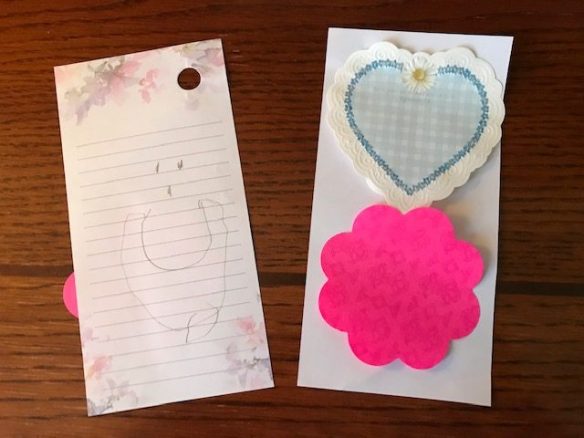
5. Timothy’s balloon man. My grandson loves those tall, floppy air-filled contraptions often seen at car lots. We learned they are called air dancers. But he calls them balloon men. My son and daughter-in-law found a mini one Timothy could play with.

Then Jason sent me this drawing Timothy made of a “Big balloon man and baby balloon man.”

Happy Friday!


Book Review: Rorey’s Secret

Rorey’s Secret is the fourth of Leisha Kelly’s series about the Wortham family, set during  and just after the Depression. The fourth through sixth books are called the Country Road Chronicles and take place a few years after the first three, when the Wortham children are teenagers.

This book begins with mom Julia Wortham in the kitchen preparing a birthday dinner for one of their neighbor boys. The Hammond family lost their mother at the beginning of the second book. Their father, George, had not coped well at first, but seemed stable now. Several of the Hammond’s ten children are over visiting the Worthams at any given time. The youngest is trying to help Julia fry chicken, and making a mess. Just as another Hammond child tries to bring newborn kittens in the house, the oldest drives up with his wife in labor and very active toddler diving in Julia’s cabinets because he likes the bang all the pans make as they fall out. As Julia’s husband and son come in from working, Julia sends them off for the doctor.

But the doctor can’t be reached, and Julia reluctantly plays midwife. Somehow after several hours, the baby is born, everyone’s fed, and several of the Hammond family go home.

As Julia and her husband, Samuel, prepare to drop into bed, they notice a strange glow in the distance: a fire over at the Hammonds’. Sam and his son and daughter drive over to help: Julia stays behind because the new mother and baby are still at her house for the night.

Sarah, the Wortham’s daughter, tries to keep the younger Hammond children safely away from the barn’s flames, but ten-year-old Bertie dashes away into the barn out of concern for the calves. Sarah alerts her father, who runs after Bertie to bring him out. Then the roof caves in.

Both Bertie and Sam are pulled to safety, but both are injured, Sam seriously. His son takes both of them back to the Wortham’s house and goes to try to find the doctor again. Julia, worried sick, tries to help them the best she can.

Inexplicably, several of the Hammonds blame middle son Franky for the fire. In the previous books there has been a subplot involving him. He seems to have a learning disability: he can’t learn to read no matter how much he wants to. He can do math in his head, but not on paper. Of course, not much was known about such then, and his schoolmates and even his father think he’s stupid. Franky is also the most dreamy, sensitive, and spiritual of the bunch. If he had started the fire, he’d be the first to own up to it. There also seems to be some tension between Franky and his teenage sister, Rorey, but neither will open up about it.

Rorey, for her part, is being cagey and aloof. The bulk of the book focuses on the tension between Rorey, Franky, and the rest of the two families as the cope with the aftermath of the fire. When Rorey tells a part of her secret to Sarah, then Sarah’s in a quandary as to whether to keep her promise not to tell.

The point of view rotates from chapter to chapter between Julia, Sarah, and Franky. I could identify a lot with Julia, worrying about her husband, feeling overwhelmed with all the people and issues, wanting to set things straight between Franky and his father. She struggles to trust God and seek wisdom. But she makes a good point here:

Somewhere I’d heard that the first time a young person does something really bad, a significant bit of their future and the choices they make rest upon the kind of response they get. I prayed our response to Rorey would be what she needed (p. 229).

I loved the first couple of books in the series. All the chaos in the beginning of this one nearly made my head spin. Still, life is like that sometimes, and that’s one of the hardest times to maintain trust in the Lord. I liked the way this one worked out in the end and what everyone learned along the way.

(Sharing with Carole’s Books You Loved, Booknificent)

Book Review: Suffering Is Never for Nothing

Suffering Is Never for Nothing by Elisabeth Elliot is “a very slight adaptation” of a series of talks Elisabeth gave at a conference. Someone had given a set of the conference CDs to Jennifer Lyell. She was so blessed, she gave copies to others. Finally she met and befriended Elisabeth and her husband, Lars, when Elisabeth could no longer speak. Later she obtained permission to transcribe the talks and have them published.

Though this volume wasn’t published in Elisabeth’s lifetime, if you’ve read her books, listened to her radio program, or heard her speak, you’ll hear familiar themes.

Just a bit of background for those who might not be familiar with Elisabeth: she and her husband were missionaries to an Indian tribe in Ecuador when several of the missionary couples were burdened to try to reach a tribe then known as Aucas ( later it was discovered they called themselves Waorani). The Aucas were thought to be a savage tribe: their every encounter with any from outside their world ended badly. After several seemingly friendly encounters, the men thought the time had come to try to meet the tribe in person. The first visit went well, but then the Aucas speared all five of the men to death. A few years later Elisabeth, her young daughter, Valerie, and Rachel Saint, sister to another of the men, Nate Saint, went to live with the Auca/Waorani. Elisabeth shared that story in Through Gates of Splendor. In later years, Elisabeth remarried, but her second husband died of cancer. Before that marriage, Elisabeth lost almost the entire body of the translation work she had painstakingly labored over in the jungle. Along with these major losses in her life, she’s dealt with the everyday ones we all face.

I don’t know if Elisabeth intended to start a writing career when she published her first book: she was still a missionary in the jungle at the time. But God led her to write several more. I was one of many who considered her a mentor from afar, appreciating her no-nonsense, straightforward style and firm foundation on the Word of God.

To come back to this book, after naming several examples of suffering, Elisabeth boiled it down to this definition: “Suffering is having what you don’t want or wanting what you don’t have” (p. 9). That’s well and good, but what do we do about it? Elisabeth says, “I’m convinced that there are a good many things in this life that we really can’t do anything about, but that God wants us to do something with” (p. 8).

Probably our biggest struggle concerning suffering is wondering where God is in it and why He allows it. Verse after verse assures us that God is right there with us in suffering. And some passages give us a few ideas of why He might allow it. Elisabeth says, “The deepest things that I have learned in my own life have come from the deepest suffering. And out of the deepest waters and hottest fires have come the deepest things I know about God . . . The greatest gifts of my life have also entailed the greatest suffering” (p. 9).

Still, “There would be no intellectual satisfaction on this side of Heaven to that age-old question, why. Although I have not found intellectual satisfaction, I have found peace. The answer I say to you is not an explanation but a person, Jesus Christ, my Lord and my God” (p. 12). She shares that when she first heard the news that her first husband was missing, she didn’t hear anything more about his condition or whereabouts for five days. God brought to her mind Isaiah 43:2-3: “When thou passest through the waters, I will be with thee; and through the rivers, they shall not overflow thee: when thou walkest through the fire, thou shalt not be burned; neither shall the flame kindle upon thee. For I am the Lord thy God, the Holy One of Israel, thy Saviour.” She realized God wasn’t promising anything about her husband, but He promised to be with her.

“The questions remains, is God paying attention? If so, why doesn’t He do something? I say He has, He did, He is doing something, and He will do something” (p. 13).

She discusses the perspective of the cross and the two different kingdoms, the one on this world and the kingdom of God.

It’s He who was the Word before the foundation of the world, suffering as a lamb slain. And He has a lot up His sleeve that you and I haven’t the slightest idea about now. He’s told us enough so that we know suffering is never for nothing (p. 16).

We are not adrift in chaos. To me that is the most fortifying, the most stabilizing, the most peace-giving thing that I know about anything in the universe. Every time that things have seemingly fallen apart in my life, I have gone back to those things that do not change. Nothing in the universe can ever change those facts. He loves me. I am not at the mercy of chance (p. 43).

Faith is not a feeling. Faith is willed obedience in action (p. 45).

She then discusses our response: acceptance, gratitude, offering whatever it is back to God, and the transfiguration He works in us, with a chapter devoted to each of those.

Now if I had had a faith that was determined God had to give me a particular kind of answer to my particular prayers, that faith would have disintegrated. But my faith had to be founded on the character of God Himself. And so, what looked like a contradiction in terms: God loves me; God lets this awful thing happen to me. What looked like a contradiction in terms, I had to leave in God’s hands and say okay, Lord. I don’t understand it. I don’t like it. But I only had two choices. He is either God or He’s not. I am either held in the Everlasting Arms or I’m at the mercy of chance and I have to trust Him or deny Him. Is there any middle ground? I don’t think so (pp. 26-27).

Many years ago I read a different book by Elisabeth on this topic, A Path Through Suffering. At first I thought this was a republication of that book by a different name. It’s not, though. Some of the information probably overlaps, but they are two different books, both worthy to be read and extremely helpful.

I enjoyed reading this book over the last few weeks with the True Woman Summer Book Club and looking through the comments and study questions there.

(Sharing with Grace and Truth, Carole’s Books You Loved, Booknificent)

Writer Newsletter Survey Results

A couple of weeks ago I invited you to participate in a survey I was conducting about writers’ newsletters.

Some of you subscribe to my blog via email. Someone asked me privately if that was what I meant by a newsletter. No, when you subscribe to the blog, you get an email from WordPress each time I post with that post’s content. A newsletter is something in addition to that, with additional news or thoughts not posted on the blog (though it may contain links back to the blog as well.)

I’ve been told that some publishers put great stock in the size of one’s newsletter list. As a reader, I don’t subscribe to very many newsletters myself, from either bloggers or authors. So I wanted to discern how other readers felt about them in order to know whether I should start one as I finish my book.

31 people responded to my survey. Here are my questions and their answers:

1. Do you subscribe to newsletters from authors or bloggers? How many?

    • Yes, a few: 17
    • Yes, several: 5
    • No: 8

2. If you don’t subscribe to any, why?

    • I don’t want any more email: 12
    • I already follow their blog or other social media: 8
    • Not interested: 4
    • Other: 4

3. What’s the ideal frequency of newsletters?

    • Weekly: 5
    • Monthly: 10
    • Quarterly: 5
    • A couple of times a year: 1
    • Only when a new book is coming out: 6
    • Other (please specify): 4 responses:
      • not daily, only if you have a new book on sale. Weekly or whatever makes sense to you.
      • whenever the author feels the need
      • None thank you
      • Bi monthly

4. What do you like to see in newsletters? Check all that apply.

    • News about upcoming publications: 16
    • Chatty news about the author (family, travel, hobbies, activities, etc.): 12
    • Interesting background information related to book: 16
    • Sales: 3
    • Bonus material: 11
    • Quotes or reviews from other readers: 2
    • Upcoming events (speaking events, book signings, etc.): 9
    • What books the author is reading or recommends: 11
    • None – would rather read this on blog: 10
    • Other (please specify): 5 reader responses:
      • I am glad to see this blog with info about your book/s as they happen.
      • Summaries with links to make it easy to choose what you want to read.
      • Material relevant to my interests. I don’t have time for a bunch of fluff.
      • I subscribe to a few newsletters from bloggers who have “subscriber freebies”, mostly homeschool materials. But I don’t generally read the email except to find the password to the subscriber page. I generally dislike getting extra email and prefer to read content from blogs I can subscribe to in Feedly.
      • Giveaways (there should be some sort of perk for the reader)

5. What don’t you like about newsletters? Check all that apply.

    • Too frequent: 20
    • Too long: 15
    • Too repetitive (sharing information already seen on blog or other media): 17
    • Not enough information: 3
    • Other (Please specify): 8
      • dull colors; find some other color than gray for your background
      • I don’t want to read a blogpost – I’d rather have the feeling of being an “insider” into their real life.
      • Repeated items for sale. I don’t mind sales, but I don’t like to keep getting it in my inbox over and over. That’s annoying. Perhaps just a reminder that it is there if you want it, but not being pushy about it.
      • Always trying to say me something (perhaps “sell” was meant?)
      • I find them presumptuous.
      • When they are interesting I want to share them, it’s more difficult than sharing a blog post
      • I don’t like a cluttered inbox. I prefer to control what I read.
      • Too much bragging in general

6. Have you ever bought an author or blogger’s product directly from their newsletter or as a result of their newsletter?

    • Frequently: 1
    • Occasionally: 16
    • Never: 14

7: What is your preferred way to hear from a blogger or author? Check all that apply.

    • Newsletter: 11
    • Blog: 24
    • Facebook: 11
    • Twitter: 4
    • Instagram: 5
    • Other (please specify): 2
      • I use all of the above 🙂
      • their website

8. How do you feel about a writer’s offer of free downloads, booklets, printables, prayer guides, etc., on their blog or newsletter?

    • Great! I download lots: 4
    • It depends on what it is. I download occasionally: 20
    • Not interested: 5
    • Other (please specify): 2
      • I like downloads as do others. But the danger for you is that people like free things and just because they take your free things, doesn’t mean they will pay for stuff. And if you give too much free too often, then there isn’t a reason to for me to buy your book.
      • I don’t prefer them. I feel they are gimmicky and I cringe at them.

9. Have you ever subscribed to a newsletter just to enter a contest and unsubscribed later?

    • Yes, frequently: 5
    • Yes, occasionally: 14
    • No: 12

10. If your favorite writer has a blog and a newsletter, do you read both?

    • Yes, I do for several writers: 3
    • Yes, I do for a few: 15
    • No, I only read their blog: 9
    • No, I only read their newsletter: 3

First of all, thank you so much to those who responded! Your feedback is helpful and I really appreciate it! The survey was set up so that I have no idea who took it or who shared what responses, but I appreciate each one.

As you can see, opinions vary. People are pretty much agreed that they don’t want just sales flyers, a lot of repetition, or an excess of mail. Of course, if a writer has followers across several outlets, some of those followers will only follow on one. So some repetition is inevitable. That’s why I generally just choose one way to follow each writer.

But other preferences differ. Each blogger or author will have to experiment to see what his or her particular readers like, what they have time for as writers, etc.

My thoughts:

I probably should have put more distinction between newsletters of bloggers and authors. But these days most publishers want authors to have a platform before submitting a manuscript, so a lot of book authors started out as bloggers.

I only subscribe to one blogger’s newsletter, because it’s part of a reading challenge. I prefer to keep email for correspondence. With email, there’s an understated urgency to handle or answer whatever it is. I prefer reading blogs through Feedly. Plus, so many bloggers’ newsletter share a list of their blog posts from the last week or month, which I’ve already seen.

I don’t subscribe to many authors’ newsletters, and I have unsubscribed to those that have arrived weekly or monthly. One that I subscribe to comes out quarterly. Most of the rest are occasional, just whenever there is an update (which is my preference.)

My favorite author blog has maybe ten authors, so each only posts once every other week. I read a few of them, so when the other authors that I don’t read post, I often still skim over their writing. This is where I find a lot of newsy posts, background information about books, personal details, etc.

So as a general rule, as a reader, I prefer blogs to newsletters. One respondent mentioned web sites: I should have included that as an option. I was equating blogs with web sites, but usually a blog is one part of an author’s web site. I only follow a couple on Facebook because the information there generally comes too often for me.

As a writer, well, I am still trying to decide what to do. I’ve thought about starting a newsletter with information about what I am writing, where I am in the process, how you can pray, if you’re so inclined. It would probably come out no more than quarterly unless there’s exciting news (like landing a contract! 🙂 ). On the other hand, I could just put that information on the blog.

Some good posts I’ve found on the subject:

I’d love to hear your thoughts about writer newsletters, either as a reader or a writer — or both! Please share in the comments.

Literary vs. Biblical Redemption

I watched the last episode of a long TV series while riding my exercise bike. The villain of many years had made several attempts to change his ways. Most often he’d fallen back into familiar esponses. But the last couple of years, he had made faltering, but increasing steps in the right direction. In the finale, he sacrificed himself for the good of others, expecting no rewards or good outcomes for himself — and in that final act, finally found his happy ending.

When my children were little, I called this the Curious George philosophy of redemption. The content of the little monkey’s cartoons has changed since then, but 30 years ago the George books and shows mostly ran by a similar formula. George would do something wrong. Sometimes he was naughty; most times he was just a curious little monkey. But inevitably, he’d cause trouble. Something would fall and crash, someone would lose something, a big mess would be made. People would be upset with George, and he’d feel bad. Then George would notice a need that only he could take care of, and everyone would be happy with him again. The good seemingly canceled out the bad.

Daniel Boscaljon says in The Oxford Handbook of English Literature and Theology, in a chapter called “Possibilities of Redemption Through the Novel”:

Redemption is a powerful and uplifting theme that acknowledges the human potential to succeed after having failed. Theological understandings of it focus on how humans can restore their relationships with God despite having fallen from grace into sin. Literature takes the same theme of brokenness and renewal and places it in the context of life on earth, thus including understandings of redemption that may stray from those theologically defined. In this way, even ‘secular’ literatures can be seen as doing ‘theological’ work.

In literary redemption, the character has a transformation of some sort. He changes his ways, either suddenly or gradually. He had been selfish, but now he acts in another’s best interest even at the cost of his own welfare. Literary redemption can provide balance to the plot in sometimes beautiful ways.

A supernatural, unlikely, or convenient ending in literature is called Deus ex machina, a Latin phrase meaning “god from the machine.” In ancient Greek plays, actors playing gods would be brought to the stage in some kind of machine to save the day and set things right. In more modern literature, the rescue may not be from a god: it may be from an act of nature or someone outside the story who swoops in at the last minute. Though sometimes this outside rescue can be used to great effect, usually it’s criticized as contrived.

In real life, though, there’s no hope without outside help from God. God does not weigh our good and bad deeds to determine our fate. Good deeds don’t make up for or cancel the bad. The Bible states many times over in many ways that we’re bound in sin with no way to save ourselves. Jesus Christ, who is both God and the only totally sinless, righteous human, gave Himself in our place to satisfy God’s just demands for holiness and to take the punishment for our sins. It’s His sacrifice that redeems, not ours. Repentance is a change of mind that leads to a change of action, a turning away from sin and our own ways of achieving righteousness to God and His mercy and grace. That change inside us works out into our everyday lives.

To be sure, there’s sacrifice in Christian life. We’re often called upon not to serve self and to sacrifice for the good of others. But this sacrifice isn’t from a desire to rack up enough good points to outweigh our bad ones: it flows from our thankfulness at God’s redeeming us and our love for Him and our fellow humans.

To me, two examples of literary redemption that come closest to the the biblical are Jean ValJean in Les Miserables and Sidney Carton in A Tale of Two Cities, two of my favorite books. Valjean stole a loaf of bread to feed his sister’s starving family and was caught and imprisoned. Escape attempts increased his sentence to 19 years. Prison life and the ill treatment he received when he finally got out turned him into a man so hard that he stole from a bishop and a child. But an unexpected, undeserved act of grace from the bishop undid him and caused him to turn to God. The good acts he did the rest of his life flowed from that one turnaround in his life. I saw an article in some forgotten source years ago quoting an actor who played Valjean in the Broadway musical as saying that it was the greatest act of self-redemption in literature. And I thought, “No, no, no! How can you sing those beautiful songs night after night and miss the fact that God changed him?”

Sydney Carton was a dissolute lawyer in Tale of Two Cities who helped defend Charles Darnay. Sydney’s promising talents have all but drowned in drink. He fell in love with Darnays wife, Lucie, but he knew she could never return his love. She was fully in love with her husband. But, out of love for her, Sydney did the one thing that would help her most. (Spoiler alert.) He looked enough like Darnay to be mistaken for him, so he smuggled himself in and Darnay out of prison. Darnay joined Lucie and escaped Paris: Sydney went to the guillotine. What keeps this from being just a literary redemption is that Sydney finds faith: all through the night before his final act, he walks through Paris reciting to himself John 11:25-26: “I am the resurrection and the life, saith the Lord: he that believeth in me, though he were dead, yet shall he live: and whosoever liveth and believeth in me, shall never die.” One note I read said this quotation showed Sydney was thinking his death would give life to others. That’s true in a sense, but the verse talks about faith in God providing for eternal life. I think Sydney was encouraging himself that God would resurrect him in the end.

I’m thankful we don’t have to provide our own redemption. We never could. Even our most righteousness acts are tainted and soiled compared to God’s perfect righteousness. No many how many we rack up, it would never be enough. But “how much more will the blood of Christ, who through the eternal Spirit offered himself without blemish to God, purify our conscience from dead works to serve the living God” (Hebrews 9:14).

For we ourselves were once foolish, disobedient, led astray, slaves to various passions and pleasures, passing our days in malice and envy, hated by others and hating one another. But when the goodness and loving kindness of God our Savior appeared, he saved us, not because of works done by us in righteousness, but according to his own mercy, by the washing of regeneration and renewal of the Holy Spirit, whom he poured out on us richly through Jesus Christ our Savior, so that being justified by his grace we might become heirs according to the hope of eternal life. Titus 3:3-7

But he was pierced for our transgressions; he was crushed for our iniquities; upon him was the chastisement that brought us peace, and with his wounds we are healed. All we like sheep have gone astray; we have turned—every one—to his own way; and the Lord has laid on him the iniquity of us all. Isaiah 53:5-6

I once heard a story that a traveling preacher was accosted by a man wanting to know how to be saved just as the last call came for the preacher’s train to be boarded. Not having time to go into the gospel message as much as he would have liked, the preacher quoted Isaiah 53:6 above: “All we like sheep have gone astray; we have turned—every one—to his own way; and the Lord has laid on him the iniquity of us all.” Then he told the man, “Go in at the first ‘all,’ and come out at the last one.”

(Sharing with Inspire Me Monday, Tell His Story, Purposeful Faith,
Let’s Have Coffee, Anchored Abode, Share a Link Wednesday,
Stories of Hope, Grace and Truth, Fresh Market Friday)

Laudable Linkage

Here are some of the thought-provoking reads I’ve discovered in the last couple of weeks:

How Can a Survivor Thrive After Sexual Abuse? HT to Challies. “Jenn Greenberg is one of those stories. She was abused by her church-going father. Yet she has retained her faith. She has recently written a courageous, compelling book that reflects on how God brought life and hope in the darkest of situations. Greenberg shows how the gospel enables survivors to navigate issues of guilt, forgiveness, love, and value. And she challenges church leaders to protect the vulnerable among their congregations.”

Seek the Giver, Not the Gift? HT to Challies. “The idea that we should seek the giver, not the gift, has truth behind it, but it can be misleading.”

Without Apology, HT to Challies. “When my children see me admit wrong and ask forgiveness, it is a powerful example. When my children see me struggle, yet choose right, it is even better. It teaches them victory over sin is possible with Jesus’ strength.”

Love Through the Awkward, HT to Challies. “It shouldn’t surprise us that the key to surviving awkward moments is really the key to the rest of Christian living: forgetting personal comfort and choosing selfless service.”

Do You Like Yourself?

For My Angry Friends. Thoughts about a biblical perspective on governmental authorities.

In Defense of Owning Too Many Books. “The volumes of books I continue to bring home are not reminders of guilt or inadequacy, but rather invitations to the vast world of ideas and stories worth exploring.”

8 Ways to Take Care of You. Self care is a hot topic these days, but this is the most rightly focused and balanced list I have seen.

The Life-Changing Magic of Making Do, HT to The Story Warren. “Making do is a deeply pragmatic philosophy. It means asking of our things the only question we should ever ask of them: ‘Can you fulfill your intended use for me?’ The answer – if we can be honest, and resist a moment of discomfort, inconvenience or boredom – is, extraordinarily often, yes. Making do is about taming the reflex to discard, replace or upgrade; it’s about using things well, and using them until they are used up.”

A to Z Activities for Kids and Parents, HT to Story Warren.

Seen on Pinterest, though I couldn’t find the original source:

Have a great weekend!

Friday’s Fave Five

It’s Friday, time to look back over the blessings of the week
with Susanne and other friends at Living to Tell the Story .

It’s been a fun week! Here are some of the highlights:

1. Jason’s birthday!

2. Timothy’s decorations. He taped streamers all over the house for his daddy’s birthday. In the top picture below, he asked his parents to bring in the fans from the bedrooms to blow them around.

3. Lactose-free ice cream. I didn’t have ice cream for years until this was invented. I may have had more than a couple of root beer floats and some vanilla and chocolate ice cream with Reese’s “magic shell” so far this summer.

4. A new ironing board, cover, and pad. Sometimes the little things can make a big difference. My ironing board pad was too flat to be of much use, so I got a new cover and pad. As I took off the old one, I saw that the ironing board itself was severely rusted and more bent than I had realized. So I got a new one of those as well. I don’t have to use them all that much, but when I need them, it’s great to gave good tools.

5. Timothy’s obstacle course. We don’t usually watch American Ninja Warrior, but it came on after we finished watching something else on TV, and Jason mentioned liking it. So we left it on for a bit. Then Timothy built his own obstacle course across the living room floor with throw pillows, an exercise mat, his little couch, ending with climbing over the back of our couch. I wish I had taken a picture. He ran his course several times over that night. One of the funniest moments was when, just as Timothy was climbing over the couch, Jason said, “You know, I don’t think I would have been allowed to do that when I was young.” 🙂 Probably not. Parents do loosen up a bit by the time they become grandparents. Plus, with grandkids, it’s not an everyday thing.

Happy Friday!

Book Review: The Mill on the Floss

The Mill on the Floss by George Elliot (pen name for Mary Ann Evans) is her second novel, published in 1860. The Floss in the title is the river which powers the mill. The mill is owned by a Mr. Tulliver, having been in his family for several generations.

Tulliver has two children, Tom and Maggie, and most of the novel’s action revolves around them. Tom is not very academic, but he’s bright in other ways. He’s pretty sure of himself, doesn’t much question whether he’s in the right, and lives by a rigid moral code.

Maggie, by contrast, is bright, affectionate, and impulsive. She’s continually misunderstood by everyone except her father, who always takes up for her and lovingly calls her “the little wench.” Her mother just thinks she’s naughty. Her coloring is darker than what’s regarded as beautiful in that day, at least by the proud Dodson family her mother comes from. Her impulsiveness gets her into trouble, even when she’s trying to do the right thing. For instance, once her aunts were all telling her mother she should do something with Maggie’s mass of hair. So Maggie goes into another room and cuts her hair herself — which horrifies the Dodson sisters. But Maggie’s no saint, as evidenced by pushing her pretty, petite, perfect cousin, Lucy, into the mud when Tom plays with Lucy instead of Maggie. Maggie especially seeks Tom’s love and approval:

Her brother was the human being of whom she had been most afraid from her childhood upward; afraid with that fear which springs in us when we love one who is inexorable, unbending, unmodifiable, with a mind that we can never mould ourselves upon, and yet that we cannot endure to alienate from us

As the children grow up, Mr. Tulliver loses a law suit that he has fought for years, plunging the family into financial ruin and himself into poor health. Tulliver blames the lawyer of his opponent, a Mr. Wakem, for his troubles and declares he’ll never forgive him. He makes Tom write in the family Bible “you’ll remember what Wakem’s done to your father, and you’ll make him and his feel it, if ever the day comes.”

Both children drop out of school to come home and help.

They had gone forth together into their life of sorrow, and they would never more see the sunshine undimmed by remembered cares. They had entered the thorny wilderness, and the golden gates of their childhood had forever closed behind them.

Tom finds a position, works hard, and engages in some trading on the side. Maggie, leafing through some of the few books they have left, comes across one by Thomas a Kempis urging a defeat of self-love by self-denial. She takes this attitude to an unnatural extreme.

One day she runs into Mr. Wakem’s deformed son, Philip, whom she had met years earlier when he was in school with Tom. Philip had developed something of a crush on her and wants to see her. Even though she thought her father was wrong in his attitude toward the Wakems, she can’t defy him. But she can’t be unkind to him, either. Philip convinces her to walk with him in an out-of-the way area and also convinces her that her self-denial, even of the pleasure of good books, is unnatural and extreme. They spend about a year meeting in private, talking about books and other things — until Tom finds out and harshly rebukes them both.

After her father’s death, Maggie takes a position away for a few years, and then comes back to town. Her mother now keeps house for her sister’s widower, Lucy’s father. Lucy wants Maggie to experience some rest and enjoyment and asks her fiance, Steven Guest, to come over for some singing and to bring his friend — Philip Wakem. Maggie explains that she can’t see Philip, but then Tom consents for her to do so in that setting. Phillip loves Maggie, but Tom has said if she chooses to marry Philip, he’ll cut ties with her.

Maggie and Stephen find themselves oddly attracted to each other. They try to fight it, mainly for Lucy’s sake. Maggie wonders if her life will always be miserable.

We can’t choose happiness either for ourselves or for another; we can’t tell where that will lie. We can only choose whether we will indulge ourselves in the present moment, or whether we will renounce that, for the sake of obeying the divine voice within us,–for the sake of being true to all the motives that sanctify our lives. I know this belief is hard; it has slipped away from me again and again; but I have felt that if I let it go forever, I should have no light through the darkness of this life.

My thoughts:

Eliot’s great strength is getting the reader inside her characters’ heads. One source called this “psychological realism.” In the first few chapters the minute play-by-play action of everyone’s thinking is a bit much: I think Eliot refines this to a better balance in later books. But the thoughts and interactions do establish everyone’s character and set us up for what’s to come.

This book is said to be somewhat biographical. Maggie’s circumstances were different from Eliot’s, but they were alike in having morally upright brothers who disapproved of their actions. Neither was considered physically attractive (at least in childhood – Maggie was deemed a striking as an adult). Both were intelligent, though Eliot received much more education. Both grew up in rural villages with an evangelical upbringing. Eliot turned away from the faith as an adult but “she had respect for religious tradition and its ability to maintain a sense of social order and morality” according to Wikipedia.

I’ll forewarn you that the book has a sad ending. Conflicts are finally resolved, but in a tragic way. When I first began to suspect the book might be headed that way, I was dismayed and hoped I was wrong.

The sad ending made me wonder what the point of it all was. Some sources suggest one aspect is the struggle between destiny and choice. Some characters and situations seem drawn toward and inexorable conclusion, but, in Maggie’s case, she valiantly fights against temptation and does what she considers the right thing. Then she’s persecuted by society worse than if she had succumbed. Another source suggested that dealing with small-town persecution is another theme.  Perhaps the similarities between Maggie and Eliot were Eliot’s way of venting. Some say it’s a book about growing up.

Though this book will never rival Middlemarch and Daniel Deronda as my favorite Elliot books, and though I didn’t like the ending, I’m still glad to have read it. Her rich characterizations, depiction of rural life, and delving into the deepest of her characters’ thoughts all make for good reading.

I listened to the audiobook wonderfully read by Laura Paton. I esocially liked the way she portrayed two of the aunts: the imperious, self-appointed head of the Dodson clan, Sister Glegg, and the gloomy hypochondriac, Sister Pullet. I also read several chapters and a few other section in the Kindle book. This book is my 19th Century classic for the Back to the Classics challenge.

Have you ever read The Mill on the Floss? What did you think?

(Sharing with Carole’s Books You Loved, Booknificent)

Do We Know God for Who He Really Is?

Someone recently told me of a gift sent by a friend of her family’s. Though she appreciated that this person thought of her, the gift revealed how much the giver didn’t really know the receiver.

Of course, we don’t always the hit the nail on the head even with those closest to us. I try to always get gift receipts just in case something isn’t right, even if I bought the gift from a link the recipient sent to me. Sometimes we thought we saw the person admiring that item, only to find they considered it and decided against it. Sometimes faulty memory or understanding leads to poor choices. Sometimes we make an educated guess that falls flat.

But usually the better we know a person, the better we are at choosing just the right gift for them.

There are other ways we reveal how much we know another person. I’ve heard myself and my motives described in ways that make me wonder what led the speaker to those conclusions.

Some years ago I read a greeting card for a husband to a wife that was meant to be humorous. The card had several cartoonish drawings of things the husband got wrong with short captions. At the end, the card declared, “I may get all these things wrong, but I sure do love you, honey!”

But blissfully saying, “I love you!” is undermined when one’s actions display a lack of thought or consideration. Yes, we all fail each other sometimes, and need to be forgiving and forbearing. Yet there’s a difference between occasionally letting each other down and a whole lifestyle that shows either blatant ignorance of what pleases the other person or a lack of care.

Truly getting to know someone as they really are takes lots of time together: time talking, doing things together, observing one another.

It’s the same with God. “And this is eternal life, that they know you, the only true God, and Jesus Christ whom you have sent” (John 17:3). Yet so often people describe God in ways the Bible does not portray Him. Or they live out their lives the way they think He wants them to, without finding out for sure what He said.

If we don’t know God for who He really is, the results are more serious than a well-meant but inappropriate gift. We’re in danger of creating a god in our own image, according to our likes and dislikes rather than His. And if eternal life is a matter of knowing Him, then not knowing Him is a matter of eternal death.

We’ll never know God as completely here as we will in heaven, but we should be continually growing in our knowledge of Him and in our own transformation into His likeness. He’s given us His Word. Though it’s relatively short, compared to all the things He could have told us, it contains just what He wants us to know.

The ESV Study Bible notes in one of its appendices:

The Bible is God’s written revelation of who he is and what he has done in redemptive history. Humans need this divine, transcendent perspective in order to break out of their subjective, culturally bound, fallen limitations. Through God’s written Word, his people may overcome error, grow in sanctification, minister effectively to others, and live abundant lives as God intends (p. 2507).

Throughout the Bible, God says that people worship Him with their lips, but their hearts are far from Him. Let’s not just blissfully express our love to Him without regard for who He truly is and what He truly wants. Let’s make it a priority to spend time with Him in His Word and prayer and get to know Him more and more for who He truly is.

 I am the good shepherd. I know my own and my own know me, just as the Father knows me and I know the Father; and I lay down my life for the sheep. John 10:14-15

Let us know; let us press on to know the LORD. Hosea 6:3a

But grow in the grace and knowledge of our Lord and Savior Jesus Christ. 2 Peter 3:18

For further reading: How to Know God.

(Sharing with Inspire Me Monday, Tell His Story, Purposeful Faith,
Let’s Have Coffee, Share a Link Wednesday, Faith on Fire, Grace and Truth)

(Please take my Writer Newsletter Survey)


Friday’s Fave Five

It’s Friday, time to look back over the blessings of the week
with Susanne and other friends at Living to Tell the Story .

Another Friday, another opportunity to stop a moment and reflect on some of the week’s best moments:

1. An outing at the park. The one fun thing Jim wanted to do on his week off was to take the family to a park with a lakefront. Though it turned out to be too hot or too lacking in time for some activities, it was fun and the view was lovely. We’ve talked about bringing dinner there some evening, when hopefully it will be a bit cooler and the time more open-ended. We’ve even talked about renting paddle-boats next time. Can’t wait to see what Timothy thinks of that.

2. Refurbished light fixture. As I mentioned last week, Jim spent most of his time off painting the bathroom walls and cabinets. I had wanted to replace the light fixture, because I didn’t like the brass finish (especially now that we’ve gone light grey in there) and it was hard for me to reach and clean the cut glass. He decided to try painting it white, and that looked fine. Plus he took everything apart and cleaned the glass parts for me.

3. Lunch Sunday. Jason and Mittu got ready for church Sunday, but then she wasn’t feeling well enough to go. A bit later in the morning they came to our house to make lunch. Always nice to come home and find meal preparation in progress, especially on a Sunday.

4. Working AC. Our air conditioner was having trouble keeping up, so we had someone come out to service it this week. Then during a thunderstorm we lost power for a bit, and I was dreading the loss of AC – but thankfully the power came back on in just a few minutes.

5. A neighbor’s bounty. A neighbor shared some vegetables from their garden with us this week.

If you have a moment, I invite you to participate in a survey about writer or blogger newsletters. – do you subscribe to any, what things do you like in them, etc.

Happy Friday!