Unknown's avatar

About Barbara Harper

https://barbarah.wordpress.com

Book Review: The Thirty-Nine Steps

39 stepsThe Thirty-Nine Steps by John Buchan opens with thirty-seven-year-old Scotchman Richard Hannay bored with life in London in May of 1914. He had been a mining engineer in Rhodesia and came to England, but has no friends and nothing to do. He’s on the verge of finding something else to do with his life when he’s accosted at his door by an American from a neighboring flat pleading for his help.

He lets the man in, a Franklin Scudder, who tells him what seems a fantastic tale at first. Scudder has just faked his own death. He’s sort of a free-lance spy who had come upon a secret on international intrigue, a plot to kill the Greek premier, Karolides, when he comes to England, which will set off a series of negative political repercussions. When Hannay suggests Karolides can be warned not to come, Scudder objects that Karolides is needed for the meetings he is to attend. What Scudder wants to do is hide out in Hannay’s flat until June 15, when he can get to the appropriate authorities.

At first Hannay thinks Scudder must be insane, but the more he talks, especially when he brings up Karolides, whom Hannay had just been reading about, Hannay believes him and agrees to let him stay. Meanwhile Scudder changes disguises to look like a British officer.

Hannay enjoys having the company for several days and notices Scudder scribbling in a notebook from time to time. When Hannay has to go out for a meeting, he comes home to find Scudder stabbed to death in his flat.

And that’s just the first chapter.

Shocked and disconcerted, Hannay investigates his flat for clues and considers whether to call the police. No one knows him in London, and he knew little enough about Scudder to make the whole situation seem fishy, concluding that he would probably be suspected for the murder. It was three weeks until the June 15th meeting, and Hannay decides to take Scudder’s notebook and take on his task.When he leaves his flat he notices a face in a neighboring window watching him.

On the run both from the police and the men who were after Scudder, Hannay’s journey takes him into all sorts of places and situations.

I liked that Hannay is presented as a fairly ordinary man. He has a few talents that come in handy, but in general he’s just a “regular chap” trying to do what he thinks is the right thing. He says he is “no Sherlock Holmes,” but he uses his wits and powers of deduction a fair bit.

I am an ordinary sort of fellow, not braver than other people, but I hate to see a good man downed, and that long knife would not be the end of Scudder if I could play the game in his place.

All this was very loose guessing, and I don’t pretend it was ingenious or scientific. I wasn’t any kind of Sherlock Holmes. But I have always fancied I had a kind of instinct about questions like this. I don’t know if I can explain myself, but I used to use my brains as far as they went, and after they came to a blank wall I guessed, and I usually found my guesses pretty right.

The writing grabbed me early on and held me throughout the book. Hannay got into various scrapes, building up the suspense of how he would get himself out of them, whether he’d make it to the authorities he needed to in time, whether he’d get in to see them, whether they’d believe him. The suspense lasted right up to the last page. After I finished the book I went back over some of the political stuff to get a better grasp of it,  but even without that I had picked up enough to follow and enjoy the story. I also loved the Britishness of it and Hannay’s way of expressing himself.

Buchan wrote this while he was recovering from an ulcer. One day while visiting him where he was convalescing, his daughter counted 39 steps in the building, and Buchan decided to use that as a vital clue in the book. He wanted to write a “‘shocker’…where the incidents defy the probabilities, and march just inside the borders of the possible.” It’s one of the first “man on the run” type stories. He went on to write four more Hannay novels. This book was made into several films, one of them by Alfred Hitchcock, which I planned to look up until I read that all the films varied greatly from the book.

I listened to the audiobook wonderfully narrated by Robert Powell and read a number of sections in the Kindle version. I’d gotten the Kindle version on sale some time ago, but Hope’s review encouraged me to move this up on my TBR list. I quite enjoyed the story!

(Sharing with Semicolon‘s Saturday Review of Books, Literary Musing Monday, Carole’s Books You Loved)

Save

Save

Upcoming Procedure

Some of you who have read here for a long while may remember that I’ve had bouts with irregular rapid heartbeats for a number of years. At first I was diagnosed with SVTs, supraventricular tachycardia, with sudden jumps to 200 beats a minute that wouldn’t go back to normal without an ER visit. The last few years the symptoms have changed to smaller versions of palpitations with my heart feeling like it’s vibrating or quivering, usually for just a few seconds at a time, but sometimes longer. When I first shared this with my doctor, he said that it’s not unusual for “middle-aged” women to experience palpitations. But when they seemed to be increasing, I spoke to him again, and he sent me to a cardiologist. They had me wear a monitor for a couple of days and I was again diagnosed with SVTs.

From the beginning they mentioned a surgery called an ablation in with they go in through the blood vessels in the groin to the heart and “zap” the nerves causing the problem. I learned later that what they actually do is burn very, very small areas to create scar tissue to disrupt the nerve signals. I didn’t want to do anything invasive at first and tried to control it with medication, but it was getting so bothersome I finally decided to have it a couple of years ago. Some of you may remember my profound disappointment when, after putting off this surgery for years and looking forward to finally fixing the problem, they were not able to complete the procedure. With an SVT ablation they do an EP study of the heart first (for which I was awake – no fun), and that showed not SVTs but atrial problems, which required a different kind of procedure, which they evidently couldn’t do while they were in there. I distinctly remember being told that the other procedure was more risky and they only did it if the patient was at a higher risk by having diabetes and blood pressure problems, but I was later told that was a misunderstanding.

I was told that the atrial tachycardia carried a higher risk of blood clots, so I was put on a full dose of aspirin. I didn’t seriously consider an ablation for this because of my understanding that it would be riskier.

Then in June I had a bout of atrial fibrillation that lasted 13 hours and ended up spending the night in the ER. At the follow-up visit with my cardiologist, when he brought up the possibility of an ablation, I brought up what he had told me about it being riskier. He said that somehow we had miscommunicated on that and it’s actually better to do it without the risks of diabetes and high blood pressure. He said that one good thing about the ER visit was that it documented the afib: when the previous attempted ablation left me in afib, they weren’t sure it wasn’t triggered by something they did while they were in my heart. So the EKG readings they did while I was in the ER confirmed that this is what I have. He wants to do a cryoablation which uses cold rather than heat.

I wrestled a couple of days with whether to go through with this kind of ablation. They always have to tell you the worst possible scenarios (damaging the heart unintentionally, blood clots, even death. Yikes!) But that long afib event in the ER with its own possibility of causing blood clots scared me. I figured if there was a risk without having surgery and a risk with surgery, the better course would be to have the surgery and fix the problem.

So that is scheduled for next week. I’m purposefully not naming the date here because I don’t want it generally known when I won’t be home – even though it probably wouldn’t be a problem, you never know who is reading what’s online. 🙂 If you’re someone I have communicated with previously and you’d like to know, feel free to email me.

I was telling a friend on Sunday that there’s a song I hear on the radio sometimes that says something like, “If your heart keeps right, if your heart keeps right, there is joy and gladness in the darkest night.” My mind has been converting that to, “If your heart beats right…” 🙂 I am praying that this procedure will indeed help my heart “beat right.”

I you feel led to pray, I have some specific prayer requests:

  1. That this date will stick if it is God’s will. It was rescheduled by the doctor’s office once already, and that involves my husband having to rearrange his time off and rearranging care for his mom – besides prolonging everything.
  2. That this procedure will fix the problem this time.
  3. They said some people have to have the procedure done twice. Please pray that it will get taken care of with just the one.
  4. I have to go off the medications that we’re trying to keep this in control with five days ahead of the procedure, so please pray that I won’t have any serious afib (or blood clots!) during that time. One wrinkle here is that when I was in the ER, one of the medications they used was something that stays in your system for a couple of weeks, and my cardiologist said they couldn’t do the surgery while that was in my system. So not only do I really not want to go through another ER experience, I don’t want that to cause a push back for the surgery.
  5. That I won’t have any blood clots or negative side effects.
  6. That everything will go well with my husband’s mom at home. Though we have a hospital just minutes from us, the one we have to go to is 30 minutes away. At the closer hospital it’s easier for Jim to just run home for a few minutes and check on things or turn her or whatever. All of her needs should be covered and she’ll have someone with her at all times, but just pray that all goes well with her.
  7. That God will give me a calm and peaceful heart, mind, and spirit about it all.

So far I am approaching it much more calmly than I did the last procedure, though I do have moments of “nerves” about it all. It’s like when you have to give a speech, and you’re as prepared as you can be and have given it all over to the Lord, but you still have that butterflies in the stomach feeling. I just keep giving it back to the Lord and reminding myself that He is in control and reminding myself of several people who have told me their dad/uncle/grandfather/friend/etc. has had this with no problems.Last time I was greatly helped by reading Running Scared: Fear, Worry, and the God of Rest  by Ed Welch in the time leading up to the procedure – I may look back over my notes or over passages from that this time.

I’ll have to be in the hospital overnight and avoid lifting or anything “strenuous” for several days. Jim is taking off the day of the procedure and a few days following. I’m getting some housework done ahead of time, both to keep myself and my thoughts occupied and also so hopefully nothing will be needed besides the everyday meals and dishwashing.

That’s probably much more than you wanted to know. 🙂

I appreciate your concern and interest and especially your prayers. I’ll let you know when it’s over and how it went.

What’s On Your Nightstand: July 2017

What's On Your Nightstand

The folks at 5 Minutes For Books host What’s On Your Nightstand? the last Tuesday of each month in which we can share about the books we have been reading and/or plan to read.

Even though there is still nearly a week left in July, it’s the last Tuesday and therefore time to look over what we have been and will be reading.

Since last time I have completed:

Classics:

Don Quixote by Miguel de Cervantes, reviewed here. I was glad to conquer this one.

The Strange Case of Dr. Jeckyll and Mr. Hyde by Robert Louis Stevenson, reviewed here. Loved this – much food for thought.

Cyrano de Bergerac by Edmond Rostand, reviewed here. This one will always hold a special place in my heart.

The Thirty-Nine Steps by John Buchan, review coming soon. I enjoyed this suspenseful tale, one of the first “man on the run” stories, very much.

Nonfiction:

Fierce Convictions: The Extraordinary Life of Hannah More  – Poet, Reformer, Abolitionist by Karen Swallow Prior, reviewed here. A remarkable woman: very good book.

Songs of a Housewife: Poems by Marjorie Kinnan Rawlings (author of the beloved The Yearling), edited by Rodger L. Tarr, reviewed here. I loved much of this.

Finishing Our Course with Joy: Guidance from God for Engaging with Our Aging by J. I. Packer, reviewed here. Great advice.

Christian or Inspirational Fiction:

A Proper Pursuit by Lynn Austin, reviewed here. A young woman in the late 1800s goes in search of the mother who left the family and finds an assortment of various types of femininity in her grandmother and great aunts. Good.

Until We Reach Home by Lynn Austin, reviewed here. Three Swedish sisters immigrate to America in 1897, meet and overcome hardships, and look for a true home. Very good.

All She Ever Wanted by Lynn Austin, reviewed here. A woman in conflict with her teenage daughter takes her on a road trip where she discloses the dysfunctional past she had kept hidden plus learns things she never knew about her own mother and granddaughter. Good.

Now, that’s not as much as it looks like. Two of the books were just short of finished last time, so they belong more to June than July. I’ve been working through an audiobook of Don Quixote for weeks, and the other classics here were very short audiobooks (3-4 hours each).  And Finishing Our Course With Joy was fairly short as well.

You also may have noticed a Lynn Austin trend. 🙂 I have so many books in my Kindle app from various sales that sometimes it’s hard to scroll through and decide what to read next. I decided to choose an author and read all of her book that I had, and chose Lynn because I have enjoyed others of her books. It’s been interesting to read several books from one author in a row like that.

I’m currently reading:

The Death of Ivan Ilych by LeoTolstoy. Very nearly finished with this one. Very moving.

Unlimited by Davis Bunn. Edge of your seat goodness!

All Things New by Lynn Austin

Lessons I Learned From My Grandchildren by Delia Halverson. I am about ready to toss this one, but it’s so short I figure I may as well finish it. Weak theology in places, faulty in others. Disappointing and not recommended.

Up Next:

The Illusionist’s Apprentice by Kristy Cambron

The Story Keeper by Lisa Wingate

Threads of Suspicion by Dee Henderson

Resurrection by Leo Tolstoy

Taking God At His Word: Why the Bible Is Knowable, Necessary, and Enough, and What That Means for You and Me by Kevin DeYoung

Each of the last few years I’ve been reading one book by Dickens that I have not read before. I was planning on The Pickwick Papers, but I am not terribly excited about that one. I may go with Hard Times or The Mystery of Edwin Drood instead. Have you read Pickwick?

Whew! I think that’s the longest Nightstand post I’ve ever done.

I am having a procedure next week – more on that tomorrow – and one thing I am looking forward to, besides getting it over with, is spending the recuperating time reading.

What are you reading?

With All Our Minds

I admit I enjoy learning. I liked reading the encyclopedia when I was a child. When I was in college, I once remarked that I could be a professional student. I loved taking classes, and as graduation came, I lamented that I couldn’t get to all of them that I wanted to. But I had a huge college debt already and needed to actually get on with life beyond college.

However, I’ve known women whose eyes glaze over when a pastor or Bible teacher mentions verb tenses or Greek words, things I love because they help me understand the text better. I’ve known some women to fidget, sigh, squirm, and make funny comments during a more academic Sunday School lesson and then become thoroughly engaged listening to a speaker with more froth than substance.

Sometimes these women are gifted in other ways. Some are more outgoing, easily engage with people socially, and are great at making people feel welcome – all things that don’t come naturally to me and that I have to work at.

Just as those of us who are introverted and do not easily begin conversations have to go outside our comfort zones sometimes, so those who are not naturally academically inclined have to go beyond their natural grain sometimes. By “not academically inclined” I don’t mean not smart. There are different kinds of smart, “book smart” being just one of them.

And granted, there are some speakers and writers who overdo the academics with a plethora of multi-syllabled theological terms that only a seminary graduate would know. I’m not talking about that kind of academics. I’m talking about this:

And you shall love the Lord your God with all your heart and with all your soul and with all your mind and with all your strength. Mark 12:30, ESV.

Do not be conformed to this world, but be transformed by the renewal of your mind, that by testing you may discern what is the will of God, what is good and acceptable and perfect.  Romans 12:2, ESV.

Wherefore gird up the loins of your mind, be sober, and hope to the end for the grace that is to be brought unto you at the revelation of Jesus Christ. 1 Peter 1:13, KJV. (The ESV renders “gird up the loins of your mind” as “preparing your minds for action.“)

About this we have much to say, and it is hard to explain, since you have become dull of hearing. For though by this time you ought to be teachers, you need someone to teach you again the basic principles of the oracles of God. You need milk, not solid food, for everyone who lives on milk is unskilled in the word of righteousness, since he is a child. But solid food is for the mature, for those who have their powers of discernment trained by constant practice to distinguish good from evil. Hebrews 5:11-14, ESV.

Be diligent to present yourself approved to God as a workman who does not need to be ashamed, accurately handling the word of truth. 2 Timothy 2:15, NASB.

God doesn’t want to touch just our hearts from His Word, He wants us to use our minds, to engage our brains.

I think one reason that so many spiritual books marketed to women are so shallow, as Aimee Byrd wrote, is that we tend to want to be spoon-fed processed “inspirational” food without having to think too much about it. And, as I wrote recently in regard to doctrine, sometimes we approach the Bible just wanting “something to get me through the day” or something uplifting rather than wanting to study it.

There are times, like when there are young children in the house, or during times of illness or exhaustion, when there is not as much time or our brains aren’t quite as up to exercise as usual.

And we have to be careful to keep things in balance and not become like the Pharisees, who were all academic knowledge and no heart and soul.

But next time we pick up our Bibles or listen to someone preach or teach, let’s seek to be taught, to think, to learn.

Teach me your way, O Lord, that I may walk in your truth; unite my heart to fear your name. Psalm 86:11, ESV.

Put false ways far from me and graciously teach me your law! Psalm 119:29, ESV.

Teach me, O Lord, the way of your statutes; and I will keep it to the end. Psalm 119:33, ESV.

Teach me good judgment and knowledge, for I believe in your commandments. Psalm 119:66, ESV.

Thy Word is Like a Garden, Lord

Thy Word is like a garden, Lord, with flowers bright and fair;
And every one who seeks may pluck a lovely cluster there.
Thy Word is like a deep, deep mine; and jewels rich and rare
Are hidden in its mighty depths for every searcher there.

Thy Word is like a starry host: a thousand rays of light
Are seen to guide the traveler and make his pathway bright.
Thy Word is like an armory, where soldiers may repair;
And find, for life’s long battle day, all needful weapons there.

O may I love Thy precious Word, may I explore the mine,
May I its fragrant flowers glean, may light upon me shine!
O may I find my armor there! Thy Word my trusty sword,
I’ll learn to fight with every foe the battle of the Lord.

Words: Ed­win Hod­der, The New Sun­day School Hymn Book, 1863

(Sharing With Inspire Me Monday, Literary Musing Monday, Woman to Woman Word-filled Wednesday, Faith on Fire)

Book Review: All She Ever Wanted

All She Ever WantedAll She Ever Wanted by Lynn Austin opens with a stressed-out Kathleen Seymour. She’s just lost her job, and her daughter, who has always been given everything she ever wanted, has been caught shoplifting. Advised by a counselor to try to connect better with her daughter, Kathleen decides they should go on a road trip back to where she grew up, where she has not been for thirty-five years.

On the way, Kathleen opens up about her own dysfunctional, poverty-stricken childhood that she had kept carefully hidden, with a thief for a father, a mother with little energy and interest, and a Communist uncle.

Conversations with friends and relatives along the way also reveal to Kathleen much she didn’t know about her own mother and grandmother’s lives. Each woman had left home trying to escape her family or situation, each faced stumblingblocks and sorrows, and each made mistakes with her own children. Will they ever find “all they ever wanted,” or are their sins past forgiveness?

My thoughts:

Truly each person has hidden sorrows and struggles, and we need to be “quick to hear, slow to speak, slow to anger” (James 1:19). And, truly, God’s forgiveness is available to all who will accept it and believe in His Son, Jesus. And, truly, we all have enough of our own sins and foibles to deal with that should keep us from judging each other. And we all need to seek God’s will for our lives rather than navigating them on our own and making a mess of things. I was thankful for those emphases throughout the book.

Some readers would want to know that one of the women fell into extramarital sex, but nothing is explicit, and that does happen. It’s a believable part of the story, not there just for titillation.

Though it’s a good story, it’s not my favorite from Lynn. I’m having a hard time putting my finger on exactly why. It was a little disjointed with the back-and-forth timelines between the women. The next to last chapter, while good, and resolved in the ways I would have hoped, yet containing some surprises, seemed just a little too…pat, maybe. There were a couple of places I disagreed with the theology a bit. But none of these were big enough that I wouldn’t recommend the book, and I especially liked the last chapter.

(Sharing with Semicolon‘s Saturday Review of Books, Carole’s Books You Loved)

Save

Laudable Linkage

IMG_0195
I don’t usually do these three weeks in a row, but I have come across a lot of good reading lately!

An Army Without Supplies. The people on the “front lines” – of either military or spiritual endeavors – are needed, but so is the support system behind them.

Instant Coffee, Instant Faith. “It is not the massive floods that cause a tree to grow; it’s the steady stream of water day after day, month after month, year after year. The Christian life does not consist only of great breakthroughs; it consists mainly in mundane, steady obedience.”

A Blog on Worship, HT to Proclaim and Defend. “Worship God, not just with your voice, but with your obedience, your devotion, your service, your time, your resources, your priorities, your thoughts, and your actions. Jesus bought all of you, so worship with all of you. Worship: It’s more than you think.

What Does Forgiveness Look Like?

How We Misunderstand Strong Women, HT to True Woman.

When the Words of My Mouth Are Pleasing Mostly to Me, HT to True Woman.

I Had an Abortion, HT to True Woman. Counsel to someone who has lost hope of forgiveness.

If You Like Narnia….suggestions for other books in a similar vein.

And finally, I saw this on Pinterest but couldn’t get to where it originated from. But it hit home – I have a tendency to over think things.

Overthinking

Have a great weekend!

Friday’s Fave Five

It’s Friday, time to look back over the blessings of the week with Susanne at Living to Tell the Story and other friends.

It has been a busy week! But a good one. Here are some of the best parts:

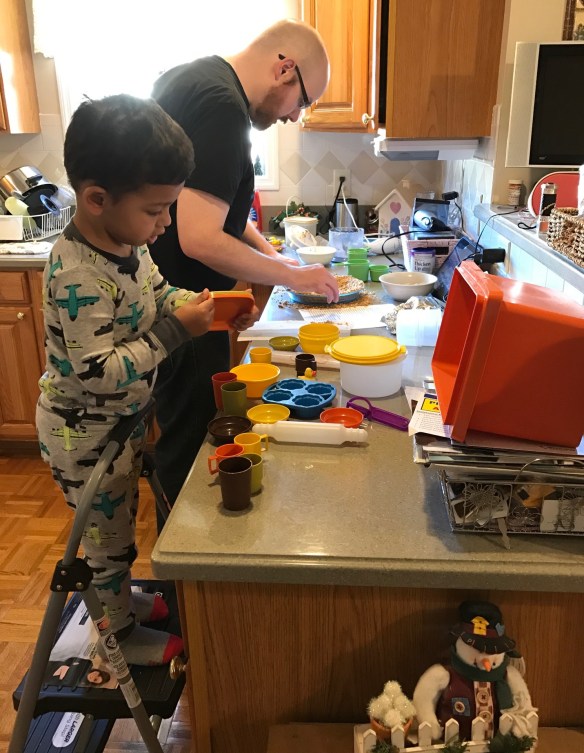
1. Jason’s birthday!

IMG_0017(1)

IMG_0010(1)

Mittu and Timothy made that amazing cake!

2. An outing. We celebrated Jason’s birthday early over the weekend so we’d have more time. He took his actual birthday off during the week, and he and Mittu took Timothy to a children’s art and science museum called The Muse, and invited me along. It was so fun to watch Timothy engage with various displays and participate in some of them with him. I don’t have any photos – just about the time I would get my phone camera out and read, the moment passed. Then we tried a new-to-us pizza place called Sergeant Pepperoni’s. It was packed, and with one server working as hard as she could, it took about 40 minutes to get our food, but it was good. More help came in while we were there, so maybe someone had called sick or something. Then it was home for naps. Small children’s schedules coordinate nicely with Grandma’s schedules that way. 🙂 Timothy and I were both pretty wiped out by that point.

3. Lunch with Melanie at Red Lobster. Last time I was good and looked for something lighter and healthier – this time I indulged in my favorite popcorn shrimp. 🙂 We enjoyed talking so much, the time passed so fast – I was shocked when I looked at the time and saw I needed to rush home before my mother-in-law’s caregiver needed to leave.

4. A day at home. Last week, for various reasons, I was out with errands I think every single day, even Saturday, which I try to keep free of them. This week, besides grocery shopping on Monday, I had some fun times out. But it was nice on Thursday to have a full day at home. I was contemplating going to the gym, but then my mother-in-law’s caregiver had to run out to take her daughter somewhere at the time I would have gone, so that took care of that for me. 🙂

5. Mexican food. We got take-out from a new-to-us Mexican food place last Friday night, and even though we probably won’t use them again for various reasons, I enjoyed it. I grew up in southern Texas, where Mexican or “Tex-Mex” food was a regularity, and I crave it sometimes.

It’s been a scorcher this week, very hot days and no rain, so I have been exceptionally glad for air conditioning. And for good reading – I finished some excellent books in the last several days.

What are some highlights from your week?

Save

Review: Cyrano de Bergerac

Cyrano de Bergerac is a play written by Edmond Rostand in 1897 but set in 1640 Paris. It became an instant success and has remained so ever since. In one sense it’s a throwback to “France’s golden age—a time when men were musketeers, women were beautiful heiresses, and the wit flashed as brightly as the swordplay” (according to SparkNotes), represented in stories like The Three Musketeers, which was published 50 years before Cyrano. Cyrano even references The Three Musketeers in places. In another sense it’s a parody of such stories. Part comedy, part tragedy, the main focus is its title character, Cyrano.

Cyrano excels in almost every area. He’s witty, an excellent poet, a superb swordsman, and he commands the respect of almost all who know him. The one area where he lacks confidence is romantic relationships, and that’s due primarily to his extremely oversized nose. He thinks no woman would find him attractive or even give him a chance, especially his cousin, Roxanne, whom he confesses to one friend that he loves. When Roxanne sends him a message that she wants to meet with him privately, he begins to hope that perhaps she could love him, and he pours out his heart in a letter to her. But when they meet, he learns that she loves a handsome young man in his regiment, Christian, and she asks him to watch over Christian.

He agrees, and when he tells Christian that he is Roxanne’s cousin, Christian confesses that he loves her but he can’t approach her. Roxanne loves “flowing words,
Bright wit,” and Christian is tongue-tied and inarticulate. The men each lament their deficiencies:

CHRISTIAN:
Oh, to express one’s thoughts with facile grace!. . .

CYRANO:
. . .To be a musketeer, with handsome face!

Then Cyrano hits on an idea: they can combine their talents. He can teach Christian what to say, and that will give him an outlet for his own heart. He gives Christian the letter he had just written to Roxanne but left unsigned and tells Christian to send it to her in his name.

What could possibly go wrong with that plan?

The rest of the play shows how they each progress and carries them through various scenes, but I don’t want to give away any more details.

Some of the comedic sections are priceless, such as a lengthy exchange with Cyrano and another man who is trying not to look at or comment on Cyrano’s nose and then is questioned by Cyrano (“Is there anything extraordinary about it?…Is it soft and swinging like an elephant’s trunk? Is there a wart on the end of it? Or a fly?…Is it a phenomenon?”) When Christian, hoping for a kiss, wants to speak to Roxanne himself and can’t seem to come up with anything except, “I love thee,” Roxanne responds, “‘Tis the theme: embroider it,” and later “Gather up your scattered eloquence.” Here are just a few more samples:

Tradesman: You are not Samson!
Cyrano: I will be, my dear sir, if you’ll lend me your jaw.

Cyrano: Whom I love? Come now, reflect. The dream of being loved, even by a homely girl, is one forbidden me. Forbidden by this nose of mine that precedes me everywhere by fifteen minutes.

I enjoyed the comedy and the swashbuckling, but most of all I enjoyed the more earnest parts, such as when Cyrano is trying to coach Christian when they’re half hidden in the darkness under Roxanne’s balcony (reminiscent of Romeo and Juliet‘s balcony scene). Getting frustrated with the process, Cyrano pushes Christian out of the way and then speaks from his heart. The last few scenes, when Cyrano goes to visit Roxanne some fourteen years after the action in the previous scenes, is masterfully written. The time of day, the season, the double meaning to Cyrano’s words, and the development of the conversation all come together to form once of my favorite sections of literature with one of my favorite lines (which I can’t tell, or else you’d know the ending!)

I looked at SparkNotes and Shmoop‘s analysis a bit, and disagreed with Shmoop’s especially. They seemed to think the main theme was Cyrano’s lack of self-esteem, that if he had not been hung up on his one defect, he could have had a life of love (see the Shmoop heading “Why Should I Care?” for more on this).

But I think the theme has to do with the self-sacrificial nature of real love. A couple of times Cyrano had an opening to confess his love, but he abstained, for the happiness and then the honor of another. All the characters grow in their understanding of love, finding that it goes beyond handsome faces, stolen kisses, and “embroidered” words, but Cyrano embodies it the most.

I did not investigate translations like I did before reading Don Quixote, and I wish I had. I looked around a bit afterward and learned that one by Brian Hooker is considered the best. I was primarily looking for an audiobook version that read the actual play rather than an audio performance of it, and found that here, translated by Howard Thayer Kingsbury, and enjoyed it very much. It says it is narrated by Flo Gibson, but it is actually narrated by Grover Gardner, who did an excellent job. I also got this Kindle version translated by Charles Renauld and looked around it and the Gutenberg version, and didn’t like either of them as much, at least, as far as I compared them, which wasn’t much. For instance, where in the audiobook Roxanne tells Christian to “embroider” his words, the Gutenberg version says to “vary” them, and the Renauld version just says, “Amplify!” I don’t know which is closest to the original, but “embroider” sounds a lot better to me. But I do appreciate Renauld’s introduction and preface detailing some of the difficulties of translation, not only from a different language, but from the poetry in which the play was originally written, and his reasons for making the choices he did, ending with the admonition that those who would be critical should “Try the task!” While looking up information on translations, I came across this fascinating discussion with some examples of how different translations handle one of Cyrano’s speeches and this great article.

One place where translations differ greatly is near the end when Cyrano speaks of the one thing he can take with him when he dies that no one can take away from him. Some translations say “plume,” others say “panache.” The audiobook said “plume,” and I admit it didn’t make sense to me at first. Renauld says in his introduction:

Now, what is this panache upon which “Cyrano” sets such a high value? To understand it is to appreciate, to miss it is to miss the meaning of the play. An explanation of it is, therefore, not out of place in this introduction.

The panache is an external quality which adds colour and brilliancy to internal things already worth having for their own intrinsic value. Its main justification is personal bravery…The panache is literally a high plume, or bunch of plumes, that waves high above a commander’s head-gear…There is magnetism in the panache…Henry the Fourth said to his soldiers; “you will find it always on the path of honour and duty.” The panache, too, is essentially joyful. “Cyrano” is joyful, in spite of a life that would breed discouragement and bitterness in almost any heart but his.

That sheds light on this earlier speech of Cyrano’s when someone criticizes his clothes:

It is my character that I adorn.
I do not deck me like a popinjay ;
But though less foppish, I am better dressed :
I would not sally forth, through carelessness.
With an insult ill wiped out, or with my conscience
Sallow with sleep still lingering in its eyes.
Honor in rags, or scruples dressed in mourning.
But I go out with all upon me shining,
With liberty and freedom for my plume,
Not a mere upright figure ; — ’tis my soul
That I thus hold erect as if with stays,
And decked with daring deeds instead of ribbons.
Twirling my wit as it were my moustache,
The while I pass among the crowd, I make
Bold truths ring out like spurs.

And it also sheds light on one place where they are battling Spain, and a cadet comes in with “a collection of shabby hats spitted on his sword, their plumes bedraggled and holes through the brims,” “spoils of war” he gathered from the enemy’s camp.

So it does look like the theme has to do with panache, brave, magnetic, joyful flair. But I still think it has to do with love as well.

There are multiple film versions of the play – I’d love to check out Jose Ferrer’s, one of the most famous ones, if I can find it. I did find this scene of it:

I had seen this play at least once, maybe a couple of times, years ago, and remembered the basic story line, but I am so glad I read (or listened to) it now. There was so much to enjoy about it, and I feel sure I’ll read it again in the future.

(Sharing with Semicolon‘s Saturday Review of Books, Literary Musing Monday, Carole’s Books You Loved)


Book Review: Fierce Convictions

I really didn’t know anything about Hannah More when I first saw Fierce Convictions: The Extraordinary Life of Hannah More – Poet, Reformer, Abolitionist by Karen Swallow Prior making the rounds a couple of years ago, but so many bloggers spoke positively of it that I requested it for the next gift-giving occasion. It turns out I am in good company: in his preface to this book, Eric Metaxas said he hadn’t know much about her, either, until doing research for his book on William Wilberforce, and then he got so excited, he tried to include as much about her as he could. When he met Prior and found out her doctoral dissertation was on More, he urged her to write a book.

Hannah was born to a family of five daughters in 1745. Her father being a teacher and her own thirst for learning led to her receiving an education beyond the norm for girls in that era. She and her sisters established a school together as they got older. Hannah wrote some plays for the students that were well-received. She was engaged for a long period of time, but the marriage never went forward. In a transaction common for the day, her former fiance offered her an annuity “sufficient to allow More to pursue a literary vocation as compensation for the time she devoted to him” (p. 37).

An influential friend sent a copy of one of her plays to David Garrick, a famous actor of the day; thus “the door to the literary capital of England was opened” (p. 49). Hannah became friends with a number of Londoners, including Garrick and his wife, Horace Walpole, Samuel Johnson, William Wilberforce, and a host of others. She was so close to Wilberforce that one of her anonymous publications was thought to be his. She was included in the Bluestocking Circle begun by “one of the wealthiest and most influential women of the day” (p. 76), Elizabeth Montagu. More’s influence and literary career grew.

But for various reasons, More became disenchanted with life in London and moved to Cowslip Green in between two villages.

More had always been bemused–and sometimes amused–by the excesses and superficialities she witnessed [in London]. So while the glistening of the fashionable life grew ever duller over several years, hints of More’s doubts about this fool’s gold can be found even from her earliest seasons there. It is clear that she was undergoing a greater sense of calling to more serious work, to more devotion in her faith, and with it to ministry in serving others (p. 95).

She was given a book of John Newton’s letters which she described as “full of vital, experimental religion” – vital meaning, according to Prior, “‘full of life,’ so opposite the stale, dead religion found in many Church of England members” (p. 105).

The word experimental alluded to the growing emphasis during the eighteenth century on the importance of individual experience in religious practice, the need of each person to have an authentic and personal faith rather than simply to adhere to rote tradition (p. 105).

Wilberforce had originally “thought that being a sincere Christian required withdrawing from the corrupt corners of human business” and was inclined to “retreat from public life in favor of a course devoted to piety.” John Newton encouraged him to “stay at his post, and neither give up work, nor throw away wealth; wait and watch occasions, sure that He, who put him at his post, would find him work to do” (p. 113). Later Wilberforce’s “influence dissuaded [Hannah] from her growing inclination to shrink from the world” (p. 117). Thank God that both of these people “stayed at their post.” “Even John Wesley sent Hannah a message through her sister: ‘Tell her to live in the world; there is the sphere of her usefulness; they will not let us come nigh them” (p. 203). The bishop of London asked her, “Where can we find any but yourself that can make the ‘fashionable world’ read books of morality and religion, and find improvement when they are only looking for amusement?” (p. 202).

More joined with Newton, Wilberforce, and others involved in fighting the slave trade.

As a goldfish swimming in a bowl doesn’t know what water is, so a person living in eighteenth-century Great Britain–immersed in an economic and social structure built on the slave trade–could not easily, if at all, see slavery for what it was. To do so required, it seemed, a certain kind of perceptiveness of mind and spirit. Hannah More was one of the few who possessed it (p. 108).

Even Wilberforce acknowledged that the fight against slavery could not by won in Parliament alone, that “more is to be done out of the House than in it,” that “changing the minds in Parliament would require changing the heart of the nation first” (p. 128).

The battle against slavery was, in many ways, led by the poets–and other writers and artists–who expanded their country’s moral imagination so it might at last see horrors too grave for the rational mind to grasp (p. 128).

Hannah used her influence and her pen to fight against slavery, a fight which took over forty years. She also used it to encourage education, especially for girls and for the poor, and to provide edifying reading material. Prior explained that tracts or pamphlets at that time were like blog posts today, and Hannah used them for educational, religious, and sometimes political causes, eventually leading to the establishment of Cheap Repository Tracts.

But she did more than write. She and her sisters started a number of schools for the poor, financed by Wilberforce, fighting against the opinion of the time that the poor should not be educated or taught to read (some thought the poor would have no use for it: others thought it might disturb the order of things). She became one of the few female members of what was called the Clapham Sect – not a sect as we think of it today, but a group of influential “like-minded believers, ‘bound together by shared moral and spiritual values, by religious mission and social activism, by love for each other, and by marriage,’ [who] changed history as they sought to serve God in every area of their lives, personal and public, at home and abroad” (p. 167). “The efforts of the Clapham community were three-pronged: they aimed at alleviating the suffering and oppression of the lower classes, reforming the excessive and negligent behaviors of the upper classes, and advancing Christianity at home and throughout the world” (pp. 173-174).

She was not flawless. Some of her views would have modern readers scratching their heads, and Prior does an excellent job explaining them in the context of Hannah’s times. But she yielded herself, her influence, her energy, her finances, and her pen to God and was used mightily by Him. One quoted source said, “What Wilberforce was among men, Hannah More was among women” (p. 240).

Somewhere between Birrell’s hatred and Roberts’s hagiography is a woman who was at once ordinary and remarkable. She was a woman with virtues and flaws, faith and fears, vision and blind spots. But she was also one whose unique gifts and fierce convictions transformed first her life and subsequently her world and ours (p. 253).

To Walpole, More was testimony, in the words of one of her early biographers, that “the most implicit faith and the most devoted zeal in Christianity could consist with the highest mental attainments; and that the most devoted piety was no obstacle to cheerfulness and humor” (p. 170).

In the epilogue Prior also shares some reasons why More is not more well-known today, among them the modernist movement, which “rejected the values that most defined the Victorian age: duty, family, piety” (p. 252). In addition, her one novel “is practically unreadable for most readers today. tastes have changed, and the art of the novel has progressed toward more nuance and complexity than the plain didacticism of More’s novel” (p. 235). But I am glad that Prior brought her to our attention and shared her life with us.

It took me just a little while to truly get into the book. I am not sure if it took that long to get into the rhythm of Prior’s style or if it just got more interesting to me around the time that Hannah went to London, and more so when she decided to leave. I especially appreciated Prior’s couching everything into its historical setting so that we weren’t getting just the facts, but truly understanding how historical events and beliefs affected Hannah and how she in turn affected them.

And on a completely separate note, one of Prior’s explanations helped me better understand Jane Austen’s Sense and Sensibility:

During the so-called long eighteenth century (1660-1830), a “cult of sensibility” arose that exalted the outward manifestations of emotional sensitivity–weeping, fainting, and the like–as the marks of morality and refined character, to the point that sensibility became more important than benevolent or moral actions (p. 185).

In context, Prior said this about More’s writing concerning animal cruelty. She sought to raise awareness of some of the brutal practices of the day in order to stop them yet did not devolve into “emotional indulgence” and “inordinate affection” the “cult of sensibility” employed towards animals (p. 197).

I’ll close with a few favorite quotes from More herself:

It should be held as an eternal truth, that what is morally wrong can never be politically right (p. 136).

I am at this moment as quiet as my heart can wish. Quietness is my definition of happiness (p. 69).

Atrocious deeds should never be called by gentle names (p. 205).

God can carry on his own work, though all such poor tools as I were broken (p. 247).

The more I see of the ‘hounoured, famed, and great,’ the more I see of the littleness, the unsatisfactoriness of all created good; and that no earthly pleasure can fill up the wants of the immortal principle within.

Bible Christianity is what I love…a Christianity practical and pure, which teaches holiness, humility, repentance and faith in Christ; and which after summing up all the Evangelical graces, declares that the greatest of these is charity (p. 155).

(Sharing with Semicolon‘s Saturday Review of Books, Literary Musing Monday, Carole’s Books You Loved)

Save

Save

Book Review: The Strange Case of Dr. Jekyll and Mr. Hyde

Jeckyll and HydeIn a way it’s too bad that most modern readers know the premise behind The Strange Case of Dr. Jekyll and Mr. Hyde by Robert Louis Stevenson. We miss a lot of the build-up of the mystery the other characters are trying to solve. But it’s still an enjoyable story.

It begins in Victorian-era London when a lawyer, Mr. Utterson, is taking a walk with his cousin when they pass a door that stirs a memory for the cousin, Mr. Enfield. Once Enfield was walking in the same area when he witnessed a young girl being trampled by a man. He and the crowd around them insisted that the man pay the girl immediately for damages, and the man went into the particular door they’re now passing to obtain a check written on the account of a reputable man in the city. Enfield describes the man negatively, saying he seemed deformed, though Enfield couldn’t put his finger on exactly what was wrong with him. When he mentions that the man’s name is Hyde, Utterson stops him, for he knows who Hyde is and wishes to avoid gossip.

But the incident increases Utterson’s concern. His friend and client, Dr. Jekyll, has just changed his will to leave everything to Hyde, and Utterson feels sure that the account Hyde drew on was Jekyll’s. He fears Hyde may be blackmailing Jekyll, but Jekyll says Hyde is no one to worry about.

Some time later, a maid witnesses Hyde killing a man in the street who turns out to be a member of Parliament and another of Utterson’s clients. Hyde seems to disappear after that, and Jekyll says he has cut off ties with him. But then all of a sudden Jekyll stops going out and receiving visitors. One day when Utterson happens to see him through a window and stops to talk for a while, Jekyll seems glad to see him at first, and then suddenly with a look of horror slams down the window. Then one night Jekyll’s butler, Poole, come to Mr. Utterson to say that something is terribly wrong: his master has been locked in his laboratory for days and now doesn’t sound like himself. Utterson comes with Poole, and they decide to break down the door. What they find I will leave you to discover, but a couple of letters left for Utterson explain what has been going on.

As most readers know (and if you don’t know and don’t want to, skip this paragraph!), Hyde and Jekyll are the same man. What’s perhaps the most interesting aspect of the book to me is Jeckyll’s reasons for his experimentations. He had struggled with the conflicting parts of himself wanting to do good or evil, and decided to see if he could separate them – not in order to filter out the bad and therefore conquer it, but so the bad side could do what it wanted without restraint and without consequences such as marring the good name of Jekyll.

I had learned to dwell with pleasure as a beloved daydream on the
thought of the separation of these elements. If each, I told myself, could be housed in separate identities life would be relieved of all that was unbearable: the unjust might go his way delivered from the aspirations and remorse of his more upright twin and the just could walk steadfastly and securely on his upward path doing the good things in which he found his pleasure and no longer exposed to disgrace and penitence by the hands of this extraneous evil.

When Jekyll becomes alarmed at how far Hyde has gone and resolves not to let him out any more, Stevenson masterfully describes incomplete repentance which isn’t true repentance.

It was Hyde, after all, and Hyde alone, that was guilty. Jekyll was no worse; he woke again to his good qualities seemingly unimpaired; he would even make haste, where it was possible, to undo the evil done by Hyde. And thus his conscience slumbered.

Yes, I preferred the elderly and discontented doctor, surrounded by friends and cherishing honest hopes; and bade a resolute farewell to the liberty, the comparative youth, the light step, leaping impulses and secret pleasures, that I had enjoyed in the disguise of Hyde. I made this choice perhaps with some unconscious reservation, for I neither gave up the house in Soho, nor destroyed the clothes of Edward Hyde, which still lay ready in my cabinet.

As the first edge of my penitence wore off, the lower side of me, so long indulged, so recently chained down, began to growl for licence.

I sat in the sun on a bench; the animal within me licking the chops of memory; the spiritual side a little drowsed, promising subsequent penitence, but not yet moved to begin.

Elisabeth Elliot once wrote that she was dealing with guilt over something she had done and was astounded by it, thinking, “That’s just not me.” She was brought up short by the realization that it was indeed her fault, that she couldn’t blame it on provocation or circumstances. Even if she had been provoked, she could have looked to God for help to respond rightly. That jarred me, because I was too prone to blame my bad reactions on the circumstances that caused them rather than my innate sinfulness. It’s telling that Jekyll blamed Hyde’s wrongdoings on Hyde alone as if he were a separate being rather than actually himself. The first step in gaining any kind of victory over the Hyde in each of us is to recognize and own the fact that he is us.

I don’t know much about Stevenson himself. A quick perusal of the Wikipedia article about him says he grew up in a religious home but declared himself an atheist in his twenties. He recognized just how horrible what the Bible calls our “old man” or “flesh” could become, and seemed to realize that it couldn’t be reigned in just with conscience. I don’t know if he ever knew that we could be completely liberated from its penalty and power only through Christ: “O wretched man that I am! who shall deliver me from the body of this death? I thank God through Jesus Christ our Lord” (Romans 7:24-8:1a).

This is a short book: paperback copies are less than 100 pages, and the audiobook I listened to was only 2 hours and 19 minutes. So for those who might like to read classics but are intimidated by their length, this one might be good to try. Even though I knew the basic story, I gained much by reading the book. I started out listening to an audiobook, but though the narrator was fine in the narrative, he was terrible with the character’s voices, so I switched to the 99 cent Kindle version. I chose it for the horror/Gothic category of the Back to the Classics challenge. I’m not into horror at all and thought I might skip this category until I read Rebekah’s review of this book. I am thankful for both of those influences leading me to read a book that I would have been unlikely to pick up otherwise.

(Sharing with Inspire Me Monday, Semicolon‘s Saturday Review of Books, Carole’s Books You Loved)

Save

Save

Save