Unknown's avatar

About Barbara Harper

https://barbarah.wordpress.com

Laudable Linkage

Laudable Linkage

Some of the good blogging found this week:

Nearness Is Enough, HT to Challies. “For years, I thought the nearness of God would mean that everything would be okay or, at the very least, feel okay. I hoped that his nearness would mean some sort of tangible presence, some sort of relief from pain. I hoped that it would act as a shield and protection around me, that it would stop the fiery arrows of the enemy from penetrating my heart. But that was not the nearness of God.”

Trump, Trudeau, and the 51st State. The situation in Canada, from one who lives there.

Narcissus in Public, HT to Challies. “I took my family to downtown DC, ending the day with what we had envisioned as an idyllic skate at the ice rink in the National Gallery’s Sculpture Garden. Although it was lovely, as ice skating always is, the experience was marred by the presence, for most of our one-hour skate, of a cluster of young women for whom the rink’s only value was as background scenery for Instagram glamour shots.”

The Prosperity Gospel We Sometimes All Believe In. “There is a version of the prosperity gospel that we can all believe in and it goes something like this: ‘God, I gave my life to you, and in exchange I expect you to make my life easy. I may not need riches or opulence, perfect health or abundant wealth, but I would like ease. And if you take that ease from me, I may just assume that your feelings for me have altered or your love for me has waned. I may even regret following you. Please, just keep my life easy.’”

Please Don’t Sing “Imagine” at Funerals, HT to Challies. Or any time, really.

Will You Pass the Test of Praise? HT to Challies. “Generally, testing feels like something we want to avoid. But Scripture mentions a surprising test which looks, at first glance, like an exam we all want and could easily ace.”

The End of My Words. “‘The words of Job are ended.’ Have you ever come to the end of your words? I have. More than once, in my sanctification process, I’ve cried and wailed, and a time or two, I’ve even screamed my case before God until nothing was left. Dry bones. And at the end of my words, something miraculous took place.”

Hosting a Missionary Family. Tips and insights for churches and families hosting a visiting missionary.

Charles Spurgeon quote

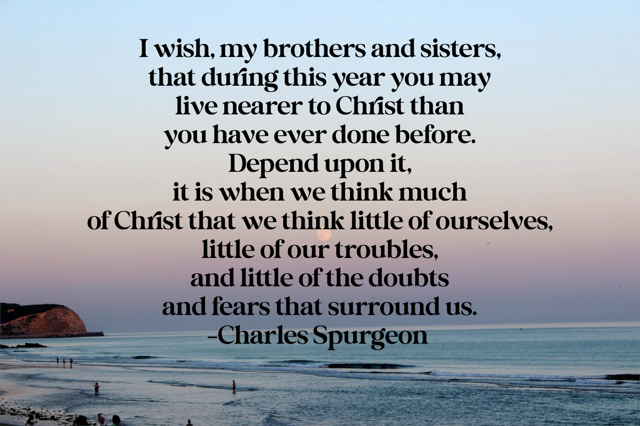
I wish, my brothers and sisters, that during this year you may live nearer to Christ than you have ever done before. Depend upon it, it is when we think much of Christ that we think little of ourselves, little of our troubles, and little of the doubts and fears that surround us.
— Charles Spurgeon

Friday’s Fave Five

Friday's Fave Five

We did get our predicted snow last Friday–3-4 inches at our house. Thankfully the power stayed on. We stayed home Saturday and then ventured out to church Sunday with no problem. It’s been cold enough that some snow is still around. The roads and parking lots are mostly clear, but there’s enough ice to require watchfulness. We’re supposed to get more snow Sunday.

Meanwhile, we’re counting blessings with Susanne and friends at Living to Tell the Story.

1. A long overdue haircut and a coupon. I had a coupon for a $7.95 haircut at a new place near us. I hadn’t had a cut since September, so it felt really good for the shaggy ends to be cleaned up.

2. An outing. Jason and Mittu invited us to Timothy’s favorite pizza place to celebrate his reaching his reading goals. It was good to get together again–somehow we hadn’t seen each other in a couple of weeks except in passing at church. Plus I enjoyed getting out to do something fun.

3. A dentist’s visit over with. Seeing the dentist is not my favorite thing to do, even as nice as she is. This time, I was concerned about a couple of bumps on the side of my tongue. When one sees bumps where there are not supposed to be any, one’s mind jumps to the worst case scenario (at least this one does). She didn’t think they were anything serious, but took pictures to research further and perhaps consult with an oral surgeon. We talked so much about my tongue that nothing was said about my teeth, but I assume they are all okay.

4. More rooms painted. We have front room that’s smaller than a living room which we have called the sitting room, reading nook, and various other designations. Jim painted that this week and is now on the kitchen/dining area. Along the way, he’s replacing old yellowish light bulbs with brighter white ones. I am so pleased with how everything is looking!

5. Spring cleaning as we go. While Jim had the curtains off the front room window, I thought to myself that I should wash the window while he went out for more paint. That window is hard to get to normally. Then he mentioned that he already had washed it. I washed and ironed the curtains while he took care of the blinds. I mentioned that I’d like to dust the top of some of the pictures before he put them back on the wall, because I had trouble reaching them while dusting. He said he had been dusting all the pictures and plaques before hanging them back up. Isn’t he thoughtful? I helped do some of that after he finished painting the front room. I’ve been astonished at how much dust was still on things that I regularly dust!

While the furniture has been moved out of the way, he’s swept and vacuumed normally hard-to-reach areas.

Probably no one will notice that the curtains have been washed or the farthest corners under the couch swept or the backs of plaques dusted. But it feels good to have them done. It hadn’t occurred to me that we’d be doing this cleaning while painting room by room, but it makes sense to do it while the furniture is out of the way and everything is off the walls. Doing a room at a time is easier than doing all the spring cleaning at once. And, to be honest, I don’t think I have ever spring cleaned this thoroughly.

How is your January going so far?

Review: Set the Stars Alight

Set the Stars Alight

In Amanda Dykes’ novel, Set the Stars Alight, Lucy Claremont is the daughter of an English watchmaker whose family invites a young “lost boy” into their circle. Dash grew up in America until both parents died. He lived with a distant aunt who wasn’t home much and seemed not very interested in him.

Lucy’s father loved to tell stories and riddles to the children. Many of his stories centered on a legend about a man who lived 200 years before, Frederick Handford. Handford was a seaman who, accused of treason, stole a boat called the Jubilee and was never heard from again. Many had searched for any sign of Handford or the Jubilee, to no avail. Many stories had been told about what might have happened.

Lucy grew up with a love for the ocean and a desire to research and find the Jubilee. Dash grew up loving the stars, after hearing about them from Lucy’s father and using his homemade telescope. Their interests and circumstances seemed to take them in opposite directions until their paths crossed again while researching the Jubilee.

The story shifts back and forth from 2020 to the 1800s and what really happened with Frederick Handford. He was the son of a respected admiral who, since his own glory days, fell to drink. Frederick grew up with his father on one end of the house, drinking and raging, and his mother at the other end, playing parts of Handel’s Messiah. When his mother died, he ran away to escape his father’s rage and neglect. He was taken in by a kind local shepherd, but inadvertently brought tragedy to the man and his family. Frederick spent the rest of his life trying to make it up to them, especially the man’s daughter, Juliette.

Amanda writes in her author’s notes that this story felt like a set of nesting dolls, with many layers and stories within stories. That’s an apt description.

Amanda’s stories have a way of deeply touching hearts. Her characters are real and flawed, yet their stories are redemptive.

One of my favorite quotes comes from the book comes from a poem titled “The Old Astronomer to His Pupil” by Sarah Williams:

Though my soul may set in darkness, it will rise in perfect light;
I have loved the stars too fondly to be fearful of the night.

A few more quotes that stood out to me:

He is coming, and coming, and coming, and coming after you. In every sunset, in every snatch of birdsong In everything that stirs deep into you and makes you hungry for bigger things, eternal things. That is Him, pursuing you with tenderest grace. In the places so hard they wring your soul. In the places so beautiful they steal your breath. He is there, filling your soul, giving you breath.

Made-up tales that stand through time . . . they are echoes . . . of truth.

I think it’s our duty to keep the stories, to pass them on. It is our duty—and our honor. In a world as dark as ours, we—that is, people—forget how to see the light. So we remind them by telling the truth, fighting the dark, paying attention . . . setting the stars alight. There are things shining brightly all along, if we will notice.

Such freedom, to know our limits. And to know the God who has none.

God had a way of redeeming wounds with the strength of others.

Surprise gave way to curiosity, And curiosity–as it was meant to from the time God breathed life into the great wide world–made way for wonder.”

I listened to the audiobook, which was mostly good except the narrator’s diction wasn’t clear in places. I checked out the e-book from Libby to get the author’s notes and look up some passages.

I thought the modern-day part of the book moved a little slowly at times. But overall, this was a lovely, touching story.

(Sharing with Bookish Bliss Quarterly Link-Up)

Cultivating Awe of God’s Word

Cultivating awe of God's Word

Are you in awe of God’s Word?

If you’re like me, you’d probably say, “Not as often as I’d like to be.”

There are times when our meeting with God is special, when He gives us just what we need in the moment, we notice something new, or we’re blessed by an old, familiar, but beloved passage.

But other times—we’re sleepy, distracted, hurried, or we’re slogging through a book like Leviticus.

I was struck recently by a quote from G. K. Chesterton in Winter Fire: Christmas with G.K. Chesterton: “The world will never starve for want of wonders; but only for want of wonder.” Though he wasn’t talking about the Bible there, I felt what he said was true of the Bible as well.

Chesterton’s quote reminded me a couple of verses:

How precious to me are your thoughts, O God! How vast is the sum of them! (Psalm 139:17.

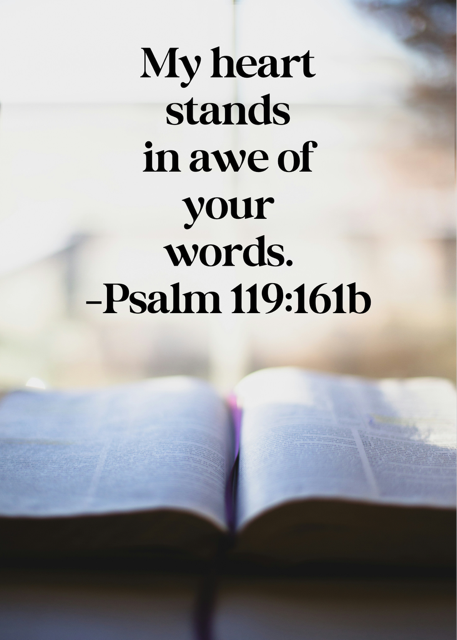
My heart stands in awe of your words. I rejoice at your word like one who finds great spoil (treasure, plunder) (Psalm 119:161a-162).

So what can we do when we feel less than awed by God’s Word?

Employ practical helps. It’s hard to be awed when we’re sleepy or distracted. Getting enough sleep, choosing a more wakeful time of day, taking a shower or doing a few minutes of exercise first can help us be more alert. Removing distractions as much as possible helps: turning off the phone, choosing a time you can be somewhat alone, etc.

Pray. Psalm 119:18 is an apt prayer: “Open my eyes, that I may behold wondrous things out of your law.” When we’re dull in spirit, we can appropriate another of the psalmist’s prayer: “I am greatly afflicted; Renew and revive me [giving me life], O LORD, according to Your word” (Amplified Version).

Remember:

Who is speaking to us. I’m inspired by what George Guthrie says here: “I am still blown away by the idea that the God of the universe wants to communicate with us on a daily basis and that he has chosen to do so in this miraculous book we call the Bible.” As we meditate on who He is and the ways He has worked in our lives, our hearts will warm towards Him and His Word.

That God chose these specific words for us. Psalm 139:17-18 says God’s thoughts are vast, more than the sand. One of our former pastors used to say that the Bible is divinely brief. Out of the multitudes of things God could have said, He inspired and preserved in the Bible what He wants us to know. So each sentence has a purpose.

The cost and privilege of having a Bible in our own hands. Most people didn’t until after the printing press was invented in 1440 AD. Even when it became widely used, books were too expensive for many people to have. When books became more widespread, brave men like William Tyndale labored and gave their lives to have it translated into English that everyday people could read.

Past experiences with the Bible. Remembering some of those special times in the Bible that I mentioned at the beginning can reawaken our desire for it to speak to us again.

Our enemies: the world, which tries to turn our heads; our flesh, prone to wander, to laziness, to self-indulgence; and the devil, who wants to deceive and distract us. It’s no wonder we often have to fight for time and attention while reading the Bible. But the struggle is worth it.

Slow down. Sometimes we rush through our time in the Bible just to get it done or to get to other tasks. Reading a smaller amount and taking time to reflect on it is better than zipping through several chapters without retaining anything.

Ask why this passage is in the Bible. If God inspired all of Scripture, each passage is there for a purpose. What does it tell us about God?

Begin with hymns or praise. I’ve often been encouraged by missionary and writer Elisabeth Elliot’s confession in On Asking God Why: “When I stumble out of bed in the morning, put on a robe, and go into my study, words do not spring spontaneously to my lips–other than words like, ‘Lord, here I am again to talk to you. It’s cold. I’m not feeling terribly spiritual. . . .'” She found help by reading through hymns or psalms.

Get help from a good study Bible, commentary, or study group. All three have helped me by giving some background or explanation of the passage or pointing out things I overlooked in my own reading.

Keep reading in spite of feelings, or the lack of them. Another former pastor said that one of his best times of prayer began with his confession that he didn’t feel like praying. It often happens that way with Bible reading, too. We might not feel awe-inspired as we begin. But the Bible says it is living and active (Hebrews 4:12). As we read, God speaks to us and enlivens us. Even if we don’t feel any differently after reading, God has fed us.

Thank God for what we read. We often divide our quiet time with the Lord into prayer and Bible reading. But we can integrate those activities. When we read of God’s love, we can thank Him for sharing His love with us. When we read an example of His love, power, or wisdom, we praise Him for them right as we read. We can turn some of the verses into prayer and praise. Awe of God’s Word is not an end in itself, but leads us to awe of our God.

In the Everyday Gospel Christmas Devotional, Paul David Tripp says:

The beginning of Matthew presents us with a majestic one-time moment in history that you shouldn’t run past in your desire to complete your daily Bible reading. God has recorded and preserved it for you because he wants it to leave you in gratitude and awe. And that awe is meant to capture your heart with such force that it changes the way you think about who you are and how you live your life. (December 16 reading).

Awe in our Bible reading doesn’t just help us enjoy it more. As Tripp says, awe captures our hearts in order to change us. Awe is part of beholding Him: “And we all, with unveiled face, beholding the glory of the Lord, are being transformed into the same image from one degree of glory to another” (2 Corinthians 3:18).

“The world will never starve for want of wonders; but only for want of wonder,” Chesterton said. There is much to inspire awe and wonder in the Bible. May God give us eyes to see and hearts to understand.

awe of God's words

(I often link up with some of these bloggers.)

Laudable Linkage

Laudable Linkage

I hope you are warm and snug this cold winter morning (if you’re in the northern hemisphere–if it’s summer where you are, stay cool!) Here are some good reads found this week:

Reading the Bible to Meet God, HT to Challies. “In my book Help My Unbelief: Why Doubt is Not the Enemy of Faith I wrote about how important it is to read the Bible to meet God, to read it relationally and as sustenance for the soul. Often we simply read it for information, to follow a rule, or as an academic pursuit. Reading to meet God sounds like a great idea and the ideal for a Christian, but how do we actually do it”

Life Beyond the Spiritual Shallows. “There is a depth to God’s character that cannot be assessed with quick glances and fleeting thoughts. We will never become the kind of women who face the lion’s den without a deep understanding of God’s character. We will never know that depth if we cannot find ways to circumnavigate our brain’s wiring and study God’s Word for longer than eight second bursts.”

Preparing for the Storm, HT to Challies. “We don’t acknowledge the likelihood of impending trials, so we don’t prepare for them. It’s only after the trial has passed, when we’re left trying to pick up the shards of hope and put our lives back together, that we realize we need to stockpile emergency supplies for the next time Sorrow comes knocking at our door. Having lived through one storm, we realize we’ll need a reservoir for the next one.”

Why Pray for Protection When Suffering Keeps Coming? John Piper answers a difficult question from a listener about praying for protection when it seems pointless, when God let bad things happen in the past.

Are You Your Spouse’s Biggest Cheerleader? HT to Challies. “It works both ways. Wives need their husbands to encourage and affirm and cheer for them as well. In healthy, thriving marriages, husbands and wives are cheerleaders for one another. Smart husbands and smart wives know that the Bible is right on target when it says, ‘Death and life are in the power of the tongue’ (Proverbs 18:21). Spoken words can destroy or empower.”

Little People with Big Emotions: 5 Strategies for Emotionally Healthy Kids. This is excellent, something I wish I’d had when mine were young. “I wish I had been better equipped to help my kids when they experienced big emotions. How can we help our children manage their feelings without stuffing them down, prettying them up, or feeling like there’s no room for them?”

Four Reasons Acts 2:38-39 Does Not Imply Infant Baptism. “Though this passage mentions both children and baptism, Acts 2:38–39 leaves no room for infant baptism. Here are four reasons why.”

Sin and repentance

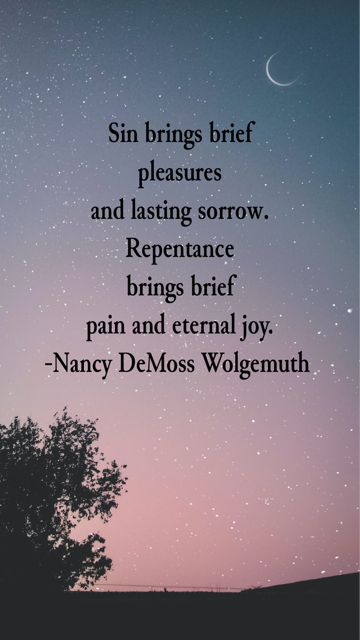
Sin brings brief pleasures and lasting sorrow.
Repentance brings brief pain and eternal joy.
Nancy DeMoss Wolgemuth

Friday’s Fave Five

Friday's Fave Five

This image is apt for today, as we’re predicted to get 3-6 inches of snow. That is a really big deal in our area. I’m hoping we get less than that and that the power stays on. But Jim went to the store yesterday, and we’re ready to hunker down and see what happens.

Meanwhile, I’m dwelling on things to be thankful for from the last week with Susanne and friends at Living to Tell the Story.

1. A steak and egg biscuit. I had to go in for some fasting lab work last Friday, and rewarded myself afterward with a steak and egg biscuit from Bojangles. I don’t care for the rest of their food, but I like their biscuits. This one was so good. It’s a little too heavy to eat very often, but it hit the spot that day. Plus I got Bo-Berry (blueberry) Biscuits to split with Jim.

2. Good lab results. These days, physicals seem to consist primarily of talking about blood chemistry. I’m thankful all my numbers were good–even my overall cholesterol as well as the good and bad kinds were within normal range.

3. Help taking down Christmas decorations. Jesse came over last Saturday to help us take down Christmas stuff, which was greatly appreciated. Plus, I’ve wanted for a long time to sort through ornaments and pull out the ones that needed repair or that we don’t really use any more. Usually there’s not time in the rush of putting up or taking down decorations. But I wanted to do that even if it meant leaving that one box out for a while. I was able to get that done (which wasn’t as involved as I thought it would be) plus reorganize some of the boxes so things fit better.

4. Sorting, organizing, and purging. I don’t know what it is about January that inspires those activities, but I was glad I was able to scratch that itch a bit. 🙂

5. Painting. Jim has been painting the hallway this week, and it looks so much brighter than the Basic Builder’s Beige that was on the walls. We were going for a very light grey, but the paint looks white, which is fine. The hallway walls didn’t take long, but it was a little tedious to take down all the family pictures and put them back up. Plus, between three bedrooms, a bathroom, two closets, and a small room housing the furnace and hot water heater, he had seven doors to paint. Those were not as fun. But they look great.

It’s hard to believe we are a third of the way through January already. How was your week?

Stay warm, friends!

Winter Fire: Christmas with G. K. Chesterton

Winter Fire: Christmas with G. K. Chesterton

I’ve not read G. K. Chesterton except for one novel, The Man Who Was Thursday, and a few pithy quotes. The quotes were enough to entice me to read more. So I was excited to see Winter Fire: Christmas with G. K. Chesterton by Ryan Whitaker Smith.

When I looked at the sample of the book at Amazon, however, I was disappointed that the book seemed to be less of Chesterton and more on Smith commenting on Chesterton. I eventually decided to get the book anyway, and I am glad I did.

Smith says that reading Chesterton is an “acquired taste,” and I agree. I would not have gotten nearly so much out of Chesterton’s quotes here without Smith drawing out the meaning.

If you’re not familiar with Chesterton, Wikipedia says he “wrote around 80 books, several hundred poems, some 200 short stories, 4,000 essays (mostly newspaper columns), and several plays. He was a literary and social critic, historian, playwright, novelist, and Catholic theologian and apologist, debater, and mystery writer.” He was a columnist for several newspapers and even wrote some Encyclopedia Britannica entries (including the one for Charles Dickens). He might be known best for his Father Brown stories about a priest who also does detective work.

He was baptized into the Church of England as a child, dabbled in the occult, then came back to the Anglican church as an adult, and later converted to Catholicism. I am curious how and why he embraced Catholicism but haven’t read enough to know his thinking. But “Christian themes and symbolism appear in much of his writing.”

Smith says Chesterton wrote prolifically about Christmas, much more than could be included in this book.

Winter Fire contains thirty days of readings, with Smith expanding on, explaining, and giving the cultural background to quotes about Christmas from some of Chesterton’s essays. After each reading is a Bible verse and questions for thought.

Then there are a variety of Chesterton’s other writings: several poems, a few essays, and a couple of short stories. Finally, Smith included recipes and games prevalent at the time Chesterton lived (1874-1936). The weirdest game, called Snapdragon, involved raisins doused in brandy, then set on fire. Then children tried to reach into the fire quickly and grab a raisin.

One of the readings here inspired a blog post, A Christmas Boomerang, and I have another post or two in mind based on thoughts read here.

Smith says the title of this book “is taken from a quote featured in the reading for Day 13: ‘Christ is not merely a summer sun of the prosperous but a winter fire for the unfortunate.’ The image of a fire burning amid the frosts of winter seemed a fitting image to draw from for a book that not only celebrates the comfort, joy, and revelry of Christmas, but the mercy of God who has called us to His everlasting feast” (p. 12). He writes that “The purpose of our journey is not so much to dwell in ‘the place from which Christmas came,’ but to allow that place to dwell in us, to return to our own country with christened eyes, to look upon our everyday surroundings with a baptized imagination” (p. 17).

I have scores of quotes marked, but I’ll try to share just a few:

In the majestic march of Progress, we have first vulgarised Christmas and then denounced it as vulgar. Christmas has become too commercial; so many of these thinkers would destroy the Christmas that has been spoiled, and preserve the commercialism that has spoiled it” (Chesterton, p. 32).

I have never understood what people mean by domesticity being tame; it seems to me one of the wildest of adventures (Chesterton, p. 45).

Omnipotence and impotence, or divinity and infancy, do definitely make a sort of epigram which a million repetitions cannot turn into a platitude. It is not unreasonable to call it unique. Bethlehem is emphatically a place where extremes meet. (Chesterton, p. 84).

Christmas did not merely borrow certain traditions from paganism; it survived paganism. It was a stronger thing than all the pagan world could offer. It was fiercer than its creeds, more potent than its rituals (Smith, p. 116).

The land endures the harshness of winter in order to be reborn in the vigor of spring. Everywhere we look, nature is rehearsing resurrection, preparing for the day when all things will be made new, when measurable time gives way to immeasurable eternity (Smith, p. 128).

These are a couple of stanzas from Chesterton’s poem “The House of Christmas”:

A Child in a foul stable,
Where the beasts feed and foam;
Only where He was homeless
Are you and I at home;
We have hands that fashion and heads that know
But our hearts we lost—how long ago!
In a place no chart nor ship can show
Under the sky’s dome.

To an open house in the evening
Home shall men come,
To an older place than Eden
And a taller town than Rome.
To the end of the way of the wandering star,
To the things that cannot be and that are,
To the place where God was homeless
And all men are at home.

The book cover, texture, and illustrations have a lovely old-fashioned feel to them.

Chesterton uses a lot of irony, and often. as Smith says, is “saying several things at once” (p. 11). I have question marks at a couple of places in the book. But I was inspired, taught, and encouraged by much that I read, and I am sure I’ll read this again in future Advent seasons.

(Sharing with Bookish Bliss Quarterly Link-Up)

Reading Plans for 2025

Reading Plans for 2025

I like to set some goals for my reading year. If I mean to read more of a certain author, or get to particular titles, those things don’t happen unless I plan for them.

But I also like having flexibility to read a new find or pick up something I am in the mood for or feel the need to read about.

Some of my reading goals this year:

  • One Dickens book I’ve not read yet.
  • A couple of classic books.
  • One C. S. Lewis book I’ve not read yet.
  • A book about writing.
  • A book about productivity, time management, or organization.
  • At least one biography, autobiography, or memoir.
  • A Bible study book.
  • A Christian living book.
  • A book related to midlife or aging.
  • Some of the unread books on my shelves or in my Kindle.

I like reading challenges that help me reach my goals and expand my horizons. Plus, reading challenges are a fun way to share about books we love. But I don’t like being involved in too many because of the record-keeping involved.

These challenges best intersect with my goals:

Mount TBR challenge

Bev at My Reader’s Block hosts the Mount TBR Reading Challenge, where we set a goal to read a certain number of books we already own. Details and rules are here. Bev has set the challenge up in increments of twelve, each set represented by a particular mountain. Last year I read 31 books from my shelves and Kindle app. This year I’m aiming for Mt. Blanc again, which is 24 books.

TBR 25 in '25

The TBR 25 in ’25 Challenge hosted by Rose City Reader dovetails nicely with the Mount TBR challenge. It’s the same idea—to read books you own but haven’t read it (though rereads count, too). The difference is, we aim for 25 and list them some time during the challenge. I don’t have my whole list figured out yet, but I know I want to read Ron Hamilton: The Man Behind the Patch by Shelly Hamilton, Bloom In Your Winter Season by Deborah Malone, Writing for Busy Readers: Communicate More Effectively in the Real World by Todd Rogers and Jessica Lasky-Fink, The Testament by John Grisham (have not read anything by him. I got this at a library sale a few years ago), The Wingfeather series by Andrew Peterson, and Rembrandt Is in the Wind: Learning to Love Art through the Eyes of Faith by Russ Ramsey, to name a few.

I listed this challenge last year but then forgot about it since it was new to me.

2025 Nonfiction Reader Challenge

Shelly Rae at Book’d Out hosts the Nonfiction Reader Challenge. This can be done one of two ways. Shelly has twelve books in different categories that we can aim for. Or we can be a “Nonfiction Grazer” and make our own goals. Although I might hit a few of her categories, I’ll go the grazer route and incorporate the nonfiction goals mentioned above.

Historical Fiction Reading Challenge

Finally, The Intrepid Reader. hosts the Historical Fiction Reading Challenge. A lot of my fictional reads fit this category. I’m going to aim for the Medieval level at 15 books.

Do you have any reading goals or participate in any book challenges?

(Sharing with Bookish Bliss Quarterly Link-Up)

Does God Have a Specific Will For Your Life?

Does God have a specific will for your life?

I became a Christian in my later teen years, when one faces myriad choices that will affect the rest of life: college or not, and where; majors; vocations; mates, location.

In the years since my teens, I’ve read a number of opinions about discerning God’s will for your life, or for specific decisions.

Some say God does not have a specific will for whom you marry, what job you do, etc. Big and small decisions are up to you–if you love God, whatever you want to do is fine. I assume they base that view on Proverbs 16:9: “The heart of man plans his way, but the Lord establishes his steps.”

And while that verse is true and comforting, I don’t really see a “do whatever you want” attitude in Scripture.

God had a specific will at least for some people:

  • Rebekah to marry Isaac.
  • David, not his brothers, to be king.
  • Not David, but his son to build the temple (2 Samuel 7).
  • Moses to lead the children of Israel from Egypt (Exodus 3)
  • Mary to bear Jesus.
  • Paul to go to Macedonia, not Asia (Acts 16:6-10).

Furthermore, James 4:3-17 warns against planning to go to another town and trade without taking God’s will into account. I would assume that principle applies to all our plans, not just travel and trade.

And then, Ephesians 2:8-10, after the famous verses about being saved by grace through faith and not our works, informs us that “we are his workmanship, created in Christ Jesus for good works, which God prepared beforehand, that we should walk in them.” God saves His people by His grace, and their faith is then expressed in good works. But could it also mean that, in God’s workmanship, He prepared each person for specific works? Some commentators seem to think so. Speaking of this passage, Warren Wiersbe says:

These works are not only good; they are also “prepared.” “Good works which God hath before ordained [prepared] that we should walk in them” (Eph. 2: 10). The only other time this word is used in the New Testament is in Romans 9: 23: “vessels of mercy, which he had afore prepared unto glory.” The unbeliever walks “according to the course of this world” (Eph. 2: 2), but the believer walks in the good works God has prepared for him.

This is an amazing statement. It means that God has a plan for our lives and that we should walk in His will and fulfill His plan. Paul is not talking about “kismet”—an impersonal fate that controls your life no matter what you may do. He is talking about the gracious plan of a loving heavenly Father, who wills the very best for us (Be Rich [Ephesians]: Gaining the Things That Money Can’t Buy, pp. 60-61, Kindle version).

On the other end of the spectrum, conscientious people who care very much about God’s will can become almost obsessed with finding and following it, and fearful of missing it. This is where I was in my early twenties.

One example was in dating my husband. When we began to get more serious, I struggled with whether he was the man God wanted me to marry. My parents were divorced, so I knew love didn’t always last. I had been engaged before. But in processing things after we broke up, I realized we were not right for each other. I was stunned that I didn’t see that in the first place. If I could have been so mistaken then, how could I be sure now?

It took me a long time to realize that if I earnestly wanted and asked for God’s guidance, He would answer that prayer. I had grown tired of the “dating game” in college and prayed that no one would ask me out that God didn’t want me to go out with. Jim was the very next person to ask me out. Unlike in my previous relationships, I was praying for God’s guidance in dating and finding the person He wanted me to marry. There was no reason to think my relationship with Jim was not God’s leading.

On the other hand, for many years I feared I had missed God’s will in my college major. I wanted to major in English, but felt Home Economics Education would be more practical. By the time I got to my senior year, I knew I did not want to teach in high school. With a later interest in writing, I wished I had chosen that English major. I grieved that I had “wasted” my college education by choosing wrong.

However, I realized God did use my major tremendously in my life, even though the outcome was not the intended one. More than anything, I wanted to establish a Christian home, and what I learned in my major fueled that desire. The Bible classes and Christian influence and teaching all through school fed my soul and grounded me spiritually. The education classes helped with people skills. I realized writing can be a form of teaching. I minored in English, so I did get a few classes in writing. And I’ve had opportunity since to take in writing instruction through books, blogs, webinars, and conferences.

God doesn’t make His will elusive. He wants to lead and guide us.

This is God, our God forever and ever. He will guide us forever (Psalm 48:14).

For you are my rock and my fortress; and for your name’s sake you lead me and guide me (Psalm 31:3).

You make known to me the path of life; in your presence there is fullness of joy; at your right hand are pleasures forevermore (Psalm 16:11)

I will instruct you and teach you in the way you should go; I will counsel you with my eye upon you (Psalm 32:8).

Trust in the Lord with all your heart, and do not lean on your own understanding. In all your ways acknowledge him, and he will make straight your paths (Proverbs 3:5-6).

I’ve often wished that God told us exactly what He wants us to do, as He did for some in Bible times. But I think seeking His will is an exercise in faith that can result in drawing closer to God as we evaluate and pray over aspects of our life that we might not otherwise.

I think finding God’s will is somewhere between the two extremes of not considering it at all and considering it overmuch.

So how do we find God’s will?

Pray. “If any of you lacks wisdom, let him ask God, who gives generously to all without reproach, and it will be given him” (James 1:5). “We do not know what to do, but our eyes are on you” (2 Chronicles 20:12). “We have not ceased to pray for you, asking that you may be filled with the knowledge of his will in all spiritual wisdom and understanding” (Colossians 1:9).

Be humble and willing for whatever God wants. “He leads the humble in what is right, and teaches the humble his way” Psalm 25:9).

Read God’s Word regularly. “You guide me with your counsel, and afterward you will receive me to glory” (Psalm 73:24). However, the Bible is not like a “Magic 8 Ball.” We don’t open the Bible, let our finger fall on a verse, and take that as God’s answer.

Even in our regular reading, we have to be careful not to take a verse out of context and apply it to ourselves. Let’s say you are considering the mission field. In your daily quiet time, you come to God’s call to Abraham in Genesis 12: “Go from your country and your kindred and your father’s house to the land that I will show you.” That may seem like a direct answer. But what are you going to do when you come across Mark 5:19: “Go home to your friends and tell them how much the Lord has done for you, and how he has had mercy on you.” God may use these verses to help you be willing to go or stay, but the main point of the verses concerns what God is doing in the lives of those in the passage.

Instead, as we read the Bible day by day, we get to know our God better. As we do, we discern more how He might be leading.

Do what you know to be the will of God now. “But seek first the kingdom of God and his righteousness, and all these things will be added to you” (Matthew 6:33). Many verses speak of God’s will:

Finally, then, brothers, we ask and urge you in the Lord Jesus, that as you received from us how you ought to walk and to please God, just as you are doing, that you do so more and more. For you know what instructions we gave you through the Lord Jesus. For this is the will of God, your sanctification: that you abstain from sexual immorality; that each one of you know how to control his own body in holiness and honor (1 Thessalonians 4:1-4).

Give thanks in all circumstances; for this is the will of God in Christ Jesus for you (1 Thessalonians 5:18).

I appeal to you therefore, brothers, by the mercies of God, to present your bodies as a living sacrifice, holy and acceptable to God, which is your spiritual worship. Do not be conformed to this world, but be transformed by the renewal of your mind, that by testing you may discern what is the will of God, what is good and acceptable and perfect (Romans 12:1-2).

There’s a lovely song titled “This Is the Will of God” incorporating several verses about God’s will.

Consider your gifts and bent. “Having gifts that differ according to the grace given to us, let us use them” (Romans 12:6a). “As each has received a gift, use it to serve one another, as good stewards of God’s varied grace” (1 Peter 4:10). As a quiet, bookish person who doesn’t like crowds, I’m not likely to be called to something involving lots of noise and activity and people. An extrovert who loves being with and talking to people likely will not thrive alone in an office eight hours a day.

Sometimes you discover your gifts by trying different things. In my early Christian life, I was often asked to participate in children’s ministries. I did, and I hope it was useful to those involved. But I didn’t really enjoy it and often had to deal with myself about a less-than-enthusiastic attitude. Then one day our Awana secretary at church asked me to be her assistant, helping with ordering and checking in supplies, keeping score during games, adding up points and assembling awards. I loved it.

One caveat here: God may call you to something you don’t feel gifted for, like He did for Moses, Gideon, Jeremiah, and others. In that case, either He has already gifted you, and you don’t realize it yet, or He will when your gifts are needed.

Ask others. “Where there is no guidance, a people falls, but in an abundance of counselors there is safety” (Proverbs 11:14). Sometimes another person’s insight can be very helpful. They might have wisdom in the area you’re wondering about, or they might see something in you that you don’t see. It helps to ask more than one person, because one opinion might be a little off.

Take the next step. God usually leads step by step, without giving us the whole roadmap at once. If you think God might be leading you to a particular college, look into it. Ask for materials from them. Perhaps go visit. If you think God may be leading you to a certain vocation, read about it, learn about it, maybe take an internship in it. Those experiences, bathed in prayer, can help you know whether to take the next step.

What do you want to do? “Delight yourself in the Lord, and he will give you the desires of your heart” (Psalm 37:4). This doesn’t mean God will give you every little thing your heart desires. As a good parent, He sometimes has to say no. But as we delight ourselves in Him, He puts the right desires in our heart. Again, sometimes He calls us to do what we don’t want to at first. But often, what we yearn to do is what He is leading us to do.

Serve faithfully where you are. As a young man, Joseph could not have known all that was ahead for him: being sold into slavery by his brothers, being wrongly accused, sent to prison, and then becoming second to Pharaoh in Egypt. But He was faithful to God in every situation. Likewise, as a shepherd boy, David had no idea he would someday be king. Even after he was anointed by Samuel, it was years before he came to the throne. Yet he followed and served God all along the way.God

Consider open and closed doors. “A wide door for effective work has opened to me, and there are many adversaries” (1 Corinthians 16:9). Once I planned to go on a school-sponsored mission trip over Christmas break. But the school officials would not approve my going because I was in debt to the school: they felt I needed to work to take care of my obligations before asking people to give to a mission trip.

A closed door doesn’t necessarily mean that opportunity is not God’s will. It may not be the right time. Or the closed door may be an obstacle rather than a “no”–some Christians have gotten into countries that are closed to missionaries by pursuing other vocations within those countries. Gladys Aylward was not approved by China Inland Mission to be one of their missionaries, but she worked and saved money to go to China on her own. She had a long, fruitful ministry.

Likewise, an open door doesn’t necessarily mean that situation is God’s will. There may be several open doors, and discernment is needed to know which one. But by and large, this is one way God guides.

Trust God for the answer. Once my husband had an opportunity for a new job in another state. He was happy in his work, but he felt he should investigate the other possibility. He interviewed and was offered the job.

But he wasn’t sure what to do. There were no red flags, no extenuating circumstances that would point to one job or the other. He was willing to stay or go.

He went to our pastor for counsel, who shared with him Proverbs 16:11: “The plans of the heart belong to man, but the answer of the tongue is from the Lord.” The pastor told Jim that as he had prayed for God’s guidance and was willing to do whatever God wanted, he could trust that when the time came to give a final answer, whatever God laid on his heart at that moment was the right thing to do.

When discussions on God’s will come up, someone will say, “Does God have a will about everything? Even what cereal you eat?” Well–some cereals are certainly better for you than others. There are times in Scripture when circumstances are left up to the individual, like the differences in Romans 14, or the famous disagreement between Barnabas and Paul in Acts 15. Paul once said of Apollos, “Now concerning our brother Apollos, I strongly urged him to visit you with the other brothers, but it was not at all his will to come now. He will come when he has opportunity” (1 Corinthians 16:12). We don’t know what steps Apollos took to come to that decision. Paul shares general thoughts about marriage in 1 Corinthians 7 and distinguishes between God’s instruction and his own advice, but he doesn’t seem to tell any one individual what to do. 1 Corinthians 10 deals with different situations involving meat offered to idols, something common in that day and time. Many of these situations may not have God’s exact will expressed, but they involve wisdom, spiritual maturity, love and concern for others, and a concern for God’s glory over selfish desires.

Multitudes of books have been written on this topic, so there’s much more that could be said and a variety of opinions. But I think we would agree that God promises to lead us and wants us to seek to follow Him closely.

The heart of man plans his way, but the LORD directs his steps. Proverbs 16:9

(I often link up with some of these bloggers.)

Laudable Linkage

Laudable Linkage

Have things settled down for you now that the holidays are over? Or has your new year started full tilt? We’re in resting/puttering mode–getting things done here and there but taking it slow after a lovely but busy couple of weeks.

There are several good reads found this week. I hope you’ll have time for some of them.

A Happy New Year Task for Writers. Though geared to writers, it’s good for us all. Before resolutions or goals or words for the year, we need to consecrate everything to the Lord.

How Healthy Is Your Soul? Six Questions for a New Year, HT to Redeeming Productivity. “Strewn throughout Scripture, prophets and apostles, wise men and the God-man all urge us to watch ourselves, pay attention to ourselves, and stay awake “lest we drift away” (Hebrews 2:1). Unless we keep our hearts ‘with all vigilance’ (Proverbs 4:23), they will not be kept.”

More Bible, Better Bible in 2024. This was written to preachers but is good for anyone who writes or speaks from the Word of God: we need to read and study it for our own souls, not just to find something to share with others. This was written by one of our former pastors.

The Good Shepherd Is the Lover of My Soul. Some good lessons from the life of Michal, David’s first wife.

What Happens When We Share the Gospel? Six Encouragements, HT to Challies. We may not know exactly what’s going on in hearts when we share the gospel. But there are a few things we do know.

Honor Your (Elderly) Parents: How Adult Children ‘Make Some Return,’ HT to Challies. “What can we tell adult children in the church to help prepare them for this call to honor aging parents and elders? As one in the thick of learning the lessons (and the blessings) of honoring, I would suggest three main messages for the adult children among us.”

Parental Regret: How to Move Forward When You’ve Let Your Kids Down, HT to Challies. “Rather than letting regrets anxiously swirl in our minds, we can take the off-ramp of reckoning honestly with what happened. Did you notice the pattern? It’s relational. Let your regrets move you toward the Lord, toward other Christians, and toward your kids.”

God’s Power Is Made Perfect In Weakness, HT to Challies. “He’s not saying God gives me his power and I feel powerful. This isn’t a shot of divine Red Bull that makes Paul powerful in his own right. No, God’s power is at work even as Paul is weak.”

Finally, just for fun, (Southern) Pride and Prejudice–Jane Austen’s book read in an “American Southern” accent.

Maybe the circumstances you most fear will contain treasures you least expect. Sarah P. Walton

Maybe the circumstances you most fear will contain treasures you least expect.
Sarah P. Walton