Here are some of the latest good reads discovered this week:
God Is Eager to Forgive You. “God promises to show favor at the faintest whisper of a cry. He promises to answer ‘as soon as He hears.’ No probation. Just the ear of God, listening to the cry of a penitent sinner’s heart. He doesn’t see you as ‘damaged goods,’ a ‘second-class citizen,’ or a blight on His church. The sinner who has turned to Christ in forgiveness has the righteousness of the Savior credited to his account. It’s this righteousness, not the black mark of sin, that the forgiving Father sees.”
Emphasizing What The Bible Emphasizes. “When our issue of the moment begins to dominate our thoughts and conversations—to the exclusion of other healthy, worthy topics—what is missing is balance and proportion.”
Are You Casual with the Holiness of God? HT to Challies. “Imagine that, after suffering a loss on the battlefield, an American army general decided to galvanize his troops by taking the Declaration of Independence into battle. Sounds a little farfetched, I know. What kind of general would play so fast and loose with one of the most precious artifacts in the nation’s history? Though it may not seem likely to happen with American soldiers, this scenario actually did play out in Israel as the era of judges came to a close.”
To Rejoice with Those Who Rejoice, HT to the Story Warren. “As we pondered what we’d both seen, we concluded that often the people of God are better at mourning than rejoicing. Leaning into support, lifting up in prayer, and bringing a meal are actually easier than being a champion for, celebrating, and truly finding joy in someone else’s experience of blessing.”
The Ministry of the Pew: Sunday Morning for Normal Christians. “May I introduce you to what others have called the ministry of the pew? Ministry that you — normal Christian — perform every Lord’s day. Such is the ministry of the Not-Up-Fronts, the army sitting facing the pulpit.”
Anything Worth Doing, Is Worth Doing Badly, HT to Challies. “As Christians we should be those who work most excellently, because we are serving a better, more worthy, Master. And yet, I’m afraid this ideal of excellence often causes well meaning Christians to stop ‘doing’ altogether. They turn the adage into, ‘If it can’t be done well, don’t do it at all.’ And that is unbiblical.”
It’s hard to fathom that we’re at the last Friday of May already. Time goes by so fast! I like to stretch out the moments a bit by sharing the best with Susanne and friends at Living to Tell the Story.
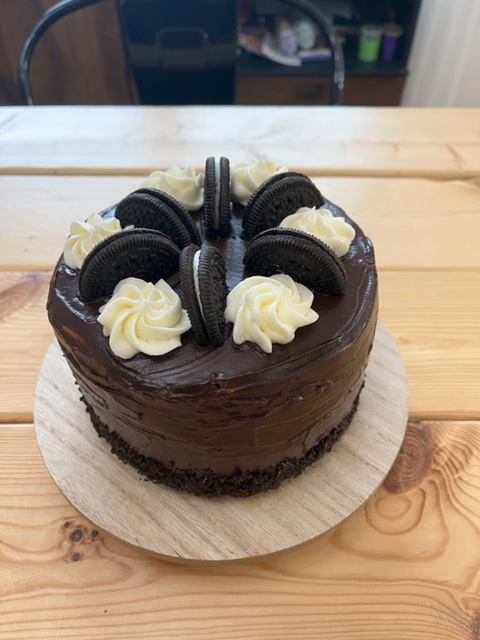
1. Family gatherings. Saturday, my son and daughter-in-law had us over to celebrate my grandson’s successful completion of third grade. 🙂 We had pizza, salad, garlic bread, and this cute Oreo cake Mittu made.
Then Wednesday, we had everyone but Mittu over for dinner (unfortunately, she was nursing a sore throat).
2. Jesse’s travels. My youngest son is off to visit my oldest son in RI. This is the first time Jesse has traveled by himself and the first time any of us has been to see Jeremy except my husband when he helped him move. So far the trip has gone well. They’re not only both avid game players, but they like long strategy games that none of the rest of us usually plays. I’m sure they’ll have a great time playing, seeing sights, and meeting Jeremy’s friends, many of whom are also avid game players. One of these days, we’re going to get up to RI, too.
3. Eating out. On the way home from the airport, Jim and I discussed whether to eat dinner somewhere or get something to take home. After discovering one restaurant I’d wanted to visit had closed, we ended up at Cracker Barrel. That was a treat for me, not only because it is one of my favorite places, but it is not Jim’s. 🙂 So it was nice not only to eat out with him, but for him to offer to take me there. He did find that he liked their lemon trout.
4. A light cooking week. If you’ve read here long, you know this is a favorite. 🙂 Due to the party, taking Jesse to the airport, and various other reasons, I only cooked this week for dinner on Wednesday and breakfast Sunday morning. I think that’s a record. It almost felt like vacation. One of those times, Jim had an eye doctor appointment near a mall which has a Sarku’s (which we love. I wish they were located other places than malls). So he offered to bring some home.
5. A non-dairy treat. I’ve been lactose-intolerant for many years, but lately I’ve been trying to cut down on dairy products in general to see if that helps some stomach issues. I perused the non-dairy items in the freezer section and brought home this. I sampled a couple of spoonfuls before putting it in the freezer, and it was pretty good.
That’s my week. How was yours?
I hope you have a good Memorial Day weekend as we honor those who have given their lives for us.
For readers, nothing sounds more cozy than curling up with a good book, a throw blanket, and a cup of coffee and a cookie or two within reach. Add in a warm fire, a rainy day, and just the right lamp, and we’re in reading heaven.
Or perhaps your ideal reading environment is on the beach under an umbrella, or on your back deck during a cool evening.
In any of those scenarios, we probably picture a physical book. In fact, friends have told me that they don’t like the idea of e-books because they like the feel of an actual ink-and-paper book in their hands.
I understand that. I can’t imagine reading Little Women, for instance, without my favorite old-fashioned illustrated version.
I first started using the Kindle app on my iPad mini for traveling purposes. Otherwise, I’d bring at least two, and possibly three, books with me anywhere I went. I also wanted to take advantage of the occasional Kindle sale or free book. But I never thought the Kindle app would become my main source of reading.
However, once I got used to the Kindle app and discovered many of its features, I grew to love it. When I talked with a paper-book-only friend about some of these Kindle features, she had been totally unaware of them. So I thought I’d share some of these features with you in case you had not heard of them, either. This is not a paid or affiliate post.
All of these features are on the Kindle app. I assume they are all on the Kindle device as well, but I don’t know.
By the way, I’m avoiding the term “real book.” Paper, digital and audio books are all real books.
The Kindle app:
Saves space. It’s nice to “pack” a whole library rather than trying to fit three books into my baggage when traveling. But even at home, I don’t have any space for more books. We have three full-size bookcases, one half-size, and at least three boxes of books in closets. I’ve culled books to give away several times, but my bookcases are still full. There’s no room in the house to add any more.
Adjustment of text size. The print in some books is tiny. I can set the text in the Kindle app to the size that’s best for me.
Easier to hold, especially while lying down. If you’ve ever read in bed, I’m sure you’ve experienced your book falling in your face or your hand cramping after a while.
Can be used on Apple devices as well as many Android. The iPad mini is the perfect size for me, but if you prefer reading on a regular iPad or other device, you can.
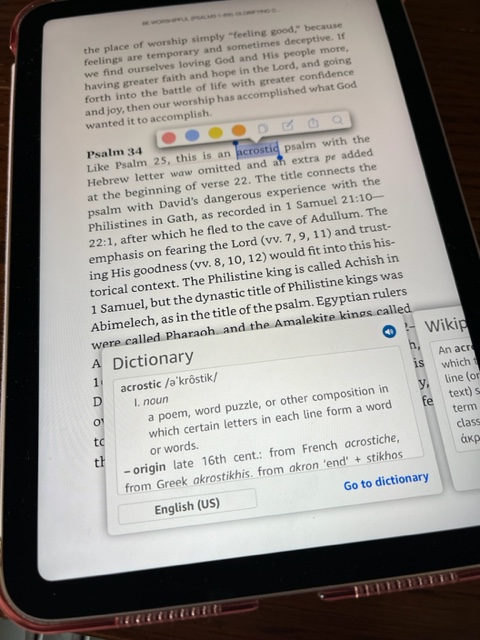
Built-in dictionary. If I come across an unfamiliar word while reading, I don’t usually take the time to stop and look it up. I get the gist of it from the context and keep going. But in the Kindle app, you can highlight the word, then a dictionary definition will pop up. I’ve gotten so used to that feature, I’ve wished it was available on everything I read online as well as in ink-and-paper books!
Translations.You can also highlight phrases in another language and get the translation instantly.
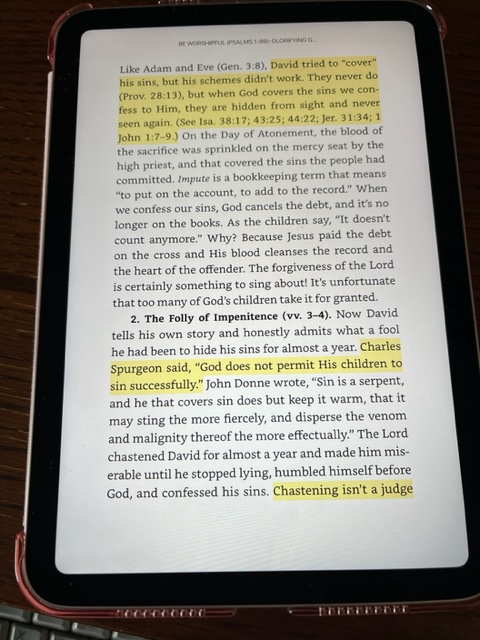
Highlighting. You can highlight passages in the book in five different colors. I usually just use the standard yellow for quotes I want to remember. But sometimes I’ve used blue for main points so I can see them at a glance.
Add notes. When you highlight a section, an icon will show up at the top that looks like a paper and pencil. You can tap that and add your own notes–like writing in the margin of a paper book.
Search function. When you tap on a page in the Kindle app, a magnifying glass icon appears at the top. You can search for a particular word or name or phase. Sometimes I forget who a particular character is, so this feature is like looking back several pages to refresh your memory. Or if I remember a snatch of a sentence but didn’t highlight it, I can look it up.
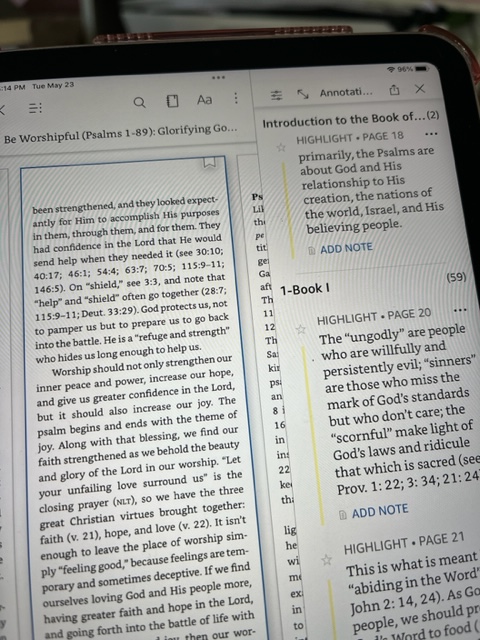
List of notes. That same list of icons that appears at the top of the page when you tap it also shows an icon that looks like page or notebook. Tap that, and you’ll see a list of all the quotes you’ve highlighted from the book as well as notes you’ve added. This is a great help to me when I just want to review the book for my own memory or when writing a review for the blog. I can tap on a highlighted quote, email it to myself, then copy and paste it into a blog post.
Kindle sales. I’ve mentioned before that I check Kindle sales from Inspired Reads and Gospel eBooks lists. Though these are Christian sites, I would not endorse everything they list. But I’ve gotten scores of books trough them. A $1.99 e-book is a great way to try an new author or stock up on books from a favorite author. Plus I get a weekly email from Iron Stream Media offering some of their books free or for 99 cents.
Advance readers or launch teams. Most authors use e-versions rather than an ink-and-paper book to send to readers who agree to review an upcoming book or serve on an author’s launch team. So having Kindle access affords you that opportunity.
Syncs to any device that supports a Kindle app. I mentioned that I usually read e-books on my iPad mini. But I have the Kindle app on my iPhone as well. So if I find myself with an unexpected wait time while I’m out, I can read a bit. It’s not as easy to read a book on a phone, but it can be done, and it’s a good way to pass the time waiting.
Whispersync. If you get the same book via Amazon for the Kindle and Audible for an audiobook, if they are set up to “Whispersync,” you can pick up with one from where you left off on the other. I don’t usually do this–I usually have one or the other. But occasionally, usually due to sales, I’ll have both. It’s nice to be able to go back and forth.
As with anything else, there are a few disadvantages to using the Kindle app. Here are a few:
It’s harder to share books. I believe Amazon lets you share Kindle books with another person for two weeks. But it’s easier to hand them a book for however long they need it. Of course, if your friend doesn’t live near you, sharing electronically is an advantage.
You can’t see what others are reading. I liked the idea that I was “advertising” a book by reading it in public. Or I’d see what someone else was reading and ask about it. You can’t really do that with an e-book without feeling intrusive.
Your device needs charging. But we’re so used to charging devices, that’s not much of a hardship. Unless the power is out.
You don’t really own Kindle books. This is the biggest disadvantage to me. If an author or publisher decides to take their books down, and they are not downloaded on your device, they’ll just disappear from your library. Thankfully, that doesn’t happen often.
You can’t give or sell your read e-books like you can ink-and-paper books.
If you’re trying to reduce screen time due to eye strain or other reasons, you might prefer a physical book.
By and large, I’ve found the advantages to using the Kindle app outweigh the advantages.
Do you use the Kindle or Kindle app? What do you like or dislike about it?
In D. E. Stevenson’s novel, Miss Buncle’s Book (linked to my review), Barbara Buncle is a quiet single lady in 1930s England who needs to make some money. So she writes a book about what she knows–her neighbors. She changes their names and some of their activities. Her book becomes a best-seller. But some of her neighbors recognize themselves and their town. And some of them are determined to find out who is behind the pseudonym “John Smith.”
At the end of that book (spoiler alert), Miss Buncle marries her publisher, Arthur Abbott. They move to Hampstead Heath, away from the heat caused by Barbara’s book.
Miss Buncle Married opens with the newlywed couple enjoying married life, but not the city. They’re expected to be out almost every night, playing bridge with friends and attending events. They long for a quieter home life. So Barbara starts looking at houses in the country.
Barbara finds the house of her dreams in Wandlebury. Arthur isn’t sure about the fixer-upper. But Barbara has everything redone nicely, and they love their new home.
It’s not long before they meet their new neighbors. The pastor’s wife who loves to gossip, thinking it gives her and “in” with her neighbors, when really they hold her at arm’s length because they don’t want to become her subjects. A large, temperamental artist, his languid wife, and their three children, two of whom have claimed Barbara’s back yard as their playground. Mrs. Chevis-Cobb, the society matron who changes her will when her relatives displease her. Jerry, a young woman who supports herself by caring for horses.
Arthur’s nephew, Sam, comes to visit the Abbotts regularly and begins to mature nicely.
Of course, the reader wonders, “Will Barbara write another book? And will it get her into as much trouble as last time?” I’ll leave that for you to discover.
Barbara is presented in both books as somewhat naive and innocent, yet with amazing insight in some ways. She doesn’t mean to meddle, but her attempts to help people present some quite funny episodes in the book.
Some of my favorite quotes from the book:
He . . . looked at his wife, and, as he looked at her, he smiled because she was nice to look at, and because he loved her, and because she amused and interested him enormously. They had been married for nine months now, and sometimes he thought he knew her through and through, and sometimes he thought he didn’t know the first thing about her—theirs was a most satisfactory marriage.
Jerry found Barbara very soothing and comforting during this difficult time. It was not necessary to confide in Barbara to gain her sympathy—you just talked to Barbara about odds and ends of things, and you came away feeling a different creature.
“It’s turned out all right after all,” she said contentedly. “Things usually do, somehow. You worry and fuss and try to make things go the way you think they should, and then you find that the other way was best. I’m going to try not to worry about things anymore.”
As with the first book, this is a secular work, and thus I wouldn’t agree with everything here, like many classics. It’s a clean story, but there are some oddities, especially with the strange family next door.
But all in all, this was a sweet, funny story. I listened to the audiobook superbly read by Patricia Gallimore. The picture above is from the audiobook cover as well, which I like much better than the book cover.
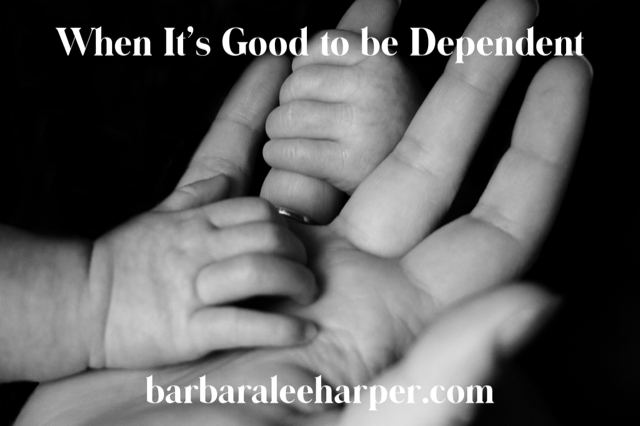
As parents, we ultimately work ourselves out of a job. As much as we love our children and miss them when they leave home, we want them to be able to stand on their own two feet as responsible adults. We’ll always listen, support, and help them when they need it, if we’re able. But there is every likelihood we’ll be gone before they are, so they need to function independently.
Spiritually, though, we never outgrow our dependence on God. In fact, we mature more spiritually the more we realize our need for dependence on God.
In Psalm 30, David said, “As for me, I said in my prosperity, “I shall never be moved.” By your favor, O Lord, you made my mountain stand strong; you hid your face; I was dismayed” (verses 6-7). Warren Wiersbe says “prosperity” here means “careless ease, a carefree self-assurance because things are going well” (Be Worshipful [Psalms 1-89]: Glorifying God for Who He Is, p. 116).
That happens all too easily, doesn’t it? When things are going well, we forget God is the One who made them go well. We get comfortable, and we forget our need for God . . . until a crisis comes up. The Bible is replete with examples of individuals and nations who went through that pattern.
My friend J. D. Wininger is a rancher who wrote recently about depending on God through unpredictable weather. His area faced eighteen months of drought last year. Now they’ve had so much rain, he can’t harvest some crops or plant others. I’ve often thought that the life of a farmer or rancher is one of felt dependence on God through all the things that can happen to influence the outcome of crops and herds.
But people in other occupations are just as dependent, even if they don’t know it. Employees think everything is going fine, until they receive notice that their particular job has been phased out, or their company is closing or has been bought by someone else. A new technology can put a whole industry out of business.
As the recent pandemic showed us, one part of society affects another. Suddenly we couldn’t count on finding basic supplies at the grocery store or even a bed in the hospital when needed.
And it’s not just in the area of physical provision that the rug can be pulled out from under us. We can be on top of the world socially. Then a poorly-worded tweet gets us “canceled.” Or a rumor or misunderstanding turns friends against us. David wrote, “All who hate me whisper together about me; they imagine the worst for me . . . Even my close friend in whom I trusted, who ate my bread, has lifted his heel against me” (Psalm 41:7, 9). Job lamented, “My relatives have failed me, my close friends have forgotten me. . . All my intimate friends abhor me, and those whom I loved have turned against me” (Job 19:14, 19).
Many of us have had the experience of being in perfect health one day only to be hit with a debilitating illness out of the blue. Or a loved one who seemed fine is found to have cancer that has been growing for months.
Does God shake things up for us sometimes as a thump on the head to remind us that we need Him? I don’t think so. He’s a loving father, not a capricious one.
But I think He does teach us through His Word and through life experiences to remember to depend on Him for everything. He reminds us that He is our creator, provider, protector, friend. He promises to meet all our needs. He promises to be with us in any trial.
When we forget any of those things and become self-reliant, we usually get ourselves into trouble. I did a study once on what happens when we want our own way. It’s not pleasant.
Recently I was praying over a recurrent physical issue. As pondering and prayer intermingled, my thoughts ran something like this; “You know, most people don’t even think about this, much less pray about it. Am I going to have to pray about this every day? Can’t I just ask You to take care of it now and forever?”
The “Lord’s prayer” came to mind, where Jesus instructed His disciples to pray, “Give us this day our daily bread.” Our daily bread. Not enough for the week, or a lifetime. But just what we need for today.
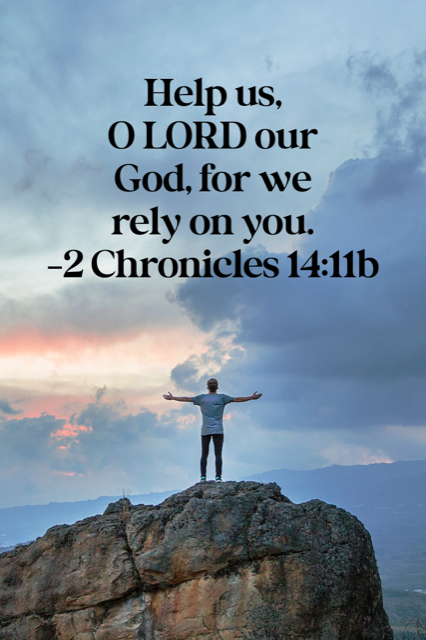
One day King Asa of Judah faced a much larger army from Ethiopia that had come against Judah (2 Chronicles 14). “And Asa cried to the Lord his God, ‘O Lord, there is none like you to help, between the mighty and the weak. Help us, O Lord our God, for we rely on you, and in your name we have come against this multitude. O Lord, you are our God; let not man prevail against you’” (verse 11).
I looked up the Hebrew word translated “rely” and read some of those occurrences here. The word can also be translated, lean, stay, and rest.
Rest.
Isn’t that what happens when we rely on God? We don’t have to worry about what’s going to happen. We can trust and obey.
Jean Sophia Pigott caught this idea of resting in the Lord in her marvelous hymn, “Jesus, I am Resting, Resting.”
Simply trusting thee, Lord Jesus, I behold thee as thou art, And thy love, so pure, so changeless, Satisfies my heart; Satisfies its deepest longings, Meets, supplies its ev’ry need, Compasseth me round with blessings: Thine is love indeed.
As God’s child, I never outgrow my need for Him. I never become independent from Him. The farther I go in life, the more I realize I need Him for everything, great and small.
Abide in me, and I in you. As the branch cannot bear fruit by itself, unless it abides in the vine, neither can you, unless you abide in me.I am the vine; you are the branches. Whoever abides in me and I in him, he it is that bears much fruit, for apart from me you can do nothing. (John 15:4-5).
There’s so much good writing on the Internet each week. Here’s some I found:
Opposition is Bad, but Hell is Worse, HT to Challies. “In the early centuries of Christianity, the Church understood that a false understanding of salvation was more dangerous than persecution. Persecution can only kill the body, but a false gospel can kill the soul. Today, many live as if political evils are worse than hell.”
Store Up Today for Tomorrow’s Crisis, HT to Challies. “The real application of Jesus’s saying lies further back. To take his words to heart, our focus should be not so much on what we should say as what we should store. To apply Jesus’s insight, if we want to be the kind of person who speaks words of wisdom and grace, then we have to begin by storing up wisdom and grace.”
The Funny Thing About Hope, HT to Challies. “Hope is a crazy thing. Without hope, life becomes very hard and difficult. With hope, people manage stress, pressures, and tough circumstances better. Yet, when in tough circumstances, one of the easiest things to lose is hope. When hope is lost, the circumstances only grow in magnitude. At this point, the tendency is downward. Light easily turns to darkness. Joy turns to sorrow. Stability turns to anxiety. Confidence turns to fear.”
It’s time to pause for just a bit to reflect on the week’s blessings with Susanne and friends at Living to Tell the Story.
1. A pre-Mother’s Day dinner out. We stopped going out for Mother’s Day years ago due to long wait times. But I suggested this year going out all together some time before Sunday. So we did that Friday night. Even though the restaurant somehow didn’t have our reservation listed, they got us in fairly soon. I got a piece of Triple Chocolate Cake to take home. It was such a big piece and so rich, I had to split it over two days. The meal and time together were both great.
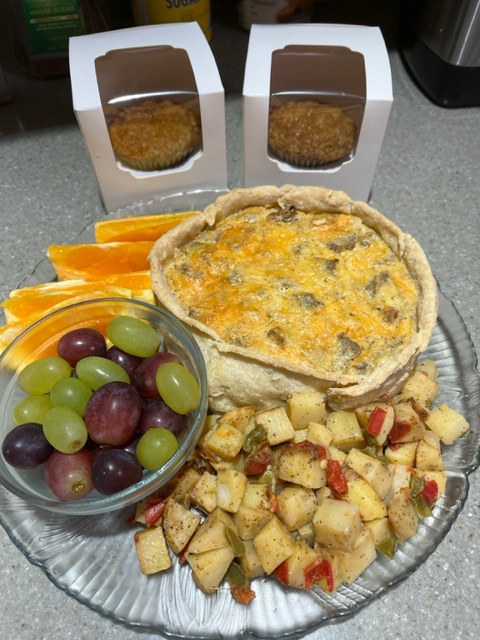
2. Mother’s Day breakfast. We’ve usually kept our Sunday morning breakfast routine on special Sundays just due to logistics. Saturday night, I was puzzled when Jason and Timothy came over around 9 p.m. They brought a wonderful Mother’s Day breakfast that Mittu had made which I could just reheat in the morning: quiche, fried potatoes, orange slices, grapes, and carrot muffins.
That was such a sweet and thoughtful thing to do. And it was very good! We could only eat about half of it Sunday, so we had leftovers for a couple more breakfasts this week.
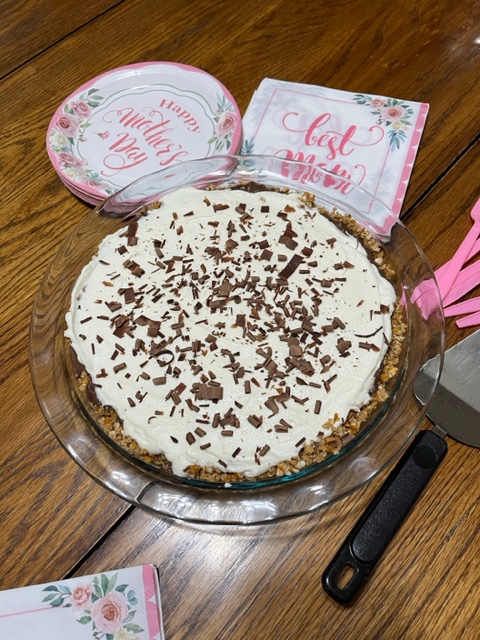
3. Mother’s Day. Jim grilled burgers, Jesse shucked corn on the cob and other assorted things, Jason made Chocolate Pretzel Pie.
It was nice to have the day off in the kitchen, and everything was delicious. I received some sweet cards and gifts.
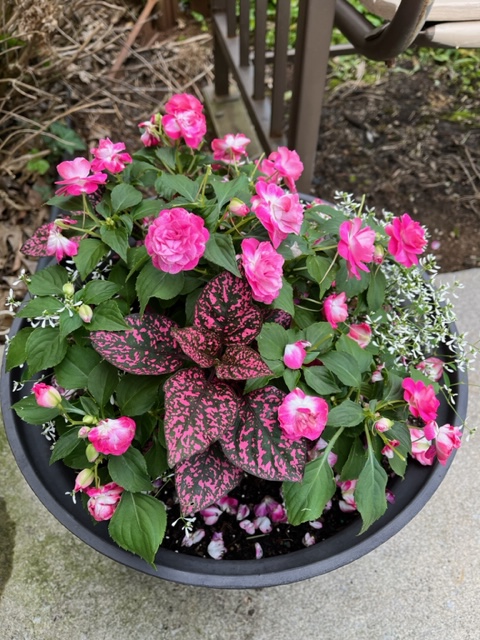
4. Hanging plants. Jim usually gets annuals in hanging baskets for me for Mother’s Day. This year he asked if I wanted to go with him to pick out the flowers. It was fun to do that together (he said it was less-time-consuming and stressful, but more expensive 🙂 ).
Outside and inside view of hanging plants
Then, I had not yet planted the flowers I had bought the day before for the planters in front and back of the house. Jim helped with that by clearing out the old stuff. Plus he planted a few in an area by the mailbox. So often, over the years, we’ve had to “divide and conquer” things like this for various reasons. It was nice to do them together. Plus everything looks so nice with fresh flowers in.
This was a ready-made grouping of flowers at the garden center. I loved the colors and combination.
As we were walking around the garden center, we spied this interesting looking plant. We found it was a foxglove, so we decided to get it for the front porch. I didn’t know they grew so tall–about four feet. It has become something of a conversation piece.
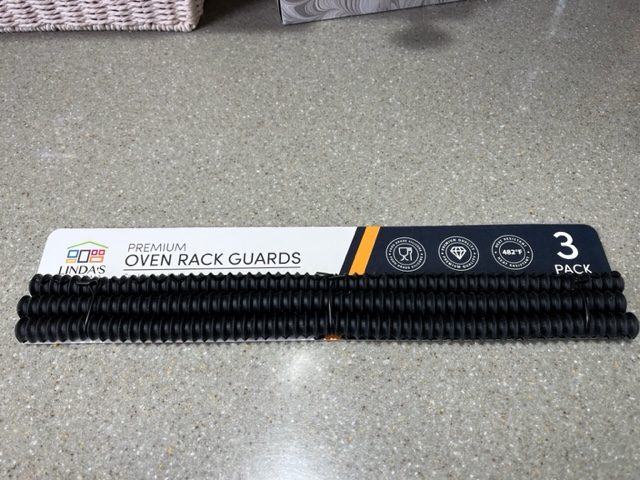
5. Oven guards. Somehow I came upon a reel of neat things found on Amazon–and because I stopped to watch it, my reels on Instagram were then flooded with similar videos. But this sounded great, because I frequently burn my wrist on the top rack when putting something in the oven. Our family does “wish lists” for gift ideas, so I put this on my list, and my husband got it for me. I haven’t baked anything yet since I installed them, but I am looking forward to doing so pain-free!
I could list more, but I’ll stop at 5. 🙂 It’s been a lovely week. I hope yours has, too.
. . . you’d like authors to be able to keep writing books, right?
You may not be aware of some ways publishing has changed over the last few years. These changes put different pressures and requirements on new and published authors. I’ll discuss some of those changes as I go.
But here are ways you can help authors keep books coming:
Buy their books. Sometimes I hear people say they never buy books. Some can’t; that’s understandable. I’ll get to some other ways we can help that don’t cost money.
But buying a book isn’t just an investment for the author. If you were going to a concert, a professional ball game, or even a movie, you’d pay a high price for just 2-3 hours of entertainment. The price of a book can give you 10+ hours of entertainment.
For many of us, though, our book appetite is bigger than our wallet.
If you can’t pay full price, books are frequently on sale. I often get Kindle books for less than $2. Inspired Reads lists half a dozen or so and Gospel eBooks lists several, but you need discernment with these two: I wouldn’t recommend everything they list. Tim Challies lists a Kindle sales most days, usually Christian nonfiction and classics.
If you pre-order books, you often get a lower price. Audible.com frequently has “two books for one credit” and other audiobooks sales. Then there are library sales, thrift store sales, garage sales. Even though the author does not get much money from these purchases, they still help his sale numbers (which publishers look at when considering whether to publish his future books).
I have not tried these, but I’ve heard recommendations for Chirp (audiobooks), BookBub, and CelebrateLit.
Ask for books for gifts. I usually let my family know of a few books I’d like for birthday and Christmas ideas.
Write a review. Amazon reviews carry great weight with publishers, plus they are helpful to other buyers considering the book. The reviews don’t have to all be 5-stars to help. In fact, it looks a little suspicious if all the reviews are 5-star. Reviews don’t have to be long and shouldn’t “spoil” the plot.
One of the ways publishing has changed over recent years is that authors have to do as much as 80% of their own marketing, even if they’re traditionally published. With the closure of so many brick-and-mortar bookstores, publishers don’t have the opportunity to advertise there via posters, end-caps displays, author events, etc. They have always depended on word of mouth, but much more so now.
Besides Amazon, reviews on Goodreads or one’s blog help get the word out as well.
Mention a book on Instagram with the hash tag #bookstagram. You can add additional hashtags like #amreading, #historicalfiction or whatever the genre is, and the author’s name (#roseannamwhite, for example). You can add a picture of the book cover, a picture of you holding the book, a picture of the book cover on your Kindle app, etc.
Get the book for free. Even though an author doesn’t get the revenue from free books, if you review them, they get the word of mouth publicity. Some authors and publishers will give free copies of their book in exchange for an honest review. NetGalley offers digital Advanced Reader Copies of books to reviewers. Revell is a Christian book publisher with a program to offer free books for review. Audible.com includes some titles for free for its members.
Check books out of the library. Libraries don’t keep books that don’t get checked out. So keeping an author’s book active helps, and reviewing helps even more. Plus libraries are likely to buy more books by authors whose books are frequently checked out.
Request a book be added to the library. Most libraries have ways to do this online.
Suggest your favorite book or author for a book club suggestion.
Follow your favorite author. Publishers and agents want writers to have a “platform” before they risk putting time and money into them. Many a debut author has been turned down, sadly, because of a low platform. I’ve read that the primary following publishers look at is a writer’s email list numbers. That’s why you so see many authors asking you to subscribe to their newsletter. I have to confess I don’t subscribe to many myself just because I don’t have time to read them all and I don’t want lots of extraneous email. Plus I disagree with the thought that an author’s biggest fans and promoters are going to come from their email lists. But that’s how the system stands today. So if you really want to support a particular writer, following them primarily through an email list, but also on Facebook, Twitter, and/or Instagram will help their platform numbers. As a bonus, most writers will offer freebies via extra chapters or resources to email subscribers.
Be on an author’s launch team. The first few days after a book comes out are critical to the book’s success in the eyes of publishers. Authors will ask for volunteers for launch teams to help when the book comes out. Being on a launch team usually involves receiving an advanced copy of the book, reading it before publication, and having a review ready for Amazon within the first day or two after the book is released. Some authors will also ask for posts on Facebook about the book. Some will offer material for blog posts, like interview questions and answers.
You may not be able to do all of these, but helping an author in any of these ways will be much appreciated and will help keep good books coming.
Which of these most resonates with you? Do you have any other ideas for ways to support authors and help promote good books?
I waited with my youngest infant son in the doctor’s examining room for a well baby check-up. It took the doctor an interminable time to come. Meanwhile, baby had a leaky diaper that necessitated cleaning him and the examining table. Then baby spit up all over his clean clothes and his mom..
And I thought wryly about “the nobility of motherhood.”
Mothering is filled with highs and lows. There is nothing like snuggling with a baby wrapped in a hoodie towel fresh from his shower, the smell of baby shampoo wafting from his hair. Or receiving your first gift of a wildflower plucked with chubby toddler fingers especially for you. Or “book gluttony” after a library visit. Or laughs and tickles and playgrounds when they are young to games and talks and insights when they are older.
But there are also continual struggles with never-ending laundry, picking up toys, feeling like there is not enough time and energy to go around, not to mention blow-out diapers, meltdowns, trying to teach manners, arguing over why eating candy before dinner is not a good idea and why “everybody else is doing it” is not a good reason.
Some women focus more on the bad than the good, as one woman did when she wrote that she regretted having children. So now she advises other women not to have them. She feels motherhood keeps women “out of the work force, trapping them in a prison of domesticity.”
One of her reasons not to have children is that her children disappointed her. She doesn’t reflect on how she disappointed them. She tells women, “To persist in saying ‘me first’ is a badge of courage.” Yet she doesn’t feel that way about the child saying “me first.”
It’s true we sometimes come to motherhood with idyllic expectations. Christians know that our children are born with sin natures, but we’re surprised how early and strongly those natures exert themselves.
And we bring our own sin natures into the mix. It’s no wonder all these sin natures bumping into each other cause conflict and stress.
But they are also an excellent segue for teaching about grace and our need for God’s forgiveness and help. It’s not for nothing Colossians 3:12-14 says, “Put on then, as God’s chosen ones, holy and beloved, compassionate hearts, kindness, humility, meekness, and patience, bearing with one another and, if one has a complaint against another, forgiving each other; as the Lord has forgiven you, so you also must forgive. And above all these put on love, which binds everything together in perfect harmony.”
Besides sin, children aren’t born knowing how to behave, share, think of others’ feelings, take turns. That’s what parents are for: to patiently teach them all those things.
Many in our society at large honor those who invest their lives in others–teachers, mentors, philanthropists. Yet so many look down on the investments of everyday motherhood, which for love’s sake deals with the nitty gritty and teaches and trains children through the highs as well as the lows, the mundane as well as the heart-warming. Why is being in the work force considered more valuable than training children at home? Why is taking care of and training children considered such a low-level occupation (even among paid professions like child care and teaching, some of the lowest-paid jobs) when children are our future?
Being a mother is hard work. Nothing else in my life showed me my own selfishness and need for God’s wisdom and enabling.
But being a mother is also rewarding work. My children aren’t perfect–of course not, coming from an imperfect mother. I pray God makes up for my mistakes with them. But my children are enjoyable people to know and be around.
In everything else I thought about being when I grew up, I always wanted to be a wife and mother as well. I am so thankful God gave me that opportunity.
So to the naysayers I respond: yes, it is worth it to be a mother. I am so grateful for my mother’s investment of time and love in me and for other women who “mothered” me in various ways.
Even as I try to defend and support motherhood, however, I am keenly aware of the pain of some women whose longing for motherhood is an unanswered prayer. God, for reasons only He knows, has not seen fit so far to bring husband and children.
Though motherhood is a blessing, it is not God’s highest calling. God’s highest calling for each woman is to be exactly where God placed her, doing exactly what He called her to do, whether that’s being a teacher, secretary, writer, nurse, or whatever. He can work in and through us to develop Christlikeness and further His kingdom in any number of ways.
Here are several good online reads found this week:
7 Things Moms Will Always Need to Hear. “Throughout my mothering journey, I think I’ve learned more from fellow moms who are further down the parenting path than from any other source of wisdom besides the Bible.”
Counsel for Those Struggling with Assurance. “Christians wrestle with nagging doubts about their standing with God. In this article, I would like to define what assurance is, explain why Christians might lack assurance, and offer counsel for those who are struggling with worries about their salvation.” If you struggle with assurance of salvation, I invite you to read of my own battle with this in Blessed Assurance.
3 Powerful Ways the Holy Spirit Is Active In Our Bible Study. “Why do some Christians talk so much about Bible study? If we are truly led by the Spirit (Rom 8:13–17), some may ask, what need is there for something as dry and cognitive as study? Could we be in danger of quenching the Spirit and trusting our own efforts if we focus too much on rigorous, academically responsible study of the Scriptures? I cannot capture in a single blog post the sum total of the work of God’s almighty, infinite, and eternal Spirit. But perhaps I can highlight a few of the exceptionally clear and certain ways God has shown his Spirit to be at work in and through the Scriptures.”
Honour the King? HT to Challies. “‘I don’t understand how a Christian can agree to a proclamation declaring somebody other than Jesus to be our only king’. Well, it’s really not very hard. Jesus has the title ‘king of kings’ (Rev 17:14), not ‘the king who obliterates kings’! Jesus calls the kings of the earth to kiss him in Psalm 2, not to repent of their failure to introduce democracy. It’s very possible to be both in authority and under authority at the same time (e.g. the centurion in Matt 8:9). So, Jesus’ kingship isn’t an excuse to look at the British crown and say: ‘Not my king!'”
When Leaders Fall. “Then a few days later, I heard of allegations against another Christian leader – one I am less familiar with but whom I had respected from what I knew of him and his teaching. It brings up all kinds of questions: Why is this happening with so many Christian leaders? How many more? Who else? And how can we know who to trust? There is a lot I don’t know, and I’m still processing it all, but, here are a few things I do know.”
Please Don’t Weaponize Good-Faith Disagreement, HT to Challies. “In this new world, Christians seem increasingly unable to critique without canceling. We don’t see in our disagreements an opportunity to pursue truth together—to argue by appealing to Scripture, logic, reason, and tradition. Instead, disagreements devolve into quarreling. All heat, no light.”
The Theology of Work, HT to Redeeming Productivity. “Many people today find themselves in opposite gutters along the highway of Biblical work; those gutters being laziness and idleness on the one side and workaholism on the other. Some people spend their lives chasing meeting after meeting or shift after shift and others spend their lives binging show after show, or scrolling reel after reel on their phones.”
Love Me, Love My Food. Very interesting article about how learning to love (or at least eat without a show of distaste) another culture’s food is a way of showing love to them.
When Mother’s Day Hurts. It can, for several reasons. But God sees, knows, loves, and helps.










 Stray Thoughts