Unknown's avatar

About Barbara Harper

https://barbarah.wordpress.com

Circle of Spies

Circle of Spies is the third of Roseanna M. White’s Culper Spy Ring, a real life spy ring active during the Revolutionary War (Ring of Secrets was the first and Whispers from the Shadows was second). Although we don’t know that the ring continued, Roseanna said in the last book that someone in the CIA said it was possible. So Roseanna imagined how the spy ring could have worked during the War of 1812 in the second book, and now in the Civil War.

Marietta Hughes is an unlikely heroine at first. She has lived mostly for her own will and pleasure, not walking with the God of her parents. She married Lucien Hughes, wealthy president of a railroad company. But Lucien had been killed. Marietta had an understanding with his brother, Devereaux, that they would marry as soon as was proper after her period of mourning.

But then Marietta’s grandfather, Thaddeus Lane, informs her that the Hughes family is not staunchly Unionist, as they proclaim. Not only are they Confederate, but Devereaux is the head of a secret fifth column bent on killing Lincoln and seizing power.

As if that wasn’t enough to turn Marietta’s world upside down, Lane tells her that their family has been involved as a ring of spies since the Revolutionary War. Then he tells her that a Pinkerton man, Slade Osborne, is on his way to infiltrate the secret society to try to find proof that will lead to their arrests. Marietta’s job is to distract Devereaux as much as possible to facilitate Osborne’s investigation.

Thus begins a game of cat-and-mouse. Osborne is not altogether certain he can trust Marietta at first. Marietta is revolted at what she has learned about the Hughes family, but must keep pretending she is in love with Devereaux.

I ached with Marietta as she came to face what she had become and wondered if God could forgive her. Sometimes the realization of the magnitude of one’s sin breaks open to them more fully after they believe. Osborne, too, has a broken background, as well as complications from a twin brother whose values were the opposite of his.

By the end of this book, I wanted to put everything else aside to keep reading what happened. There were some quite exciting twists and turns!

I did disagree with one point, though, when a character says that God doesn’t speak for or against slavery. He does: I wrote once about the Bible and Slavery. But I did like what the character had to say about trying to reconcile the views of different Christians on the issue: “At last we realized we didn’t have to, because God so very rarely tells us what society should do—rather, He tells us how we, as believers, should behave in whatever society to which we belong” (p. 226).

In-between this book and the previous one was a little novella titled A Hero’s Promise. Julienne Lane has been helping a friend, Freeda, hide runaway slaves and get them to safety. Julienne is unsure whether to let her fiance, Jack Arnaud, in on the situation.

Meanwhile, Jack has postponed their wedding twice already but might have to do so again. A mentally unbalanced man is being set up by enemies to assassinate President Jackson, and the Culpers must intervene.

The assassination attempt was based on a true event.

I enjoyed these forays in early American history and spycraft. But even more, I enjoyed the journeys of faith Roseanna takes her characters through.

Mary’s Three Encounters with Jesus’ Feet

The first time we meet Mary of Bethany in the Bible, her family is hosting Jesus. Mary’s sister, Martha, was “distracted with much serving.” Luke 10:38-42 doesn’t say the disciples were with them or whether Martha was even preparing a meal, though I had always assumed both. Jesus was teaching, so probably more people were there than Him and the siblings. But however many people were there and whatever Martha was doing for them, she was “anxious and troubled.” I’ve been in poor Martha’s shoes many times. I can only imagine how frenzied I would be, wanting everything to be just right, if someone as important as Jesus was in my home.

I’ve always thought of Martha as the older sibling and Mary the younger. I’m not sure where their brother, Lazarus, fits in, but I’ve assumed the middle.

Mary is found at Jesus’ feet, listening to His teaching. Rabbis didn’t usually teach women, but Jesus welcomed Mary. Mary’s posture indicates she looked up to Jesus, both literally and figuratively. She was so caught up in what He was saying, she seemingly didn’t even notice Martha’s bustling about.

Martha spies Mary listening to Jesus. With older-sister indignation, Martha says, “Lord, do you not care that my sister has left me to serve alone? Tell her then to help me.”

I don’t know how well Martha knew Jesus at this time. John 11-5 says “Jesus loved Martha and her sister and Lazarus.” Jesus is often spoken of as coming to or from Bethany, so He probably visited with these siblings many times. But the beginning of this incident simply says, “A woman named Martha welcomed Him into her house” (Luke 10:38), as if they hadn’t known each other before. Martha is quite bold to speak to the Lord so, especially if this is their first encounter. She seemed confident that the Lord would side with her in her busy service.

But He didn’t. He acknowledged her care and concern, but He said, “One thing is necessary. Mary has chosen the good portion, which will not be taken away from her.”

Nancy Leigh DeMoss Wolgemuth paraphrases Jesus saying to Martha, “Your company means more to Me than your cooking. You are more important to Me than anything you can do for Me” (Place of Quiet Rest, p. 43).  

The second time we see the sisters, Lazarus is seriously ill (John 11). They send for Jesus, saying, “Lord, he whom you love is ill.” So by this time, the relationship between Jesus and the siblings is deep and well-established.

But Jesus purposefully waits to come and see them. By the time He arrives, Lazarus has been dead four days and has already been buried.

Martha comes away from the mourners to talk with Jesus. But Mary, coming a little later, “fell at his feet, saying to him, ‘Lord, if you had been here, my brother would not have died.'” Both women expressed faith, but in different ways. Mary was not afraid to share her sorrow and anguish. Perhaps she was also hurt and confused that Jesus had not come sooner. She laid it all at Jesus’ feet.

“When Jesus saw her weeping, and the Jews who had come with her also weeping, he was deeply moved in his spirit and greatly troubled.” “Surely he has borne our griefs and carried our sorrows” (Isaiah 53:4).

The final time we see Mary of Bethany is in John 12, just six days before Jesus’ final Passover with His disciples. Martha is serving once again, but uncomplainingly this time. Mary takes “a pound of expensive ointment made from pure nard, and anointed the feet of Jesus and wiped his feet with her hair. The house was filled with the fragrance of the perfume.” (This appears to be a different incident from that in Luke 7:36-50, though there are a few similarities.)

Mary’s action brought criticism. Judas wondered aloud why this ointment could not have been sold and distributed to the poor (not, Scripture indicates, because he was concerned about the poor, but because he kept the money for the group and helped himself to it.) He not only thought such extravagance was a waste on Jesus, but he coveted it for himself.

But Jesus came to Mary’s defense once again. “Leave her alone, so that she may keep it for the day of my burial.” A pound of ointment would have been much more than was needed for a pair of feet, so perhaps Jesus was saying that the rest would be used for His burial.

However, the New Living Translation says, “She did this in preparation for my burial,” and a few others have similar wording. If this is correct, Mary got what so many others missed: that Jesus was going to die.

I tried to discover what significance might be attached to anointing feet in Bible times. Scripture speaks of washing feet. People wore sandals on dusty, unpaved roads. So a host would have a servant wash the feet of guests. Jesus does this, taking on the role of a servant, in the Upper Room at the last supper. One article suggested Mary’s anointing Jesus’ feet is a foreshadowing of what Jesus would do.

Jesus is the Christ or Messiah, both of which mean “anointed one.” One article indicated Mary’s anointing was in recognition of Jesus as the Christ, the promised Messiah.

Isaiah 52:7 proclaims, “How beautiful upon the mountains are the feet of him who brings good news, who publishes peace, who brings good news of happiness, who publishes salvation, who says to Zion, ‘Your God reigns.’” Perhaps Mary was so thankful for the feet of Him who brought the good news of salvation to her that she wanted to anoint them.

But Jesus references His upcoming burial in connection with Mary’s anointing.

Several things stand out to me about Mary.

Her humility. In each of these encounters, Mary is at Jesus’ feet. I had known about each of these incidents, but I just recently made the connection that they all involved Jesus’ feet. James tells us, “God opposes the proud but gives grace to the humble” (James 4:6)

Her devotion. She was caught up in listening to and worshiping Jesus, no matter what else was going on around her. She was willing to give sacrificially to show how much she valued Him.

Her lack of self-consciousness. Scripture doesn’t indicate any of her actions were done for self-glory or attention from others.

Her lack of defending herself. She let the Lord handle criticism of her. She knew He understood, even if others didn’t.

Her confidence. She knew Jesus well enough to trust Him with both her worship and her sorrow.

Her intent listening. She hung on His every word.

Her perception. By listening, truly listening to Jesus, she apparently understood what others did not about His coming death.

The only words of Mary that the Bible records are after Lazarus’ death. Obviously, those are the only words of hers that the Holy Spirit wanted to reveal in Scripture. But this and Martha’s outspokenness seem to indicate that Mary was the quiet one. Another Mary, Jesus’ mother, “treasured up all these things, pondering them in her heart” (Luke 2:19). Mary of Bethany seems the same type of person. Jesus loved both sisters, and physical quietness is not necessarily more spiritual than outspokenness. But “a gentle and quiet spirit . . . in God’s sight is very precious” (1 Peter 3:4).

Mary could not have known that her humble and loving actions would become inspiration for Jesus followers for more than 2,000 years.

We can’t sit at Jesus’ feet physically, but we can join Mary there spiritually as we humbly and intently listening to His Word and lay our sorrow, confusion, questions, and loss before feet of the One who knows, loves, and cares for us best. We can worship with abandon, giving our all in His honor.

(I often link up with some of these bloggers.)

Laudable Linkage

Here’s my latest list of good online reads:

My Grandmother Would Tell You That, HT to Challies. “I could write out my grandmother’s full name and you wouldn’t recognize it. She wasn’t famous, wealthy, accomplished, or well-known. But her unremarkable life was truly remarkable because of who Jesus was to her.”

Martyn Lloyd-Jones, April Witkowski & the Myth of the Wasted Ministry, HT to Challies. “Our lives today will not be defined by our dreams, hopes, or expectations of what is to come (of what may never come) but will be defined by our faithful execution of the life and ministry God has given us in this moment. If we are faithfully serving God today in accordance with his Word and our calling and gifting, our lives are not a waste but rather the very definition of success.”

What Pins Are You Juggling? A Parenting Story, HT to Challies. One of the hard things about children growing up: “‘I have all these pins that I’m juggling and I have to keep them all up in the air and I can’t let any of them drop.’ I ended with a little sob of self-pity and mom-guilt that I am oh so good at. She came over to my chair and looked me in the eye. ‘But they’re not your pins.’”

Evidence of God’s Faithfulness in Ukraine, HT to Challies. After praying for this country for months now, it’s good to get a peek at some ways God is working there.

From the Heavens to the Depths: Sparking Wonder for Him Through Science. “When we shy away from science, we miss a breathtaking opportunity to open our kids’ eyes to the true majesty, the wonder, the artistry, and the magnificence of our Creator. The very foundations of science require acceptance of our universe as ordered, discoverable, and characterizable — a philosophy that lends itself to a higher, intelligent power who put it all into order in the first place. When we guide our kids through the mysteries and splendors of creation, we give them a glimpse of the brilliance, mastery, and goodness of the Creator, a glimpse that complements rather than contradicts the attributes He reveals through Scripture.”

5 Steps to Break Free from To-Do List Overwhelm. “As Christians we want to be faithful in the tasks the Lord has given us. But often we mistake busyness for productivity. We think if our to-do lists are full, and we are frantically working on them each day, surely we must be on the right track.”

How to Create an Effective Weekly Schedule, HT to Redeeming Productivity. “Every Monday for the past 5 years, I’ve taken the first 15 minutes to plan the week ahead. For me, this has been my single greatest productivity routine.” Great tips here for how to implement.

The Art of Moving On: When and How to Disengage from a Goal, HT to Redeeming Productivity. “When discussing goals, we typically talk about employing perseverance and persistence, even in the face of adversity and setbacks. ‘Quitters never win, and winners never quit,’ and all that. While grit is essential to goal achievement, Wrosch argues that an equally important part of successful living is knowing when to give up and disengage from a goal. “

Friday’s Fave Five

It’s the last Friday of April already. Time to pause with Susanne and friends at Living to Tell the Story to count our blessings.

1. Ribs. Jason and Mittu received a gift card to Honey-Baked Ham and got some ribs to share with the family. They brought over potatoes, vegetables, rolls, and peanut butter fudge, too!

2. Getting calls made and little things done. Some of these have been on my to-do list for too long. Two calls led to two appointments–so one item crossed off leads to another. But at least they are in the process of getting taken care of.

3. Customer service resolved. My husband had a question about billing and had to talk to three different people over a few days, probably adding up to a couple of hours of time. The first one told us wildly different things than the last two. But the final person seemed to know what was going on and could explain it satisfactorily.

4. Timothy wanting to show us his adventures. Timothy and his parents went to the aquarium in Chattanooga, and then he and his dad did some dam-building scenarios with sand and magnet blocks on their back patio. Jason put pictures from his phone up on the big screen via the Apple TV to show us. I loved hearing Timothy say, “Show them the one about. . . “

5. Cookie mix. I got a little package of peanut butter cookie mix, I think made by Betty Crocker, and added some chocolate and peanut butter chips to it. The mix only made a dozen cookies, which was good for just the two of us. It was nice to satisfy a hankering for a little something sweet without all the to-do of baking them from scratch.

Bonus: A picture that made me smile. Jim took this picture from the kitchen window of life imitating art–a bunny on the window sill and in the back yard.

Bunnies

How about you? Any blessings from your week?

April Reflections

April reflections

I thought I’d go ahead and share my end-of-month post since I have other things scheduled for the last few days of April.

I found a quote from Mark Twain in my files that seems to describe April weather: “In the spring I have counted one hundred and thirty-six different kinds of weather inside of four and twenty hours” (from a speech titled “The Oldest Inhabitant-The Weather of New England”). It sure feels that way! We’ve had another cold snap this week, but I hope we’ve seen the last of 30-degree weather til next October.

We finally went to an annual “Chalk Walk” event downtown where artists drew masterpieces on Market Square. We enjoyed celebrating Easter and my grandson’s 9th birthday this month. But otherwise, April has been pretty low-key. Even still, it seems to be passing all too quickly.

One big change in our schedule is that my husband started working four days a week instead of five. He usually works much more than 8 hours a day anyway, so it was no hardship to change his work week to four ten hour days. Now he has Fridays off to get away from the pressures of work and get other things done or just relax. He took Timothy fishing last weekend.

The only problem with a four-day work week is that I get discombobulated on Fridays, feeling like they are Saturdays. 🙂

One sobering event this month was the death of the man who was a youth pastor in my home church during my college years. I was out of the youth group by that time, but I got to know him while working in the church office one summer while the church secretary was out sick. His wife gave me several recipes, one of which shows up regularly for dinner (Cherokee Casserole–this recipe is pretty similar except I use tomato sauce instead of tomatoes and American cheese instead of cheddar). He and his wife were missionaries in Mexico for several decades. He developed a sudden kidney problem and died the day before he was supposed to start treatment. I felt for his wife having to deal with everything in Mexico, but she said the folks at the churches there were a big help. She’s planning to stay there for now.

Then I mentioned last week that Ron Hamilton passed away. We did not not know him and his wife personally, but felt in some ways like we did. Our whole family listened to and sang his music since before our kids were born. His death was not unexpected, as he had been declining from early-onset dementia for years. It’s a mercy, in a way, that he is released from the effects of illness on his body. But I almost get teary when a song of his comes on the radio or my playlist.

Timothyisms

It’s been a long time since I shared one of these. Last night, Jim mentioned that our lilac bush was in bloom. He commented his grandmother usually wore lilac-scented perfume, so he always connected that scent with her. Mittu asked Timothy what his grandmother smelled like. He replied, “Cookies and clean laundry.” 🙂

Creating

As I looked on Pinterest for card ideas for Timothy’s birthday, I saw these free downloads for a Minecraft birthday party. I used one of their sign designs for a card. I figured that would be better than anything I could do by hand.

Watching and Listening

I have a couple of podcasts queued up that I haven’t listened to yet.

I enjoyed watching the latest season of The Mandalorian. As I mentioned before, I am not all that into Star Wars, but I really like this series.

My husband and I watched On a Wing and a Prayer, based on a true story about a man and his family who were passengers in a friend’s small plane when the pilot had a heart attack. It was not the best-made film we’ve ever seen. But it was enjoyable. I liked that during the closing credits it included some footage of the real-life man from the story who had to land the plane.

We also watched Ithaca, a coming-of-age story about a teenager during WWII. His father has passed away and his older brother is a soldier, so he takes on a job with the telegraph office to help out at home. In that era, however, most of the telegraphs he delivers are informing families of the death of their sons. His eyes are opened to hard things in the world. The movie moved very slowly. I told my husband, it could have been really sweet and poignant, but there was something missing. I just couldn’t put my finger on what. Then I learned this film was a remake of The Human Comedy, an older film starring a young Mickey Rooney. I may watch that some time for comparison.

Reading

Since last time I have finished (titles link to my reviews):

I’m currently reading:

  • Be Worshipful (Psalms 1-89): Glorifying God for Who He Is by Warren Wiersbe
  • Humble Roots: How Humility Grounds and Nourishes Your Soul by Hannah Anderson
  • Blogging for God’s Glory in a Clickbait World by Benjamin Vrbicek and John Beeson
  • Circle of Spies by Roseanna M. White, audiobook
  • All That It Takes by Nicole Deese
  • The Dwelling Place by Elizabeth Musser

Blogging

Besides the weekly Friday Fave Fives, Saturday Laudable Linkage, and book reviews, I’ve posted these since last time:

A few weeks ago, I read Broken Links: How Often Should You Check and Fix Them on Your Blog. I used to fix old non-working links in my blog as I discovered them, mainly as a courtesy so someone who found an older post wouldn’t get frustrated by links that no longer went anywhere. But I didn’t know, until this article, that search engines would rank your blog lower if you have a lot of broken links. Plus, this author, Hugh, says spammers are more active on blogs with broken links. Both these effects result from broken links in the comments as well as in one’s post. He shared Broken Link Check Dot Com and told how to use it. So I’ve spent a couple of sessions ferreting out broken links and fixing or deleting them. I can only stand to do a handful at a time, so I have a long way to go yet.

Writing

No real headway this month. Hopefully I’ll get back into it next month.

How was your April? Are you looking forward to anything in May?

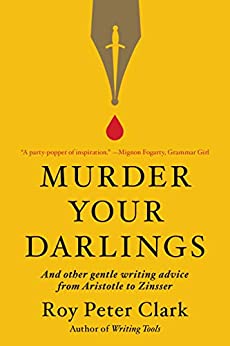
Murder Your Darlings

Murder Your Darlings is not a detective mystery or true crime drama.

Murder Your Darlings is writing advice. You see it a lot in writing circles these days, but it originally came from Sir Arthur Quiller-Couch, a British author and professor (known as Q, not to be confused with the WWII spy-gadget-maker). This phrase was first delivered in a lecture to his students in 1914 which was later published. In context, he said, “Whenever you feel an impulse to perpetrate a piece of exceptionally fine writing, obey it—whole-heartedly—and delete it before sending your manuscript to press. Murder your darlings” (p. 17).

Roy Peter Clark interprets Q’s advice thus: “Ask yourself, ‘Am I including this because it provides the reader with a memorable and delightful piece of evidence to prove the point of my text? Or is it beside the point even though it reveals what a good wordsmith I am?'” (p. 21).

In other words, the phrase, sentence, or paragraph that’s the most precious to you, but doesn’t really add anything to your thesis, must go. Clark opines that you don’t have to “commit verbicide on the words you love the most” (p. 17). You can save them in a file for another day.

Clark, known as “America’s writing coach,” shares advice from over 50 other writing sources in Murder Your Darlings: And Other Gentle Writing Advice from Aristotle to Zinsser. Clarks says, “I am not trying to steal their thunder. I am trying, instead, to amplify it, to pay back my debt to the authors who shaped my craft” (p. 8).

Some of these books are filled with writing advice, and Clark pulls out a lesson or two to discuss. “Most of what you will read here is why I appreciate them, what I or others have learned from them, and what I think you, the reader, can take away and apply to your own work” (p. 23).

Clark begins each chapter with a “toolbox,” a brief summary of the particular principle or writing instruction he’s going to discuss. Then he’ll give a little background about the work he is drawing from, the author, illustrations of the writing advice under consideration, whether he agrees or disagrees and to what extent. He ends each chapter with a short list of “Lessons” summarizing the main points of the chapter.

Clark’s book is quite readable. The Lessons at the end are particularly helpful to remind oneself of the salient tips from a chapter. Some of the writers he quotes from are well-known, others are not.

As you can imagine, I have multitudes of passages highlighted from the book. Here are a few:

It turns out that the internet is not an information superhighway. It is, instead, a polluted ocean with buried treasure sitting here and there on the bottom. Neutralize the poison of the propagandists, hackers, conspiracy theorists, trolls, and bullies by devoting your online efforts to the public good (p. 83).

Early writing is not sculpture, but clay, the stuff in which you will find the better work (p. 105).

An implied social contract exists between the reader and an author of nonfiction and that the contract reads, “Please believe me, my memory of events may be flawed, but none of this was intentionally made up.” If the author decides to veer from this standard, say, by using composite characters, the author must be transparent, revealing the strategies before the story begins, not in a footnote at the end (p. 222).

Donald Murray . . . advised writers to use “Shorter words, shorter sentences, shorter paragraphs at the points of greatest complexity” (p. 231).

Another Roman author, Horace, steps into the light with a sense of mission that is both public and aesthetic, arguing that the purpose of great literature is to delight and instruct or, on the good days, to do both! (p. 237).

This is a secular book, and there are words I wouldn’t use and situations and philosophies I wouldn’t agree with. But I found it fairly easy to sidestep those things just to glean the writing advice.

Clark’s book will help you hone your craft by sharing wisdom with you from sources that you might not have found yet. And the sources he quotes might inspire you to look up the authors’ original works.

Thankful God Is Not a Stranger

Thankful God Is not a Stranger

“I was so thankful, when this happened, that God was not a stranger to me.”

I don’t remember when or where or from whom I heard this. I don’t recall the context or what the “this” was that happened. But this statement has stayed with me for decades.

In my early Christian life, when something negative happened, I’d be shaken. I wonder if this was happening because I’d done something wrong. I’d feel that God was far away. I knew He loved me, but I didn’t feel so loved. I’d ponder all the “what ifs,” which would shake me up even more.

After a few decades of walking with the Lord, I can’t say I’m not still shaken in a crisis. But I’ve wrestled through reasons God allows suffering. I’ve experienced His grace through trials. I know He has reasons for what He allows and He’ll be with me through it all. I may not like certain circumstances, and I may pray to get out of them as soon as possible. But my confidence in God isn’t shaken.

So I can echo and “amen” the unknown author of my beginning statement. God sometimes uses crises to bring people to Himself, or bring them back to Himself if their hearts are wandering. But it’s so much easier to go through a crisis with the God you know and can place your full confidence in. We can be like the psalmist, “not afraid of bad news; his heart is firm, trusting in the LORD” (Psalm 112:7).

However, we don’t just need God in crises, do we? We need Him for everything. “In him we live and move and have our being” (Acts 17:28). We need His wisdom to know how to handle situations that come up. We need His love to show to others. We need His strength in our weakness, His grace when we fail, His encouragement when we’re low.

He conveys these things to us through a couple of means: His Word and His Holy Spirit. But have you ever noticed that the passage about letting God’s Word dwell in you richly in Colossians 3 and being filled with the Holy Spirit in Ephesians 5 are parallel? The same “results” are listed for each one. The Holy Spirit inspired the Word of God, so of course that’s what He would use to equip us. “All Scripture is breathed out by God and profitable for teaching, for reproof, for correction, and for training in righteousness, that the man of God may be complete, equipped for every good work” (2 Timothy 3:16-17). Scripture meets our need for the day as well as fortifying us for the future.

Sometimes that “equipping” comes through other people as they share God’s Word with us. But we need to dig into God’s Word for ourselves as well. Someone has said that God gives birds their food, but He doesn’t throw it into their nests (I’ve heard that attributed to Luther, Spurgeon, and Josiah Gilbert Holland). Though the saying was probably meant to show the need to work for a living, I think it has an application to learning God’s Word as well. God has given us such treasure in Scripture, but we need to read it and mine for it.

Anyone who has been married for several years can tell you that they thought they knew and loved their spouse on their wedding day, but that was nothing compared to ten or twenty or thirty years later. That’s true of long-term friendships as well. Shared conversations, experiences, good times and trials, have deepened the relationship as they got to know each other more thoroughly over the years.

The same is true in our relationship with God. Eternal life starts with coming to know God in repentance and faith: “And this is eternal life, that they know you, the only true God, and Jesus Christ whom you have sent” (John 17:3). But we get to know Him better as we read the Bible, pray, exercise faith, and depend on Him through various circumstances.

The better we know Him, the less likely we are to fall apart in a crisis, to be deceived or led astray, to walk away from our faith. We’ll never be perfect til we get to heaven, but we grow in grace and knowledge of him.

If you don’t know God, I invite you to learn more here. And if you do, keep getting to know Him better and better.

(I often link up with some of these bloggers.)

Laudable Linkage

Here’s my latest list of noteworthy reads found this week.

What Do You Do When You Are Spiritually Dry? HT to Challies. “Often when we feel dry, we are tempted to neglect the one thing that will satisfy our souls. Think about it: When you feel dry, what things do you want to toss out? Bible reading, prayer, fellowship. But this is the problem. If you are dry, spiritually thirsty, the worst thing you can do is go to the desert! You need to go to the fountain! God calls Himself “the fountain of living waters” (Jer 2:13). If we do not desire God, we need to go to God!”

When We Fear the Worst, HT to Challies. “Friend, I don’t know what fears and worries weigh on your soul today. But I do know that they can feel heavy—sometimes debilitatingly so. They can nag at you and trip you up and keep you discouraged and despairing. But there is a sure foundation we stand on, a God who holds us fast even while the winds and waves beat down. And he will not let us go. Not now. Not ever.”

Where Do I Find the Grace to Forgive? “Christians should be the most gracious of people. But when we forget what we’ve received from God or minimize our need for salvation, we become bill collectors. We go through life trying to collect the love, respect, appreciation, apology, or attention we feel others owe us.”

Standing on the Promises Is More Active than it Sounds. “‘Standing on the promises of Christ the Lord/…Overcoming daily with the Spirit’s sword…’ Standing on a promise requires knowledge of what has been promised. Do you have a sufficient base in Scripture for your heart to rest upon?”

The Art of the Ebenezer, HT to the Story Warren. “He looked into the past and remembered Israel’s defeat and anguish. He wanted to memorialize their repentance, prayer, fasting, fighting, and victory. But by erecting the stone of remembrance, Samuel also looked toward the future, wanting to remind the next generations to look at that stone and remember God’s faithfulness and power when the next tough trial came their way.”

The Strangeness that Stands Out, HT to the Story Warren. “If we give up essential truths of the Christian faith in order to be culturally relevant, we make ourselves eternally irrelevant. We make the church boring. The world needs a church that does more than offer an echo of our own times.”

Ron Hamilton Has Come Forth as Gold. I wrote about Ron earlier this week, and I’m sure many tributes will be written. But I enjoyed this one from Chris Anderson about ways Ron ministered to us. And he rightly includes a note about Ron’s wife, Shelly, at the end.

Friday’s Fave Five

Another week goes by with a whoosh. I’m thankful Susanne at Living to Tell the Story hosts this weekly pause to stop and count our blessings. Here are a few of mine:

1. Timothy’s birthday!

His mom made this amazing Minecraft gluten-free Oreo cheesecake for his birthday.

We met them for lunch at Timothy’s favorite pizza place, then went to their house for a birthday dinner of fish tacos. All in all, I think he had a nice day. 🙂

2. Internet work in the area completed. We received texts on several different days that our Internet provider was doing updates in our area which might cause an interruption or loss of service. It wasn’t noticeable most of the days, but wouldn’t you know the biggest loss of service occurred the morning I had a Zoom call. I was able to tie my iPad into the hot spot on my phone, and everything went well. We finally received a text that they were done.

3. Rummaging through old cards and mementos. I was looking for a particular picture that I had taken out of a photo album and then hadn’t put back in the right place (a bad habit that I am striving not to do any more!) I thought for sure I had used it on my computer or Facebook, but could not find it in on any digital formats. I checked the photo albums it could have come from, and it wasn’t there. I had a couple of boxes with old cards and letters with a few photos and looked through them. I didn’t find the picture I wanted there, but I had fun looking through everything else in the box. I didn’t let myself open every card and note—I didn’t have that kind of time. But I found a few treasures. And I did get them organized into groups from each recipient. (What do you do with old cards?)

4. Finally finding the picture I was looking for in time to use it in yesterday’s post. 🙂 I had a copy of it in a scrapbook I had made for Jason when he graduated from high school.

5. Swiss Ham Ring-Around, one of our must-have dishes using leftover ham from Easter.

Happy Friday!

Goodnight, Ron

Ron Hamilton and his wife, Shelly, were graduate assistants when I was a freshman in college. They were well-known on campus, perhaps because they were both involved in most school music productions, or perhaps because Shelly’s father, Frank Garlock, was a well-known speaker and the song leader at one of the largest churches in town.

A few years into their marriage, Ron developed a problem with his left eye. After numerous tests, the doctor recommended surgery to see what the trouble was. If nothing serious was wrong, Ron would wake up with a sore eye. But if the trouble was cancer, the eye would have to be removed.

When Ron woke up, his wife told him his eye was gone. Though this was a trial, they were thankful the cancer was contained within the eye and had not spread to his brain, as the doctor had feared.

Some time after his surgery, Ron brought out the cards and verses people had sent him and wrote what became his signature song, “Rejoice in the Lord.” The lyrics contain imagery between spiritual and physical sight.

In darkness, He giveth a song. . .

I could not see through the shadows ahead
So I looked at the cross of my Savior instead . . .

Now I can see testing comes from above. . .

When Ron came home with a “pirate patch,” kids began calling him “Patch the Pirate.” Ron had written a few other songs, and parents asked him if he could write some songs for children. Ron adopted the persona of Patch the Pirate and his wife became Sissy Seagull (mainly because she had laryngitis when they started taping and could only “squawk”). Their first recording took off with parents clamoring for more. They currently have some 42 “Patch the Pirate Adventures,” each usually around a theme, with a story and several songs.

My children listened to Patch the Pirate tapes for years as they went to sleep at night. I sang this to them and to my grandson:

Ron became a local celebrity. We attended a few of his appearances at local Christian bookstores. My youngest two each performed in Patch the Pirate musicals when they were in elementary school.

One of our former pastors was an assistant pastor at the church where Ron served as song leader and music director. Our former pastor said that Ron would quietly visit children in the hospital as Patch.

Many of the songs that I think were originally written for children have ministered to me over the years. One was “How Can I Fear?”

Another was “A Tender Heart.”

“Abba, Father” was a favorite of mine and my youngest son’s. It especially meant a lot to me when recovering from transverse myelitis.

Ron wrote a number of fun songs for the Patch adventures, too, like “The Poochie Lip Disease” and “I Love Broccoli.

Ron and his family traveled to minister in churches. Shelly’s father had opened Majesty Music, which became an outlet for Patch tapes, CDs, and songbooks as well as the adult music Ron and Shelly wrote.

Later, “Patch clubs” were formed for children to participate in local churches. Now there is a Patch the Pirate app, with the Hamiltons’ daughter and son-in-law taking over the reins.

BBN Radio plays the Patch adventures on Saturday mornings.

The Hamiltons had no way of knowing that an eye surgery would lead to all this.

Yet life was not always rosy. Their oldest son, Jonathan, developed mental problems and took his own life on Mother’s Day, 2013. Jonathan had wanted to serve God with music and had written music for several songs, among them “Higher Ground” and “You Are Always Good.” Ron shared a bit of testimony from that time here:

Then several years ago, Ron was diagnosed with early onset Alzheimer’s. He’s been slowly declining the last few years. Shelly has been keeping folks updated via her Facebook page.

Ron just slipped into eternity yesterday.

If there is anyone who has used all their talents for the Lord, it was Ron. Only eternity will tell how God has used him.

Ron would not have wanted to be put on a pedestal. But I like what Elisabeth Elliot said about pedestals in A Lamp for My Feet:

Pedestals are for statues. Usually statues commemorate people who have done something admirable. Is the deed worth imitating? Does it draw me out of myself, set my sights higher? Let me remember the Source of all strength (“The Lord is the strength of my life,” says Ps 27:1 AV) and, cheered by the image of a human being in whom that strength was shown, follow his example.

I didn’t know Ron personally, though I encountered him a few times. He seemed a quiet, humble man who earnestly desired to share God’s truth through song and story. Ron wrote a song for his father titled “I Saw Jesus in You,” but many of us can see we saw Jesus in Ron.

Ron also wrote “Goodnight” for his father as well. The first verse speaks of a father putting children to bed. The second tells of the grown son putting his dad to bed. The last verse looks forward to seeing in the morning those we’ve said “Goodnight” to on earth.

Goodnight, Ron. We can’t thank you enough for the way you have ministered to our hearts for God for more than forty years. We’ll see you in the Morning.