Unknown's avatar

About Barbara Harper

https://barbarah.wordpress.com

What Is God’s Highest Calling?

I winced when I heard my mentor-from-afar say that motherhood was the highest calling.

Thirty years ago, hearing such sentiments encouraged me that my decision to stay home to raise my children was a valuable one, contrary to the feminist teaching that stay-at-home moms were somehow lesser beings than career women. And I am sure that’s how this writer and speaker meant her statement.

But where does that sentiment leave women to whom God has not given husbands or children? I know from this speaker’s other writings and speeches that she did not regard single or childless women as any less called by God to serve Him. Maybe in her desire to encourage mothers swimming against the tide of societal pressure, she just didn’t realize how her statement about calling sounded.

I’ve also heard preachers say that being a minister of the gospel is the highest calling. I don’t think they meant it arrogantly. It surely is a privilege to be able to study God’s Word and minister to people with the bulk of your time and life.

But I don’t think the Bible calls motherhood or professional ministry or anything else the highest call of God (unless I’ve missed it. Please feel free to let me know if I have).

In the parable of the talents in Matthew 25:14-30, a man gave three of his servants differing amounts of money and told them to invest it while he was away. When he came back, he called his servants to give an account of what they did with what he gave them. The person with five talents and the one with three each invested their talents and doubled their money. They were each told, “Well done, good and faithful servant. You have been faithful over a little; I will set you over much. Enter into the joy of your master.” The main focus on the passage was on the one servant who didn’t invest anything, but hid his talent away. The master was highly displeased and that servant was punished.

But even though the second servant isn’t the focus, I note that he didn’t grumble, “Well, I could have made ten talents if I had been given five like this other guy. But I was only given three, so this was the best I could do.” No, he was commended for doing what he could with what he had been given.

Paul tells us we’re not wise to compare ourselves with others (2 Corinthians 10:12), yet we all too easily fall into that trap.

What is God’s highest calling? No one profession or ministry. God’s highest calling for each person is to surrender themselves to Him for whatever He asks. He has a place and purpose for each of us.

When we cared for my husband’s mother in our home, hospice sent a bath aide out twice a week. I can’t think of anyone who grew up saying, “I want to give old people baths when I grow up.” But our primary bath aide treated her job as the most important thing she could be doing at the moment. She was efficient, she was on time unless something hindered, she was cheerful. She didn’t gripe about unpleasant aspects of the work. She treated my mother-in-law with dignity and respect. It was like she brought sunshine in with her. But her light came from the Son she loved.

Philippians 2:14-16a tells us we “shine as lights in the world, holding fast to the word of life.”

We can shine His light and make a difference no matter where we are or what God has called us to. Secretaries, executives, doctors, nurses, firefighters, custodians, nursing home residents, all have unique spheres of influence.

In my husband’s first professional job, his supervisor was from a religion where he had been told not to read the Bible. His boss would never have entered a Baptist church, except maybe for a funeral or wedding. So my husband’s only means to share Christ with him were through conversations and working side by side over several years.

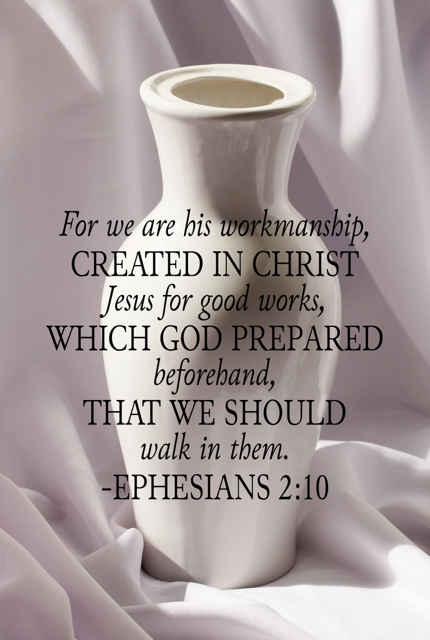
Ephesians 2:10 tells us, “For we are his workmanship, created in Christ Jesus for good works, which God prepared beforehand, that we should walk in them.” Those good works are not meant to count for salvation: the previous two verses tell us our salvation is a gift of God, not a result of our works. But from that salvation, from our love and thankfulness, we spend our lives to serve Him. There are things He created us to do, and our highest calling is to do whatever He has put before us with grace.

Does shining our light for the Lord mean nonstop witnessing? No. But when we “do all to the glory of God” (1 Corinthians 10:31), it shows in our lives.

We can shine for God whether we’re comforting a child with a skinned knee, drawing blood, answering a customer service call with a cheerful voice and efficient help, preaching a sermon, washing a patient’s hair, letting someone in our lane of traffic, or having the same conversation for the fifth time with an elderly loved one.

What matters is not the size of our service, but the One for Whom we do it and the love and grace He wants to show others through us.
(I often link up with some of these bloggers.)

Laudable Linkage

I have a fairly short list to share today.

Elizabeth the Faithful”–a Small Reflection on Our Queen, HT to Challies. I’ve read several tributes to and reflections of Queen Elizabeth, but I particularly liked this one, which contains an except of David Martyn Lloyd-Jones’ sermon after her she first became queen.

Why I’m No Longer Trying to Be Extraordinary, HT to the Story Warren. “Who are the people who left a lasting mark on you? My guess is they weren’t superstars, celebrity pastors, or people with global influence. In my life, the most influential people were the teachers, coaches, pastors, and family members whose roots went down deep. They led lives of quiet faithfulness, regularly slowing down long enough to be present with those around them.”

Will You Be Good at Your Thing Today? “There are many things we can be good at in this worldGod gives several talents to each person. But on this morning on this day, this nurse being good at drawing blood might make all the difference to this young boy. Whatever you do today, if you can, do it well. It might move someone from feeling terrified to being glad to see you

Questions to Ask Yourself Before You Apply a Passage to Others, HT to Challies. “Some expositors and exegetes are gifted at applying Scripture. It’s as though these communicators have read our minds. They seem to effortlessly connect a text to our experiences and emotions. I envy them. Application doesn’t come easily for me. I have to work at it.”

Little Kids and Big Emotions. “Is there a way to help our children to begin to manage their feelings without stuffing them, prettying them up, or feeling as if there’s no room for them?”

For writers, seen at The Funnies, HT to Challies:

Just after praying for some dear to my heart, I was blessed and comforted to see this verse in my morning reading in Daily Light today:

Friday’s Fave Five

Wow, this month is going by so fast. Susanne at Living to Tell the Story hosts this opportunity to pause and appreciate the good things of the week, lest they’re forgotten in the bur of passing time.

1. Grandparent’s Day was last Sunday. Jason and Mittu observed it by bringing over dinner and dessert as well as flowers for me and jerky for Jim. Timothy colored pictures for us both.

2. Not getting sick when I thought I was. I thought I was catching a cold one morning, but felt better that evening and the next day. It must have been allergies, but it was odd to suddenly have such a reaction when I have been taking Claritin every day for months. Jim saw a weather report that day showing a map of our whole state under an allergen cloud.

3. A customer service call that took care of a problem (actually a second call, but thankfully everything got straightened out). It’s nice to hear those words, “I can help you with that.”

4. The Tennessee State Fair. We haven’t gone to the fair since a year or two before the pandemic. It’s a bit of a sensory overload outside, but we enjoyed watching Timothy on some rides. Inside the main building we always enjoy the 4-H competition displays in various categories.

We had a couple of unexpected blessings, one in finding a parking space right next to a gate. There were no signs about paying for parking, so we parked close and free. Jesse rode with us, and as we walked to the gate, the attendant asked if we had tickets to the fair. No—we had planned on buying them at the gate. She said she had three that she had been given to hand out to family members, but none of hers wanted to come. So she gave them to us.

5. Delicious coolness. The afternoons are still warm, but the mornings and evenings have been pleasant harbingers of fall breezes to come.

What’s something good from your week?

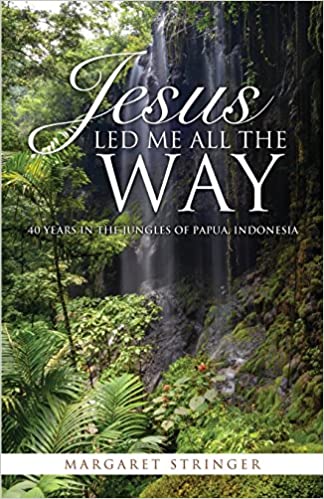
Jesus Led Me All the Way

I’ve mentioned before that Margaret Stringer is one of my favorite people. She was a missionary in Indonesia for forty years among former headhunters and cannibals. Though she had a variety of ministries among the people, one of her main jobs was reducing their language to writing, translating the New Testament into their language, and then teaching the people how to read.

The church we attended in SC supported Margaret. When she “retired,” she lived close enough to the church that she was available to come speak to the ladies’ group several times. She could have us laughing til we were in tears telling us about incidents that would have been quite scary when they happened to her.

Jesus Led Me All the Way is her second book about her time in Indonesia, the first being From Cannibalism to Christianity.

Margaret tells how from a very early age, she was sure God had called her to be a missionary. She had a hard time getting the first visa she needed, and it seemed like everyone brought up to her how Paul wanted to go to Macedonia in Acts, but God wouldn’t let him. Margaret wanted God’s will, whether that was Indonesia or somewhere else. But the delays and obstacles just made her more sure that Indonesia was where God wanted her. Later on the field, she was grateful for the hard time she had getting there because of the assurance it gave her that she was in God’s will.

She tells of her arrival on the field, early missionary life, learning the customs and language, getting adjusted to jungle food (like grub worms). She talks about how important it is to understand the world view of the people you’re trying to witness to.

It took a lot of patience to teach people who had not been taught before or hire helpers to learn the language when they had not had paying jobs before. If they wanted to go fishing instead of come to “work,” they did.

One chapter is on “People I Can’t Forget,” most of whom became part of the church there. It took much time and patience and prayer and overcoming many mistakes, but what a joy to see God open people’s eyes to His truth at last.

Margaret includes here one of my favorites of her stories. Once she was in an area where no house or huts were available, so she stayed in a small metal building with open windows (screens but no glass). Once when a terrible storm hit, rain blew in, destroying about 90% of her handwritten translation work. As she tried to salvage what she could and mop up the rest, she felt discouraged. She “fussed” with the Lord about dropping her down in the jungle and leaving her all alone. When she went to bed, something fell off the wall and hit her on the head. She felt like that was the last straw. She turned on her flashlight to see what had fallen. It was a plaque that said, “He cares for you.” She started laughing and said, “OK, Lord, I get it. Thank you.” She comments, “For some people, God speaks in a still small voice. Others of us, however, He conks on the head” (p. 125).

Margaret tells of difficulties in the translation work. She had to consider not just getting the words into Citak, but making them understood in their culture. For instance, they did not have a word for sister or brother—their words were older sister, younger sister, older brother, younger brother. That took some thought when dealing with Mary, Martha, and Lazarus. All of their verbs incorporated time of day, so that had to be considered when translating narratives. The suffix “na” at the end of a sentence indicated the information was heard from someone else rather than witnessed directly. In Luke 11:11, when Jesus asks whether a father would give a serpent to his child when asked for a fish, they said, “Of course.” “The Citak people love to eat snake, and a good-sized python has much more meat on it than the average fish, so who wouldn’t want a snake instead of a fish?” (p. 205). they had to find a different word for a poisonous snake that conveyed the idea of the passage, that “no good father would give his son a poisonous snake when he asked for a fish.”

The Citak people had a big celebration day with invited guests, including dignitaries, when they handed out the completed New Testaments. One of Margaret’s greatest joys was seeing the Citak people’s joy at having the Word of God for themselves and their ability to read and understand it. But one of her greatest sorrows was when people from other villages with different dialects wanted the Bible in their language, too. She knew that it would take more time than she had left on the field to translate the NT for all the people there that needed it.

Margaret writes that the people “went from naked cannibals, without the Bible or ability to read, to 23 churches, and having the New Testament in their language. The journey was sometimes funny, sometimes frustrating, sometimes discouraging, sometimes dangerous, but always rewarding” (p. xvii). I’m thankful she shared glimpses of that journey with us.

When You Have to Say No

When my husband and I were first married, if someone in the church we attended asked me to participate in some ministry, I usually said no. I worked in the nursery and sang in the choir. But I felt intimidated and inadequate to do much of anything else.

The ladies’ group in this particular church was highly organized with officers over various areas of responsibility. One fall, the president explained nominees for the next year would be notified soon. She encouraged those nominees not to say an automatic no, but to pray about the opportunity.

I was a nominee for the first time that year. I had been on a committee that changed the main hall bulletin board once a month to focus on a couple of missionaries our church supported. Bulletin boards had been the bane of my college education major, and I wasn’t excited about overseeing the committee for them for a whole year. But I took to heart the admonition to pray about it. I didn’t feel I should say no.

I was elected. I did not have to participate in every bulletin board, but I assembled a committee of ladies to work on them, usually two a month. Another officer made up the list of which missionaries were featured each month. Sometimes I’d come up with the idea for the boards; sometimes the ladies would.

Even though I was a reluctant officer at first, I learned and grew through the year. I came to actually enjoy bulletin boards, and I learned principles that enabled me in other areas of responsibility.

But then I went to the other extreme of feeling like everything that anyone asked me to do in church was of the Lord. I was soon overrun and overburdened.

It doesn’t take long, in church or in life, to learn that you can’t say yes to everything. Yet it’s hard to say no. You don’t want to let people down or let a need go unmet.

But no one can do everything. Here are some truths I learned along the way when trying to decide what to take on or let go. Maybe they’ll be a help to you, too.

Pray for wisdom. Just as my former ladies’ group president advised me not to say no until I prayed over an opportunity, I also should not say yes until doing the same. I shouldn’t use “Let me pray about it first” as a cop-out or stall tactic. But, even if I feel pretty sure one way or the other, I need to take it to the Lord.

Evaluate your season of life. When I had young babies, I felt like I was barely keeping my head above water. The outside ministries I was involved in only added pressure, and I wish now I had stepped back from them. I finally learned to do so with my third child. Likewise when we cared for my mother-in-law in our home, my husband and I both had to lay other ministries aside. There just wasn’t time or energy or mental space for anything else.

Remember little things add up. In one church, I had one major responsibility plus a lesser one. Over time, I was asked to take on other small tasks. They didn’t involve a great amount of time, so I said yes. But the small things that weren’t too much on their own added more pressure all together. I had to hand off some of them to others.

Remember my no may be someone else’s yes. Once I felt particularly bad about saying no to an opportunity, even though I felt sure I should. The person who said yes was as reluctant as I was with my first office, but she did a wonderful job. I realized that if I had said yes, I would have been robbing her of that opportunity.

Don’t feel guilty. If this opportunity is of the Lord, He has someone in mind for it. If it’s not you, He’ll help bring the right person to it. Or it may be time to set certain ministries aside or reorganize them. This happened with a homeschool support group we were part of in GA. It had started out small: one mom got together with a few other moms, organized field trips and get-togethers, and began an informal newsletter. But the group grew exponentially. When the woman who started the group had her seventh baby, she had to drop everything involved with the group. For the next year, I think the only thing we did as a group was the monthly renting of the skating rink. But by the end of that year, different moms volunteered for different areas. The year off had shown us how much we wanted and needed the group plus helped us diversify responsibilities so everything wasn’t on one person. And that gave more people opportunity to learn and grow in their areas. In hindsight, it might have been better if the original mom had tried to transition things before having to drop it all. I don’t know if she just didn’t think of it or if she had planned to continue until she realized she couldn’t. She might not have had time to figure it all out. But it all worked out for the best.

And sometimes a lack of available personnel means it’s time for that particular ministry to come to an end. Greg McKeown suggests running a “reverse pilot” in his book, Essentialism: The Disciplined Pursuit of Less. This isn’t a Christian book, but it has lots of good common-sense principles. A pilot program is used by companies to help discern whether a certain product or service would be beneficial. A reverse pilot tries to discern what the effect would be of removing a certain product or service. Greg told of a senior executive in a new position who kept up with his predecessor’s detailed visual report for the other executives. This report was time-consuming for both him and his team and didn’t seem to serve any useful purpose. So he just stopped doing it to see what happened. No one seemed to miss it. As organizations, churches, and even our individual lives change over the years, some practices will no longer be needed.

Don’t say yes for the wrong reasons. As much as we don’t want to disappoint people, we can’t always do everything everyone else wants. We also shouldn’t say yes for fear of missing out. We have to guard against pride: sometimes being part of a certain committee or ministry might bring a measure of prestige or feelings of importance.

Consider the trade-offs. What will be the impact of this new responsibility mean to my schedule, my energy, my family, and other ministries and activities I am involved in? Can I handle something new, or will I need to let something go if I take this on? Is it worth the trade?

If you have to say no, be gracious. I’ve asked someone to participate in a particular ministry only to be met with wide eyes and the equivalent of “Are you kidding?” This was someone who, as far as I could tell, seemed to have extra time. But then another lady volunteered who I would never have asked because of everything else I knew she had on her plate. Of course, we don’t really know what people have going on in their lives. And the issue isn’t always one of time. But when you find you do need to say no, don’t make the other person feel bad for asking. Ultimately you both want the right person for the job or ministry or opportunity. When you pray about and feel you’re not that person for this situation, you might also pray about the best way to say no so that the asker isn’t discouraged. Maybe something like, “I’m sorry, I have all I can handle right now. But I’ll be praying God will lead you to the right person.” You might also suggest someone else that you feel would be a good fit (and it’s probably best to ask them first if they’d mind your suggesting their name).

Remember even Jesus said no to some requests. Jesus did not give a sign when people asked for one, because they had plenty of evidence to believe who He was. Once, after a full day of preaching, he went out alone the next morning to pray (Mark 1:38). People found Him and “would have kept him from leaving them, but he said to them, ‘I must preach the good news of the kingdom of God to the other towns as well; for I was sent for this purpose’” (Luke 4:42-43). Healing was part of His ministry, but not the main purpose. Every person He healed would eventually die. Every person He raised from the dead would face death again. He came to provide hope for life after death and kept that the main focus.

Even aside from ministry opportunities, we have to tell ourselves no sometimes to activities that are harmless in themselves but aren’t our main purpose. We have more activities available than ever before and need God’s wisdom and guidance to know what’s best.

How about you? What helps you decide whether to say yes or no to new opportunities?

(I often link up with some of these bloggers.)

Laudable Linkage

Here are a few of the thought-provoking reads found this week:

Hey, Christian, Don’t “Quiet Quit” Your Faith, HT to Challies. “But enough about the noisy quitters! What about the quiet quitters of the faith? There’s been a lot of ink spilled over the rise of the ‘Dones’, those who have just finished with the faith. But there’s a way of leaving the faith that’s less obvious. . . “

Driven by Awe, HT to Challies. “When Christians think of fighting sin, we usually imagine strict self-discipline and saying ‘no’ to wrong desires. Certainly, self-control is one of the fruits of the Spirit and a means of helping us fight our sin. But, what if we had another tool given to us by the Spirit to help us overcome?”

When You Hear of a Scandal, HT to Challies. “I’m no longer naïve. I’m not surprised when I hear of a Christian leader falling into sin. I have, however, learned four important lessons on how to guard my own heart when I hear of another leader who’s fallen.”

Though My Flesh May Fail: Reflections on Chronic Suffering From the Hospital Bed, HT to Challies. “I’m a firm believer in the sovereignty of God’s grace. I believe everything that happens to the believer is for good. After receiving an autoimmune diagnosis and seeing the subsequent bills roll in, though, this conviction has been put to the test. Amidst temptations to doubt, God continues to reveal His good purposes for me in my affliction. As I sit in my hospital bed today, three lessons stand out among the rest as reminders of the sovereignty of God’s grace and His goodness in my life.”

Planning Like Paul. “Some Christians think that making plans for your life is the opposite of being Spirit-led. . . They’ll tell you that if you make plans then you aren’t trusting God. What you really need to do is just let go and let God. But is this the model of the Christian life that Scripture presents us with? Should we never make plans? Are goals simply a manifestation of a lack of faith?”

A Few Handfuls for Weary Little Listeners. I love this idea and examples of speaking directly to children in a message.

Stories Are Light. “Isn’t this why we read to our children, why we fill their minds and hearts with true and beautiful story? Why we seek to cultivate their imagination and sense of what is good and holy? This beautiful confession took my words away. Wow, I said. You’re right. That is beautiful and true and wise.”

Tomorrow is the twenty-first anniversary of 9/11. Some years I have acknowledged the anniversary with post, but not always. But I do like to take a moment to think about it. Many of us promised we would “never forget” that tragedy, and I want to keep that promise. It’s a good time to pray for the survivors, the families of the fallen still living with loss, the fight against terrorism.

Friday’s Fave Five

Susanne at Living to Tell the Story hosts this opportunity to look back at the previous week and appreciate the good things in it. Sometimes we overflow with things to give thanks for; other times we have to dig for them. But this is a good exercise either way.

1. A long weekend. My husband took Friday off before Labor Day to have a four-day weekend. We had the kids over for grilled burgers Monday, and Mittu made a gorgeous cheesecake. Jason and Mittu brought over gluten-free cheese pizzas and assorted toppings Friday night and then had us to their house for Sunday lunch after church.

2. A new light fixture above the sink. The one we had was broken and held together with tape. Jim used one of his days off to replace it. I always feel bad when a home project turns into a bigger deal for him than we thought it would be. He had to make four trips to Home Depot. The first light he bought didn’t work with our configuration. The second turned out to be an off color. I don’t remember what the other two trips involved. But he finally got it in. Not only is it more pleasant to look at, but it’s much brighter.

3. A super clean tub and sink. My cleansers and scrubbers weren’t taking complete care of the stains in the sink and tub. Jim has a drill with a brush attachment and scoured both fixtures til they were gleaming.

4. A breakfast biscuit. Somehow in talking with the kids I mentioned that when I used to take them to school, I’d “reward” myself by getting a breakfast biscuit once a week or so. But because I’m not usually out early in the mornings any more, I hadn’t had one in a long while. The next morning, Jim had to go out for something and surprised me by bringing back Chick-Fil-A biscuit.

5. A good critique session. I mentioned recently joining a writing critique group. Everyone in the group has a chance to “present” several pages of their work for others to edit and offer suggestions. It does feel very vulnerable, but it is so valuable. Even with running our pages through a spelling and grammar checker, mistakes are missed. And then there are larger issues, like when a phrase or paragraph is confusing or something hits in an unintended way. This past week was my turn to present, and the comments were so kind (as I knew they would be, even though I felt nervous beforehand). I had a chance to ask for feedback afterwards and got lots of good ideas.

Bonus: We watched Timothy last night while his parents went on a date. They brought me this wonderful cookie in the cutest little box:

Just before sitting down to start this post, I heard of the passing of Queen Elizabeth. She was such a stabilizing factor over the course of such a long reign. My heart goes out to her family and British friends.

The Lost Heiress

In The Lost Heiress by Roseanna M. White, set in the Edwardian era, Brook Eden grew up as the ward of Prince Grimaldi in Monaco. But the circumstances of her real family are a mystery. When Brook was a young child, she and her mother were in a carriage accident. An opera singer came to their aid, and Brook’s mother asked the woman to take Brook, a packet of letters, and her necklace before she died.

Brook friend, Justin, thinks he has discovered her real family and makes the arrangement for Brook to meet them in Yorkshire, England. Brook’s father, Lord Whitby, and his sister know right away Brook is his lost daughter. It takes the rest of the family and the servants longer to accept her.

This happened fairly early in the story, leaving me to wonder where the conflict was going to come into the plot.

Well, there’s plenty of conflict. A distant cousin, Lord Pratt, is a predator who sets his sights on Brook as the heiress of the Whitby estate. He bribes a servant to spy on Brook and bring him information. Justin’s father dies, leaving him as the new Duke of Stafford. His responsibilities necessitate his traveling to his family’s holdings in other countries, leaving Brook vulnerable to Pratt’s machinations. Justin begins to feel more for Brook than friendship but doesn’t want to seem like he is only interested now that she is an heiress. He decides to wait. But when he returns, he and Brook clash instead of resuming their easy friendship. Unbeknownst to either of them, someone has been preventing their letters from reaching each other. Other suitors appear to have made inroads into Brook’s affections. And no one realizes the danger Brook is in from a possession she doesn’t even know she has until a near-fatal attack and a stunning betrayal opens their eyes.

Several of the main characters are Christians and learn to deal with broken dreams, new and uncomfortable circumstances, trust in God when He doesn’t seem to be near, and finding forgiveness.

In the author’s notes, Roseanna said she wrote the first version of this story when she was twelve, finishing it at thirteen! After nineteen years, nine books, and many rewrites, it was finally published as the first in the Ladies of the Manor series.

A story about a lost heiress finding her true home might seem like a fluff read. But I have found no fluff in Roseanna’s books. She brings so much depth into her characters’ personalities and struggle. I enjoyed this book very much and have already started the sequel.

Daily Light on the Daily Path

When I mentioned Daily Light on the Daily Path in my post about pursuing the fruit of the Spirit, my friend Susan commented that she wasn’t familiar with the book. Since that might be the case for others as well, I thought I’d take the opportunity to share about it.

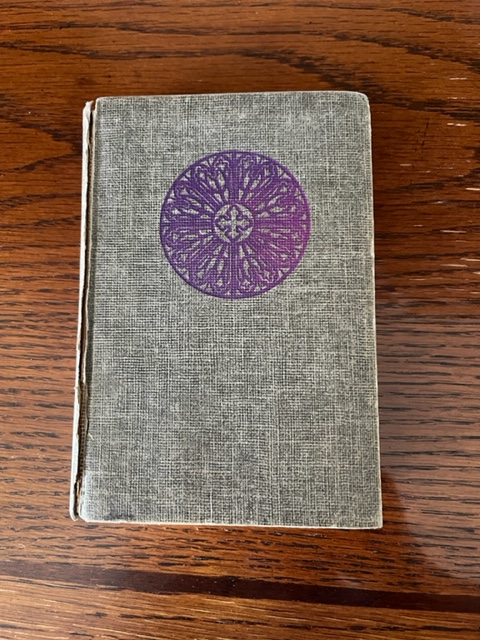
I first heard about Daily Light in missionary biographies, particular Amy Carmichael’s and Isobel Kuhn’s. I don’t remember if I assumed it was an older, out of print book: I don’t recall seeking it out. But one day when a home school conference was held nearby, I visited their sales area. I found a 1906 copy of Daily Light on sale for $2. So I grabbed it! They must have printed a lot that year, because I have worn out two versions from that year and am on my third (the latter two found online).

I found that Daily Light is a devotional book made up entirely of Scripture readings for every day. They were compiled by Jonathan Bagster of Bagster and Sons Publishing Firm for his own family’s devotions. His son later published the readings as a devotional book.

Most of the Scripture selections for the day follow a theme, like the one from September 1 about meekness.

Others follow a progression of thought, like this one.

One of my favorites from April 10 pairs verses together like this:

Behold, I was shapen in iniquity; and in sin did my mother conceive me.—Thy renown
went forth among the heathen for thy beauty: for it was perfect through my comeliness,
which I had put upon thee, saith the Lord God.
I am a sinful man, O Lord.—Behold, thou art fair, my love; behold, thou art fair.
I abhor myself, and repent in dust and ashes.—Thou art all fair, my love; there is no
spot in thee.
When I would do good, evil is present with me.—Be of good cheer; thy sins be forgiven
thee.
I know that in me (that is, in my flesh) dwelleth no good thing—Ye are complete in
him.—Perfect in Christ Jesus.
Ye are washed, . . . ye are sanctified, . . . ye are justified in the name of the Lord Jesus,
and by the Spirit of our God.—That ye should shew forth the praises of him who hath called
you out of darkness into his marvellous light.
Psa. 51:5. -Ezek. 16:14.Luke 5:8. -Song 4:1.Job 42:6. -Song 4:7.Rom. 7:21. -Matt. 9:2.Rom. 7:18. -Col. 2:10. -Col. 1:28.I Cor. 6:11. -I Pet. 2:9.

We used the book for family devotions for a while, but my husband didn’t like reading verses grouped together out of context. Though I do prefer reading through the Bible a book at a time in order to get everything in context, these selections seem to have been combined prayerfully and carefully.

Many days these readings were just what I needed for the day. One of the most memorable times was when I was in the hospital with transverse myelitis and scheduled for an MRI. Every nurse and aide who came into my room asked me if I was claustrophobic. I wasn’t sure—I’d never been in a situations when I felt claustrophobic before. They described the close quarters of the MRI machine and the need to be perfectly still. They could give medication for calmness for the procedure, but it would have to be done ahead of time. I opted not to take the medicine. The morning of my MRI, September 4, the day’s selection from Daily Light contained several verses about being still, something that had been emphasized to me so much for the scan:

Ruth 3:18  Sit still, my daughter

             Isaiah 7:4 Take heed, and be quiet; fear not, neither be fainthearted.

             Psalm 46: 10   Be still, and know that I am God

   John 11:40 Said I not unto thee, that, if thou wouldest believe, thou shouldest see the glory of God?

   Isaiah 30:15 In returning and rest shall ye be saved; in quietness and in confidence shall be your strength

             Psalm 4:4 Commune with your own heart upon your bed, and be still

             Psalm 37:7 Rest in the LORD, and wait patiently for him

   Psalm 112:7-8 He shall not be afraid of evil tidings: his heart is fixed, trusting in the LORD. His heart is established

When they first put me in the MRI machine, I did feel panicky. But God kept bringing these verses to mind over and over, and they calmed and comforted me.

So every September 4 when I come across these verses, I am reminded of the Lord’s help that day.

Another time that stands out was when we were house-hunting as we prepared to move from SC to GA in the late 90s. The reading for March 6 included these verses:

The Lord your God . . . went in the way before you, to search you out a place to pitch your tents in, in fire by night, to shew you by what way ye should go, and in a cloud by day. -Deut. 32:11,12.
—As an eagle stirreth up her nest, fluttereth over her young, spreadeth abroad her wings, taketh them, beareth them on her wings: so the Lord alone did lead him. Psa. 37:23,24.
—The steps of a
good man are ordered by the Lord: and he delighteth in his way. Though he fall, he shall not be utterly cast down: for the Lord upholdeth him with his hand. Psa. 34:19.

When I read the first verse to my husband, he said, “Does that mean we’re going to live in a tent? Thankfully, no. 🙂

The 1906 version has a section at the back titled “Thoughts for Personal and Domestic Exigencies” (love that title!) It has a page of Scripture readings for thanksgiving, birthdays, marriage, sickness, anxiety, affliction, and bereavement. My 1999 version doesn’t have this section, unfortunately.

I’ve read Daily Light for about 30 years now. I like to read it to begin my devotional time, to get my mind and heart in gear. But some days, like when we’re traveling, or when I have an early medical appointment, or on Sundays, DL may be all I read for devotions that day.

I didn’t know there were evening readings until I ordered a more modern version. I don’t know if they were added later or if originally the morning and evening readings were published separately.

The original versions use the KJV, but you can find DL in several other Bible versions now. It is also online several places, including Crosswalk (if you don’t mind their ads) and Christian Classics Ethereal Library. This site will send the day’s readings from the NIV via email.

So that’s my long history with Daily Light on the Daily Path. Had you heard of it? Have you read it?

Passive or Pursuing?

I’ve read Daily Light on the Daily Path nearly every day for about 30 years now. But I saw something in the reading for September 1 that I don’t remember noticing before.

The topic for September 1 morning reading was meekness. The first verse portion came from Galatians 5:22, which lists meekness as a fruit of the Holy Spirit.

Years ago I read of a mother teaching her children that because the fruit of the Spirit was something that He grew in us, they could sit back and relax since there was nothing they could do to produce this fruit.

While I agreed that only the Holy Spirit could produce His fruit in us, something bothered me about a totally passive response.

Then on this first September morning, another phrase stood out to me from the day’s reading in 1 Timothy 6:11: “Follow after meekness.” Other versions say “pursue” instead of “follow after” and translate “meekness” as “gentleness.”

Here was a verse telling us to pursue, to follow after, something that’s part of the fruit of the Spirit. Pursuing doesn’t indicate a passive approach.

In context in 1 Timothy 6, Paul has warned Timothy about wrong doctrine and false teachers. The motivation for some of these false teachers was monetary gain. Paul encourages contentment and warns that the pursuit of money brings a snare. He warns “the love of money is a root of all kinds of evils. It is through this craving that some have wandered away from the faith and pierced themselves with many pangs” (verse 10).

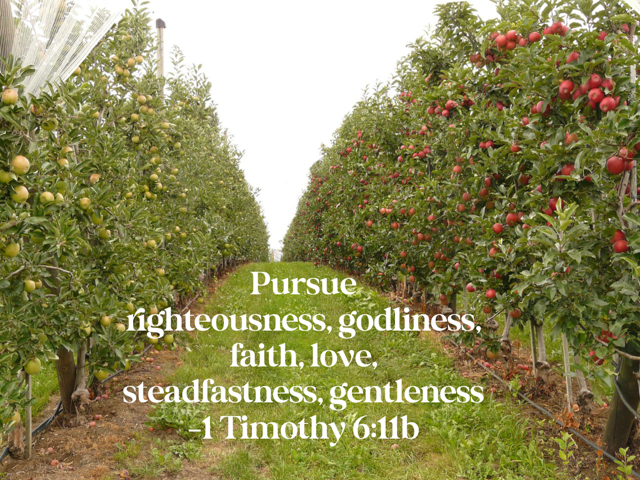
Then the word “but” provides a pivot: “But as for you, O man of God, flee these things. Pursue righteousness, godliness, faith, love, steadfastness, gentleness.”

Some of these characteristics are also part of the fruit of the Spirit (“But the fruit of the Spirit is love, joy, peace, patience, kindness, goodness, faithfulness, gentleness, self-control,” Galatians 5:22-23). They are given to us, yet we’re also told to pursue them.

I’m not generally good with plants. But I know only God can make something grow. Farming has been an act of faith for hundreds of years. Farmers till the ground, sow seed, water, fertilize, and weed. But they have no control over whether drought or storms or disease or insects affect their crops beyond their ability to care for them.

Many of us have had the experience of planting a new flower or vegetable according to instructions, eagerly awaiting the first green shoots, only to be disappointed when nothing happened.

But, though only God can make something grow, He doesn’t usually produce a bumper crop without requiring human input. He doesn’t need our input, but He requires it. Even in the garden of Eden, before sin brought weeds and thorns, man’s job was to “work it and keep it” (Genesis 2:15). Sure, God places lovely wildflowers in overlooked corners and lush growth in uninhabited rain forests. But many things that seem to grow without effort are the wrong sorts of things–weeds and vines that choke out other growth.

We’re saved by grace through faith plus nothing (Ephesians 2:8-9). And our sanctification is from God as well.

But He wants our cooperation, our obedience.

Warren Wiersbe, in his commentary on Timothy, Be Faithful, sheds some light. A little later in 1 Timothy 6, verse 19, Paul says, “Laying up in store for themselves a good foundation against the time to come, that they may lay hold on eternal life” (KJV). Wiersbe comments, “‘That they may lay hold on eternal life’ (1 Tim. 6: 19) does not suggest that these people are not saved. ‘That they may lay hold on the life that is real’ would express it perfectly.” The ESV translates it closer to that meaning: “thus storing up treasure for themselves as a good foundation for the future, so that they may take hold of that which is truly life.”

So that’s probably similar to what we’re dealing with concerning the fruit of the Spirit. God gives it: we don’t work it up in our own efforts. But in love and obedience, we lay hold of and pursue and cooperate with the Spirit’s working in our lives.

How do we pursue the qualities God wants us to have?

Intentionality. We don’t drift into holiness. “Pursue” indicates planning and purpose.

Turn away from wrong things. The command to pursue certain things followed the command to flee other things.

Pray. We can’t be or do what God wants us to in our own strength. We need to ask Him to fill us with His Spirit.

Read God’s Word. God speaks to us through His Word, giving us wisdom and knowledge. If we’re having trouble in a particular area, maybe we need to study and memorize verses in that area.

Behold Him. 2 Corinthians 3:18 says we’re changed to be more like our Savior when we behold Him. The Bible is not just a self-help book or a manual for overcoming our faults. The Word of God is the means by which we behold Him: we need to seek Him, not just formulas.

Yield to Him. John 14:26 says that the Holy Spirit will remind us of what God has taught us. When we’re angry and about to give way to our temper, and the Holy Spirit brings to mind a verse warning about the dangers of anger, we need to yield to Him. When we’re about to indulge in a third dessert, and God brings to mind verses about gluttony and self-control, we need to yield to Him. “Neither yield ye your members as instruments of unrighteousness unto sin: but yield yourselves unto God, as those that are alive from the dead, and your members as instruments of righteousness unto God” (Romans 6:13).

So is the fruit of the Spirit something we passively receive?

Yes.

But if we’re not in God’s Word, growing in grace and knowledge of Him, yielding to Him as He convicts us in our daily walk, that fruit is not going to ripen and mature. We can’t do even those things without His enabling and help. But He wants us to actively pursue His will.

At least, that’s how I understand it after this study. What do you think?

(I often link up with some of these bloggers.)