Unknown's avatar

About Barbara Harper

https://barbarah.wordpress.com

How Can We Make Our Souls Fire-Resistant?

A few years ago, we came home from having lunch at my son and daughter-in-law’s place to find a large burned patch in the grass to the left of our house as well as damage to a neighbor’s fence.

As we talked with neighbors, we learned that the neighbor behind us had been burning leaves earlier in the week. She thought she had the fire completely out and left a few days later to go out of town.

But underneath the ash, fire had been quietly smoldering for several days. Finally it erupted into flame and then spread over the dry grass. Thankfully neighbors saw it and called the fire department.

It was frightening to me that all this could happen in just a few hours while we were out. Perhaps the fire had already started before we even left, but we didn’t notice it since our driveway is on the other side of the house.

Since the photo above is a panorama shot, it’s a little distorted. Our fence line actually turns a corner rather than standing in a straight line all the way down. Still, you can see how the fire neatly went around the fence.

Another evidence of God’s protection is that just a few months earlier, we had a row of dead trees rather than a fence. Some of you may remember our ordeal of having 50 trees on our property line die off. We had to find someone to cut them down and haul them off, and then someone else when the first crew didn’t fulfill their obligations. Then my husband found some used fencing on Craig’s List and spent several evenings and Saturdays putting up the new-to-us fence.

But imagine what would have happened if that row of dead trees had been in the line of the fire. I shudder to think about the possibilities. I’m grateful for God’s mercy and timing.

I don’t know what brought this incident to mind recently—maybe the sight of a different neighbor burning something in his yard last week.

James 3:5 came to mind: “So also the tongue is a small member, yet it boasts of great things. How great a forest is set ablaze by such a small fire!” Just as an almost-put-out fire can blaze up and burn out of control, a small tongue can cause immeasurable damage.

Lust is another kind of fire. Job said that if he had been unfaithful to his wife, “that would be a heinous crime; that would be an iniquity to be punished by the judges; for that would be a fire that consumes as far as Abaddon, and it would burn to the root all my increase (Job 31:11-12). Proverbs asks, “Can a man carry fire next to his chest and his clothes not be burned? Or can one walk on hot coals and his feet not be scorched? So is he who goes in to his neighbor’s wife; none who touches her will go unpunished” (6:27-33).

Anger is not always bad in itself. God is angry at certain things. We should be angry at injustice, at mistreatment, and so on. But much anger arises from selfish reasons. Some of us have been on the receiving end of the quick flash fire of someone else’s anger. But a slowly smoldering undercurrent is no better. Psalm 37:8 says, “Refrain from anger, and forsake wrath! Fret not yourself; it tends only to evil.”

Gossip can easily spread like wildfire. “For lack of wood the fire goes out, and where there is no whisperer, quarreling ceases. As charcoal to hot embers and wood to fire, so is a quarrelsome man for kindling strife. The words of a whisperer are like delicious morsels; they go down into the inner parts of the body” (Proverbs 26:20-22).

Most sins are more easily dealt with when they’re small. If we let temptation linger without turning from it, if we fail to quench it completely, it can build up under the surface until it suddenly erupts and spreads.

But sometimes it seems we’re not only surrounded by temptation, but filled with it. We have an enemy of our souls who knows what our particular triggers are. And we have an old nature that fights against the new nature we received when we believed on the Lord Jesus as our Savior (Galatians 5:16-16). What hope do we have when the devil lures us and our own flesh betrays us?

I thought it was so unusual that the fire in our yard bypassed the vinyl fencing. I looked up whether vinyl was heat-resistant, and it is, according to this article. Vinyl fencing is hard to ignite, won’t spread easily if it does ignite, and can be easily put out.

How can we help our souls to be fire-resistant?

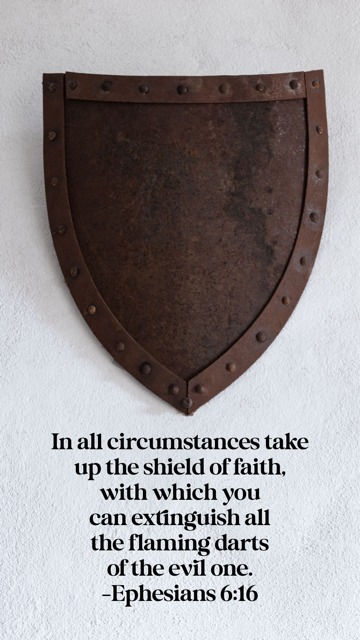
In describing the armor of God in Ephesians 6, Paul says, “ In all circumstances take up the shield of faith, with which you can extinguish all the flaming darts of the evil one” (verse 16). The word “extinguish” in the Greek means, according to the definitions at the bottom of this page, “extinguish, quench, suppress, thwart.” The shield of faith doesn’t just stop the fiery arrows of temptation from reaching us: it actually puts them out.

What kind of faith makes up this shield? The faith that acknowledges the one true God is righteous, kind, and good. The faith that believes His will and purposes are better than Satan’s lures or our desires. The faith that wants to please Him more than it wants to indulge self. The faith that believes and applies His Word. Proverbs 6:23-24a says, “For the commandment is a lamp and the teaching a light, and the reproofs of discipline are the way of life, to preserve you.” Jesus resisted Satan’s temptations with the Word of God (Matthew 4:1-11).

The Pulpit Commentary says of the shield of faith in Ephesians 6:16:

Withal taking up the shield of faith. The θυξεός was a large oblong shield covering a great part of the body, not the ἀσπίς, smaller and more round. Faith, in its widest sense, constitutes this shield – faith in God as our Father, in Christ as our Redeemer, in the Spirit as our Sanctifier and Strengthener – faith in all the promises, and especially such promises as we find in Revelations 2. and 3. “to him that overcometh” (comp. promise to Ephesus, Revelation 2:7) Wherewith ye shall be able to quench all the fiery darts of the evil one. “Fiery darts” were weapons tipped with inflammable materials, firebrands, curiously constructed, adapted to set on fire. Metaphorically, considerations darted into the mind inflaming lust, pride, revenge, or ether evil feelings, emanations from the great tempter, the evil one. That such considerations sometimes start up suddenly in the mind, against the deliberate desire, sometimes even in the middle of holy exercises, is the painful experience of every Christian, and must make him thankful for the shield on which they are quenched. An act of faith on Christ, placing the soul consciously in his presence, recalling his atoning love and grace, and the promises of the Spirit, will extinguish these fiery temptations.

We can say with David:

For it is you who light my lamp;
the Lord my God lightens my darkness.
For by you I can run against a troop,
and by my God I can leap over a wall.
This God—his way is perfect;d
the word of the Lord proves true;
he is a shield for all those who take refuge in him.

For who is God, but the Lord?
And who is a rock, except our God?—
the God who equipped me with strength
and made my way blameless.

(Psalm 18:28-32)
(I often link up with some of these bloggers.)

Laudable Linkage

Here are some great thought-provoking reads found recently:

Bored With Christianity? HT to Challies. “In a world that offers such multitudinous choices and options for life and happiness–why persist in this same old religion with the same old book?”

Christ’s Crucifixion Isn’t Child Sacrifice, HT to Challies. “Many professing Christians are uncomfortable with God killing his Son as the penalty for our crimes. They see this as child sacrifice. From their perspective, it’s impossible for such a doctrine to be consistent with God’s character when it’s so clear that God abhors the killing of innocent children.”

Unfathomable. “Give them a taste of this big, wild, wonderful world that was made by a bigger, wilder, more wonderful God. It won’t make any of your problems, or theirs, disappear. But I have a strong hunch that in the presence of something so large, they will be reminded of the One who is Unfathomable himself.”

Cosmic Significance Therapy. “For Moses, the aim of considering the brevity of life isn’t hopelessness, but a proper outlook—an eternal perspective. And this perspective shapes how we live and work today.”

When You’re Up to Your Neck in Mud—Sing! HT to Challies. “Singing in adversity gives hope and lifts spirits. If that’s true in general terms, how much truer wouldn’t that be if we were up to our necks in mud and singing songs that actually spoke of hope, songs like psalms and biblical hymns?”

I’m Not an “Angel Mommy,” and Here’s Why. “As a follower of Christ and a mother who suffered three miscarriages, I have a vastly different view of what my babies are experiencing. People who die don’t earn angel wings.”

The Delight and Distress of Preaching, HT to Challies. I’ve experienced what this writer discusses, even though I am not a preacher and have done little speaking. By the way, I would much rather hear a preacher or teacher who feels like this than one who is brash and overconfident.

Knowledge Is Not a Bank, HT to Challies. “Knowledge is not a bank. It’s more like a garden. Truths and skills that are planted in our minds can bear good fruit in our lives. But just as a neglected garden will run wild with useless weeds, so our minds can easily become a wilderness of distractions, anxieties, and trivialities that choke out the good and productive knowledge we’ve accumulated before it gets the chance to take root and grow into real applications in our real lives.”

Reject the Algorithm, HT to Challies. This isn’t written from a Christian perspective, but makes some good points for being genuine rather than trying to get the most clicks.

Song of Suffering: A Short Film Featuring Joni Eareckson Tada, HT to Challies. This video is well worth 13 minutes of your time.

Friday’s Fave Five

Once again we’re pausing for a bit with Susanne and friends at Living to Tell the Story to recount the blessings of the week. This has been one of those weeks with much more than five faves, but I’ll try to narrow it down. 🙂

1. Having the family all together. My oldest son came in from RI for a visit last Friday night and will be here a few days more. We’ve had lots great time all together chatting, eating, playing games. Then various combinations of family members visited in smaller groups. I love it.

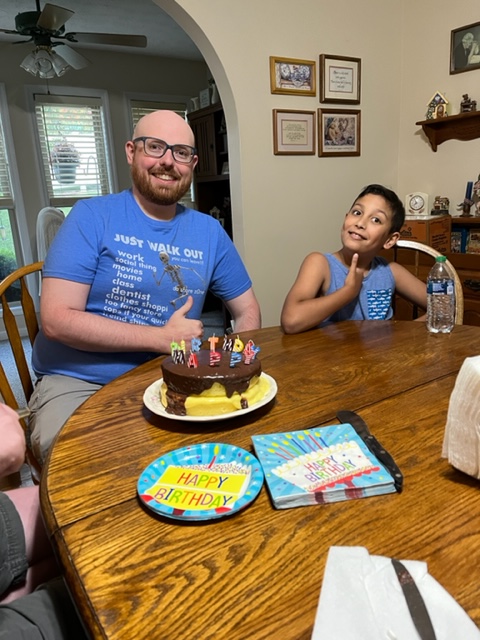
2. Jeremy’s birthday. I’m so glad he could be here for it.

3. Several fun outings. We went to a car show, which included a kids’ area with Nerf target shooting, balloon animals, and other similar things. Then over a couple of days we went to a BrickUniverse LEGO Fan Convention, a bubble tea place (I didn’t try it, but everyone else enjoyed theirs), a French creperie, the art museum . . . I think that’s all so far. I’ll elaborate on a couple of these on my end-of-month post or in a post of their own. It’s been nice to chill at home between outings.

4. A new critique group. I’ve been praying about finding a group to exchange writing with and get feedback from. I was invited to participate in one via Zoom and was delighted to see a few fellow bloggers there I have known a long time. We had an introductory meeting, and I am looking forward to future meetings.

5. Password is a show I watched as a kid, and there is a new iteration of it that just started airing last week. It’s a little too hyped-up, but otherwise I love the game itself.

What’s something good from your week?

Making Time to Read the Bible

Elisabeth Elliot is one of my favorite women, writers, missionaries, speakers, people in general. I’ve read almost all of her books. I received her newsletter for many years.

I was able to hear her speak in person twice. On one of those occasions, we had an opportunity to have her sign one of our books written by her. I had several of her books, but couldn’t quite work up the nerve to ask her to sign it. Then when my pastor heard I was going to hear her speak, he asked me to have her sign one of his books.

I stood in a long line waiting for my turn at just a few minutes with Elisabeth. And what did I say in those precious few moments?

“How do you find time to write so many books?”

Duh.

In her practical, no-nonsense way, she said, “You don’t find time. You make time.”

I’ve told this story here before, but it illustrates an important truth. We have so many things that can fill our time these days. We have to make time for what’s most important.

I’ve never seen a poll on this subject, but I would guess if we asked a large group of Christians why they don’t read the Bible, most of them would say lack of time. They know they need to, and they feel guilty for not reading Scripture regularly. But somehow the day is gone before they know it. They might read a verse or two or a short devotional before they go to bed, but their brains are too fried for much more.

But Jesus said spending time with Him is the one needful thing in our lives. So rather than waiting for time for Bible reading to magically open up, we need to make time in our schedules for it. We need to prioritize it.

Here are a few ideas for making time to read the Bible:

Pray about it. God says to ask Him for wisdom. One of the hardest times for me to make time for Bible reading was when my second child was born. With my first child, I could read while he napped. But when my second child napped, I now had a preschooler. I could tell I wasn’t getting spiritually nourished. I’d whimper to the Lord at the end of the day that I didn’t know when I could have set aside time for Bible reading that day.

He gave me the idea to ask Him at the beginning of the day to help me be alert to time to read. And He did. Normally I like more of a schedule routine, but I had to learn to grab what moments I could some days.

Don’t make too big a production of it. I think we often sabotage our devotional time because we feel we can’t have it unless we read so many minutes or chapters, consult a commentary or two, sing or read a hymn, draw something pretty in the margins of our Bible, journal for fifteen minutes afterward. Those are all great practices, and often we can employ several of them at certain seasons in life. But if we feel we haven’t actually had devotions unless we’ve done all that, no wonder we don’t get to it some days. The essential thing is to spend some amount of time in the Bible itself.

Have a plan. If we have to decide every day what part of the Bible we’re going to read from, that takes up valuable time. Early in my Christian life, I was urged to read the whole Bible through, and I think that grounded me more than anything else. I don’t do it in a year any more: that felt too rushed to me. There are multitudes of Bible reading plans available, from one year to two years to five years to a chronological reading. Don’t feel you have to read all of the planned reading for that day. But knowing where to go next makes it a lot easier to pick up and read rather than flipping through trying to find somewhere to start.

You might think that having a plan is stifling, and you’d rather read as the Spirit leads. The Bible was meant to be read in context. We get more from a particular book of the Bible when we read it in progression from start to finish. We wouldn’t read a letter from anyone else by reading the second paragraph on page two one day and the third paragraph on page one another day.

I can testify that God does speak to people through regular planned reading. I can’t tell you how many times my Bible reading for the day has been exactly what I needed. Of course, we can take a break in the plan if we feel a need to study some other part of the Bible at some point or have some kind of special need.

Know why. Any time I read about starting a new habit or making a major change, the writer will advise readers to know our “why.” When obstacles come up, when we’re tired, when it’s not convenient to do what we need to do, remembering why we do it can carry through when we don’t “feel” like it. I wrote last week about reasons I still read the Bible. I started a list years ago of reasons to read the Bible, and have been adding to it ever since until now I have over fourteen typed pages of reasons. But in a sense, I don’t need that list to keep me going. I’ve experienced the benefits of reading the Bible so much that I don’t want to go without it.

Lay other things aside. I confess that if I pick up a book or magazine or turn on the TV or open Facebook and then realize I haven’t read the Bible that day yet, I sometimes feel a little resentful at having to stop what I am doing. Even knowing all the benefits of reading the Bible, I feel that petty irritation at being interrupted and having to stop something I enjoy. But that only lasts for a moment. Once I do start reading, I’m glad I did.

Listen. Personally, I get more out of my Bible from reading rather than listening. But there are ways to hear the Bible being read if that’s the best option for others.

Plan for Bible reading after a natural break in the day. It can be hard to change gears in the middle of the afternoon to stop and read the Bible. It’s easier if we plan for it in conjunction with something else: after breakfast, after showering, after the kids go to school or take a nap, etc.

Keep the Bible handy. This is easy to do now with Bible apps for the phone. Years ago, my neighbor with three little stair-step girls kept her Bible open in the kitchen. That’s where she spent much of her time, and she could read a little while waiting for water to boil, etc.

Anything is better than nothing. For years I have been reading Daily Light on the Daily Path. It ‘s composed of just Scripture, usually on a particular topic for the day or in a progression of thought. I like to use it to begin my devotional time. But on Sundays, that’s all I read. Likewise, if I have an early medical appointment or obligation, or we’re traveling, that might be all I read for the day.

Normally I like having a good amount of open-ended time in the Word. But the days I truly only had time for a few verses, God gave me what I needed.

How about you? What tips have you found for making time to read the Bible?

(I often link up with some of these bloggers.)

Laudable Linkage

Though I am way behind on my blog reading once again due to a busy week, I still came across some good reads I wanted to share with you.

Why Don’t I Care? Steps to Overcoming Spiritual Apathy, HT to The Story Warren. “One of the most frustrating parts of my life is that I’m not as passionate about God as I should be. I imagine many Christians feel similarly. There are some, however, for whom this feeling goes deep and lasts long.”

Strengths, Weaknesses, Warts, and All. “Here’s what she knew, and I do too: We all have done bad things, experienced bad things and had bad things done to us. But God uses all those things to help others if we let Him.”

God’s Healing: Kintsugi in Practice. “It literally takes brokenness and turns it into beauty, and it sees the brokenness not as something to hide, but as something to value as part of the object’s history. As I looked into Kintsugi, I discovered many similarities with God’s healing work.”

Prayer That Pleases God. “We pray. We pray because God tell us to. We pray because we need to. We pray because prayer matters. But do we pray with confidence that God is pleased with our praying? Do we pray with confidence that God is pleased with our praying even when he does not grant our petitions?”

Dishes and Divorce: Why Little Things Can Lead to a Breakup. “How do couples come to a place where something as small as a plate on the counter has them contemplating divorce? I believe it comes down to one basic reality: the little things either communicate love, or they don’t.”

Never Forget! “The book of Deuteronomy contains Moses’ words to the Israelites as they are on the verge of entering the Promised Land, and one message comes across loud and clear: Don’t forget!”

Context Matters: The Whole Armor of God. “Context matters. If we learn to read the Bible for what it is—and not simply as a collection of vibrant metaphors for vague spiritual truths—we’ll discover that some of our most familiar passages may have far more usefulness than we’d previously assumed.”

Friday’s Fave Five

It’s been a good week, but a busy one between an online conference last weekend and getting ready for my oldest son’s visit this weekend and his birthday a little later. I’m thankful to pause a moment with Susanne at Living to Tell the Story and friends to note the blessings of the week.

1. The Enrich Conference for writers, speakers, and teachers hosted by the Kauffmans of Lighthouse Bible Studies and Refresh Bible Study Magazine. It was totally free (except the in-person attendees had hotel and food expenses)—the Kauffmans just did this as a ministry. The sessions were all so good.

2. Takeout dinners. The one problem with attending a conference online is that you still have home responsibilities to take care of between sessions. My dear husband graciously got dinners out for us so I could rest a bit between afternoon and evening sessions.

3. Jason and Mittu’s 13th anniversary. It’s been fun to have memories of their wedding week popping up on Facebook. Then and now:

4. A boys’ camping trip. Jim, Jason, and Timothy camped overnight at a place that was not exactly a “glamping” site, but was more than a sleeping bag on a tent floor. They had a good time.

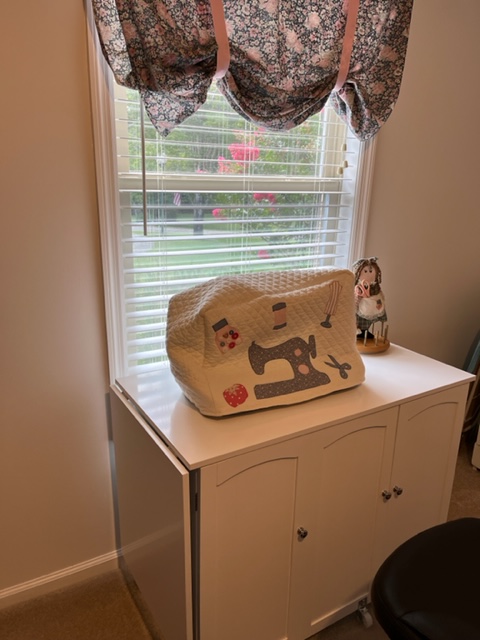
5. A pretty view. Our crepe myrtle must have just grown out enough to be seen from my sewing room window—I don’t remember seeing its blooms there before this year. I enjoy the view not only when I am in the room, but when I walk by it as well.

What’s something good from your week?

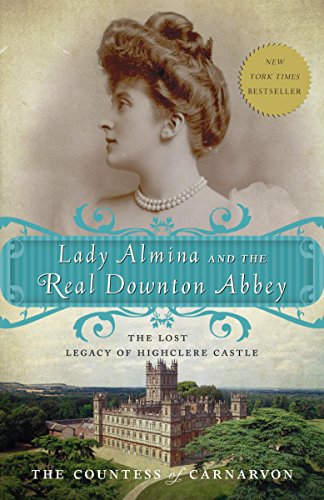
Lady Almina and the Real Downton Abbey

You don’t have to be a fan of Downton Abbey to enjoy Lady Almina and the Real Downton Abbey: The Lost Legacy of Highclere Castle. If you enjoy British manor houses and history, especially the Edwardian era, you’ll like the book whether you’ve seen the series or not. But if you are a Downton Abbey aficionado, you’ll probably enjoy some of the behind-the-scenes information about the setting for the series.

The fictional Downton Abbey is set in a real castle called Highclere, home to the current eighth Earl of Carnarvon and his wife, the author of this book, the Countess of Carnarvon.

An able historian, the Countess draws from diaries, letters, and other information to tell of one of her predecessors, Lady Almina, who married the fifth Earl of Carnavon in 1895.

Almina was the illegitimate daughter of Alfred de Rothschild, a wealthy banker. Though she had been presented at court, “she had not been invited to the highly exclusive, carefully policed social occasions that followed. Almina’s paternity was the subject of a great deal of rumour, and no amount of fine clothes or immaculate manners could gain her access to the salons of the grand ladies who quietly ruled Society. So Almina had not attended all the crucial balls of her debut season, occasions that were designed to allow a young lady to attract the attentions of an eligible gentleman” (p. 4). But somehow she drew the attention of George Edward Stanhope Molyneux Herbert. Apparently her beauty and large dowry overcame the circumstances of her birth. But from all accounts, Almina and George were fortunate to have a genuine marriage where they truly loved each other.

One of Almina’s main functions was to plan and host dinners and gatherings, even for the Prince of Wales, her husband’s friend. She was a master of organization and a charming hostess.

Unlike many women, she traveled with her husband, a man of many and varying interests.

But life changed during WWI. Almina had found a knack for nursing during one of her husband’s illnesses. During the war, she converted part of the castle into a hospital. She wanted the soldiers to feel like guests at a country estate. She knew they needed respite for the mind and soul as well as the body. But she wasn’t just a distant financier: she donned a nurse’s uniform, made rounds with the doctor every morning, and helped in various ways, even bathing gangrenous feet.

After the war, when travel could resume again, Almina and George traveled to Egypt. George had been to Egypt many times, because of his love for travel and the area, but also for his heath. The damp winters of England were unhealthy for him, so he often spent winters in Egypt. He had financed several excavations over the years without finding much for his efforts. He was going to give up, but then his partner in the work, Howard Carter, wanted to go one more time. George agreed, and this time, to their amazement, they found the tomb of Tutankhamun (not a spoiler as this is mentioned early in the book).

Between these major events, the book tells various details about George and Almina’s family, upstairs vs. downstairs life, the progression of the war and its aftermath, details around the Earl’s discovery of King Tut’s tomb, and Almina’s long-term legacy.

Almina grasped early on “that she was only one part of a machine that would long survive her. Part of her initial task on arrival was to understand the history and community that she was becoming a part of” (p. 15). “Everyone at Highclere, whether they worked above or below stairs, on the farm or in the kitchen, had a role to fulfil, and Almina was no different,” (p. 11).

In shows and films about this era, we often see lords of the manor not doing much besides hosting lavish dinner parties and going hunting. But, in fact, they had a lot of responsibility. Before the war, the Earl had an idea where things were going, and took a large sum of money out of the bank. “Considering that he was morally responsible for the welfare of the entire household, as well as the tenants, he refused the offer [of selling some of his land to the government] and set about adding to his flocks and herds. He also bought one and a half tons of cheese and an immense amount of tea. . . Once he had deposited the gold in his bank in Newbury, he was in a position to provide 243 men women and children with all essentials for at least three months” (pp. 125-126).

The current countess adds in the epilogue that even now, “The challenge for Highclere is to ensure that the Castle and its estate businesses remain strong enough to preserve their rich heritage. It is the same need to balance business and conservation that confronted Almina” (p. 292). “It was the economic fallout of the Second World War, combined with new tax structures, that made it impossible to maintain the opulence of previous generations at Highclere Castle,” (p. 301). When Almina’s son became the sixth earl, he had a reduced staff. WWII took a further toll on the whole country in many ways. The current earl and countess live at the castle part of the time and in a cottage at other times. They offer the house for various gatherings and other purposes (like settings for films) not only as a means of upkeep, but to preserve the house’s legacy.

The countess says in the prologue this book “is not a history, although it is set against the exuberance of the Edwardian period, the sombre gravity of the Great War and the early years of recovery after the conflict. It is neither a biography nor a work of fiction, but places characters in historical settings, as identified from letters, diaries, visitor books and household accounts written at the time.”

It took me a little while to get into this book. The first part was largely informational. But by the time the book got to the war and the castle becoming a hospital, my attention was more engaged. Overall, I really enjoyed it.

I got the Kindle version of this book a while back during a sale, but got the audiobook recently during another sale. Wanda McCaddon is a wonderful narrator for the book: I had previously heard her narration of several other classics.

There is a sequel to this book which I don’t have yet but would like to read some day: Lady Catherine, the Earl, and the Real Downton Abbey. Lady Catherine was Almina’s daughter-in-law, an American who was not an heiress and wasn’t raised in anything like the society she married into. Her husband inherited the estate at a fairly young age, so they were both thrust into big responsibilities sooner than expected. Then they had to manage during WWII and the subsequent changes to the country and their lives.

If you’re interested in the castle, the countess has an Instagram account for it here: https://www.instagram.com/highclere_castle/. She shares some of the hidden nooks and crannies as well as the gatherings they currently host and other interesting details.

This book could fit in the Celebrity category of the the Nonfiction Reader Challenge. George and Almina were celebrities in their day, Downton Abbey has brought a new celebrity to the castle, and the current The Earl and Countess are celebrities now.

Why Keep Reading the Bible?

Do you reread books?

Little Women is one I’ve read several times. As a child, I identified with Jo. Even though we’re different personalities, I could relate to getting into “scrapes” despite one’s best intentions, the angst of growing up and learning self-control, the desire to write. But in some ways, I felt more closely aligned with Beth, the shy, quiet sister.

In early married days, I could empathize with Meg, especially her kitchen disaster on the day her husband brought home unexpected company.

After I had children, I could see myself in Marmee.

I’ve read Mere Christianity three times, I think, and I still haven’t mined its depth. I get a little more from it each time. But I could probably benefit from rereading it once every few years.

I’ve read some of my favorite biographies three or four times: Isobel Kuhn, Amy Carmichael, Rosalind Goforth, Through Gates of Splendor, and others. Each time, I am inspired by people’s life stories.

I don’t think I’ve read any book more than five times, though.

Except the Bible.

Someone asked me recently why I keep reading the Bible. He suggested that since I have read it through several times over, I must be pretty familiar with it by now.

Some years ago, I posted 13 Reasons to Read the Bible. Since then, I’ve added to that list as I have found more reasons within God’s Word that encourage me to read it. In fact, I have about fourteen typed pages of reasons in a Word document. I am trying to wrestle them into one chapter for the book I am working on. But suffice it to say, the reasons I have for reading the Bible in the first place are also reasons to continue reading it. It provides light, joy, comfort, encouragement, encourages my faith, helps me fight sin, tells me more about God.

But for this post, rather than going into general reasons to read Scripture, I’m just going to list reasons to keep reading it once we’re fairly familiar with it.

There’s always more to learn. I’m sometimes surprised at things I seem to have overlooked in previous readings. For instance, Michele recently wrote about Paul’s admonition to “come together for the better.” How had I never noticed that phrase, “for the better” before?

I notice different things each time. As with Little Women or Mere Christianity, each time I read through the Bible, I build on previous readings and have weathered different life experiences to perceive things I didn’t before.

I need to keep eating. The Bible is often compared to food. Physically, if I didn’t eat, I might last for a while on the strength of what I have eaten in the past. But at some point I am going to weaken severely if I don’t take in new food. I need to keep partaking spiritually as well. Hebrews 5:12-15 and 1 Corinthians 3:1-2 talk about progressing from “milk” to “meat” spiritually as we mature.

I need to be reminded. God often told His people to remember what He had told them—and they all too often forgot. As the old song says, we’re “prone to wander.” Peter says in his writing “I am stirring up your sincere mind by way of reminder” (2 Peter 3:1).

God says to meditate on His Word day and night in Psalm 1, Joshua 1, and many other places. To meditate on it—to keep turning it over in my mind—I need to keep reading it because (see above) I forget.

Anticipation. When we reread a favorite book or rewatch a favorite movie, we look forward to our favorite parts all over again, even though we know what’s coming.

Relationships thrive on communication. We are often told that Christianity is not just a list of rules, but it’s a relationship with God. “And this is eternal life, that they know you, the only true God, and Jesus Christ whom you have sent” (John 17:3). My husband and I have been married for 42 years. We know each other’s opinions on many things, and we know what the other will say in some circumstances. But we’re not bored with each other, and we haven’t run out of things to talk about. Similarly, I don’t get tired of hearing what my heavenly Father has to say.

Recalibration. My husband uses microscopes both in his work and as a hobby. Every now and then, his microscope has to be readjusted. It hasn’t gotten totally out of whack, but continued use, gravity, dust and other things affect its function. It has to be fine-tuned in order to work correctly. The same could be said for cars, pianos, guitars, and other things. As I wrestle with the flesh and am exposed to a range of ideas in the world, I need to fine-tune my thinking regularly and line it up with God’s.

The Bible meets my needs. The Bible says it gives enlightenment, joy, comfort, guidance, and so much more. I don’t know how many times I’ve been thinking or praying about something just before I open my Bible to read, and then I find the very thing I was thinking about in my scheduled reading for the day.

I need to be filled up in order to pour out. “All Scripture is breathed out by God and profitable for teaching, for reproof, for correction, and for training in righteousness, that the man of God may be complete, equipped for every good work” (2 Timothy 3:16-17). If we compare the passage about being filled with the Holy Spirit and letting the word of Christ dwell in us richly, we find many parallels. The Holy Spirit works through the Word of God to enable us to minister to others.

God’s Word enables me to do His will. “His divine power has granted to us all things that pertain to life and godliness, through the knowledge of him who called us to his own glory and excellence, by which he has granted to us his precious and very great promises, so that through them you may become partakers of the divine nature, having escaped from the corruption that is in the world because of sinful desire” (2 Peter 1:3-4). I remember marveling the first time I “discovered” this verse. All things that pertain to life and godliness–through the knowledge of Him–by His great and precious promises.

I still need to change. I haven’t “arrived.” 2 Corinthians 3:18 says we’re changed to be more like Christ as we behold Him. “And we all, with unveiled face, beholding the glory of the Lord, are being transformed into the same image from one degree of glory to another. For this comes from the Lord who is the Spirit.” I still need to behold Him every day. Jesus said, “Sanctify them in the truth; your word is truth” (John 17:17). I still need to hear truth to be sanctified. I still need to “grow in the grace and knowledge of our Lord and Savior Jesus Christ” (2 Peter 3:18).

Reading the Bible is still necessary. In the famous Mary and Martha story, Jesus said, “Martha, Martha, you are anxious and troubled about many things, but one thing is necessary. Mary has chosen the good portion [sitting at Jesus’ feet to hear and learn from Him], which will not be taken away from her” (Luke 10:38-42). “One thing have I asked of the LORD, that will I seek after: that I may dwell in the house of the LORD all the days of my life, to gaze upon the beauty of the LORD and to inquire in his temple” (Psalm 27:4). Jesus said, “It is written, ‘Man shall not live by bread alone, but by every word that comes from the mouth of God'” (Matthew 4:4).

God wants me to continue in it. Paul told Timothy: “But as for you, continue in what you have learned and have firmly believed, knowing from whom you learned it and how from childhood you have been acquainted with the sacred writings, which are able to make you wise for salvation through faith in Christ Jesus. All Scripture is breathed out by God and profitable for teaching, for reproof, for correction, and for training in righteousness, that the man of God may be complete, equipped for every good work” (2 Timothy 3:14-17). I still need all those things the Bible is profitable for.

I need God’s Word to flourish. Psalm 1 says the person who meditates on God’s Word day and night is like a tree planted right by the water, a continual source of nourishment and refreshment. That tree “yields its fruit in its season, and its leaf does not wither” (verse 3). I want to be like that.

I love God’s Word. “I find my delight in your commandments, which I love. I will lift up my hands toward your commandments, which I love, and I will meditate on your statutes” Psalm 119:47-48).

I’ll admit, every day’s reading isn’t thrilling (I’m in Chronicles right now). But even though every “meal” in the Bible isn’t a Thanksgiving feast, it all nourishes me. Most days, God gives me something to take with me through the day.

If I do find myself feeling like I’m in a rut, reading from a different translation helps jolt me out of familiar wording. I had not used a study Bible until the last few years, and the notes and observations helped me glean more from a passage than I did on my own.

When I first started reading the Bible as a teenager, I felt it was my lifeline. I still do. I can’t imagine not reading it regularly any more, it has become so much a part of my life.

How about you? Do any of these reasons resonate with you? Do you have other reasons I didn’t mention?

(I often link up with some of these bloggers.)

Laudable Linkage

Though I’m a little behind on blog reading due to the online conference I’m attending, I still found lots of great stuff to share.

My Biggest Struggle with Daily Devotions, HT to Challies. “My biggest struggle with daily devotions is not carving out the 20 to 30 minutes needed to read the word and spend time with God. The most difficult part is slowing down my heart and mind enough to get anything from it.”

How Should We Apply Biblical Narratives, HT to Knowable Word. “A biblical narrative’s presence doesn’t necessarily imply approval of its contents. Description is not the same as recommendation. But in the absence of explicit commentary from the biblical author, how can we sort out what to apply from each story?”

From Rage to Repentance, HT to Challies. “Hamid* unexpectedly walked in just as the service was beginning. At once I felt anxious chills in the back of my head and neck, my body’s way of telling me that it feels threatened. The last time I had seen this man had been five years previous – and he had been screaming at me in the middle of the street . . .” Wonderful and encouraging story of God’s grace.

Why It’s Right for God to Seek and Demand Glory, HT to Challies. Way back in college, one of my Bible professors brought up the question of why it’s ok for God to seek to be glorified, but it would be selfish on anyone else’s part. Unfortunately, he didn’t answer the question, and it has troubled me from time to time over the years. I knew God deserved glory, and because He is inherently good, it’s not wrong for Him to seek it. But the thought that helped me most was that we’re changed by beholding His glory (2 Corinthians 3:18)–one reason He wants us to see His glory is so we might become more like Him. There’s a quote I can’t find right now, I think from John Piper, that says God doesn’t “need” glory, but we need to glorify Him. This post brings up another couple of reasons.

The Value of Knowing Both Sides, HT to Challies. “This skill—the skill of articulating both sides of an issue—is one that is in short supply in American culture. Most debates that we observe on television consist of two people trying to outshout and demonize each other. This is because it is much easier to dismiss opposing arguments than it is to understand them.”

When the Same Sin Comes ‘Round Again. This post brings out some good conclusions concerning Abraham’s repeated sin of lying about his relationship with his wife. But it’s also a good example of using observation and considering context when studying the Bible.

Entrusting My Treasure. “I wanted to require God to insulate my family from hurts in exchange for our sacrifice and service. This would not do.”

Be Careful About the Multiplying Attacks on Christian Nationalism. “There are those that are conflating conservative politics and Christianity, but the political left is conflating all conservatives into one category in order to dismiss them all.”

Friday’s Fave Five

It’s August! Many schools here have started or will next week. But to me, August still seems like summer. We seem to be in a pattern of high heat during the day and thunderstorms at night.I’m thankful we didn’t lose power one night during a torrential rain storm, though it blinked off for a few seconds several times. I wish I could send some of our rain to friends in TX.

We pause on Fridays with Susanne at Living to Tell the Story to think over the blessings of the week lest they slip by without notice or thanksgiving.

1. A government phone call went well. Odd how you have to go to an agency, then have a phone appointment, then they send you a form, instead of doing it all at once. But it all went well and didn’t take very long.

2. Hummingbirds. We got our feeder up late this year, and it usually takes them several days to find us. But right away we had a little family of them (at least I think it’s a family) visiting several times a day. I see two flying around together frequently. Another one looks like a youngster since he’s smaller than the others, and he’s not as skittish as they are. Most of the time, the adults are flapping their wings and darting in and out as they drink. But the little guy lands and sips and looks around and sips some more. It’s fun to watch them.

3. A virtual conference. The Kauffmans of Lighthouse Bible Studies and Refresh Bible Study Magazine are hosting an Enrich Conference Thursday-Saturday this week for both in-person and online attendees. Katy Kauffman is one of my favorite writers at The Write Conversation and Blue Ridge Mountains Christian Writer’s Conference Blog, and I’ve taken one of her classes at the Carolina Christian Writer’s Conference. For all the negatives of the pandemic, one of the positives is being able to attend conferences online.

4. Feedly is working again. Feedly is the blog aggregator I use, and it was leaving out several blog posts over a few days. Then one day all the backlog came flooding in.

5. Our Ring camera. Jim was away one night when the Ring app alerted him that someone was at our door at 3 a.m. He called me and had me call 911 to have the police check around. As we looked at the Ring camera video, we saw a woman leaving something on our porch. When it became clear she wasn’t still around, while still on the phone with Jim, I opened the front door to find…a Door Dash delivery for someone named Elizabeth. Either Door Dash was given the wrong address or the driver didn’t find it. But while it was scary to wake up to news of someone on the porch in the wee hours, it was a relief to find out the situation was not threatening.

And I did turn my own Ring notifications back on!

Have a great weekend!