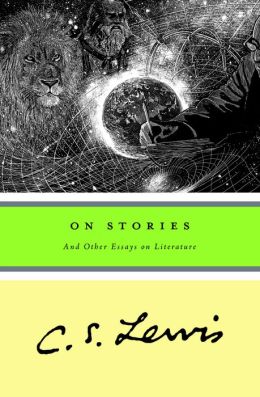
Book Review: On Stories and Other Essays on Literature

On StoriesSomeone recommended On Stories and Other Essays on Literature by C. S. Lewis some time last year. I asked for and received it for Christmas, but then set it aside when I entered a number of reading challenges for this year. But something in How to Read Slowly touched off a train of thought that reminded me of Lewis’s book, so I was happy to pick it up recently. Then realizing it could qualify for Carrie’s Narnia Reading Challenge for July made me push a little harder to try to get through it by the end of the month.

Nineteen of Lewis’s essays were compiled for this book by Walter Hooper, one of his biographers, his private secretary for a time, and eventually the literary executor of his estate. The last selection in the book is a transcript of a discussion recorded with Lewis and two colleagues. Many of the essays were previously published in magazines or in Lewis’s books: others had been unpublished until this book. Some are Lewis’s thoughts on fiction, science fiction, writing for children, etc., while others are critiques of other writers’ work (Dorothy L. Sayers, Rider Haggard, George Orwell, Tolkien, and others).

There is no way to really review a book like this, so I am just going to share some observations.

I hadn’t known and was fascinated to learn in Hooper’s mini-biography which introduces the book that in Lewis’s time “the most vocal of the literary critics were encouraging readers to find in literature almost everything, life’s monotony, social injustice, sympathy with the downtrodden poor, drudgery, cynicism, and distaste: everything except enjoyment. Step out of line and you were branded an ‘escapist'” (p ix). I’m glad Lewis not only stepped out of the box but succeeded and made it okay to enjoy stories as stories.

Lewis states many times in various essays that he did not write the Narnia series or his science fiction trilogy with morals or symbolism in view, as many people in his time and since have thought. They started with certain pictures in his mind (a faun carrying an umbrella) and developed from there. “Never…did he begin with a message or moral, but…these things pushed their own way in during the process of writing” (p. xv). He says in the transcript at the end, “The story itself should force its moral on you. You find out what the moral is by writing the story” (p. 145).

Reepicheep and Puddleglum the Marshwiggle were his favorite characters (p. xi).

He decried the kind of fiction where “the author has no expedient for keeping the story on the move except that of putting his hero into violent danger. In the hurry and scurry of his escapes the poetry of the basic idea is lost” (p. 10). Of course he had no problem with putting the hero in danger, as you know if you’ve read Narnia or the Space Trilogy: sometimes that’s a necessary part of the plot. But if that’s all the story is, it might be enjoyable to some, but there’s no deeper meaning.

He also believed that the “marvels in a good Story” should not be “mere arbitrary fictions stuck on to make the narrative more sensational” (p. 12). In other words, the story itself should be intrinsic to the “world” in the story. A story about pirates should  have a different feel and problems than a story about giants and dragons. The plot shouldn’t be such that it could be stuck into any setting.

He quotes Dorothy L. Sayers as saying, about the assumption that she wrote to “do good”: “My object was to tell that story to the best of my ability, within the medium at my disposal — in short, to make as good a work of art as I could. For a work of art that is not good and true in art is not good and true in any other respect” (p. 93).

When asked what he thought of a certain book, he replied, “I thought it was pretty good. I only read it once; mind you, a book’s no good to me until I’ve read it two or three times” (p. 146).

I found his thoughts on critiques and book reviews quite interesting in “On Criticism” and in his answering of some criticisms of his work in “On Science Fiction.” Then to see/read him “in action” critiquing other books was enlightening. He didn’t pull any punches, but he wasn’t mean or belittling, and he complimented and praised the good while sharing honestly what he thought was bad. He made a strong case for truly evaluating what was good and bad and not deeming a book bad just because one doesn’t like a particular genre.

He thought The Lord of the Rings would “soon take its place among the indispensables” (p. 90). He was right. 🙂

I didn’t look up every word I didn’t know in this book, but I should have, especially with a dictionary app at hand on my phone. I eventually started doing so partway through the book.

Though Lewis has such a wealth of knowledge, I found him very readable and not hard to follow for the most part. I’d love to have sat in on one of his classes.

And here are some of my favorite quotes:

“It might be expected that such a book would unfit us for the harshness of reality and send us back into our daily lives unsettled and discontent. I do not find that it does so….Story, paradoxically enough, strengthens our relish for real life. This excursion into the preposterous [speaking here of The Wind in the Willows] sends us back with renewed pleasure to the actual” (p. 14).

“No book is really worth reading at the age of ten which is not equally (and often far more) worth reading at the age of fifty – except, of course, books of information” (p. 14).

On the topic of frightening elements in children’s literature, he agreed that “we must not do anything likely to give the child those haunting, disabling, pathological fears against which ordinary courage is helpless,” but to withhold “the knowledge that he is born into a world of death, violence, wounds, adventure, heroism and cowardice, good and evil…would be to give children a false impression and feed them on escapism in the bad sense. There is something ludicrous in the idea of so educating a generation which is born to the Ogpu and the atomic bomb. Since it is so likely they will meet cruel enemies, let them at least have heard of brave knights and heroic courage. Otherwise you are making destiny not brighter but darker. Nor do most of us find that violence and bloodshed, in a story, produce haunting dread in the minds of children…Let there be wicked kings and beheadings, battles and dungeons, giants and dragons, and let villains be soundly killed at the end of the book…I think it possible that by confining your child to blameless stories of child life in which nothing at all alarming ever happens, you would fail to banish the terrors, and would succeed in banishing all that can ennoble them or make them endurable” (pp. 39-40) (emphasis mine).

On The Lord of the Rings: “Here are beauties which pierce like swords or burn like cold iron; this is a book that will break your heart” (p. 84).

“‘But why,’ some ask, ‘why, if you have a serious comment to make on the real life of men, must you do it by talking about a phantasmagoric never-never land of your own?’ Because, I take it, one of the main things the author wants to say is that the real life of men is that of mythical and heroic quality” (p. 89).

“The value of myth is that it takes all the things we know and restores to them the rich significance which has been hidden by the ‘veil of familiarity.’ The child enjoys his cold meat (otherwise dull to him) by pretending it is buffalo, just killed with his own bow and arrow. And the child is wise. The real meat comes back to him more savory for having been dipped in a story…If you are tired of the real landscape, look at it in a mirror. By putting bread, gold, horse,apple, or the very roads into a myth, we do not retreat from reality: we rediscover it. As long as the story lingers in our mind, the real things are more themselves. This book [LOTR] applies the treatment not only to bread and apple but to good and evil, to our endless perils, our anguish, and our joys. By dipping them in myth we see them more clearly” (p. 90).

I love that – that by seeing truth in stories we sometimes see it more clearly than we otherwise would have.

If you like Lewis or like literature, I highly recommend this book to you.

Chronicles of Narnia Reading Challenge

(This will also be linked to Semicolon‘s Saturday Review of Books.)
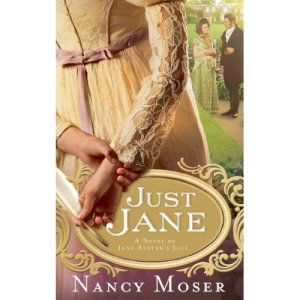
Book Review: Just Jane

Just JaneJust Jane: A Novel of Jane Austen’s Life by Nancy Moser caught my eye when it came through as free or inexpensive for the Kindle app because I so enjoyed How Do I Love Thee?, her novelization of Elizabeth Barrett Browning’s life.

The novel is written from Jane’s point of view beginning when she is in her early twenties. She’s the seventh of eight children, the youngest of two girls. She enjoys writing and her family enjoys hearing her stories, but there doesn’t seem to be much thought of publishing yet. She has had some encounters with a Tom Lefroy to the point where she believes they have an understanding. While he is away at law school she cherishes hopes of their coming union. But, if you know her life story, you know she never hears from Tom and he marries someone else.

She continues at home doing all the things a single woman in the 1800s would do, with the addition of writing, until her family moves to Bath. She not only doesn’t want to go, but she is furious that the decision was made without even consulting her. She has lived in the rural village of Steventon all her life and hates Bath. She has no choice but to move with her family, but she does not write during the years they live there.

Though she has another romantic encounter or two, she never marries. When her family moves again to more commodious accommodations, she is inspired to pick up her pen again. Her first novel is rejected, which may be an additional reason she stops writing for a while, but eventually, as the world knows, she is finally published. She writes anonymously at first but eventually her secret comes out.

The book ends some years before her death, but the author provides a postscript with details of her remaining years. I much appreciated a section at the back where Moser tells what is fact and fiction in the book. Unfortunately, many of Jane’s letters were destroyed, and though Moser drew from them and even seamlessly wove some into the story, she had to fill in the best she could with what she knew.

I thought I would really like this book since I liked the earlier book of Moser’s and since I generally enjoy Austen’s books. I didn’t dislike it per se, I just didn’t love it as much as I thought I would. Sometimes when you approach a book with high expectations it makes it especially hard for it to live up to them. I felt there was too much information about her family: by the time she’s in her mid-twenties, most of her brothers have either already married or are getting married, and the drama of their relationships wasn’t really what I was reading the book for. Then again, I’m sure she and her parents and sister would have been involved and interested, so it was definitely a part of her life and I can understand its inclusion. I missed her humor: some of her writing has been described as “biting satire” (some of the “bite” goes a little too far for me sometimes),  but some of it has a lighter touch. I just finished listening to Northhanger Abbey and loved some of the humorous interchanges with Henry especially (also the name of her favorite brother) and the way she subtly gets across to the reader some of the things naive Catherine Morland misses in her first foray away from home. I also thought she came across as somewhat negative (downright grouchy sometimes), but near the end she did say that she wrestled with discontentment and was guilty of “the unforgivable act of complaining. For what good comes from that particular vice – for the complainer or her unlucky listener?” Moser says in her afterword that Jane was “witty, wise, discerning, creative, loyal. She was also stubborn, judgmental, insecure, and needy. She was…a lot like us.” She did learn along the way that she could “wallow in unhappiness or make a determined choice to leave it behind and move forward. Life is not fair – nor often understandable. But it is ours to live to the best of our ability.”

I did empathize with what seemed to be an inclination towards introversion: though she loved visiting family and having them visit, there were times she declined certain activities because she just needed some time alone. She “embraces silence and solitude.” Though she attended balls in her younger years, she seemed to be more of a homebody later on.

So…upon reflection I guess I did appreciate more from it than I thought. 🙂 That’s one thing reviews are good for – going back over the story and trying to put it all into perspective. I did enjoy her more at the end of the book than at the beginning or middle and appreciated what she learned about contentment and life and finding one’s place.

And I loved the cover!

One last note that I especially liked: when one reviewer seems to portray Jane’s work as “educational,” she says, “I didn’t mean for it to be educational…at least not with any conscious intent.” Her sister Cassandra replies, “Your stories portray true life. In that there is always education.” Amen to that. I think that’s what resonates with us in the books that most appeal to us, no matter the setting: when they depict something of real life and touch our hearts with truth.

Linking to the Austen in August challenge:

Austen in August

(This will also be linked to Semicolon‘s Saturday Review of Books.)
 

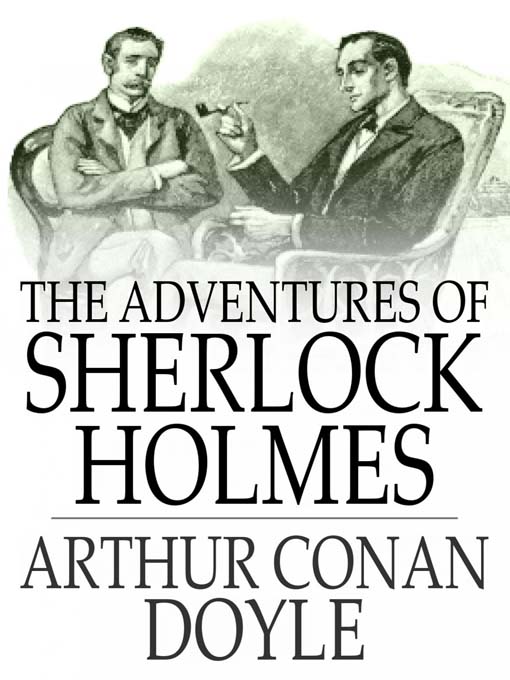
Book Review: The Adventures of Sherlock Holmes

Adventures of Sherlock HolmesThe Adventures of Sherlock Holmes by Sir Arthur Conan Doyle is a collection of short stories published after the first two novels. All were originally published in magazines. I’m not a great fan of short stories, but it was a nice break to have each case end with the chapter rather than having novel-long plots and twists and characters to keep up with. I enjoyed the audiobook read very nicely by actor Derek Jacobi.

The format of the stories is much the same as the novels. The ones in this volume are not told in chronological order: some occured while Watson still lived with Homes, others occured after Watson married. At the beginning of many of them Watson explained why he chose to chronicle that particular case out of the many Holmes had solved. Though there are similar characteristics in each story, Doyle did an excellent job in keeping them from becoming formulaic and predictable. Some involve the police, some don’t. In a few Holmes let the perpetrator go for various reasons (in one, the man did not have long to live; another involved a young man whom Holmes thought would go right after the scare of almost getting into big trouble). Some involved a crime that had already been done, some involved a crime that had yet to be committed, some involved other mysteries.

This book contains twelve stories: probably the most notable is “A Scandal in Bohemia” for the mention of Irene Adler. Some portrayals of this story of Holmes cast her as a love interest, but in this story she is not that. He admires her wit, which rivals his own, and the fact that she is one of very few people who have ever outsmarted him. In fact, Watson says,

It was not that he felt any emotion akin to love for Irene Adler. All emotions, and that one particularly, were abhorrent to his cold, precise but admirably balanced mind. He was, I take it, the most perfect reasoning and observing machine that the world has seen, but as a lover he would have placed himself in a false position. He never spoke of the softer passions, save with a gibe and a sneer. They were admirable things for the observer — excellent for drawing the veil from men’s motives and actions. But for the trained reasoner to admit such intrusions into his own delicate and finely adjusted temperament was to introduce a distracting factor which might throw a doubt upon all his mental results. Grit in a sensitive instrument, or a crack in one of his own high-power lenses, would not be more disturbing than a strong emotion in a nature such as his.

I thought it interesting, after wondering aloud in my review of The Sign of Four whether a genius in one area has to be unbalanced in others, that Watson says Holmes has a “precise but admirably balanced mind” while explaining that emotions were “abhorrent” to him — which seems a little unbalanced to me. 🙂

I enjoyed more unfolding of Holmes’ personality. Some accounts I’ve read cast him as manic-depressive or autistic, but I think (at least so far) that he was just a classic introvert. He claims Watson as his only actual friend, spends a great deal of time alone and thinking, but can be genial and even soothing when he needs to be. Some modern versions also portray him as rude, but in these first three books I haven’t seen that, at least that I can remember.

I’m glad that more modern versions of Holmes’ stories cast Watson as a strong character rather than a doddering old man who is only along as a sidekick. He is a skilled doctor and apparently handy with a revolver (from his army days) since Holmes asks him to bring it along for particularly dangerous cases.

I’m trying to read the Holmes stories in publication order, and the next is another collection of short stories, The Memoirs of Sherlock Holmes. I may skip ahead to The Hound of the Baskervilles, which I’ve been particularly wanting to get to. I don’t think the reader will lose anything by reading them in any order: I just wanted to partake of them as the general public would have at first in order to see how they unfold. But I’ll put off that decision for a little while in order to take a break from Holmes to participate in the Austen in August challenge.

(This will also be linked to Semicolon‘s Saturday Review of Books.)

Austen in August Challenge

Austen in August

I just saw yesterday, while perusing the What’s on Your Nightstand posts, that Lost Generation Reader is sponsoring an Austen in August reading challenge (HT to Bluerose). As the name indicates, the idea is to read something by or about Jane Austen during the month of August. Since I’ve already started Just Jane, a novelization of her life by Nancy Moser, I’m delighted to be able to jump in without straining much from the other challenges I am participating in this year. I’ll also listen to Northhanger Abbey via audiobook. I have more Austen books both on hand and in my audiobook library, so after I finish these two I’ll decide if I want to add any more.

What’s On Your Nightstand: July 2014

What's On Your NightstandThe folks at 5 Minutes For Books host What’s On Your Nightstand? the fourth Tuesday of each month in which we can share about the books we have been reading and/or plan to read.

Ack! This is one of those early 4th Tuesdays that snuck up on me! I didn’t realize it was a Nightstand Tuesday until seeing others in my feed reader. Here goes:

Since last time I have completed:

The Knowledge of the Holy by A. W. Tozer, reviewed here.

Women of the Word by Jen Wilkin, reviewed here, easily one of my top ten books of the year.

How to Read Slowly: Reading for Comprehension by James W. Sire, reviewed here.

The Sign of the Four by Sir Arthur Conan Doyle, second of the Sherlock Homes novels, via audiobook, reviewed here.

The Book of Three by Alexander Lloyd, first book in the Prydain Chronicles, reviewed here.

I will Repay by Baroness Orzcy, part of The Scarlet Pimpernel series, via audiobook primarily, reviewed here.

I’m currently reading:

Just Jane: A Novel of Jane Austen’s Life by Nancy Moser

On Stories by C. S. Lewis

Gospel Meditations for the Hurting by Chris Anderson and Joe Tyrpak

The Adventures of Sherlock Holmes by Sir Arthur Conan Doyle, audiobook.

Next up:

Why We Are Not Emergent: By Two Guys Who Should Be by Kevin DeYoung, Ted Kluck, and David F. Wells. This will finish my TBR Challenge list. Woot! Unless I do the alternates, which I’d like to do, but I’m going to take a break from this list and read some other things that have stacked up in the meantime.

Undetected by Dee Henderson

I also did a fun little A-Z Bookish Questionnaire if you’d like to look in or maybe try it yourself.

Happy reading!

Book Review: How to Read Slowly

How to Read SlowlyI don’t remember how the book How to Read Slowly: Reading For Comprehension by James W. Sire first came to my attention, but it caught my eye when it did. I didn’t want to change my reading speed necessarily, but I did want to learn how to retain more from what I read, especially non-fiction (stories seem to stay with me longer and better with less effort). Even with marking quotes, using sticky tabs to mark the most important passages, and sometimes even outlining the chapters, I still tend to forget a great deal. Even though this was a book about comprehension rather than retention, I figured the one would aid the other.

I had not known Sire was a Christian when I bought the book, but right at the beginning he states that though this book would be beneficial to any reader, he primarily wanted to encourage “Christians to think and read well. Christians, of all people, should reflect the mind of their Maker. Learning to read well is a step toward loving God with your mind. It is a leap toward thinking God’s thoughts after Him” (p. 12). To which I say a hearty “Amen!”

With both instruction and example, Sire shows how to detect an author’s world view, how to read “between the lines” while not “inventing or imagining what is not really there” (p. 42),  how to “track the flow” of author’s argument or reasoning process. He has a whole chapter on poetry, another on reading fiction, another on reading in context (not imprinting our current way of thinking on older books, but understanding the context in which they were written). He gives tips for how to read, what to look for, what to mark, and encourages a lot of rereading. He talks about the difference between reading nonfiction and imaginative literature.

Here are some quotes that stood out to me:

What is the primary reason for reading poetry or any imaginative literature? Beyond all psychologizing as to real or apparent motives, we read literature because we enjoy it — and we enjoy it because we are grabbed by it, our attention is arrested. We say, “Aha! Yes, that’s how it is.”

In great literature — poetry and fiction — we see ourselves, our friends, our enemies, the world around us. We see our interests portrayed in bold relief — our questions asked better than we can ask them, our problems pictured better than we can picture them by ourselves, our fantasies realized beyond our fondest dreams, our fears confirmed in horrors more horrible than our nightmares, our hopes fulfilled past our ability to yearn or desire. In literature we catch reality in a mirror…

Life is short, but art is long. Sophocles is dead, but Oedipus lives on…Each of us when we read a great piece of literature is a little more human than before (pp 58-59).

Well-wrought poems and works of imaginative literature can do for us what stone-cold prose can never do. They can help us grasp the full dimension of ways of life other than our own (p. 86).

Our ability to read well depends to a large degree on just how clearly we understand ourselves and how much we realize ours is not the only way to look at reality….I am not saying we ought not to disagree with anything we read. Indeed not. We must disagree if the thrust is in opposition to what we take — after reflection, study, and prayer — to be the truth. But we must also be sure that we have “heard” the other person as he or she wishes to be heard (p. 141).

We have more to fear from naivete with regard to error than we do from clear knowledge of error that we recognize as error….A knowledge of the truth is the best defense against error (p. 146).

One thing the Bible does not do: it does not denigrate the mind. The Bible is not anti-intellectual. Rather it gives the reason why all of us know what we know, why we can think with some degree of accuracy, and why we fail to think with complete accuracy (p. 148).

Every avid reader struggles with the sheer amount of good books on our shelves that we haven’t gotten to as well as the ones we see in stores or online or recommended by friends. Sire says, “We will never catch up. But we can get on with it…Reading does get done. The point is to start and then to read well. How far we get, how many books we read, must not become the issue” (p. 155).

I don’t know if I would say that I enjoyed the book – it’s not something I’d pick up for fun. But I did benefit from it. It feels a little like high school or college English class in some places (not surprisingly, Sire taught English literature and philosophy at various colleges), but I liked classroom English, so I didn’t mind that aspect of the book. The section on the mechanics of poetry got a little technical for me (I had not known, or else had forgotten, what a spondee was), but I appreciate his illustration that even the meter and rhythm of a poem illustrate its message. I just don’t know how many people are seriously going to count syllables and abab cdcd the rhyming lines outside of a classroom unless they’re really into poetry. But that’s the only part that went a little overboard (for me. Someone else may have found it fascinating). This is a book I would highly recommend for anyone interested in the subject.

(This will also be linked to Semicolon‘s Saturday Review of Books.)
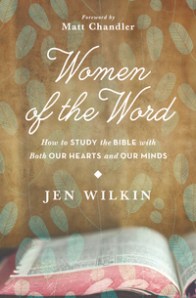
Book Review: Women of the Word

WOTWI have to confess that my first thought when I saw Women of the Word by Jen Wilkin mentioned favorably around the blogosphere was, “Hey! She took my title!” That’s not a very spiritual reaction, I know. 🙂 I’ve been blessed to have been able to compile a ladies’ newsletter for our current church for a couple of years and for a former church for about 9 years, and one column I’ve had in it  for a long time has gone by that same title, “Women of the Word.” It began after a discussion about devotions during one of our ladies’ meetings and the realization that no matter how long one has been a believer, there are always going to be struggles either maintaining a devotional time or making it what it ought to be. So I began the column to encourage ladies along that line and have begun to wonder lately if perhaps I might put them all together and see if they might possibly form a book.

My second thought, after reading a little bit about this book, was that I must get it. Everything I’d heard about it indicated that the author had the same passion as I do for getting women into the Word of God.

And the book definitely did not disappoint in any way.

Jen is not content to just get you into the Bible, however. She wants to equip women to dig for the true meaning of the Bible rather than using the Xanax approach (just seeking something to get through the day) or any number of other faulty approaches. She reminds us that God wants us to love Him not just with our hearts and souls, but also with our minds. She says that when she first began to read her Bible, she approached it with questions like, “Who am I?” and “What should I do?” Though the Bible did give her some insight for those questions, she eventually realized that “I held a subtle misunderstanding about the very nature of the Bible. I believed that the Bible was a book about me…I believed the purpose of the Bible was to help me” (p. 24). She learned that “We must read and study the Bible with our ears trained on hearing God’s declaration of Himself” (p. 26).

When I read that God is slow to anger, I realize that I am quick to anger. When I realize that God is just, I realize that I am unjust. Seeing who He is shows me who I am in a true light. A vision of God high and lifted up reveals to me my sin and increases my love for Him. Grief and love lead to genuine repentance, and I begin to be conformed to the image of the One I behold.

If I read the Bible looking for myself in the text before I look for God there, I may indeed learn that I should not be selfish. I may even try harder not to be selfish. But until I see my selfishness through the lens of the utter unselfishness of God, I have not properly understood its sinfulness (pp. 26-27).

“It’s possible to know Bible stories, yet miss the Bible story” (p. 11). In our quest for Biblical literacy, “we may develop habits of engaging the text that at best do nothing to increase literacy and at worst actually work against it” (p. 37). “We must be those who build on the rock-solid foundation of mind-engaging process, rather than on the shifting sands of ‘what this verse means to me’ subjectivity” (p. 87).

The author then shares ways to read the text within the context and to read it for comprehension, interpretation, and application. There is  an excellent chapter as well for teachers, one section of which makes an excellent case for women Bible teachers. She appears to believe, as I do, that women should teach women rather than men, but she gives some excellent reasons why women should teach other women.

I also appreciated how she dealt with an issue in the conclusion that I have seen some up in just the last couple of years. These days, when you try to encourage Bible reading and study or try to bring to bear what the Bible says on a conversation, you can sometimes be accused of “worshiping the Bible.” Jen answers:

I want to be conformed to the image of God. How can I become conformed to an image I never behold? I am not a Bible-worshiper, but I cannot truly be a God-worshiper without loving the Bible deeply and reverently. Otherwise, I worship an unknown God. A Bible-worshiper loves an object. A God-worshiper loves a person (p. 147).

In short, I love this book and highly recommend it. I do more than recommend it: I don’t often do this, but I encourage you to get it. I’m more than happy that the title I was considering using for a book has been attached to such a one as this.

I’ll close with one last quote:

We must make a study of our God: what He loves, what He hates, how He speaks and acts. We cannot imitate a God whose features and habits we have never learned. We must make a study of Him if we want to be like Him. We must seek His face…

We see Him for who He is, which is certainly a reward in itself, but it is a reward with the secondary benefit of being forever altered by the vision (p. 150).

(This will also be linked to Semicolon‘s Saturday Review of Books.)

A-Z Bookish Questionnaire

booksflr

I saw this at Carrie‘s, who saw it at Amy‘s, and thought it looked like fun. All links behind book titles are to my reviews.

Author you’ve read the most books from: Probably Elisabeth Elliot.

Best sequel ever: I had to sit and think about this one for a long time. I don’t know if I’d say this is the best sequel ever, but I do like the sequels of the Mitford books, especially In This Mountain.  It’s not quite as light and cheery as the others, because Father Tim struggles with retirement, his wife’s fame while his work (and importance, so he thinks) seems to be declining, depression, and a serious setback with his diabetes. But I love how he works through it and comes out of it. Then again, I also like the sequels to the Narnia series, Little Women, the Little House books, Anne of Green Gables (especially the book of the first year of Anne’s marriage), and others.

Currently reading: Just Jane by Nancy Moser (a fictionalized account of Jane Austen’s life), How to Read Slowly by James W. Sire, Women of the Word by Jen Wilkens, and listening to The Adventures of Sherlock Holmes via audiobook.

Drink of choice while reading: Decaf coffee or Decaf Diet Coke.

E-reader or physical book? I prefer physical books, but now that I have gotten used to using the Kindle app for my iPad mini, I enjoy it, too. Can’t beat the free or inexpensive books for it – my library has grown exponentially.

Fictional character you probably would have actually dated in high school: Hmm. I don’t usually think of the characters I read about in that way, and so far I’m not coming up with anyone high school or college age that I would have been interested in back then. Except maybe Laurie in Little Women as played by Christian Bale in the film – though he really wasn’t my type.

Glad you gave this book a chance: The Woman in White by Wilkie Collins. I read descriptions about several of his books, but they just didn’t sound interesting to me. But when so many who read a different book of his for Carrie’s Classic Book Club loved it, I thought maybe I should give him a chance. Loved this and plan to read more in the future.

Hidden gem book: Five Little Peppers and How They Grew. It’s been a long time since I’ve read it and I probably should again, but it was rather a plain book that I didn’t know anything about when I started, but I loved it.

Just finished: I Will Repay by Baronness Orczy and The Knowledge of the Holy by A. W. Tozer.

Kinds of books you won’t read: Anything sexually explicit or with too much bad language, horror books, mysteries that are creepy or too scary.

Longest book you’ve read: Les Miserables by Victor Hugo. All 1440+ pages of the unabridged version.

Major book hangover because of: I’m not sure what a book hangover is supposed to be. If it means one that continues to impact or speak to you after you’ve read it, that would be the Bible.

Number of bookcases you own: 3 tall ones, 2 short ones, and I have at least 4 boxes of books in closets.

One book you have read multiple times. Oh, my. Many, for many reasons. If I had to choose just one….well, let’s make it one nonfiction and one fiction. 🙂 Fiction: Little Women – fun to read at different stages of life and see it through different characters. Nonfiction, besides the Bible: Through Gates of Splendor.

Preferred place to read: Sitting sideways on the couch in the family room.

Quote that you like, from a book you’ve read: Oh my, again. I usually have multiple quotes marked in every book. To go with a recent one: “I believe there is scarcely an error in doctrine or a failure in applying Christian ethics that cannot be traced finally to imperfect and ignoble thoughts about God,” A. W. Tozer in The Knowledge of the Holy.

Reading regret: The only book that comes to mind that I have regretted reading (I think that’s what this question is asking) is one that we picked up at a library visit when my kids were little. When my son asked about it, I just felt a check in my spirit about it, but we got it anyway. When I looked at it when we got home, it was a pretty awful (both in writing and in subject) New Age book encouraging kids to disobey and drop everything they’d ever believed, complete with a “spirit guide” coauthor who had his own afterword in the back. 😦 It did open up a discussion with the one son who had shown interest in it. The only others that just came to mind were some unsavory ones my dad had around the house in my preteen years (he was not a Christian at the time and I wasn’t yet, either). 😦 It pays to be careful what you read, because those things do come back to your mind.

Series you started and need to finish: The Mysterious Benedict Society, Sherlock Holmes (working on the latter.)

Three of your all-time favorite books: This is another hard one. I’m going to invoke my executive privilege as owner of this blog and name 3 nonfiction and 3 fiction. 🙂 Aside from the Bible and the ones I mentioned before as having read multiple times, By Searching by Isobel Kuhn, Climbing by Rosalind Goforth, Evidence Not Seen by Darlene Deibler Rose. For fiction: Jane Eyre, Les Miserables, and A Tale of Two Cities.

Unapologetic fangirl for: The Incorrigible Children of Ashton Place series, especially the audiobooks read by Katherine Kellgren. Clever writing, rollicking good fun, but not without some pathos. I hope, when the series ends and we finally find out how the children got left in the woods to be raised by wolves and what their connection is to some others in the story, that it’s not going to be something I’d have a problem with.

Very excited for this release more than all the others: Besides the next in the above-mentioned Ashton Place series (I don’t know when it might be), a new one in Jan Karon’s Mitford series due out in September: Somewhere Safe With Somebody Good.

Worst bookish habit: My husband would probably say buying and keeping too many books. 🙂 I honestly can’t think of one. I like to take good care of them. Unless it’s the urge to get ahead of the story, but I generally don’t like to read or skip ahead any more. I like to read it as it unfolds even if it drags a bit in places.

X marks the spot: If this means bookmarks, I tend to use just whatever scrap of paper is at hand, though I have some nice bookmarks in my desk drawer (I just don’t think to go get them). If it refers to marking quotes or points I want to remember, I use the little Post-it notes sticky tab strips. But I do mark my books with a pencil as well – most of them, anyway.

Your latest book purchase: Physical book: Women of the Word by Jen Wilkins; Kindle app: Hidden Places by Lynn Austin.

Zzz snatcher book: If this means a book that has kept me awake reading it – it has been a while since that happened. I tend to fall asleep if I read past bedtime. But the ones with the potential to are Dee Henderson’s books, the last one being Unspoken. I’ve got her newest one on my shelf but have been trying to save it as a reward after I finish some of my reading challenge lists.

Let me know if you do this, and I’ll come by and see what you have to say.

Book Review: I Will Repay

I Will RepayWhen I mentioned to someone that I liked The Scarlet Pimpernel, about an Englishman who disguised himself and rescued those slated for the guillotine during the French Revolution, this person (sadly, I’ve forgotten who) told me the author, Baroness Orczy, wrote several books about The Scarlet Pimpernel’s adventures and she really liked I Will Repay. So I put I Will Repay on my TBR list, and recently took advantage of its being free for the Kindle and only $2.99 at Audible.com (at the time of this writing) to get both and use their “Whispersync” connection to go back and forth between text and audio, depending on my circumstances.

The story begins with a heated argument between young Vicomte de Marny and the older Paul Déroulède. Between rage and too much to drink, de Marny insists on a duel. Déroulède easily wins the duel, but de Marny tries to fight further. When Déroulède puts up his sword to disarm him, de Marny charges at that moment right into Déroulède’s sword and dies.

The young man is carried home to his invalid father and 14 year old sister Juliette. They are told by the young man’s friends that he died “in fair fight,” but the father, described as “almost a dotard,” makes Juliette swear that she will somehow avenge her brother’s death. He adds to the oath the torment he says that her brother’s soul will undergo until she exacts her revenge (though, of course, in reality nothing we say or do after a person has died has an effect on the state of their soul). Juliette, grieving, young, and impressionable, agrees to this oath and lives under the weight of it for the next ten years.

By this time the French Revolution is well underway. Juliette’s father has died and Déroulède has become a favorite of the people, probably due to the bourgeois ancestry which had kept him from being fully accepted by the aristocracy despite his wealth. Juliette tricks her way into becoming a guest in his home, but it takes several weeks for a plan to come to mind to deal with him. In the meantime, she finds qualities about him that she likes, and he falls in love with her rather quickly. Thus she is torn between her feelings and her oath to her father on her dead brother’s body. “That awful oath, sworn so solemnly, had been her relentless tyrant; and her religion – a religion of superstition and of false ideals – had blinded her, and dragged her into crime.”

When I first started the book, I was a little dismayed because I’ve always thought the whole tradition of duels was rather silly, and I was afraid the ensuing romance would be fairly silly, too. However, I was greatly surprised by the depth of the novel as well as the unexpected twists and turns the plot took. I had an idea how the story would ultimately end up, but it didn’t go any of the routes I thought it would. This is one audiobook that I looked for ways to listen to beyond the usual, even carrying it around with me while I dusted.

In a conversation with Sir Percy Blakeney, aka the Scarlet Pimpernel, Déroulède describes Juliette as a saint and an angel and says he has fallen “madly, blindly, stupidly, hopelessly” in love. Sir Percy responds,

“And ’twill be when you understand that your idol has feet of clay that you’ll learn the real lesson of love,” said Blakeney earnestly.

“Is it love to worship a saint in heaven, whom you dare not touch, who hovers above you like a cloud, which floats away from you even as you gaze? To love is to feel one being in the world at one with us, our equal in sin as well as in virtue. To love, for us men, is to clasp one woman with our arms, feeling that she lives and breathes just as we do, suffers as we do, thinks with us, loves with us, and, above all, sins with us. Your mock saint who stands in a niche is not a woman if she have not suffered, still less a woman if she have not sinned. Fall
at the feet of your idol an you wish, but drag her down to your level after that – the only level she should ever reach, that of your heart.”

I disagree that you have to sin together to really be in love, but I do agree that a couple needs to understand that they’re both sinners and that they’ll need grace to live with one another, that true love happens when that happens, not when we’re in a state of near worship. And indeed, Déroulède finds later “She had ceased to be a saint or a madonna; she had fallen from her pedestal so low that he could not find the way to descend and grope after the fragments of his ideal.” What happens then I will leave for you to discover.

And even though this is not a religious book per se, it does contain spiritual truth when more than one character has to learn that “‘Vengeance!’ which is not for man…[is] God’s alone.”

All in all I really enjoyed this novel. I don’t know that I’ll seek out any more of the Scarlet Pimpernel’s adventures any time soon. I like a good swashbuckling adventure every now and then, but I don’t like to make a steady diet of them. Still, these books are as good a source as any of this kind of tale, so the next time I am in the mood for one, perhaps I’ll look up another in the series.

Some readers will want to know that the word “demmed” for “damned” occurs a handful of times.

The full text of I Will Repay can be found online through Project Gutenberg.

(This will also be linked to Semicolon‘s Saturday Review of Books.)
This also completes one of my selections for the  Back to the Classics Challenge hosted by Karen at Books and Chocolate.

classics2014

Book Review: The Knowledge of the Holy

Knowledge of the HolyI read The Knowledge of the Holy by A. W. Tozer some years decades ago, but The Cloud of Witnesses Challenge inspired me to pick it up again, and I am so glad I did.

“True religion confronts earth with heaven and brings eternity to bear upon time,” Tozer begins. He writes that the church has lost its view of the majesty of God and their awe of Him, and that in turn is having an effect on what kinds of Christians it is producing (if that was true at the time of the book’s publication in 1961, how much more is is true now!) “No people has ever risen above its religion…no religion has ever been greater than its idea of God. Worship is pure or base as the worshiper entertains high or low thoughts of God” (p. 1).

“A right conception of God is basic not only to systematic theology but to practical Christian living as well. It is to worship what the foundation is to the temple; where it is inadequate or out of plumb the whole structure must sooner or later collapse. I believe there is scarcely an error in doctrine or a failure in applying Christian ethics that cannot be traced finally to imperfect and ignoble thoughts about God” (p. 3).

“The one mighty single burden of eternity begins to press down upon him with a weight more crushing than all the woes of the world piled one upon another. That mighty burden is his obligation to God. It includes an instant and lifelong duty to love God with every power of mind and soul, to obey Him perfectly, and to worship Him acceptably. And when the man’s laboring conscience tells him that he has done none of these things, but has from childhood been guilty of foul revolts against the Majesty in the heavens, the inner pressure of self-accusation may become too heavy to bear.

The gospel can lift this destroying burden from the mind, give beauty for ashes, and the garment of praise for the spirit of heaviness. But unless the weight of the burden is felt, the gospel can mean nothing to the man; and until he sees a vision of God high and lifted up, there will be no woe and no burden. Low views of God destroy the gospel for all who hold them” (p. 4).

Tozer’s purpose, then is to help people think about God “as He is in Himself, and not as…imagination says He is” (p. 16), at least as much as we can know about Him from His Word, for we could never comprehend Him totally. He does so in readable everyday language rather than that of a theologian.

“The study of the attributes of God, far from being dull and heavy, may for the enlightened Christian be a sweet and absorbing spiritual exercise. To the soul that is athirst for God, nothing could be more delightful” (p. 19).

After a chapter on the Trinity and on what an attribute is, Tozer then discusses some of God’s attributes one by one, from omniscience, self-sufficiency, and self-existence to His justice, love, mercy, grace and several others. As He discusses each one, he also discusses how they relate to each other.

“I think it might be demonstrated that almost every heresy that has afflicted the church through the years has arisen from believing about God things that are not true, or from over emphasizing certain true things so as to obscure other things equally true. To magnify any attribute to the exclusion of another is to head straight for one of the dismal swamps of theology; and yet we are all constantly tempted to do just that” (p. 123).

“We can hold a correct view of truth only by daring to believe everything God has said about Himself. It is a grave responsibility that a man takes upon himself when he seeks to edit out of God’s self-revelation such features as he in his ignorance deems objectionable. Blindness in part must surely fall upon any of us presumptuous enough to attempt such a thing. And it is wholly uncalled for. We need not fear to let the truth stand as it is written. There is no conflict among the divine attributes. God’s being is unitary. He cannot divide Himself and act at a given time from one of His attributes while the rest remain inactive. All that God is must accord with all that God does. Justice must be present in mercy, and love in judgment. And so with all the divine attributes” (p. 124).

“God is never at cross-purposes with Himself. No attribute of God is in conflict with another” (p. 136).

“Both the Old and the New Testaments proclaim the mercy of God, but the Old has more than four times as much to say about it as the New” (p. 140). (Interesting! Especially as people seem to think the NT is more “merciful” than the Old.)

“When viewed from the perspective of eternity, the most critical need of this hour may well be that the Church should be brought back from its long Babylonian captivity and the name of God be glorified in it again as of old. Yet we must not think of the Church as an anonymous body, a mystical religious abstraction. We Christians are the Church, and whatever we do is what the Church is doing. The matter, therefore, is for each of us a personal one. Any forward step in the Church must begin with the individual” (p. 180).

It’s not unusual for me to think of God as He is or to think high thoughts of Him: that comes with having regular times in the Word of God and hearing His Word proclaimed by faithful preachers. Yet too often my response is something like “Wow, that’s neat!” or a quick prayer of thanks as I go on to the next verse or go about the tasks for the day. Having this sustained time of focusing on what He says about Himself and Who He is has been both humbling and uplifting. I highly recommend this book to everyone.

I wanted to say just a word about reading what some friends have called “deep” books. It’s actually been a long time since I’ve read this kind of book, and I’m thankful to the The Cloud of Witnesses Challenge for encouraging me to get back into them. It works best for me to read a little bit from a book like this after my regular devotional time. It’s not that I couldn’t pick it up at odd times during the day and get something out of it, but personally I just get more out of it by regularly plodding through in the morning before my attention is diverted. For some people other times of day work best. Mere Christianity was a little easier to do this with because the chapters were very short: the chapters here were longer, so some days I was only able to read a few pages at a time. Someone encouraged me once that just fifteen minutes a day in a book will eventually get you through it, and get you through more in a year than you’d think. Neither of these books was hard to read or understand.

I’ll close as Tozer does:

Thus far we have considered the individual’s personal relation to God, but like the ointment of a man’s right hand, which by its fragrance “betrayeth itself,” any intensified knowledge of God will soon begin to affect those around us in the Christian community. And we must seek purposefully to share our increasing light with the fellow members of the household of God.

This we can best do by keeping the majesty of God in full focus in all our public services. Not only our private prayers should be filled with God, but our witnessing, our singing, our preaching, our writing should center around the Person of our holy, holy Lord and extol continually the greatness of His dignity and power. There is a glorified Man on the right hand of the Majesty in heaven faithfully representing us there. We are left for a season among men; let us faithfully represent Him here (pp. 183-184).

(This will also be linked to Semicolon‘s Saturday Review of Books.)