The Hidden Art of Homemaking, Chapter 5: Interior Decoration

It’s Week 5 of  The Hidden Art of Homemaking Book Club hosted by Cindy at Ordo Amoris where we’re discussing Edith Schaeffer’s book, The Hidden Art of Homemaking a chapter at a time.

Chapter 5 is about Interior Decoration, and I have to say I think this might be the chapter I feel most at home in so far, because Edith talks about decorating one’s living space, whether a “dream home” or a boarding house room, not with the latest decorating fads for a magazine-worthy decor, but with originality and personality. She says our “spot” should not only express something of ourselves to visitors but should also be a place that is satisfying and feels “at home” to us. She advises the reader not to wait for certain funds or the ideal home (some of my frustrations along those lines are here) or even for marriage, but to start right where we are with personal touches to our space, and as she has said in previous chapters, ideas beget ideas, creativity begets more creativity.

She shares some personal examples that may be beyond the scope of what many of us can or want to do, but they’re good for sparking ideas. Some are time-honored traditions, like making quilts or rugs from scraps, or restoring old furniture rather than buying new. We did some of this when we were first married, transforming a storage barrel used in college into a side table with a long tablecloth over it. Once when the kids wanted a tree house, and new lumber was prohibitively expensive, my husband found some used wooden palettes and took the boards apart, sanded them down and made a great tree house. That was one of the things I hated leaving behind when we moved.

After last week’s chapter about drawing and sketching, I began to wonder why she didn’t include crafts or home arts, like embroidery, quilting, etc., but she mentions them here.

There is nothing inherently wrong with buying new furniture and decorations, and we’ve done a good bit of that as well, but the goal should be to make it homey and express one’s own tastes and personality.

We do need to keep in mind the other people with whom we live. I don’t believe in stripping the place bare when young children are in the house, but that’s probably not the time for antique vases. I have decidedly feminine tastes in decorating, but living with all males, I’ve tried to have the family room, at least, more neutral. My husband has said that if he lived alone he probably wouldn’t think to decorate, but he does appreciate the homeyness decorations add. He usually leaves the decorating choices up to me, but we do major furniture shopping together and consult on paint colors, etc.

We need to keep in mind, too, that “this world is not our [ultimate] home,” that we’re to lay up treasures in heaven rather than earth, that here on earth moth doth corrupt and thieves can break through and steal, and we’re not to set out hearts too much on “things.” And sometimes “we are to be willing to sacrifice in the area of material things as well as in all other areas, to put first the things of God, to put first His use of our time, or money, and our talents” (p. 79). I was reminded of that just yesterday morning with this post about a time of loss. Isobel Kuhn tells of a time early in her marriage when they were ministering to a poor  tribe whose manners were decidedly different from her own. She was pleased with her nesting and her newlywed “things,” but then one of the women blew her nose into her hands and then wiped them on the new couch, and a mother held her baby away from her while the baby urinated on the new rug. Those things weren’t done to express hostility toward Isobel – it’s just the way things were done there. She had to struggle to not let her precious “things” take precedence in her heart over the needs of the people she was working with, and she learned to be very practical with her possessions. The Goforths lost everything four different times in their lives. After the last time, “when, in the privacy of their own room, the ‘weaker vessel’ broke down and wept bitter, rebellious tears, Goforth sought to comfort her by saying, ‘My dear, after all, they’re only things and the Word says, ‘Take joyfully the spoiling of your goods!’ Cheer up, we’ll get along somehow.’” He wasn’t being calloused: he had a generally faith-filled, buoyant spirit, while his wife had…one rather more like my own. We need to hold all of God’s material gifts to us loosely, remembering they are ultimately His and He has promised to supply all we need.

But even within those parameters, He often allows for some expression of personality and creativity in our living spaces.

I shared a tour of my house here, but I thought I might share just a couple of those expressions of personality here.

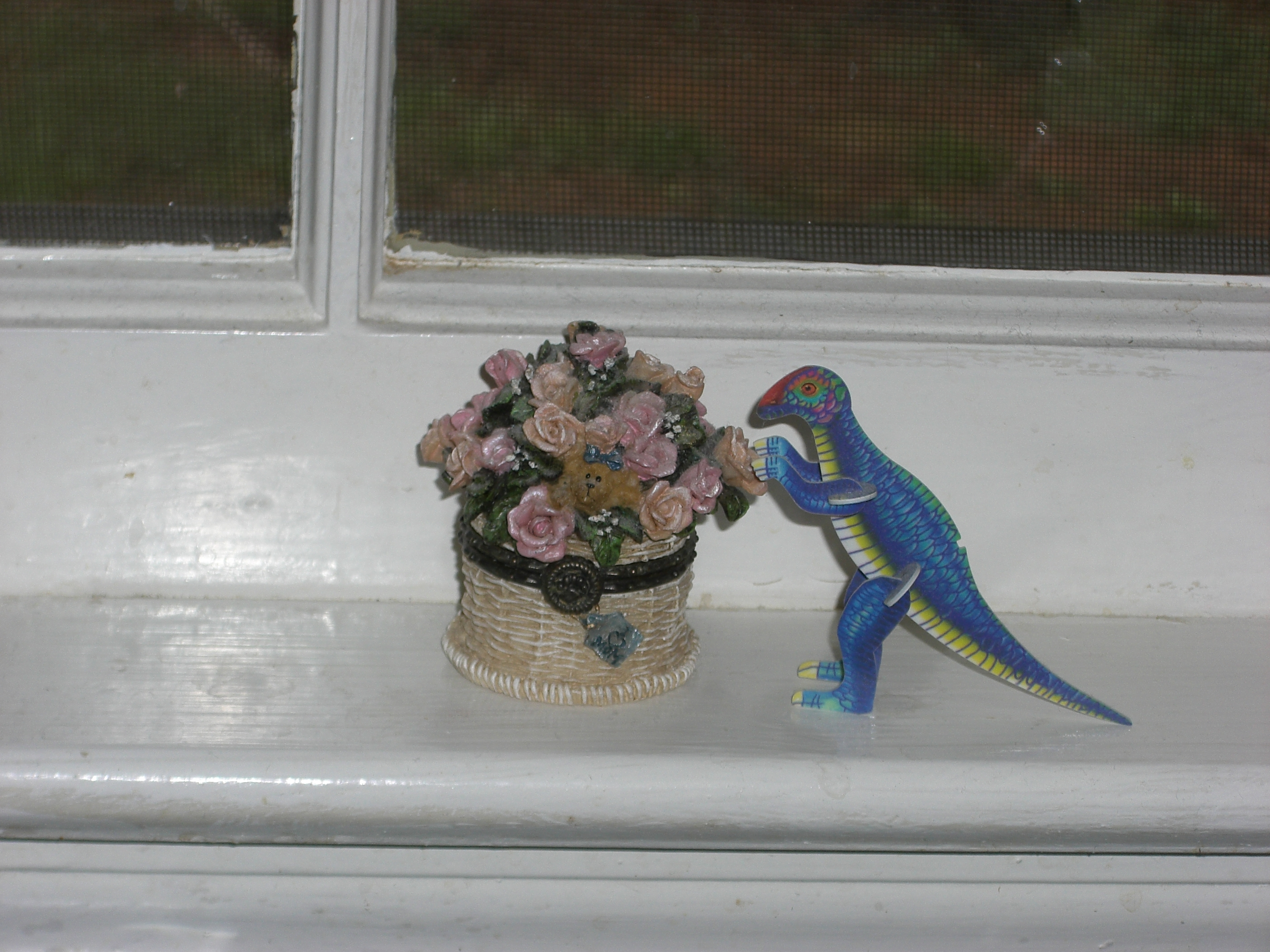
This one has a story behind it:
CIMG0034

I collected Boyd’s Bears figurines for a while, and this is a small figurine of a flower basket with a teeny little bear hiding in it. I kept it on the windowsill above the kitchen sink for a while. One day I found this little dinosaur next to it, put there by one of the boys when they were younger. I don’t know if the dinosaur was supposed to be after the flowers or the bear. 🙂 Or maybe the boys were just adding to the decorations. But I’ve always loved this as a picture of living with boys, and now I keep these together in a little curio cabinet.

Of course, living with boys, sometimes the “decorating” gets a little out of hand…

Life with boys

I mentioned Boyd’s Bear figurines – I posted some of my collection here. I just love their little faces and the details of them. There is only room for so many, though, before they become just a blur of too many to keep track of, but I tried to get my collection to reflect my interests – there is one holding the music to an Irish folks song, one reading a book, a couple cooking, several “Mom” and “couple” ones. Most were given to me by my husband or Mom.

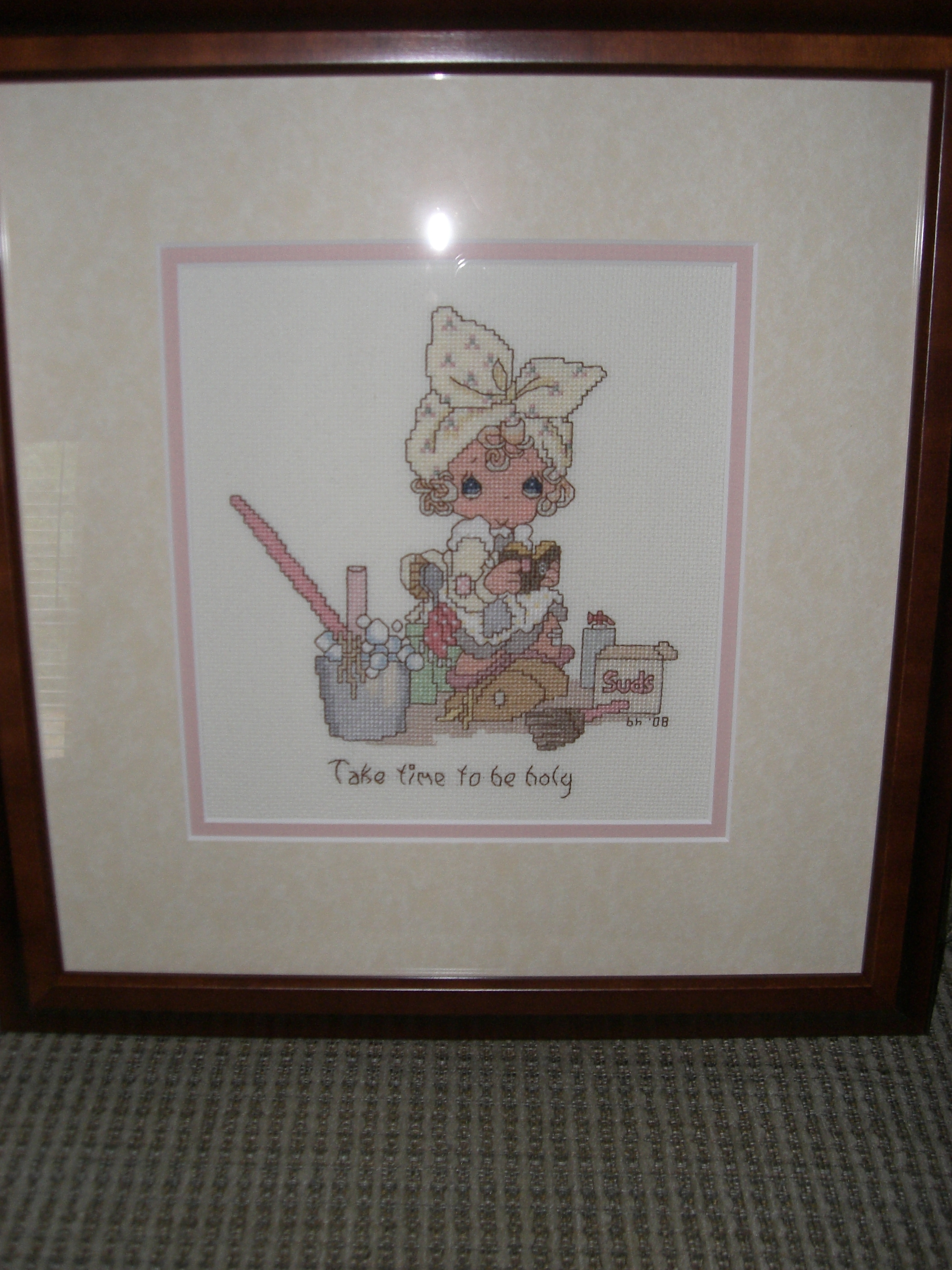
Another of my favorites is a needlepoint piece I did when expecting my first son. My youngest still had it up in his room until his twelfth birthday, when we took it down so he wouldn’t get teased about it. That was kind of sad – an official turning from little boyhood.

Needlework bears

You can’t really tell from the picture, but there are different types of stitching in different places and the little cookies are raised rather than flat.

CIMG0557

This is one I am hanging on to. I don’t know if I will hand it off to a grandchild (if any of their parents want it) or keep it for a playroom here.

A few years ago I realized that I had done a lot of cross stitch through the years that I had given away for gifts, but didn’t have much that I had done for my own home. I wanted to do a few pieces both to express my own personality and maybe to hand down to progeny. Of course, my tastes are more feminine, as I said, and having all boys, I don’t know if they’d be interested in any of these just because their mom made them, and daughters-in-law will have their own tastes. I hope when I am gone that they will keep some things like this for grandchildren – I often wish I had something personal from my grandparents. But at any rate, these are a couple of my favorites:
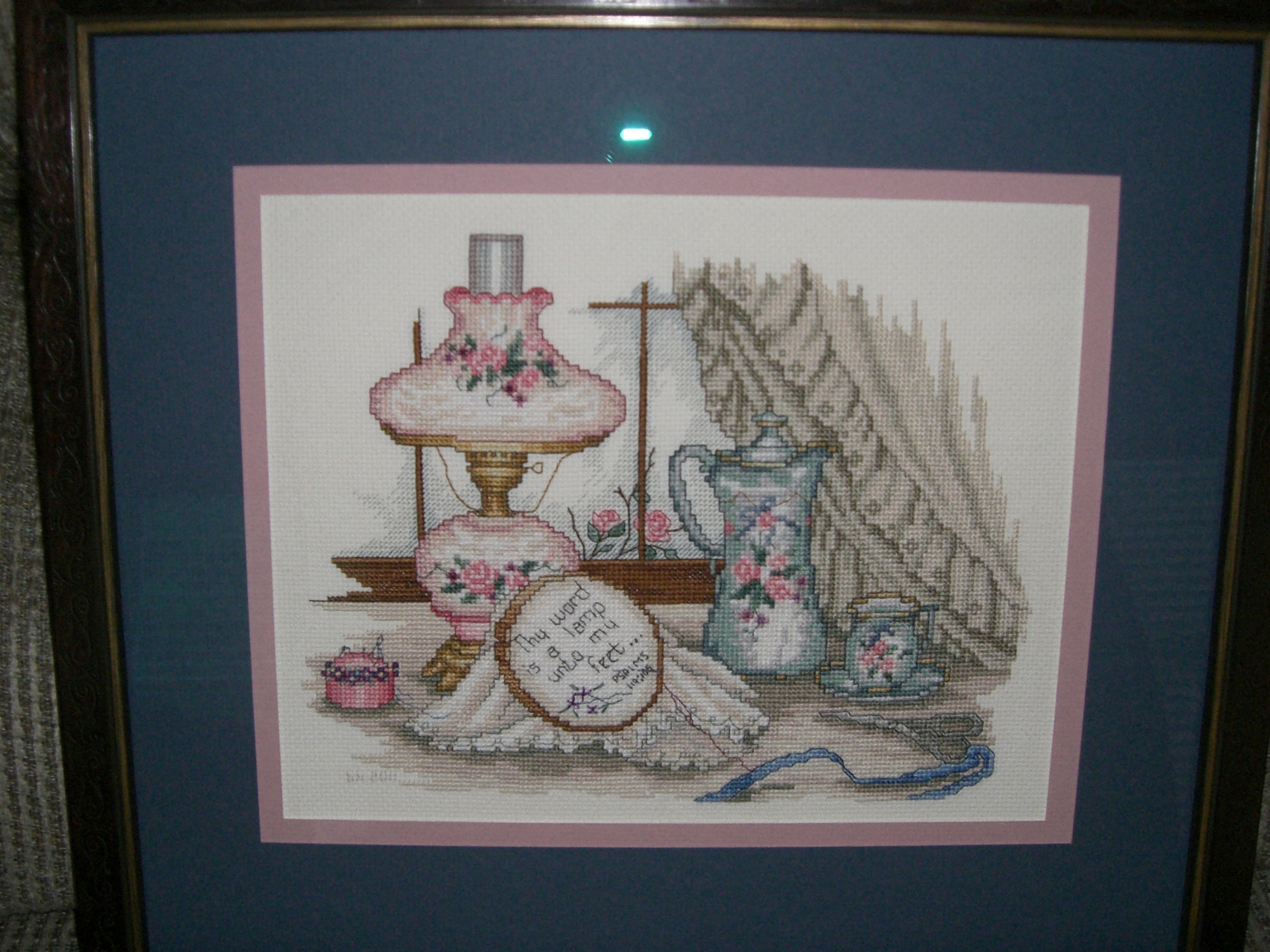
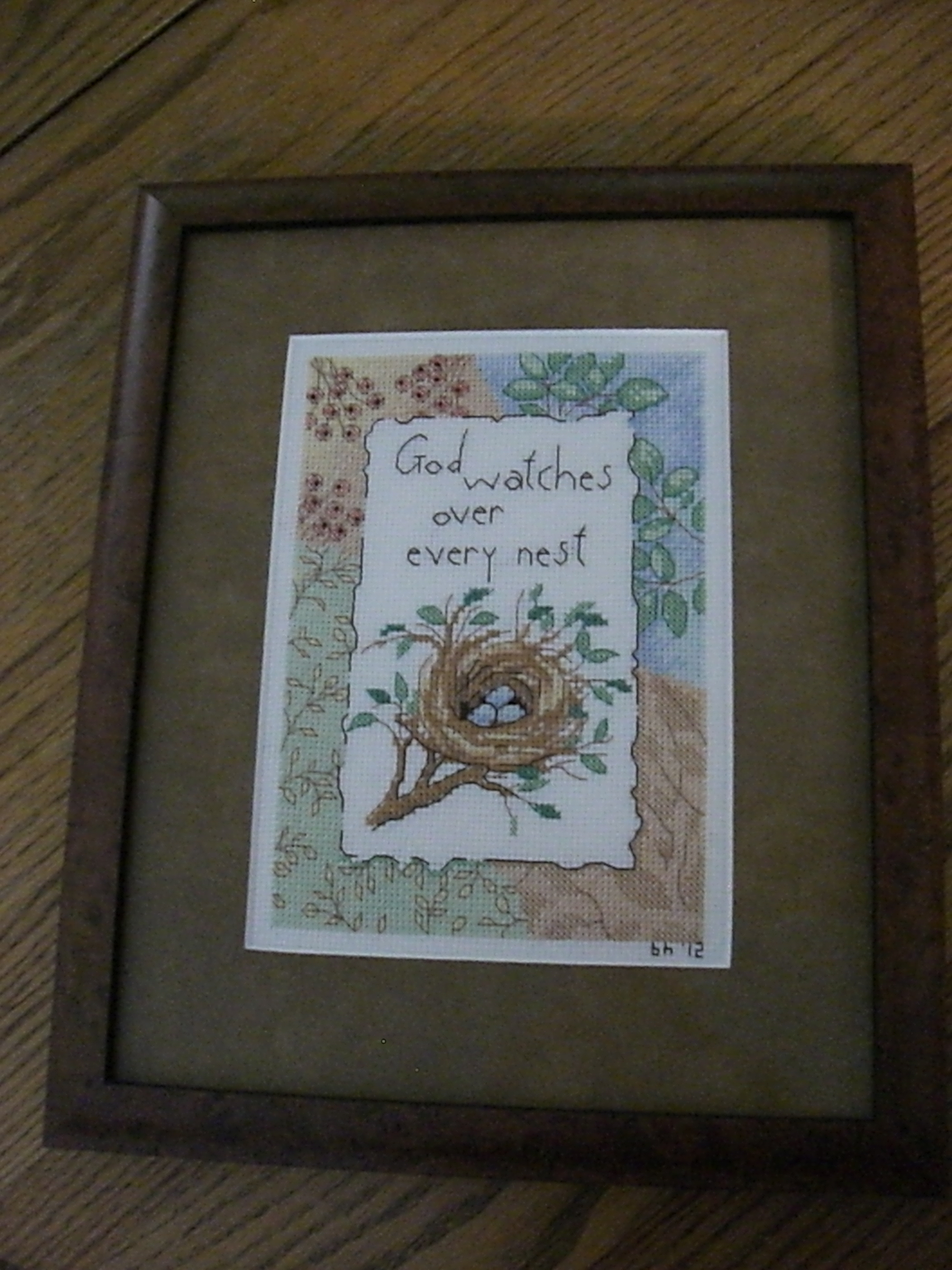
Our only investment in “real art” was a set of prints by Paula Vaughan, a gift to me from my husband, who knew how much I liked them. But I have also framed cards and pages from calendars.

I did have one class in Home Furnishings in college, where we learned a bit about elements of art and principles of design, but I am far, far from expert in it. I never did get to go on and take the next class, Interior Decorating, which I would have loved, I think. Sometimes I watch decorating shows and “get” what the designers are saying, sometimes I have no idea. 🙂 I don’t always agree with what they do, but I sometimes enjoy listening to their reasons. But though some of these principles and elements are helpful (i.e., wondering why something looks “wrong” with the end table next to the couch and then realizing that it’s because the lamp there is way too small in proportion to the rest of the furniture), overall what’s most important is what Edith stresses: making a place homey, comfortable, and an expression of your own creativity and personality.

More discussion on this chapter is here.

This post will be also linked to Women Living Well.

The Hidden Art of Homemaking, Chapter 4: Painting, Sketching, and Sculpturing

It’s Week 4 of  The Hidden Art of Homemaking Book Club hosted by Cindy at Ordo Amoris where we’re discussing Edith Schaeffer’s book, The Hidden Art of Homemaking a chapter at a time.

In Chapter 4 Edith discusses how to incorporate “Painting, Sketching, and Sculpturing” into everyday life as an expression of creativity and encourages us that we can do so without having formal training or making a career of it. It can be used, just like the other categories of creativity that she’s discussed, to enrich our lives and stimulate our imaginations.

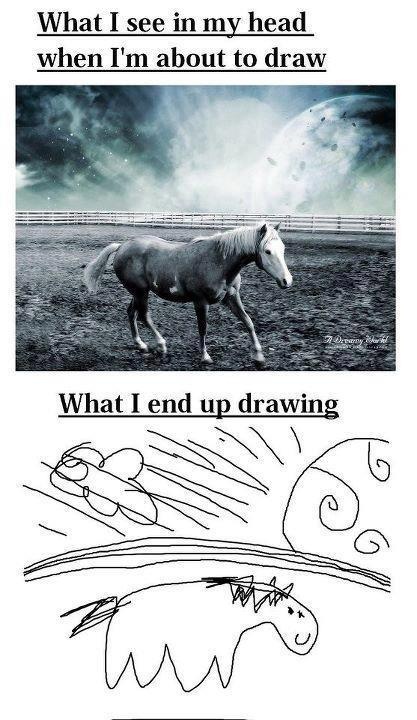
This chapter was a little harder for me because I have absolutely no talent in this area. In fact, a photo I saw on Pinterest pictures this perfectly:

drawing

I don’t even do stick figures very well, though they were useful at times when I had a little one on my lap that I was trying to entertain and keep relatively still and quiet, in church or a doctor’s waiting room. I’d draw something and ask them what it was, and they’d recognize my fledgling attempts to portray a duck or a car (I had to laugh when the Cube first came out because they looked just like the cars I used to draw.)

I don’t even remember doodling much in high school or college. In Junior High a new classmate said something about having had art in her previous school, and I was incredulous and envious. I don’t remember having any kind of artistic instruction in school (until a college Art Appreciation class), and no one in my family, as far as I knew, had any artistic tendencies. Somehow my middle son developed a talent for drawing quite well in his later high school and college years, mostly teaching himself with various art books, except for a year or when he was under the instruction of a gifted art teacher who helped him refine his talents.

I went through a “paint by number” phase in elementary school. I did enjoy a little bit of painting when a talented lady in one church we were in hosted a night to teach other ladies how to paint a flower on a tote bag. She used the same pattern with everyone to make easier to teach en masse but had different paints so we could each choose our own colors. It was exciting to me to learn to use light and shade to make a flat blob of a flower appear more realistic. I took a couple of One Stroke painting classes at Michael’s and loved them, but just never went any further with it.

But though I can’t draw well, I can use aids. I went through periods of using stamps or stencils or even stickers to make cards or decorate various things. I like to buy decorative Post-it notes or notepads rather than plain ones. I disagree with Edith when she says “Original ideas carried out can be an expression of love and care which cannot be made by buying something  ‘ready made’ or plastic” (p. 50). I think that kind of thinking can be burdensome and guilt-inducing, to feel personally or to make our loved ones feel that a gift that’s store-bought doesn’t “measure up” to something hand-made.

She didn’t discuss art appreciation in this chapter, but she has discussed in other chapters that we can come to appreciate forms of creativity that we may have no talent in ourselves.  I did mention an Art Appreciation class in college: I enjoyed it, but didn’t retain much from it, perhaps because one can’t go over the material as readily as one can music from Music Appreciation.

Unfortunately we did not go to museums much as the children were growing up, so I’m afraid I’ve perpetuated my ignorance in this area. I found one neat book about identifying art and artists that I wanted to use some time with them, but we never got around to it. These days, however, there is so much information available on the Internet that one can learn something of classic art if one wants to. I did discover over the years that I seem to like realistic more that abstract art, like that of Normal Rockwell and some of the old masters, though I liked some of the Impressionists, too, like Mary Cassatt. I find that I do enjoy art more by learning about it: the last time we were at a museum, as we were leaving I saw there were headphones one could use for a self-guided tour, and I thought that would be the way to really get the most out of it (for me).

But besides learning about great paintings and painters, one can develop an eye for artistry, for appreciation of color and design. I think for me that happened mostly through a Home Interiors class (thankfully interior decorating is the next chapter!) and then grew through various craft classes and helped as I started doing a newsletter for our church ladies’ group in terms of layout, making a cover page that is reasonably attractive, etc. Someone who really knew what they were doing in that area could probably point out many ways in which I could improve, and that’s fine – we all can grow, no matter what our level of knowledge or talent. But I am thankful for the ways I have grown so far.

I liked her idea of using drawing, even simple stick figures, to not only help keep a child’s interest during a sermon but also to help them grasp what was being taught. A former pastor used to say that it helped him in his Bible study to draw things out as he read.

My favorite line in this chapter, which really could be applied to the whole book, is “Ideas carried out stimulate more ideas” (p 49). I tend to gather a lot of ideas and my imagination can be stimulated by perusing Pinterest or web sites or books, but even that doesn’t compare to actually carrying out those ideas. Whatever area of creativity we’re discussing, just starting in some way or another stimulates more ideas, more creativity.

You can find more discussions on this chapter here.

Previous chapters discussed:
Chapter 1: The First Artist.
Chapter 2: What Is Hidden Art?
Chapter 3: Music.

Book Review: Betrayal

BetrayalBetrayal by Robin Lee Hatcher is the second in her Where the Heart Lives series about three orphans who were separated and try to find each other as adults. Each book focuses on one of the siblings: the first book in the series, Belonging, reviewed here, featured older sister Felicia.

In Betrayal older brother Hugh Brennan has just been released from prison where he had served as a result of his father’s betrayal. He has heard that Felicia is in Idaho and sets out to find her, but then his horse is injured and he has to stop for a while. He comes across the ranch of Julia Grace who, though wary, offers him food, a place to stay, and a few days work while his horse heals. Hugh, of course keeps his background as private as possible.

Julia has secrets of her own. She was plunged into a marriage of convenience to escape a lifetime of shame, but her husband abused and belittled her. He has passed away, and her one security is the ranch he left her, which she steadfastly refuses to sell to her husband’s brother.

Can these two wounded souls ever come to trust each other with their futures as well as the  secrets of their pasts?

I enjoyed the story and the journey Robin led Hugh and Julia through and the things they learned along the way about trust and true security.

(This will also be linked to Semicolon‘s Saturday Review of Books.)

The Hidden Art of Homemaking Book Club, Chapter 3: Music

It’s Week 3 of  The Hidden Art of Homemaking Book Club hosted by Cindy at Ordo Amoris where we’re discussing Edith Schaeffer’s book, The Hidden Art of Homemaking, a chapter at a time.

In Chapter 1, “The First Artist” (linked to my thoughts) Edith makes the case that because God as Creator is artistic, making the world not just functional but beautiful, and we’re created in His image, it follows that we’re created to be creative and to appreciate the artful and beautiful. In Chapter 2, “What Is Hidden Art?” (also linked to my thoughts), she goes on to explain that she is talking primarily about everyday endeavors, not necessarily pursuing the Arts as a profession (though some are called to that), and encourages us that though we’re finite and limited, though being creative requires some discipline and prioritizing, there are ways we can pursue it. The next several chapters are going to delve into some specific areas where we can learn to appreciate and perhaps even incorporate beauty and creativity. Chapter 3 discusses music in particular.

Experiencing music together as a family or with friends gives an outlet for expression, for relaxation, for “creative ideas and imagination [to be] sparked off” in each other, for enjoyment, and for personal development. She encourages letting children start off with their natural inclination to explore sound and rhythm (I can remember mine banging pans and such as toddlers).

She spends only the last few paragraphs talking about musical expression in the Bible, but that would be a very rich study to pursue further. We have the Psalms with their variety of emotions expressed in song, we have the encouragement to “make a joyful noise” unto the Lord, the instruction to teach and admonish one another with psalms and hymns and spiritual songs. God tells Job about when the morning stars sang together and is Himself called a song: “Behold, God is my salvation; I will trust, and not be afraid: for the Lord Jehovah is my strength and my song; he also is become my salvation” (Isaiah 12:2).

To my regret, I don’t know how to play a musical instrument, but I do enjoy singing around the house, in the car, etc. I can’t say I know a lot about music, but I have always enjoyed it, and one of my favorite classes in college was Music Appreciation. I did not grow up with classical music but developed a love for it in college. I’m not much into pop music – the closest I get to it is some of Josh Groban, Michael Buble, Il Divo, etc. I love “the standards” – “I’ll Be Seeing You,” “The Way You Look Tonight,” etc. I also grew to enjoy folk songs – American, Irish, Scottish, English – a lot of songs from musicals, and a rich variety of hymns. Music, even secular music, touches the soul in a particular way that nothing else does.

I remember having a little toy drum and piano when my kids were toddlers, and if I remember correctly, our library had a regular time for preschoolers that involved musical instruments. Of course I sang to them from their infancy, we sang a variety of songs together, and they grew up hearing music at home. They all went to sleep listening to Patch the Pirate and other musical tapes. We didn’t start any formal lessons until they were 8: that was the age recommended to me by a friend who is the mom of a very musical family, and coincidentally, the age their school began piano lessons. I wanted them to take piano because it would give them a good foundation for singing, for choir, and for any other instrument they wanted to take, plus it’s a good discipline and use of time. I don’t know if any of them liked it. They were excited to begin, not so excited about practicing. They would have liked it a lot better if they hadn’t had to play in front of people at recitals. Only one taught himself a variety of other instruments (guitar, penny whistle, ocarina). But they do all enjoy listening to music. They all sang in school choirs, one sang in the church choir for a while, and one sang with an ensemble at school.

Edith mentioned at some point in the first couple of chapters that even if we don’t have talent or skill in a given area of art or creativity, we can learn to appreciate it, to see the beauty in it. I had not originally planned to do this when I first started this post, but this morning I was thinking that it might be helpful to some to share a little bit about listening to classical music from an amateur. I mentioned earlier that I didn’t have much exposure to classical music until college. I grew up with “You’re Cheatin’ Heart” and other such lovely little ditties. 🙄 I can remember going to hear an orchestra with my Girl Scout troop and being fascinated, hearing a high school concert of Handel’s Messiah, and a few other exposures, and then when I got to college, I not only heard more classical music from some of the programs we were required to attend, but I had a Music Major roommate who got me started with some basic classical records. Then my senior year I was required to take Music Appreciation and loved it. But the first time or two I heard a whole concert, I was lost. I found a couple of parts that particularly appealed to me, but afterward I couldn’t have told you what they were. Listening more and learning more about classical music helped immensely. I don’t know a whole lot, but here are a few pointers for enjoying classical music:

1. Listen for the theme, a few notes put together in a specific pattern that repeats. This is easiest to do at first with something that is a variation on the same theme, like the second movement from Hayden’s Symphony No. 94, the Surprise Symphony (so called because it has some unexpected loud parts designed to wake up those who were dozing :)) or Ravel’s Bolero or the first movement of Beethoven’s Fifth Symphony. The composer takes the same series of notes and repeats them with different variations: different instruments, different themes, different harmonies, different tempos and rhythms, etc. It’s similar to your music leader at church saying, “Everyone sing harmonies on the first stanza of this hymn, men sing the second stanza, ladies the third, then we’ll all join in unison on the fourth without the instruments.”

2. Listen for how the themes work together. This is easiest to do if the themes mean something to you, like in Tchaikovsky’s Romeo and Juliet Overture: the first part is here, the second part is here – I guess maybe it was too big for one YouTube video. It begins with what some people would consider high church or holy-sounding music, representing the friar, then goes into the the fight theme, representing the discord between the two families (the music picks up, clashes, you can imagine sword thrusts back and forth), then goes into the love theme (which you’ve probably heard at some point),  – and then all these themes start interacting, playing over and above each other as the young lovers try to connect amidst the fighting, the friar tries to help out, etc. Even if you can’t follow it line by line, you can get the overall feel of it. One of my favorite examples is The Moldau by Smetana, representing one of the rivers in his native Czechoslovakia. It begins with two streams that merge into a river, then the river flows alongside a country wedding, through mermaids, rapids, etc. It wasn’t until the Romantic Era that music was made to represent nature or literary themes on a large scale: before that it was mostly “absolute music” the same interplay of themes, but just as themes and not meant to represent something in life. Still nice, but a bit harder to pick out sometimes.

Two good piece for children are Peter and the Wolf and Carnival of the Animals (especially the latter with Odgen Nash’s poems in-between.

3. Listen for the progression. Like a good story, most classical pieces have a beginning, build to a climax, and then resolve.

4. Read up just a bit on the different kinds of compositions. A symphony, for instance, has 2 or 3 “movements,” and each one usually following certain parameters (the second is usually slower, for instance) and each with its own themes. It helps you not to feel so lost if you know a little bit about how it is put together and what to expect.

5. Learn a bit about the piece. Knowing that Dvorak’s New World Symphony was written when he felt America didn’t have a”national sound,” and that he invoked a lot of Native American and African-American-sounding themes in it, helps you get more out of it. The song “Going Home” is from the second movement.

6. Learn about the composer. A friend did this once: chose a composer and read about him while listening to various works of his to get the flavor of them. Knowing that Hayden’s situation and personality were both different from Beethoven’s, for instance, helps to account for some of the differences in their music.

You can see why Easy Listening music is called that. 🙂 It’s not that classical music is hard, necessarily, but you do get more out of it if you put a little more into it. And then just like any other song or story, once you’re familiar with a piece, you enjoy it, anticipate your favorite parts of it, etc.

I wish I had listened to more classical music with my kids. I had planned to have some sessions with one of these pieces playing in the background while we did other things, but I either never thought about it when we could have done it, or it never worked out as they got older and busier.

I mentioned my thirteen favorite classical music pieces here and some favorite CDs here (though I’d have several to add to that list now). Here are some of my favorite selections from different genres:


The Hidden Art of Homemaking Book Club: Chapter 2: “What Is Hidden Art?”

Photo Sharing and Video Hosting at Photobucket

It’s Week 2 of  The Hidden Art of Homemaking Book Club hosted by Cindy at Ordo Amoris where we’re discussing Edith Schaeffer’s book, The Hidden Art of Homemaking, a chapter at a time.

Chapter 2 is “What Is Hidden Art?” Edith defines it as art found in the “minor” or “everyday” areas of life rather than art as one’s occupation or profession. Because we have different gifts and interests, the “hidden art” in each of our lives might look a little different. Because we have multiple demands on our time, no one can do it all. But incorporating some degree of artistry and creativity will require some discipline and prioritizing:

“All art involves conscious discipline. If one is going to paint, do sculpture, design a building or write a book, it will involve discipline in time and energy — or there would never be any production at all to be seen, felt or enjoyed by ourselves or others. To develop ‘Hidden Art’ will also, of course, take time and energy – and the balance of the use of time is a constant individual problem for all of us: what to do, and what to leave undone. One is always having to neglect one thing in order to give precedence to something else. The question is one of priorities” (p. 32).

But the discipline and prioritizing are worth it.

“It is true that all men are created in the image of God, but Christians are supposed to be conscious of that fact, and being conscious of it should recognize the importance of living artistically, aesthetically, and creatively, as creative creatures of the Creator. If we have been created in the image of an Artist, then we should look for expressions of artistry, and be sensitive to beauty, responsive to what has been created for us” (p. 32).

That doesn’t mean we can or should “drop everything to concentrate on trying to develop into great artists” (p. 32), nor does it necessarily mean we need to take courses in Art, which can sometimes discourage, making us feel “‘outside’ the magic circle of the talented” (p. 33). But we begin to develop an eye for seeing the artistic and then incorporating it in everyday ways.

I loved this chapter on many levels. I liked the encouragement to seek the beauty in everyday life as well as the acknowledgement that we’re limited in what we can do, and that’s ok.

In the “middle age” of life I’m in now, those limitations actually help provide focus. For instance, I’d love to learn how to play an instrument. I know I could take lessons even now in my mid-50s (I know an 84-year-old who takes lessons!) But I’ve sometimes said I have enough things I want to do to keep me occupied til I’m over 100. The time it would take to practice and learn an instrument well enough to begin to enjoy it is time I’d rather spend in other pursuits right now (though sometimes I’m still tempted!)

But though lessons of some kind can be beneficial and enjoyable, the focus of this book is more on little touches and everyday ways to incorporate creativity. I’m looking forward to the next chapters!

There is a Hidden Art of Homemaking Pinterest Board where members have been posting some of the everyday beauty in their lives, mostly outdoors shots so far. Here are some from around the house (some current, some past):

 photo CIMG5810.jpg

CIMG1857

CIMG1855

CIMG0112-1

You can find others’ thoughts on Chapter 2 here. Normally the link-up post is on Tuesdays. My Tuesday this week was taken up with hubby’s surgery for a detached retina, but I hope to be posting these chapters on or before Tuesdays from here on out.

Book Review: Comforts From Romans

ComfortsComforts From Romans: Celebrating the Gospel One Day at a Time by Elyse Fitzpatrick wasn’t originally on my radar, but I saw that the True Woman site would be going through Romans 1-8 in the four weeks preceding Easter, using this book as a supplement. I had been wanting to do something a little different in my pre-Easter reading, and I had been wanting to read something by Elyse Fitzpatrick, so I ordered the book. In the meantime, I decided to do a different reading plan for Easter, so I saved this book for afterward and caught up with the weekly discussion about it at True Woman (under Romans Reboot).

The book is not a thorough exegesis or commentary of all of Romans 1-8, but rather a “devotional taste” of its truths. Elyse mainly just pulls out those parts of it dealing with “the absolutely shocking message of grace” (p. 13). The gospel isn’t just for the obtaining salvation at the beginning of our Christian lives: we need to hear it and think about it daily. Why? To stir up praise and gratitude to God for it, but also to remind ourselves, because we’re too prone to forgetting that our relationship with God is based on Jesus’ righteousness and not our own even after salvation.

If you’re familiar with Romans at all, you know that the first three chapters start with very bad news: the fact that we are all sinful, that our sin deserves judgment from God, and there is nothing we can do in ourselves to deliver ourselves. Even if we could perfectly obey every command of God from here on out (and we can’t), that won’t erase the sin we’ve committed up to now. It’s hopeless — which is why the gospel is very good news: Jesus kept every law of God in our place, and because He was perfectly righteous and the eternal Son of God, He was the only One who could take our sin and punishment in our place so that we could be saved when we believe in Him. Elyse discusses all of these factors in more detail: our “ruined righteousness,” our inability to keep God’s law, the great grace of God in Jesus Christ, what He accomplished in our salvation, and the implications of grace in our everyday lives. It is very refreshing and encouraging: even having known these truths for decades, it has been good to meditate on them again, to be reminded of the freedom we have in Christ.

One aspect of that freedom that particularly resonated with me was when she discussed receiving an email from a friend about something she had done wrong. Elyse writes that she was able to receive the criticism, acknowledge its truth, confess and apologize for it without negative feelings for the messenger: “Because the gospel tells me that I am more sinful and flawed than I ever dared believe, I am no longer entrapped in trying to prop up my former flawed identity…I can freely admit my failure without needing to cover up, be defensive, or beat myself up…Rather than raking myself over the coals, wondering, How could I be such an idiot and sin like this? I am now free to say, Of course I sinned like this! It’s just God’s grace that I don’t get e-mails like this every day! I am, after all, a very great sinner…but I’ve got a very great Savior” (pp 79-80).

There are a few places I have some quibbles with. One is in an otherwise very good series of chapters about “One Man’s Obedience,” Jesus’s having fulfilled all of God’s law perfectly every single day of His life. How He interacted with His siblings is conjecture, of course, since the Bible doesn’t say much about His childhood, but we can imagine what He must have encountered showing love to His siblings, yet being laughed at, misunderstood, sinned against, and so on. When she gets to His baptism, however, she says, “At that moment He knew without question who He was and why He’d come” (p. 86). I don’t think He doubted it or didn’t know until then: I don’t think His Father’s voice saying, “This is my beloved Son with whom I am well pleased” was meant to reassure Him, but rather to be a testimony to those witnessing it. She goes on to say that “The Spirit, His Spirit, was finally released and flew to Him like a dove, granting Him the power to live and die and rise again.” I don’t think that’s what the Spirit was doing, but what exactly was going on and signified at Christ’s baptism is a discussion for another time, and I do understand good people can differ in their opinions about it.

In another place, she’s discussing the righteousness we have in Christ and the joy we should feel because of it: “Be done now with all your stupid efforts to approve of yourself and to look good…Be revolted by your own goodness and your love of reputation!…Dance a lot. Brag a ton about how righteous He’s made you. Show off your new clothes! Be as free as a drunk to look stupid and hop about for joy. Weep over your sin. Rejoice over His obedience…All those lessons about how to keep your religion dignified and presentable will be completely blasted away in the raucous party that will be known as ‘heaven'” (p. 100). I get that when we really grasp that we have the righteousness of Christ, when we really comprehend that as much as we’re able, we’ll be exceedingly joyful, but I don’t see anything in the glimpses of heaven the Bible shows us that compare it to a raucous party. Yes, the angels in heaven rejoice over one sinner who repents (Luke 15:7), but I don’t see that rejoicing as “raucous.” Not a big deal or a big quibble — we’ll see when we get there what it’s like. 🙂 I also cringe a little bit at “hopping around like a drunk.” I grew up in the home of an alcoholic: I have seen happy drunks (and other kinds as well), and to me it’s incongruous to think of rejoicing in Christ’s righteousness looking like that. Yes, I do know the Bible says “be not drunk with wine, wherein is excess; but be filled with the Spirit” (Ephesians 5:18) as a comparison of being under the control of something else, and that may be the kind of allusion Elyse means here, or she probably was just getting at the idea of rejoicing with abandon. It just kind of rubbed me the wrong way because of my background, but again, it’s a small quibble, taking more time to explain that it is probably worth.

Another quibble is the interchangeable use of “law” and “rules.” The verses in the Bible about “the law” are referring to the commandments given to Israel in the first five books of the Bible. Much of Romans deals with the fact that we’re no longer under that law, but that doesn’t mean we’re no longer under any “rules,” that rules are evil, etc. The New Testament is full of commandments. I delved into that more here. We don’t keep rules, or even commandments, in order to be saved, because salvation is by grace through faith. We don’t keep them to be “made” or “kept” righteous even after salvation: our walk, our growth, is by faith, not by our own works. But we don’t ditch the NT commands to love our neighbors as ourselves, etc., either: we seek His grace, His power, is strength, His love, to enable us. Commandments and laws can’t produce righteousness, but they show us what it looks like so we can see where we fall short and how much we need help.

The one area I had a big problem with, though, is when discussing Romans 6:12-14, she says, ” My guess is that you’re feeling a little nervous right now and that you’re tempted to ask the same question that Paul does in the next verse: ‘Yes. yes, but, but…are we to sin because we are not under law, but under grace?’ to which I respond, ‘You can if you want to. But God forbid that you would want to in light of all He has done'” (p. 112). She then says very much the same thing at the beginning of the next chapter. I do see the “God forbid” in Scripture, but I don’t see the “you can sin if you want to.” That totally threw me.

I wish she had talked a little bit more about sanctification in the book. She does somewhat. She discusses that we “serve in newness of spirit, and not in the oldness of the letter” (Romans 7:6), that we’re motivated to live for Christ not by heaping on more rules, but out of gratitude for what He has done, that we’re dead to sin, etc. I really would loved to have seen a discussion of Romans 8:13 about mortifying the deeds of the body through the Spirit. I’ve mentioned before that there are action verbs in the New Testament that indicate effort on our part, though it is not an effort to earn righteousness but rather effort springing from His righteousness in us. But I still wrestle with all of that, with what’s my part and what’s His part.

Probably one of the most helpful statements in the book, which ties together much that I’ve mused on here, is this, in a discussion of what it means to have died to sin: “This happened through our union with Christ in His death, burial, and resurrection as is demonstrated at our baptism. Paul doesn’t give us new, more stringent rules to live by. No, he tells us who we are. It is the realization of our new identity that will ultimately and at heart level transform us” (p. 102).

(This will also be linked to Semicolon‘s Saturday Review of Books.)

The Hidden Art of Homemaking Book Club

HomemakingI saw at Sherry‘s the other day that Cindy at Ordo Amoris is hosting a read-along book club for the next twelve weeks or so to read Edith Schaeffer’s book, The Hidden Art of Homemaking. I had read this book some time in my early married years, and it had a great impact on me. I had been wanting to revisit it, and this provided the perfect impetus: it will be inspiring and enjoyable to compare thoughts with others while we work through the book. The idea is to discuss a chapter a week and then link up at Cindy’s to compare notes.

Sadly, I could not find my copy of the book! But I did find it online here, and that will tide me over until I can find mine or obtain a new copy.

As a young woman, I wrestled with the idea of wanting my home and even my dress to be attractive. Would we be more effective Christians if we spent less time on mundane, earthly things that will pass away and lived like John the Baptist? Edith’s book helped me greatly in that regard. In the first chapter, “The First Artist,” she goes into great detail observing God’s creativity and artistry in creation. When He created the world, He called it good. And even though it has been marred by sin, still “The heavens are telling of the glory of God; And their expanse is declaring the work of His hands.” (Psalm 19:1). God could have made the world just functional, but He also made it beautiful, not only for our enjoyment, but also that we might see something of Him in His handiwork.

She also discusses the ways in which we’re created in His image, and a part of that image which will reflect Him is in the area of creativity and artistry. We’re limited by the fact that we’re finite and inherently sinful, whereas He is not, but still, we can reflect Him in these areas. In later chapters she’ll acknowledge that we have other priorities and limits on our time and finances, but she’ll discuss simple ways of incorporating art and beauty into the everyday, such as this incident when a tramp came to the door, and instead of handing a sandwich out through a barely-opened screen, she made up a nice tray complete with flowers. She’s not talking about investing big bucks buying high-end art, though there is nothing wrong with that if one can afford it: rather, she’s discussing having an eye and developing a taste for bringing beauty and artistry into even the mundane, to bring enjoyment to others and to reflect His beauty.

We’re also supposed to introduce ourselves with this first post. My name is Barbara. I became a Christian as a teenager. I’ve been married for 33 years and have three boys, one of whom is married, and only the youngest is still at home. No grandchildren yet! I’ve been privileged to be a stay-at-home mom ever since my first pregnancy. Maybe because I did not come from a Christian home, or maybe because God just wired me that way, I’ve had a heart for creating a truly Christian home since before I was married (I even listed homemaking as one of the themes of my life.) I think every woman is a homemaker, because every woman lives in a home, and her home will reflect her personality to some degree, whether she’s single, married, with children or without, and even at this stage in life when the nest is almost empty. My husband has often said that if he lived alone, there probably would be nothing on the walls, and he doesn’t always understand exactly why I have certain things there, but he likes the hominess of it. One of my most treasured comments on my blog was from him on this topic.

Besides homemaking, I enjoy reading, some crafts (mainly stitching and paper crafts), and writing.

Those discussing the first chapter are linking up here this week. I hope you can join in! Even if you can’t read the books right now, I’d love to hear your thoughts on creativity and artistry in homemaking.

What’s On Your Nightstand: April 2013

What's On Your NightstandThe folks at 5 Minutes For Books host What’s On Your Nightstand? the fourth Tuesday of each month in which we can share about the books we have been reading and/or plan to read.

April has been a lovely spring month. Though I’ve been energized to get some projects done, I did get some good reading in as well.

Since last time I have finished:

The Picture of Dorian Gray by Oscar Wilde, both audiobook and Kindle, reviewed here. Not a pleasant book, but an intriguing one. Reviewed here.

The Victory Club by Robin Lee Hatcher about four friends on the homefront in WWII, reviewed here.

Joni and Ken: An Untold Love Story by Ken and Joni Eareckson Tada with Larry Libby. I think this will be one of my top ten books of the year. I appreciate their pulling back the curtain a bit to share not only the love story but the trials and tribulations and persevering “to attain a new level of love rather than simply surviving or grimly hanging on.” Reviewed here.

In This Mountain by Jan Karon (audiobook). Father Tim deals with retirement and wondering what his life has been worth while his wife’s fame as an author goes to new heights. Though it’s a bit darker than the other Mitford books, I very much enjoyed it.

Sense and Sensibility and Northanger Abbey by Jane Austen via audiobook. It has been fun revisiting them. I had reviewed the books earlier here and here, and I enjoyed them much more this time around. I caught much more of Austen’s wit, satire, and irony in each.  I have a feeling that if one were in the same room with Austen at a social occasion, much would be shared in knowing looks and smiles rather than tittered.

The Guardian by Beverly Lewis, third in her new Home to Hickory Hollow series, reviewed here.

I’m currently reading:

Introverts in the Church: Finding Our Place in an Extroverted Culture by Adam S. McHugh. Not enjoying is as much as I thought I would, having a few quibbles with one chapter in particular, but hope to finish and discuss it soon.

Comforts From Romans: Celebrating the Gospel One Day at a Time by Elyse Fitzpatrick.

Up next:

Island of the Blue Dolphins, by Scott O’Dell, selected by Amy at Hope is the Word for Carrie’s Reading to Know Book Club for May, which is covering both adult and children’s classics this year. I’ve never read this, so am looking forward to it.

Betrayal by Robin Lee Hatcher, second in the Where the Heart Lives series.

The Freedom of Self-Forgetfulness by Tim Keller.

His Ways, Your Walk, focusing on Bible passages written specifically to women, newly published by my friend Lou Ann Keiser.

The Hidden Art of Homemaking by Edith Schaeffer along with Cindy at Ordo Amoris who is hosting a read-along book club.

Audiobooks: Pride and Prejudice by Jane Austen and Shepherds Abiding by Jan Karon.

What’s on your nightstand?

Book Review: The Guardian

OLYMPUS DIGITAL CAMERAThe Guardian, by Beverly Lewis, is the third in her new Home to Hickory Hollow series.

Jodi Winfield has come to Lancaster to house-sit for her cousin and his wife while they’re on vacation. While out jogging she comes across a little girl asleep on the side of the road. She searches for missing child alerts, but finds none, and tries to reach her cousin, who is also a policeman. The little girl only speaks German, so she can’t communicate with Jodi about where she is from or how she got there.

Jodi’s search leads her to the Amish community of Hickory Hollow, which has been praying and searching constantly for the little girl. Though normally wary of outsiders, or Englishers, they can’t help but be grateful for this one’s part in returning the little girl safely home. The girl’s mother, Maryanna, particularly befriends Jodi, and they find they have much in common in terms of love and loss, and ultimately much to teach each other.

I did have a quibble with Maryanna seeming to equate the “right” of Psalm 94:15 with “dressing Plain and leading a simple, quiet life,” but understood that the Amish might interpret it that way.

Though this is part of the Hickory Hollow series, it is easily read as a stand-alone book. I was hoping the story would NOT lead to a “join the Amish and all your problems will be taken care of” ending, and I was not disappointed. 🙂 I love the coziness of Beverly’s books, even when dealing with the depth of problems her characters face.

(This will also be linked to Semicolon‘s Saturday Review of Books.)

Book Review: Joni and Ken: An Untold Love Story

Joni and KenAt 36, Joni Eareckson felt that marriage was probably not in God’s plan for her, not only because of her age, but because of her paralysis resulting from a diving accident in her teens. Who would be willing to take on all that would be involved?

After Ken and Joni met at church, then got to know one another, then started dating, Ken felt he could. He knew he loved her and he felt their marriage could work.

Joni was afraid he idealized her. He had read about her before meeting her, accompanied her on mission trips, heard her speak, and even though she tried to be realistic about herself and her humanness (when the leg bag collecting her urine broke in public while on a tour behind the Iron Curtain, she quipped that that was God’s way of not letting the attention and acclaim go to her head), she was afraid some people thought of her more highly than they ought to.

But after much time together and discussion, they married, And though they loved each other dearly, after some years the relentless details involved in Joni’s care began to wear on Ken. He began to pull away, to need time to himself to get away from it all. Soon their lives were on nearly parallel tracks, rarely intersecting. She had had a ministry and association before he came on the scene, and he felt unneeded in her world: he had his teaching and coaching and fishing trips.

Then unexplained and excruciating pain descended on Joni, not only requiring more care, but causing frustration because nothing seemed to help. And then came a cancer diagnosis…

Marriage has its rough spots anyway, but add all these to the mix, and any of them could break a marriage. In Joni and Ken: An Untold Love Story, with Larry Libby, they want to make clear that what pulled them through was not their own strength, but God’s grace when they came to the end of their own strength. They don’t want to come across as super-saints, but as real people who found God’s grace sufficient in the most trying of times “to attain a new level of love rather than simply surviving or grimly hanging on” (p. 15).

I loved Larry Libby’s preface, talking about fairy tales and sad love songs, then musing:

We all dream dreams and know very well that they don’t always work out. Life is particularly hard on high expectations. Things hardly ever fall together the way we would have scripted them. The fact is, if we put our hope in a certain set of circumstances working out a certain way at certain times, we’re bound to be disappointed, because nothing in this life is certain.

So what’s the solution? To give up on dreams?

No, it is to realize that if we belong to God, there are even bigger dreams for our lives than our own. But in order to walk in those bigger dreams, we may face greater obstacles than we ever imagined and find ourselves compelled to rely on a much more powerful and magnificent God than we ever knew before (p. 15).

I know it’s the style these days to have a book jump back and forth in the time line, but it is somewhat confusing and choppy, and I think would have flowed much better maybe by opening with one incident and then flashing back to the beginning and progressing from there to the current time.

There is one kind of odd spot in the book when Joni had a horrible night suffering from pneumonia and prayed that Jesus would manifest Himself to her in a special way. As Ken ministered to her, suddenly she said.”You’re Jesus!” She went on to say that she could feel His touch through Ken’s, could see Him in Ken’s smile. That I can understand, but manifesting Jesus, being a conduit through which He can work, isn’t the same thing a being Jesus. And I think that’s what she ultimately meant.

I scanned some of the reviews on Amazon and was surprised to find some criticism that the book didn’t contain enough or reveal enough. I thought it was quite gracious of the Tadas to reveal as much as they did in order to show God’s grace and to encourage others: the rest really is none of our business.

Overall I loved the book and would recommend it to anyone.

I linked to this speech of Joni’s before, but it shares a condensed version of some of what is in the book.

(This will also be linked to Semicolon‘s Saturday Review of Books.)