Booking Through Thursday: Bookless

btt2.jpg The question for today from the Booking Through Thursday site is:

It happens even to the best readers from time to time… you close the cover on the book you’re reading and discover, to your horror, that there’s nothing else to read. Either there’s nothing in the house, or nothing you’re in the mood for. Just, nothing that “clicks.” What do you do?? How do you get the reading wheels turning again?

I honestly can’t imagine that ever happening. 🙂 I have a stack of books waiting to be read, a few more on the shelves for “some day,” and several magazines piled up. I also have a list of books to check out compiled from other people’s reading lists that I have seen on the Spring Reading Challenge or on people’s sidebars.

I always have to-be-read non-fiction, which takes me longer to slog through, and there have been times I have no new fiction in the house (I’m usually into a couple of books at the same time, one of them always fiction). Then I might go to the Christian bookstore and just look around and see what looks interesting. I also have some I want to reread, like Jan Karon’s Mitford series, so that’s another possibility.

And…sometimes I just need to give reading a break and do something else. But those breaks don’t usually last long. 🙂

I forgot about the last couple of Booking Through Thursdays — I actually read the questions and planned to think about it and answer later — and then forgot. 😳 They had to do with whether we read in public or not and why, and where would we not read. Sure, I read in public — why not? 🙂 It helps pass the time, especially in places like doctor’s offices, airports and airplanes, etc. Sometimes I’ll read if I am eating by myself in public because I feel awkward sitting there alone — but sometimes it would feel more awkward to open a book in a restaurant. But I usually try to avoid eating out alone.

Choosing not to read in public has more to do with appropriateness or rudeness rather than location: I wouldn’t read a book in church (except the Bible passage while the preacher is reading it. 🙂 ) or at a play or concert or speech where I am supposed to be there to listen to what’s going on. And even in airplanes and doctor’s offices, sometimes it is rude to keep my nose in a book and ignore someone next to em who is trying to strike up a conversation.

One of my favorite people

from_cannibalism_small.jpgSeveral weeks ago at our ladies’ meeting one of my favorite people in all the world spoke to us. Margaret Stringer was a missionary to Indonesia (then known as Irian Jaya, now West Papua) for over 40 years. She’s been “retired” from the field for the last 2-3 years, but she stays more active than a lot of people half her age. When she retired she thought she would never have an opportunity to go back, but she was able to go for several weeks last November and December. She showed some video footage (24 minutes condensed from 5 hours) while she told us what was going on, interspersed with some history here and there of the people.I tell you — seeing footage of former cannibals and headhunters now singing hymns, hearing about the most powerful and feared witch doctor in the area who became a believer and whose son is now the head of the church — that just does something to your heart. The same God who performed miracles in lives in Bible times, who worked through Hudson Taylor and Amy Carmichael and other well-known missionaries in centuries past, is still the same God today and still has the same power to change lives.

Margaret and her co-worker were the last of what was a pretty good-sized mission station, with a doctor and his wife, and I think other missionary couples and three single ladies, if I remember correctly. There are some missionaries who go to work in one church in another country for life, and there are others who go to various places and start works, then “work themselves out of a job” by training the new believers to take over their own church — there’s a place for both types. But Margaret’s village was the latter type. I appreciated the way she endeavored to help them not to be too dependent on her. When they asked her to name the church, for instance, she told them they should name it.

She told us about one man who, during this visit, said something like, “When you left us, I was very sad for a long time. But you told us you were leaving God here, and He helped me. So when you leave this time, I will be sad, but not for as long a time, because God is here with me.” She said that’s not exactly how she put it to him, it it was so neat he got the concept that God was still there and didn’t leave when she did, and he could depend on Him.

I was amazed at her fearlessness. In one piece of footage, she was getting out of a boat to see one of the villages she used to work in, and one man took her hand and began leading her away. Her friend said, “Where are you going?” She said, “I don’t know!” As people came to greet her and hug her, the man would stop for a few minutes, and then take her hand and lead her away again. Finally he led her to his house, where he had prepared lunch for them.

Margaret can tell tales about harrowing, scary experiences that have us all in stitches laughing.

Some years ago before she retired, I asked her if she had ever considered writing a book, and she said yes, she was thinking about it. She’s had such interesting life experiences that she tells in such an engaging way, and the Lord’s hand has been so obviously in her life, I really feel these stories need to be shared.

Her first book is out now, titled From Cannibalism to Christianity. She had several copies with her that night, so I got one for myself plus two to give away to my mother-in-law and one friend who couldn’t come.

This book tells the story of one particular village, from first contact to the establishment of a full-fledged church. There are hilarious moments as well as frightening ones. But what joy there is in seeing the light of understanding dawn after repeated sharing of the gospel. I don’t remember if Margaret said this in the book, but I know I heard her say while speaking to us that there were moments when she thought, “This isn’t going to make sense to them.” Imagine sharing the Word of God with someone who doesn’t know anything about it and doesn’t know who God is. Yet they did share God’s Word by faith, and the Holy Spirit gave understanding and conviction.

Secularists don’t have to worry about the people’s culture being infringed on. The people still have their own traditions and culture. But they also have hope and life. As I said in an earlier post, I don’t know why anyone, even the most unchristian person on the planet, would have any objection to helping people get rid of traditions like cannibalism and killing a twin baby.

I asked Margaret’s cousin (I believe that’s who it was — either a cousin or a sister-in-law) who came with her if Margaret was writing any more books. She said Margaret had some in mind but had a hard time getting still enough to write with all the invitations to speak. I hope she keeps having opportunities to speak, but I hope some time she can find a way to keep writing, too. I would love to read her life story some time.

Show and Tell Friday

show-and-tell.jpg Kelli at There’s No Place Like Home hosts the “Show and Tell Friday,” asking “Do you have a something special to share with us? It could be a trinket from grade school, a piece of jewelry, an antique find. Your show and tell can be old or new. Use your imagination and dig through those old boxes in your closet if you have to! Feel free to share pictures and if there’s a story behind your special something, that’s even better! If you would like to join in, all you have to do is post your “Show and Tell” on your blog, copy the post link, come over here and add it to Mr. Linky.“

Over 25 years ago as a college student I first heard the well-known story of the five missionaries who were killed by the tribe of Indians in Ecuador known then as the Aucas (later it was discovered their name for themselves was the Waodani) with whom they were trying to make contact. I read the book Through Gates of Splendor by Elisabeth Elliot, whose husband, Jim, was one of the five, which tells of these men, how they came to Christ and then to Ecuador, the events leading up to this moment, and the miraculous way the Lord opened the door for Elisabeth , her young daughte Valerie, and Rachel Saint, sister of Nate Saint who was another of the men, to go live with the same Indians who killed their loved ones and to bring them the gospel.

It’s a story that has been impacting lives for years. My life was one of them. To read of the faith and devotion of these men and their wives, the willing sacrifices they made, the way the Lord ministered to them and to the Waodani, and then to read about Waodani becoming brethren in the faith and growing in the Lord — I just don’t think I can convey everything the Lord has done in my own heart as a result.

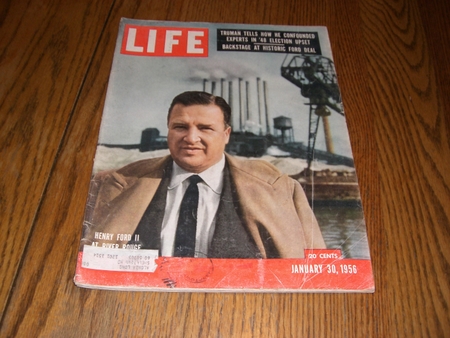
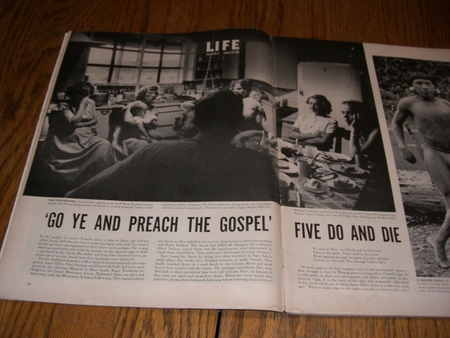
Elisabeth’s book tells of a photographer for Life magazine named Cornell Capa who came out with the first responders to search for the men in the jungles after their deaths and the edition I have includes several of his pictures. It may seem an odd, silly thing, but I have always wished I could get a copy of that edition of Life.

Well, last Christmas I received a copy of it from my oldest son, Jeremy. We each make “Christmas lists” for the others in our family so that we have some idea of what to get for each other, but Jeremy likes to come up with something “just right” for the recipient that is not on the list. He had heard me speak of this and searched the Internet to see if he could find it. He had to buy a whole bundle of other issues that this one was in, but he ordered it and gave me the copy from January 30, 1956, which has a the ten-page story and pictures of this incident.

cimg0662.jpg

cimg0663.jpg

This is a treasure to me not only because it is a piece of history from an event that touched my life in so many ways, but also because of Jeremy’s thoughtfulness in getting it for me.

By the way, if you are interested in reading more about this story, besides Through Gates of Splendor mentioned above, several other books have been writen. Rachel Saint wrote The Dayuma Story, but the only copy of that I found searching the Internet shows Ethel Emily Wallis as the author: I don’t know if this is a republication of Rachel’s book or a completely different book. I read Rachel’s: I haven’t read this one. Another of the widows, Olive Fleming Liefeld, wrote Unfolding Destinies. The most recent one is End of the Spear by Steve Saint, son of Nate Saint. (I reviewed the film by the same name here.) These are just the ones I have read: there may be others I don’t know of. I have read most of Elisabeth Elliot’s other books since then as well.

You can visit Kelli’s place to see more “Show and Tell” stories or share your own.

And the winner is….

The winner of the book give-away for Queen of the Castle: 52 Weeks of Encouragement for the Uninspired, Domestically Challenged or Just Plain Tired Homemaker by Lynn Bowen Walker from my interview with her is…

(Trumpet fanfare…)

Bet!

Interview with Lynn Walker

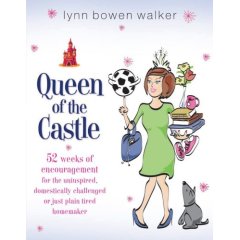
queen2.jpgBack during the Fall Reading Challenge, I saw on a couple of people’s reading lists the book Queen of the Castle: 52 Weeks of Encouragement for the Uninspired, Domestically Challenged or Just Plain Tired Homemaker by Lynn Bowen Walker. That sounded right up my alley! Though I enjoy being a homemaker and have wanted to be one all my life, like every job, there are days when I feel uninspired, challenged, and tired. There are plenty of great tips and ideas even for super-homemakers. I let my family know it was one of the things I would like for Christmas, and I received it and started it in January. I am loving it!

A few weeks ago Lynn e-mailed me and asked if I wanted to be part of her 30 Blogs in 30 Days blog tour. Did I ever! She also sent me a copy of her book to use however I wanted to. I decided to give it to a commenter on today’s post, so, if you are interested, leave a comment on this post and I will draw a name Thursday morning.

I’ve enjoyed communicating with Lynn and asking these questions:

1. You mentioned in the first chapter that you read many books about homemaking but none seemed to meet your needs, so you wrote your own. What was missing from the books you read?

I love reading about homemaking. And many of the books I read were great as far as they went. But most of them focused so narrowly on just one part of being a homemaker, and I needed help in all kinds of areas! I wanted to know not just how to be a great mom, but also how to manage my time when there were so many requests to volunteer, how to get dinner on the table when I wasn’t home in the afternoons to cook it, how to cope with the drudgery of doing the same old chores when I’d rather be trying a new cheesecake recipe 🙂

I also wanted not just information on what to do, like how to clean and organize, but encouragement to help me want to do it. When I understand from the book of Proverbs that God values the character quality of diligence, for example, that helps me to drag out the vacuum cleaner a little more often.

2. What do you think is the greatest need of homemakers today?

That’s a tough one. I think so many of us go to school and prepare for a career in the work place, whether it’s being a teacher, an accountant, a chemist – then we find ourselves home, raising a family, and we don’t really know what we’re doing! So I think training would be nice.

But also, and probably more important, would be encouragement. We are doing the toughest job in the world, one that demands 24 hours a day, 7 days a week, with no vacation, no sick days, no tangible paycheck, not even the chance to go to the bathroom by ourselves sometimes (!), and our culture says we “don’t work.” That’s discouraging! It takes real effort to value what you do when no one around you seems to value it. I would really like to tell women who are keeping their homes, loving their husbands, and raising their children, good job! Keep it up! What you are doing is important. By building a strong family and providing a place where people can come to have their needs met, what you’re doing is really making a difference in the world.

3. What’s your least favorite homemaking task?

Probably mopping.

Most favorite?

That would be baking. Preferably something chocolate.

4. Can you tell me about the process of writing this book? When did you first consider it? How long did it take you to write once you started?

The book actually started more than ten years ago. When my youngest entered kindergarten, I joined a writers’ group, where we met monthly and exchanged manuscripts. At the top of each manuscript we were supposed to say what kind of work this was – “This is the beginning of the third chapter in my memoir,” for example – so everyone could get a context for what they were reading.

I noticed that month after month, I kept submitting things where I wrote at the top, “This is another article for a women’s magazine on the importance of the job of homemaker.” After a couple of years it finally dawned on me: being a homemaker was my passion! And it bothered me that we were so under-represented in books and magazines. I wondered if maybe God was directing me to do more than just write articles; maybe He wanted me to put my passion for homemaking into a book.

It was probably seven or eight years later before the book was done. I can’t remember exactly, but I know my boys were in elementary school when I started, and as I was finishing it up, our eldest headed off to college.

5. What is your writing schedule like? Just in bits and snatches as you can, or a regular system?

I had to write Queen of the Castle in short snatches of time, between driving the kids to where they needed to be and doing everything else that fills the committed homemaker’s day. I learned to jot down notes in my lap as I was driving (do not try this if you can possibly avoid it!). I wrote while in the bleachers at school waiting for the Washington D.C. informational meeting; I wrote in parking lots waiting for Little League practices to end; I wrote in the corner of the wrestling mat in the muggy gym, in the midst of sweaty boys. It was a rare treat when I had an hour to actually sit at the computer and write.

But that’s one of the things that has made me so thankful about this whole process. God so graciously allowed me to be a devoted homemaker and mom, and not miss a minute of my kids’ growing up years, yet still gave me the opportunity to write a book. How cool is that? What an amazing God we serve. I have no idea how He managed that!

6. How do you keep track of the quotes you use? I have little pieces of paper sticking up out of books to mark passages I want to go back to. 🙂

The little sticky notes in books is a wonderful method! I also photocopy quotes I like from library books. My favorite method is to copy quotes onto 3 x 5 cards, and to make sure I note where I got the quotes from in case I want to go back to the source later.

7. I like the weekly format. Often with these types of books, I read straight through and get all excited, but at the end of it I don’t retain much. This format helps me think on the chapter for the week all week. In fact, in light of this interview I tried to read ahead, but felt I was cramming in too much at once and decided I’d rather stay with the format as is. How did you decide on this format?

I’m glad you like it, Barbara! I like the weekly format, too, probably because I’m very distractible and very forgetful; focusing on just one thing at a time works for me  I also like knowing right where to go when I need ideas for a St. Patrick’s Day dinner, or a refresher on how to make that Thanksgiving gravy!

The format kind of evolved over the years, I’m not quite sure how. I originally thought I might do a “365 days of homemaking” approach, but soon realized if I did that I’d end up with a thousand page book!

8. I like that you mentioned that every woman is a homemaker whether she is single, has children or not, etc. Sometimes ladies in these various situations feel left out or avoid what they think of as “mom blogs” or “mom books” or get-togethers when there is really good, helpful information there. How would you encourage us as women to come together as women rather than segregating into “moms” and “singles,” etc.?

Because I go to a really small church, we don’t have enough women to form a college group; we don’t have enough singles to form a singles group. We all just meet together as ladies, so I’m sure that’s impacted my thinking. We did a “homemaking” Bible study a number of years back which I co-lead, and one of the real joys of that for me was seeing women who hadn’t considered themselves homemakers before realize that even if they lived alone, they had a home, they used it to minister to others, they were indeed homemakers. Our homes are vehicles God has given us where we can minister to others, no matter our marital situation, or whether or not we have kids.

9. Do you have another book project in mind?

Nothing definite. I love homemaking and I love to cook, so any book project would probably have to include those two. If anyone has any ideas, I’d love to hear them!

10. Who are some of your favorite authors?

I love to read essays and I love to read humor, so any authors who marry the two, I devour! Some of my favorites are E. B. White (who wrote Charlotte’s Web but also wrote lots of essays for The New Yorker), Bill Bryson, Calvin Trillin, Dave Barry. I also love to read essays about homemaking, so those writers would be Beverly Nye, Peg Bracken, Phyllis McGinley, Laurie Colwin, Erma Bombeck, and Gladys Taber.

11. Do you have a web site? If not, do you think you might in the future?

I don’t, and I’m not sure if I’ll ever be ready to make that technological leap. I just got a cell phone and still can’t quite figure out how to retrieve messages. Of course I’m married to an electrical engineer, the daughter of an electrical engineer, and my two sons are both studying electrical engineering. God has a great sense of humor.

12. How has your family responded to your book project and publication?

Book? Did Mom write a book? 🙂

~~~~~~~~~~~~~~~~~~~~~~~~~~~~~~~~~

Thanks so much, Lynn, for visiting and allowing me to ask these questions. I have thoroughly enjoyed it. And thanks for the encouragement and inspiration. You can find Lynn’s book in many bookstores, at Amazon.com, and Christianbook.com. Or you can try to win a free copy here! Just leave a comment on this post. You don’t have to have a blog to enter. I will draw a name Thursday morning and post the winner then.

The contest is closed. Congratulations to Bet on winning the copy of this book. 

An Interview and a Book Give-away

queen2.jpgOn Wednesday, May 2 I will be hosting an interview with Lynn Bowen Walker, author of Queen of the Castle: 52 Weeks of Encouragement for the Uninspired, Domestically Challenged or Just Plain Tired Homemaker AND I will be giving away a copy of her book to a commenter on that particular post that day. You do not have to have a blog to enter — just comment on that post. I will draw names from among all the commenters on Thursday morning.

I had one friend who is a “super-homemaker” think this book was not for her since she didn’t feel uninspired or domestically challenged. Well, I think there are plenty of tips, thoughts, great quotes, and ideas that even super-homemakers would benefit from the book. 🙂

Hope to see you Wednesday!

Booking Through Thursday: Seasonal reading

The question for today is:

  1. Does what you read vary by the season? For instance, Do you read different kinds of books in the summer than the winter?
  2. If so, do you break it down by genre, length of book, holiday, or…?

No, I really don’t choose by books according to the season except I might read a book whose setting is Christmas around Christmastime if I happen to see one out around then that looks interesting. Otherwise I choose my reading based on what my favorite authors have out, what I have seen recommended by others, and what I just happen upon that looks interesting.

Join the Booking Through Thursday meme here.

Nice, but still a rebel

Some weeks ago I finished Mere Christianity by C. S. Lewis and started writing a review, but got distracted and busy and haven’t gotten back to it. I do intend to finish it soon: one difficulty is that there are a number of good quotes from the book I want to use, but if I use all of them it would make for an exceptionally long post.

One quote, however, has been on my mind, and I wanted to go ahead and post it separately.  It’s from the chapter “Beyond Personality” in a section that discusses the dilemma of how you can sometimes have an unsaved person who is actually nicer than some Christians. Lewis goes into many reasons for that which I won’t reproduce here, but one reason has to do with general disposition. Person A may be a quieter, calmer person and generally nice and personable, yet unsaved. Person B may have a more excitable personality and a fiery temper which the Lord has been giving him grace to overcome, and he may be a lot better than he was, yet compared with Person A he doesn’t seem as nice. Lewis then goes on to say (emphasis mine):

If you have sound nerves and intelligence and health and popularity and a good upbringing, you are likely to be quite satisfied with your character as it is. “Why drag God into it?” you may ask. A certain level of good conduct comes fairly easily to you. You are not one of those wretched creatures who are always being tripped up by s*x, or dipsomania, or nervousness, or bad temper. Everyone says you are a nice chap and (between ourselves) you agree with them. You are quite likely to believe that all this niceness is your own doing: and you may easily not feel the need for any better kind of goodness. Often people who have all these natural kinds of goodness cannot be brought to recognize their need for Christ at all until, one day, the natural goodness lets them down and their self-satisfaction is shattered….

If you are a nice person — if virtue comes easily to you — beware! Much is expected from those to whom much is given. If you mistake for your own merits what are really God’s gifts to you through nature, and if you are contented with simply being nice, you are still a rebel: and all those gifts will only make your fall more terrible, your corruption more complicated, your bad example more disastrous. The Devil was an archangel once; his natural gifts were as far above yours as your are above those of a chimpanzee.

….We must not suppose that even if we succeeded in making everyone nice we should have saved their souls. A world of nice people, content in their own niceness, looking no further, turned away from God, would be just as desperately in need of salvation as a miserable world — and might even be more difficult to save.

For mere improvement is no redemption, though redemption always improves people even here and now and will, in the end, improve them to a degree we cannot yet imagine. God became man to turn creatures into sons: not simply to produce better men of the old kind but to produce a new kind of man. 

If what you want is an argument against Christianity (and I well remember how eagerly I looked for such arguments when I began to be afraid it was true) you can easily find some stupid and unsatisfactory Christian and say, “So there’s your boasted new man! Give me the old kind.” But if you once have begun to see that Christianity is on other grounds probable, you will know in your heart that this is only evading the issue. What can you ever really know of other people’s souls — of their temptations, their opportunities, their struggles? One soul in the whole creation you do know: and it is the only one whose fate is placed in your hands. If there is a God, you are, in a sense, alone with Him. You cannot put Him off with speculations about your next door neighbors or memories of what you have read in books. What will all that chatter and hearsay count (will you even be able to remember it?) when the anesthetic fog which we call “nature” or “the real world” fades away and the Presence in which you have always stood becomes palpable, immediate, and unavoidable?

Book Review: Finding Your Path

fyp_book_cover_6.jpgI met Mitch and D.K. Raymer through the Thursday Thirteen. They both seemed like kind and gracious people, were genuine Christians, and I noticed Mitch often posted helpful job tips. My husband is in business and my oldest son was a business management major in college, so these caught my eye. At some point I noticed that Mitch had written a book called Finding Your Path: Your Path to a Job. It looked like something that would be good to pass along to my sons, but I never got around to ordering it. Then came a Thursday Thirteen in which Mitch offered a free copy of his book to thirteen people who signed up for it, asking only for our thoughts about the book when we were done. So I signed up right away! I received my book in the mail, told my son about it and left it on his desk, but kept forgetting to pick it up myself. So I finally put it on my Spring Reading List and just finished it this morning.

According to Mitch’s blog:

This book introduces Christian principles that will not only help you find a job, but find Christ, too. It is not intended for degree-holding professionals – they’ve already found their career path. This book is written for you, the backbone of America’s workforce. If you are:

  • a high school student who is not going on to college
  • a college student looking for part-time work
  • a SAHM who wants to supplement your family’s income
  • a blue-collar or service worker looking for “an edge” before your next job interview
  • a middle-aged worker facing a career change
  • a retiree re-entering the workforce
  • anyone who wants to brush up on your job hunting skills

Mitch has been an administrator and Human Resources director, reading thousands of applications and interviewing thousands of job-seekers. This book grew out of some of his experiences, finding that some did not know the basics about preparing for a job interview. Mitch is imminently qualified to write this book” he has been on the other side of the desk and knows what employers are looking for.

The first few sections of the book establish some basic foundational principles: how to have a relationship with God and know your sins are forgiven, how to grow in Him and depend on Him and seek His wisdom in “finding your path,” several character issues such as honesty, self-esteem (not based on false flattery but in the security of knowing God created you and has a plan for you), fear, humility, integrity, patience, God’s love and provision. As I read this part, I thought, what a great way to start! These issues are helpful in all of life as well as in finding and keeping a job.

The next section helps determine which path to follow by asking questions and giving advice about interests, aptitude, skills, levels of responsibility one would be comfortable with, needs, wants, and priorities. Two of my favorite passages in this section are Exodus 31:1-5:

1 And the LORD spake unto Moses, saying,

2 See, I have called by name Bezaleel the son of Uri, the son of Hur, of the tribe of Judah:

3 And I have filled him with the spirit of God, in wisdom, and in understanding, and in knowledge, and in all manner of workmanship,

4 To devise cunning works, to work in gold, and in silver, and in brass,

5 And in cutting of stones, to set them, and in carving of timber, to work in all manner of workmanship.

and Exodus 36:1:

Then wrought Bezaleel and Aholiab, and every wise hearted man, in whom the LORD put wisdom and understanding to know how to work all manner of work for the service of the sanctuary, according to all that the LORD had commanded.

It was an encouragement for me when I was a young person to learn that God didn’t just call people into “full-time Christian service,” but He also called and gifted all of us for the particular task He has for each of us. Mitch’s section here is very helpful for someone trying to determine just what skills God has gifted him with.

The next detailed and extremely practical section defines the tools one needs when job-hunting: resumes, cover letters, letters of reference, and examples of each. Then he moves into how to find job openings, how to proceed in applying for a job, what to expect from the interview process and how to present oneself during an interview, the best way to follow up an interview. Sprinkled throughout this section are helpful business etiquette tips.

I think Mitch did a wonderful job with this book. The words “practical” and “helpful” came to mind often as I read the different sections. There are many nuts-and-bolts tips and a foundation of faith: he not only starts out the book establishing Biblical principles, but all throughout the book he reminds the reader that God is in control and will guide and help him in this process.

This book would make a wonderful graduation gift or a great tool for anyone seeking to “find their path” in today’s job market. I highly recommend it.

Booking Through Thursday: Where Does the Time Go?

btt3.gif

This week’s Booking Through Thursday question is:

Have you ever missed an important appointment because you have become so engrossed in a book you forgot the time or were up so late reading that you didn’t wake up in time? Been late to work because you couldn’t resist the temptation and left the house too late?

I don’t think I have ever missed an appointment completely because of reading, but I have made myself run late a few times because I was reluctant to put a book down. I’ve also stayed up too late reading, then was tired the next day, then needed a nap and so wasn’t as productive as I should have been. I try to avoid doing that — but for some books it is just worth it. 😀