Book Review: 84, Charing Cross Road

 84, Charing Cross Road is made up of a series of letters between Helene Hanff and Marks & Co., a used-book shop in London, from 1949-1969. Helene’s main correspondent was Frank Doel.

Helene first contacted Marks & Co. from a magazine advertising their out-of-print and antiquarian books. Helene was looking for a list of such books which she couldn’t find at a decent price here. Someone signing himself FPD answered her queries and sent what he could find.

As Helene asked for more books and commented on the ones she received, eventually the correspondence became less formal. She and Frank called each other by their first names. When an English neighbor told Helene that Londoners were under rations (“2 ounces of meat per family per week and one egg per person per month”) she was “simply appalled” and sent them a small Christmas parcel (p. 7). That led to numerous packages being sent to the Marks & Co. store and divided up among the employees. Some of them even wrote Helene back personally.

The relationship between Helene and Frank was purely platonic: Frank’s wife even wrote to Helene sometimes.

Helene occasionally came across as somewhat brash and even a bit curmudgeonly, but Frank and the rest took her in good humor.

“Frank Doel, what are you DOING over there, you are not doing ANYthing, you are just sitting AROUND. Where is [a list of books she had asked for]. NOTHING do you send me. you leave me sitting here writing long margin notes in library books that don’t belong to me, some day they’ll find out i did it and take my library card away” (p. 10).

Some of her writing is just like that–iffy capitalization, etc.

She had plans to visit England sometime, but finances and circumstances never worked out (at least during the timing of this book: I read elsewhere that she did go years later after Frank had passed away and the store went out of business. She wrote of this trip in The Duchess of Bloomsbury Street and did get to meet Frank’s wife and daughter).

My thoughts:

When I first heard of this book, I thought it was fiction and set longer ago than it was. I was expecting it to be “charming.” Once I put my expectations aside, I was able to enjoy the book for what it was. It was nice to watch the friendship unfold over the years. I am amazed that Helene could buy books and send food and nylons overseas at reasonable prices.

I enjoyed some of Helene’s observations:

“I do love secondhand books that open to the page some previous owner read oftenest. The day Hazlitt came he opened to ‘I hate to read new books,’ and I hollered ‘Comrade!’ to whoever owned it before me” (p. 7).

“I wish you hadn’t been so over-courteous about putting the inscription on a card instead of on the flyleaf. It’s the bookseller coming out in you all, you were afraid you’d decrease its value. You would have increased it for the present owner. (And possibly for the future owner. I love inscriptions on flyleaves and notes in margins, I like the comradely sense of turning pages someone else turned, and reading passages someone long gone has called my attention to)” (p. 27).

For those who would want to know, there are a few “damns” and “hells” and a couple of crude expressions.

Helene had started out writing plays and scripts and eventually wrote articles and books. Wikipedia says she’s most well-known for this book, her first. A later book, Q’s Legacy, tells the background of how she started looking for the particular books which led her to write Marks & Co.

A 1987 film based on this book starred Anne Bancroft and Anthony Hopkins (whom I can just picture as Frank). Part of me would like to see it; part of me is afraid too much stuff would be added in to flesh out the story. This book is only 97 pages, but perhaps they added in details from Helene’s other books.

Although the book wasn’t “charming” in the way I originally thought it would be, it does have a charm all its own. I’d love to read the other books some day.

(Sharing with Carole’s Books You Loved, Booknificent)

 

Book Review: Sweet Mercy

In the novel Sweet Mercy by Ann Tatlock, seventeen-year-old Eve Marryat is glad her family has to leave St. Paul, Minnesota in 1931. The city had become a haven for gangsters and crime: Eve had even witnessed a man being killed.

Her father, newly laid-off from the Ford Motor Company, is taking the family back to where he grew up in Mercy, Ohio. His family owns the Marryat Island Ballroom and Lodge right on the beach, and Eve and her parents will help out in various capacities. Eve has idyllic memories of her family’s previous visits to the hotel and beach.

Before long, Eve learns that things and people aren’t always what they seem. She learns she has an albino cousin she never knew of before. At first he seems curmudgeonly, she assumes because of what he looks like and how other treat him. She soon finds out he harbors deep pain. She’s surprised to find that a bum who comes for an occasional handout meal has attended college and has ambitions. A boy she meets and starts a relationship with seems good and kind, until she finds out he’s a part of a crime network. And then she learns of nefarious goings-on right there in her uncle’s hotel.

Eve has a hard time with everyone else’s wrongdoing until she’s put into a position she has to cover up.

All I knew for sure was there wasn’t a place in the world that matched my dreams. For as long as I lived I would never stop pining for Paradise, but the gates had been shut and bolted long before I was born. I knew that now. The heartsickness of life outside of Eden was everyone’s lot, including mine

Her guilt and need for mercy open her eyes to her judgmentalness and everyone else’s need for mercy as well.

When I first read the description of this book, I thought the gangster side of it an odd topic. But I loved the way Ann showed us Eve’s character and opened her eyes as well as ours. I enjoyed Ann’s creative phrasing, like “A small steel bridge, humped like the back of a frightened cat” and “The day hobbled along on wounded feet.” I loved the many layers of the title’s meaning. This is another winner.

(Sharing with Carole’s Books You Loved, Booknificent, Literary Musing Monday)

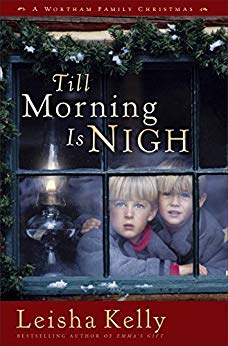
Book Review: Rorey’s Secret

Rorey’s Secret is the fourth of Leisha Kelly’s series about the Wortham family, set during  and just after the Depression. The fourth through sixth books are called the Country Road Chronicles and take place a few years after the first three, when the Wortham children are teenagers.

This book begins with mom Julia Wortham in the kitchen preparing a birthday dinner for one of their neighbor boys. The Hammond family lost their mother at the beginning of the second book. Their father, George, had not coped well at first, but seemed stable now. Several of the Hammond’s ten children are over visiting the Worthams at any given time. The youngest is trying to help Julia fry chicken, and making a mess. Just as another Hammond child tries to bring newborn kittens in the house, the oldest drives up with his wife in labor and very active toddler diving in Julia’s cabinets because he likes the bang all the pans make as they fall out. As Julia’s husband and son come in from working, Julia sends them off for the doctor.

But the doctor can’t be reached, and Julia reluctantly plays midwife. Somehow after several hours, the baby is born, everyone’s fed, and several of the Hammond family go home.

As Julia and her husband, Samuel, prepare to drop into bed, they notice a strange glow in the distance: a fire over at the Hammonds’. Sam and his son and daughter drive over to help: Julia stays behind because the new mother and baby are still at her house for the night.

Sarah, the Wortham’s daughter, tries to keep the younger Hammond children safely away from the barn’s flames, but ten-year-old Bertie dashes away into the barn out of concern for the calves. Sarah alerts her father, who runs after Bertie to bring him out. Then the roof caves in.

Both Bertie and Sam are pulled to safety, but both are injured, Sam seriously. His son takes both of them back to the Wortham’s house and goes to try to find the doctor again. Julia, worried sick, tries to help them the best she can.

Inexplicably, several of the Hammonds blame middle son Franky for the fire. In the previous books there has been a subplot involving him. He seems to have a learning disability: he can’t learn to read no matter how much he wants to. He can do math in his head, but not on paper. Of course, not much was known about such then, and his schoolmates and even his father think he’s stupid. Franky is also the most dreamy, sensitive, and spiritual of the bunch. If he had started the fire, he’d be the first to own up to it. There also seems to be some tension between Franky and his teenage sister, Rorey, but neither will open up about it.

Rorey, for her part, is being cagey and aloof. The bulk of the book focuses on the tension between Rorey, Franky, and the rest of the two families as the cope with the aftermath of the fire. When Rorey tells a part of her secret to Sarah, then Sarah’s in a quandary as to whether to keep her promise not to tell.

The point of view rotates from chapter to chapter between Julia, Sarah, and Franky. I could identify a lot with Julia, worrying about her husband, feeling overwhelmed with all the people and issues, wanting to set things straight between Franky and his father. She struggles to trust God and seek wisdom. But she makes a good point here:

Somewhere I’d heard that the first time a young person does something really bad, a significant bit of their future and the choices they make rest upon the kind of response they get. I prayed our response to Rorey would be what she needed (p. 229).

I loved the first couple of books in the series. All the chaos in the beginning of this one nearly made my head spin. Still, life is like that sometimes, and that’s one of the hardest times to maintain trust in the Lord. I liked the way this one worked out in the end and what everyone learned along the way.

(Sharing with Carole’s Books You Loved, Booknificent)
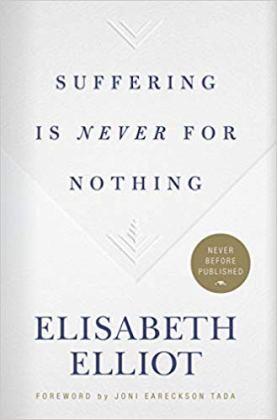
Book Review: Suffering Is Never for Nothing

Suffering Is Never for Nothing by Elisabeth Elliot is “a very slight adaptation” of a series of talks Elisabeth gave at a conference. Someone had given a set of the conference CDs to Jennifer Lyell. She was so blessed, she gave copies to others. Finally she met and befriended Elisabeth and her husband, Lars, when Elisabeth could no longer speak. Later she obtained permission to transcribe the talks and have them published.

Though this volume wasn’t published in Elisabeth’s lifetime, if you’ve read her books, listened to her radio program, or heard her speak, you’ll hear familiar themes.

Just a bit of background for those who might not be familiar with Elisabeth: she and her husband were missionaries to an Indian tribe in Ecuador when several of the missionary couples were burdened to try to reach a tribe then known as Aucas ( later it was discovered they called themselves Waorani). The Aucas were thought to be a savage tribe: their every encounter with any from outside their world ended badly. After several seemingly friendly encounters, the men thought the time had come to try to meet the tribe in person. The first visit went well, but then the Aucas speared all five of the men to death. A few years later Elisabeth, her young daughter, Valerie, and Rachel Saint, sister to another of the men, Nate Saint, went to live with the Auca/Waorani. Elisabeth shared that story in Through Gates of Splendor. In later years, Elisabeth remarried, but her second husband died of cancer. Before that marriage, Elisabeth lost almost the entire body of the translation work she had painstakingly labored over in the jungle. Along with these major losses in her life, she’s dealt with the everyday ones we all face.

I don’t know if Elisabeth intended to start a writing career when she published her first book: she was still a missionary in the jungle at the time. But God led her to write several more. I was one of many who considered her a mentor from afar, appreciating her no-nonsense, straightforward style and firm foundation on the Word of God.

To come back to this book, after naming several examples of suffering, Elisabeth boiled it down to this definition: “Suffering is having what you don’t want or wanting what you don’t have” (p. 9). That’s well and good, but what do we do about it? Elisabeth says, “I’m convinced that there are a good many things in this life that we really can’t do anything about, but that God wants us to do something with” (p. 8).

Probably our biggest struggle concerning suffering is wondering where God is in it and why He allows it. Verse after verse assures us that God is right there with us in suffering. And some passages give us a few ideas of why He might allow it. Elisabeth says, “The deepest things that I have learned in my own life have come from the deepest suffering. And out of the deepest waters and hottest fires have come the deepest things I know about God . . . The greatest gifts of my life have also entailed the greatest suffering” (p. 9).

Still, “There would be no intellectual satisfaction on this side of Heaven to that age-old question, why. Although I have not found intellectual satisfaction, I have found peace. The answer I say to you is not an explanation but a person, Jesus Christ, my Lord and my God” (p. 12). She shares that when she first heard the news that her first husband was missing, she didn’t hear anything more about his condition or whereabouts for five days. God brought to her mind Isaiah 43:2-3: “When thou passest through the waters, I will be with thee; and through the rivers, they shall not overflow thee: when thou walkest through the fire, thou shalt not be burned; neither shall the flame kindle upon thee. For I am the Lord thy God, the Holy One of Israel, thy Saviour.” She realized God wasn’t promising anything about her husband, but He promised to be with her.

“The questions remains, is God paying attention? If so, why doesn’t He do something? I say He has, He did, He is doing something, and He will do something” (p. 13).

She discusses the perspective of the cross and the two different kingdoms, the one on this world and the kingdom of God.

It’s He who was the Word before the foundation of the world, suffering as a lamb slain. And He has a lot up His sleeve that you and I haven’t the slightest idea about now. He’s told us enough so that we know suffering is never for nothing (p. 16).

We are not adrift in chaos. To me that is the most fortifying, the most stabilizing, the most peace-giving thing that I know about anything in the universe. Every time that things have seemingly fallen apart in my life, I have gone back to those things that do not change. Nothing in the universe can ever change those facts. He loves me. I am not at the mercy of chance (p. 43).

Faith is not a feeling. Faith is willed obedience in action (p. 45).

She then discusses our response: acceptance, gratitude, offering whatever it is back to God, and the transfiguration He works in us, with a chapter devoted to each of those.

Now if I had had a faith that was determined God had to give me a particular kind of answer to my particular prayers, that faith would have disintegrated. But my faith had to be founded on the character of God Himself. And so, what looked like a contradiction in terms: God loves me; God lets this awful thing happen to me. What looked like a contradiction in terms, I had to leave in God’s hands and say okay, Lord. I don’t understand it. I don’t like it. But I only had two choices. He is either God or He’s not. I am either held in the Everlasting Arms or I’m at the mercy of chance and I have to trust Him or deny Him. Is there any middle ground? I don’t think so (pp. 26-27).

Many years ago I read a different book by Elisabeth on this topic, A Path Through Suffering. At first I thought this was a republication of that book by a different name. It’s not, though. Some of the information probably overlaps, but they are two different books, both worthy to be read and extremely helpful.

I enjoyed reading this book over the last few weeks with the True Woman Summer Book Club and looking through the comments and study questions there.

(Sharing with Grace and Truth, Carole’s Books You Loved, Booknificent)
Book Review: The Mill on the Floss

The Mill on the Floss by George Elliot (pen name for Mary Ann Evans) is her second novel, published in 1860. The Floss in the title is the river which powers the mill. The mill is owned by a Mr. Tulliver, having been in his family for several generations.

Tulliver has two children, Tom and Maggie, and most of the novel’s action revolves around them. Tom is not very academic, but he’s bright in other ways. He’s pretty sure of himself, doesn’t much question whether he’s in the right, and lives by a rigid moral code.

Maggie, by contrast, is bright, affectionate, and impulsive. She’s continually misunderstood by everyone except her father, who always takes up for her and lovingly calls her “the little wench.” Her mother just thinks she’s naughty. Her coloring is darker than what’s regarded as beautiful in that day, at least by the proud Dodson family her mother comes from. Her impulsiveness gets her into trouble, even when she’s trying to do the right thing. For instance, once her aunts were all telling her mother she should do something with Maggie’s mass of hair. So Maggie goes into another room and cuts her hair herself — which horrifies the Dodson sisters. But Maggie’s no saint, as evidenced by pushing her pretty, petite, perfect cousin, Lucy, into the mud when Tom plays with Lucy instead of Maggie. Maggie especially seeks Tom’s love and approval:

Her brother was the human being of whom she had been most afraid from her childhood upward; afraid with that fear which springs in us when we love one who is inexorable, unbending, unmodifiable, with a mind that we can never mould ourselves upon, and yet that we cannot endure to alienate from us

As the children grow up, Mr. Tulliver loses a law suit that he has fought for years, plunging the family into financial ruin and himself into poor health. Tulliver blames the lawyer of his opponent, a Mr. Wakem, for his troubles and declares he’ll never forgive him. He makes Tom write in the family Bible “you’ll remember what Wakem’s done to your father, and you’ll make him and his feel it, if ever the day comes.”

Both children drop out of school to come home and help.

They had gone forth together into their life of sorrow, and they would never more see the sunshine undimmed by remembered cares. They had entered the thorny wilderness, and the golden gates of their childhood had forever closed behind them.

Tom finds a position, works hard, and engages in some trading on the side. Maggie, leafing through some of the few books they have left, comes across one by Thomas a Kempis urging a defeat of self-love by self-denial. She takes this attitude to an unnatural extreme.

One day she runs into Mr. Wakem’s deformed son, Philip, whom she had met years earlier when he was in school with Tom. Philip had developed something of a crush on her and wants to see her. Even though she thought her father was wrong in his attitude toward the Wakems, she can’t defy him. But she can’t be unkind to him, either. Philip convinces her to walk with him in an out-of-the way area and also convinces her that her self-denial, even of the pleasure of good books, is unnatural and extreme. They spend about a year meeting in private, talking about books and other things — until Tom finds out and harshly rebukes them both.

After her father’s death, Maggie takes a position away for a few years, and then comes back to town. Her mother now keeps house for her sister’s widower, Lucy’s father. Lucy wants Maggie to experience some rest and enjoyment and asks her fiance, Steven Guest, to come over for some singing and to bring his friend — Philip Wakem. Maggie explains that she can’t see Philip, but then Tom consents for her to do so in that setting. Phillip loves Maggie, but Tom has said if she chooses to marry Philip, he’ll cut ties with her.

Maggie and Stephen find themselves oddly attracted to each other. They try to fight it, mainly for Lucy’s sake. Maggie wonders if her life will always be miserable.

We can’t choose happiness either for ourselves or for another; we can’t tell where that will lie. We can only choose whether we will indulge ourselves in the present moment, or whether we will renounce that, for the sake of obeying the divine voice within us,–for the sake of being true to all the motives that sanctify our lives. I know this belief is hard; it has slipped away from me again and again; but I have felt that if I let it go forever, I should have no light through the darkness of this life.

My thoughts:

Eliot’s great strength is getting the reader inside her characters’ heads. One source called this “psychological realism.” In the first few chapters the minute play-by-play action of everyone’s thinking is a bit much: I think Eliot refines this to a better balance in later books. But the thoughts and interactions do establish everyone’s character and set us up for what’s to come.

This book is said to be somewhat biographical. Maggie’s circumstances were different from Eliot’s, but they were alike in having morally upright brothers who disapproved of their actions. Neither was considered physically attractive (at least in childhood – Maggie was deemed a striking as an adult). Both were intelligent, though Eliot received much more education. Both grew up in rural villages with an evangelical upbringing. Eliot turned away from the faith as an adult but “she had respect for religious tradition and its ability to maintain a sense of social order and morality” according to Wikipedia.

I’ll forewarn you that the book has a sad ending. Conflicts are finally resolved, but in a tragic way. When I first began to suspect the book might be headed that way, I was dismayed and hoped I was wrong.

The sad ending made me wonder what the point of it all was. Some sources suggest one aspect is the struggle between destiny and choice. Some characters and situations seem drawn toward and inexorable conclusion, but, in Maggie’s case, she valiantly fights against temptation and does what she considers the right thing. Then she’s persecuted by society worse than if she had succumbed. Another source suggested that dealing with small-town persecution is another theme.  Perhaps the similarities between Maggie and Eliot were Eliot’s way of venting. Some say it’s a book about growing up.

Though this book will never rival Middlemarch and Daniel Deronda as my favorite Elliot books, and though I didn’t like the ending, I’m still glad to have read it. Her rich characterizations, depiction of rural life, and delving into the deepest of her characters’ thoughts all make for good reading.

I listened to the audiobook wonderfully read by Laura Paton. I esocially liked the way she portrayed two of the aunts: the imperious, self-appointed head of the Dodson clan, Sister Glegg, and the gloomy hypochondriac, Sister Pullet. I also read several chapters and a few other section in the Kindle book. This book is my 19th Century classic for the Back to the Classics challenge.

Have you ever read The Mill on the Floss? What did you think?

(Sharing with Carole’s Books You Loved, Booknificent)
Book Review: Every Secret Thing

In Ann Tatlock’s novel Every Secret Thing, Elizabeth Gunnar had attended Seaton Preparatory School in Delaware. Her high school English teacher there, Mr. Dutton, encouraged and nurtured her love of literature and inspired her to become an English teacher herself.

There are mentions through the book that something terrible happened to Mr. Dutton, and his story is told piecemeal in Elizabeth’s flashbacks. He was a well-loved teacher, so his tragedy hit the student body hard. But Elizabeth and three of her friends were stunned that the school covered up what really happened.

Now, twenty years later, Elizabeth has returned to Seaton as an English teacher. Mr. Dutton’s shadow looms large, but eventually Elizabeth finds her footing. One of her students, a girl named Satchel Paige, seems aloof, but Elizabeth learns of her troubled family background, and they eventually form a relationship.

Elizabeth speaks often of what she calls “moments of being.” She borrowed the phrase from Virginia Woolf, who described them as “a sudden shock, a welcome shock, in which she sensed something beyond the visible, or, as she wrote, the shock ‘is or will become a revelation of some order; it is a token of some real thing behind appearances.'” Elizabeth felt those moments were God manifesting Himself or trying to get our attention, and she even wrote a paper on that premise. But she knew Virginia didn’t believe in God. And she was sad to discover that Mr. Dutton didn’t, either, though he gave her an A on her paper.

Satchell progresses well until a crisis at home affects both herself and Elizabeth.

I feel I am not doing justice to this story: there’s so much I can’t say because I don’t want to spoil it. But I loved this book.

For one thing, I loved the era. Elizabeth graduated a couple of years behind me, so all the 70s references were familiar and nostalgic to me.

Then I identified very much with Elizabeth as the bookish “Jesus freak” (as some Christians were called then) introverted A student.

I loved the threads of “moments of being” throughout the novel as well as the thread of invisibility. Both Elizabeth and Satchell had felt invisible for different reasons. Elizabeth brought up Jesus’s calling of Nathanael, seeing him when he thought he was alone under a fig tree. I liked the truth that sometimes God uses us in ways we never knew until much later.

Overall, it’s a beautiful, redemptive story. It’s one of my favorites of Ann’s. I hope you’ll read it and tell me what you think.

(Sharing with Booknificent, Carole’s Books You Loved)

Book Review: A Place Called Morning

In the novel A Place Called Morning by Ann Tatlock, Mae Demaray faces a grandparent’s worst nightmare. Her two-year-old grandson died while in her care, due to a moment of carelessness on her part.

Long after her daughter and son-in-law forgive her, Mae can’t forgive herself. She refuses to be alone with her other grandchildren, withdraws from the ministry she enjoyed for years at the children’s hospital, withdraws, in fact, from almost everything, including God. Mae’s daughter tries various ways to draw Mae out, but Mae resists.

The one activity she does keep up is her relationship with Roy, an old family friend. Roy is a few years older than her and has some kind of mental or learning disability. For as long as she can remember, her mother invited Roy from the orphanage for dinner and family get-togethers. Now her parents and her husband have all passed away, and Roy lives in a boarding house. Mae has Roy over for lunch a couple of times a week. He does odd jobs around the house and yard for her. The upkeep on her house, inherited from her parents, is too much for her, and the extra cash helps his fixed income.

Then another crushing family tragedy occurs, this one threatening her relationship with Roy. But in the aftermath, a long-buried family secret is revealed. Though it throws Mae for a loop at first, ultimately it opens her eyes and causes all her walls to come crashing down.

As a grandmother, the first part of this book was hard to read. I could really identify with Mae’s feelings in the loss of her grandson.

I loved the truths Ann brought out about relationships with family and with God. I loved where Mae ended up.

(Sharing with Carole’s Books You Loved and Booknificent)


Book Review: Buried Dreams, Planted Hope

Katie Neufeld was the young daughter of our pastor when we lived in GA several years ago. In the intervening years she grew up, went to college, became a nurse, met the man of her dreams, and got engaged, following close to God each step of the way.

Then the unthinkable happened. A few months before the wedding, Katie and her fiance, Jerod, were in a horrific car accident, hit from behind and “pinballed” between two other cars. Jerod did not survive his injuries.

Katie shares her story in Buried Dreams, Planted Hope. She tells her background of how God worked in her life as she grew up, how she and Jerod met and fell in love, the accident, the raw grief afterward, and the many ways God ministered to her heart. Her father, Kevin, writes from his standpoint as a parent helping his daughter through such deep pain. At some point he realized he had suffered a loss of a friend and future son-in-law as well and had his own grief to deal with in addition to hers.

Part of their reason for writing is to share with others who might be going through their own season of grief the comfort and hope that they’ve found. Their joy is not the pasted-on, grin-and-bear-it, “everything is fine” when it’s not variety. It’s hard-won, through the pain and not bypassing it. There are still unanswered questions and mysteries about God’s will in all of this. But they’ve found, as Job and countless others have, that God shares Himself even when He doesn’t give satisfactory answers to our whys.

A few of the quotes I marked:

We made the conscious choice to be honest about our thoughts and feelings with those around us. Far too often Christians froth at the mouth with pious platitudes and paint an impossibly rosy picture (p. 3).

In all of these things, God is really taking me back to the basics and teaching me to trust. To believe that He will take care of me and provide for me in this drought. When I start to worry or dread, I am not trusting. As messy and ugly as the circumstances of my life are right now, I know my God, and I know I can count on Him (p. 113).

That last quote reminded me of something Spurgeon said about Hebrews 12:27, that God sometimes shakes up our world “that the things that cannot be shaken may remain.”

One of the lessons we learned was that it wasn’t our job to stop her tears. The Bible says to weep with those who weep. Oftentimes we attempt to stop the tears of others, but this, though well-intended, turns out to be more about our own discomfort with tears than the one who sheds them. In those initial days, there were many times where we would wrap our arms around Katie and cry with her (p. 142).

Taking every thought captive isn’t an easy or a one-time-fix-all task, but it’s a critical skill to learn and put into daily practice that will serve you well when those thoughts start to creep in that you know are not of God (p. 243).

When I reached my rock bottom, I found that Jesus was the Rock at the bottom, that sure and steady Rock that I could hold onto, the Rock that I realized was already holding on to me. And in those darkest and lowest moments, when He was all I felt I had left, I realized like no time ever before that He was all I’d ever needed (p. 245).

Suffering has this way of liberating us from the petty concerns and worries of everyday life. It clears the clutter and idols and helps us realize that Jesus really is all we need (p. 247).

Even though my story doesn’t have the cliche happy ending right now, there is still joy, although different from any I’d ever experienced in the past. A more pure form of joy (p. 252).

One of the ways God ministered to Katie was by unexpectedly bringing across her path people further along on the road of grief who could assure her that she wasn’t crazy, understand her feelings, and provide hope that things would get better. Katie and Kevin want “to comfort those who are in any affliction, with the comfort with which we ourselves are comforted by God” (2 Corinthians 1:4).

(Sharing with Literary Musing Monday, Carole’s Books You Loved, and Booknificent)

Book Review: The Inheritance

In 1996, two professors going through Louisa May Alcott’s letters and journals discovered a previously unknown and unpublished manuscript. The Inheritance was Louisa’s first novel, written when she was 17. Neither the professors nor anyone else could find any other information about the novel. There was no record of it having been submitted for publication and rejected. Maybe Louisa just wrote it for fun or for her family. After the novel’s discovery, it was published in 1997.

The heroine of the story is Edith Adelon. She was discovered as a poor orphan in Italy by Lord Hamilton, who took pity on her and brought her home. There she became a companion to Hamilton’s daughter, Amy.

As the story  opens, Edith is a young woman and Amy is a teenager. Edith teaches Amy “music, painting, and Italian, and better lessons still in patience, purity, and truth,” but she’s not exactly a governess. However, she is regarded by Lady Hamilton as “poor and lowborn,” and as such, she is not allowed to mingle with “noble” guests as an equal (p. 17). Lord Hamilton died years before. Amy’s older brother, Arthur, her mother, Lady Hamilton, and her mother’s niece, Lady Ida complete the household. A friend, Lord Percy, comes for an extended visit and the young siblings learn his background: he and his brother had loved the same woman, and once Percy found out, he stepped back for his brother’s happiness. “Careless of the wealth and honor that might be his, he prized far more the purity and worth of noble human hearts, little noting whether they beat in high or low.” He visited the “poor and suffering” and still kept a hope that he “might win a beautiful and noble wife to cheer life’s pilgrimage and bless him with her love” (p. 13).

Ida hopes to attract Percy’s attention for herself, but when she sees him favoring Edith, Ida’s latent jealousy comes to the surface. Between Ida’s verbal jousts, another visitor’s ignoble intentions, and a betrayal of her kindness, Edith has her hands full.

Yet there is a secret to Edith’s background that none of them knows. But will it be revealed or suppressed and forgotten?

The story is only 150 pages and has elements of both a Gothic novel and what were called sentimental novels. It’s a very sweet story, but a little overdone in places. Edith is too good to be true. Descriptions such as this one abound: “With an angel’s calm and almost holy beauty, Edith bore within as holy and pure a heart–gentle, true, and tender” (pp. 12-13). Likewise, Percy’s “calm, pale face and serious eyes are far more beautiful than mere comeliness and grace of form, for the pure, true heart withing shines clearly out and gives a quiet beauty to his face, such as few possess” (p. 5).

But even though Louisa’s writing is understandably not as mature as her later works, and the characters are a little two-dimensional, I thought it was very sweet and a good effort on Louisa’s part for her age then.

Several years ago I saw a film version of The Inheritance which I enjoyed immensely. It must have come out not long after the book was published. It’s been a while since I’ve seen it, but it kept to the main points of the book. A few exceptions: it has Lord Hamilton as still living for most of the film; shows Lady Hamilton as warm and friendly whereas she is described as cold and haughty in the book; and it has Edith loving and racing horses, which was not at all in the book. I’m looking forward to seeing the film again some time now that I’ve read the story.

Thankfully Tarissa, who hosts the Louisa May Alcott Reading Challenge, told me about the Internet Archive, which loans copies of books that have been photocopied page by page. It’s not quite the same as an e-book, but once I figured out how to make the page fit my iPad mini, I read it quite easily. I’m glad to know this service exists! The edition I read included a lengthy introduction by the two professors who discovered this manuscript, Joel Myerson and Daniel Shealy.

I’m counting this book as my Classic Novella (250 or fewer pages) for the Back to the Classics Challenge.

(Sharing with Carole’s Books You Loved and Booknificent)

Book Review: The Other Alcott

Louisa May Alcott has been famous for hundreds of years as the author of Little Women. Not many people know that her younger sister, Abigail May (who went by May and is Amy’s counterpart in LW) had some success as an artist. May probably would have gone further in her career, but she died at the age of 39. The Other Alcott is Elise Hooper’s attempt to bring May’s story to the forefront via fiction.

The book begins just after Little Women has been published and the Alcott family received the first reviews. Praise was high for Louisa’s book, but not so kind for May’s illustrations. May decided she needed more instruction, so she approached Louisa about living with her in Boston and taking art lessons there. After some curmudgeonly grumbling, Louisa agreed.

A few years later, Louisa, May, and another friend traveled to England, where Louisa wrote and May explored and took lessons. They were prohibited from traveling to Paris at that time due to war, but a few years later May traveled to Paris on her own and continued her studies. She met John Ruskin and several other “women artists languishing in the margins of the historical record.” She became friends with Mary Cassatt during the beginnings of the Impressionist movement. Mary eventually became a well-known Impressionist, but the movement was controversial at first. May continued along a more traditional route. “Her paintings were exhibited in the Paris Salons of 1877 and 1879, major accomplishments for an artist of the era.” She wrote a book titled Studying Art Abroad, and How to do it Cheaply.

She met and married Ernest Nieriker, a Swiss tobacco merchant and violinist, in 1878. In November of 1879, May gave birth to a daughter named after Louisa but called Lulu. But May died seven weeks later, Wikipedia says from childbed fever, Hooper says from cerebral spinal meningitis. May wanted Lulu to be sent to Louisa in the event of here death. Louisa raised Lulu until her own death ten years later, when Lulu was sent back to her father.

I enjoyed learning more about May’s life. I had particularly wondered why her daughter was sent to Louisa, and this gave insight into that decision. It was interesting to read of the Impressionist movement’s beginnings.

May and Louisa seemed to be the most headstrong and spirited of the Alcott sisters. May’s burning of one of Louisa’s early manuscripts (an event that really happened and was portrayed in LW) gives a glimpse of the way they could clash. But I felt Hooper played up their differences and potential for butting heads a bit overmuch. She admits in her afterward that the estrangement between the two in her book was made up for the story. I know authors may have to make up some details and dialogue in a fictionalization of a true story, but I felt this went too far. Hooper also portrayed May as resenting the way her book counterpart, Amy, was portrayed. I don’t know if this is true or made up or over-emphasized for the book. The book indicates Louisa was unhappy about May’s marriage and suspicious that her husband was really after Louisa’s money, but Wikipedia says, “Louisa Alcott called the day a ‘happy event’ and described Ernest as a handsome, cultivated and successful ‘tender friend’. Further, ‘May is old enough to choose for herself, and seems so happy in the new relation that we have nothing to say against it.'”

Louisa comes off as mostly grouchy in this portrayal. The author says of May, “Creating beauty through art made her happy. And being happy seemed to be her natural state.” But Hooper did not portray May as happy except during her courtship and early married days.

Hooper describes one scene where May finds herself in a class of all men sketching a male nude model who, when he sees May, acts lewdly toward her. Again, I don’t know f this scene is real or invented, but even if real, it went into more detail than needed.

So, I have mixed emotions bout the book, and reviews seem to be mixed as well. Though I did enjoy learning more about May, and I think the cover of the book is gorgeous, I don’t think I will be reading this author again.