How Do We Delight In the Lord?

How do we delight in the Lord?

Delight yourself in the LORD, and he will give you the desires of your heart (Psalm 37:4).

Whenever I’ve heard teaching or preaching on this verse, the emphasis has always been on the second half. We’re taught that this verse isn’t a blank check for whatever our hearts might want. Instead, as we delight in the Lord, He will give us the desires we ought to have. The better we know Him and delight in Him, the more our desires will align with His.

However, I don’t think I’ve ever heard the first part of the verse explained–unless I have forgotten it. It seems to be assumed that we know what it means to delight in something.

And we do. “Delight” carries the connotation of pleasure and joy. We delight in people–a husband, child, grandchild, or friend. We might take pleasure in a special gift, heirloom, or a just-right or longed-for purchase. We take joy in special occasions–graduation, wedding days, dinner with friends.

But do we take joy in God?

We’re often thankful for our salvation, answered prayer, the beauty of creation, and many other gifts from God. And that’s good.

But do we delight in Him?

Here are some ways that are a help to me–perhaps they will be to you, too.

Delight in God’s Word.

The Bible is the primary way God speaks to us in our day. There will be times our Bible reading might seem a little dry, but God promises “All Scripture is breathed out by God and profitable for teaching, for reproof, for correction, and for training in righteousness, that the man of God may be complete, equipped for every good work” 2 Timothy 3:16-17).

The more we read the Bible with a heart to know God, the more we’ll delight in it, and then in Him. Psalm 119 calls God’s Word a delight ten different times.

Aside from specific study, have you ever opened the Bible to find exactly what you needed for the moment? Fellow blogger Nancy Ruegg calls this experience Bible Hugs. I don’t know how many times I have been pondering a question, issue, or need, and my scheduled Bible reading for the day addressed the very thing I was thinking about.. That makes me feel so seen and loved by my Father.

One quick example: I was in the hospital thirty years ago undergoing tests for what would eventually be diagnosed as transverse myelitis. I was scheduled for an MRI, which was fairly new at the time. Any medical personnel who came into my room asked me if I was claustrophobic. I wasn’t sure–I had never been in a position that would cause me to feel claustrophobia. But their questions were making me that way! They explained that some people are bothered by being surrounded by the MRI machine and having to be still through the somewhat lengthy scan. They could give me something to relax me for it, but would need to know if I wanted it early enough to order it and then for it to be administered in time.

That day, the reading in my Daily Light on the Daily Path devotional was full of verses about stillness, like, “Sit still, my daughter,” “Take heed, and be quiet; fear not, neither be fainthearted,: “Be still, and know that I am God,” “In returning and rest shall ye be saved; in quietness and in confidence shall be your strength, ” “Commune with your own heart upon your bed, and be still,” “He shall not be afraid of evil tidings: his heart is fixed, trusting in the LORD.” Those calmed my heart. I recited them to myself while in the MRI machine and even dozed off.

Study God’s attributes.

At first, that might sound like a dry academic pursuit. Instead, such a study leads to worship and joy.

As an example, a friend and I are studying God’s attributes in None Like Him: 10 Ways God Is Different From Us and Why That’s a Good Thing by Jen Wilkin.

The first chapter deals with God’s infinity. Jen points out that it is impossible to measure Him in any way. David says “his greatness is unsearchable” (Psalm 145:3). Solomon said the highest heaven could not contain God (1 Kings 8:27).

God Himself measures the waters, the heavens, and the mountains, but “Who has measured the Spirit of the Lord?” (Isaiah 40:12-13).

God’s greatness inspires awe and worship, but also fear. What might a God that big do to us? Does He even notice us or care about us?

Yes, Jen says. He knows the number of our hairs (Luke 12:7). He measures our sorrows and tears (Psalm 56:8). He measures our sins, yet “his immeasurable grace exceeds them” (Romans 4:7-8; 5:20).

When I read this book the first time, I was amazed how meditating on God’s attributes increased my faith: “God can take care of anything! What do I have to worry about?” But learning about Him more deeply also spilled over into love for Him and delight in Him.

Mardi Collier had a similar experience as a result of Bible study. She and her husband, Ken, served at The Wilds Christian Camp and Conference Center in various capacities for years (at one time, he was the president). When she talked with her husband about wanting to know God better, he suggested she start in the psalms and make note of every verse that said something about God. She made a notebook and started a new page every time she saw a new attribute of God, adding to each page as she found other verses. Her study expanded to the rest of the Bible. That project eventually became a book: What Do I Know About My God?

So as we read the Bible, we don’t just get through the scheduled reading for the day: we look for God. What does the passage say about God? But we don’t just read it academically. We read it personally.

Remember what God has done.

Psalm 150:2 tells us to “Praise him for his mighty deeds; praise him according to his excellent greatness!” We marvel at God’s hand throughout history as we read the Bible. Not only does He demonstrate His wisdom and ability in leading and providing for and protecting His often unappreciative people, He also shows His love and compassion for them.

But God didn’t just work in history. He works in our lives today. David writes in Psalm 63:5-8: “My soul will be satisfied as with fat and rich food, and my mouth will praise you with joyful lips, when I remember you upon my bed, and meditate on you in the watches of the night; for you have been my help, and in the shadow of your wings I will sing for joy. My soul clings to you; your right hand upholds me.” Whether making a list with pen (or computer) or lying awake and thinking in the middle of the night, recounting God’s work in our lives causes us to joy in Him.

Some years ago, I was encouraged to write down my “Ebenezers.” The word means “stone of help” and comes from 1 Samuel 7:12, where Samuel placed a stone as a memorial of God’s help and called it “Ebenezer.” God helps us every day in big and small ways, but I made a list of some special times when I particularly saw God’s hand at work (that list can be found here.)

Pray.

Prayer is a big subject with many facets, but for our purposes today, I’ll just say there’s nothing like a direct answer to a personal prayer–or the realization that God’s “no” was the best response–to inspire our delight in the Lord.

Read and sing hymns.

Colossians 3:16 says we are taught and admonished as we sing psalms, hymns, and spiritual songs. Music and poetry have a way of engaging our minds as well as our emotions and can feed our delight in the Lord.

I can hardly sing “Is He Worthy?” without getting teary. “God of Heaven,” “Behold Our God,” and “O God Beyond All Praising” all transport me into instant worship.

Another favorite is the lesser-known but lovely “O God My Joy” (lyrics and background information here), based on Psalm 43:3-4: “Send out your light and your truth; let them lead me; let them bring me to your holy hill and to your dwelling! Then I will go to the altar of God, to God my exceeding joy, and I will praise you with the lyre, O God, my God.”

And then there are the multitudes of hymns that are testimonies of what God has done in our lives.

See God’s hand in creation.

Psalm 19:1 says, “The heavens declare the glory of God, and the sky above proclaims his handiwork.” Have you ever been stopped in your tracks by a gorgeous sunset, beautiful flowers, or majestic mountain scenes and marveled at God’s handiwork?

Then David wrote in Psalm 8:3-4: “When I look at your heavens, the work of your fingers,
the moon and the stars, which you have set in place, what is man that you are mindful of him, and the son of man that you care for him?” The God of such grandeur knows and loves and cares for us!

Turn thoughts to God all through the day.

We don’t have to confine our worship or our delight in the Lord to our time in the Bible with Him or in prayer. As we go about our daily tasks, we can pray, sing, or think about God’s character, words, and deeds.

What helps you most to delight in the Lord?

(I often link up with some of these bloggers.)

Spiritual Maturity Is Dependent

Whether we have our own children, or nieces and nephews, or friends’ children, or little ones at church, we expect to see them grow. Even though we marvel at how quickly they seem to grow, we would be concerned if they didn’t.

We also assume that children will grow mentally, emotionally, and spiritually. Moms might miss the cute antics of their little ones, but they’d be alarmed if their teenagers acted like toddlers.

Though there is an aspect of grief when children become adults and leave home, there is anticipation, too. We look forward to seeing what God will do in their lives.

As much as we miss our kids when they move away from home, we know something is wrong if they’re forty and still living in their parents’ basement, playing video games most of the day.

Maturity in the children we’re close to seems to be measured by their ability to stand on their own two feet–to function successfully as adults on their own. Though we welcome their coming to us for advice, and we love to help them in any way we can, we know we won’t be around forever.

Spiritually, though, we don’t grow independent from God. We don’t become spiritual adults as we move away from Him to live our own lives.

Instead, we grow spiritually when we realize how little we actually have control over, when we’re aware we need God every moment of every day. We grow more dependent on God as we mature.

How do we mature spiritually?

We take in His Word. 1 Peter 2:2, NKJV: “As newborn babes, desire the pure milk of the word, that you may grow thereby.” Acts 20:32: “And now I commend you to God and to the word of his grace, which is able to build you up and to give you the inheritance among all those who are sanctified.

We grow in grace and knowledge of the Lord. 2 Peter 3:16-18: “There are some things in them that are hard to understand, which the ignorant and unstable twist to their own destruction, as they do the other Scriptures. You therefore, beloved, knowing this beforehand, take care that you are not carried away with the error of lawless people and lose your own stability. But grow in the grace and knowledge of our Lord and Savior Jesus Christ.”

We pray. Colossians 1:9-10: “And so, from the day we heard, we have not ceased to pray for you, asking that you may be filled with the knowledge of his will in all spiritual wisdom and understanding, so as to walk in a manner worthy of the Lord, fully pleasing to him, bearing fruit in every good work and increasing in the knowledge of God.”

We learn from the leaders God gave the church. Ephesians 4:11-13: “And so, from the day we heard, we have not ceased to pray for you, asking that you may be filled with the knowledge of his will in all spiritual wisdom and understanding, so as to walk in a manner worthy of the Lord, fully pleasing to him, bearing fruit in every good work and increasing in the knowledge of God.”

We develop discernment by learning to distinguish between good and evil. Hebrews 5:12-14: “For though by this time you ought to be teachers, you need someone to teach you again the basic principles of the oracles of God. You need milk, not solid food, for everyone who lives on milk is unskilled in the word of righteousness, since he is a child. But solid food is for the mature, for those who have their powers of discernment trained by constant practice to distinguish good from evil.”

Renew our minds. Romans 12:2: “Do not be conformed to this world, but be transformed by the renewal of your mind, that by testing you may discern what is the will of God, what is good and acceptable and perfect.

Behold Christ. 2 Corinthians 3:18: “And we all, with unveiled face, beholding the glory of the Lord, are being transformed into the same image from one degree of glory to another. For this comes from the Lord who is the Spirit.”

What does spiritual maturity look like?

Stability. Ephesians 4:14: “That we may no longer be children, tossed to and fro by the waves and carried about by every wind of doctrine, by human cunning, by craftiness in deceitful schemes.”

Awareness of our weakness. 2 Corinthians 12:9-10: “But he said to me, ‘My grace is sufficient for you, for my power is made perfect in weakness.’ Therefore I will boast all the more gladly of my weaknesses, so that the power of Christ may rest upon me. For the sake of Christ, then, I am content with weaknesses, insults, hardships, persecutions, and calamities. For when I am weak, then I am strong.”

Endurance and hope. Romans 5:3-4: “Endurance produces character, and character produces hope, and hope does not put us to shame, because God’s love has been poured into our hearts through the Holy Spirit who has been given to us.”

Fruit of the Holy Spirit evident in our lives. Galatians 5:22-23: “But the fruit of the Spirit is love, joy, peace, patience, kindness, goodness, faithfulness, gentleness, self-control.”

Jesus. Ephesians 4:13: “Until we all attain to the unity of the faith and of the knowledge of the Son of God, to mature manhood to the measure of the stature of the fullness of Christ.”

Maturity doesn’t always accompany age. Some older people aren’t very mature at all, and some young people can display remarkable maturity. But the good news is, whatever stage we are in now, we can grow spiritually and become more and more like Christ.

Ephesians 4:13

(I often link up with some of these bloggers.)
What Do You Tell Yourself?

What do you tell yourself?

I imagine we all talk to ourselves throughout the day. Sometimes we ask things like, “Where did I put my phone?” Or “What did I come in here for?”

Sometimes we commiserate with ourselves about the driver who just cut us off in traffic or the rude salesperson.

We might berate ourselves when we’ve done something we think is dumb. Or congratulate ourselves when we feel we have done something well.

Occasionally, our self-talk goes much deeper. Hard times come, and we conclude God doesn’t love us. A time of suffering drags on, and we feel there’s no hope in sight.

There are multitudes of reasons to read the Bible. One is that we might discern truth from falsehood–not only in others, but also in ourselves.

I love this quote before from David Martyn-Lloyd Jones in Spiritual Depression:

Have you realized that most of your unhappiness in life is due to the fact that you are listening to yourself instead of talking to yourself? Take those thoughts that come to you the moment you wake up in the morning. You have not originated them but they are talking to you, they bring back the problems of yesterday, etc. Somebody is talking. Who is talking to you? Your self is talking to you. Now this man’s treatment [in Psalm 42] was this: instead of allowing this self to talk to him, he starts talking to himself. “Why art thou cast down, O my soul?” he asks. His soul had been depressing him, crushing him. So he stands up and says, “Self, listen for a moment, I will speak to you.”

The psalms provide multitudes of examples of the writer correcting his wrong thoughts and encouraging himself with God’s truth. They show the writer coming to God with a problem or an issue: Where are you? Why are you not acting? The wicked are faring better than Your people. I’m hurting here. People are persecuting me for no reason.

And then the writer reminds himself of truths about his God: He’s here. He loves us. He cares. The wicked will face consequences some day if they don’t repent. God will strengthen me and help me.

We don’t have to live at the mercy of thoughts running rampant or dragging us down. We take our thoughts captive. We can search our Bibles, turn to familiar helpful passages, and ask God to remind us of His truth. We renew our minds with His Word.

Psalm 131:2

(A few lines here have been taken from a couple of previous posts.)

(I often link up with some of these bloggers.)

Rely on God and Make Every Effort

Rely on God and Make Every Effort

We all have trouble with self-control in some areas: eating habits, overspending, wasting time, cutting remarks, flares of temper, etc. We’ve had enough experience trying to correct those issues that we know willpower alone doesn’t conquer them.

As Christians, we know self-control is one part of the fruit of the Holy Spirit mentioned in Galatians 5:22-23. So if we’re struggling with anger, we pray for the Spirit’s help and control. Then five minutes later, we find ourselves ranting at the driver who cut us off in traffic or the computer that mysteriously isn’t working right.

So what happened?

Peter tells us, “His divine power has granted to us all things that pertain to life and godliness, through the knowledge of him who called us to his own glory and excellence” (2 Peter 1:3). He has already given us “all things that pertain to life and godliness.” How? “By which he has granted to us his precious and very great promises, so that through them you may become partakers of the divine nature, having escaped from the corruption that is in the world because of sinful desire” (verse 4). Then, “For this very reason, make every effort to supplement your faith . . . with self-control” (among other things, verses 5-6).

“Make every effort” doesn’t mean we try to drum up our own righteousness. That’s impossible. That’s why Jesus died for us, so that He could take on our unrighteousness and grant us His righteousness when we repent of our sin and trust in Him for salvation. But it’s because He did this that we have “all things that pertain to life and godliness.”

I tend to want to figure out where the lines are, what’s God’s part and what’s my part, what’s the formula? But God doesn’t usually work by way of formulas. Somehow He works in us “to will and to do of His good pleasure” (Philippians 2:13). But He doesn’t expect us to be passive. He uses means to accomplish His will in us.

We need to recognize and correct the lies we tell ourselves and take responsibility for our actions and reactions. Often we blame other people (“If he hadn’t said this, I would not have been tempted to say that”). Or we blame circumstances (“I was busy and missed lunch, so those doughnuts were irresistible”).

We need to change our thinking so it lines up with His. Romans 12:2 tells us, “Do not be conformed to this world, but be transformed by the renewal of your mind.”

We might feel like we just can’t help ourselves. But God says, “No temptation has overtaken you that is not common to man. God is faithful, and he will not let you be tempted beyond your ability, but with the temptation he will also provide the way of escape, that you may be able to endure it” (1 Corinthians 10:13). We need to pray that God will help us look for the way of escape rather than an excuse to indulge.

We need to yield to God instead of insisting on our right to our own way: “Neither yield ye your members as instruments of unrighteousness unto sin: but yield yourselves unto God, as those that are alive from the dead, and your members as instruments of righteousness unto God” (Romans 6:13, KJV).

We need to abide in Him, because without Him we can do nothing. (John 15:1-5).

We spend much time in Scripture, which “is breathed out by God and profitable for teaching, for reproof, for correction, and for training in righteousness, that the man of God may be complete, equipped for every good work” (2 Timothy 3:16-17).

We behold Him in His Word. 2 Corinthians 3:18 says: “But we all, with open face beholding as in a glass the glory of the Lord, are changed into the same image from glory to glory, even as by the Spirit of the Lord.”

When self is screaming for its own way, we need to remember Jesus said, “If anyone would come after me, let him deny himself and take up his cross daily and follow me” (Luke 9:23).

We may need to make some determinations, like David did in Psalm 101:2-3: “I will walk with integrity of heart within my house; I will not set before my eyes anything that is worthless.” I used to be against making resolutions, because they seemed like setting ourselves up for failure, as well as focusing on our own effort. And then I came across 2 Thessalonians 1:11: “To this end we always pray for you, that our God may make you worthy of his calling and may fulfill every resolve for good and every work of faith by his power.” Every resolve for good. But relying on God’s power, not my own.

I think of God’s part and my part something like what the children of Israel did in the Old Testament. Sometimes God supernaturally defeated their enemies. But usually, they had to pick up their swords and fight. They learned from sad experience that they only won when God was with them and they were relying on Him.

I think it is similar for us. Sometimes God will seemingly instantly deliver us from a wrong desire or habit. But often it takes prayer and relying on God’s Word and help to make any headway. And since self-control is a fruit of the Holy Spirit, and fruit takes time to grow, it may take time for us to gain victory in a given area.

Another way I think of these things is what happened when Jesus told the lame man to walk or the man with a withered hand to stretch it out. Both of them could have said, “That’s the very thing I cannot do.” But they obeyed–and in the process, God gave the strength to do His will. I usually want to “feel” strengthened before I obey–but often He gives strength as we obey.

May God give us wisdom, grace, and strength as we rely on His work in us and cooperate with His working outward through us.

2 Peter 1:3

__________
This post was inspired by an excellent chapter on discipline and self-control in True Woman 201: Interior Design: Ten Elements of Biblical Womanhood by Mary Kassian and Nancy Leigh DeMoss (now Wolgemuth). Our ladies Bible study at church is going through this book, which is based on Titus 2:1-5.

(I often link up with some of these bloggers.)
“Deep roots are not reached by the frost”

Tolkien quote

When I was looking for winter inspiration last week, I came across a poem by J. R. R. Tolkien from The Fellowship of the Ring. It’s a riddle Bilbo Baggins wrote for Frodo to help him find the real Strider. But one line in particular caught my eye.

This is the first half of the riddle:

All that is gold does not glitter,
Not all those who wander are lost;
The old that is strong does not wither,
Deep roots are not reached by the frost.

If you’re like me, you might’ve read the first line as the familiar saying adapted from Shakespeare’s Merchant of Venice: “All that glisters is not gold.”

Tolkien flips it. The king they are looking for in LOTR isn’t “glittering” in his kingly accouterments yet. (Does that sound like someone else you know?)

But that’s not the line that arrested me. What stopped me in my tracks was this: “Deep roots are not reached by the frost.

Trees that aren’t evergreens look dead in the winter, don’t they? They have no leaves or fruit. They are barren for many months. They might lose limbs to ice or heavy snow.

In fact, releasing their autumn leaves helps protect them from harsh, freezing conditions. If trees kept their leaves all winter, they might lose more limbs from the extra weight when iced over. Insects would eat more of their vegetation. Since water expands when frozen, cells in leaves would rupture in freezing temperatures.

Some of the trees that fall over in bad weather have shallow or damaged roots.

But if roots are firm and deep enough, trees withstand the winter. They not only survive: they sprout new leaves when spring comes. They grow. They flourish.

Deep roots are not reached by the frost.

When we go through a spiritual winter, we might feel leafless and fruitless. Jesus said branches are pruned in order that they might bear more fruit. Sometimes new growth comes only when parts are cut away–not just old, diseased parts, but branches that look perfectly fine.

Jesus said a person whose heart is like rocky ground “endures for a while, and when tribulation or persecution arises on account of the word, immediately he falls away” (Matthew 13:21).

But if we’re deeply rooted in Christ, winters won’t destroy us.

Therefore, as you received Christ Jesus the Lord, so walk in him, rooted and built up in him and established in the faith, just as you were taught, abounding in thanksgiving (Colossians 2:6-7).

When we’re rooted in Him, we know His character. We can trust Him even when we don’t understand what He is doing.

When we’re rooted in Him, we’re firm in our identity. We’re His children. We’re forgiven, cleansed, sanctified, known, loved.

When we’re rooted and built up in Him, we’re established in the faith. We won’t be “tossed to and fro by the waves and carried about by every wind of doctrine, by human cunning, by craftiness in deceitful schemes” (Ephesians 4:14).

We stand firmly no matter what storms are raging around us, no matter how deep the frost, no matter what losses we face. As Paul wrote in 2 Corinthians 4:8-9:

“We are afflicted in every way, but not crushed;
perplexed, but not driven to despair;
persecuted, but not forsaken;
struck down, but not destroyed.”

May we walk as we received Him, humbly, dependent on Him and not ourselves. May we be so rooted and built up in Him that no frost can reach our roots.

Colossians 2:6-7

(I often link up with some of these bloggers.)

Bearing With Small Trials

Bearing with small trials

I’ve never chosen a word for the year–I’ve often said that God has much more to say to me than one word. 🙂

But a phrase that has come to mind often these last weeks is “bear up.” I can get down and whiny over not feeling well or first world problems or barren winter landscapes or several overcast days in a row or a number of other relatively minor things. I often have a harder time with these smaller trials than with the big ones. It’s almost instinctive to turn to the Lord in a major crisis and ask His grace and help. But I stumble over everyday troubles.

Yet every day can’t be sunshine and roses. We live in a fallen world. As Longfellow said in “The Rainy Day,” “Into each life some rain must fall, Some days must be dark and dreary.”

God has said all through Scripture to expect suffering, and He tells us He uses it for our spiritual growth.

Overcast days and long winters aren’t really suffering. Sure, they can affect one’s outlook. There is such a thing as Seasonal Affective Disorder. But my “winter blues” aren’t to that extreme and can’t really compare to cancer and chemo or persecution.

Proverbs 24:10 comes to mind: “If you faint in the day of adversity, your strength is small.”

Yes, it is. And if it’s so small in these minor issues, what’s it going to be when a major crisis comes my way?

The second stanza in Amy Carmichael’s poem, “Make Me Thy Fuel,” says:

From subtle love of softening things,
From easy choices, weakenings,
Not thus are spirits fortified,
Not this way went the Crucified;
From all that dims Thy Calvary,
O Lamb of God, deliver me.

Softening things? Easy choices? That’s my jam. I am not soldiery. I am a wimp.

So I feel the need to learn to “bear up” under the everyday trials of life–both to be a better testimony and to become more resilient when bigger hardships happen.

I like the NKJV translation of 2 Timothy 2:3: “You therefore must endure hardship as a good soldier of Jesus Christ.”

I don’t think enduring hardship means being stoic. David was a soldier, but he poured out his heart in the psalms.

Nor do we need to deny our pain or frustration or sadness, large or small. A broken toe may not hurt as much as a crushed leg, but it does hurt. However, we need God’s perspective on our trials.

Enduring hardship doesn’t mean we can’t pray or that we deal with the small stuff and only go to God with the big things. We’re told to “[cast] all your anxieties on him, because he cares for you” (1 Peter 5:7, emphasis mine).

But we can “[look] to Jesus, the founder and perfecter of our faith, who for the joy that was set before him endured the cross, despising the shame, and is seated at the right hand of the throne of God” (Hebrews 12:2).

We can pray to be “strengthened with all power, according to his glorious might, for all endurance and patience with joy” (Colossians 1:11).

Both of those last two verses mentioned joy. What joy? The joy that someday, all trials and pain and suffering of any size will be over (Revelation 21:4). The joy that no matter what we go through, God is with His children (Isaiah 43:2). The joy that He provides help, strength, and grace (2 Corinthians 12:8-10). The joy that He uses trials to test our faith and perfect us (James 1:2-4).

In an older book titled Formula for Family Unity, Walter and Trudy Fremont shared an example of a mother trying to help her son as he gets ready to go out in the cold to do his paper route. She had an overly sympathetic attitude, saying, “Oh, honey, it’s so cold out there; I’m afraid you’ll freeze on your paper route.” The son then felt sorry for himself for having to go out in the cold. They suggest it would be better for the mother to say, “When you finish your paper route, I’ll have a cup of hot chocolate waiting and a good breakfast” (pp. 103-104). She acknowledges that his job is cold and hard, but in a way that braces him to face it.

We, too, can reframe how we think about the things that get us down. Cold, grey winter days? God is still working even through dormancy. Hard freezes reduce the number of bugs that show up in summer. I can work on inside projects or curl up with a book and a blanket.

Minor illnesses that reduce my energy for a few days? How often have I wished I could stop the normal routine and rest or read or engage in quiet activities. Here’s the perfect opportunity.

Several overcast days in a row? They make me appreciate sunshine even more. I can keep busy with pleasant or useful occupations or play uplifting music rather than focus on the grey skies.

One reason God allows trials in our lives is to draw our attention and foster our dependence on Him. I can all too easily feel sorry for myself and then feed my self-pity. Instead, I need to preach God’s truth to myself and rely on His grace and strength.

May “God . . . who comforts the downcast,” “who loved us and gave us eternal comfort and good hope through grace, comfort your hearts and establish them in every good work and word” (2 Corinthians 7:6; 2 Thessalonians 2:16-17).

(Just to be clear: I am not trying to make light of anything anyone is going through, or to say “Just grin and bear it.” I’m sharing my thought process about my own tendency to maximize smaller trials.)

2 Timothy 2:3

(I often link up with some of these bloggers.)

Plug In or Abide?

Plug in or abide?

Most of us have devices we have to recharge: a cell phone, a smart watch, iPads, earbuds, electronic cars, etc. Packing lists for travel include cords and cables for charging. We seek outlets in airport terminals to charge up until our next flight. The threat of storms and power outages causes us to make sure all our devices are charged just in case.

Some of this technological language has filtered into other areas of life. We talk of rest and rejuvenation as needing to recharge our batteries. We say we need to “plug into” some community or power source.

Some might even think of their time in the Bible and prayer as a spiritual recharge. But Joni Eareckson Tada challenges that thought in her devotional book, Spectacle of Glory. In the reading for November 4, she writes that we don’t “sit down for our quiet time and ask ourselves, How long do I have to be plugged into God today to get a good spiritual charge?” She expands that thought by saying:

We don’t get charged up in God in order to unplug and live on our own–until it’s time for the next charge. No. We never disconnect from Him. We are living branches connected to the living Christ. His life is our life.

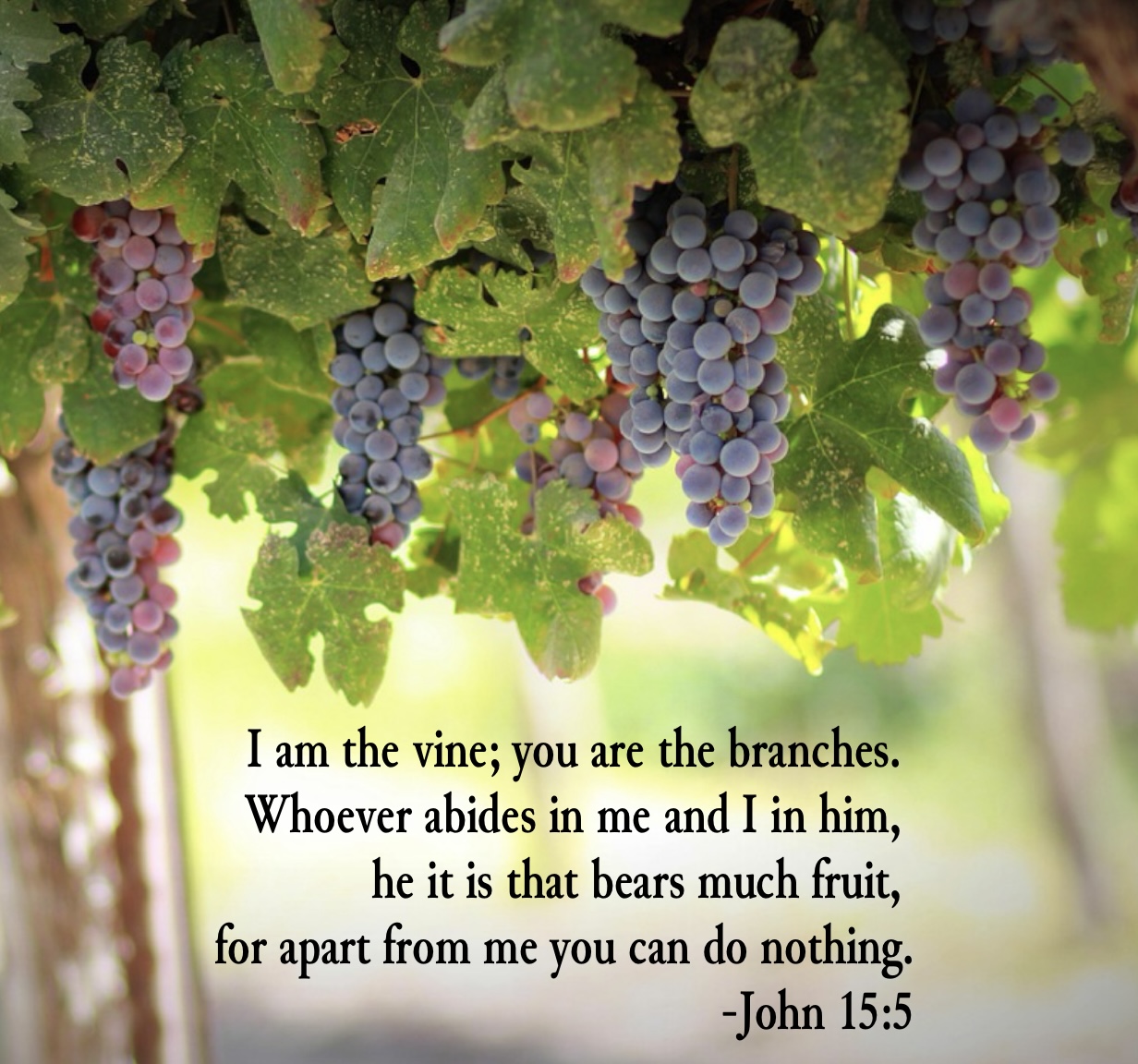
Instead of plugging in, we abide in Him, as Jesus said in John 15:5: “I am the vine; you are the branches. Whoever abides in me and I in him, he it is that bears much fruit, for apart from me you can do nothing.”

In one of the best definitions for abiding that I have read, Joni says:

Abiding is living in constant awareness of total dependence on Jesus. It involves a constant flow of life-giving sap from the Holy Spirit–not a spiritual charge that takes us up to 80 percent. Abiding in Christ is a 100 percent relationship.

We’re placed in Christ when we believe on Him, and that connection is never severed. But we don’t always consciously think about depending on Jesus.

How do we cultivate that awareness of our dependence on Him? Well, trying to do anything in our own strength will often cause us to fall flat, reminding us we need His strength.

Jesus goes on in John 15 to talk about prayer and His words abiding in us. We don’t confine prayer and Bible reading to our devotional time and then go off on our own. Psalm 1 talks about meditating on God’s instruction day and night. Isaiah 26:3 says “You keep him in perfect peace whose mind is stayed on you, because he trusts in you.” We can talk with Him all through the day. We think about His Word as we make decisions and go about our work, asking Him for help and wisdom in knowing how to apply what He has said.

Then we demonstrate our love to Him by obeying His Word. It’s not that we keep His commandments to try to earn His love. We come to Him for salvation because we can’t keep all His commandments all the time. But when He saves us, we value what He says and we seek His strength to obey Him because we love Him.

Once we believe on Jesus as our Lord and Savior, we’re a branch connected to His vine. His life flows through us. He doesn’t charge us up and then send us off to live independently til we need another charge. We don’t have to worry about becoming disconnected to Him. He’s always with us, constantly empowering us to live for Him. But we abide in Him when we lean into that relationship and depend on Him.

Jesus saying that we can do nothing without Him reminds me of these stanzas from Frances Ridley Havergal’s lovely hymn, “I Could Not Do Without Thee

I could not do without thee,
O Saviour of the lost,
whose precious blood redeemed me
at such tremendous cost;
thy righteousness, thy pardon,
thy precious blood, must be
my only hope and comfort,
my glory and my plea.

I could not do without thee,
I cannot stand alone,
I have no strength or goodness,
no wisdom of my own;
but thou, belovèd Saviour,
art all in all to me,
and weakness will be power
if leaning hard on thee.

May He teach us all to abide more consciously and fully in Him.

John 15:5

(Revised from the archives)

(I often link up with some of these bloggers.)
Dealing with Distractions During Prayer

Distractions during prayer

If you’re like me, settling down to pray triggers all kinds of distractions. It’s not so much that other people interrupt me, though that happens occasionally. The problem is usually in my own mind going a dozen different directions.

Here are some practices that have helped me:

Allow for quiet time during the day. I think one reason our thoughts scatter so much is that we don’t often have quiet time to just think any more. If I am cooking or cleaning in the kitchen, I turn the Christian radio station on. If I am driving or getting ready for the day, I listen to music or an audiobook. All of those things can be edifying in themselves. But especially if you are an internal processor like me, your mind needs time to think things through. So allowing for some quiet thinking time during the day helps our thoughts not to go so far afield when we sit down to pray.

Keep a notepad nearby. If I suddenly remember an item I need to add to the grocery list or a blog idea or an appointment I need to make while I am praying, I jot it down to take care of when I am done. That way my mind isn’t struggling to remember those things while also praying. You could also use the notes app on your phone, if the phone itself wouldn’t be a distraction.

Deal with your phone. You may want to silence your phone, depending on whether someone might need to get in touch with you. I have some prayer prompts on my phone, but otherwise I put it in my pocket or turn it face down on my desk. I have most notifications turned off anyway because I don’t like my phone dinging all day. I check my email and social media often enough that I don’t need my phone to tell me every time something comes through for me.

Pray out loud. Depending on whether or not I am alone, praying aloud or in a whisper can keep me focused.

Walk or do something active while praying. Sitting with head bowed and eyes closed makes some of us sleepy. I know many people who like to pray when they take a walk.

Integrate prayer with Bible reading. We often divide prayer and reading into two separate activities. But we can pray as we read. When we come to a passage about praise, we can praise the Lord right then. If something from the Bible convicts us, we can confess that o the Lord immediately and ask for His help.

Use prayer lists. I didn’t always like prayer lists. I felt that if prayer is just talking to my Father, then wouldn’t it seem weird to bring Him a list instead of just talking to Him normally? But then I realized I do use lists when I talk to people. I always jot down things I want to discuss with the doctor before I see him. I might even do the same before calling or FaceTiming my son–even though we can text or email, some things that are better discussed when we’re actually talking. I think God knows our frailties and doesn’t mind if we use aids to prayer.

Pray throughout the day. In my early Christian life, I felt like I hadn’t officially prayed for something unless I prayed about it during my devotional time. But that can result in a ridiculously long prayer list. Plus I might forget a request I heard during the day. Now I try to pray for a request immediately when I hear or see it. With all our other relationships, we have shorter conversations throughout the day and then longer, one-on-one times. It can be that way with the Lord, too: we don’t have to confine all our prayer to our devotional time.

Divide up requests. Some people pray for their country one day, their church another day, their family another day, missionaries one day, and so on. Others pray through their church directory a few people at a time.

Use prayer prompts. I like to use Scriptural prayers to start off my prayer time. Most often I use what we call “the Lord’s prayer.” For instance, I might start, “Our Father . . . Thank you for being My Father. Thanks for making me Your child. Thank you for giving us a picture of a loving Father and child to understand your care of us.” And I go through the rest of that prayer in like manner.

I also like to use prayers like Paul’s in Colossians 1:9-12 or Ephesians 3:14-19 for myself and others. I’ve made a list of them in my notes app as I have found them.

Though I am not quite as fond of prayer acronyms, I did find them helpful in keeping me focused when I first started praying. One is PRAY:

Pray
Repent
Ask
Yield

Another is ACTS:

Adoration
Confession
Thanksgiving
Supplication

Confess and carry on. When I find my thoughts miles away while praying, I just usually say, “I’m sorry, Lord,” and get back to it. Sometimes the thing my mind runs to is something to stop and pray about.

Let distractions remind us of our need. Elisabeth Elliot once wrote in A Lamp For My Feet:

Distractions can be useful. They provide constant reminders of our human weakness. We recognize in them how earthbound we are, and then how completely we must depend on the help of the Holy Spirit to pray in and through us. We are shown, by a thousand trivialities, how trivial are our concerns. The very effort to focus, even for a minute, on higher things, is foiled, and we see that prayer–the prerequisite for doing anything for God–cannot be done without Him. We are not, however, left to fend for ourselves. The Spirit too comes to help us in our weakness.

What about when people distract us? Jesus faced that as well. He took care to pray alone at night or early in the morning, but people still found Him and interrupted Him. A Sunday School teacher from years ago once said that when someone called his home during family devotions, he wanted to answer the phone by saying, “Do you realize you’re being used of the devil right now?” But Jesus never responded in such a way when His time with His Father was interrupted. He always responded graciously. It is taking me a long time to learn that God is over even our interruptions.

I think one of the most important things to remember about prayer is that it is not a performance or a ritual. We’re talking to our loving Father when we pray. We can lay our hearts bare in all our humanness and imperfection, knowing He loves us and wants what is best for us.

Romans 8:26

(I often link up with some of these bloggers.)
Thanksgiving in Unexpected Places

Thanksgiving In Unexpected Places

During and after Thanksgiving several weeks ago, I began to notice thanksgiving in places in the Bible where it’s easy to overlook. I jotted down some notes, thinking I might write about this next autumn. But then I thought–why not now? Though we emphasize Thanksgiving in November, we’re supposed to be thankful year-round. Plus, a thankful post now would go along with the theme of thanksgiving in unexpected places.

One such passage was 1 Timothy 2:1-2: “First of all, then, I urge that supplications, prayers, intercessions, and thanksgivings be made for all people, for kings and all who are in high positions, that we may lead a peaceful and quiet life, godly and dignified in every way.”

We understand the need to pray for our authorities. But thanksgiving? Even for the ones I didn’t vote for, the ones whose ideology is opposite mine?*

I understand that Nero was the ruler when Paul wrote this letter to Timothy. How could anyone be thankful for Nero?

I imagine that even a bad dictator is better than total anarchy. The Bible says God “removes kings and sets up kings” (Daniel 2:21) and “It is God who executes judgment, putting down one and lifting up another” (Psalm 75:7). Scripture gives numerous examples of God working through rulers who didn’t know Him or follow His ways.

We can be thankful that, no matter who is in charge, God ultimately rules. We can respect someone’s authority even if we can’t respect them personally.

Another unexpected mention of giving thanks is in a passage we normally turn to in anxiety: “The Lord is at hand; do not be anxious about anything, but in everything by prayer and supplication with thanksgiving let your requests be made known to God. And the peace of God, which surpasses all understanding, will guard your hearts and your minds in Christ Jesus” (Philippians 4:3b-7).

It’s natural to pray in troubling situations. But when we’re anxious, one of the last things on our minds is thankfulness. Yet we can be thankful that “The Lord is at hand,” He loves us, He knows the best outcome and course of action, and He has the power to answer and keep us. Thanksgiving reminds us how He has answered prayer and delivered us in the past and encourages our faith to trust Him for present and future concerns.

It’s also hard to be thankful when we’re in pain. Pain can become all-absorbing. But David writes, “I am afflicted and in pain; let your salvation, O God, set me on high! I will praise the name of God with a song; I will magnify him with thanksgiving” (Psalm 69:29-30). David goes on to say in verse 32, “When the humble see it they will be glad; you who seek God, let your hearts revive.” Thanksgiving revives and encourages us as well as others. Gratefulness acknowledges that God has a purpose even in suffering (Romans 5:1-5).

Another surprising place to see thanksgiving mentioned is Romans 1. Paul details mankind’s downward spiral, resulting in God’s judgment. A lack of thankfulness (verse 21) is listed in the passage along with idolatry, slander, deceit, faithlessness, hatred toward God, and more. Paul’s letter to Timothy lists characteristics of people in the last days, including lack of gratefulness, as well as selfishness, pride, and disobedience (2 Timothy 3:1-5).

Is a lack of thankfulness as bad as all those other things? Apparently so.

Thanking God for who He is and what He has done and given is a way to acknowledge that all we have comes from Him. It keeps us from pride and from feeling entitled. “The one who offers thanksgiving as his sacrifice glorifies me” (Psalm 50:23).

What a gracious Lord we have. He doesn’t “need” our thanks, though He deserves it. He’s not feeding His ego by desiring our thanks and praise. He wants us to be thankful to encourage us to keep our eyes on Him, to trust Him for all we need, to keep us on track and away from self-dependence or idolatry.

I am reminded and encouraged to “give thanks in all circumstances; for this is the will of God in Christ Jesus for you” (1 Thessalonians 5:18)–not just in November, but every day; not just in good times, but in every situation.

1 Thessalonians 5:18

* I am not thinking of specific examples here and don’t want to get into any political debates. I will not publish comments containing political rants.

(I often link up with some of these bloggers.)

The Light Shines in the Darkness

Light shines in the darkness

Before we take the Christmas decorations down, I love to just sit and look at the lights for a while, to savor the season that passed so quickly. Besides lights on the tree, I have a lighted garland over the windows next to my desk and a small tree on my dresser, as well as the outdoor lights.

Christmas lights are one of the things I miss the most when everything goes back to “normal.” The rest of the winter can be hard with less light and barren, cold, colorless landscapes. Valentine’s Day is a bright spot for us. We have family birthdays in February and March. But that stretch of winter is usually my least favorite part of the year.

It helps to know that, after the winter solstice in December, we’re gradually getting more sunlight. It doesn’t look or feel like it at first. But I take it on faith that it is happening and it will be noticeable in several weeks.

Scripture mentions light over 200 times. God made it the first day of creation in Genesis 1. And the last chapter of the last book of the Bible, Revelation, says that in the “new Jerusalem,” we won’t need lamps or even sunlight any more, because “the Lord God will be their light.”

Some of the Bible references to light are metaphorical. One of my favorite verses is Isaiah 9:2: “The people who walked in darkness have seen a great light; those who dwelt in a land of deep darkness, on them has light shone.” Matthew 4:12-17 says this was fulfilled in Jesus.

When Simeon saw Jesus as a baby, he said, “My eyes have seen your salvation that you have prepared in the presence of all peoples, a light for revelation to the Gentiles, and for glory to your people Israel” (Luke 2:22-32).

In John 8:12, Jesus declared, “I am the light of the world. Whoever follows me will not walk in darkness, but will have the light of life.”

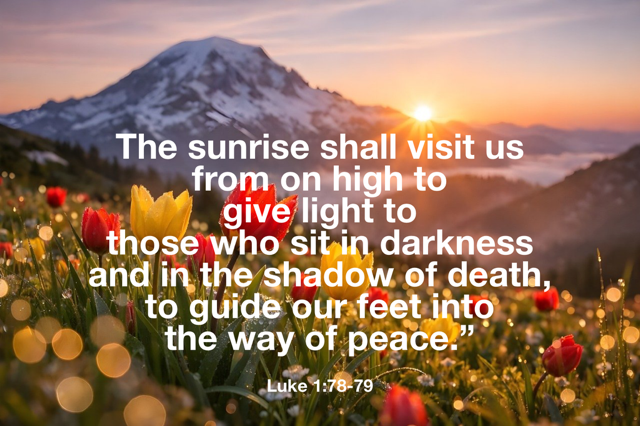
After John the Baptist was born, his father, Zechariah, said, “And you, child, will be called the prophet of the Most High; for you will go before the Lord to prepare his ways, to give knowledge of salvation to his people in the forgiveness of their sins, because of the tender mercy of our God, whereby the sunrise shall visit us from on high to give light to those who sit in darkness and in the shadow of death, to guide our feet into the way of peace” (Luke 1:76-79). Some other translations use “dawn” or “dayspring” in place of “sunrise.”

Josh Taylor shares this beautiful observation in Mercy Mild: A 25-Day Christmas Devotional Tracing Christ’s Love from Eden to Eternity:

When you’re watching a sunrise, you can’t pinpoint the exact moment night becomes day. It spreads, seeps into everything, changes the whole landscape one shade at a time. That’s what God’s mercy does through Jesus. It doesn’t just blast away the darkness—it transforms it, warms it, makes things grow that couldn’t grow before.

Christmas isn’t just about string lights and wrapped presents. It’s about light breaking into darkness in the gentlest way possible. About God looking at our mess and instead of sending judgment, sending His Son—the Dayspring, the Sunrise.

Sometimes the quietest light makes the biggest difference (pp. 140-141).

Sometimes God appears in a blaze of glory: on Sinai, to Paul the apostle, in Revelation. But when Jesus came to save us, He came gently, spreading His light like a sunrise.

Sometimes it’s hard to see His light. As Andrew Peterson wrote in his beautiful song, “Is He Worthy,” the world feels broken. Sometimes it seems like the wrong side is winning

But John 4:9 assures us, “In him was life, and the life was the light of men. The light shines in the darkness, and the darkness has not overcome it.”

Maltbie Babcock captures something of this truth in “This Is My Father’s World”: “Though the wrong seems oft so strong, God is the Ruler yet.”

His light is with us beyond Christmas. We see God’s light in His Word. We see it in His people. We see it when people turn to Jesus for salvation and serve Him and others. 

Those big, glorious bursts of God’s light are usually for a short time, for specific special occasions. Then life goes back to (a hopefully new) normal. After all the excitement Mary experienced with a visit from Gabriel, having baby Jesus, and running from Herod, she spent the next several years as an ordinary wife and mother. But she “treasured up all these things, pondering them in her heart.” (Luke 2:19). After the shepherds saw the angel host and followed the instructions to find the newborn Jesus, they likely went back to shepherding. But “they made known the saying that had been told them concerning this child. . . And the shepherds returned, glorifying and praising God for all they had heard and seen, as it had been told them” (Luke 2:17, 20). 

Like Mary, we can treasure and ponder what we’ve seen, heard, and experienced. Like the shepherds, we can share His light with others, glorifying and praising Him in our everyday lives.

2 Corinthians 4:6

(I often link up with some of these bloggers.)