A Gradual Dawning

A Gradual Dawning

We don’t think of Isaiah as an evangelistic book. We perceive evangelism as a New Testament concept rather than an Old Testament one.

Yet we find many admonitions in the OT for Israel to be a testimony not just to its own people, but to the nations.

Our ladies’ Bible study is going through Isaiah using Tim Chester’s book, Isaiah for You, as a springboard. Chester says this about evangelistic encouragement in Isaiah:

They [Israel] were to live under God’s rule expressed in the law in such a way that the nations would see that it is good to know God (Deuteronomy 4: 5-8). Isaiah himself uses this kind of language in Isaiah 2: 2-5: “Come, descendants of Jacob, let us walk in the light of the Lord.” Why? So that “many peoples will come and say, ‘Come, let us go up to the mountain of the Lord’”. The people of Israel were to attract the nations to God.

The ladies discussed how we can do that in our day, when many people don’t seem to want to hear it. There was a time in the USA when people were more open to Christianity. But now, we feel like we’ll get a negative reaction if we try to share Christ with others.

A verse that came to mind during that discussion was Psalm 119:130: “The entrance of Your words gives light; It gives understanding to the simple” (NKJV).

Even if someone says they don’t believe God’s Word, it can shine God’s light into their hearts.

That light is not always a blinding Damascus Road experience like Paul had. Sometimes people understand fully when they are first presented with the gospel. But I would guess that doesn’t happen often.

When I spent the night with my best friend in high school, her mother would often wake us up in the morning by coming in with a cheery voice while throwing open the curtains.

Going from darkness and sleep to bright light was not welcome. It was a shock to the system, though perhaps in some cases it’s necessary.

When I wake up these days, I look toward the bathroom, where the nightlight is on, to get my eyes adjusted to a bit of light. Then I turn on my phone to guide me to the bathroom. Then I turn on the bathroom light, usually squinting in the process. Gradually my eyes get adjusted so I can take in the full light of day.

I think sharing God’s light often works the same way. We receive a little, get our spiritual eyes adjusted, and then we’re able to receive a little more.

When I was in college, a new family came to my church who I became very close to. I called them my adopted spiritual family. The father told us once that when he was younger and not a Christian, he took an acquaintance home from a school function. As she tried to talk to him about the Lord, he answered her gruffly.

When he dropped her off, she probably felt her efforts had failed. But he thought to himself, “What was she talking about, anyway?” That conversation was a catalyst to his finding out more and eventually coming to know the Lord.

Peter writes in 2 Peter 1:19, “We have the prophetic word more fully confirmed, to which you will do well to pay attention as to a lamp shining in a dark place, until the day dawns and the morning star rises in your hearts.”

As we share God’s Word, we can trust that He will use it to open understanding. We may not see any response at first, or we may see a negative one. Not everyone will receive His light. But for those who do, perhaps the light will gradually dawn like a slow sunrise until they see clearly.

The entrance of God's words give light and understanding.

(I often link up with some of these bloggers.)

The Tomb Is Empty that We Might Be Filled

The tomb is empty that we might be filled.

Some people only think about Jesus at Christmas. Perhaps they are inspired by sweet paintings of a mother and child and promises of peace on earth and good will to men.

But Jesus is no longer in the manger.

He grew up to be a man, led a righteous life, kept all of God’s law in our place, and died on the cross for our sins. His death on the cross canceled our sin debt, demonstrated His love, reconciled us to God, took the punishment for our sins, made it possible for us to be saved, and more.

But Jesus is no longer on the cross.

Some of His last words were “It is finished.” He had done everything necessary to make it possible for people to be saved.

He was taken down from the cross and buried in a borrowed tomb.

But Jesus is no longer in the tomb.

When friends came to care for His body, instead they found an angelic messenger declaring, “He is not here; He is risen, just as He said.” “God raised him up, ending the pains of death, because it was not possible for him to be held by death” (Acts 2:24, CSB).

Jesus’ resurrection testifies that Jesus is the Son of God, validates His claims, removes death’s sting, gives hope in sorrow, show’s God’s power, and so much more.

Now Jesus is sitting at the right hand of the Father, praying for us, and preparing a place for us to be with Him. Yet He also dwells in our hearts through faith. “Christ in us” is “the hope of glory” (Colossians 1:27).

The manger, the cross, and the tomb are all empty—that we might be filled with His presence, pardon, power, and peace.

Emptied that Thou shouldest fill me,
A clean vessel in Thy hand;
With no pow’r but as Thou givest
Graciously with each command.

Witnessing Thy pow’r to save me,
Setting free from self and sin;
Thou who boughtest to possess me,
In Thy fullness, Lord, come in.

Mary E. Maxwell, “Channels Only”

“If you come to seek His face, not in the empty sepulchre, but in the living power of His presence, as indeed realizing that He has finished His glorious work, and is alive for evermore, then your hearts will be full of true Easter joy, and that joy will shed itself abroad in your homes. And let your joy not end with the hymns and the prayers and the communions in His house. Take with you the joy of Easter to the home, and make that home bright with more unselfish love, more hearty service; take it into your work, and do all in the name of the Lord Jesus; take it to your heart, and let that heart rise anew on Easter wings to a higher, a gladder, a fuller life; take it to the dear grave-side and say there the two words ‘Jesus lives!’ and find in them the secret of calm expectation, the hope of eternal reunion.” —John Ellerton

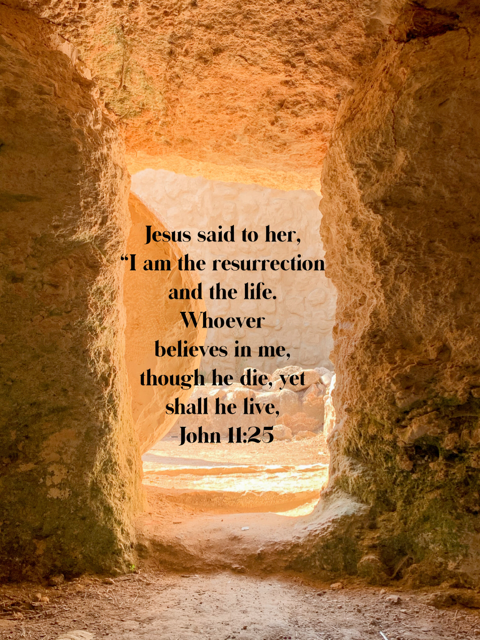
Jesus is the resurrection and the life. Whoever believes in Him will live though he dies.

This post was inspired by a short piece written by Terry Rayburn.

I often link up with some of these bloggers.

What Did Jesus’ Death on the Cross Accomplish?

What did Jesus' death on the cross accomplish?

Often we want to get right to the happy part of Easter: springy clothes, family get-togethers, church services with songs of triumph and victory.

But we shouldn’t rush too quickly past the cross. Without the cross, there would be no redemption; without death, there would be no resurrection.

I thought I’d take a little time to look up verses that share what Jesus’ death on the cross accomplished for us. We know Jesus died for our sins, but we don’t often think of other things that happened as a result of the cross.

I’m sure there’s much, much more that could be said. But here is some of what I found:

Expression of God’s love

In this the love of God was made manifest among us, that God sent his only Son into the world, so that we might live through him. In this is love, not that we have loved God but that he loved us and sent his Son to be the propitiation for our sins (1 John 4:9-10).

The forgiveness of our sins

For while we were still weak, at the right time Christ died for the ungodly. . . but God shows his love for us in that while we were still sinners, Christ died for us. Romans 5:6, 8

Reconciliation to God

For if while we were enemies we were reconciled to God by the death of his Son, much more, now that we are reconciled, shall we be saved by his life (Romans 5:10).

For in him all the fullness of God was pleased to dwell, and through him to reconcile to himself all things, whether on earth or in heaven, making peace by the blood of his cross. And you, who once were alienated and hostile in mind, doing evil deeds, he has now reconciled in his body of flesh by his death, in order to present you holy and blameless and above reproach before him (Colossians 1:19-22).

Opportunity to become God’s children through faith and repentance

But when the fullness of time had come, God sent forth his Son, born of woman, born under the law, to redeem those who were under the law, so that we might receive adoption as sons. And because you are sons, God has sent the Spirit of his Son into our hearts, crying, “Abba! Father!” So you are no longer a slave, but a son, and if a son, then an heir through God (Galatians 4:4-7).

Opportunity for Gentiles to become part of God’s family

Therefore remember that at one time you Gentiles . . . were at that time separated from Christ, alienated from the commonwealth of Israel and strangers to the covenants of promise, having no hope and without God in the world. But now in Christ Jesus you who once were far off have been brought near by the blood of Christ. For he himself is our peace, who has made us both one and has broken down in his flesh the dividing wall of hostility by abolishing the law of commandments expressed in ordinances, that he might create in himself one new man in place of the two, so making peace, and might reconcile us both to God in one body through the cross, thereby killing the hostility. And he came and preached peace to you who were far off and peace to those who were near. For through him we both have access in one Spirit to the Father. So then you are no longer strangers and aliens, but you are fellow citizens with the saints and members of the household of God (Ephesians 2:11-19).

Canceled our debt of sin

And you, who were dead in your trespasses and the uncircumcision of your flesh, God made alive together with him, having forgiven us all our trespasses, by canceling the record of debt that stood against us with its legal demands. This he set aside, nailing it to the cross (Colossians 2:13-14).

Fulfillment of God’s Law

 For God has done what the law, weakened by the flesh, could not do. By sending his own Son in the likeness of sinful flesh and for sin, he condemned sin in the flesh, in order that the righteous requirement of the law might be fulfilled in us, who walk not according to the flesh but according to the Spirit (Romans 8:3-4).

Our holiness

And you, who once were alienated and hostile in mind, doing evil deeds, he has now reconciled in his body of flesh by his death, in order to present you holy and blameless and above reproach before him (Colossians 1:21-22).

Change of life and focus

He died for all, that those who live might no longer live for themselves but for him who for their sake died and was raised (2 Corinthians 5:15).

For our sake he made him to be sin who knew no sin, so that in him we might become the righteousness of God  (2 Corinthians 5:21).

Victory over death and its fear

Since therefore the children share in flesh and blood, he himself likewise partook of the same things, that through death he might destroy the one who has the power of death, that is, the devil, and deliver all those who through fear of death were subject to lifelong slavery (Hebrews 2:14-15).

The new covenant

Therefore he is the mediator of a new covenant, so that those who are called may receive the promised eternal inheritance, since a death has occurred that redeems them from the transgressions committed under the first covenant (Hebrews 9:15).

Assurance of His provision

He who did not spare his own Son but gave him up for us all, how will he not also with him graciously give us all things? (Romans 8:32).

Opportunity to live with Him

Our Lord Jesus Christ, who died for us so that whether we are awake or asleep we might live with him (1 Thessalonians 5:1).

Eternal Life

For God so loved the world, that he gave his only Son, that whoever believes in him should not perish but have eternal life (John 3:16).

Crucifixion was one of the most painful and humiliating deaths possible. In that sense, it seems strange to be thankful for it, despite all it accomplished for us. I love how Chris Anderson captured this in his song, “My Jesus Fair”:

O love divine, O matchless grace—
That God should die for men!
With joyful grief I lift my praise,
Abhorring all my sin,
Adoring only Him.

As we contemplate the cross this week and beyond, may we respond like Chris wrote above and like Isaac Watts wrote in “Alas and Did My Savior Bleed“:

Thus might I hide my blushing face
While His dear cross appears.
Dissolve my heart in thankfulness,
And melt mine eyes to tears.

But drops of grief can ne’er repay
The debt of love I owe;
Here, Lord, I give myself away,
’Tis all that I can do.

2 Corinthians 5:21

(I often link up with some of these bloggers.)

We Won’t Understand All, But We’ll Trust More

We won't understand fully, but we'll trust more

I used to sometimes hear a song titled “Farther Along.” The chorus said:

Farther along we’ll know all about it,
Farther along we’ll understand why;
Cheer up, don’t worry, live in the sunshine,
We’ll understand it all by and by.

The stanzas talked about temptations, trials, toil, death of loved ones, and seeming injustices with the comfort that someday, when Jesus takes us home to heaven, we’ll understand it all.

The Bible does tell us to encourage and comfort one another with the truth that someday we’ll be with God in heaven where there is no sorrow, pain, or death. It also assures us that although we only know in part now,  “then I shall know fully, even as I have been fully known” (1 Corinthians 13:12). I’m sure a lot of things will make sense then that don’t now and we’ll know exponentially more than we do now.

But I don’t know if we’ll understand everything that God did and allowed while we were on earth. Because He will still be God and we still won’t be. He is omniscient, and we will never be.

This is just speculation, but I think we’ll experience something of what Job did. Throughout the book bearing his name, Job wished he could plead his case before God. When God finally spoke to Job, He really didn’t answer his questions or tell him why he suffered what he did. He pretty much just shared how He took care of creation.

If you’ve ever wondered, as I have, what God’s discussion of animals had to do with Job’s suffering, Layton Talbert suggests in Beyond Suffering: Discovering the Message of Job, “By belaboring this point with Job, God unveils one of His divine qualities. The Lord is powerful and majestic and wise beyond man’s comprehension, but He is also compassionate . . . even towards beasts. He talks as if He has intimate knowledge of their nature and needs because He does. That’s the point” (p. 206).

Somehow that was enough for Job. He responded, ““I know that you can do all things, and that no purpose of yours can be thwarted. . . .  I had heard of you by the hearing of the ear, but now my eye sees you; therefore I despise myself, and repent in dust and ashes” (Job 42:2, 5-6).

Even though Job’s suffering wasn’t explained to him, his encounter with God humbled him, silenced his questions, and inspired his worship.

I think it might be much the same for us.

I’ve often wondered if God will show us in heaven some of the behind-the-scenes activities of our time on earth: how a frustrating delay kept us from a fatal accident, how a closed door to a seemingly perfect opportunity guided us towards God’s best. We see parts of such things now, the “edges of His ways,” as Job said (26:14),  but I am sure there is much more to God’s working and guidance in our lives than we realize here.

We struggle to trust Him perfectly now. We know from His Word, from testimonies of others, and from our own experience that He is good, wise, kind, trustworthy and so much more.

But there is still much that doesn’t make sense to us. Why that venture failed. Why our loved one died so early. Why that nagging disease that took up so much time, thought, and energy was part of His plan. We trust that He really does work all things together for those that love Him (Romans 8:28). But we still wonder why certain things happen as they do.

Perhaps God doesn’t explain everything because He wants to increase our trust and dependence on Him. Perhaps we wouldn’t understand even if He did explain, just as a child won’t understand why he can’t have ice cream before dinner or why he has to stop playing and go to bed. I love what John Piper wrote in his poetic version of Job, The Misery of Job and the Mercy of God: “Beware, Jemimah, God is kind, In ways that will not fit your mind.”

Elisabeth Elliot wrote in On Asking God Why:

There are those who insist that it is a very bad thing to question God. To them, “why?” is a rude question. That depends, I believe, on whether it is an honest search, in faith, for his meaning, or whether it is a challenge of unbelief and rebellion. The psalmist often questioned God and so did Job. God did not answer the questions, but he answered the man–with the mystery of himself.

He has not left us entirely in the dark. We know a great deal more about his purposes than poor old Job did, yet Job trusted him. He is not only the Almighty–Job’s favorite name for him. He is also our Father, and what a father does is not by any means always understood by the child. If he loves the child, however, the child trusts him. It is the child’s ultimate good that the father has in mind. Terribly elementary. Yet I have to be reminded of this when, for example, my friend suffers, when a book I think I can’t possibly do without is lost, when a manuscript is worthless.

“God did not answer the questions, but he answered the man–with the mystery of himself.”

I don’t know if we’ll ever understand all the mystery of God, even in heaven. But when we see Him, we’ll be “lost in wonder, love, and praise,” as the hymn says.

When we see Him, whatever doesn’t make sense to us here won’t matter. Our faith will be sight. Our trust will be perfect.

May we be growing toward more perfect trust even now as we behold Him through His Word.

1 Corinthians 13:12

(I often link up with some of these bloggers.)

The Power of Words

The Power of Words

I was surprised to hear in a song recently the line “Love doesn’t need any words.”

The song went on to say that love is “proven by the things we do and not say —
for actions speak louder than words.”

Well, it’s true that actions can belie words. It’s true that actions and words need to line up. It’s true that love needs actions as well as words.

But I wouldn’t say that love doesn’t need words.

If you’re familiar with the five “love languages” as taught by Gary Chapman, you know that words are one of the five. The rest are quality time, gifts, acts of service, and physical touch. Chapman’s premise is that we all give and receive love in these ways, but usually one or two of them make us most feel loved. He tries to make people understand that if you do things for your loved one all day (acts of service), but their love language is words of affirmation, they are not going to feel loved. Conversely, if their love language is acts of service, and you tell them several times a day that you love them, the words are going to ring hollow if you never help them in the kitchen or do anything for them. So we should try to find the way our loved one most perceives love and express our love that way.

I’ve not read Chapman’s book, but I have heard these things taught many times. There may be some caveats concerning the idea of love languages, but I think the basic idea is sound.

But this idea of not needing words reminds me of a quote attributed to St. Francis of Assisi: “Preach the gospel at all times. If necessary, use words.” I just saw that Francis is not known to have said this. I am not surprised, because it always bothered me. It’s true that our lives should demonstrate what we believe. But someone likened this to saying, “Feed starving children; when necessary use food.”

The gospel is made up of words. It’s “the power of God for salvation” (Romans 1:16).

Jesus Himself is called the Word of God. He said, “The words that I speak unto you, they are spirit, and they are life” (John 6:63). He also said, “Now ye are clean through the word which I have spoken unto you” (John 15:3).

Paul said, “So faith comes from hearing, and hearing through the word of Christ.” (Romans 10:17). Paul also said the gospel is the power of God unto salvation.

The Bible has much to say about words.

There is one whose rash words are like sword thrusts, but the tongue of the wise brings healing (Proverbs 12:18).

Death and life are in the power of the tongue, and those who love it will eat its fruits (Proverbs 18:21).

I tell you, on the day of judgment people will give account for every careless word they speak, for by your words you will be justified, and by your words you will be condemned (Matthew 12: 36-37).

Let no corrupting talk come out of your mouths, but only such as is good for building up, as fits the occasion, that it may give grace to those who hear (Ephesians 4:29).

There are times not to use words. Ecclesiastes tells us there is “a time to keep silence, and a time to speak” (3:7). When Elijah was so discouraged after his encounter with Jezebel, an angel let him sleep and fed him before his encounter with the Lord. Jesus told His disciples at one point, “I still have many things to say to you, but you cannot bear them now” (John 16:12).

The Bible says so much more about words: the power of the Word of God, how we use words, what we use them for.

We’re to speak true words, but we’re not to browbeat with them.

A soft answer turns away wrath, but a harsh word stirs up anger (Proverbs 15:1).

With patience a ruler may be persuaded, and a soft tongue will break a bone (which Pulpit Commentary says means, “gentle, conciliating words, overcome opposition, and disarm the most determined enemy, and make tender in him that which was hardest and most uncompromising) (Proverbs 25:15).

A gentle (wholesome, healed, soothing in other translations) tongue is a tree of life, but perverseness in it breaks the spirit. (Proverbs 15:4).

Words can tear down, wound, and deceive. Words can build up, sooth, and encourage,

May God give us wisdom to know when to speak and when to be silent and grace to help our words and actions to honor and rightly reflect Him.

Death and Life are in the power of the tongue, Proverbs 18:21

(I often link up with some of these bloggers.)

Do You Have Access?

Do you have access to God?

It’s so frustrating to click on a link and then see the message “You do not have permission to view this page.”

Or to forget a password and then have to go through several steps to finally get into your account.

Or to be told you’re not dressed right or you don’t have the proper credentials to enter a venue.

Or to race to a business only to find it closed.

Or to call the doctor’s office at 4 p.m. Friday and hear a recording that their phone lines are closed for the week.

I think in America, especially, we’re so used to our freedoms that our blood boils when we’re denied access to something we think we have a right to.

But the fact remains that we don’t have access to everything. We need the right permissions, passwords, attire, level of security, or timing to get where we need to go.

If you read the first few books of the Old Testament in the Bible, you see that not everyone had access to every part of the temple. Oh, people could pray wherever they were. But God prescribed a detailed sacrificial system. Only certain animals in perfect condition could be brought as sacrifices. The different kinds of sacrifice had different procedures. Only the priests could perform certain functions. Only the high priest could go into the inner part of the temple, the most holy place, or the Holy of Holies, and then only once a year. There was a thick curtain between the Holy Place and Most Holy Place.

Some loved God and wanted to be as close to Him as possible. David, the man after God’s own heart, longed for the courts of the Lord and said he’d rather be a doorkeeper in God’s house than to dwell in tents of wickedness (Psalm 84).

Many people followed the rules and brought whatever sacrifices were required because that was just how things were. Some performed the outer rituals, but lived whatever way they pleased away from the temple.

One king, Uzziah, who presumed to go into the temple to burn incense was struck with leprosy.

The message was loud and clear: You do not have access!

That’s why it was so remarkable that when Jesus died, the thick curtain blocking the way in the Holy of Holies was “torn in two, from top to bottom” (Matthew 27:51).

That would have been utterly shocking to the Jewish people at the time.

What many people missed was that the whole sacrificial system pointed to Christ. He was the perfect sacrifice, the perfect high priest. The book of Hebrews wonderfully shows how everything in the sacrificial system pointed to Christ.

Because He lived a righteous life in our place, because we couldn’t, and He took our sin on Himself, He is the access to being right before God.

The writer of Hebrews says:

Therefore, brothers, since we have confidence to enter the holy places by the blood of Jesus, by the new and living way that he opened for us through the curtain, that is, through his flesh, and since we have a great priest over the house of God, let us draw near with a true heart in full assurance of faith, with our hearts sprinkled clean from an evil conscience and our bodies washed with pure water. Let us hold fast the confession of our hope without wavering, for he who promised is faithful (Hebrews 10:19-23).

Jesus did not create a way to God only for the Jews, but for everyone else as well:

Remember that you were at that time separated from Christ, alienated from the commonwealth of Israel and strangers to the covenants of promise, having no hope and without God in the world. But now in Christ Jesus you who once were far off have been brought near by the blood of Christ. For he himself is our peace, who has made us both one and has broken down in his flesh the dividing wall of hostility by abolishing the law of commandments expressed in ordinances, that he might create in himself one new man in place of the two, so making peace, and might reconcile us both to God in one body through the cross, thereby killing the hostility. And he came and preached peace to you who were far off and peace to those who were near. For through him we both have access in one Spirit to the Father. So then you are no longer strangers and aliens, but you are fellow citizens with the saints and members of the household of God (Ephesians 2:12-19).

That’s why Jesus could say, “I am the door of the sheep. . . . If anyone enters by me, he will be saved and will go in and out and find pasture” (John 10:7,9) and “I am the way, and the truth, and the life. No one comes to the Father except through me” (John 14:6).

Have you gone through that Door? Do you have access to God through Christ? If not, you can today. For more information, read here. Then you can “draw near with a true heart in full assurance of faith.”

Jesus said, "I am the way, and the truth, and the life. No one comes to the Father, except through me" John 14:6

(I often link up with some of these bloggers.)

But I Did Everything Right

Why do things go wrong when I did everything right?

In my early Christian life, I’d get frustrated when problems crept up while I was attempting to do something for the Lord. Even getting to church Sunday morning could be a battlefield as breakfast burned, one child couldn’t find a shoe, another was bereft over his lost Bible, and the baby had a blowout diaper just before time to leave.

I’ve known people who were actively serving the Lord ministering to others when disaster struck: a serious accident, a cancer diagnosis, a child’s death. We might wonder why God allowed this to happen when these people seemed to be doing everything right.

Of course, we know we don’t really do everything right. We fight sin every day. Our motives aren’t always pure. Jesus said the greatest commandment is to love God with all our heart, soul, mind and strength—so the biggest sin would be failing to keep that commandment. And we all fail to do that daily.

But God, as a loving Father, chastens His children when they do wrong, cleanses them when they confess their sins to Him (1 John 1:9), and blesses obedience. Anything we receive from Him is due to His grace, not our “earning” His favor.

Most of us realize the “prosperity gospel” is wrong—the belief that if you obey God, especially in giving big offerings to their evangelists, you’ll be blessed with health, wealth, and prosperity.

But we unwittingly buy into a version of the same thought: if I am doing God’s will, then everything should work out. We don’t expect wealth or perfect health, but we feel there shouldn’t be any obstacles and God should bless us.

Job’s friends displayed the corollary of this idea. Since Job was suffering so severely, they reasoned Job must have done something really awful to deserve it. Much of their council tried to convince him to fess up to whatever he’d done wrong.

In Be Loyal (Matthew): Following the King of Kings, Warren Wiersbe wrote, “Many Christians have the mistaken idea that obedience to God’s will produces ‘smooth sailing.’ But this is not true. ‘In the world ye shall have tribulation,’ Jesus promised (John 16: 33).”

Trying circumstances aren’t always a sign that God is displeased with us.

How do we know this?

We see several Biblical people besides Job who suffered through no fault of their own: Daniel, Joseph, Paul, even Jesus.

Things might go wrong for any number of reasons.

We live in a world that’s been fallen since Genesis 3. That’s one reason Jesus said, “Do not lay up for yourselves treasures on earth, where moth and rust destroy and where thieves break in and steal, but lay up for yourselves treasures in heaven, where neither moth nor rust destroys and where thieves do not break in and steal (Matthew 6:19-20). Tires go flat, metal rusts, moths and termites and mold destroy.

We also have an active enemy who tries to trip us up. Satan will attempt to put obstacles in our way or damage our testimony when we get frustrated.

God allows suffering to produce something in us. “We rejoice in our sufferings, knowing that suffering produces endurance, and endurance produces character, and character produces hope, and hope does not put us to shame, because God’s love has been poured into our hearts through the Holy Spirit who has been given to us” (Romans 5:3-5). Suffering refines us, purifies us, increases our steadfastness, prunes us to produce more growth.

Some suffering is not for our sake, but for others. Jesus said one man was born blind not because he or his parents had sinned, “but that the works of God might be displayed in him” (John 9:3). Peter wrote “ In this you rejoice, though now for a little while, if necessary, you have been grieved by various trials, so that the tested genuineness of your faith—more precious than gold that perishes though it is tested by fire—may be found to result in praise and glory and honor at the revelation of Jesus Christ. (1 Peter 1:6-7). After Jesus told the disciples that He must go away soon, He said, “I do as the Father has commanded me, so that the world may know that I love the Father” (John 14:31).

Think of how Elisabeth Elliot and Joni Eareckson Tada and others have glorified God and helped multitudes through their trials.

Elisabeth Elliot wrote in Keep a Quiet Heart:

The disciples’ worst fears were about to be realized, yet He commanded (yes, commanded) them to be at peace. All would be well, all manner of things would be well–in the end. In a short time, however, the Prince of this world, Satan himself, was to be permitted to have his way. Not that Satan had any rights over Jesus. Far from it. Nor has he “rights” over any of God’s children… But Satan is permitted to approach. He challenges God, we know from the Book of Job, as to the validity of His children’s faith.

God allows him to make a test case from time to time. It had to be proved to Satan, in Job’s case, that there is such a thing as obedient faith which does not depend on receiving only benefits. Jesus had to show the world that He loved the Father and would, no matter what happened, do exactly what He said. The servant is not greater than his Lord. When we cry “Why, Lord?” we should ask instead, “Why not, Lord? Shall I not follow my Master in suffering as in everything else?”

Does our faith depend on having every prayer answered as we think it should be answered, or does it rest rather on the character of a sovereign Lord? We can’t really tell, can we, until we’re in real trouble (emphasis mine).

The Warren Wiersbe quote I referred to above doesn’t stop with Jesus’ promise that we’ll face tribulation. Dr. Wiesrbe goes on to say, “When we find ourselves in the storm because we have obeyed the Lord, we must remember that He brought us here and He can care for us.”

Asaph wrote in Psalm 73 that he was so confused and upset over the fact that the wicked seemed to prosper while the righteous suffered, it seemed like his attempts to do right were in vain (verse 13). “But when I thought how to understand this, it seemed to me a wearisome task, until I went into the sanctuary of God; then I discerned their end” (verses16-17). God will deal with them in His own time. Meanwhile, “The Lord is not slow to fulfill his promise as some count slowness, but is patient toward you, not wishing that any should perish, but that all should reach repentance” (2 Peter 3:9). God has “no pleasure in the death of the wicked, but that the wicked turn from his way and live” (Ezekiel 33:11).

God’s reckonings don’t all occur in this life. We’re not in heaven yet. Whatever we suffer here, whether minor irritations and obstacles or major disasters, God has promised to be with us and help us. And then, when He takes us up to be with Him, our troubles will seem light compared to “the eternal weight of glory beyond all comparison” that He is preparing for us (2 Corinthians 4:16-18).

The middle stanzas of William Cowper’s poem, “God Moves in a Mysterious Way,” bring out these truths:

Ye fearful saints, fresh courage take,
The clouds ye so much dread
Are big with mercy, and shall break
In blessings on your head.
 
Judge not the Lord by feeble sense,
But trust him for his grace;
Behind a frowning providence
He hides a smiling face.
 
His purposes will ripen fast,
Unfolding ev’ry hour;
The bud may have a bitter taste,
But sweet will be the flow’r.

When things go wrong even when, especially when we think we’re on the right track, God knows, God is with us, and He will give grace and help to deal with the situation.

In the world you will have tribulation. But take heart; I have overcome the world. John 16:33

(I often link up with some of these bloggers.)

Everyday Worship

Everyday Worship

At a recent ladies’ Bible study, the topic of worship came up. We agreed that worship wasn’t just singing in church. But some of the women wondered how we can maintain a worshipful attitude while correcting our children or cleaning the house.

That’s where the rubber meets the road, doesn’t it? It’s one thing to worship while reading an inspiring passage, singing in church, or hearing preaching that opens our eyes to truth about God.

But how can we carry that into everyday life? Cleaning, errands, traffic, and computer problems don’t seem conducive to worship.

It helps to consider once again what worship actually is. I heard a preacher define worship as “worth-ship,” ascribing to God His worth.

Dictionary.com defines worship as: “reverent honor and homage paid to God or a sacred personage, or to any object regarded as sacred; adoring reverence or regard.”

Our Bible study is going through Isaiah using Tim Chester’s Isaiah for You: Enlarging Your Vision of Who God Is. Chapter 3 focuses on Isaiah 12, which is an example of worship even though the word isn’t used.

Isaiah had previously discussed God’s great anger towards His people who had disobeyed Him and sought help from godless people rather than Him.

  • Verse 1 thanks God that “though you were angry with me, your anger turned away, that you might comfort me.
  • Verse 2 declares, “Behold, God is my salvation; I will trust, and will not be afraid; for the Lord God is my strength and my song, and he has become my salvation.”
  • Verse 3 assures, “With joy you will draw water from the wells of salvation.”
  • Verse 4 reminds us to thank the Lord, call upon His name, make known His deeds, proclaim His name among people.
  • Verses 5 and 6 tell us to sing and make known His greatness and the glorious things He has done.

Thinking of who God is and what He has done for us turns our hearts to worship.

But what about those moments that seem contrary to worship?

We can do these things in the midst of traffic snarls, dusting, or waiting on hold on the phone. In fact, worship would redeem the time and change our mood and frustration. As we remember His salvation, our joy will overflow. As we remember who He is and what He has done, our hearts turn to praise. As we remember His greatness, we sing His praise with joy and tell others about Him. Those things can infuse all we do.

Since God is our strength and my song, we can ask His help and strength.

We have to remember, too, that worship is an act, not a feeling. After Job lost everything, “Then Job arose and tore his robe and shaved his head and fell on the ground and worshiped. And he said, ‘Naked I came from my mother’s womb, and naked shall I return. The Lord gave, and the Lord has taken away; blessed be the name of the Lord'” (Job 1:20-21). In the psalms of lament, the writers acknowledge who God is even while pouring out their hearts to Him about their problems. In fact, it’s because of who He is that they can tell Him what’s wrong. They know that He cares and can be trusted to help.

Singing not only springs from worship, but it can lead us to worship. Sometimes when we come into church Sunday mornings from a busy week and the trials of getting ready that always seem to come up on Sunday mornings, we plop down in our chairs and don’t feel worshipful. But once we start singing, our hearts are turned to God. We can do that at home, too. I love to have Christian music playing while I’m puttering around the house.

Another aspect of worship is yielding our whole selves to God. Romans 12:1-2 says, “I appeal to you therefore, brothers,by the mercies of God, to present your bodies as a living sacrifice, holy and acceptable to God, which is your spiritual worship.” When we give Him everything, we’re acknowledging that He is worth yielding all to.

He redeems not only our souls, but our work. Elisabeth Elliot said in A Lamp for My Feet:

The job has been given to me to do.
Therefore it is a gift.
Therefore it is a privilege.
Therefore it is an offering I may make to God.
Therefore it is to be done gladly, if it is done for Him.
Therefore it is the route to sanctity.

Here, not somewhere else, I may learn God’s way. In this job, not in some other, God looks for faithfulness. The discipline of this job is, in fact, the chisel God has chosen to shape me with–into the image of Christ.

We could substitute task, responsibility, or even ministry for the word “job” there.

When dealing with a fretful little one, we can appreciate God’s fatherly care of us when we’re fussy. When a child is being stubborn, we can be thankful for God’s patience with us and seek His help to be patient with our children. We can remember that we’re modeling parental love and care that our children will hopefully one day translate into their relationship with God.

When cleaning the house, we can rejoice in imitating His bringing order out of chaos. We’re reflecting a God who does things “decently and in order” (1 Corinthians 14:40). We’re caring for our family by creating a safe, sanitary place, and a peaceful home. When I’ve gotten irritated at how often things need to be cleaned, I sometimes think about God’s patience in cleansing me every day.

When the car or oven or computer break down, it’s a reminder that this world and everything in it is temporary. All we have is His, and we can trust Him to supply our needs. Meanwhile, we lay up treasure in heaven, where moth and rust don’t corrupt and thieves don’t break through and steal (Matthew 6:19-21).

If we regularly spend time reading and thinking about God’s Word, reasons for worship and examples will come to mind throughout the day.

These things remind me of one of my favorite poems:

Lord of all pots and pans and things,
since I’ve not time to be
A saint by doing lovely things
or watching late with Thee
Or dreaming in the dawn light
or storming Heaven’s gates
Make me a saint by getting meals
and washing up the plates.

Although I must have Martha’s hands,
I have a Mary mind
And when I black the boots and shoes,
Thy sandals, Lord, I find.
I think of how they trod the earth,
what time I scrub the floor
Accept this meditation Lord,
I haven’t time for more.

Warm all the kitchen with Thy love,
and light it with Thy peace
Forgive me all my worrying
and make my grumbling cease.
Thou who didst love to give men food,
in room or by the sea
Accept this service that I do,
I do it unto Thee.

—Klara Munkres

How can we worship during everyday, mundane, or even negative circumstances? By acknowledging His worth and doing all we do as unto Him.

How about you? What helps you keep a worshipful attitude in everyday life?

Hebrews 12:28 acceptable worship

(I often link up with some of these bloggers.)

How Can We Love Like God Loves Us?

How can we love like God loves us?

This time of year, our hearts are drawn toward love. Whether one celebrates Valentine’s Day or not, we can’t help but hear about it and see displays in stores.

Valentine’s Day is one of my favorite holidays. I love to make cards for my family, prepare a special meal, and bake heart-shaped cupcakes served on festive, heart-covered paper plates. I love receiving cards, flowers, and my favorite candy. I don’t often listen to mushy love songs, but I’m more inclined to in February.

As fun as those things are, we know real love goes deeper. It shows up “for better or worse, for richer or poorer, in sickness and in health.” Love can feel giddy or warm and fuzzy. But love can also feel like hard work..

Jesus told us to “love one another just as I have loved you” (John 13:34; 15:12). What’s more, He told us to go beyond loving those who please us or love us back, but also to love those who persecute us and hate us.

How can we do that? After all, He is God, and we are not. Oswald Chambers said in the April 30 reading from My Utmost for His Highest, “The springs of love are in God, not in us. It is absurd to look for the love of God in our hearts naturally; it is only there when it has been shed abroad in our hearts by the Holy Spirit.”

I’m far from perfect in this, but I’ve found these things to help:

Pray for more love

I was encouraged when I realized there were passages in the Bible about praying to be more loving. That indicates God knows we’re not perfectly loving yet and we need to grow in love. I sometimes pray these for myself and need to do so more often.

Now may our God and Father himself, and our Lord Jesus, direct our way to you, and may the Lord make you increase and abound in love for one another and for all (1 Thessalonians 3:11-12).

And it is my prayer that your love may abound more and more, with knowledge and all discernment (Philippians 1:9).

That Christ may dwell in your hearts through faith—that you, being rooted and grounded in love, may have strength to comprehend with all the saints what is the breadth and length and height and depth, and to know the love of Christ that surpasses knowledge (Ephesians 3:17-19).

May the Lord direct your hearts to the love of God and to the steadfastness of Christ (2 Thessalonians 3:5).

Abide in Him

Trying to love as Jesus did will show us soon enough that we can’t do it in our own power. “Abide in me, and I in you. As the branch cannot bear fruit by itself, unless it abides in the vine, neither can you, unless you abide in me. I am the vine; you are the branches. Whoever abides in me and I in him, he it is that bears much fruit, for apart from me you can do nothing” (John 15:4-5).

We have come to know and to believe the love that God has for us. God is love, and whoever abides in love abides in God, and God abides in him” (1 John 4:16).

Be Filled with the Spirit

Ephesians 5:5 tells us, “God’s love has been poured into our hearts through the Holy Spirit who has been given to us.” Part of the fruit of the Spirit is love, so when we’re filled with Him, we’ll be filled with His love.

Behold Him

It makes sense that to love as Jesus loved, we need to consider how He loved.

He took initiative. God loved us even before we knew Him, before we turned to Him, even before the foundation of the world (Ephesians 1:3-6). “We love because he first loved us” (1 John 4:19).

He showed grace. “God shows his love for us in that while we were still sinners, Christ died for us” (Romans 5:8). He loved us when we were most unlovable and undeserving. He didn’t wait for us to “clean up” or get “good enough.”

His love was sacrificial. “For God so loved the world, that he gave his only Son, that whoever believes in him should not perish but have eternal life” (John 3:16). God gave not just a pittance, not just a fraction, but rather what was most dear to Him. 

His love is active. The Father and Son love not just in word, but in deed. “By this we know love, that he laid down his life for us, and we ought to lay down our lives for the brothers” (1 John 3:16). “Greater love has no one than this, that someone lay down his life for his friends” (John 15:13).

He gave of Himself. “Therefore be imitators of God, as beloved children. And walk in love, as Christ loved us and gave himself up for us, a fragrant offering and sacrifice to God” (Ephesians 5:1-2). That giving involved inconvenience, weariness, misunderstandings, false rumors, humiliation, pain, and death. He ministered to others when He was the only One who deserved to be ministered to.

His love is kind. “For we ourselves were once foolish, disobedient, led astray, slaves to various passions and pleasures, passing our days in malice and envy, hated by others and hating one another. But when the goodness and loving kindness of God our Savior appeared, he saved us, not because of works done by us in righteousness, but according to his own mercy, by the washing of regeneration and renewal of the Holy Spirit, whom he poured out on us richly through Jesus Christ our Savior” (Titus 3:3-6).

He is longsuffering. “The Lord is slow to anger and abounding in steadfast love” (Numbers 14:18a).

His love corrects us. “My son, do not despise the Lord‘s discipline or be weary of his reproof, for the Lord reproves him whom he loves, as a father the son in whom he delights” (Proverbs 3:11-12). God’s love is not indulgent. Sometimes love involves doing the hard thing of bringing sin to the surface so it can be dealt with.

More than just observing how He loved, we need to observe His glory. 2 Corinthians 3:18 tells us, “And we all, with unveiled face, beholding the glory of the Lord, are being transformed into the same image from one degree of glory to another. For this comes from the Lord who is the Spirit.” We’re changed to be more like Him as we behold Him.

Once a missionary was troubled because she didn’t love others the way she knew she should. For years she berated herself with the need to be more loving, but she continually failed, leaving her continually discouraged. Finally she started to meditate on God’s love for her. Without realizing it, her life was transformed so much that people asked her husband what had happened to her.

If we just tell ourselves over and over, “I need to be more loving,” we’re going to get discouraged because we’re focusing on ourselves and setting ourselves up for failure. But when we concentrate on His love for us, our hearts will overflow with that same love to others. No wonder Paul prays that we might know the love of Christ (Ephesians 3:19).

He took the first step in loving me, so I should not wait on others to make the first move. His love came at a great sacrifice, so I should not be surprised when love costs me. He loved me at my most unworthy and forgave a multitude of my offenses, so how can I withhold love from others? When I meditate on His love for me, His love flows through me to others.

Love one another as I have loved you. John 15:12

(Revised from the archives)

(I often link up with some of these bloggers.)

When Small Frustrations Boil Over

When Small Frustrations Boil Over

Often it’s not the big issues of life that trip me up: it’s the little everyday irritations. Anger and frustration can go from 0 to 60 in seconds over some dumb little problem.

Recently I was working on a blog post when my mouse started sticking. Either it wouldn’t move on the screen, or it wouldn’t highlight what I needed. I tried to highlight a phrase, and the mouse jumped to another part other than what I was trying to work on.

I checked my battery: it was fine. I checked that the USB sensor was within range and moved it closer anyway. Nothing helped.

I’m sorry to say I was so frustrated that I banged the mouse on the desk several times and shouted at it.

I know that doesn’t help. But it felt good. For a few moments.

Then, of course, I was ashamed of myself. I thought, “I’m glad no one was around to see that.”

But someone was.

Proverbs 15:3 says, “The eyes of the LORD are in every place, keeping watch on the evil and the good.” That’s a comfort, that He sees all that goes on, knows what is happening to us, will meet our needs, and provide grace for whatever He allows.

But it’s also a reminder that we don’t “get away with” anything.

I was reminded, too, of Ephesians 3:10: “Through the church the manifold wisdom of God might now be made known to the rulers and authorities in the heavenly places.” It’s odd to think of angels and creatures from Ezekiel looking down at God’s people on earth and learning about His wisdom. I have to wonder what they learned by seeing the temper tantrum of one of God’s children over such a minor issue.

I’m thankful that “with You there is forgiveness, so that You may be feared” (Psalm 130:4), that “If we confess our sins, he is faithful and just to forgive us our sins and to cleanse us from all unrighteousness” (1 John 1:9), that “As a father shows compassion to his children, so the Lord shows compassion to those who fear him. For he knows our frame; he remembers that we are dust” (Psalm 103:13-14).

I’m rebuked by the fact that since I don’t act like that when other people are around, it shows I do have some measure of self-control even though it didn’t feel like it in the moment.

And I’m convicted by remembering that giving way to temper and frustration in a little thing makes it that much easier to give way in other situations.

I reasoned that if the testing of our faith by trials is supposed to produce steadfastness, as James says, and we’re to “let steadfastness have its full effect, that you may be perfect and complete, lacking in nothing” (James 1:3-4), that’s true of small trials as well as large ones.

I thought of verses about anger, like Ecclesiastes 7:9: “Be not quick in your spirit to become angry, for anger lodges in the heart of fools.” I thought how God is “merciful and gracious, slow to anger and abounding in steadfast love” (Psalm 103:8; 145:8; 86:15). I remembered once again that as we “behold His glory,” we’re “transformed into the same image from one degree of glory to another” (2 Corinthians 3:18). I need to behold Him more in His Word.

Practically, I was motivated to remember to tell my husband the problem with my mouse. If I had done that one of the last several times I had problems, it would’ve prevented my little blow-up.

As I thought through all these things, I considered writing a blog post. Then I thought, “Nah, lesson learned, pick up and go on.” But the next day or so, the Daily Light on the Daily Path reading for the day was filled with verses linked to and including the Proverb mentioned above about God seeing us. That seemed a confirming nudge to go ahead with this blog post.

How about you? Do you ever lose it over little things? What have you found to help? Do any of these thoughts resonate with you?

Proverbs 14:29

(I often link up with some of these bloggers.)