Tips for Getting Out of a Devotional Rut

Tips for getting out of a devotional rut

Do you ever chafe at the routine things you have to do?

Some days I am irked at having to take a shower. I know, I know, people didn’t always bathe every day, and I don’t have to. But if I don’t, I won’t be able to stand myself before the day is over.

Then we unload and reload the same dishes in the dishwasher, wash the same clothes, buy the same groceries only to have them disappear.

Sometimes that sense of sameness can creep into my time with the Lord as well. I’ve mentioned before that I like to start with what we call “the Lord’s prayer” and expand my prayer time from there. But when I see those same words every day, it’s easy to run through them without even thinking.

We know reading God’s Word and talking with Him in prayer are precious privileges. What can we do when they seem just part of the day’s routine?

Here are some ideas:

Pray. Ask God to help you treasure time with Him and give you wisdom to keep it fresh.

Change the order of what you do. If you normally pray and then read, reverse the order. Or pray as you read, letting the Scripture prompt your prayers.

Change your time or location. If you normally have your quiet time in a comfy living room chair, try the kitchen table or the patio or the park.

Listen to the passage instead of reading or while reading. Some Bible apps have the ability to hear the passage read.

Go back to basics. Journals, markers, commentaries, etc., can all aid in Bible study. But sometimes we get more caught up in the aids than the Word itself. Just pick up the Bible sometimes and ask God to speak to you through it rather than looking at your time with God as a homework assignment to get through.

Use a study Bible or commentary. I don’t mean to contradict what I just said. But if you are used to just reading through a passage, then a study Bible can shed new light or bring in insights with background information or connection to other passages.

Use a different aid. If you use the same aids all the time, ask a trusted friend for recommendations of others.

Vary how much you read. If you usually read a chapter or two a day, try slowing down and digging all you can out of a few verses. Or, if you like to go slowly, try reading through a whole chapter or book. We benefit from both the larger overview reading and camping out in one place for a time.

Start with a hymn or psalm. Some people like to sing during their devotional time. But even just reading through the words of a hymn can spur our hearts to worship. And the psalms remind us God is interested in our hearts.

Read from a different translation. I see things I didn’t notice before when I read from a translation I am not used to. Or a familiar verse won’t sound familiar and I’ll question, “Is that what it really says,” prompting further study.

Have a Bible reading project. Some years ago, I heard someone say that Jesus never claimed to be God. I knew that wasn’t true, but I also knew He didn’t stand on a mountaintop and proclaim His identity to the world in a public way. So as I read through the gospels, I put a “C” by every verse where Jesus claimed something about Himself. That was such a rich study. It woke me up in my reading since I was looking for particular things. You could also go through the gospels and put a “P” by every verse which fulfills a prophecy from the Old Testament. Someday I’d like to note every verse which speaks about creation and what we learn from it.

Take a break from the book you are in. I like to read through a book of the Bible rather than hopping around at random. You get the context of the overall message that way and see how the individual points fit together. But some books, like Leviticus and Chronicles, can be a little dry. Take a break one day and read a few psalms or a short epistle like Philippians.

Build in a free day. The church we attended the last few years had a Bible reading plan that spanned five days of the week. We discussed the week’s reading on Sunday. Saturday was a catch-up day. Since I didn’t usually need to catch up, and I didn’t want to get ahead of where we were reading as a group, I used Saturdays to work through a different Bible study book or Christian nonfiction book. I benefit more from those kinds of books when I set aside time to dig in; I can’t just pick them up at random and read a few paragraphs like I can other books (at least I can’t get as much out of them that way). I’ve come to treasure my different routine on Saturdays. I read from Daily Light on the Daily Path every day, so I am getting something directly from God’s Word even if I don’t read a whole chapter.

Remind yourself of the benefits. It helps to get through routine tasks when I remind myself of their benefits. On occasional days I don’t make my bed, I am reminded that the room does look more neat when the largest item in it is neat. When the room is neat, I feel less cluttered mentally. I remind myself to be thankful that I can take a shower easily: in some eras and cultures, that wasn’t always possible. Though going to the grocery store is tiring, we’re blessed to have food readily available.

There are almost innumerable benefits to reading the Bible and praying. God’s Word sheds light, gives wisdom, peace, comfort, teaches us who and how great God is, and so much more.

Read and pray anyway, even if you don’t particularly feel like doing so. The worst thing we can do on those days is avoid the Bible and prayer or just give them short shrift. God’s Word revives us, so if we avoid it, we’re avoiding the very means God can use to enliven our hearts and renew our love for His Word. “Unless thy law had been my delights, I should then have perished in mine affliction. I will never forget thy precepts: for with them thou hast quickened me” (Psalm 119:92-93, KJV). One of our former pastors said that one of his best times of prayer happened when he had to start out confessing that he didn’t feel like praying.

Every meal is not a Thanksgiving feast, but every meal nourishes us. In the same way, some times with the Lord in His Word will be special and deeply meaningful. Other times may not feel that way, but they still nourish our souls and help us grow spiritually.

What have you found to help when your devotional time is in a rut?

Your testimonies are my delight and counselors. Psalm 119:24

(I often link up with some of these bloggers.)

God’s Correction Is a Blessing

God's Correction is a blessing.

I recently saw a meme which said that our relationship with God is not about Him pointing out our sin, but about exchanging our hearts with Jesus.

I had to think about that a while.

I’m not sure what the writer meant by exchanging hearts with Jesus. Maybe she was alluding to Ezekiel 36:26, where God says He will remove our heart of stone and give us a heart of flesh.

But what particularly struck me was the downplaying, even the rejection, of the need for God to point out our sin. The thought reminded me of a song that was popular when I was a kid. The singer prays at night during a lonely time. She doesn’t want God to correct, challenge, or chasten her. She just wants Him to listen.

Our relationship with God is more than dealing with sin, of course. But dealing with sin is certainly part of it. Even the allusion to needing a new heart is an indication that all is not right with ours.

No one enjoys having their wrongdoings pointed out. Yet God pointing out our sin is not a negative aspect of our relationship with Him. It’s a blessing. It’s sin that comes between us, hinders our prayers, and clouds our fellowship. When God convicts us of sin, it’s a sign of His love and an opportunity to confess to Him and be forgiven. Proverbs 28:13 says, “Whoever conceals his transgressions will not prosper, but he who confesses and forsakes them will obtain mercy.”

We might think of it a little like this. Suppose a young boy who is old enough to know better kicks a ball around in the house and breaks a window, hits his little sister, skips school, and is found smoking with his friends—and then asks his parents for the latest video game. Most parents would say, “We have some other things to talk about first.”

The parents correct the child not just because he’s not living up to their standards or embarrassing them in front of the neighbors, but for his own good. A child who is never corrected by his parents will never learn to say no to himself or rein himself in. He’ll most likely have trouble in school, in his job, and in relationships because he’s never been taught to do anything but have his own way.

We don’t like to be shown that we’re doing something wrong. Everyone having their own “truth” these days makes it even harder to pin down an authoritative right and wrong.

But what about when we are wrong?

If you’re going the wrong direction, wouldn’t you want someone to tell you before you go too far out of your way?

If you are training to be an accountant, wouldn’t you want to work out the mistakes in your calculations so you don’t cost yourself or your client great sums of money?

If you’re a brain surgeon, wouldn’t you want the best training and practice so you’re not a hazard to your patients?

Correction is a fact of everyday life. We’re in a constant state of growth. Learning better ways to do things and treat people involves examining our thoughts, motives, speech, and actions, ferreting out what’s bad, and learning improved ways to think, feel, speak, and act.

The need for correction is even more vital spiritually.

Sin is what originally separates us from God. Isaiah 59:2: “Your iniquities have made a separation between you and your God, and your sins have hidden his face from you so that he does not hear.”

Jesus died on the cross to take care of our sin. 1 John 3:5: “You know that he appeared in order to take away sins, and in him there is no sin.” Galatians 2:21b: “If righteousness were through the law, then Christ died for no purpose.”

Well, you might say, I am a believer. The Bible says “There is therefore now no condemnation for those who are in Christ Jesus (Romans 8:1). So I don’t have to worry about sin any more.

No, that’s not true. I John 1:6-10 says—to Christians—

 If we say we have fellowship with him while we walk in darkness, we lie and do not practice the truth. But if we walk in the light, as he is in the light, we have fellowship with one another, and the blood of Jesus his Son cleanses us from all sin. If we say we have no sin, we deceive ourselves, and the truth is not in us. If we confess our sins, he is faithful and just to forgive us our sins and to cleanse us from all unrighteousness. If we say we have not sinned, we make him a liar, and his word is not in us.

Our sins are forgiven and we’re not under condemnation. But we still have an old nature. After we’re saved, we fight against sin because we have a new nature that wants to please our Father. As we grow in Him, He convicts us of things that are wrong so we might confess them and put them aside. Sin doesn’t sever our relationship, but it does affect it.

Usually after several years of being a Christian, we’ll be convicted about things we never thought of when we were first saved. That’s a blessing: if God dealt with everything in our lives at once, we’d be overwhelmed. As parents, the things we deal with our children at age fifteen will be different, and likely more advanced, than what we dealt with at age five.

Being convicted of our sin does more than prompt us to confess and forsake the sin. It also humbles us and reminds us how much we need to be in God’s Word and to rely on Him for our daily walk.

A. W. Tozer said, “We must allow the Word of God to correct us the same way we allow it to encourage us.” “All Scripture is breathed out by God and profitable for teaching, for reproof, for correction, and for training in righteousness, that the man of God may be complete, equipped for every good work’ (2 Timothy 3:16-17). Multitudes of verses in proverbs tell us that wise people receive corrections, but fools don’t listen.

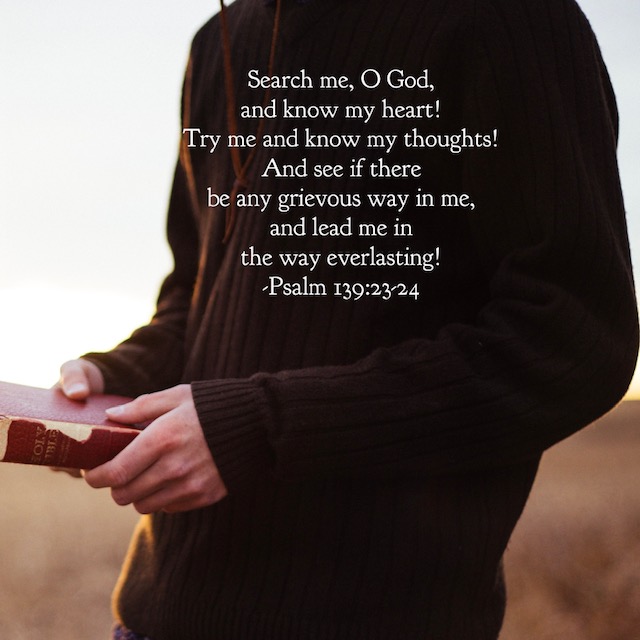
Like the psalmist, we need to regularly invite God to “Search me, O God, and know my heart! Try me and know my thoughts! And see if there be any grievous way in me, and lead me in the way everlasting” (Psalm 139:23-24). “Examine me, O LORD, and prove me; Try my mind and my heart” (Psalm 26:2). Paul tells us to examine ourselves before taking communion.

God “disciplines us for our good, that we may share his holiness. For the moment all discipline seems painful rather than pleasant, but later it yields the peaceful fruit of righteousness to those who have been trained by it” (Hebrews 12:10b-11).

We don’t approach a stern judge who is ready to bang his gavel. We come to one who sympathizes with us in grace. “Since then we have a great high priest who has passed through the heavens, Jesus, the Son of God, let us hold fast our confession. For we do not have a high priest who is unable to sympathize with our weaknesses, but one who in every respect has been tempted as we are, yet without sin. Let us then with confidence draw near to the throne of grace, that we may receive mercy and find grace to help in time of need” (Hebrews 4:14-16).

So don’t search the Bible or pray only for assurance and affirmation. Let God’s Word and Spirit do their sanctifying work of searching you and correcting you. The process may not be pleasant, but His cleansing ultimately brings great peace and joy.

(I often link up with some of these bloggers.)
Tips for Finding a New Church Home

I wrote a couple of weeks ago about ways churches could help visitors to find out more about their church. I thought it only fair to look at the other side of the coin: how can new visitors to a church help their visit to go well?

We have many options to watch churches online. But we miss so much if we just observe from afar rather than taking the time to participate with others of like faith. Yes, all Christians belong to the church as a whole. But it’s in our individual congregations where we serve, learn, grow, build each other up, practice the “one anothers” in the Bible.

It’s disconcerting to look for a new church home. On one hand, we don’t want to flounder around for long. On the other, we want to take time to make the best decision. Meanwhile, we feel adrift until we find the place where we feel we belong and can serve.

These are some factors that have helped us when visiting churches.

1. Pray for God’s wisdom and direction, not just before your search, but all during it.

2. Decide what’s most important to you. Obviously, you want to find a church that preaches truth from the Bible. But as I mentioned in the previous post, it’s possible in cities like ours to find hundreds of churches with the same statement of faith, the same core beliefs that we ascribe to. So sometimes we end up weighing secondary issues, like:

Traditional vs. contemporary style of service and music
“King James Only” or other Bible versions
Casual or formal
Expositional or topical preaching
Continuationist or cessationist (referring to certain gifts of the Holy Spirit)
Reformed or not
Age-segregated or family-integrated
Songleader and choir or worship team
Premillennial, post-millennial, amillennial (referring to “end times”)

We can acknowledge that no one’s salvation is dependent on their views of these secondary issues, and Christians have freedom of conscience in some of these areas to choose what they think best. But if you feel strongly one way, you’re going to be uncomfortable in a church that practices another way.

And then there are issues like programs for the various family members, preferences for a large or small church, etc. But I would encourage folks not to be too rigid about programs and church size. We were hesitant about our last church because it had fewer than 25 people, and we didn’t want to be in a church that small. But we loved the church and the people, and it had a real family feeling to it. There are advantages to large and small churches–neither is right or wrong. If you’ve been used to one, maybe give the other a try. And personally, I am less interested in programs than I used to be.

3. Research. Asking people you know for church recommendations is often a good place to start. But it’s vital to research churches on your own as well.

Thankfully, these days most churches have at least basic websites where you can find a statement of faith. Most church sites will tell you a little more about themselves (though, after you’ve looked at several, they all begin to sound alike. One of my pleas in the previous post was for church websites to tell what’s distinctive about the church as much as possible). Many church web sites will have audio or video recording from previous services, which helps you know what the worship and preaching styles of the church are. We also like to look at information about the pastoral staff. Where a pastor has gone to school or what organizations he has served with will shed light on where he is coming from.

Many churches have a Facebook page. Some will have more information there than on their web site.

Sometimes we’ve looked up the pastor’s Facebook profile if we don’t find much information on the church’s website or Facebook page.

Doing as much research as possible ahead of time will help you narrow down your church choices and hopefully avoid unpleasant surprises.

4. Arrive early for your first visit. We try to leave early for our first time at a church for several reasons: we don’t know what traffic will be like; we like to find out where to go and where bathrooms are; we want to allow time to chat if people stop to introduce themselves.

5. Be friendly. Many church members fail in greeting first-time visitors. But we can make it easier by being approachable, friendly, open-faced, even introducing ourselves first. If we scowl or avoid eye contact or arrive late and leave as soon as possible, we’re not giving people a chance to welcome us.

6. Go to a smaller service. Usually we just go to the main service for our first visit to a church. If all goes well, then we’ll go to Sunday School or a midweek prayer meeting. Those meetings are often where people are more open and friendly—I don’t know if it’s because the group is smaller, or they regard visitors to those services as less likely to be just passing through.

7. Go more than once. Unless something glaring comes up in our first visit, we go to a church we are considering at least twice, and usually much more often.

8. Don’t judge; give grace. At the church we belonged to when we were first married, we had a visitor once who griped about several things. While we were glad to have problems pointed out so we could correct them, it was dismaying that this man had so many complaints, and that he voiced them his first time there.

Sometimes things might be a little off during your visit—that’s one reason we try to go more than once. Sometimes the sound system will have problems one morning or someone will flub the announcements or misspeak. There might be dust and debris on the bathroom floors; maybe a cleaning crew member was sick or missed their rotation. Any number of things can go wrong–or at least not as well as hoped.

9. Jot down questions as they arise. We don’t usually fill out a visitor’s card. If we visit a couple of times and decide to move on, we don’t want to keep receiving letters or phone calls from a church.

But if we attend over several weeks, questions might come up about the pastor’s or church’s stand on particular issues. Sometimes we ask about those when chatting with the pastor after a service. Sometimes my husband will call the pastor during the week. Usually if we’re seriously considering membership, we’ll meet with the pastor or invite him and his family for dinner. We’ve found most pastors to be very open to questions.

10. There is no perfect church. A church is made up of imperfect people, so of course it’s not going to be perfect. We know that on one level, yet it’s easy to go from church to church without finding one that’s “just right.” With so many churches close by, it’s easy to think the ideal one with all the features we want might be the next one. And if family members disagree about what features they want, the decision is even harder.

The church my husband grew up in was the only Baptist church in an area dominated by a different sect. The church members just had to learn to get along and set aside their differences, because there was nowhere else to go. That’s not a bad scenario.

Lastly, don’t be like Mr. Bean. 🙂 I don’t know how everyone around him kept a straight face.

You want to look for a place where you can serve, not just a place where you can receive benefit. But for us, looking for specific ways to serve (beyond greeting, praying for people, showing kindness, pitching in, etc.) comes later as we see the needs and see where we best fit.

Eventually, God will lead us to the local church we can call home and settle into.

What has helped you as you have looked for a new church home?

(I often link up with some of these bloggers.)

Love Does Not Eliminate Hard Things

Imagine your best family friend and mentor was a skilled physician. If someone in your family got seriously ill, your doctor friend would be the first person you’d call. And though your friend had other responsibilities, you’d expect him to come as soon as he could.

Mary and Martha must have felt that way when Lazarus was sick. Jesus was not a doctor, but He was a healer. He was their friend. They knew He was the Messiah, though they didn’t understand fully how His role would work itself out. But they had every reason to expect that Jesus would come to them right away.

But He didn’t.

Now Jesus loved Martha and her sister and Lazarus. So, when he heard that Lazarus was ill, he stayed two days longer in the place where he was” (John 11:5-6).

Knowing that Lazarus was ill, and the family wanted Him to come, Jesus delayed. He didn’t wait an hour or a day. He waited two days.

What struck me in my recent reading of this familiar passage was the little word “so.” The passage doesn’t say, “Jesus loved them, but he stayed.”

It doesn’t say, “In spite of the fact that Jesus loved them, He delayed.”

Instead, “He loved them. So He waited.”

He waited because he loved them.

If you’re not familiar with the story, Lazarus dies before Jesus comes. By the time Jesus arrives, Lazarus has been in the tomb four days. Mary and Martha are crushed and greet Jesus with, “Lord, if you had been here, my brother would not have died.”

But the story doesn’t end there. Jesus raises Lazarus from the dead.

Why didn’t He come before Lazarus died and save everyone the heartache by healing him?

Jesus told the disciples, “Lazarus has died, and for your sake I am glad that I was not there, so that you may believe.”

Jesus told Martha, “Did I not tell you that if you believed you would see the glory of God?

Just before He raised Lazarus, He prayed, “Father, I thank you that you have heard me. I knew that you always hear me, but I said this on account of the people standing around, that they may believe that you sent me.”

He wanted them to know who He was and believe in Him. The disciples and Mary and Martha knew, but He wanted to manifest Himself to them in deeper ways. The crowd was a mixture of people, many of whom did not know Him yet.

Jesus had healed a girl not long after she died and a young man at his funeral. But someone could have said, “Maybe they weren’t really dead in the first place. Maybe He just revived them.”

But Lazarus had been buried for four days. When Jesus told men to roll away the stone in front of the tomb, Martha objected because of the odor that would arise from his corpse. There’s no question that Lazarus was actually dead.

Jesus could have performed a miracle to heal Lazarus beforehand. But He performed a greater miracle by raising him from the dead, that His friends might be strengthened in their faith and that others might believe.

Jesus’ raising of Lazarus was a precursor not only of Jesus’ future resurrection, but of that of all believers. How many people through the ages have been comforted by what Jesus told Martha: “I am the resurrection and the life. Whoever believes in me, though he die, yet shall he live, and everyone who lives and believes in me shall never die.”

Jesus showed His love in other ways as well.

He came to Mary and Martha though His life was in danger. When Jesus told the disciples He was going to Judea, they reminded Him the Jews there wanted to stone Him. When He insisted, Thomas was so sure of danger that he said, “Let us also go, that we may die with him.”

Jesus was “deeply moved” and wept, even though He was about to raise Lazarus. “He had to be made like his brothers in every respect, so that he might become a merciful and faithful high priest in the service of God” (Hebrews 2:17).

We often want to remove all the hard places from the lives of those we love. As parents especially, we want to make things as easy as possible for our children. And that’s not a wrong desire. But it’s often through the hard things that we grow in our faith and in our character. “Suffering produces endurance, and endurance produces character, and character produces hope, and hope does not put us to shame, because God’s love has been poured into our hearts through the Holy Spirit who has been given to us” (Romans 5:3-5). That doesn’t mean we go too far the opposite direction and heap hard things on them. We need God’s wisdom and balance.

God doesn’t take away all the hard parts of life. He uses them to deepen our knowledge of Himself, strengthen our faith, to mature us, to comfort us that we may comfort others.

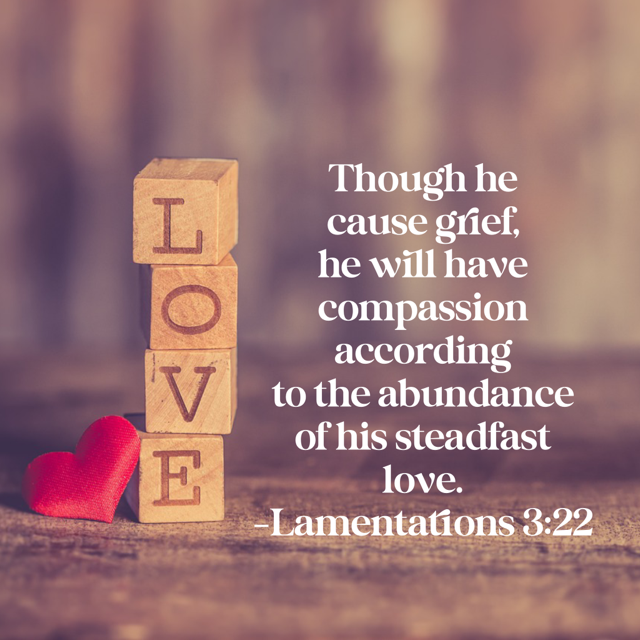
“Though he cause grief, he will have compassion according to the abundance of his steadfast love; for he does not afflict from his heart or grieve the children of men” (Lamentations 3:32-33).

(I often link up with some of these bloggers.)

To Be a Clod

Amy Carmichael was one of Elisabeth Elliot’s heroes, and both women are heroes of mine.

Recently a newsletter from the Elisabeth Elliot Foundation closed with this poem by Amy Carmichael, which Elisabeth had quoted in one of her radio broadcasts:

From prayer that asks that I may be
Sheltered from winds that beat on Thee,
From fearing when I should aspire,
From faltering when I should climb higher,
From silken self, O Captain, free
Thy soldier who would follow Thee.

From subtle love of softening things,
From easy choices, weakenings,
Not thus are spirits fortified,
Not this way went the Crucified;
From all that dims Thy Calvary,
O Lamb of God, deliver me.

Give me the love that leads the way,
The faith that nothing can dismay,
The hope no disappointments tire,
The passion that will burn like fire;
Let me not sink to be a clod;
Make me Thy fuel, Flame of God.

—Amy Carmichael

 I first read this poem as a young adult. I may have been in college or a newlywed when I first read Amy Carmichael of Dohnavur by Frank Houghton. I couldn’t help but be inspired by Amy’s fervor, courage, and determination to follow God wherever He led her. She became a missionary to India. It might be more correct to say she made India her home for the rest of her life.

There’s something about youth that is inherently passionate. Most young people have a burning desire to make their lives count, to make a difference, to further a cause bigger than themselves.

But after several decades, we tend to get more settled, don’t we?

Being settled isn’t always a bad thing. Though I continue to learn and grow, I am more settled in my convictions, less like “children, tossed to and fro by the waves and carried about by every wind of doctrine, by human cunning, by craftiness in deceitful schemes” (Ephesians 4:14).

I’m more settled in my self-image. I’ve never been super-model material, but I am okay with that now.

I’m more settled in my marriage. After forty-three years, my husband and I know each other pretty well. We’ve worked out our differences and learned to complement (and compliment) each other. We still find plenty to talk about.

But I hope I never become settled in the sense of complacency in my faith and walk with God, to let “easy choices” of “silken self” give way to the “subtle love of softening things.” We can be more inclined to do so as our physical capacity begins to decline.

I’ve often wondered at Amy’s use of the word “clod” in the next-to-last line. After the beautiful phrasing in the rest of the poem, “clod” seems like a jolt, like stubbing your toe on a rock. I would guess Amy probably did that on purpose.

A quick look in the dictionary shows that a clod is a lump, usually of dirt or clay. But it’s also a term used for an oaf or dolt. Amy may have meant the word in the latter sense. But I like to think of it as a lump, especially since she spoke of sinking to be a clod.

I’m not a soil specialist; I am not even a gardener. But when I think of a clod, it seems like it has three possibilities for its future.

First, it could erode. Wind and rain could chip off tiny bits of it until nothing is left.

It could get harder due to the sun beating down on it while it just sits there.

Or it could be tilled, broken up into useful soil again.

The last thought brings to mind Hosea 10:12: “Sow for yourselves righteousness; reap steadfast love; break up your fallow ground, for it is the time to seek the LORD, that he may come and rain righteousness upon you.”

The ways God has used me have changed over the years with age, health issues, life circumstances. I can’t (and don’t even desire to) do things I once did.

But that was true of Amy, too. After a fall, she became an invalid for the last twenty years of her life. How she ministered to others changed. But she still followed hard after God in her heart, met with people as she was able, wrote books, sent notes of encouragement to her coworkers and inhabitants of the orphanage and hospital on the Dohnavur complex.

Of course, age and declining abilities are not the only contributors to cloddishness. It’s easy at any age to settle into a cozy lump of inertia.

May God give us hearts soft and pliable to His leading and will rather than soft to comfort and pleasures.

(I often link up with some of these bloggers.)

How Churches Can Help Visitors

In our four decades of marriage, we’ve been a member of six different churches and visited several others. Most of the time, a change in church has been made necessary due to my husband’s job sending us to a new state. A couple of times, we left for other reasons, but we don’t take leaving a church lightly. We like to find a church home and stay there as long as possible.

It’s amazing how intimidating it is to visit a new church, even for seasoned church attenders. I’m not sure why. We don’t expect anyone to throw stones or tomatoes or snub us. Though church styles vary, we have an idea what to expect. If it’s so unnerving for us to visit a new church, unchurched people are probably even more uncomfortable.

We’re currently searching for a new church home. I wanted to share just a few “stray thoughts” about our church visiting experiences while they are fresh in my mind.

First of all, I feel a church website is absolutely essential. In our case, we attend Baptist churches. If you search online for Baptist churches in Knoxville, you’ll find multiple pages of listings. I found one directory listing 25, but there are more. They all have basically the same statement of faith, so we’d agree on the most important core beliefs, like Jesus being the Son of God, salvation by grace through faith, the inspiration of the Bible, etc.

But churches with the same doctrinal base can vary greatly in personality and in secondary issues, like the following:

Traditional vs. contemporary style of service and music
“King James Only” or other Bible versions
Casual or formal
Continuationist or cessationist (referring to certain gifts of the Holy Spirit)
Reformed or not
Age-segregated or family-integrated
Songleader and choir vs. worship team
Premillennial, post-millennial, amillennial (referring to “end times”)

No one’s salvation is going to be in question on either side of these secondary issues. And there are some categories that we would be fine with on either side, though we might have a preference for one or the other. But others we feel more strongly about. We can grant that other believers have freedom of conscience to do something differently than we would, but we would have a hard time worshiping in a place where we disagreed with a lot.

So if we were to try to visit each of the list of 25 churches just once, that would take us 25 weeks—almost half a year. Normally we like to visit more than once, unless there’s something glaringly obvious during the first visit that would make us shy away. So we could spend more than a year visiting around. We’d like to find a church home in much less time.

It’s pretty standard now to look up a church’s web site before visiting. It’s helpful if the church’s site can tell us as much about the church as possible.

One church’s site said something like, “We don’t like labels. We just like to talk about Jesus.”

My husband’s father worked in a grocery store. He was allowed to bring home canned goods that had lost their labels, because customers would not buy them. If my mother-in-law was looking for tomato sauce, she might open cans of peaches, green beans, or SpaghettiOs before finding what she needed.

So labels do help. We would assume most Christian churches like to talk about Jesus. Anything they can share about the distinctives of their church will help visitors know if they want to investigate further or not. As my husband said, they might as well tell us what they are, because we’re going to find out eventually anyway. Some people are going to be looking for certain particulars while others are trying to avoid them. It saves everyone time if some of these things are spelled out up front.

Besides the statement of faith on a church website, we like to see times of services, some information about the pastor(s), a place to access past sermons or full church services (audio or video), information about the various ministries of the church. Some church sites have a “What to expect” or “How to prepare for your visit” page that might include style of dress (though most of them say anything is fine within reason), which door to go to, etc.

If a church has a Facebook page, it helps if the page contains more than just location and times of services. Many churches will put their services on Facebook, which helps. Some will put announcements or reminders. Some will have photos from recent events. All of that helps give potential visitors a feel for the church. Some churches will have a public Facebook page for potential visitors and a separate private page for members where they can share prayer requests or information that is not for the general public.

Then, once people do actually come to your church, appropriate signage is helpful, especially if you have multiple buildings or doors. Barring signs—or maybe in addition to signs—it’s nice to have someone available to answer questions about where the nursery, bathrooms, etc., are.

When we’ve been members, greeting new people has been one of the hardest things to do. But it’s essential. Once I get started, I am usually fine.

I could tell you multiple stories of odd greeting situations in churches, but that would take too long. I’ll share just one. In one church, no one spoke to us or even looked at us until their designated hand-shaking time (what my daughter-in-law calls “howdy time”). And then it was like some weird science fiction show where everyone came alive and became friendly while the music played. Then when the music stopped, everyone closed up again, not looking at or talking with us any more.

Some churches have a designated greeter at the door. Though that’s nice, those people shouldn’t be the only ones greeting newcomers.

On the other extreme, I read of a church that stationed an official greeter every 25 feet. That’s going too far the other way, unless you have a humongous church building.

It’s best just to sincerely and warmly say hello to people you don’t recognize, maybe “We’re so glad to have you.” If there is time, you could ask whether they just moved to the area, where they moved from, etc.

In our most recent visits, almost every church has had an older lady who has greeted us in just such a way, going beyond the perfunctory and obligatory greeting. They’ve been so genuinely interested and kind that I have felt, “If we stay here, she’s one I want to get to know.” I wanted to say that to encourage older people in general that, even though you may not be able to do all you once did, this seemingly minor act carries great weight.

Most visitors do not want to be made a spectacle or have attention drawn to themselves. Some churches will have new people stand up—one had visitors stay seated while everyone else stood for the hand-shaking time. Both scenarios are uncomfortable.

Some churches have had gift bags for visitors. I appreciate the thought, but gifts are not really necessary. One church had plastic cups that had the church’s name on the side. Because this church was a little aggressive about handing out gift bags, we ended up with six of those—that none of us wanted. They tried to give us more the next week, and we had to gently but firmly say no, thank you. Another had mugs with the church name, but also filled them with candy. A lot of churches will have pens with their name on the side that they hand out along with visitor’s cards to full out. The pens are a nice small reminder of the church. The one gift bag I most appreciated was from a particularly large church and had brochures about their various church ministries–what they did, when and where they met, who to contact for more information. And they had a few miniature candy bars, a plus. 🙂

Then during the church service, it helps to have what is expected made very clear–when to stand, join in the singing, etc. No one wants to stand out by doing the wrong thing at the wrong time. One church we visited was the first I’d attended with a worship team on stage. They had a choir as well. Sometimes everyone on stage was singing, sometimes just the small team in front. But no one told the congregation when it was their turn. I tried to figure out when I was supposed to sing by watching what others in the congregation did, but some sang and some didn’t. So I still didn’t know what to do. I ended up singing along very softly so I wouldn’t be noticed either way.

Sometimes you are as friendly as you know how to be in church, you’ve extended yourself, you’ve bent over backwards to meet everyone’s needs and wants, the singing has been great, the message has been biblically based and Spirit-filled–and visitors still don’t return. Have all your efforts been for naught? Have you failed?

No. You’ve ministered to people as unto the Lord. That “counts,” whether they become part of your church or not. Sometimes when we have chosen one church over another, it hasn’t been because of anything wrong with the one we didn’t choose. Sometimes there’s something indefinable about why we feel inclined more toward one church. But we appreciate the ways people have ministered to us when we’ve visited, and we hope to extend the same grace when we find a church home.

What are your thoughts? Are there other ways to make church visitors feel welcome—or at least less intimidated?

(I often link up with some of these bloggers.)

Be Your Own Unique Style of Grandparent

Be Your Own Unique Style of Grandparent

I’ve only been a grandparent for eight and a half years, and I only have one grandchild. So I am not an expert. I’m still learning how best to navigate this phase of life.

But one piece of advice I read in a forgotten source has stayed with me. The writer had a granddaughter whose other, wealthier grandmother loved to take the child shopping.

The writer’s budget was a little tighter, and she couldn’t afford many shopping forays. So she faced a dilemma when her granddaughter wanted to be taken shopping. This writer’s solution was to say, “Your other grandmother is the shopping grandma. I’m the baking grandma.” She and her granddaughter spent fun time in the kitchen.

I thought that was such a neat idea. We don’t have to compete with the child’s other grandparents or even parents. We don’t have to follow Pinterest or Instagram influencers, though we can learn from them. We can grandparent in our own unique style and way.

And we don’t even need to specialize in one area. I had hoped to be the reading grandma, but my grandson isn’t particularly interested in reading when he is here. Though we can share our interests, it’s best not to push them. It’s better to share their interests.

We’ve done a few crafty things together, colored, played games, baked cookies. But mostly I just want to be available to him, to listen to him, to let him know that his grandfather and I love him very much.

I only had two grandparents growing up. My father’s father died before I was born. My mother’s mother passed away when I was four, so I have only hazy memories of her.

My mother’s father was a big tease and had a distinctive laugh. My mom would sometimes make us kids coffee–really just a lot of sugar and milk with just a little coffee. But we felt so grown up when we drank it. When my grandfather saw us drinking our special brew, he would tease, “If you drink coffee, hair will grow on your chest.” My grandfather had a lot of “If-then” predictions, and I knew he was teasing–but I still checked sometimes just to be sure.

We lived with him for a few years when I was young. For a while, he drove me to a friend’s house in the mornings so I could ride to school with them (I assume everyone else’s work schedules didn’t allow them to take me). It seemed like every time we were in the car together, two songs always came on the radio: “Mairzy Doats” and “Mr. Lonely.” I can’t think of those songs without thinking of my grandfather.

When we moved to another city, he would come to visit and always brought Dunkin Donuts. No matter when I woke up in the mornings, I could hear him and my mom talking in the kitchen over a cup of coffee.

He married again, and I don’t remember much about his second wife. Not long after they married, she developed dementia. She was very dependent on him. Friends urged him to place her in what we would now call respite care so that he could go hunting with them, an activity he loved. When he came back, the facility she was in had her tied down in a chair (I assume because she tried to wander off, looking for him. Restraints like this are not allowed now). He said, “Never again,” brought her home, and cared for her the rest of his life. When she died, he lamented to my mom that he didn’t know why the good Lord gave him two good women and then took them away.

He was also heavily involved in the Boy Scouts, and we used to visit their Jamboree every year and see him.

My father’s mother had kids in Texas, Louisiana, and Alabama, and she divided her time among them. The “Galloping Gourmet” was a thing then, and we called my grandmother the “galloping grandma” due to her many travels around the Gulf coast.

For a couple of summers, I got to travel with her to visit relatives. I enjoyed the time with her as well as getting to know aunts and uncles and cousins I didn’t see often otherwise.

When she lived nearby, she often had me over to spend the night. She loved to read, and one of my favorite memories is of us sitting up in separate twin beds in her room, reading before bedtime.

She loved to crochet. Almost any time she was sitting still, she was working on a crochet project. I especially liked the trim she crocheted around doilies and handkerchiefs. I never did learn crochet, but I like to think my love of crafts and needle arts was inspired by her. She and my aunt also made clothes for me in my childhood.

I don’t recall that she had a garden, but her sister, my aunt Jewel, had a large one. They loved fresh vegetables.

When my grandmother was away, she would write me letters. My first forays into writing consisted of composing letters to her. We wrote back and forth all her life.

She could be a little harsh in her discipline. But we knew that she loved us.

I don’t remember either of my grandparents giving me direct spiritual instruction. But I knew they both loved God in their own way. My grandfather and aunt took me to the Lutheran church in my earliest years, and I think he was responsible for my attending a Lutheran school in first and second grade. When I was with my grandmother, it was understood that we’d be attending her Baptist church. Their faith shaped their morals, values, and conversation.

I look forward to making memories with my grandson, Timothy. But most of all, I hope I can have the same influence as the biblical Timothy’s grandmother had on him. “I am reminded of your sincere faith, a faith that dwelt first in your grandmother Lois and your mother Eunice and now, I am sure, dwells in you as well” (2 Timothy 1:5). Later, Paul admonished Timothy to “continue in what you have learned and have firmly believed, knowing from whom you learned it and how from childhood you have been acquainted with the sacred writings, which are able to make you wise for salvation through faith in Christ Jesus” (2 Timothy 3:14-15).

God gives grandparents responsibility to pass his truth along to the next generation:

Only take care, and keep your soul diligently, lest you forget the things that your eyes have seen, and lest they depart from your heart all the days of your life. Make them known to your children and your children’s children (Deuteronomy 4:9).

One generation shall commend your works to another,
    and shall declare your mighty acts.
On the glorious splendor of your majesty,
    and on your wondrous works, I will meditate.
They shall speak of the might of your awesome deeds,
    and I will declare your greatness.
They shall pour forth the fame of your abundant goodness
    and shall sing aloud of your righteousness (Psalm 145:4-7).

They say that most of what we teach our children is “caught” rather than “taught.” I think that’s probably especially true of grandchildren. We won’t have as much directly instructive time with them as their parents do. But hopefully, through our love, our lives, our testimony, and our words, we can have a great influence on them for God. That’s my prayer.

O God, from my youth you have taught me,
    and I still proclaim your wondrous deeds.
So even to old age and gray hairs,
    O God, do not forsake me,
until I proclaim your might to another generation,
    your power to all those to come (Psalm 71:17-18).

Psalm 71:17-18

(I often link up with some of these bloggers.)
What Does God Want Us to Continue?

There is something exciting about a bright, shiny, new beginning, isn’t there? A new project, a new start, a new book, a new year, a new routine. Whatever happened before, we can start fresh.

Perhaps that’s the appeal of New Year’s resolutions, even though most people confess to not keeping them or even making them even more.

Granted, we all need to make time to take stock, to adjust our routines, to see what needs to change—whether we do that on Jan. 1 or some other time.

But sometimes we need to set our faces and purposes once again to continue something we’ve already started, to stay the course, to keep going.

A few weeks ago, the pastor of the church we were visiting spoke from Colossians. I happened to notice the word “continue” in a couple of places in the book, which brought to mind a couple of other verses that used the word. I looked into the word more after I got home and then again last week.

What does God want us to continue?

Fearing the Lord: Let not your heart envy sinners, but continue in the fear of the Lord all the day (Proverbs 23:17, ESV).

Being in His Word:If ye continue in my word, then are ye my disciples indeed (John 8:31, KJV; ESV says “abide”).

In His love: “As the Father hath loved me, so have I loved you: continue ye in my love (John 15:9, KJV, ESV says “abide”).

Gathering with other believers to pray, fellowship, learn doctrine: “These all continued with one accord in prayer and supplication, with the women, and Mary the mother of Jesus, and with his brethren . . . And they continued stedfastly in the apostles’ doctrine and fellowship, and in breaking of bread, and in prayers” (Acts 1:14; 2:42, KJV; ESV has “devoting themselves.” Though this is not a command here, it is in Hebrews 10:25).

They went out from us, but they were not of us; for if they had been of us, they would have continued with us. But they went out, that it might become plain that they all are not of us” (1 John 2:19, ESV).

Speaking His Word with boldness: “And now, Lord, look upon their threats and grant to your servants to continue to speak your word with all boldness” (Acts 4:29, ESV).

In His grace: “And after the meeting of the synagogue broke up, many Jews and devout converts to Judaism followed Paul and Barnabas, who, as they spoke with them, urged them to continue in the grace of God” (Acts 13:43, ESV; also “continue” in the KJV).

In the faith: “Strengthening the souls of the disciples, encouraging them to continue in the faith, and saying that through many tribulations we must enter the kingdom of God” (Acts 14:22, ESV; also “continue” in the KJV).

“If indeed you continue in the faith, stable and steadfast, not shifting from the hope of the gospel that you heard, which has been proclaimed in all creation under heaven” (Colossians 1:23, ESV; same in KJV).

In His kindness: “Note then the kindness and the severity of God: severity toward those who have fallen, but God’s kindness to you, provided you continue in his kindness. Otherwise you too will be cut off” (Romans 11:22, ESV; also “continue” in the KJV).

In prayer: “Continue steadfastly in prayer, being watchful in it with thanksgiving” (Colossians 4:2, ESV; also in KJV).

In what you have learned and believed: “But as for you, continue in what you have learned and have firmly believed, knowing from whom you learned it and how from childhood you have been acquainted with the sacred writings, which are able to make you wise for salvation through faith in Christ Jesus” (2 Timothy 3:14-15, ESV; also in KJV).

Continue in doctrine: Meditate upon these things; give thyself wholly to them; that thy profiting may appear to all. Take heed unto thyself, and unto the doctrine; continue in them: for in doing this thou shalt both save thyself, and them that hear thee” (1 Timothy 4:16, KJV; ESV, “persist”).).

In brotherly love: “Let brotherly love continue” (Hebrews 13:1, ESV; also in KJV).

In the perfect law of liberty: “But he who looks into the perfect law of liberty and continues in it, and is not a forgetful hearer but a doer of the work, this one will be blessed in what he does” (James 1:25, NKJV; “perseveres” in the ESV).

Though this same concept may be displayed in other words (abide, dwell), these passages give us plenty to think about for the moment, don’t they?

With all the excitement of the new, let’s not forget the foundation and steadiness of the old.

Mac Lynch wrote a beautiful song incorporating the words of 2 Timothy 3:14: “Continue thou in the things thou hast learned.” He wrote this when he was the music director at The Wilds Christian Camp. I don’t know if this is how the song was used, but I can imagine it being sung the last night of camp week, urging campers to continue on with the Lord, not to make decisions at camp and then forget them when back in their regular worlds. I know it won’t be familiar to most of you, but I hope you’ll give it a listen and be blessed and encouraged by it:

And of course, the only way to continue these things is if we had at one time begun them. If you haven’t, this as as good a day as any to do so. Especially if you don’t know Jesus as your personal Lord and Savior, I invite you to learn more here.

(I often link up with some of these bloggers.)
Everyday Hallelujahs

Last Sunday, as I set the table for breakfast, the music I was listening to on BBN Radio transitioned to the “Hallelujah chorus” from Handel’s magnificent oratorio, The Messiah.

Just a couple of weeks before, we had attended a Christmas concert in which the “Hallelujah chorus” was performed. The audience stood as one when the first notes were played, a tradition said to have begun with King George on his very first hearing of this tribute to the King of kings.

So in my kitchen, I almost felt like I should pause at attention while the chorus played. Was it disrespectful, even sacrilegious, to keep placing silverware and stirring eggs while such praise to God played in the background?

There will come a time when all other endeavors will cease and everyone will praise the King.

After this I looked, and behold, a great multitude that no one could number, from every nation, from all tribes and peoples and languages, standing before the throne and before the Lamb, clothed in white robes, with palm branches in their hands, and crying out with a loud voice, “Salvation belongs to our God who sits on the throne, and to the Lamb!” And all the angels were standing around the throne and around the elders and the four living creatures, and they fell on their faces before the throne and worshiped God, saying, “Amen! Blessing and glory and wisdom and thanksgiving and honor and power and might be to our God forever and ever! Amen” (Revelation 7:9-12).

I can only imagine what a glorious day that will be. We get a little foretaste of it now in church, when we lay aside our ordinary pursuits of the week to gather with God’s people and sing His praises together.

But worship isn’t just for Sundays or public gatherings. We don’t acknowledge God on Sundays and then go back to our regular work without giving Him any more thought.

We can worship Him in everything we do because He is with us and has given us all we have.

I have set the Lord always before me;
because he is at my right hand, I shall not be shaken.

Therefore my heart is glad, and my whole being rejoices;
my flesh also dwells secure.

You make known to me the path of life;
in your presence there is fullness of joy;
at your right hand are pleasures forevermore (Psalm 16:8-9, 11).

If then you have been raised with Christ, seek the things that are above, where Christ is, seated at the right hand of God. Set your minds on things that are above, not on things that are on earth (Colossians 3:1-2).

So, whether you eat or drink, or whatever you do, do all to the glory of God (1 Corinthians 10:31).

God reigns over creation and nations. But He also reigns over homes and kitchens. We don’t have to wait til heaven or even Sunday to praise Him. We can raise our hallelujahs for everyday blessings as well as the major events of life, in joy as well as trouble and sorrow.

So I continued folding napkins, setting out condiments, flipping over the hash browns, and pulling out the crescent rolls while singing in my heart.

The Lord God omnipotent reigneth!

He shall reign for ever and ever!

Hallelujah!

Hallelujah!