God Uses Flawed People

Recently I was praying for someone who had walked away from church and possibility Christianity. Humanly speaking, he had good reason. Christians aren’t always the best representatives of what they are supposed to believe.

A parachurch organization that reached out to teens in my public high school was an important influence in God’s drawing me to Himself. Years later, my understanding of Biblical doctrine led me to a place that I could no longer support them.

My husband and I had a discussion last week about an institution we had both been a part of. There were glaring problems in the policies as well as in the prevailing attitudes of individuals.

Yet my sense during my time there was not, “Ugh, this is such an awful place.” I was aware of some problems, and came to understand others later. Yet God used that place to ground me in my faith and draw me closer to Himself. How can that be?

How can it be that an organization or group of people can be used of God while so flawed?

As our church has studied through the first few books of the OT, we’ve seen that God’s people have never been a showcase of pristine saints. One man in another church we were in, when asked in Sunday School what he was learning from the OT narratives, said, “If God can use and have mercy on those rascals, there’s hope for me.”

Some of the Biblical people that God used in a major way failed spectacularly.

This doesn’t mean we set the bar low. Our goal is not to be like the lowest examples in the Bible of those who followed God. Our goal is to be like Christ. We’ll never reach that goal this side of heaven. But as we behold Him in His Word, we should be growing in grace more and more like Him.

And depending on Him, filled with His Spirit, we can show His grace and patience to those who fail and falter.

Yes, there are times to walk away from a particular person or church or institution that strayed far from what it should be and will not listen to counsel. But if we “cancel” everyone who doesn’t live and believe perfectly, we’ll have no one left.

When we stand before God some day, we’ll give an account of ourselves, not anyone else. Though others will have to give an account of their failures, we won’t be able to blame them for our own. God has promised His grace for every trial, His way of escape for every temptation, His strength in our weakness. If everyone we ever knew failed us, He never will. “And God is able to make all grace abound to you, so that having all sufficiency in all things at all times, you may abound in every good work” (2 Corinthians 9:8).

When people talk about forsaking institutional religion because it’s so flawed, I want to ask, “Have you ever read Corinthians?” Talk about a messed-up church. Yet neither God nor His apostle forsook it. They took time to correct and admonish. If the Corinthians had refused to hear and rebelled, that would have been a different story. But they took the apostle’s warnings to heart. They made some changes immediately, but I am sure their overall growth was probably a slow process.

Isn’t that the way for us as well? If we’re still growing in grace and the knowledge of the Lord, we should be farther along now than we were a few years ago. But we still mess up. We still stumble over besetting sins. On our worst days, we’re far from the shining testimony we should be.

This is not an excuse. We’re accountable when we offend someone or make them stumble. We need to walk circumspectly and confess our sins to God and those we sin against.

Yet we also don’t forsake God’s people as a whole because of their flaws. The church is Christ’s bride, our brothers and sisters in Him. We don’t excuse or ignore flaws. Sometimes confrontation is necessary. But we also look for the grace. Instead of writing someone off or retaliating when they fail, we pray for them and seek to point them in the right direction, remembering we’re part of the same family. We love and serve and encourage and forgive and forbear. Because He did that for us.

Peter denied Jesus. James and John jockeyed for position and wanted to call down fire from heaven on those who didn’t run in the same circles. They fell asleep instead of supporting Him, argued with Him, thought they knew better than Him. But Jesus kept working with them, and look at them a few years later. That transformation is what we long for and pray for, for ourselves and others. Thank God for His longsuffering and mercy and grace.

Put on then, as God’s chosen ones, holy and beloved, compassionate hearts, kindness, humility, meekness, and patience, bearing with one another and, if one has a complaint against another, forgiving each other; as the Lord has forgiven you, so you also must forgive. And above all these put on love, which binds everything together in perfect harmony. And let the peace of Christ rule in your hearts, to which indeed you were called in one body. And be thankful (Colossians 3:12-15).

Let us hold fast the confession of our hope without wavering, for he who promised is faithful. And let us consider how to stir up one another to love and good works, not neglecting to meet together, as is the habit of some, but encouraging one another, and all the more as you see the Day drawing near (Hebrews 10:23-25).

(I often link up with some of these bloggers.)

Objectionable Elements in Books and Film

Christians vary widely in what they consider objectionable material.

On one side are those who don’t restrict themselves from reading or watching just about anything. Any suggestion that some material might not be appropriate is met with accusations of legalism and censorship.

On the other side are those who, if they applied their preferences to everything they read, would not even be able to read their Bibles.

Most of us are somewhere in-between.

The difficulty is that the Bible doesn’t give us specifics such as: these words are okay, these words are not, these words are tolerable up to three times. Only this amount of skin is acceptable. These sins are okay to read about, but these are off limits.

So we have to draw from other truths and principles in the Bible. But we have to make sure we’re not pulling one thread and disregarding others.

Some would immediately go to Philippians 4:8: “Finally, brothers, whatever is true, whatever is honorable, whatever is just, whatever is pure, whatever is lovely, whatever is commendable, if there is any excellence, if there is anything worthy of praise, think about these things.” A great verse. Our mental health would be much better if we followed this verse.

But is this verse saying we can’t watch war movies? Or murder mysteries? Or any book that has sexual sin in it?

The Bible contains a great deal of violence. Here are just a few samples:

And Ehud reached with his left hand, took the sword from his right thigh, and thrust it into his belly. And the hilt also went in after the blade, and the fat closed over the blade, for he did not pull the sword out of his belly; and the dung came out (Judges 3:21-22).

At that time Menahem sacked Tiphsah and all who were in it and its territory from Tirzah on, because they did not open it to him. Therefore he sacked it, and he ripped open all the women in it who were pregnant (1 Kings 15:15).

So the angel swung his sickle across the earth and gathered the grape harvest of the earth and threw it into the great winepress of the wrath of God. And the winepress was trodden outside the city, and blood flowed from the winepress, as high as a horse’s bridle, for 1,600 stadia (Revelation 14:19-20).

The Bible tells us about sexual sin. Judah visited a prostitute, which was bad enough; but then he discovered she was his daughter-in-law. Amnon was guilty of both rape and incest when he assaulted his half-sister, Tamar. David called for the wife of Uriah, one of his mighty men, while Uriah was away in a battle. After committing adultery, impregnating Bathsheba, then trying to cover the whole affair up, David had Uriah put in the hottest part of the battle so he would be killed. Then David married Bathsheba. Solomon had 700 wives and 300 concubines.

And the Bible shows us an array of deception, injustice, and just about every kind of sin imaginable.

Some might say, there you go. All of this is in the Bible, so it’s okay to watch or read it in other venues.

Well, before we jump to that conclusion, we have a couple of things to consider.

The Bible is honest in reporting people’s sins because none of us is without sin. This honest acknowledgment of sin shows our need for a Savior.

But no sin in the Bible is there gratuitously, just for scintillation and excitement. Only the bare minimum of details is given to convey what happened. When sin is portrayed, it’s shown as wrong.

God often cites violence as one reason for His judgment. Have you ever noticed, for instance, that one reason for Noah’s flood was that “the earth was filled with violence”? (Genesis 6:9-14).

We don’t see details of David and Bathsheba or Amnon and Tamar in the bedroom. The warnings against the “strange woman” of Proverbs are enough to show her danger but not enough to cause one to lust just from hearing about her.

So just because a sin is cited in the Bible doesn’t mean it is okay. If you read the whole counsel of God, you see what He thinks about each one.

But because people do sin, the Bible tells us about it.

I heard someone say once that they didn’t read a certain book because two characters committed adultery.

Personally, I would not toss a book or movie just because there was adultery or murder in it. It would depend on how it was handled. Is the author presenting the sin as okay or wrong? Are there disturbing details that put negative images in my head? Is the need for forgiveness and redemption shown?

I don’t really care for books or shows where adultery is the main story arc. However, I have read books that show the devastating effects of adultery on the wife and children who were left behind in a broken marriage. I’ve read some that showed the hard work needed to come to a place of forgiveness. And I have seen redemptive stories where the broken couple worked through their issues and the marriage was restored. These things happen to real people in our world today. They can help us empathize with what people in such situations go through.

And the same could be said of most other sins in literature or shows. A murder mystery is more about figuring out the puzzle of “whodunnit” rather than glorifying murder. Most portray murder and violence as wrong: the whole purpose of the plot is finding the offender so he or she can be brought to justice. But there are shows and books that play up the violent part of such a story, seeming to delight in the gore or the perverted thinking of the perpetrator.

After the success of the 1985 film version of Anne of Green Gables, starring Megan Follows, a TV series called Road to Avonlea aired based on some other books of L. M. Montgomery. A friend was telling someone how much she enjoyed the series, when her companion said she didn’t watch it because of some characters’ tendency to gossip. I did not see the series. I know from reading many of L.M.M.’s books that gossip was a besetting sin of many characters in her stories. But gossip wasn’t presented as admirable or acceptable. In fact, innocent characters suffered due to gossip. So whether or not the author spelled out the wrongness of gossip, she showed it. On the other hand, if watching this program caused this woman to be tempted to gossip or to think lightly of it, then she was right in avoiding the show.

1 Corinthians 10:6 says, “Now these things took place as examples for us, that we might not desire evil as they did.” Paul then warns against the practices of some in the OT: idolatry, sexual immorality, putting God to the test, and grumbling (funny, but we don’t see people objecting to the latter in modern literature). Then he says in verse 11, “Now these things happened to them as an example, but they were written down for our instruction, on whom the end of the ages has come.” Just as the Bible teaches from both good and bad examples, so can stories in film or literature.

So how do we determine what’s acceptable or not in reading or viewing? How the wrong is handled is one factor. Is it written in a way to glorify the wrong, giving more details than necessary, showing no consequences? Does it cause me to sin in watching or reading? This is my objection to “steamy” scenes even in Christian fiction, not to mention secular works. Even if I can discern between right and wrong in the work, does the wrong lure me or put wrong words or images or desires in my head?

These principles guide me as well:

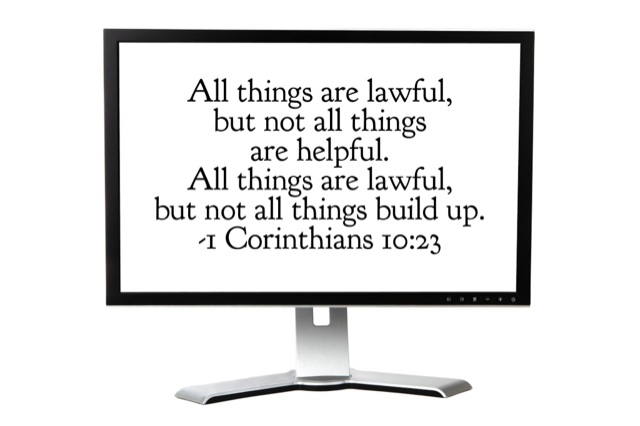
“All things are lawful,” but not all things are helpful. “All things are lawful,” but not all things build up (1 Corinthians 10:23).

“All things are lawful for me,” but not all things are helpful. “All things are lawful for me,” but I will not be dominated by anything (1 Corinthians 6:12).

If a show or book is tearing me down rather than building me up or bringing me under the power of wrong, I need to step away from it.

Another guideline is conscience. Conscience is not a perfect guide and needs to be trained by the Word of God. But we shouldn’t ignore conscience lest it become seared or numbed.

Of course, this topic could be expanded exponentially. We haven’t even touched on wrong philosophies. Reading the Bible and other books helps us develop discernment. But we don’t have to restrict our reading to what we agree with. We read everything with Christian eyes even if what we’re reading isn’t Christian. We evaluate as we go along. But if I sense a wrong philosophy is filtering into my thinking, it might be time to pull back.

Though I’ve been discussing secular books and shows, these same principles guide in Christian viewing and reading as well. Once I picked up a book aimed at helping teen guys battle lust. I scanned the first few pages to see whether I might bring the book home for my then-teen boys. But then I put the book back down. I felt if they didn’t have a problem with lust before they started, they would before they finished. The authors were way too explicit in describing the kinds of problems and situations they wanted to counsel guys to avoid.

These are some of the guidelines I use in evaluating what to watch or listen to. What are some of yours?

_______

I’m thankful to Dr. Ronald Horton, chair of the English department of my college when I was there and my Literary Criticism teacher, for a lecture on this topic when I was a student. What he taught formed the foundation of my thinking. Some years later, his lecture was turned into a booklet and sold in the university bookstore. When I was about 3/4 of the way through this post, I decided to see if he had posted his notes online anywhere. I found them here on A Biblical Approach to Objectionable Elements in a chapter from a larger volume titled Christian Education: Its Mandate and Mission. If you’re interested and have time, this is an excellent read. He goes into a lot more detail and nuance than I can here. 

(I often link up with some of these bloggers.)

Spiritual Freedom

Many a child has watched the clock count down to the last school bell on the last day of school before summer.

Then they burst through the school doors with a William Wallace burst of “Freeeedom!!!”

No more alarm clocks, homework, lunch lines, math. Only three glorious months of doing what they want. Sleeping in. Watching cartoons. Playing games. Going swimming. Seeing friends.

Yet they are not entirely free to do what they want, are they? They are free from one kind of restraint. But they still have to eat the green stuff at dinner, mind their manners, entertain little brother while mom is busy, take out the trash, etc., etc., etc.

Teenagers chomping at the bit to become adults and “do whatever they want” find the same thing. They do get one kind of freedom, but also a greater burden of responsibility.

Proponents of “free love” in the 60s found that their actions weren’t really free. Disease, unexpected pregnancy, and no long term security were not what they bargained for in their freedom.

There’s a sense in which no one experiences entire freedom to do whatever they want.

The Bible says, “But I say, walk by the Spirit, and you will not gratify the desires of the flesh. For the desires of the flesh are against the Spirit, and the desires of the Spirit are against the flesh, for these are opposed to each other, to keep you from doing the things you want to do” (Galatians 5:16-17).

There doesn’t seem to be any middle ground. We’re either yielding to the flesh or the Spirit. Sure, we have to yield to parents, employers, family, the police, etc. But all of those are within the context of the flesh or Spirit. Sometimes we yield to others in an effort to keep life running smoothly—ultimately a desire to please ourselves.

Some who most desire the freedom to do what they want are the most enslaved to their own passions.

What does it mean, then, that “Now the Lord is the Spirit, and where the Spirit of the Lord is, there is freedom”? (2 Corinthians 3:17). Or “So if the Son sets you free, you will be free indeed”? (John 8:36). Surely that doesn’t mean the “do whatever I want” kind of freedom, does it?

No. The death of Jesus Christ freed us from:

  • The law of Moses that people in the OT were under. “Let it be known to you therefore, brothers, that through this man [Jesus] forgiveness of sins is proclaimed to you, and by him everyone who believes is freed from everything from which you could not be freed by the law of Moses” (Acts 13:38-39). The book of Galatians was written to people who had freedom in Christ yet thought they had to go back under this yoke. “For freedom Christ has set us free; stand firm therefore, and do not submit again to a yoke of slavery” (Galatians 5:1).
  • Sin and death. “For the law of the Spirit of life has set you free in Christ Jesus from the law of sin and death” (Romans 8:2). We still have to battle sin, but its power over us has been broken. “For if we have been united with him in a death like his, we shall certainly be united with him in a resurrection like his. We know that our old self was crucified with him in order that the body of sin might be brought to nothing, so that we would no longer be enslaved to sin” (Romans 6:5-6). By God’s grace, we have the ability to fight it and win now. And we still have to face physical death (unless the Lord returns before that happens), but not the second death in the lake of fire (Revelation 20:11-15). Even physical death has lost its sting, because death takes us to God (2 Corinthians 5:6-10).
  • Condemnation. “There is therefore now no condemnation for those who are in Christ Jesus” (Romans 8:1).
  • Darkness. “For at one time you were darkness, but now you are light in the Lord. Walk as children of light” (Ephesians 5:8).

We have also been freed to something.

  • God our Father. “And because you are sons, God has sent the Spirit of his Son into our hearts, crying, “Abba! Father!” (Galatians 4:6).
  • Sanctification eternal life: “But now that you have been set free from sin and have become slaves of God, the fruit you get leads to sanctification and its end, eternal life” (Romans 6:22).
  • Light. “Again Jesus spoke to them, saying, ‘I am the light of the world. Whoever follows me will not walk in darkness, but will have the light of life'” (John 8:12).
  • Grace and Mercy. “Let us then with confidence draw near to the throne of grace, that we may receive mercy and find grace to help in time of need” (Hebrews 4:16).
  • Rest. “Come to me, all who labor and are heavy laden, and I will give you rest. Take my yoke upon you, and learn from me, for I am gentle and lowly in heart, and you will find rest for your souls. For my yoke is easy, and my burden is light.” (Matthew 11:28-30).
  • Sufficiency: “And God is able to make all grace abound to you, so that having all sufficiency in all things at all times, you may abound in every good work” (2 Corinthians 9:8).
  • Heaven. “Father, I desire that they also, whom you have given me, may be with me where I am, to see my glory that you have given me because you loved me before the foundation of the world” (John 17:24).

And so much more!

So what kind of freedom is this, exactly?

The Pulpit Commentary on 2 Corinthians 3:17 sheds some light: “The liberty of confidence (ver. 4), and of frank speech (ver. 12), and of sonship (Galatians 4:6, 7), and of freedom from guilt (John 8:36); so that the Law itself, obeyed no longer in the mere letter but also in the spirit, becomes a royal law of liberty, and not a yoke which gendereth to bondage (James 1:25; James 2:12) – a service, indeed, but one which is perfect freedom (Romans 5:1-21; 1 Peter 2:16).”

We’re freed from trying to earn righteousness with God. When we believe on Jesus as Savior and Lord, He cleanses us and enables us to do everything God wants us to do. We serve Him as His children, out of love, by His grace.

And can it be that I should gain
An int’rest in the Savior’s blood?
Died He for me, who caused His pain?
For me, who Him to death pursued?
Amazing love! how can it be
That Thou, my God, should die for me?

Long my imprisoned spirit lay
Fast bound in sin and nature’s night;
Thine eye diffused a quick’ning ray,
I woke, the dungeon flamed with light;
My chains fell off, my heart was free;
I rose, went forth and followed Thee.

Charles Wesley, from “And Can It Be”

(I often link up with some of these bloggers.)
What to Do with Regret

I regret hitting my sister.

I don’t remember our ages or the circumstances. Probably a lot of hitting occurred between the six of us siblings over the years, though I’m sure my parents discouraged it.

But I think my regret over this particular incident indicates that I was old enough to know better at the time.

I’ve accumulated a lot of regrets since then. Things I said and shouldn’t have. Things I should have said but didn’t. Wrong or thoughtless choices. Selfish actions and attitudes. Time wasted. Projects unfinished or not even started.

The regret that haunts me the most is my wrong attitude while caring for my mother-in-law. Instead of welcoming the opportunity to show love to her by caring for her at her neediest, I resented the encroachment on my own time and plans and the pervasive weight of responsibility.

Not all regrets occur because of sin. Unstarted projects, for example, are a reminder that I am limited and can’t do everything I’d like to do. Yet they can serve to remind me to seek God’s wisdom in what I spend my time on.

Some regrets are due to mistakes or not enough knowledge at the time.

There are some regrets where I still don’t know whether I was right or wrong, like my college major. I wanted to major in English, but then decided Home Economics Education was more practical. However, by the time I got to my second senior year (I crammed four years into five . . .), I knew I didn’t want to teach. I liked the imparting knowledge part, but not the discipline and inspiring uninterested students. I felt like I wasted all that time and money since I didn’t “use” my major in the expected sense. Now I wish I had majored in English for the sake of writing. Yet God has used what I learned in college. I rest in Proverbs 16:9: “The heart of man plans his way, but the LORD establishes his steps.”

All too often, though, regrets are the aftermath of sin.

Regret vs. repentance

Regret is not repentance. Judas regretted betraying Christ, but as far as we know, did not repent of it. He is an illustration of the “grief produces death” Paul mentioned in 1 Corinthians 7:10.

Peter regretted denying he knew Christ and wept bitterly over it. But he repented and was restored. His sermon and actions after Pentecost and his epistles show a changed man.

King Saul and David both said, “I have sinned.” King Saul kept going back to his murderous ways in pursuing David. David gave us Psalm 51.

2 Corinthians 7 shows how repentance changes our attitudes. Paul had written a stern letter to the Corinthians over their sin and waited to hear how they would receive his admonitions. He was comforted when Titus came with news that the Corinthians responded with longing, mourning, and zeal (verse 7). Paul notes the changes in the Corinthians produced by godly repentance. I like how the Amplified Bible explains it: “For [godly] sorrow that is in accord with the will of God produces a repentance without regret, leading to salvation; but worldly sorrow [the hopeless sorrow of those who do not believe] produces death. For [you can look back and] see what an earnestness and authentic concern this godly sorrow has produced in you: what vindication of yourselves [against charges that you tolerate sin], what indignation [at sin], what fear [of offending God], what longing [for righteousness and justice], what passion [to do what is right], what readiness to punish [those who sin and those who tolerate sin]!” (verses 10-11).

I’ve confessed my selfish attitudes to the Lord. I lean on the blessed promise of 1 John 1:9: “If we confess our sins, he is faithful and just to forgive us our sins and to cleanse us from all unrighteousness.” I’ve always been told that “confess” in that verse means to say the same thing God says about our sin. We don’t downplay it or make excuses for it. We call it what it is in all its bald-faced despicableness.

When regret lingers

But even after confessing to the Lord and being assured of His forgiveness, regret still lingers, quite heavily sometimes.

The inclination is to confess it to the Lord all over again. But if we believe His word, He forgave us the first time we confessed our sin to Him.

Another inclination is to beat ourselves up over our wrongdoing. While it’s good to note our foolishness, wrong thinking, and actions, it doesn’t help to keep self-rebuke on repeat. We usually end up discouraged but not moving forward.

So what do we do with the regret that remains?

The only solution I have found is to let that regret spur me on to different actions and attitudes now.

I received my only traffic ticket while speeding on a road that I frequently traveled. I was humiliated and embarrassed by being pulled over by the police and questioned. I paid my fine with no contest, because I knew I was in the wrong.

Every time I traveled down that road again, I slowed down when approaching the place where I got my ticket. The discomfort of the previous encounter made me want to avoid experiencing that pain again and take extra steps to make sure I was doing right.

Some years ago, I broke and dislocated my little toe when I banged it against the wall while coming out of my bathroom door. I’ve come through that door hundreds of times—I don’t know why I didn’t do so properly then. Observing the x-ray, the doctor said my toe looked like a jigsaw puzzle. You can bet I walked very carefully through that door and around corners for weeks afterward to make sure my poor, battered toe didn’t come anywhere near them. But even after the pain subsided, the carefulness remained.

The pain of regret can do the same for us, instilling a carefulness, sensitivity, and watchfulness we might not otherwise have had. Those features often expand from the particular thing we regret to our walk in general.

We need to let regret lead us to repentance. Then we need to let God’s grace and forgiveness seep down into our souls and and enable us to make whatever changes we need to make.

The regret over a missed opportunity to share Christ with someone can help us pray and prepare for the next time. Regret over lost temper and harsh words can drive us to the Scriptures and prayer for help.

My regrets over my attitudes as a caregiver remind me of my selfishness and my need to seek God’s grace to serve Him and others, not my own desires. I knew caring for my mother-in-law was the right thing to do, even though I didn’t feel glad about it then. But I can say now that I am thankful we did.

How about you? Does regret weigh you down or spur you on?

(I often link up with some of these bloggers.)

My God, My Father

I grew up with a mental image of God as a somewhat stern, authoritarian father, looking down from heaven just waiting for me to mess up so He could zap me.

Some people think of God as a kindly and indulgent father, one who never says no, never scolds, slips them money, and always bails them out of trouble.

Some people view God’s fatherhood as that of a dear old man, well-meaning but hopelessly out of touch.

Some feel God is like a father who is capricious and impossible to please.

Others feel that God is a distant Father, either absent or uninvolved and uncaring.

But our Father God is not like any of those.

Our earthly fathers help inform our view of God for better or worse. A faulty father might imprint on our minds a skewed perception of God. A good father will give a positive but still shadowy picture of our heavenly Father.

But it’s good to learn of our Father for who He is.

He loved us enough, even when we were His enemies and totally uncaring about Him, to rescue us from our rebellion and darkness.

Giving thanks to the Father, who has qualified you to share in the inheritance of the saints in light. He has delivered us from the domain of darkness and transferred us to the kingdom of his beloved Son, in whom we have redemption, the forgiveness of sins (Colossians 1:12-14).

See what kind of love the Father has given to us, that we should be called children of God; and so we are. (1 John 3:1a).

He makes us heirs with Christ:

For you did not receive the spirit of slavery to fall back into fear, but you have received the Spirit of adoption as sons, by whom we cry, “Abba! Father!” The Spirit himself bears witness with our spirit that we are children of God, and if children, then heirs—heirs of God and fellow heirs with Christ, provided we suffer with him in order that we may also be glorified with him (Romans 8:15-17).

He keeps us secure.

I give them eternal life, and they will never perish, and no one will snatch them out of my hand. My Father, who has given them to me, is greater than all, and no one is able to snatch them out of the Father’s hand. I and the Father are one. (John 10:28-30).

He wants us to come to Him with our needs.

Your Father knows what you need before you ask him. Pray then like this: “Our Father in heaven . . . ” (Matthew 6:8-9).

But when you pray, go into your room and shut the door and pray to your Father who is in secret. And your Father who sees in secret will reward you (Matthew 6:6).

He provides for us.

And do not seek what you are to eat and what you are to drink, nor be worried. For all the nations of the world seek after these things, and your Father knows that you need them. Instead, seek his kingdom, and these things will be added to you (Luke 12:29-31).

He has compassion on us:

As a father shows compassion to his children, so the Lord shows compassion to those who fear him. Psalm 103:13.

He cares enough for us to discipline us when we need it.

My son, do not despise the Lord’s discipline or be weary of his reproof, for the Lord reproves him whom he loves, as a father the son in whom he delights (Proverbs 3: 11-12).

It is for discipline that you have to endure. God is treating you as sons. For what son is there whom his father does not discipline? If you are left without discipline, in which all have participated, then you are illegitimate children and not sons. Besides this, we have had earthly fathers who disciplined us and we respected them. Shall we not much more be subject to the Father of spirits and live? For they disciplined us for a short time as it seemed best to them, but he disciplines us for our good, that we may share his holiness. For the moment all discipline seems painful rather than pleasant, but later it yields the peaceful fruit of righteousness to those who have been trained by it (Hebrews 12:7-11).

He reassures us:

Fear not, little flock, for it is your Father’s good pleasure to give you the kingdom (Luke 12:32).

He shapes us, surrounding us with care and concern and interest like a potter bending over his creation:

But now, O Lord, you are our Father; we are the clay, and you are our potter; we are all the work of your hand (Isaiah 64:6).

He gives good gifts and doesn’t change moods or character:

Every good gift and every perfect gift is from above, coming down from the Father of lights, with whom there is no variation or shadow due to change (James 1:17).

He comforts us:

Blessed be the God and Father of our Lord Jesus Christ, the Father of mercies and God of all comfort, who comforts us in all our affliction, so that we may be able to comfort those who are in any affliction, with the comfort with which we ourselves are comforted by God (2 Corinthians 1:3-4).

He leads and guides us:

For all who are led by the Spirit of God are sons of God (Romans 8:14).

He blesses us:

Blessed be the God and Father of our Lord Jesus Christ, who has blessed us in Christ with every spiritual blessing in the heavenly places (Ephesians 1:3).

He’s preparing a place for us to live with Him eternally.

In my Father’s house are many rooms. If it were not so, would I have told you that I go to prepare a place for you? (John 14:2).

There was a popular song years ago that said God is watching us from a distance. But no. He is close and personal, caring and concerned.

Is He your father? “But to all who did receive him, who believed in his name, he gave the right to become children of God” (John 1:12).

(I often link up with some of these bloggers.)

Walking Through the Flames

When we were taking care of my mother-in-law in our home, our caregiver would stay with her on Sunday mornings while we went to church. I offered to trade off with my husband for Sunday evening services, but he always chose to stay home with her. I think he wanted to give me a break since I was with her so much while he was at work.

Jesse, our youngest son, was still home at that time. So he and I had about a twenty minute drive to church. I usually plugged my phone into the car speakers with the music on shuffle. Sometimes I turned the music down and we talked. Sometimes he’d fall asleep or play a game on one of his devices. Sometimes one or both of us would sing along softly.

But when “Walking Through the Flames” came on, we sang along together at full voice.

I’m not sure what about this song inspired our outburst. It’s based on Shadrach, Meshach, and Abednego in Daniel 3 who would not bow down to the king’s idol, even when their lives were threatened. Their faith and their words have inspired believers for centuries:

“Our God whom we serve is able to deliver us from the burning fiery furnace, and he will deliver us out of your hand, O king. But if not, be it known to you, O king, that we will not serve your gods or worship the golden image that you have set up” (Daniel 3:17-18).

If you know the story, “Nebuchadnezzar was filled with fury” (verse 19), ordered the furnace to be heated seven times hotter than normal, and had the three Hebrew men tied up and thrown in.

The furnace was so hot, the men who threw Shadrach, Meshach, and Abednego in died. But the three Hebrew men, instead of immediately succumbing to flames, were walking around untied. And what was more, someone else was with them, and “the appearance of the fourth is like a son of the gods” (verse 25).

Nebuchadnezzar called them out and saw that they were not only unhurt, but they were not even singed. They didn’t even smell like smoke. Then “Nebuchadnezzar answered and said, ‘Blessed be the God of Shadrach, Meshach, and Abednego, who has sent his angel and delivered his servants, who trusted in him, and set aside the king’s command, and yielded up their bodies rather than serve and worship any god except their own God'” (verse 28). He decreed that no one in the land could speak against the God of the God of Shadrach, Meshach, and Abednego without dire consequences. Although Nebuchadnezzar was not a believer yet, the next chapter in Daniel tells how he became one. No doubt this incident had a part in establishing his faith in the one true God.

In “Walking Through the Flames” (words are here), Jeanine Drylie retells the story in song and then applies it to us.

But when the hour of trial comes and fire is all around
We’ll find the place we’re walking on is really holy ground.

And praise be to God that the flames will set us free
And praise be to God, we shall gain the victory.

The version in my playlist is sung by Mac Lynch on a CD by the Wilds Christian Camp titled Praise the Everlasting King. Unfortunately, I can’t find that CD or that version of the song online anywhere. But here’s the song by the Northland Baptist Bible College:

I wrote a couple of posts based on truths from this passage of Scripture: “But If Not,” when our pastor was diagnosed with pancreatic cancer, and From “What If” to “Even If.”

These truths and this song will always minister to me. But my heart will also be warmed by the memory of singing this song along with my son in the car on Sunday evenings.

(I often link up with some of these bloggers.)

 

When You’re Afraid to Take Communion

I am embarrassed to admit this, but for many years I was hesitant and sometimes outright afraid to take communion. But I thought sharing my experience might help some who have wrestled with the same thing. If you’ve never had troubles with this issue yourself, you might know someone who does.

I became a Christian as a teenager, and most of the churches I’ve attended since then have taken a serious view of communion. We had communion about once a month. Usually the whole church service was built around celebrating communion rather than just tacking it on at the end. By contrast, one church we visited had communion every Sunday, and it was just another part of the service, like passing the offering plates. I much preferred the special emphasis placed on it.

Often, the second half of 1 Corinthians 11 is read before communion (or the Lord’s Table or the Lord’s Supper, as it has also been called). In that passage, Paul recounts how Jesus instituted communion with the disciples the night before He was betrayed. Then Paul issues this solemn warning:

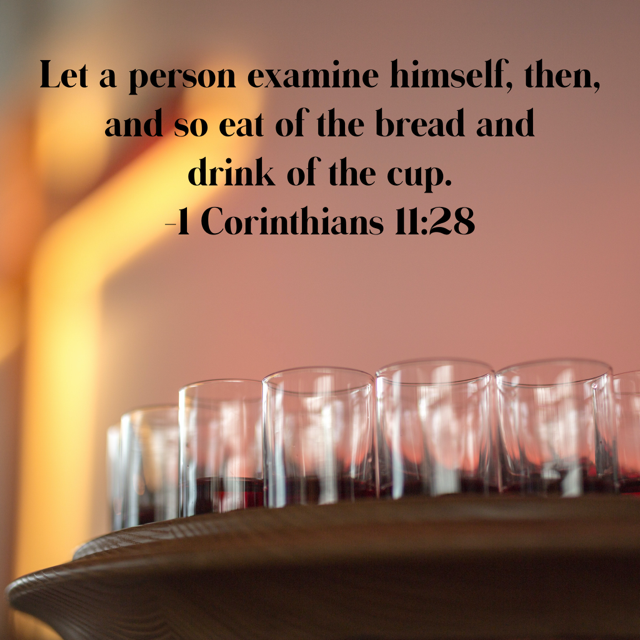
 Whoever, therefore, eats the bread or drinks the cup of the Lord in an unworthy manner will be guilty concerning the body and blood of the Lord. Let a person examine himself, then, and so eat of the bread and drink of the cup. For anyone who eats and drinks without discerning the body eats and drinks judgment on himself. That is why many of you are weak and ill, and some have died. But if we judged ourselves truly, we would not be judged. But when we are judged by the Lord, we are disciplined so that we may not be condemned along with the world (verses 27-32).

The pastor preparing for communion would echo the same warning. Anyone who was saved was welcome to join in, but we were encouraged to examine ourselves beforehand. It would be incongruous to partake of the symbols representing Christ’s body broken and blood shed for us while harboring known sin in our hearts.

In the church we attended after we were married, time was provided during the communion service for self-examination. That was the largest church we attended, and it took time to pass the elements to everyone. Piano music would be playing softly while we waited, and there was plenty of time to pray.

My pastor there compared confession of sin to opening a series of boxes. You open a box only to find another box within. You open that box and find another one, and keep going til there are no more boxes.

As you pray and ask the Lord to search your heart, you confess to Him whatever sin comes to mind. Then you wait and see if anything else comes to mind, and confess that. And so on until nothing else comes to mind. This particular church allowed time for this.

At subsequent churches we attended, there was not much quiet time to pray. Some pastors would have people stand up and share a testimony or a passage of Scripture while we waited for the elements to be passed. Nothing wrong with that, but without that time to pray, I often felt unready to participate unless I went through this self-examination process at home beforehand.

Even with time to pray, though, I often felt unready. What if I missed confessing something? The part of the passage about eating and drinking judgment on ourselves to the point of becoming sick or dying scared me. Ending up in the ER a few days after one communion service fed that fear.

So, often I would refrain from taking the elements as they were passed, just to be safe.

Then our pastor began to address those who refrained from communion. (Had an usher told on me? Was I the only one?) I don’t remember what the pastor said except to encourage people to participate.

Over the years, God graciously helped me overcome this fear. I thought I’d share what helped in case I’m not the only one who has dealt with this.

Unworthily, not unworthy

The KJV that I grew up with translates 1 Corinthians 11:27 as “Wherefore whosoever shall eat this bread, and drink this cup of the Lord, unworthily, shall be guilty of the body and blood of the Lord.” Unworthily is an adverb describing how we partake. Newer translations are clearer in saying “in an unworthy manner.” But for years I struggled with this. Of course, none of us is worthy in ourselves. We’re only made worthy to commune with God because Jesus died for us and has saved and cleansed us—the very thing communion portrays.

The paragraph above this text in 1 Corinthians 11 (verses 17-22) addresses the way the Corinthians partook unworthily. They were making a feast out of communion in a way that showed up who had more vs. who had little. The remembrance of the Lord’s table was dividing people instead of unifying them. Plus some were drinking to the point of getting drunk while others went hungry. The rest of the passage was instruction and reminders of what communion represented and how it was to be partaken of, with reverence and remembrance of the Lord’s death.

So that’s what Paul meant by partaking in an unworthy manner–flippantly, self-indulgently, forgetfully. He didn’t mean that no one who was unworthy of God’s love and forgiveness could partake, because that would include all of us.

I’m not off the hook even if I don’t partake.

If I am examining my heart, asking God to search me, and confessing my sin to Him, and I come across something I am not willing to give up, I’m not off the hook by just not partaking of communion that day. God still wants me to deal with whatever it is and will eventually chastise me if I refuse to submit to Him.

I couldn”t remember every sin anyway.

I’ve always been thankful for the way 1 John 1:9 is phrased: “If we confess our sins, he is faithful and just to forgive us our sins and to cleanse us from all unrighteousness.” When we confess our sins, we’re not likely to remember every little sin. And as we grow in the Lord, we become aware of thoughts and actions that are sinful that we didn’t realize before. But when we confess our sins, God cleanses us from all unrighteousness.

Self-examination doesn’t need to be a long process.

Self-examination is a good thing. But we don’t need to save everything up until communion time. We need to confess sin to God as soon as we’re aware of it and convicted by it. I have become more and more aware that we all have blind spots. Jesus warned people about looking for specks in other people’s eyes when they had big logs in their own. God told people in Malachi what they were doing wrong, but they denied there was a problem. He told the church in Laodicea, “For you say, I am rich, I have prospered, and I need nothing, not realizing that you are wretched, pitiable, poor, blind, and naked” (Revelation 3:17). I’ve been regularly asking the Lord to show me my own blinds spots. When we’re seeking to walk closely with Him every day, asking Him to show us where we fall short, confessing sin to Him as we become aware of it, we won’t need extremely long periods of self-examination before we’re right with God.

Consciences need training.

I’ve discovered about myself that I have an oversensitive conscience. It would make a long post even longer to go into why I say this. The solution to that isn’t to ignore my conscience: conscience is a tool in the hands of God. Ignoring it can lead to the opposite problem of not being sensitive enough. The more I read God’s Word, the more my conscience is trained according to His will so I don’t lapse into legalism on one side or license on the other. (A good book on this subject is Conscience: What It Is, How To Train It, and Loving Those Who Differ by Andrew David Naselli and J. D. Crowley.)

Now, instead of dreading communion, I appreciate the time to remember what Jesus did for me. We get so caught up in the daily cares of life, and we’re such forgetful people, it’s good to get back to basics. I’m thankful that most of the churches I have been in have taken communion seriously. I’m thankful for God’s tender patience as I worked through some of these issues. And I am thankful that most times of communion end with joy and renewed appreciation for God’s grace.

(I often link up with some of these bloggers.)

What Can We Learn About Depression from Elijah?

You probably remember the big showdown between Elijah and the prophets of Baal from the Bible. If you grew up in Sunday School or children’s church, I’m pretty sure you heard the story taught with flannelgraph figures.

Ahab was one of the most wicked kings of Israel. God had told the prophet Elijah to tell Ahab there would be no rain in Israel for three years. No rain meant no crops; no crops meant famine. Finally, after three years, God sent Elijah to confront Ahab. Elijah called for the 450 prophets of Baal to set up an altar, as would Elijah. A bull would be cut up and laid on their altars. They would each call on their God, and the one who answered by fire was the real God.

Elijah let the other prophets go first. They prayed, cried, cut themselves for hours, but nothing happened.

Then Elijah’s turn came. He had men dig a moat around the altar and then pour enough water to soak the meat and altar and fill up the moat. Then Elijah prayed, “O Lord, God of Abraham, Isaac, and Israel, let it be known this day that you are God in Israel, and that I am your servant, and that I have done all these things at your word. Answer me, O Lord, answer me, that this people may know that you, O Lord, are God, and that you have turned their hearts back” (1 Kings 18:36-37).

And God did! Fire fell and consumed the bull, the wood, the stones, and all the water. “And when all the people saw it, they fell on their faces and said, ‘The Lord, he is God; the Lord, he is God’” (verse 39).

The prophets of Baal were slain. Rain came. That should have been that.

But it wasn’t. When Jezebel, Ahab’s wicked wife, heard what had happened, she sent a message to Elijah threatening his life.

And Elijah was afraid and ran, asking God to take his life.

How did Elijah go from facing down 450 false prophets to running from one woman? How did he go from the heights of such victory to the depths of wanting to die?

Some teachers are very hard on Elijah here. Some have even said that when God told Elijah to anoint Elisha as his successor, Elijah basically lost his ministry. Just this week, after starting this post, I saw someone accusing Elijah of “pouting.”

Thankfully, I’ve heard this passage treated differently more recently. And in my last read-through a few days ago, several things stood out to me.

Ministering to the physical ministers to the spiritual.

A lot of preachers say Monday morning is their worst time of the week. I’m not a preacher, but when I have taught or ministered in some way, I am pretty depleted afterward.

It’s significant to me that at the outset, God lets Elijah sleep, feeds him, and lets him sleep again.

We have a tendency to think it’s noble to disregard our physical needs for spiritual purposes. At times that is necessary: fasting, taking care of a new baby, ministering to someone who is ill. Sometimes you have to just do your best and trust God to make up for the deficit. But as a general rule, God has built a need for nourishment and rhythms of rest into our being. Especially when we’ve had a major crisis, or even a major victory, we can expect a crash afterward and a need for rest and recovery.

Time with God brings a change in perspective.

I find the questions that God asks people fascinating. “What are you doing here, Elijah?” (1 Kings 19:9). God knows the answers. But when He asks a question, instead of starting off with confrontation or instruction, He gives people opportunity to examine their hearts.

Elijah had thought he was all alone. He shouldn’t have—Obadiah had just told him about hiding a hundred prophets in caves for their protection. Maybe Elijah didn’t feel he was God’s only prophet, but he was the only one taking a stand. But God said, no, there were 7,000 who had not bowed the knee to Baal. The next few chapters tell of the work of some other prophets of the Lord.

God often works in quiet ways.

Like Elijah, we would have expected everything to change after the confrontation on Mt. Carmel. That demonstration had proved conclusively that the God of Israel was the real God, hadn’t it? Probably some people’s hearts turned, but Ahab’s and Jezebel’s hadn’t.

It’s interesting that the Bible most often shows God working through quiet ways rather than the miraculous. Of course, God is God. He can work a miracle any time He wants, and He still does today. But most of the miracles took place in the time of Moses, Elijah and Elisha, Jesus’ ministry, and the days of the early church in Acts. People in Jesus’ day begged Him for a sign, but He knew that if they wouldn’t believe the truth they had, they wouldn’t believe a sign, either.

God told Elijah to stand on the mountain. God passed by, and a strong wind tore rocks away. But God wasn’t in the wind. Then there was an earthquake, but the Lord wasn’t in the earthquake. Then came a fire, but God wasn’t in the fire. Then came a low whisper: other translations say a gentle whisper or a still, small voice.

The ESV Study Bible says, “God has other ways of working than the spectacular (though He is always free to work in supernatural ways)” (p. 637). This doesn’t mean God didn’t use the showdown. But the work wasn’t finished yet, and “the quiet ways of God must take their course before” this part of history is over (p. 637).

Trust God with the results.

It’s hard to pour your heart into something that apparently hasn’t done any good. The key word there is apparently. We can do God’s will God’s way and still look like we failed. But God knew what would happen and what He would do. It may look like God isn’t winning, but the story isn’t over yet.

Just a few chapters later, God’s prophecies about Ahab and Jezebel would come to pass. A king of Judah would see a revival come to the land.

Don’t go it alone.

When Elijah anointed Elisha as his eventual replacement, he didn’t retire immediately. For the rest of his ministry, he had a friend and mentee. “Then [Elisha] arose and went after Elijah and assisted him” (1 Kings 19:21). Some years after Elijah was gone, Jehoshaphat asked for a prophet of the Lord. “Then one of the king of Israel’s servants answered, ‘Elisha the son of Shaphat is here, who poured water on the hands of Elijah'” (2 Kings 3:11). Before Elisha became a mighty prophet in his own right, he served Elisha, ministering to his needs.

Do the next thing God has for you.

Was God done with Elijah?

No. God gave him three different men to anoint for different purposes (Elijah handed off two of those to Elisha). In chapter 21, God sent Elijah to confront Ahab over his theft of Naboth’s vineyard (apparently with no fear of Jezebel this time). In 2 Kings 1, God gave Elijah a message for King Ahaziah.

In 2 Kings 2, Elijah was taken up in a chariot of fire, the only person we know of who was ever taken to heaven that way. (Interestingly, God did not answer Elijah’s prayer that he might die. God had something different in mind.)

An angel said John the Baptist would come in the spirit and power of Elijah (Luke 1:8-17).

Elijah and Moses appeared when Jesus was transfigured (Matthew 17:1-8).

May believe that one of the two witnesses in Revelation 11 will be Elijah.

Does that sound like someone God was done with, or even displeased with?

Not to me.

God doesn’t cast us off when we get discouraged. If He did, all the psalmists who cried out to God in anguish and momentary disillusionment would have been in trouble. But He does want us to come to Him and renew our minds with His Word.

Of course, there is a type of depression that involves brain chemistry and can benefit from medication. But these measures—taking care of physical needs, gaining perspective, fellowship with others, trusting God with results and serving Him—can help even in those cases.

(I often link up with some of these bloggers.)
Are You a Big Z or an Ordinary N?

Imagine getting a Scrabble tray with the following letters:

JQZXKVW

Wow! All the highest-scoring letters! You’ll surely win this time!

Except there are a couple of problems.

First, there are no vowels. You’d only be able to play off vowels in your opponent’s words.

And most words are not made up of just the high-point letters. Usually you have to combine them with an ordinary D or T or N.

Too, I’ve often found that the words that use all the tiles and earn bonus points are most often made up of the more common letters.

Life is like that with people, too. The ones out front or with heavy responsibilities don’t operate alone. Stars have their publicists, make-up crew and stylists, agents, drivers. Executives have administrative assistants, mailroom workers, technicians. Presidents have cabinets, advisors, security details. Mills, factories, and manufacturers are mostly made up of everyday workers. Every company has those who keep the premises hygienic and pleasant by keeping it clean.

Have you noticed this principle in the Bible as well? Moses had Aaron and Hur. David had his mighty men. Elijah thought he was alone standing against the prophets of Baal, but God had 7,000 who had not bowed the knee to a false god. The obscure names among Jesus’ twelve closest followers were just as much disciples as Peter, James, and John.

Besides the Bible heroes we all know and love, lesser-known servants of God played key roles. A little servant girl told Naaman about the prophet in Israel who could heal him of leprosy. Unnamed prophets appear in only one scene, but deliver vital messages. “A certain man drew his bow at random” and killed King Ahab, one of Israel’s wickedest rulers. A woman only known as a Shunammite provided a respite for the prophet Elisha in his travels. A little boy gave his lunch of loaves and fishes to Jesus, who multiplied them to feed a multitude. “Joanna, the wife of Chuza, Herod’s household manager, and Susanna, and many others, who provided for” Jesus and the disciples “out of their means” alongside Mary Magdalene. Paul’s nephew brought news of an ambush planned against Paul, prompting his guards to beef up security.

Everyone has an important part to play in God’s kingdom, whether it’s a large or small part. If we envy another’s role, we forget they have their own set of problems and temptations. If we’re discontent with our role, we forget God sees and values it.

Have you ever had one tiny cog mess up a machine’s functions? A few wrong keystrokes in computer code can throw a whole program off. A little virus can wreak havoc in computers and bodies and communities. One person not doing their job right in the process of bringing a product to market can cause the end product to fail or even be unsafe. One customer service representative can make the difference in solving or causing problems, in our relief or frustrations with a company. One kind greeting at church can make a visitor feel welcome. One word of encouragement can change someone’s outlook.

The Bible uses the metaphor of the body to describe the church in 1 Corinthians 12:14-31. The body has a number of parts, but all are important. This passage has us imagine how ridiculous it would be if the whole body were an eye–how would it eat or walk or speak? Equally ridiculous is the thought of doing without one member or another. One part can’t say it doesn’t need another. Each part working together with the others helps the body function rightly, which aids all the parts. Ephesians 4:1-16 uses the same imagery, closing with, “Rather, speaking the truth in love, we are to grow up in every way into him who is the head, into Christ, from whom the whole body, joined and held together by every joint with which it is equipped, when each part is working properly, makes the body grow so that it builds itself up in love.” I’ve spoken of not thinking less of ourselves if we don’t have a big role to play, but Romans 12, also speaking of the church as a body, warns “not to think of himself more highly than he ought to think, but to think with sober judgment, each according to the measure of faith that God has assigned” (verse 3). There is no room for pride or discouragement with God’s giftings. But “having gifts that differ according to the grace given to us, let us use them” for His honor and glory and for the good of the rest of the body (Romans 12:6). We can be content in the place He has us.

My grandfather used to say, “God must love common folk, He made so many of us.” Sometimes God pushes us out of our comfort zones, like Moses, Jonah, Gideon, Esther, and others. But most of us won’t be the mega-best-selling author, the speaker followed by the masses, the hero about whom epics are written. Yet we can glorify God in our homes, churches, cars, businesses, neighborhoods. In fact, back to our Scrabble analogy, if we’re an N or T or an I, we can be used more often and in more places than a Q.

(I often link up with some of these bloggers.)

Encouragement in the Fight Against Temptation

When we’ve been Christians for decades, it seems like we’d have less trouble with sin.

After all, we’ve had so many years to grow, so many times in the Word of God, prayer, church, Sunday School, good books. We know we won’t reach perfection in this life. But shouldn’t we be closer to it?

I have not found myself anywhere near sinless perfection. And I can get quite discouraged when a random thought of anger or envy flashes across my mind. I should know better. Why am I still thinking like that?

But the Bible tells us we will always have our sin nature. “For the desires of the flesh are against the Spirit, and the desires of the Spirit are against the flesh, for these are opposed to each other, to keep you from doing the things you want to do” (Galatians 5:17). In fact, fighting sin is a good sign because it means we have God’s Spirit in us Who opposes sin.

And in some ways, as we grow in the Lord, we’ll be more sensitive to sin issues. I used to get convicted about angry outbursts. Now I get convicted about angry thoughts.

I don’t spend too much time wondering whether particular temptations come from Satan or from my own sin nature. Sometimes one or the other is a bigger factor, sometimes they work together.

But several years ago, I went through a situation that helped my perspective. For some period of weeks, I felt assaulted by untrue thoughts about God. I felt these thoughts came from Satan because they felt like an attack, and I normally didn’t have a problem with that kind of thing. I was discouraged, upset, fearful of blaspheming or at least dishonoring God.

Finally I thought of a tactic. I don’t normally try to address Satan personally. I leave him for God to handle. But I said, to whoever might be listening, “You know what? When I am tempted with wrong thoughts of God, I’m going to immediately turn my thoughts to His praise. I’ll sing a hymn or read a psalm or think about God’s attributes. So any temptation to wrong thoughts about God is going to result in more praise to Him and of Him and more worship of Him.”

The “thought attacks” stopped soon thereafter.

Recently it occurred to me that I could do the same thing with other temptations. Instead of just getting discouraged or irritated that I still have to fight selfishness or pride or jealousy or whatever, I can see the temptation as a call to arms. I can put on His armor and use the sword of His Spirit, His Word. I can preach His truth to myself and shore up my defenses. I can store up His Word in my heart, that I might not sin against Him (Psalm 119:11). I can pray against temptation (Luke 22:40, Matthew 6:13, Matthew 26:41). I can endeavor more closely to “walk by the Spirit, and you will not gratify the desires of the flesh” (Galatians 5:16). I can rejoice that God’s throne is one where we can find grace to help in time of need (Hebrews 4:15-16). I have His encouragement that “No temptation has overtaken you that is not common to man. God is faithful, and he will not let you be tempted beyond your ability, but with the temptation he will also provide the way of escape, that you may be able to endure it” (1 Corinthians 10:13). I can let God use this for good to strengthen me.

Though God offers grace, He doesn’t want us to take sin casually. Though God forgives us when we confess our sin to Him (1 John 1:9), He also tells us to “Look carefully then how you walk” (Ephesians 5:15), to put certain things away from us, to “Put to death therefore what is earthly in you” (Colossians 3:5). He warns us to “Be sober-minded; be watchful. Your adversary the devil prowls around like a roaring lion, seeking someone to devour” (1 Peter 5:8).

But “As a father shows compassion to his children, so the Lord shows compassion to those who fear him. For he knows our frame; he remembers that we are dust” (Psalm 103:13-14).

Temptation to sin isn’t sin, of course. Even Jesus was tempted.

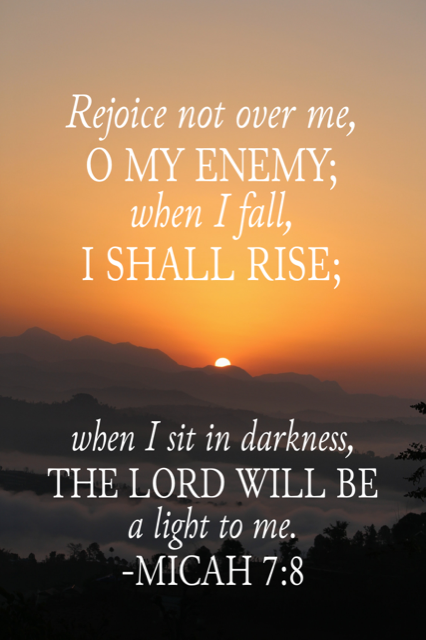
But when I do succumb to temptation, one verse that especially means a lot to me is Micah 7:8: “Rejoice not over me, O my enemy; when I fall, I shall rise; when I sit in darkness, the Lord will be a light to me.” I love what Christina Rossetti said: “A fall is a signal not to lie wallowing, but to rise.” Instead of wallowing in discouragement over temptation, we can rise against it. And God can use even this to strengthen us, to encourage others, and to glorify Himself. So, once again, what Satan means for evil, God can turn around and use for good.

(I often link up with some of these bloggers.)