
31 Days With Elisabeth Elliot: Several Short Quotes

Elisabeth Elliot2

As I knew would happen, there were many more quotes from Elisabeth that I wanted to share than there were days in October for the Write 31 Days project. I decided to put a few of the shorter ones together in one post:

From A Lamp For My Feet.

To listen to one word and go out and obey it is better than having the most exalted “religious experience.” “The man who has received my commands and obeys them–he it is who loves me: and he who loves me will be loved by my Father; and I will love him and disclose myself to him” (Jn 14:21). There is the order: hear, do, know.

From Keep a Quiet Heart:

If my life is once surrendered, all is well. Let me not grab it back, as though it were in peril in His hand but would be safer in mine!

IMG_1393

Convicting, isn’t it? And it is so silly that we do this, but too often we do.

I don’t know which of Elisabeth’s writings this came from, but it is short and sweet and very helpful:

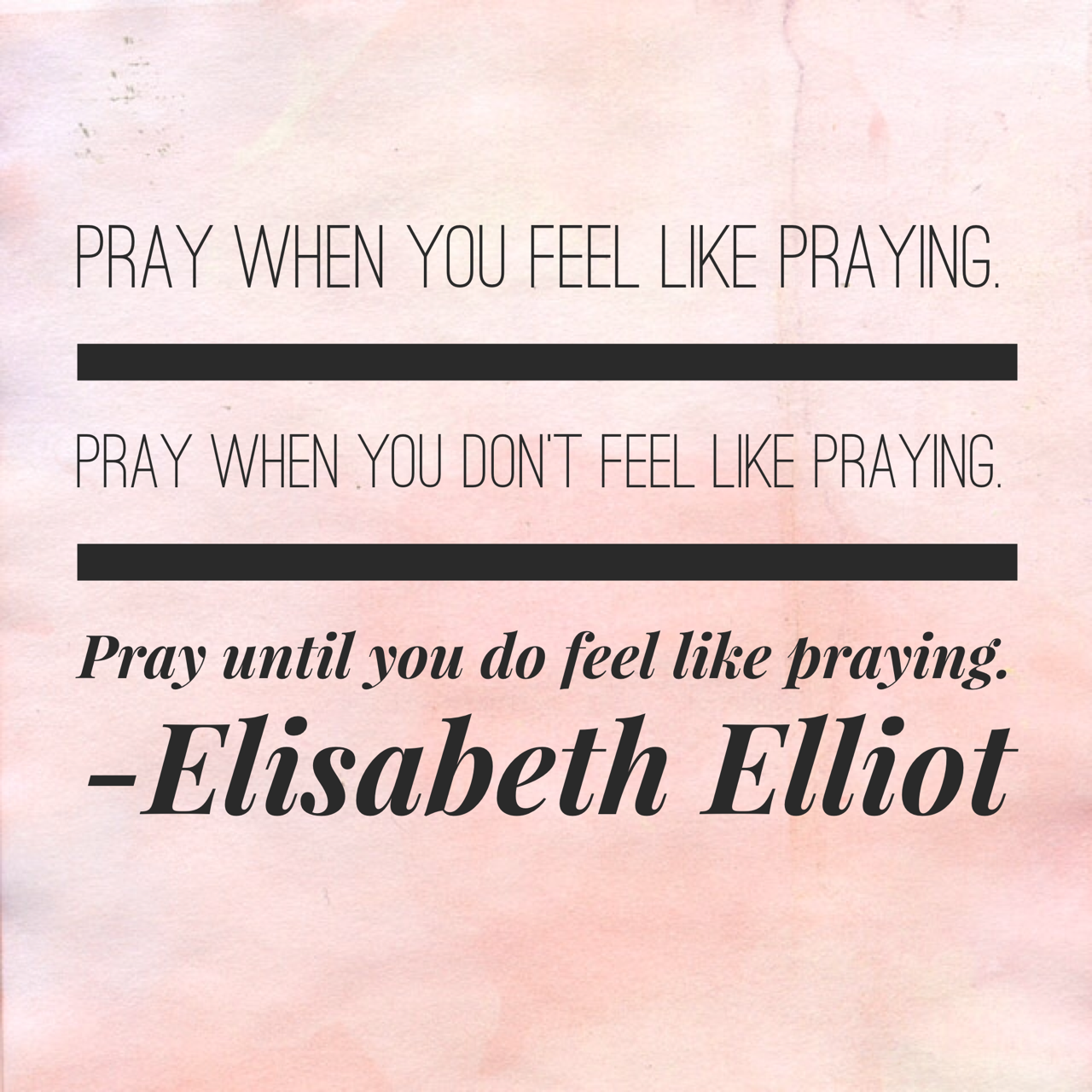
“Pray when you feel like praying. Pray when you don’t feel like praying. Pray until you do feel like praying.”

IMG_1392

From a chapter titled “God’s Curriculum” in  Keep a Quiet Heart:

An angry retort from someone may be just the occasion we need in which to learn not only longsuffering and forgiveness, but meekness and gentleness; fruits not born in us but borne only by the Spirit.

Too often I fail to learn that lesson and react in a fleshly manner instead of a spiritual one, so I am thankful for this reminder to seek the Spirit’s help in reacting in a right way.

I don’t know the source of this one, either:

A surrendered mind is not one which is no longer in operation. It is, rather, a mind freed from rebellion and opposition. To be Christ’s captive is to be perfectly free.

From Keep a Quiet Heart in a section on self-image:

If I’m so beautiful and lovable, what was Jesus doing up there, nailed to the cross and crowned with thorns? Why all that hideous suffering for the pure Son of God? Here’s why: There was no other way to deliver us from the hell of our own proud self-loving selves, no other way out of the bondage of self-pity and self-congratulation. How shall we take our stand beneath the cross of Jesus and continue to love the selves that put Him there? How can we survey the wondrous cross and at the same time feed our pride? No. It won’t work. Jesus put it simply: If you want to be My disciple, you must leave self behind, take up the cross, and follow Me.

Finally, this is from a chapter titled, “Nevertheless We Must Run Aground” in Love Has a Price Tag:

Heaven is not here, it’s There. If we were given all we wanted here, our hearts would settle for this world rather than the next. God is forever luring us up and away from this one, wooing us to Himself and His still invisible Kingdom, where we will certainly find what we so keenly long for.

Someone suggested that I share a list of Elisabeth’s books, so I will do that tomorrow, along with a video shown at her memorial service.

See all the posts in this series here.

_____________________________________________________

This is the last day to enter DaySpring.com’s contest for Write 31 Days readers. To enter to win a $500 DaySpring shopping spree, just click on this link & follow the giveaway widget instructions by October 30. Best wishes, and thanks for reading!

31 Days With Elisabeth Elliot: The Key to Supernatural Power

Elisabeth Elliot2This is from Elisabeth’s book, Keep a Quiet Heart. At first I was only going to include an excerpt of a few paragraphs, but as I read over it, I couldn’t leave anything out:

The world cannot fathom strength proceeding from weakness, gain proceeding from loss, or power from meekness. Christians apprehend these truths very slowly, if at all, for we are strongly influenced by secular thinking. Let’s stop and concentrate on what Jesus meant when He said that the meek would inherit the earth. Do we understand what meekness truly is? Think first about what it isn’t.

It is not a naturally phlegmatic temperament. I knew a woman who was so phlegmatic that nothing seemed to make much difference to her at all. While drying dishes for her one day in her kitchen I asked where I should put a serving platter.

“Oh, I don’t know. Wherever you think would be a good place,” was her answer. I wondered how she managed to find things if there wasn’t a place for everything (and everything in its place).

Meekness is not indecision or laziness or feminine fragility or loose sentimentalism or indifference or affable neutrality.

Meekness is most emphatically not weakness. Do you remember who was the meekest man in the Old Testament? Moses! (See Numbers 12:3). My mental image of him is not of a feeble man. It is shaped by Michelangelo’s sculpture and painting and by the biblical descriptions. Think of him murdering the Egyptian, smashing the tablets of the commandments, grinding the golden calf to a powder, scattering it on the water and making the Israelites drink it. Nary a hint of weakness there, nor in David who wrote, “The meek will he guide in judgment” (Psalm 25:9, KJV), nor in Isaiah, who wrote, “The meek also shall increase their joy in the Lord” (Isaiah 29:19, KJV).

The Lord Jesus was the Lamb of God, and when we think of lambs we think of meekness (and perhaps weakness), but He was also the Lion of Judah, and He said, “I am meek and lowly in heart” (Matthew 11:29, KJV). He told us that we can find rest for our souls if we will come to Him, take His yoke, and learn. What we must learn is meekness. It doesn’t come naturally to any of us.

Meekness is teachability. “The meek will he teach his way” (Psalm 25:9, KJV). It is the readiness to be shown, which includes the readiness to lay down my fixed notions, my objections and “what ifs” or “but what abouts,” my certainties about the rightness of what I have always done or thought or said. It is the child’s glad “Show me! Is this the way? Please help me.” We won’t make it into the kingdom without that childlikeness, that simple willingness to be taught and corrected and helped. “Receive with meekness the engrafted word, which is able to save your souls” (James 1:21, KJV). Meekness is an explicitly spiritual quality, a fruit of the Spirit, learned, not inherited. It shows in the kind of attention we pay to one another, the tone of voice we use, the facial expression.

One weekend I spoke in Atlanta on this subject, and the following weekend I was to speak on it again in Philadelphia. As very often happens, I was sorely tested on that very point in the few days in between. That sore test was my chance to be taught and changed and helped. At the same time I was strongly tempted to indulge in the very opposite of meekness: sulking. Someone had hurt me. He/she was the one who needed to be changed! I felt I was misunderstood, unfairly treated, and unduly berated. Although I managed to keep my mouth shut, both the Lord and I knew that my thoughts did not spring from a depth of loving-kindness and holy charity. I wanted to vindicate myself to the offender. That was a revelation of how little I knew of meekness.

The Spirit of God reminded me that it was He who had provided this very thing to bring that lesson of meekness which I could learn nowhere else. He was literally putting me on the spot: would I choose, here and now, to learn of Him, learn His meekness? He was despised, rejected, reviled, pierced, crushed, oppressed, afflicted, yet He did not open His mouth. What was this little incident of mine by comparison with my Lord’s suffering? He brought to mind Jesus’ willingness not only to eat with Judas who would soon betray Him, but also to kneel before him and wash his dirty feet. He showed me the look the Lord gave Peter when he had three times denied Him–a look of unutterable love and forgiveness, a look of meekness which overpowered Peter’s cowardice and selfishness, and brought him to repentance. I thought of His meekness as He hung pinioned on the cross, praying even in His agony for His Father’s forgiveness for His killers. There was no venom or bitterness there, only the final proof of a sublime and invincible love.

But how shall I, not born with the smallest shred of that quality, I who love victory by argument and put-down, ever learn that holy meekness? The prophet Zephaniah tells us to seek it (Zephaniah 2:3). We must walk (live) in the Spirit, not gratifying the desires of the sinful nature (for example, my desire to answer back, to offer excuses and accusations, my desire to show up the other’s fault instead of to be shown my own). We must “clothe” ourselves (Colossians 3:12) with meekness–put it on, like a garment. This entails an explicit choice: I will be meek. I will not sulk, will not retaliate, will not carry a chip.

A steadfast look at Jesus instead of at the injury makes a very great difference. Seeking to see things in His light changes the aspect altogether.

In PILGRIM’S PROGRESS, Prudence asks Christian in the House Beautiful, “Can you remember by what means you find your annoyances at times, as if they were vanquished?”

“Yes,” says Christian, “when I think what I saw at the Cross, that will do it.”

The message of the cross is foolishness to the world and to all whose thinking is still worldly. But “the foolishness of God is wiser than man’s wisdom, and the weakness of God is stronger than man’s strength” (1 Corinthians 1:25, NIV). The meekness of Jesus was a force more irresistible than any force on earth. “By the meekness and gentleness of Christ,” wrote the great apostle, “I appeal to you…. Though we live in the world, we do not wage war as the world does. The weapons we fight with are not the weapons of the world. On the contrary, they have divine power to demolish strongholds” (2 Corinthians 10:1, 3-4, NIV). The weapon of meekness counters all enmity, says author Dietrich Von Hildebrand, with the offer of an unshielded heart.

Isn’t this the simple explanation for our being so heavy-laden, so tired, so overburdened and confused and bitter? We drag around such prodigious loads of resentment and self-assertion. Shall we not rather accept at once the loving invitation: “Come to Me. Take My yoke. Learn of Me–I am gentle, meek, humble, lowly. I will give you rest” (Matthew 11:28-29 paraphrased).

See all the posts in this series here.

_____________________________________________________

DaySpring.com is celebrating all of the amazing Write 31 Days readers who are supporting nearly 2,000 writers this October! To enter to win a $500 DaySpring shopping spree, just click on this link & follow the giveaway widget instructions by October 30. Best wishes, and thanks for reading!
31 Days With Elisabeth Elliot: The Hand That Hurts and the Hand That Heals

Elisabeth Elliot2
This is titled “A Dog’s Thanksgiving” and appears in the November/December 1988 Elisabeth Elliot Newsletter:

“I remember fixing the wounded leg of my dog. There was some struggle and a hurt crying but he kept licking my hand. The hand of the one who was hurting him and the hand of the one who was healing him were the same, and his endurance of the one rested in his trust in the other. Out of the depths have I cried unto Thee, O Lord.” From This Cup, by Addison Leitch (my second husband, who died in 1973).

There are many lessons for us in the mysterious animal world. Have we ears to hear, eyes to see, hearts to learn those sweet lessons?

Our Heavenly Healer often has to hurt us in order to heal us. We sometimes fail to recognize His mighty love in this, yet we are firmly held always in the Everlasting Arms. The dog’s leg was hurting. Add’s ministrations were as delicate as possible, yet they hurt too, and the loyal dog accepted them and thanked him with his eyes. Have we the humility to thank our Father for the gift of pain?

“No discipline seems pleasant at the time, but painful. Later on, however, it produces a harvest of righteousness and peace for those who have been trained by it” (Hebrews 12:11). Let us give thanks!

IMG_1388

See all the posts in this series here.

31 Days With Elisabeth Elliot: Freedom and Discipline

Elisabeth Elliot2

This is taken from a chapter titled “How to Be Free” from Elisabeth’s book All That Was Ever Ours. After discussing a friend of her daughter’s who was having trouble at home and believed “freedom meant doing what she wanted to do,” Elisabeth wrote:

…True freedom is not to be found in throwing off personal responsibility. The man who runs away from the truth will never be a free man, for it is the truth alone, sought within the circle of his commitments, which will make him free.

Dietrich Bonhoeffer, a man who epitomized true freedom in his acceptance, for God’s sake, of the prison cell and death, wrote: “If you set out to seek freedom, then learn above all things to govern your soul and your senses. . . . Only through discipline may a man learn to be free.”

Freedom and discipline have come to be regarded as mutually exclusive, when in fact freedom is not at all the opposite, but the final reward, of discipline. It is to be bought with a high price, not merely claimed. The world thrills to watch the grace of Peggy Fleming on the ice, or the marvelously controlled speed and strength of a racehorse. But the skater and horse are free to perform as they do only because they have been subjected to countless hours of grueling work, rigidly prescribed, faithfully carried out. Men are free to soar into space because they have willingly confined themselves in a tiny capsule designed and produced by highly trained scientists and craftsmen, have meticulously followed instructions and submitted themselves to rules which others defined.

Then Elisabeth wrote of her time in the jungle with the Auca (now known as Waorani Indians), where she “enjoyed a kind of freedom which even hippies might envy. But I was free only because the Indians worked. My freedom was contingent upon their acceptance of me as a liability and, incidentally, upon my own willingness to confine myself to a forest clearing where all I heard was a foreign language.”

…meaning in life…can be found only in God’s purpose, I believe, in what he originally meant when he made us. “If you are faithful to what I have said, you are truly my disciples (those who are being disciplined),” Jesus said. “And you will know the truth and the truth will set you free.

There is one kind of freedom that Jesus was talking about in John 8:36: “If the Son therefore shall make you free, ye shall be free indeed.” Spiritually we’re set free from sin and its penalty the moment we repent and believe on Jesus Christ as our Savior, and there is nothing we can do to “earn” it. But it would not have been possible without His setting Himself under the discipline of the cross. However,  in our sanctification, in our growing day by day in the Lord, it’s one of those paradoxical things that the more we submit to His discipline, the freer we become.

See all the posts in this series here.

_____________________________________________________

DaySpring.com is celebrating all of the amazing Write 31 Days readers who are supporting nearly 2,000 writers this October! To enter to win a $500 DaySpring shopping spree, just click on this link & follow the giveaway widget instructions by October 30. Best wishes, and thanks for reading!

31 Days With Elisabeth Elliot: The Face of Jesus

Elisabeth Elliot2This is from Elisabeth’s book, A Lamp For My Feet:

The face of Jesus:

marred more than any man–
spit upon,
slapped,
thorn-pierced,
bloodied,
sweating,
the beard plucked,
twisted in pain–

For my salvation.

A glorious face, now.

Let its light shine on me, O Light of Life.

Let Your radiance fall on me, Sun and Savior,

Lighten my darkness.

Then grant me this by Your grace:

That I, in turn, may give

“The light of the knowledge of the glory of God” (2 Cor 4:6 AV)

As I see it in the face of Jesus Christ.

_____________________________

See all the posts in this series here.

_____________________________________________________

DaySpring.com is celebrating all of the amazing Write 31 Days readers who are supporting nearly 2,000 writers this October! To enter to win a $500 DaySpring shopping spree, just click on this link & follow the giveaway widget instructions by October 30. Best wishes, and thanks for reading!

31 Days With Elisabeth Elliot: The World Must Be Shown

Elisabeth Elliot2This is from Elisabeth’s book Keep A Quiet Heart:

When Jesus was speaking with His disciples before His crucifixion, He gave them His parting gift: peace such as the world can never give. But He went on immediately to say, “Set your troubled hearts at rest and banish your fears…. I shall not talk much longer with you, for the Prince of this world approaches. He has no rights over me, but the world must be shown that I love the Father and do exactly as he commands” (John 14:27, 30-31, NEB).

A young mother called to ask for “something that will help me to trust in the Lord.” She explained that she had several small children, she herself was thirty years old, and she had cancer. Chemotherapy had done its hideous work of making her totally bald. The prognosis was not good. Could I say to her, “Set your troubled heart at rest. God is going to heal you”? Certainly not. Jesus did not tell His disciples that He would not be killed. How do I know whether God would heal this young woman? I could, however, remind her that He would not for a moment let go of her, that His love enfolded her and her precious children every minute of every day and every night, and that underneath are the Everlasting Arms.

But is that enough? The terrible things in the world seem to make a mockery of the love of God, and the question always arises: Why!

There are important clues in the words of Jesus. The disciples’ worst fears were about to be realized, yet He commanded (yes, commanded) them to be at peace. All would be well, all manner of things would be well–in the end. In a short time, however, the Prince of this world, Satan himself, was to be permitted to have his way. Not that Satan had any rights over Jesus. Far from it. Nor has he “rights” over any of God’s children, including that dear mother. But Satan is permitted to approach. He challenges God, we know from the Book of Job, as to the validity of His children’s faith.

God allows him to make a test case from time to time. It had to be proved to Satan, in Job’s case, that there is such a thing as obedient faith which does not depend on receiving only benefits. Jesus had to show the world that He loved the Father and would, no matter what happened, do exactly what He said. The servant is not greater than his Lord. When we cry “Why, Lord?” we should ask instead, “Why not, Lord? Shall I not follow my Master in suffering as in everything else?”

Does our faith depend on having every prayer answered as we think it should be answered, or does it rest rather on the character of a sovereign Lord? We can’t really tell, can we, until we’re in real trouble.

I never heard more from the young woman. I neglected to ask her address. But I prayed for her, asking God to enable her to show the world what genuine faith is–the kind of faith that overcomes the world because it trusts and obeys, no matter what the circumstances. The world does not want to be told. The world must be shown. Isn’t that part of the answer to the great question of why Christians suffer?

I started to just share the paragraphs with the sentences I highlighted, but then as I reread through the whole piece, I couldn’t leave any of it out. My tendency in any trial is to ask for it to stop, now please. But God not only works in and through the trial in my own life, it is also a testimony to others…and not just to others on Earth. Ephesians 3:10 says, “ so that through the church the manifold wisdom of God might now be made known to the rulers and authorities in the heavenly places.” God shows His wisdom in His dealings with us even to creatures “in heavenly places!” When I think of it, I try now to pray not just for quick deliverance (though in my flesh that would still be my desire), but that others may see Jesus through it all.

IMG_1380

See all the posts in this series here.

_____________________________________________________

DaySpring.com is celebrating all of the amazing Write 31 Days readers who are supporting nearly 2,000 writers this October! To enter to win a $500 DaySpring shopping spree, just click on this link & follow the giveaway widget instructions by October 30. Best wishes, and thanks for reading!
Knowing God, Chapters 19 and 20: Adoption and Guidance

Knowing GodWe’re nearing the end of reading Knowing God by J. I. Packer along with Tim Challies’ Reading Classics Together Series. This week we are in chapters 19 and 20, and there is only one more week to go in this particular reading group.

The chapters in this last section have been very long, so in a sense there is proportionally less that I can say about them. One thing that has helped me this week is to remember to tie the individual chapters back to the main point of the book: knowing God. It’s easy to get occupied with the individual topics or chapters and forget that they are there in connection with how we know God. Thus studying the attributes that we’ve discussed (God’s love, grace, wrath, goodness, jealousy, unchangeableness and majesty) are a part of getting to know Him better, His Word is the main means by which we learn about Him, His propitiation of our sins is what makes it possible for us to know Him, and once we do know Him by faith, we become His children, the topic of chapter 19, and then we can trust Him to guide us, the topic of chapter 20.

Chapter 19 is “Sons of God,” and Packers says the most basic definition of a Christian is that he or she is a person who has God as Father. We are not all God’s children: we become His when we believe on Jesus Christ as our Lord and Savior.

Jesus said to him, “I am the way, and the truth, and the life. No one comes to the Father except through me.
 John 14:6

But to all who did receive him, who believed in his name, he gave the right to become children of God. John 1:12.

This chapter traces through Scripture what it means when it says we are “adopted” by God. Adoption in Rome in Biblical times wasn’t so much the modern conception of taking in of a child not born into a family and making them, by legality and love, a child of that family. It was more the idea of taking in a male heir, usually at adulthood (interestingly, this same concept was being taught on the BBN radio station by Dr. Donald R. Hubbard as I was cleaning up the kitchen after dinner last night. I am not usually still in the kitchen when this program comes on.) “God has so loved those whom he redeemed on the cross that he has adopted them all as his heirs, to see and share the glory into which his only begotten Son has already come” (p. 201). What an inheritance!

Our sonship changes everything. The emphasis in the Old Testament is on God’s holiness and our unfitness to be in His presence because we are so far from holy. Now we can run into His arms as trusting children. God’s fatherhood implies authority, affection, fellowship, and honor (p. 205). It affects our conduct, prayer, and how we live our lives: by faith, trusting in His care and provision. It shows us His love, provides a basis for hope, helps us understand the Holy Spirit’s ministry to us (making “Christians realize with increasing clarity the meaning of their filial relationship with God in Christ, and to lead them into an ever deeper response to God in this relationship,” Romans 8:15, Galatians 4:6 (p. 220), provides a different motivation for holiness (pleasing our Father), and is the basis for our assurance.

Chapter 20 is “Thou Our Guide.” Packer starts out by showing many instances in both Old and New Testaments that God had a specific plan for specific people at specific times. This is one of the main reasons I can’t subscribe to the idea that it doesn’t matter what we do (whom we marry, where we go to school, what our life’s work should be, even what our plans for the day should be). And the Bible in many places promises God’s guidance. But the main question then is how does God communicate that plan to us?

The first avenue is His Word. No, we won’t find the names of a future spouse or college or employer there. But we will get to know our Father and His character and preferences there and learn the many principles by which He wants us to live. Any seeming “leading” which contradicts a clear principle in His Word is not from Him.

When it comes to what Packer calls “vocational” decisions – the specifics about what God wants us to do, like marriage, etc. – he says, “The work of God in these cases is to incline first our judgment and then our whole being to the course which, of all the competing alternatives, he has marked our as best suited for us, and for His glory and the good of others through us” (p. 237).

As a personal illustration, I had a hard time coming to a decision about whether my husband was the man God wanted me to marry. My own parents had divorced, so I knew that just getting married didn’t insure a “happily ever after,” and I had been engaged before, in a relationship that had numerous red flags that I didn’t see until after it was broken off, so I knew it was possible to be deceived in matters of the heart. How to know if I was really on the right track? It was something I agonized over. Finally I reminded myself that I had asked God to guide me in this area, and when I told Him I didn’t want to play “dating games” any more and only wanted to date the guys He wanted me to date, Jim was the very next person to ask me out. There was no reason to doubt that he was God’s will for me. In making decisions about job changes and moves over the years, two verses that I especially relied on were Psalm 37:23 (The steps of a good man are ordered by the Lord: and he delighted in his way – prayed this esocially for my husband as the main family decision-maker), and Jeremiah 10:23 (I know, O LORD, that a man’s way is not in himself, Nor is it in a man who walks to direct his steps.)

Packer does point out, however, that we can be deceived. It’s sadly possible to quench or grieve God’s Holy Spirit. If we are out of fellowship with God, we can’t trust our sense of His leading: we need to confess any known sin, be willing to submit to His leadership, and renew spending time in His Word. Packer then gives six pitfalls that hinder our discernment of God’s will, but I am going to try to recast them into positives:

  1. Be willing to think. “God made us thinking beings, and he guides our minds as in his presence we think things out–not otherwise” (p. 237).
  2. Be willing to think ahead and weigh the long-term consequences of alternative courses of actions. “O that they were wise, that they understood this, that they would consider their latter end!” (Deuteronomy 32:9).
  3. Be willing to take advice. “The way of a fool is right in his own eyes, but a wise man listens to advice.” (Proverbs 12:15).
  4. Be willing to suspect oneself. Sometimes we don’t realize we are being unrealistic or rationalizing. We have a tendency to be self-serving. We need to ask God to “Search me, O God, and know my heart: try me, and know my thoughts: And see if there be any wicked way in me, and lead me in the way everlasting” (Psalm 139:23-24).
  5. Be willing to discount personal magnetism. Sometimes someone else’s personality or attraction (whether a personal friend or a teacher or leader) can pull us in certain directions. Some people use this magnetism on purpose to mislead: some do not but people idolize them. “Test everything; hold fast what is good” (1 Thessalonians 5:21).
  6. Be willing to wait. God does not often give guidance ahead of the time it is needed.

Even when we’ve prayerfully and carefully sought God’s guidance, “it does not follow that right guidance will be vindicated by a trouble-free course thereafter” (p. 239). Numerous examples in the Bible show people falling into trouble who were directly where God led them: the Israelites between Pharaoh and the Red Sea; the disciples in a boat in a storm, a boat that Jesus sent them off in; Paul in prison, Jesus Himself on the cross, just to name a few. An easy path doesn’t always mean we’re on the right road: a troubled path doesn’t necessarily mean we are on the wrong one.

Finally, Packer acknowledges that it is possible to miss the path sometimes, but we can trust our Father to let us know and to set us right again. “The Jesus who restored Peter after his denial and corrected his course more than once after that (see Acts 10; Gal. 2:11-14), is our Savior today and he has not changed” (p. 241).


31 Days with Elisabeth Elliot: Loneliness

Elisabeth Elliot2

This is from Elisabeth’s book On Asking God Why, from a chapter entitled “Singleness Is a Gift”  drawn from the life of Amy Carmichael. Because of its length, I am not adding any commentary.

With all her heart she determined to please him who had chosen her to be his soldier. She was awed by the privilege. She accepted the disciplines.

Loneliness was one of those disciplines. How–the modern young person always wants to know–did she “handle” it? Amy Carmichael would not have had the slightest idea what the questioner was talking about. “Handle” loneliness? Why, it was part of the cost of obedience, of course. Everybody is lonely in some way, the single in one way, the married in another; the missionary in certain obvious ways, the schoolteacher, the mother, the bank teller in others.

Amy had a dear co-worker whom she nicknamed Twin. At a missions conference they found that in the posted dinner lists, Twin and a friend named Mina had been seated side by side.

“Well, I was very glad that dear Mina should have Twin,” Amy wrote to her family, “and I don’t think I grudged her to her one little bit, and yet at the bottom of my heart there was just a touch of disappointment, for I had almost fancied I had somebody of my very own again, and there was a little ache somewhere. I could not rejoice in it. . .I longed, yes longed, to be glad, to be filled with such a wealth of unselfish love that I should be far gladder to see those two together than I should have been to have had Twin to myself. And while I was asking for it, it came. For the very first time I felt a rush, a real joy in it, His joy, a thing one cannot pump up or imitate or force in any way. . .Half-unconsciously, perhaps, I had been saying, ‘Thou and Twin are enough for me’–one so soon clings to the gift instead of only to the Giver.”

Her letter then continued with a stanza from the Frances Ridley Havergal hymn:

Take my love, my Lord, I pour
At Thy feet its treasure-store.
Take myself and I will be
Ever, only, all for thee.

After writing this, Amy felt inclined to tear it out of the letter. It was too personal, too humiliating. But she decided the Lord wanted her to let it stand, to tell its tale of weakness and of God’s strength. She was finding firsthand that missionaries are not apart from the rest of the human race, not purer, nobler, higher.

“Wings are an illusive fallacy,” she wrote. “Some may possess them, but they are not very visible, and as for me, there isn’t the least sign of a feather. Don’t imagine that by crossing the sea and landing on a foreign shore and learning a foreign lingo you ‘burst the bonds of outer sin and hatch yourself a cherubim.’ “

Amy landed in India in 1897 and spent the first few years in itinerant evangelism. She began to uncover a secret traffic in little girls who were being sold or given for temple prostitution. She prayed that God would enable her find a way to rescue some of them, even though not one had ever been known to escape.

Several years later, God began to answer that prayer…and in a few years Amy Carmichael was Amma (“Mother”) to a rapidly growing Indian family that, by the late 1940s, numbered about 900. In a specially literal way the words of Jesus seemed to have been fulfilled: “Everyone who has left houses or brothers or sisters or father or mother or children or fields for my sake will receive a hundred times as much and will inherit eternal life” (Matthew 19:29).

In answer to a question from one of her children who years later had become a close fellow worker, Amy described a transaction in a cave. She had gone there to spend the day with God and face her feelings of fear about the future. Things were all right at the moment, but could she endure years of being alone?

The Devil painted pictures of loneliness that were vivid to her years later. She turned to the Lord in desperation. “What can I do, Lord? How can I go on to the end?”

His answer: ”None of them that trust in me shall be desolate” (from Psalms 34:22 KJV). So she did not “handle” loneliness–she handed it to her Lord and trusted his Word.

“There is a secret discipline appointed for every man and woman whose life is lived for others,” she wrote. “No one escapes that discipline, nor would wish to escape it; nor can any shelter another from it.”

Her commitment to obedience was unconditional. Finding that singleness was the condition her Master had appointed for her, she received it with both hands, willing to renounce all rights for his sake and, although she could not have imagined it at the time, for the sake of the children he would give her–a job she could not possibly have done if she had had a family of her own.

Many whose houses, for one reason or another, seem empty, and the lessons of solitude hard to learn, have found strength and comfort in the following Amy Carmichael poem:

O Prince of Glory, who dost bring
Thy sons to glory through Thy Cross,
Let me not shrink from suffering,
Reproach or loss .…

If Thy dear Home be fuller, Lord,
For that a little emptier
My house on earth, what rich reward
That guerdon* were.

 *recompense; something earned or gained

See all the posts in this series here.

_____________________________________________________

DaySpring.com is celebrating all of the amazing Write 31 Days readers who are supporting nearly 2,000 writers this October! To enter to win a $500 DaySpring shopping spree, just click on this link & follow the giveaway widget instructions by October 30. Best wishes, and thanks for reading!

31 Days With Elisabeth Elliot: What Fits Us For Service

Elisabeth Elliot2

This is from Elisabeth Elliot’s book A Lamp For My Feet:

What Fits Us For Service?

Is there any Christian who does not long for some special experience, vision, or feeling of the presence of God? This morning it seemed to me that unless I could claim such I was merely going through motions of prayer, meditation, reading; that the book I am writing on discipline will prove to be nothing but vanity and a striving after wind. The Lord brought yesterday’s word to mind again with this emphasis: it is not any experience, no matter how exciting, not any vision, however vivid and dazzling, not any feeling, be it ever so deep that fits me for service. It is the power of the blood of Christ. I am “made holy by the single unique offering of the body of Jesus Christ” (Heb 10:10), and by his blood “fit for the service of the living God.” My spiritual numbness cannot cancel that–the blood will never lose its power.

See all the posts in this series here.

_____________________________________________________

DaySpring.com is celebrating all of the amazing Write 31 Days readers who are supporting nearly 2,000 writers this October! To enter to win a $500 DaySpring shopping spree, just click on this link & follow the giveaway widget instructions by October 30. Best wishes, and thanks for reading!

31 Days With Elisabeth Elliot: No Further Than Natural Things

Elisabeth Elliot2

This is from Elisabeth’s book A Light For My Path:

“Well, it’s perfectly natural for you to feel that way,” I was telling myself when I was upset with the way someone had treated me. “It’s a normal reaction.”

It was a normal reaction for a carnal mind. It was not normal for a spiritual one. The carnal attitude deals with things on one level only–this world’s. It “sees no further than natural things” (Rom 8:5 JBP).

Is there a telescope that will bring into focus things I would not see with merely “natural” vision? There is. “The spiritual attitude reaches out after the things of the spirit.” It is a different means of perceiving. It will enable me to see what I could not have seen with the naked–that is, the carnal–eye.

It works. When I looked at that person who had offended me through the “spiritual eye,” I saw in him one of God’s instruments to teach me, instead of one of the devil’s to torment me. I saw something more. I saw a person God loves, and whom He wants to love through me.

We’re called to have a supernatural reaction, not a natural one, and we can only do that by the Holy Spirit’s indwelling and power. My problem is that sometimes I want to give myself the excuse to “wallow” in what seems a justifiable natural reaction. But we can’t do that if we want to answer God’s call to live and walk as Christ did. May He fill me with His love every day, every moment of my life.

And walk in love, as Christ loved us and gave himself up for us, a fragrant offering and sacrifice to God.  Ephesians 5:2

IMG_1379

See all the posts in this series here.

_____________________________________________________

DaySpring.com is celebrating all of the amazing Write 31 Days readers who are supporting nearly 2,000 writers this October! To enter to win a $500 DaySpring shopping spree, just click on this link & follow the giveaway widget instructions by October 30. Best wishes, and thanks for reading!