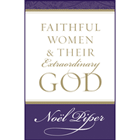
Book Review: Faithful Women and Their Extraordinary God

Faithful Women and Their Extraordinary God by Noel Piper contains short biographies of five women exemplary in their faith and walk with Christ.

Sarah Edwards came from a distinguished family and was intelligent and noted for her graciousness. Her husband, Jonathan Edwards, was brilliant, shy, and very much lacking in social graces. Their personalities complemented each other in a way helped each fulfill his and her ministries against the backdrop of war, uncertainty, and the consequences of taking a firm but unpopular stand based on Scriptural teaching.

Lilias Trotter was a gifted artist whose work impressed John Ruskin and caused him to take her under his wing. Yet she had a heart for ministry and “knew it isn’t possible to be wholly consumed twice” (p. 45) and that one or the other would have to take first place. She chose ministry first among the poorest women in society to an extent which was frowned on in Victorian England, and ultimately to Muslim women in Algiers despite a serious heart condition. Her art influenced her ministry both in her perspective and in producing literature decorated in a distinctly Arab style which appealed where “the visible beauty of a piece of literature” was thought to “validate its worth” (p. 61).

Gladys Aylward was an English parlor maid who dreamed of going to China as a missionary. She thought her hopes were dashed when she was turned down by the China Inland Mission and told that she probably could not handle learning the language, yet the Lord did lead this small 4′ 10″ woman on a remarkable journey to a great and fruitful ministry there. Among other things she was asked to aid in enforcing the new ban on foot-binding, despite telling the mandarin that she would share the gospel as well as enforce the law, and she led 100 children away from the Japanese Army over mountains through several days journey with little food to safety, alone.

Esther Ahn Kim faced the same dilemma as Shadrach, Meshach, and Abednego when Japanese authorities in Korea commanded everyone in her school to bow down to an idol. She was the only one who stood firm and erect. She escaped authorities for a while and hid out with her mother, preparing herself for imprisonment, which did in fact eventually come.

Helen Roseveare was a doctor who knew even before becoming a Christian that she would be a missionary. She ministered in the Belgian Congo, where her drive for excellence was challenged in situations where medical standards were a far cry from what she had been taught, yet she persevered and came up with ways to adapt. She chafed against needing to make bricks when her services were needed medically until one man told her that it was when she was down at the kilns with her hands as rough as theirs that they most knew she loved them and that they could trust her and listen to her tell of God. In fact, one hallmark of her life was her willingness to listen to the rebukes and instruction of those around her. It was in her ministry that an incident occurred which you may have received as an anonymous e-mail forward: a hot water bottle was needed to keep a newborn premature baby warm whose mother had died in childbirth. When the orphanage children were told and asked to pray, one girl prayed that they would receive a hot water bottle that afternoon and that a doll would be sent as well so the little baby girl’s sister would know God really loved her. And a parcel from Helen’s home, the first ever after four years there, arrived that very afternoon containing both a hot water bottle and a doll. Helen persevered through hardships, exhaustion, and an attack by rebel insurgents in which she was beaten, had her teeth knocked out, and raped. She was rescued by the National Army and went home for a year, but could not remain away and so went back to the newly renamed Zaire, which was then recovering from the devastation of war. The only one of the five women still living, she now lives in England where she writes and witnesses and tries to encourage others to consider the “fields white unto harvest.”

In some ways I am not sure why I picked up this book, because I had already read full biographies of Sarah Edwards (Marriage to a Difficult Man: The Uncommon Union of Jonathan and Sarah Edwards), Gladys Aylward (The Small Woman), and Esther Ahn Kim (If I Perish), and most of the material on them came from the books I had read. Yet it was a good refresher course of their lives, and there was even a bit of new information on some of them. I didn’t know, for instance, that Elisabeth Elliot had met and talked with Gladys. Lilias and Helen’s stories were new to me: I think I was only vaguely aware of their names before.

One reason I enjoy reading biographies is that the examples speak to me in my everyday life. For instance, when I find myself sometimes fearful to go certain places, I remind myself of situations like Gladys’s when she was alone in the middle of nowhere in Russia in wintertime, having just been put off the train that could go no farther because of the war. If God could keep her safe in those circumstances, can He not keep me, too, in situations far less perilous? I am challenged by women like Esther’s mother: could I help my child prepare to face certain suffering rather than seek for a way to hide her and protect her? There is so much I learn through what they learned and how God worked in and through them.

There is so much I wish I could share of the faith, faithfulness, and examples of God’s working in the lives of each of these women, but I would have to nearly reproduce the book to share all I’d like to. I highly recommend it to you.

(This review will be linked to Semicolon‘s Saturday Review on Books and 5 Minutes For Books‘ I Read It.)

Winner!

The winner of my giveaway for I’m Outnumbered!: One Mom’s Lessons in the Lively Art of Raising Boys by Laura Lee Groves is….

Ann!

I’ll send you an e-mail in just a moment to request your contact information.

Laudable Linkage and Video

Just a few links this week to some worthwhile reads:

Growing As a Homemaker. This is great encouragement for young moms who feel overwhelmed.

Wondering Why God Makes Life Impossible Sometimes. Jon’s Stuff Christians Like is usually funny and/or satirical (not always the same thing), but sometimes he comes up with a serious one that touches the heart. When I read this I had just been somewhat down because of problems or issues several friends or extended family members were facing, and though this truth is not new to me, I still have to go over it from time to time and adjust my perspective.

You Need a Mother Very Badly. Some of you may be familiar with Gregg and Sono Harris, pioneers in speaking and writing about the home school movement. Sono recently passed away, and this poem is a tribute by one of her sons. Keep the tissues handy, especially if you’ve lost your own mom.

From the ever helpful Tipnut: 12 Simple Sore Throat Remedies and 12 Home Remedies For Nausea.

It’s hard to believe all these people took the time to do this, but it’s pretty neat, for at least the first 45 seconds or so.

A one man quintet. This man has been to my church — but he didn’t do this then! This is one of my favorite songs.

I saw this at Nannykim‘s. I am not familiar with Francis Chan, but I can identify with this tendency to handling fears.

Laudable Linkage and Grandma’s Birthday

We enjoyed celebrating Grandma’s 82nd birthday last night  with Pizza, cake, presents and “Team Scrabble.”

I don’t know how many people are around this holiday weekend, but here are a few things I’ve enjoyed reading the past couple of weeks.

Sometimes It’s Just Plain Hard, a very honest perspective that not everyone has beautiful, inspiring last days and death, but the hardness is all the more reminder that death is an enemy and Christ has overcome it and offers new life.

Another on the subject of death: I was brought to tears by the text of The Long Goodnight, HT to Challies. My own preferences for musical style is more conservative than the accompaniment here, but the text is from an old German hymn.

Laura introduced me to the M. O. B. Society (Mothers of Boys) with the post A Woman of God in a Household of Boys.

The High Calling of a Wife and Mother in Biblical Perspective.

“If Anyone Destroys God’s Temple…” Very convicting, not the usual take you see on this passage.

Beware the anger of man that attempts to produce the righteousness of God.

How can I make sure I am regularly shepherding everyone in the church?

In the “something to think about” department: Girlie Christianity.

Hope all my American friends have a happy Independence Day! I’ve loved this explanation of the Declaration of Independence by Red Skelton since I first heard it:

Wanting things to be “perfect”

You know how it is when company’s coming. Though you always want to keep your house to a certain level of cleanliness, and you do esteem your family members above everyone else, there is just something about having company that sets off a housecleaning frenzy.

I learned long ago that I can’t usually get everything done that I’d like to do before company comes, so I’ve learned how to prioritize and hit the most important things first. If I have enough warning, sometimes I can get some of those long overdue household projects done as well.

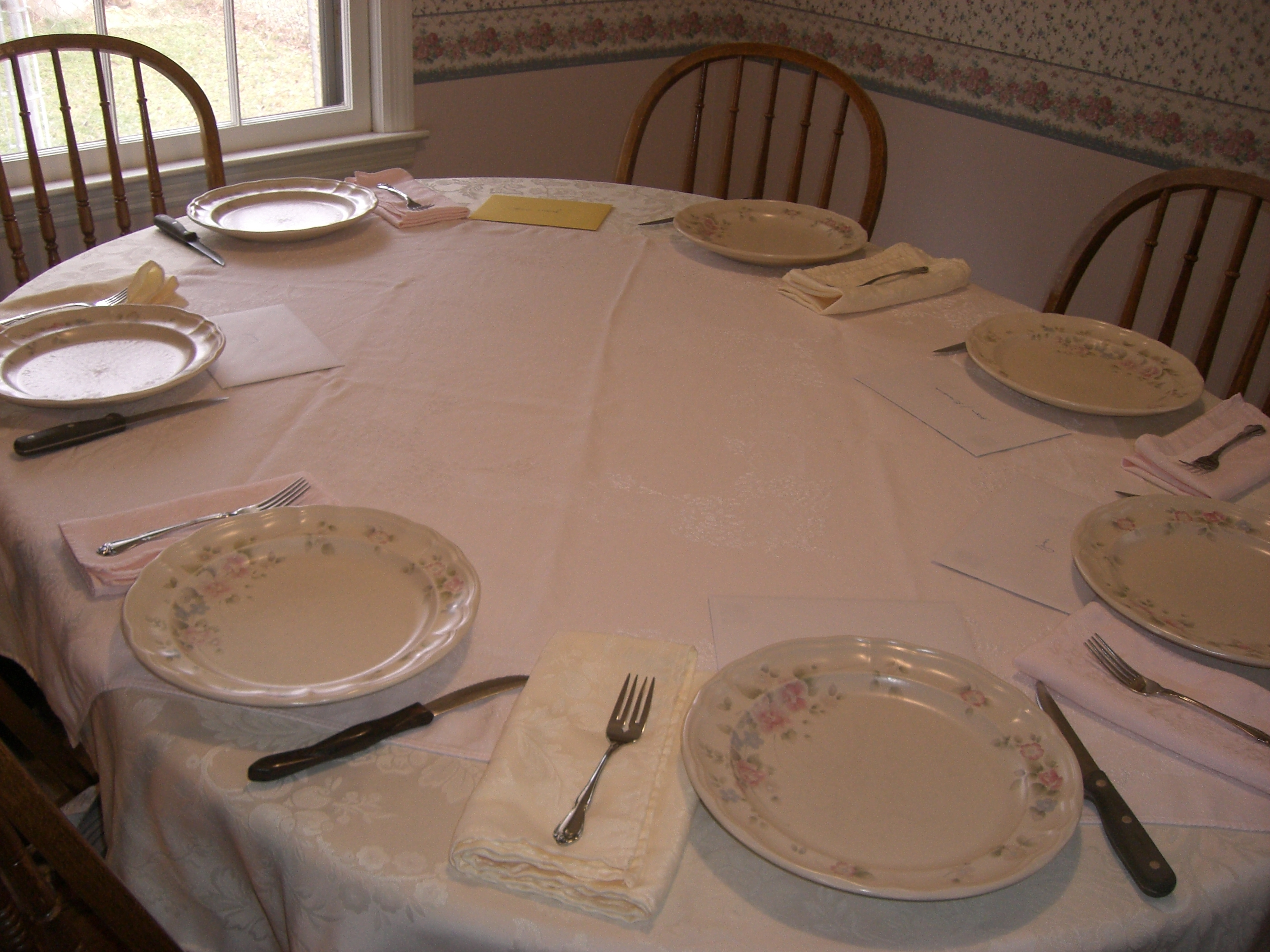
But no matter how much I do, it seems there is always something I miss. Recently a friend of my son and daughter-in-law’s was in town visiting them, and I invited them all over for dinner one night. I was rejoicing in getting just about everything done that I wanted to before she came. Dinner was not quite ready when they got here (because I decided I needed to vacuum my room before I started dinner, even though it was unlikely she would go in there. It had been needing it anyway and it was a relief of mind to get it done). They offered to help and set the table, but dinner was just a matter of waiting on things to cook through. While they waited, our guest played some different hymns on the piano. It rejoiced my heart to hear the piano in there again: no one had played in months since we let Jesse drop out of lessons this year. We enjoyed a nice time of fellowship later with dinner.

The next day, I was picking up some things in the living room when I noticed some scattered debris on the piano next to the keys. “What in the world…?” I thought. I had just dusted it the day before. As I drew closer to inspect it, I saw it was needles from the fir Christmas tree. From last December. On my piano in May. We had had the cover over the piano keys closed for so long, I didn’t even think to open it to dust under there. And there it was for our guest to discover!

That reminded me of another time in early married years when we wanted to have the youth group over after church one Sunday night. We had furiously cleaned the day before until everything was gleaming. As the young people came in and then started singing, my eyes strayed behind them to the bookcase, on top of which was the can of dusting spray, on top of which was the dustrag, which happened to be an old pair of my husband’s underwear with the distinctive waistband showing. I was mortified, but I couldn’t do anything about it: if I went toward it to remove it, all eyes would see and notice it then. So I just left it and hoped no one saw it. If they did, they were too polite to say so. I couldn’t do anything but laugh about it afterward, since there was no way to correct it.

I’ve had what sometimes seems like more than my share of laughable, imperfect cooking experiences from disastrous cakes to green gravy to volcanic teriyaki.

I was reading a book on hospitality once where the author wrote about a time when she had a bit of time to relax, so she sat on the sofa and read the newspaper. Then someone came to the door, and when she answered it she saw it was an acquaintance who had dropped by unexpectedly. The author was embarrassed that things weren’t “picked up,” but invited her guest in anyway. When the guest saw the scattered newspapers, she smiled and said something like, “Now we can be friends.” When people are “perfect,” we can’t quite relate to them and they can even seem unapproachable. But when we see they have the same struggles we do, then they are more genuine to us and we can interact with them more comfortably.

Years ago when I first joined the TMIC, I wanted to be a good testimony there. It’s frowned upon to use such a forum as a “bully pulpit,” and I didn’t want to do that, anyway. But I did want to honestly relate how God helped me and I wanted to be a light for Him there. Because of that, I tried to keep my posts upbeat and hopeful. Some months later another Christian lady joined, and I was blessed by how honest she was about her struggles. She wasn’t morose or complaining, but she shared her everyday struggles as well as her faith. I e-mailed her privately about how refreshing her posts were, and she wrote back that it wouldn’t pay to hide her struggles. By sharing that she struggled with the same things everyone else did, she was more genuine and had more of an open door.

In the chapter “Women of Like Passions” from her book Keep a Quiet Heart, Elisabeth Elliot wrote of a woman at a conference who had asked to speak to her, but was hesitant to “bother” her and was a little afraid of her. Elisabeth agreed to speak with her and tried to reassure her, and later the leader of the conference told Elisbaeth that the woman had told her, “Oh, it wasn’t bad after all! I walked in–I was shaking. I looked into her eyes, and I knew that she, too, had suffered. Then she gave me this beautiful smile. When I saw that huge space between her front teeth, I said to myself, ‘it’s OK–she’s not perfect!'”

Then in the same chapter she wrote of a time when her daughter, Valerie, was speaking, lost her place in her notes, and after a long, awkward time span of not being able to find it again, did the best she could ad-libbing the rest. She was nearly in tears as she finished, but afterward one person told her it was the best class so far and another thanked her for what she had said that helped her. Later she told her mother, “I couldn’t understand why this had happened. I had prepared faithfully, done the best I could. But then I remembered a prayer I’d prayed that week (Walt told me it was a ridiculous prayer!)–asking the Lord to make those women know that I’m just an ordinary woman like the rest of them and I need His help. I guess this was His answer, don’t you think?”

We need to let go of perfectionism. Who are we trying to fool, anyway? We so want for things to be “just right” when we have company or have an event. And that’s a worthy desire. It shows care for the guests and care for one’s home and surroundings. I’ve been in places where there was no such care, and they were uncomfortable places to be. But we don’t need to beat ourselves up when things aren’t “perfect” even when we’ve done our best. It helps to just laugh at ourselves (with others, if they’re aware), learn from the situation (next time I will lift the piano key cover and dust under there!), and, for serious offenses, go to Jesus for cleansing and restoration. Even though He is perfect, He is approachable because He bore our sin and its punishment so that we could be forgiven. We can never be perfect on our own, but by His grace we can be washed white as snow, pure and spotless.

For verily he took not on him the nature of angels; but he took on him the seed of Abraham. Wherefore in all things it behoved him to be made like unto his brethren, that he might be a merciful and faithful high priest in things pertaining to God, to make reconciliation for the sins of the people.  For in that he himself hath suffered being tempted, he is able to succour (help, aid) them that are tempted. Hebrews 2:16-18.

For we have not an high priest which cannot be touched with the feeling of our infirmities; but was in all points tempted like as we are, yet without sin. Let us therefore come boldly unto the throne of grace, that we may obtain mercy, and find grace to help in time of need. Hebrews 4:15-16.

Laudable Linkage

We’re off to a wedding in a few hours, plus the usual Saturday chores. I only have a handful of links to share with you of interesting things seen round the web this week.

All You Single Ladies…Or At Least Those Over Thirty. Though I would say it is not just for single ladies. Here is an excerpt:

I am burdened that we tend to alienate ourselves (and sometimes our churches facilitate that alienation with extensively segregated ministry) based on the particular burdens we face. Divorced. Single. Mothers. Newlyweds. I’m not discounting the value of counsel specific to our stage of life, but I’m also burdened that we not discount the commonality of our burdens. Whatever emotional battles you face now, tempting you to doubt God and despair over your circumstances, are NOT unique to you or your stage of life. They are “common to man”. You likely experience intense emotional battles (discontentment, loneliness, alienation, despair). You probably experience sin battles (sexual sin, gossip, bitterness). You have many sisters in Christ who have experienced similar variations of the struggles you face. You need your Christian family. Don’t allow Satan to use feelings of alienation to marginalize you in the church.

Let go by Jeanne Damoff. Beautiful post on not clasping, clenching God’s blessings, but letting them go into His hands.

The Glory of Plodding by Kevin DeYoung.

Learn How to Hand Quilt.

The Selling Sisters: your guide to selling onlineMy friend Lizzie of A Dusty Frame has begun a blog with her sister called The Selling Sisters having to do with tips on buying and selling online (Ebay, Etsy, online shop, etc.) from their experiences. I have been thinking about getting into some of that, and I’ve found just glancing through their site informative. I’ll know where to go when I have questions! I hope you’ll check them out.

Have a good Saturday!

Assorted reading and stray thoughts for Mother’s Day

One old post of mine getting a lot of hits these days is one about Mother’s Day reading, but since I did not know many of you then, I’ll repost a little of it here. I know some of you don’t like to look through lists of links, but there is good stuff in these. I was thinking of posting this on Saturday, but then thought some of you might like to see some of these before then.

Elisabeth Elliot wrote a leaflet she titled “A Call to Spiritual Motherhood” which she read in on of her radio broadcasts. You can read the transcript here. It is an excellent article encouraging all of us in any stage of life to spiritually “mother” younger women. Many of us have had godly women besides out own mothers who were shining examples to us, who taught us along the way and encouraged us. I think they are worthy of honor on a day like Mother’s Day, too. :)

Girltalk has some excellent articles for those who have lost children to miscarriage or a later death, struggle with infertility or have wayward children, for whom this time of year can be quite painful.

Annie’s Mother’s Day pages have several neat links. I especially liked What the Bible Says About Mothers.

I mentioned the high expectations some women might have about Mother’s Day, setting themselves up for disappointment, but I’ve often run into just the opposite: a mom who doesn’t like all the fuss on Mother’s Day, or, as Al Mohler wrote one year, that Mother’s Day is a bad idea because of the commercialism, the sentimentality, or the lack of honoring mothers other days of the year and trying to make up for it on that one day. To moms who maybe don’t like to be put on the spot or feel uncomfortable about all the attention that day, I would say just accept it as an expression of love.  You may not want or need gifts and may just want the family to have time together, and that’s fine, but don’t downplay what your family tries to do to honor you. Have you ever tried to give a gift to someone who keeps saying things like “You shouldn’t have!” so much that it takes all the joy out of giving to them? Don’t be like that (of course, balance is the key here. Maybe next year well before Mother’s Day you might want to express to your family that you really don’t want anything and ask about a family day instead, if you feel that way. But don’t downplay their efforts after they’ve already done something.)

As for the sentiment that Mother’s Day is a bad idea for the reasons mentioned: I agree with some of Dr. Mohler’s points: it’s wrong to passively neglect or actively dishonor one’s mother and then try to assuage guilt with a card and flowers on Mother’s Day. And I do agree some sentiments are over the top: sometimes when buying cards I have wondered if they were made for real people at all. Sentimentality, though, is often in the eye of the beholder. What might seem “gushy” and over the top to some might seem just right to another. And, yes, most holidays have become too commercial, but that doesn’t mean we need to do away with them completely. There are multitudes of options between going all out and not celebrating at all.

I consider Mother’s and Father’s Day and many holidays  in the same way I think of Thanksgiving: we’re supposed to be thankful all the time, but there is something special about that one day and taking special care and thought into pondering just how much we have to be thankful for and the One to Whom we owe our gratitude. So with a day dedicated to parents: it’s one of the ten commandments to honor our parents, and Mother’s and Father’s Day is just one way to do so. It’s not that we save up our honor all year for this day: we honor them all the time, but this special day we focus on them, their love to us, and all they have done for us, and let them know we love and appreciate them.

What if you don’t feel your mother is worthy of honor? The command to honor our fathers and mothers is just that — a command. During my teens I did struggle for a brief while with respecting my parents. One day after a sermon on “Children, obey your parents,” it occurred to me that the two passages that teach that (Ephesians 6:1-3 and Colossians 3:20) do not qualify the command (obey if they are saved, if they are perfect, if they do everything just right, if they deserve it). I realized that all of the commands about relationships in the rest of those passages were not dependent on the other person doing his or her part. We’re supposed to do our part whether the other one does or not. I was supposed to obey my parents and respect their position as my parents. I had to apologize for my attitude, and the Lord enabled me to indeed honor them and respect them, and even to appreciate them and to be thankful for the life they gave me, the care they took of me, and so many more things. It showed in my attitude (I had never been allowed to “backtalk,” but there are other ways a disrespectful attitude can seep out), and the Lord healed the breach between my parents and me. I only wish she were still here for me to honor, but I do honor her memory. A few years ago I wrote Things I love about my mom.

Here are some things I’ve posted in the past regarding Mother’s Day. 🙂

Mother’s Day funnies.
Mother’s Dictionary (funny).
Mother’s Kisses (poem).
Mother’s Day Poems.

For Mother’s Day…or any day

ChurchWorksMedia.com is selling a neat little month-long devotional booklet called Gospel Meditations for Women, and with Priority Mail, there is still time to get copies for Mother’s Day to distribute to the ladies of your church or just to the special ladies in your life. But even if you can’t order it in time for Mother’s Day, it is a great resource any time.

It was first written by pastors Chris Anderson and Joe Tyrpak for the ladies of their congregation last year. Each page contains a verse of Scripture with the reference for the longer passage, then about a page-long meditation on the passage, ending with the line, “Let the gospel affect your ______,” the blank being filled with the topic of the day. You can find more information here and view a sample here.

I ordered a few copies for myself and received them a few days ago. I haven’t had a chance to read all 31 entries yet, but I have liked what I have read so far. I would normally read something completely before endorsing it and recommending it, but I did want to mention it in time for Mother’s Day. I have been reading Chris Anderson’s blog, My Two Cents, for some time now and have quoted from it or linked to it occasionally, and I have always appreciated his careful handling of Scripture and his gracious interaction with others. Some of you might be familiar with his hymn “My Jesus Fair” from the Galkins Team CD, Christ, Only Always.

Laudable Linkage

Here are some great things I’ve seen around the “Net and thought some of you might enjoy as well.

Tim Challies shared a link to an incident that brought tears to my eyes: The Contagious Comfort and Mercy of God at Wrestling With an Angel. It begins this way:

One busy Saturday afternoon I was patrolling the local mall parking lot in my police cruiser. It was warm, so I had my windows down enjoying the fall air. As I drove though the lot I heard a loud piercing cry echoing like a sound bite from a horror movie.

After reading that post I clicked around and read a few other posts there. Very good, rich reading.

A Biblical view of self image and way of dealing with self-doubt by Laura at Outnumbered Mom, a new blog friend discovered through the Friday Fave Fives. Though it deals with self-doubt as a mother, the truths there are applicable to anyone.

Political angst by Wendy at Practical Theology For Women deals with a few pet peeves, such as angst in Christianity “over something the individual perceives as righteous or unrighteous but that Scripture itself only addresses in either very general terms or doesn’t address at all.”

The Marriage Bed. Be sure to read til the end! I’m sorry I forgot to note where I saw this one.

Respect within marriage.

How to Pray For Missionaries.

The Paradox of Parenting Boys. This made me smile.

A live web cam of a nesting owl, HT to Lizzie. It will be really fun once the babies hatch.

A refurbished vintage sewing cabinet. Lovely!

A video library of hand embroidery stitches. Great resource!

Paper silhouette art. These are very creative — I’ve never seen silhouettes like this.

If you need any ideas for cute Easter decorations or goodies:

Eggy Baskets.
Little nests.
Free printable cupcake toppers.

Have a great weekend! We start spring break this week!

Book Review: Mrs. Dunwoody’s Excellent Instructions for Homekeeping

Some time back I found this quote somewhere online (I forgot to note where) from a book titled Mrs. Dunwoody’s Excellent Instructions for Homekeeping:

In these notes, I have endeavored to impart knowledge necessary for keeping a neat, well-ordered home. But beyond that, I wish for you to understand the larger issues of homekeeping — creating an environment in which all family members grow and thrive, a place where each member may evolve to the full extent our Creator intended.

I liked that, and I further liked the information posted with it, that  “Mrs. Dunwoody, the wife of a judge in Georgia, was the ‘Martha Stewart’ of her time during the Civil War. She started her journal (notes) on homemaking in 1866, and would spend the next 50 years to complete her notes.”

I liked this so much that I asked for this book for the next Christmas or birthday. When I received it and started looking through it, though, I found that it was not written by a real 1860s Mrs. Dunwoody: It was written by a modern Miriam Lukken in 2003 in the style of the “receipt books” “that nineteenth century Southern women penned as a record of all they knew and thought meaningful,” and Mrs. Dunwoody was a character based the author’s great-grandmother and other Southern women.

At first I was sorely disappointed. But then as I began reading, I realized that I still did like the philosophy of housekeeping represented.

She believed that the ordinary acts we practice every day at home are of more importance to the soul than their simplicity might suggest. Taking care of our home enables us all to feel nurtured and safe; it brings comfort and solace both in the fruits of our labor and in the freedom it affords to experience life to its fullest.

She taught that women were not just doing chores, they were creating — creating a home, a place of security, warmth, contentment, and affection (p. xii).

Home reflects the creativity, serenity, and beauty we hold dear (p. 7).

Homekeeping is a fine art. It grasps with one hand beauty, with the other utility; it has its harmonies like music, and its order like the stars in their courses. I fear really good homekeeping — which exhibits itself not in occasional entertainment or a handsome parlor, but in good housekeeping which extends from the attic to the cellar, and through every hour in the year — is far from common (p. 8).

I’ll admit that my home is not in complete order from attic to the first floor every hour…but I do see her point.

Organization has more benefits than mere efficiency…Knowing your life and home are in order reduces strife and anxiety, and increases confidences. In short, establishing your own routine for tackling domestic chaos makes the task less burdensome. And everyone feels the effects of that (p. 8).

Homekeeping is an ongoing art, a process, not an end product. It will never be “all done.” Bathrooms, clothes, and dishes, once clean, have a way of getting dirty again. But home is meant to be lived in, in the fullest, most potentially filling way for everyone in it. That means that every room does not need to be picture perfect and waiting for a perfect display, but rather, each room has a sense of order and calmness to it. The home looks like someone lives there, without appearing messy or cluttered (p. 8-9).

The rest of the book is filled with household tips and snippets of wisdom on everything from laundry, etiquette, health, garden, what to do for spring cleaning, etc.

In some parts of the book she sounds a little too rigid with her routines for my taste: I think an overly rigid housekeeper who only tolerates things done in specified ways and at specified times can make her household and guests as miserable as the lax housekeeper. Balance is needed.

And she mentions that home is “a place where even the everyday things in our lives were held sacred and should therefore be cared for and treated in a special and orderly way” (p. xii). We women do have our little treasures around the house, but I would not call them sacred. We have to remember not to “lay up treasures where moth and rust doth corrupt and where thieves break through and steal” but rather in heaven. I prefer to think in terms of stewardship: the things we “own” are given to us by God, and we should therefore take care of them.

But overall her reminders help me refocus on the fact that housework isn’t just “drudgery” — it is a ministry to family and guests, it fosters order and tranquility, and it is a testimony of a God of order, creativity, and beauty.

(This review will be posted to Semicolon‘s Saturday Review of Books.)