Book Review: Women’s Ministry in the Local Church

I finished Women’s Ministry in the Local Church by Ligon Duncan and Susan Hunt a few weeks ago, but it is hard to know how to condense everything I’d like to say about it. I typed out many of the quotes I marked so I could have them handy to refer to without flipping back and forth through the book, and just those quotes took up almost three pages, which is much too long for a blog post! So I think I’ll just give you a brief overview of the book and then mention a few things I really liked about it and a couple I didn’t like so much.

The authors first set out the need for such a book to help women to teach other women as Titus 2 instructs, to present the Biblical role of womanhood as opposed to the feminist view promoted by the world, and to promote the necessity and nobility of women’s roles. The authors had found resources teaching many aspects of a woman’s relationship to Christ and women’s groups a para-church organizations, but not one integrating the women’s ministry to the church ministry as a whole. Furthermore, in some churches which do have some type of women’s ministry, that ministry is “event-, task-, or personality-driven. An inherent danger is that any ministry that is not Biblically informed will eventually become competitive and divisive” (p. 31). Ligon Duncan has an excellent section on “Why a Church Needs a Women’s Ministry” in pages 37-42.

After discussing the need and motives of women’s ministry, the authors lay out the foundations and tasks of a healthy women’s ministry and the relationship of the women’s ministry to the rest of the church.

The authors promote a complementarian position, the view “that God created men and women equal in being but assigned different — but equally valuable — functions in His kingdom, and that this gender distinctiveness complements, or harmonizes, to fulfill His purpose” (p. 32), and part of that distinction is “male spiritual leadership in the home and believing community, the Church” (pp. 32-33). A couple of quotes I especially appreciated along these lines were:

Submission has nothing to do with status. Submission is about function. Equality of being and differentiation of function characterize the Trinity. The Persons of the Godhead are ‘the same in substance, equal in power and glory,” but each has a different function in the accomplishment of our salvation (p. 73).

Submission does not restrain women. Submission frees us to accomplish our kingdom purpose (p. 78).

Domestic duties are not a hindrance to sanctification; they are essentials of the common life. The family is a context in which to develop godly character that will qualify women for service beyond hearth and home. When love for Christ is the matrix of domesticity, those duties become an aroma of Christ, the fragrance of life (2 Corinthians 2:15-16) (p. 106).

Since I’ve started sharing quotes, let me see if I can pick out a few of the most pertinent from the three pages I gleaned:

When young women learn more about womanhood from TV, movies, magazines, and the Internet than they do from mature older women, they will often make unbiblical decisions. (p. 53)

Christ, not womanhood or the women’s ministry, must be the reference point. Unless a woman’s ministry is an overflow of the gospel, women will become hinderers and nor helpers in God’s Church. Those who plan for and implement a women’s ministry must be intentional in maintaining a gospel orientation in their hearts and lives (p. 58).

Paul put heavy emphasis on sound doctrine. Sound doctrine is the antidote for error. Sound, which is the key word in these letters, is translated from a Greek word that means whole or healthy. “Christian doctrine is healthy in the same way as the human body is healthy. For Christian doctrine resembles the human body. It is a coordinated system consisting of different parts which relate to one another and together constitute a harmonious whole. If therefore our theology is maimed (with bits missing) or diseased (with bits distorted) it is not ‘sound’ or ‘healthy'” (pp. 59-60).

Titus 2:3-5 instructs the pastor to equip older women to train younger women. If this mandate is disconnected from a biblical perspective of discipleship, it can easily become purely a relational model that magnifies relationship rather than God’s glory, or an academic model that elevates knowledge over the application of the gospel into life (p.60-61).

Without in any way discounting the regular pulpit ministry of the church, we should recognize that there are certain matters more aptly addressed and applied in the context of a specific discipleship of women, whether in large groups, in small groups, or in situations of confidentiality, as women minister to women (p. 84).

The goal is not to get every woman to participate in the women’s ministry, but for the women’s ministry to serve and encourage every woman in the church (p. 111.)

Commenting on Psalm 144:12b: “that our daughters may be as corner stones, polished after the similitude of a palace”: These corner pillars were both beautiful and functional. They gave grace and dignity to the structure even as they supported it. If these pillars weakened, the structure was in danger. David considered these corner pillars to be gifts from God…Unless corner pillars stand on a firm foundation, they will topple. p. 138.

At the end of each chapter is a short testimony from pastors or women about some aspect discussed in the previous chapter. One of the most interesting and enlightening to me were a couple from women in reference to being in a church that did not see the importance of a women’s ministry, or, in some cases, did not even seem to love women:

How are women to love the church when they feel unloved by the church? I have found the answer in Scripture’s admonition to women who are married to unbelieving or disobedient husbands. The failure or weakness of male leadership does not absolve us of our responsibility. We are to run to the Author and Perfecter of our faith with our hurts, wounds, and disappointments. We are to see this season as part of our individual and corporate sanctification offered by our sovereign God who loves us steadfastly. (p. 52-53).

When women are scorned and disrespected by the philosophies of ministry that denigrate the design, calling, and roles of women, we are tempted to react with militant defensiveness. Scripture calls us to remember that Jesus, the King of the Church, delights in us. We are not called to defend ourselves but to defend Christ’s Kingdom through prayer and service. (p. 53).

The “militant defensiveness” stood out to me because I know of a handful of women who have that exact tone in pointing out perceived errors in the church and their voices and tone have become so shrill and bitter that they are doing much more harm than good. If the church is a family, a body, then dealing with problems is not best handled by “militant defensiveness.” That doesn’t mean those problems don’t need to be addressed, but there are better, more restorative and Christ-honoring ways to do it.

There are appendices in the back discussing some practical aspects of women’s discipleship ministries and Bible studies.

There were just a few things I either did not agree with or care for.

  • On page 75 a quote from a Dr. George Knight that “”Eve…brought herself into transgression by abandoning her role and taking on that of the man.” I don’t think that was her sin or even what led to her sin necessarily: her sin was simply disobeying God’s clear command; her motives: the lust of the flesh, the lust of the eyes, the pride of life.
  • This one is perhaps a minor point, but on pages 102-103 there is a section about widows which interprets I Timothy 5:3-10 as referring to two different groups of widows, those who receive church help and those who are a group qualified to minister to others. I had never heard that before, but I don’t see a distinction between two groups there: I believe it is all one group of widows and the lists actions there show what they have done, what they are being honored for, not what they are signing up to do (not that older women should not keep ministering in some way as long as they are able, but that’s another post I am thinking about).
  • On page 140 the authors say, “Bible studies should equip women to pass on the legacy of biblical womanhood to the next generation and should offer opportunities for them to have hands-on experiences in discipling one another.” I agree, but I don’t think that means Bible studies among women can only cover these topics or the passages that relate directly to women. I think studying books or other topics can be covered and is part of the foundation on which women’s ministry rests, and principles of womanhood can be brought out. Later they warn against a “prideful pursuit of knowledge…that stops short of true discipleship that moves from knowledge to wisdom — to the application of truth into life. They have perfected some Bible study skills, but they do not know how to love as godly, chaste single women, or love their husbands, or care for the sick and oppressed, or support the male leadership of the church…” and more (pp. 140-141). I do think that’s a valid concern.
  • Related to the above point, there is a section where a pastor compliments the women’s Bible study ministry in his church for coordinating with the pulpit ministry. For instance, when he preached a series on “David: A Man After God’s Own Heart,” the ladies’ Bible study ministry did a study on “A Woman After God’s Own Heart.” I think that’s really neat when that kind of coordination occurs, but again, I don’t think the ladies’ Bible study should be restricted to that kind of coordination any more than the Sunday School classes or children’s ministry or men’s meetings should. Sometimes it’s helpful when every aspect of the church is focused on a particular truth, topic, or section of the Bible, but in most cases it is helpful when the different groups study different parts of Scripture: it’s part of studying the whole counsel of God and balancing the different parts of Scripture. I’ve found that helpful even in my own Bible study or reading: if I am in a particular “heavy” section, like Job or the prophets, it helps to read a Psalm or something from the epistles as well.
  • I was surprised to find little mention of hospitality in the book. It’s implied but not really discussed much. As I mentioned in Mentoring Women, I think it hospitality is a primary way women can disciple and minister to each other; I don’t know that Paul primarily had classroom instruction and retreats in mind when he penned those verses, though I think it’s fine to use those.
  • Susan’s writing can be a bit clinical sometimes. I felt this way in her chapters of Becoming God’s True Woman as well (which I thought I had reviewed, but looking back, I just referred to it a number of times.)
  • This last point is one I want to be the most careful with because I don’t want to cause offense. Let me say first that, though I am in my particular denomination because I feel it best represents my understanding of what Scripture teaches, I know no denomination is flawless, and I can get along fine with people from other denominations if we agree on the major points: the Deity of Christ, the inspiration of Scripture, salvation by grace through faith and not by works we do, etc. Many blogs and books I read are by people from other denominations than my own. I can understand that good people can differ on some areas of teaching and application and still do everything they do as unto the Lord and be in right standing with Him.

One of those differences in some denominations is looking at God’s dealings with people through either a covenantal or a dispensational lens. This post is too long already to explain those two views and you can easily find them elsewhere, so I won’t go into all the differences. I can actually see elements of both: there are covenants God made with people throughout history that affected people for years to come, and the New Testament does refer to God’s relating to us through a “new covenant.” But, though God is always the same and people have always been saved by faith, there are different times in the Bible God had different specific requirements for His people. For instance, in our day we don’t have the same command as Adam and Eve not to eat of a certain tree, or the same requirements Old Testament Israel did with the ceremonial law. So while I would probably lean toward a more dispensational view, I certainly don’t discount the covenants and can see Biblical history through that lens as well. I can read books and blogs with those differences without a problem at all.

But this book is very, very, very heavily covenantal. Susan uses the phrases “covenantal community” and “covenantal consciousness” multitudes of times throughout the book to refer to the relationship believers in a church should have with each other. Those phrases are probably infused with meaning to her, but to me they just leave me a little cold. Just taken at face value, a covenant is a binding agreement between people. So relating to each other based on an agreement just doesn’t carry the same meaning to me as the Scriptural metaphors of the church being a family and a body, with different parts and functions all working together in a harmonious whole. Those metaphors are mentioned but not emphasized in the book. Susan  urges women’s ministry leaders to use those phrases to remind and emphasize to women their covenant relationship with each other, but the overuse of them in this book seemed to me to be an irritant and a shoving of the concept down the throat. I wouldn’t have had as much of a problem with it if she simply stated her view of the church as a covenantal community at the beginning and then went on without using those phrases so very often.

The time and space to explain all of that might seem to give it more weight than intended: it’s not really a major objection and not even an objection, really: I just think the emphasis of the type of community and relationship we’re to have with each other as believers would be better served with the more Scriptural phrases of the church being a body than the denominational phrases of “covenant community” and “covenant consciousness.” I think Susan probably means the same thing by those phrases, but to someone outside a covenantal type of denomination, it just doesn’t come across the same. Her writing is so heavily denominational, it might be off-putting to those from different denominations, but there is much good to glean if you don’t let that phraseology bother you.

It might look like I objected to more than I agreed with, but that is not really the case: it just took a bit more to explain the disagreements, and I didn’t bring out every single point I did agree with. Overall I found the book to be a rich resource and agreed with the great majority of the teaching and application. I would recommend it to anyone contemplating women’s ministry in the church.

(This review will also be linked to Semicolon‘s Saturday Review of Books.)

Laudable Linkage

Here are interesting things I’ve seen around the Web lately: maybe some will interest you as well.

10 reasons to break the sarcastic habit, with action plan.

So Was Jesus.

Thoughts on Modesty, not from the standpoint of causing guys to stumble, though that’s a valid concern, but as a matter of our own hearts before God.

“Dora the Doormat” and other Scary Straw Women of Complementarity, HT to Challies. Deals with some of the erroneous charges some make against proponents of complementarianism, the view that God created the sexes equal but with roles that complement one another.

Confessions of a Conflicted Complementarian, showing how gospel grace applies even in this.

One taxpayer’s response to the potential government shutdown. Heh, heh, heh.

Food:

Double Chocolate Treasures. I am definitely trying these!

Cake Balls. I usually take the easy route of just throwing cake batter in a 9 x 13 pan, but these looks so good.

Resurrection Rolls for Easter breakfast. I’ve posted my version with yeast rolls before, but this one uses crescent rolls and cinnamon. I might just try this kind this year.

Crafts/decorations:

Buttons on display. Really cute card made with buttons.

How to Turn Mini-Blinds Into Roman Shades, HT to Lizzie.

What guys think about modesty:

I can’t imagine all the work behind this:

Happy Saturday!

Laudable Linkage and Fun Videos

Here are a few things that stood out to me online this week:

Filling my home with the unseen, HT to Lizzie. Both the photos and the sentiments are lovely.

Pray to BLESS. I’ve heard and read a number of acronyms as a help to prayer, but I had never come across this one before. Very helpful.

The New Evangelical Virtues. Tim Challies masterfully discusses “characteristics that seem to pass as virtues today…doubt, opaqueness, and an emphasis on asking rather than answering questions.” “Humility is not found in doubting what is true, but in believing that what God says is true is true indeed.”

Spring Cleaning Your Facebook Account. No, not a discussion of purging your “Friends” list, but rather helpful questions to check our hearts. It’s not that the technology is bad, but what’s in our hearts is going to reveal itself even there.

Why Books Still Matter.

I almost labeled this “Luggage Inspectors,” but I didn’t want to be snarky. 🙂 Let’s just say don’t leave a parked car where there are monkeys:

This is amazing. I could never do this — not only because I can’t play music, but I’m sure I would knock over more than one glass.

Happy Saturday!

Laudable Linkage and a Few Funnies

Here are some interesting things I’ve seen in my online reading lately:

The Blind Quilter. Amazing. I can’t even do this with sight!

I seem to have marked several about parenting:

Mystery. Enjoying an uncommon moment of affection from a teen son. “Remember this. Remember this.

Everyday Is An Adventure about raising a son. “My boy was not disobedient, he was all boy, he was made of different temperament-a different mind, than my girls and I. I had an epiphany that day, and chose to embrace the adventure instead of struggle against it.” “Boy work is messy and smelly, but a freshly scrubbed boy in clean p.j.s is a gift from above.”

Moms and Teens. Good advice from a mom who has raised four.

First time obedience, really? I haven’t read any of Sally Clarkson’s books and have only recently heard of her, so I don’t know what her general philosophy of raising children is, but I like what I read here. Sometimes well-meaning parents, in a quest to train children to obey, run roughshod over the very hearts they’re supposed to be training.

I edited my review of One Thousand Gifts to add this, but in case you didn’t see it, in the second comment here Ann discusses her use of language that some feel is too explicit for intimacy with God, saying she wanted to reclaim it for the Kingdom and use it apart from cultural connotations and pointing out that even Spurgeon and Edwards used similar language. I do understand where she is coming from and think she had the purest motives, but I still think as sexually charged as society is today you have to be careful about what pictures words bring to mind. The cultural  connotations are going to be different from what they were in Edwards’ and Spurgeons’ time. But I do appreciate her explanation.

How To Make a Asymmetrical Stripe Buttons. So cute.

Applique with used dryer sheets.

20 tips for selling on Etsy.

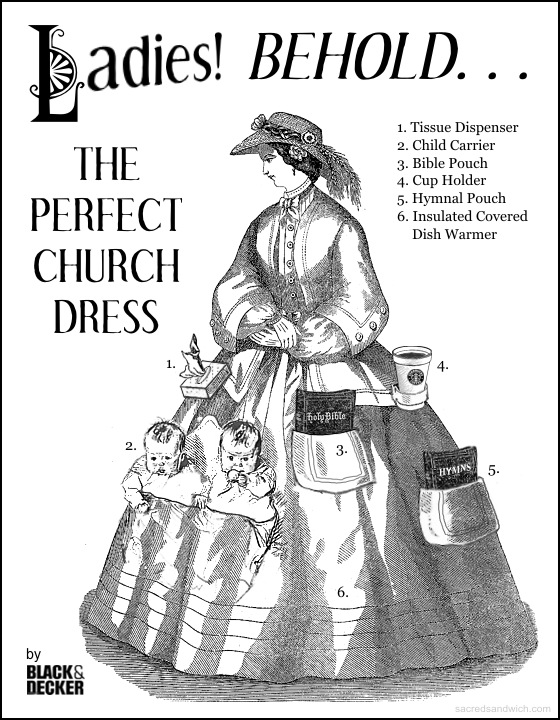
The Sacred Sandwich specializes in satire, which I think you have to be careful with because it can be easily misunderstood at times. But they do have some funny things some times:

Cuteness:

Aw, poor doggy.

Funny!

Homemaking meme

This is another post I’ve had incubating, adding to it a little at a time. Since I have to go run errands in a bit and therefore not as much time to think through some other thoughts, I decided to post this today. Feel free to use it if you like! Let me know if you do and I’ll come see your answers (or feel free to answer in the comments). And, since I created this meme, I’d appreciate a link back. 😀

1. Do you make a plan for the week? The day? Or just go with the flow?

No, I don’t, unless I have some kind of deadline coming up. I tend to work housework in around what needs to be done and when I have time to do it…and, sorry to say, when I feel like it. 🙂 But I feel like it much more often than I did years ago! I can’t stand for things to get too very cluttered or dusty for very long.

2. When is your best planning time?

Usually the night before or first thing in the morning.

3. Do you clean room by room or task by task (e.g., do you dust the whole house at one time, or do you clean the living room completely before going on to another room?)

Task by task for most things. When I have the dusting stuff out, or the vacuum, I like to do everything I have to do with it while it’s out. One exception would be bathrooms: I tend to clean the whole bathroom before going on the the next one, except that I do all the floors at one time after I’ve cleaned everything else.

4. Do you do certain tasks every day every week, like a shopping day, a laundry day, etc.?

No — see #1. I do try to avoid housework that doesn’t need to be done on Sundays, and I have to wash Jesse’s gym clothes some time between Friday afternoon and Monday morning, but otherwise I tend to attack things on an as-needed basis.

5. What’s your least favorite housecleaning task?

Probably cleaning toilets.

6. Do you have a favorite housecleaning task?

I can’t honestly say I enjoy any particular housecleaning task, but I’m okay with most once I get started, and I do like the results.

7. What do other family members do in the way of cleaning the house?

When the boys were younger we rotated different jobs — there were some done every day (dishwasher, garbage, taking recycling out, etc.) and some done weekly (vacuuming, dusting). Now Jason and Mittu take care of the dishes most nights and Jesse does whatever I ask whenever I ask — often taking our garbage and recycling and sometimes unloading the dishwasher. He also takes care of the dog as well. Jason and Jesse help bring groceries in. Since Jim works 60+ hours I rarely ask him to do anything unless I am in a real bind. I figure that’s my work while his is being the “breadwinner” (yes, we’re pretty traditional 🙂 ), but sometimes he pitches in. He takes care of anything outside. That leaves me with the laundry (though Jason and Mittu do their own), dusting, sweeping, vacuuming, bathrooms, organizing and clutter pick-up, shopping, cooking, all the extra little jobs in the kitchen, etc. — enough to keep me busy. 🙂

8. What, if anything, do you do to make housecleaning more enjoyable, (e.g., play music, set a timer, etc.).

When I was first married, I had one friend who liked to spend a lot of time on the phone — and we didn’t have cordless phones then, much less cell phones. It was popular at least in the kitchen area to have an extra-long cord so you could reach the whole room while on the phone. So sometimes I would call this friend or my mom (my mom and I rarely talked for less than an hour) while puttering around the house cleaning here and there. One of my dislikes of newer phones was that they were so small I couldn’t comfortably put them between my head and my shoulder so I could talk and use my hands for other things. These days most of us don’t talk on the phone that long any more, and many phones have gotten “hands-free” anyway.

But usually I turn on the Christian radio station or play a CD. I don’t have an iProduct. I don’t know if I’d like either headphones or earpieces. I need to borrow one of the kids’ devices and try it out to see, because sometimes I do think it would be nice to listen to an audiobook or something else. I don’t like to just sit in front of the computer to listen to anything there without doing something with my hands, so being able to take some of those things with me while I work sounds appealing.

9. What things make a room seem messy or unclean to you?

Clutter. Picking things up and establishing a sense of order does wonders for making it look cleaner.

And dust.

10. What are particular areas that are standouts to you that other people miss?

The area around the faucet on the sink. It can pretty quickly get gunky stuff around it, and in our area, even pink or black mold. Once my sister was staying with us and surprised me by cleaning the bathrooms while I was out. I think the first thing I noticed was that little gunky black line around the faucet, and it took a great deal of effort to just say thank you and not mention that.

11. How do you motivate yourself to clean when you don’t feel like it?

The biggest thing is just to get started. “Once begun is half done” as the saying goes. Another motivation is having been embarrassed a few times when someone popped in unexpectedly and the house looked like a disaster area. But then I felt really guilty one time “cleaning for company” when I thought — doesn’t my family deserve a clean home, too? Wouldn’t it help motivate them in their future to keep things clean if that’s the habit they’ve grown up with, rather than a frenzied, pressured marathon cleaning when an event is coming up? Plus I’ve learned that I just feel more peaceful and orderly in my thinking when my environment is fairly orderly. When the house is cluttered and chaotic, I just feel the same way (not to mention time and energy wasted not being able to find things when needed, etc.). And then, I have learned over the years that it is less work and takes less time to keep on top of housework than to let it slide and build up.

But probably what should be the biggest motivator for a Christian homemaker is that we’re representatives of Christ. I don’t think that means we have to keep things museum quality and can’t let our families relax in their own homes. We shouldn’t become more Martha than Mary. But “Let all things be done decently and in order” (I Corinthians 14:40), though the context is church services, surely applies in principle  to every area of life. And then of course I Corinthians 10:31 applies to all areas: “Whether therefore ye eat, or drink, or whatsoever ye do, do all to the glory of God.” If a non-Christian walked into my house unexpectedly, would a messy, unclean house or a basically clean and orderly house be a better testimony? And shouldn’t that testimony be before my own family as well, not just unbelievers? Now, I admit, I don’t think through that every time I need to clean, but every now and then getting the right perspective helps.

Sometimes collecting quotes about homemaking encourages me, too. I put several in an older post titled “Encouragement for Homemakers.” A few other homemaking-related posts are:

Wanting things to be “perfect.”

I confess: I really don’t like to cook.

Two views of housework.

Cooking style.

Thy list be done.”

ABC Homemaking Meme.

(Graphic courtesy of Fotosearch)

Laudable Linkage and Videos

It’s been a while since I’ve done this, but here are some things around the Web that I’ve found interesting — perhaps some will interest you as well.

Mercy in a Dustpan about practical ways of ministering to others in a crisis.

What If I’m Not a Gifted Evangelist? HT to Challies.

Someday Is a Liar and a Thief, good thoughts on not waiting to offer hospitality as a single person, but applicable to all of us who hope to be more hospitable “someday.”

The Vanity of Loveless Prophets.

Writing:

Novel Editing Tips.

A Showcase of Inspirational Writing Quotes.

Craftiness:

DIY Sweater Pillows, HT to Lizzie. I have an old sweater coming apart at the seams and sleeves, but the design is beautiful, and this would be a great way to preserve it.

DIY Photos on Canvas, HT to Lizzie again.

16 Crafty Bulletin and Memo Board Tutorials.

Kid’s Classroom Valentines. Cute, simple ideas for giving a different kind of Valentine.

I wouldn’t want things really to happen this way — because I’d be on the receiving end sometimes, I’m afraid — but it is funny.

And this is why I am glad I don’t live up North!

Have a great Saturday! I’m not sure yet what our plans are. If hubby doesn’t have any, I think I’m just going to putter around getting a few things done here and there. Love those kinds of days!

The Dinner Party That Wasn’t

Our new church has a “Dinner For Six” program which I’ve mentioned before: people who want to participate sign up and the coordinators divide everyone into groups of three couples. Each couple hosts dinner for the other two once during a three-month period , with everyone dividing up the meal each time. The host family provides main course, one family brings salad and bread, the other brings dessert and a beverage, and they rotate with each meal. It’s a really neat way to get to know people beyond just chatting after services and to meet people from other Sunday School classes or the other side of the church.

We had our first dinner back in October with our pastor’s family and another couple. The second couple was supposed to host in November, but the wife’s mother became ill and she spent much of the month in the hospital with her or at her home afterward. Not only was there not an opportune time, but they were just under too much pressure. Throughout December we tried to find a time that would work for everyone, but we just never could get together. The new rotations for the Dinner For Six were to begin in January, but we attempted to get our last group together one last time and arranged to do so at our home this past Saturday.

Hospitality is not my strong suit, but I’ve come a long way, by God’s grace, since early married years when I felt I had to spring clean every nook and cranny, get every house project on the docket done, and then make some elaborate new dish when company came. It was nice to have only the main dish to prepare, and I put together a tried-and-true crock pot meal that serves a crowd. I planned a side dish “just in case.” I’m more on top of regular housekeeping than I used to be, but there was plenty to do (you can’t clean too far ahead, because then you’d have to do it all over again before the event). I learned a long time ago that I’ll probably not get everything done I’d like to and to prioritize what things had to get done vs. other things I could then get to if I had time. I was a little dismayed at not having help: Mittu was sick and Jason was ministering to her, and Jesse had an basketball game two hours away which Jim attended. I felt bad about not going, but I didn’t feel I could handle being in the car so much before having people over even if I’d gotten everything done ahead of time. Plus I felt I should be here in case something happened to delay them. So I actually looked forward to putting on some music and digging in.

Everything came together fairly well. But then a couple of hours before dinner time I got word that the pastor’s wife and daughter were sick and that he would be coming alone with their part of the meal. I was disappointed that his wife couldn’t make it and felt bad that she was sick.

The pastor arrived at 6, but the other couple was nowhere to be seen. We thought perhaps they had mistaken the time, so we waited until about 6:30, then decided we should call them. Not only had they forgotten all about it, but their refrigerator had broken down and they were right in the midst of cleaning everything out of it and putting a new one in. Even though we had enough food for them to go ahead and come without bringing their portion, it just was not a good time for them. If I had been thinking we could have offered to take dinner to them, but that just didn’t come to mind.

We enjoyed the time with the pastor, but I couldn’t even really enjoy feeling a little like the Shunammite woman who helped feed the man of God because I felt that, instead of ministering to someone who was out and about and needing refreshment, I was taking him away from his sick family who would rather have him home. And though the conversation around the table was pleasant, even fun, after everything was over, I felt profoundly disappointed.

Disappointed? Why?

Because I felt like I had gone to all that work for nothing.

Nothing? No, not if everything is done as unto the Lord. Hospitality does not depend on the number ministered to, and even if only my own family had shown up, are they not worthy of hospitality as well? I do cook and clean for them regularly, of course, and we have an occasional special night with tablecloth, special foods, etc. — this could have been a special celebration “just because.”

Because I wanted my new friends to see my home.

Ah, there is the crux of it. No, it’s not like we live in a mansion and I wanted to offer a museum tour. I enjoy visiting other people’s homes and seeing what other people have on their walls, how they arrange things, what they collect, what colors they like, etc. –it helps me get to know them better and see their personality reflected in their home. And I wanted them to get to know me in the same way. I don’t think that’s necessarily wrong. But hospitality is not about me. It’s not supposed to be, anyway. It’s supposed to be centered on ministering to others.

As I worked through my disappointments, I looked for several good things from the experience:

  • The house was all clean, earning me a bit of rest and time to do other things for a few days.
  • I got a few more decorating projects completed.
  • There was enough food left over to provide for Sunday dinner, making an easy meal of just warming things up.
  • I could rejoice in having a calm, productive day rather than whipping myself and my family into a frenzy as has happened previously when company was coming.
  • We got to spend time with the pastor and ask some questions we had.

And in church the next day, hearing some of the burdens and prayer requests and even victories as one new precious soul came to the Lord, I was reminded that there are much bigger things going on in the world than my little dinner, and I need to get over myself. 🙂

If you’re still reading, thanks for listening to my rambling as I tried to work out my thoughts and perspectives. 🙂

Book Review: Faithful Women and Their Extraordinary God

Faithful Women and Their Extraordinary God by Noel Piper contains short biographies of five women exemplary in their faith and walk with Christ.

Sarah Edwards came from a distinguished family and was intelligent and noted for her graciousness. Her husband, Jonathan Edwards, was brilliant, shy, and very much lacking in social graces. Their personalities complemented each other in a way helped each fulfill his and her ministries against the backdrop of war, uncertainty, and the consequences of taking a firm but unpopular stand based on Scriptural teaching.

Lilias Trotter was a gifted artist whose work impressed John Ruskin and caused him to take her under his wing. Yet she had a heart for ministry and “knew it isn’t possible to be wholly consumed twice” (p. 45) and that one or the other would have to take first place. She chose ministry first among the poorest women in society to an extent which was frowned on in Victorian England, and ultimately to Muslim women in Algiers despite a serious heart condition. Her art influenced her ministry both in her perspective and in producing literature decorated in a distinctly Arab style which appealed where “the visible beauty of a piece of literature” was thought to “validate its worth” (p. 61).

Gladys Aylward was an English parlor maid who dreamed of going to China as a missionary. She thought her hopes were dashed when she was turned down by the China Inland Mission and told that she probably could not handle learning the language, yet the Lord did lead this small 4′ 10″ woman on a remarkable journey to a great and fruitful ministry there. Among other things she was asked to aid in enforcing the new ban on foot-binding, despite telling the mandarin that she would share the gospel as well as enforce the law, and she led 100 children away from the Japanese Army over mountains through several days journey with little food to safety, alone.

Esther Ahn Kim faced the same dilemma as Shadrach, Meshach, and Abednego when Japanese authorities in Korea commanded everyone in her school to bow down to an idol. She was the only one who stood firm and erect. She escaped authorities for a while and hid out with her mother, preparing herself for imprisonment, which did in fact eventually come.

Helen Roseveare was a doctor who knew even before becoming a Christian that she would be a missionary. She ministered in the Belgian Congo, where her drive for excellence was challenged in situations where medical standards were a far cry from what she had been taught, yet she persevered and came up with ways to adapt. She chafed against needing to make bricks when her services were needed medically until one man told her that it was when she was down at the kilns with her hands as rough as theirs that they most knew she loved them and that they could trust her and listen to her tell of God. In fact, one hallmark of her life was her willingness to listen to the rebukes and instruction of those around her. It was in her ministry that an incident occurred which you may have received as an anonymous e-mail forward: a hot water bottle was needed to keep a newborn premature baby warm whose mother had died in childbirth. When the orphanage children were told and asked to pray, one girl prayed that they would receive a hot water bottle that afternoon and that a doll would be sent as well so the little baby girl’s sister would know God really loved her. And a parcel from Helen’s home, the first ever after four years there, arrived that very afternoon containing both a hot water bottle and a doll. Helen persevered through hardships, exhaustion, and an attack by rebel insurgents in which she was beaten, had her teeth knocked out, and raped. She was rescued by the National Army and went home for a year, but could not remain away and so went back to the newly renamed Zaire, which was then recovering from the devastation of war. The only one of the five women still living, she now lives in England where she writes and witnesses and tries to encourage others to consider the “fields white unto harvest.”

In some ways I am not sure why I picked up this book, because I had already read full biographies of Sarah Edwards (Marriage to a Difficult Man: The Uncommon Union of Jonathan and Sarah Edwards), Gladys Aylward (The Small Woman), and Esther Ahn Kim (If I Perish), and most of the material on them came from the books I had read. Yet it was a good refresher course of their lives, and there was even a bit of new information on some of them. I didn’t know, for instance, that Elisabeth Elliot had met and talked with Gladys. Lilias and Helen’s stories were new to me: I think I was only vaguely aware of their names before.

One reason I enjoy reading biographies is that the examples speak to me in my everyday life. For instance, when I find myself sometimes fearful to go certain places, I remind myself of situations like Gladys’s when she was alone in the middle of nowhere in Russia in wintertime, having just been put off the train that could go no farther because of the war. If God could keep her safe in those circumstances, can He not keep me, too, in situations far less perilous? I am challenged by women like Esther’s mother: could I help my child prepare to face certain suffering rather than seek for a way to hide her and protect her? There is so much I learn through what they learned and how God worked in and through them.

There is so much I wish I could share of the faith, faithfulness, and examples of God’s working in the lives of each of these women, but I would have to nearly reproduce the book to share all I’d like to. I highly recommend it to you.

(This review will be linked to Semicolon‘s Saturday Review on Books and 5 Minutes For Books‘ I Read It.)

Winner!

The winner of my giveaway for I’m Outnumbered!: One Mom’s Lessons in the Lively Art of Raising Boys by Laura Lee Groves is….

Ann!

I’ll send you an e-mail in just a moment to request your contact information.

Laudable Linkage and Video

Just a few links this week to some worthwhile reads:

Growing As a Homemaker. This is great encouragement for young moms who feel overwhelmed.

Wondering Why God Makes Life Impossible Sometimes. Jon’s Stuff Christians Like is usually funny and/or satirical (not always the same thing), but sometimes he comes up with a serious one that touches the heart. When I read this I had just been somewhat down because of problems or issues several friends or extended family members were facing, and though this truth is not new to me, I still have to go over it from time to time and adjust my perspective.

You Need a Mother Very Badly. Some of you may be familiar with Gregg and Sono Harris, pioneers in speaking and writing about the home school movement. Sono recently passed away, and this poem is a tribute by one of her sons. Keep the tissues handy, especially if you’ve lost your own mom.

From the ever helpful Tipnut: 12 Simple Sore Throat Remedies and 12 Home Remedies For Nausea.

It’s hard to believe all these people took the time to do this, but it’s pretty neat, for at least the first 45 seconds or so.

A one man quintet. This man has been to my church — but he didn’t do this then! This is one of my favorite songs.

I saw this at Nannykim‘s. I am not familiar with Francis Chan, but I can identify with this tendency to handling fears.