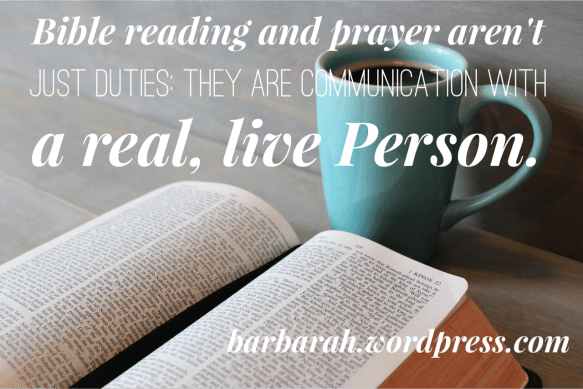
Communicating With God As a Person

IMG_1783

One of my passions is to encourage women to get into the Word of God for themselves. It’s not that I don’t think women read their Bibles, but we could all use the encouragement. Sometimes we struggle with making time for devotions either due to busy schedules or having small children at home; or, if we have a regular time, we can be tempted to go through the motions without really being “tuned in” and engaged.

It helps me to look at our having devotions from a communication or relationship angle. We’re told when we first become Christians that Christianity is not just a list of rules or a system of activities: it’s a relationship with God. But sometimes we can lose that focus and end up just doing things rotely. Remembering that we’re communicating with a Person can transform our viewpoint.

The Bible says that the marriage relationship pictures that of Christ and the church. So let’s compare the two in the realm of communication. Husbands understand if a wife has a super-busy day or if she is tired. But if that happens all the time, if he just wants to spend some time with her, and she is frantically running around taking care of children, housework, even outside ministries, and never has time to just sit down with him, he’s not going to feel loved and wanted. If she spends the time they do talk in losing focus, daydreaming, pondering what to put on her grocery list, he is not going to feel heard. If the only time she communicates with him is on the run while doing other things or when she needs him to do something, or if their only conversation is in the last few  minutes before sleep when they’re drifting off in mid-sentence, their relationship is going to suffer. Sometimes couple just need one on one time with each other.

There is nothing wrong with those types of communication in and of themselves — we are to pray without ceasing, all through the day, even while doing other things, and He wants us to come to Him with our needs, and ending the day talking with Him is lovely. But there needs to be some times of just pure focus on Him, on worship and learning from Him. Even though God doesn’t “need” us in the same sense a husband does, He wants to fellowship with us, and He knows we need to hear Him.

We can see this in other parallels, too: a hostess who prepares a sumptuous meal that no one shows up for, or, if they do, they rush through it; a parent whose child only wants “things” from him; a friend whose friend is drifting away because of a lack of time spent together.

Relationships are built on and maintained by communication. May we keep in mind that our time in prayer and the Word of God is not just one of the duties on out to-do list: it is communication with the One who loves us more than anyone else could and desires our fellowship and worship. May our desire and prayer be along the lines of Joe Zichterman’s hymn, “A passion for Thee, O Lord, set a fire in my soul and a thirst for my God. Hear Thou my prayer, Lord, Thy power impart. Not just to serve, but to love Thee with all of my heart.”

 O God, thou art my God; early will I seek thee: my soul thirsteth for thee, my flesh longeth for thee in a dry and thirsty land, where no water is. Psalm 63:1

I will delight myself in thy statutes: I will not forget thy word. Psalm 119:16

In the secret of His Presence
How my soul delights to hide!
Oh, how precious are the lessons
Which I learn at Jesus’ side!
Earthly cares can never vex me,
Neither trials lay me low;
For when Satan comes to tempt me,
To the secret place I go,
To the secret place I go.

When my soul is faint and thirsty,
’Neath the shadow of His wing
There is cool and pleasant shelter,
And a fresh and crystal spring;
And my Savior rests beside me,
As we hold communion sweet:
If I tried, I could not utter
What He says when thus we meet,
What He says when thus we meet.

Only this I know: I tell Him
All my doubts, my griefs and fears;
Oh, how patiently He listens!
And my drooping soul He cheers:
Do you think He ne’er reproves me?
What a false friend He would be,
If He never, never told me
Of the sins which He must see,
Of the sins which He must see.

Would you like to know the sweetness
Of the secret of the Lord?
Go and hide beneath His shadow:
This shall then be your reward;
And whene’er you leave the silence
Of that happy meeting place,
You must mind and bear the image
Of the Master in your face,
Of the Master in your face.

 ~ Ellen L. Goreh, 1883

(I didn’t know until trying to find a video of this hymn that there was a new tune to it. The one I am familiar with is this one, only done a bit slower and more meditatively.)

(Sharing with Inspire Me Monday, Testimony Tuesday, Woman to Woman Word-Filled Wednesday, Works For Me Wednesday)

Save

Save

Book Review: Knowing God

Knowing GodEven though I’ve been posting weekly summaries of my reading from Knowing God by J. I. Packer, I still wanted to do a general review, partly for those who did not want to keep up with the weekly readings, and partly for me to have a general review to link back to.

Even though this book has been considered a classic and has been in print for over 40 years, somehow I had never gotten around to reading it before, though I had heard of it and wanted to.

Packer says the most basic definition of a Christian is that he or she is a person who has God as Father. We are not all God’s children: we become His when we believe on Jesus Christ as our Lord and Savior.

Packer begins with the virtues of studying about God as well as the warning not to stop with just the academics, but to use what we learn to get to know God personally.

To be preoccupied with getting theological knowledge as an end in itself, to approach Bible study with no higher a motive than a desire to know all the answers, is the direct route to a state of self-satisfied self-deception. We need to guard our hearts against such an attitude, and pray to be kept from it (p. 22).

The psalmist [of Psalm 119] was interested in truth and orthodoxy, in biblical teaching and theology, not as ends in themselves, but as means to the further ends of life and godliness. His ultimate concern was with the knowledge and service of the great God whose truth he sought to understand (pp. 22-23).

He talks about what it means to know God, how knowing Him differs from knowing others, the different analogies the Scriptures use to illustrate our relationship to Him.

John 17:3: “And this is life eternal, that they might know thee the only true God, and Jesus Christ, whom thou hast sent.”

Knowing God is more than knowing about him; it is a matter of dealing with him as he opens up to you, and being dealt with by him as he takes knowledge of you. Knowing about him is a necessary precondition of trusting in him (‘how could they have faith in one they had never heard of?’ [Romans 10:4 NEB]), but the width of our knowledge about him is no gauge of the depth of our knowledge of him (pp. 39-40).

He discusses the need to know God as He truly is, not as our mental picture of Him is nor as He has been falsely portrayed by others.

All speculative theology, which rests on philosophical reasoning rather than biblical revelation, is at fault here [emphasis mine here]. Paul tells us where this sort of theology ends: “The world by wisdom knew not God” (1 Cor 1:21 KJV). To follow the imagination of one’s heart in the realm of theology is the way to remain ignorant of God, and to become an idol-worshipper, the idol in this case being a false mental image of God, made by one’s own speculation and imagination (p. 48).

He discusses what it means to believe that Jesus is God Incarnate and yet also fully man, the person and ministry of the Holy Spirit, the truth of the Bible, the need for and nature of propitiation, what the Bible means by adoption, how God guides us, why we still have trials if we know Him and He loves us, and His full adequacy to handle whatever He allows in our lives. He covers in great detail several of God’s attributes: His immutability (His unchanging nature), His majesty, wisdom, love, grace, judgment, wrath, goodness, severity, and jealousy. Each of those topics is the subject of a whole chapter, and it’s impossible to give an overview of them here, but they were quite beneficial and helpful.

As I said in one week’s summaries, sometimes in the middle of a given chapter, it was easy to get occupied with the individual topics or chapters and forget that they are there in connection with how we know God, so it helped me to stop periodically and remember to tie the individual chapters back to the main point of the book. They do all have that connection even though it might not seem like it from the titles.

Though I didn’t agree with every single little point, especially those emphasizing a Calvinistic viewpoint, I did benefit from and can highly recommend the book. I appreciate that it is not full of theologicalese – terminology that only an academic could understand. I wouldn’t call it simple reading: there were a few places that were a little hard to follow. But for the most part I think an average reader could handle it fairly easily.

I am glad I finally made time for this book and thoroughly understand why it is considered a Christian classic. There were multitudes of places I marked and many memorable and helpful quotes in the book, many more than I can possibly recount here. But I’ll close with this one:

In the New Testament, grace means God’s love in action toward people who merited the opposite of love. Grace means God moving heaven and earth to save sinners who could not lift a finger to save themselves. Grace means God sending his only Son to the cross to descend into hell so that we guilty ones might be reconciled to God and received into heaven (p. 249).

For more information, my thoughts on a couple of chapters a week are as follows:

Chapters 1 and 2, “The Study of God” and “The People Who Know Their God”
Chapters 3 and 4, “Knowing and Being Known” and “The Only True God”
Chapters 5 and 6: “God Incarnate” and “He Shall Testify”
Chapters 7 and 8: “God Unchanging” and “The Majesty of God”
Chapters 9 and 10: “God Only Wise” and “God’s Wisdom and Ours”
Chapters 11 and 12: “Thy Word Is Truth” and “The Love of God”
Chapters 13 and 14: “The Grace of God” and “God the Judge”
Chapters 15 and 16: “The Wrath of God” and “Goodness and Severity”
Chapters 17 and 18: “The Jealous God” and “The Heart of the Gospel” (Propitiation)
Chapters 19 and 20: “Sons of God” and “Thou Our Guide”
Chapters 21 and 22: “These Inward Trials” and “The Adequacy of God”

(This review will also be linked to Semicolon‘s Saturday Review of Books.)

31 Days With Elisabeth Elliot: Devotional Time

Elisabeth Elliot2
These excerpts come from the chapter “The Song of the Animals” in Elisabeth’s book, On Asking God Why. The chapter title might seem odd one for talking about time with God, but it comes from one part where she talks about all creation praising God by doing what He created them to do. She also discusses her father’s example of rising early to spend time alone with God. One thing I love about this except is that she is so transparent, ordinary, and normal here.

Few people know what to do with solitude when it is forced upon them; even fewer arrange for solitude regularly. This is not to suggest that we should neglect meeting with other believers for prayer (Hebrews 10:25), but the foundation of our devotional life is our own private relationship with God…

Christians may (and ought to) pray anytime and anywhere, but we cannot well do without a special time and place to be alone with God. Most of us find that early morning is not an easy time to pray. I wonder if there is an easy time….

The Bible is God’s message to everybody. We deceive ourselves if we claim to want to hear his voice but neglect the primary channel through which it comes. We must read his Word. We must obey it. We must live it, which means rereading it throughout our lives…

We read that our Heavenly Father actually looks for people who will worship him in spirit and in reality. Imagine! God is looking for worshippers. Will he always have to go to a church to find them, or might there be one here and there in an ordinary house, kneeling alone by a chair, simply adoring him?…

When I stumble out of bed in the morning, put on a robe, and go into my study, words do not spring spontaneously to my lips–other than words like, “Lord, here I am again to talk to you. It’s cold. I’m not feeling terribly spiritual….” Who can go on and on like that morning after morning, and who can bear to listen to it day after day?

I need help in order to worship God. Nothing helps me more than the Psalms. Here we find human cries–of praise, adoration, anguish, complaint, petition. There is an immediacy, an authenticity, about those cries. They speak for me to God–that is, they say what I often want to say, but for which I cannot find words.

Surely the Holy Spirit preserved those Psalms in order that we might have paradigms of prayer and of our individual dealings with God. It is immensely comforting to find that even David, the great king, wailed about his loneliness, his enemies, his pains, his sorrows, and his fears. But then he turned from them to God in paeans of praise.

He found expression for praise far beyond my poor powers, so I use his and am lifted out of myself, up into heights of adoration, even though I’m still the same ordinary woman alone in the same little room.

Another source of assistance for me has been the great hymns of the Church, such as “Praise, My Soul, the King of Heaven,” “New Every Morning Is the Love,” “Great Is Thy Faithfulness,” “Glorious Things of Thee Are Spoken,” and ”O Worship the King.” The third stanza of that last one delights me. It must delight God when I sing it to him:

Thy bountiful care, what tongue can recite?
It breathes in the air, it shines in the light;
It streams from the hills, it descends to the plain,
And sweetly distills in the dew and the rain.

That’s praise. By putting into words things on earth for which we thank him, we are training ourselves to be ever more aware of such things as we live our lives. It is easy otherwise to be oblivious of the thousand evidences of his care. Have you thought of thanking God for light and air, because in them his care breathes and shines?

Hymns often combine praise and petition, which are appropriate for that time alone with God. The beautiful morning hymn “Awake, My Soul, and With the Sun” has these stanzas:

All praise to Thee, who safe hast kept,
And hast refreshed me while I slept.
Grant, Lord, when I from death shall wake,
I may of endless light partake.
Direct, control, suggest, this day,
All I design, or do, or say;
That all my powers, with all their might,
In Thy sole glory may unite.

Adoration should be followed by confession. Sometimes it happens that I can think of nothing that needs confessing. This is usually a sign that I’m not paying attention. I need to read the Bible. If I read it with prayer that the Holy Spirit will open my eyes to this need, I soon remember things done that ought not to have been done and things undone that ought to have been done.

Sometimes I follow confession of sin with confession of faith–that is, with a declaration of what I believe. Any one of the creeds helps here, or these simple words: “Christ has died; Christ is risen; Christ will come again. Lord, I believe; help my unbelief.”

Then comes intercession, the hardest work in the world–the giving of one’s self, time, strength, energy, and attention to the needs of others in a way that no one but God sees, no one but God will do anything about, and no one but God will ever reward you for.

Do you know what to pray for people whom you haven’t heard from in a long time? I don’t. So I often use the prayers of the New Testament, so all-encompassing, so directed toward things of true and eternal importance, such as Paul’s for the Christians in Ephesus: ”…I pray that you, rooted and founded in love yourselves, may be able to grasp…how wide and long and deep and high is the love of Christ” (Ephesians 3:17, 18). Or I use his prayer for the Colossians, “We pray that you will be strengthened from God’s boundless resources, so that you will find yourselves able to pass through any experience and endure it with joy” (Colossians 1:11)…

My own devotional life is very far from being Exhibit A of what it should be. I have tried, throughout most of my life, to maintain a quiet time with God, with many lapses and failures. Occasionally, but only occasionally, it is impossible. Our Heavenly Father knows all about those occasions. He understands perfectly why mothers with small children bring them along when they talk to him.

Nearly always it is possible for most of us, with effort and planning and the will to do his will, to set aside time for God alone. I am sure I have lost out spiritually when I have missed that time. And I can say with the psalmist, “I have found more joy along the path of thy instruction than in any kind of wealth” (Psalms 119:14).

IMG_0023

See all the posts in this series here.

_____________________________________________________

DaySpring.com is celebrating all of the amazing Write 31 Days readers who are supporting nearly 2,000 writers this October! To enter to win a $500 DaySpring shopping spree, just click on this link & follow the giveaway widget instructions by October 30. Best wishes, and thanks for reading!

Book Review: Walking With God in the Season of Motherhood

Walking With GodI first saw Walking With God in the Season of Motherhood by Melissa B. Kruger when someone linked to her blog, and I saw this story of how the book came to be written. I thought it might be a good book to pass along to young moms, but I found much for my own heart, though my children are all grown.

This study grew out of Melissa’s desire for “a Bible study that intersected who I was as a believer with the role I had been given as a mother.” It’s not necessarily a “how to be a better parent” study. It’s more of a “how to walk with God and then let that relationship impact your ministry to your children” study.

She begins with our purpose – to glorify God and enjoy Him forever – then reminds us of our responsibility to teach the same to our children and our inability to do so for ourselves or for them on our own. Succeeding chapters discuss walking in faith, wisdom, prayer, carefulness, and then each facet of the fruit of the Spirit, ending with a discussion of the Perfect Mom Syndrome.

The study is laid out over eleven weeks, with four days of study per week and a fifth wrap-up summary of the truths covered in that week. I really like that the Bible verses are included within the study, so a busy mom trying to feed a baby or grab a few minutes of study while waiting for piano lessons or ball practice to end has everything needed right there within the book. There is an additional study guide at the back that would be great for a group study but is also helpful for personal use.

I have several quotes marked but will try to pull out just a few:

It is important to assess regularly whether my family is suffering from an overly busy calendar. However, rather than simply removing activities, my greatest need is to add one particular meeting to my schedule. Every day I need time with Jesus. While it seems counterintuitive, the addition of this one meeting promises to positively affect every other part of my day (pp. 30-31).

When impatience, anger, or discontent well up in our hearts, these are signs that we are mothering in our own strength. Rather than dealing only with our outward behavior, we need the Lord to renew and recharge our hearts…our souls find renewed energy only by abiding in Jesus. Without this time we will find ourselves depleted, discouraged, and unable to bear fruit (p. 33).

[Re the Proverbs 31 woman], We can view her as an older woman to learn from rather than a standard against which to measure ourselves (p. 73).

An additional benefit of a home at peace is that it overflows into loving care and service for our community. The goal is not to create a place to escape or avoid the world but to carefully build our home so that it is a light to the world, shining the grace of Christ to those who are without hope. A peaceful home offers a place of respite and care in the midst of a weary world (p. 76).

When we receive the abundant love of Christ, we are free to pursue others with love, not to gain their affection but to give back what we have already received (p. 93).

True joy does not discount real suffering; it shines all the greater in the midst of it (p. 115).

The ability to extend kindness requires an other-awareness. We are apt to miss the needs of those around us if we remain self-focused. Helping children to see the needs of others will bless them with perspective on their own lives, as well as propel them toward good works that display the kindness of God (p. 157).

God uses these moments to grow our hearts in grace. We can only bear the fruit of patience when we have something to be patient about (p. 164).

In Jesus the performance pendulum stops — both the pride of success and the despair of failure are absorbed by grace (p. 208).

I cannot protect my children from my weaknesses. As hard as I may try, at some point my sin will affect their lives. However, the way I deal with my failure can provide an example for them to follow. I am a sinner raising sinners. Each of my children will face the weight and sorrow of his or her own sins. Just as we teach daily hygiene habits like brushing teeth, our children need instruction on how to find cleansing for their souls. By teaching our children about confession and repentance as well as grace and forgiveness, we bless their lives for years to come (p. 213).

At some points the study seemed a bit long, both in number of weeks and in how long it took to complete the day’s reading and answer the questions. But it’s not, really – eleven weeks is a good length of time for a study. I went through the book in less time than that because I used it six days a week and went on to the next chapter after finishing one rather than reading one chapter per week, but I think the latter would be the better course, to really soak in the truths for that week before going on. And each day’s lesson only took about fifteen minutes. One could spend longer – I tend to answer the basic questions in writing but answer some of the more thoughtful ones in my head. If one did more with the writing sections, one could spend more time with each lesson. And if a day’s reading and questions take more time than one has, there is no reason you can’t take a couple of days or whatever time is needed to complete it. It’s better to go at one’s own pace and really dig into it than barrel through just to get it done. Melissa’s summaries at the end of each week’s lessons really help to review the material and help tie it all together.

I really enjoyed going through this study, found it very beneficial, and am happy to recommend it to you in whatever season you are in.

(This review will also be linked to Semicolon‘s Saturday Review of Books.)

Finding Time to Read the Bible

IMG_1218

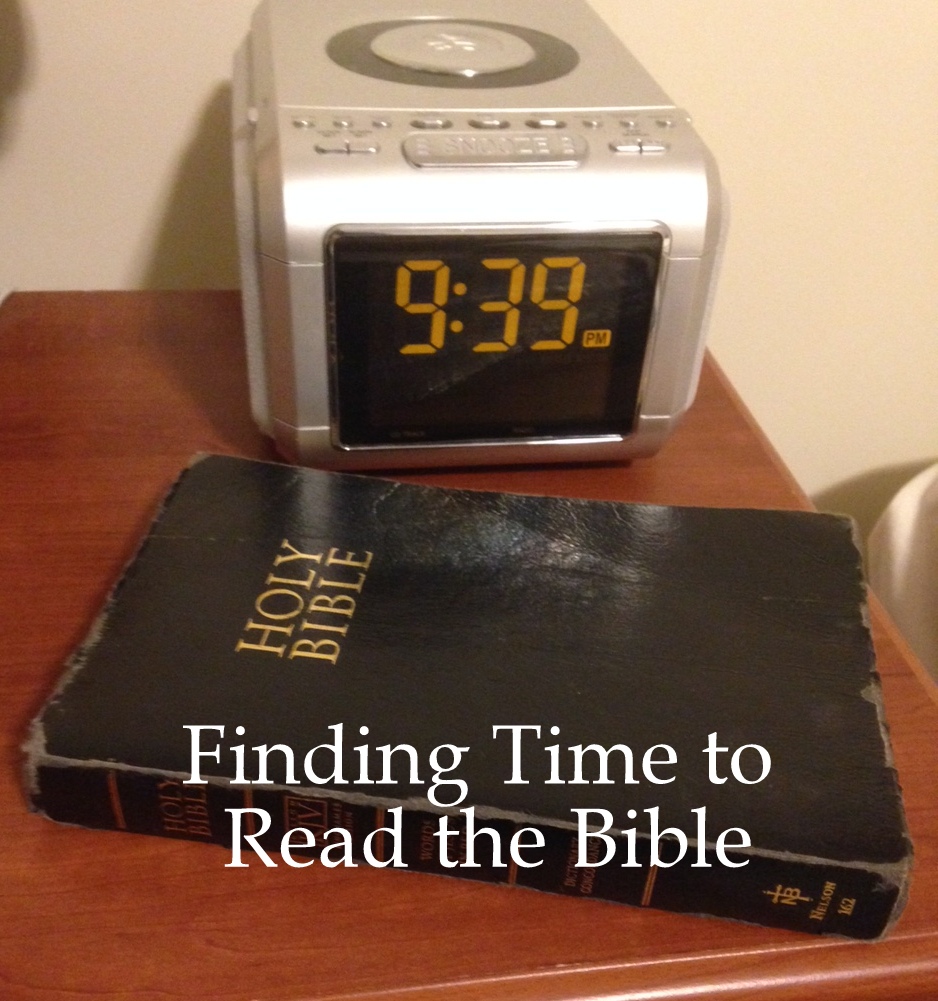
In a recent blog post I read (I’ve forgotten where), the blogger mentioned that the book she was reading on Bible study didn’t discuss where to find the time. I had the same thought with a book I am reading on the subject. I guess the authors feel that once we are assured of the importance of Bible reading and study, we’ll make it a priority and make time. And I think that’s pretty much what it comes down to. If by finding time we mean we want a time that magically opens up with the solitude and inclination we need without a dozen other things crowding in…I just don’t think that’s going to happen, at least not regularly. Years ago our assistant pastor spoke of struggling to make time for Bible reading, and said to our senior pastor, an older, godly man, “I guess you don’t have trouble making time for Bible reading any more, do you?” He just laughed.

Finding the time is always going to be a struggle. There are always duties, distractions, and people clamoring for that time, and even an Enemy of our souls fighting against it. Instead of getting discouraged about it, we can just accept that it is a common problem and  prayerfully seek ways to deal with it. Perhaps reminding ourselves of reasons to read the Bible will renew our motivation.

We need to remember, too, that making time to read the Bible isn’t just about ticking off another duty. Every relationship thrives on communication. If we went for days without talking with our husbands except in the briefest necessary exchanges, we’d feel the effects pretty soon and realize we need some time alone together. Though sometimes we need to set up routines to establish good habits, taking time to read the Bible shouldn’t be a matter of rigid schedules, but rather of taking time to meet with the One Who loves us best.

So with these things in mind, here are some suggestions for carving time out to meet with the Lord:

1. Get up earlier or stay up later. I can hear you groaning. But for many of us, that’s the only way to get some time alone.

2. Keep the Bible handy. One friend with three small children close in age kept her Bible out in her kitchen. She couldn’t set aside a longer period of solitude, but she could read in smaller snatches through the day.

3. Listen. Some people like to listen to recorded versions of the Bible while driving, exercising, making dinner, etc.

4. Plan for it after a natural break in the day. It’s hard for many of us to stop in the middle of a morning or afternoon and put everything aside to read, but a break in the routine, when we’re shifting gears anyway, can help us work in some time for reading, like after a meal, after taking the kids to school, etc.

5. Meal time, especially if you eat alone.

6. Waiting time. We usually pull out our phones or a book if we have to wait at a doctor’s office or in car line at school, but that can be a good time for some Bible reading.

7. Establish a routine. Once we get used to setting aside a certain time for Bible reading, it’s not such a scramble to look for that time every day.

8. Don’t wait for perfection. One problem with a routine is that we can’t always figure out how to function when the routine is disrupted, like when we’re traveling or someone is sick or we have small children at home. I wrote a post some time back called Encouragement for mothers of young children about the topic of trying to find time for devotions with little ones in the house. Though I normally like getting up early and having solitude and quietness for Bible reading, that just didn’t work with little ones. Yet God enabled me to read and profit from it while they kept me company or played near me, even though usually I couldn’t concentrate under those circumstances.

9. Anything is better than nothing. Normally I like a good amount of time for Bible reading or study, but when a few moments was all I truly had, God often gave me just what I needed in those few moments in just a verse or two.

10. Talk with your husband, roommates, siblings, whoever you live with. Years ago I caught part of a radio program where the preacher was scolding women who wanted to spend early morning time to have devotions, saying the husband as the leader should have that time, since the wife had “all day” in which she could have devotions. The man obviously had not spent a whole day at home alone with kids. That mentality is so wrong on many levels. Not long after that a missionary speaking at our church mentioned protecting that time for his wife, a much better example of servant leadership and love. If the only way either parent can have devotions is for one of them to watch the children, then they can do that for each other. If a particular time of day is the best time for two people in a house, they can work out different locations if they get too distracted in the same room. Whatever conflict there might be about time and place preferences, talk with each other to work out the best solution for both and be willing to compromise.

11. Pray. In the blog post I referred to earlier, I mentioned that sometimes I’d get to the end of the day and lament to the Lord that I had no idea when I could have read my Bible that day. I began instead to pray at the beginning  of the day for wisdom and alertness for those moments when I could, and that made a profound difference.

12. Set something aside. If we have times to read other books, peruse Facebook, watch TV, or play games on our phones, we have time to read the Bible. I admit, if I sit down to relax for a few minutes with a book and realize I haven’t read my Bible yet that day, I don’t always have the best attitude about laying down my book and picking up my Bible. But when I confess that to the Lord and then go ahead, He graciously speaks to me through His Word. We do need time to relax as well, but that shouldn’t come at the expense of time in God’s Word. He knows our needs, and we can ask Him for both time to spend in His Word and for some down time.

What about you? What ways have you found to make time for Bible reading?

Sharing at Thought-Provoking Thursday and Works For Me Wednesday.

31 Days of Inspirational Biography: Young Mother Trying to Find Time For Bible Reading

The following is another excerpt from Climbing by Rosalind Goforth, which I have mentioned the last couple of days and  many times before. This book shares a very human view of a woman after God’s own heart who also was “of like passions” as we are.

A devoted Christian missionary, Mrs. S, was holding a series of special meetings for our Christian women at Changte. On one occasion, this dear woman, who had no children, told me that I could never have the peace and joy I longed for unless I rose early and spent from one to two hours with the Lord in prayer and Bible study.

I longed intensely for God’s best — for all He could give me, not only to help me live the true Christian life but also for peace and rest of soul. So I determined to do what Mrs. S. had advised.

The following morning, about half-past five o’clock, I slipped as noiselessly as possible out of bed. (My husband had already gone to his study.) I had taken only a step or two when first one and then another little head bobbed up; then came calls of, “Mother is it time to get up?”

“Hush, hush, no, no,” I whispered as I went back, but too late; the baby had wakened! So, of course, the morning circus began an hour too soon.

But I did not give up easily. Morning after morning I tried rising early for the morning watch, but always with the same result. So I went back to the old way of just praying quietly — too often just sleeping! Oh, how I envied my husband, who could have an hour or more of uninterrupted Bible study while I could not. This led me to form the habit of memorizing Scripture, which became an untold blessing to me. I took advantage of odd opportunities on cart, train, or when dressing, always to have a Bible or Testament at hand so that in the early mornings I could recall precious promises and passages of Scripture.

In another place she writes of finding at the last minute that the woman who was supposed to speak at a certain function couldn’t, and she was asked to. She nursed the baby with one arm while looking through her Bible and jotting notes as she could with the other. When Jonathan came through and saw her, he wondered how she could possible get ready for a meeting under such conditions in so short a time. She replied that if she’d had hours to work on it, she would have taken it, but she trusted God would give her just what she needed in the time available.

A few pages later she writes that sometimes she got out a concordance and her Bible to study out something which she needed help on at the time. She ended up with forty outlines resulting from her studies which the Lord used first in her own life, and then in talks to other ladies.

I expanded on this theme of trying to have devotions with young children in the house in an earlier post titled Encouragement For Mothers of Young Children. I went through quite a spiritual slump at one point due to a lack of spending time with God, and He showed me some ways to do so at that super-busy time of having little ones that wasn’t my usual routine, wasn’t even a setting where I would normally “get anything” from his Word, but He enabled me in those times. I hope perhaps it will be an encouragement to some of you in that stage of life – or any stage.

photo 3(2)

For the 31 Days writing challenge, I am sharing 31 Days of Inspirational Biography. You can find others in the series here.

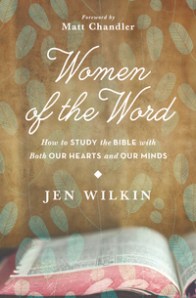
Book Review: Women of the Word

WOTWI have to confess that my first thought when I saw Women of the Word by Jen Wilkin mentioned favorably around the blogosphere was, “Hey! She took my title!” That’s not a very spiritual reaction, I know. 🙂 I’ve been blessed to have been able to compile a ladies’ newsletter for our current church for a couple of years and for a former church for about 9 years, and one column I’ve had in it  for a long time has gone by that same title, “Women of the Word.” It began after a discussion about devotions during one of our ladies’ meetings and the realization that no matter how long one has been a believer, there are always going to be struggles either maintaining a devotional time or making it what it ought to be. So I began the column to encourage ladies along that line and have begun to wonder lately if perhaps I might put them all together and see if they might possibly form a book.

My second thought, after reading a little bit about this book, was that I must get it. Everything I’d heard about it indicated that the author had the same passion as I do for getting women into the Word of God.

And the book definitely did not disappoint in any way.

Jen is not content to just get you into the Bible, however. She wants to equip women to dig for the true meaning of the Bible rather than using the Xanax approach (just seeking something to get through the day) or any number of other faulty approaches. She reminds us that God wants us to love Him not just with our hearts and souls, but also with our minds. She says that when she first began to read her Bible, she approached it with questions like, “Who am I?” and “What should I do?” Though the Bible did give her some insight for those questions, she eventually realized that “I held a subtle misunderstanding about the very nature of the Bible. I believed that the Bible was a book about me…I believed the purpose of the Bible was to help me” (p. 24). She learned that “We must read and study the Bible with our ears trained on hearing God’s declaration of Himself” (p. 26).

When I read that God is slow to anger, I realize that I am quick to anger. When I realize that God is just, I realize that I am unjust. Seeing who He is shows me who I am in a true light. A vision of God high and lifted up reveals to me my sin and increases my love for Him. Grief and love lead to genuine repentance, and I begin to be conformed to the image of the One I behold.

If I read the Bible looking for myself in the text before I look for God there, I may indeed learn that I should not be selfish. I may even try harder not to be selfish. But until I see my selfishness through the lens of the utter unselfishness of God, I have not properly understood its sinfulness (pp. 26-27).

“It’s possible to know Bible stories, yet miss the Bible story” (p. 11). In our quest for Biblical literacy, “we may develop habits of engaging the text that at best do nothing to increase literacy and at worst actually work against it” (p. 37). “We must be those who build on the rock-solid foundation of mind-engaging process, rather than on the shifting sands of ‘what this verse means to me’ subjectivity” (p. 87).

The author then shares ways to read the text within the context and to read it for comprehension, interpretation, and application. There is  an excellent chapter as well for teachers, one section of which makes an excellent case for women Bible teachers. She appears to believe, as I do, that women should teach women rather than men, but she gives some excellent reasons why women should teach other women.

I also appreciated how she dealt with an issue in the conclusion that I have seen some up in just the last couple of years. These days, when you try to encourage Bible reading and study or try to bring to bear what the Bible says on a conversation, you can sometimes be accused of “worshiping the Bible.” Jen answers:

I want to be conformed to the image of God. How can I become conformed to an image I never behold? I am not a Bible-worshiper, but I cannot truly be a God-worshiper without loving the Bible deeply and reverently. Otherwise, I worship an unknown God. A Bible-worshiper loves an object. A God-worshiper loves a person (p. 147).

In short, I love this book and highly recommend it. I do more than recommend it: I don’t often do this, but I encourage you to get it. I’m more than happy that the title I was considering using for a book has been attached to such a one as this.

I’ll close with one last quote:

We must make a study of our God: what He loves, what He hates, how He speaks and acts. We cannot imitate a God whose features and habits we have never learned. We must make a study of Him if we want to be like Him. We must seek His face…

We see Him for who He is, which is certainly a reward in itself, but it is a reward with the secondary benefit of being forever altered by the vision (p. 150).

(This will also be linked to Semicolon‘s Saturday Review of Books.)

31 Days of Missionary Stories: Isobel Kuhn Learns to Put God First

isobelkuhnIsobel Kuhn was a missionary to China in the early to mid- 1900s, alongside her husband, John. She has written a number of books about the Lord’s working in their lives and ministry, all very readable and enjoyable. She has a very readable style and is quite honest and open about her faults and foibles, but her books are also laced with humor. By Searching was subtitled My Journey Through Doubt Into Faith and describes just that. She had grown up in a Christian family yet wasn’t truly saved. When a professor at college condescendingly told her she only believed because that was what her parents told her, she realized he was right, and thoroughly let herself go into the “worldly” activities she hadn’t been allowed to pursue. This book traces her journey to true faith in Christ and her first steps in her walk with Him. In the Arena is not exactly a sequel, but it highlights many decisions, experiences, and trials in which God manifested Himself. I reviewed both books together here.

One incident that had lasting effects occurred during Isobel’s training at Bible college. Many students did not have a quiet time or devotional time with the Lord, because they spent so much time studying the Bible. “But,” Isobel wrote in In The Arena, “reading the Scriptures for a technical grasp of the general argument in a book, and reading it as in the Lord’s presence, asking Him to speak a word on which to lean that day — those were two very different things. One was no substitute for the other. Yet I knew also that some students were trying to let classwork reading do for personal quiet time. Deadness of souls was inevitable.”

As she prayed about it, she felt led to form a habit of spending one hour a day, sometimes in two half-hour segments twice a day, “in the Lord’s presence, in prayer or reading the Word. The purpose was to form the habit of putting God in the centre of our day and fitting the work of life around Him rather than letting the day’s business occupy the central place and trying to fix a quiet time with the Lord somewhere shoved into the odd corner or leisure moment.”

She and nine others covenanted to do this for about a year and meet together monthly to worship together, confess failure, and encourage each other. She wrote, “It was never my thought that this covenant should become law. My thought was merely deliberately to form a habit which would allow the Lord to speak personally to us all the days of our lives….somehow news of [this covenant] spread, and others began to join. Then—it seems as if some human beings always have to go to extremes—some signed a covenant binding them to this hour a day for life. I did not sign it. What about days of illness or emergency, when it might be impossible to keep an hour quietly? There was no need to vow; there was only need to form a habit of putting God first.”

The following is from In the Arena and tells of how this decision was tested.

This is the background of my platform of secret choices. It was the evening of the Junior-Senior party. I was a junior and had been asked to lead the devotional with which all such parties closed. I was also on the programme as Grandma in a Dutch scene, off and on all through the banquet. The week before had been so full of work and study that I had not had one moment to sit down and prepare a devotional.  Work…had delayed me, and I arrived at the supper half-hour, hungry,  exhausted, and without any devotion prepared. Besides this, I still had half an hour due on my quiet time! After the party we juniors had to clean up and I would not get to my room til midnight — the day would be gone.

Here was my platform of secret choices. That supper half-hour. (1) Should I go down and eat my supper? (2) Should I skip supper and try to prepare the devotional message? (3) Should I put God first and give that half-hour to him? The supper bell rang, and my roommate left for the dining room. I stood for a moment irresolute; then, throwing myself on my knees by my bedside I sobbed out in a whisper, “Oh, Lord, I choose you!” As I just lay in His presence too weary to form words, the sense of His presence filled the room. The weariness and faintness all left me. I felt relaxed, refreshed, bathed in His love. And as I half knelt, half lay there, saying nothing, but just loving Him, drinking in His tenderness, He spoke to me. Quietly, but point by point, He outlined for me the devotional  message I needed to close that evening’s programme. It was an unforgettable experience and an unforgettable lesson. Putting Him first always pays.

In the exhilaration of that wonder I ran down to the banquet hall, slipped into my costume, and went through the programme. At the end, when the devotional message was needed, I gave very simply what He had told me during the supper hour. Such a quiet hush came over that festive scene, I knew He had spoken, and I was content.

More than twenty years passed. I was home on furlough and visiting the Institute. It was the day of the Junior-Senior party and a group of us were reminiscing. “One Junior-Senior party a always stands out in my memory,” said one. “I forget who led it but it was a Dutch scene and the devotional blessed my soul. I’ve never forgotten it.” She had indicated the date, so I knew. I was thrilled through and through. Of course I did not spoil it by telling  her who led that devotional. In God’s perfect workings, the instrument is [often] forgotten. It is the blessing of Himself that is remembered.

 (You can see other posts in the 31 Days of Missionary Stories here.)

Devotional Tips

Bible

One of my passions is to get women into the Word of God for themselves. Since this is the time of year many renew their efforts to have read their Bibles, I thought some might find this post from the archives (2006) helpful.

For those who might be unfamiliar with the term, “devotions” or “having devotions” is the time spent in the Bible and prayer. Others call it their quiet time or their “God and I” time or other terms.

Hopefully if you are considering devotions, you already feel it is important to read the Bible, but if you need to be encouraged along those lines, some reason to read the Bible are here.

When I first became a Christian as a teen-ager, the church I was in then had a strong emphasis on reading the Bible through in a year. I am so glad, because I think that, more than anything else, got me grounded spiritually. There are many advantages to reading the Bible through in a year: it kept me focused; I knew where to read next instead of wandering around aimlessly; I discovered choice nuggets in places like II Chronicles and Zephaniah that I probably would never have discovered otherwise; it kept me balanced; it helped me understand passages in their context; and each time through I would understand the passage more. There are, however, a few disadvantages: I felt like I couldn’t stop and ponder anything because I had to keep going in order to finish the day’s reading in the time frame I had, and if I fell behind it would get awfully discouraging trying to catch up. So after some time I continued to read the Bible through, but not necessarily in a year. I feel free to stop and meditate on a particular truth I found or to study it out further. I usually read a couple of chapters a day, but I sometimes stop after a few verses or sometimes go on and read more. Then sometimes between books, I take a break and work through a Bible study book or do a word study or topical study.

Most “reading the Bible through” plans encourage reading from both the Old Testament and the New, or reading a passage from Psalms or Proverbs along with the day’s scheduled reading. I think that is probably to help you through some of those “drier” books like Leviticus.

I think this is one of those areas where anything is better than nothing, though, so if someone says, “I’m sorry, I just can’t get into Leviticus,” I would say that’s fine. Maybe some day you’ll get back to that, but reading somewhere in the Bible is better than reading nothing.

Probably for most people the first big battle is getting regular about it. It does help to make a regular time and place for it. I like to have devotions in the mornings because my mind isn’t as cluttered as it is later on. I get up a little earlier than everyone else so it is quiet, and I have my shower first so I am awake. There were some years during the getting-kids-off-to-school morning rush when the best time was after everyone left for the day. The best time for some people is in the evenings.

There are some seasons of life, like when there is a new baby in the house, or vacation times, or when company is there, when it’s hard to maintain that regular time. It’s easier to let that time slip then, but if we go back to the “anything is better than nothing” principle, we can grab a few quiet moments here and there.

Once some semblance of regularity is maintained, the next big battleground is keeping our minds on what we’re doing. There is a quote from John Donne which expresses it well: “I throw myself down in my chamber, and I call in and invite God and His Angels thither; and when they are there, I neglect God and His Angels for the noise of a fly, for the rattling of a coach, for the whining of a door.”

I think the biggest help in avoiding distractions is to be actively looking for something rather than passively reading (more on that later). Another help is to keep a notepad nearby so that when something else comes to mind, as it so often does, like an item I need to get at the store or someone I need to call today, I can jot it down so I don’t forget it later and so my mind can acknowledge that it will be taken care of and not keeping going back to that thought.

It helps to “get in gear” as we begin. I often pray, “Open thou mine eyes, that I may behold wondrous things out of thy law” (Psalm 119:18), or asking the Lord to make my heart “good ground” that the seed of His Word can fall upon. It can help, also, to ask Him for something from His Word to carry with you through the day. Some people like to begin listening to, singing, or reading through a hymn. I like to start off with the reading from Daily Light on the Daily Path for the day.

Ps. 66:18 says, “If I regard iniquity in my heart, the Lord will not hear me.” We need to ask Him to search us, show us anything wrong, and enable us to get it right so we don’t block the channels of communication.

On to some general tips:

  • I was advised early on to look for a command to follow, a warning to heed, a promise to rely on, and even to underline (this was before highlighters were invented ) those things with different colors (red for warnings, blue for promises, black for commandments, yellow for verses about salvation. etc.) or marking beside the verse with different symbols for each category. The point isn’t “coding” your Bible, but to use that as a method to think through what the passage is saying and how to apply it.
  • Ask the old journalism questions: who, what, why, when, and how. What is being said to whom by whom? Is the promise there to all people or only to a specific person or group?
  • Notice recurring words or phrases, like the phrase “let us” which occurs three times in Hebrews 10:22-24, or the recurrence of the words “know” or “knowledge” in II Peter 1:2-8.
  • Underline verbs in passages like I Cor. 13 (the love chapter) or Proverbs 2:1-5 (about the search for wisdom).
  • In some of those long sentences of Paul’s, going back to basic English can help us understand them better: find the subject and verb to learn what the sentence is actually about, and then see how the phrases fit around it.
  • When reading the epistles, it can be helpful to write them out as they were originally written: as a letter without the chapter and verse markings.
  • Use a basic dictionary. One exercise in Changed Into His Image by Dr. Jim Berg instructed the reader to go through I Corinthians 13: 4-8 and write the definitions of the major words on a separate piece of paper, then write the verses out using those definitions. That was one of the most rewarding studies I have ever done. Even though that passage isn’t hard to understand, going through that exercise opened it up in a fuller way.
  • Some passages lend themselves to charts and diagrams, like the letters to the seven churches in Revelation 2-3 or the different sacrifices in Leviticus. That kind of thing really appeals to some people, and it’s easy to compare the similarities and differences that way.
  • Sometimes it is edifying to have some type of Bible project to study out. For instance, you might look up all the references to “the fear of the Lord” to see exactly what it is and how it manifests itself, or the references to “the fool” in Proverbs so you know what kind of behavior to avoid. Matthew 4 tells us Jesus countered Satan’s temptations with the Word of God, and it’s strengthening to look up verses on the specific temptations we face. Once when I had a fleeting thought doubting God’s goodness in a certain situation, instead of just telling myself, “Don’t be silly; you know God is good,” I began to search out verses that spoke of God’s goodness. Not only did that result in knowing my God better, but it fortified my soul against that doubt. Using a concordance or computer Bible program or even Bible Gateway helps with those kinds of studies, and we can supplement those studies later as we come across verses in other reading. Once I heard someone say that Jesus never claimed to be God, and I knew that Jesus did in fact proclaim His deity. So as I read through the Gospels, I put a “C” (for “claims”) beside each verse where Jesus said something about Himself that indicated His Deity. He may have never climbed on a mountaintop and said the phrase, “I am God,” but His deity is all throughout the gospels (the results of that study are here in The Claims of Christ). When I do a study like that, I usually write all the verses out in one place (I used to do it on index cards, but now I keep it on the computer) so I can refer back to it or add to it later on.
  • Sometimes we divide our devotional time into separate prayer and Bible reading times, but we can combine the two. When we read a verse that convicts about a particular sin, we can confess it immediately. When we read something that tells us about God, we can thank and praise Him immediately. When we read a character trait that we need to incorporate in our lives, we can acknowledge that need and ask for help and grace.
  • On very familiar passages, try to imagine you are reading it for the very first time, that you are there watching the events occur, or that you are reading and trying to convey it’s truth to someone who has never heard it before.
  • Something else that Jim Berg advocates in his book it to look for the Person, the Lord, in our reading, not just the principles.
  • Remember that “all scripture is given by inspiration of God, and is profitable for doctrine, for reproof, for correction, for instruction in righteousness” (II Timothy 3:16) – even the genealogies and Leviticus. We can ask the Lord for help in some of those drier passages to see His purpose for them. For instance, from the genealogies we learn that: God keeps records; God keeps detailed records; God knew all of those people whose names we can’t pronounce and cared about them; He knows and cares for us the same way.
  • Much has been written in recent years about journaling. I stopped doing so some time ago because, for me, it was too easy to spend most of the time and thought during devotions on “what I thought” rather than what God had to say to me. But journaling can be a good way to process what you’ve read and help make it more permanent in your own mind.

There are many good books on this subject. One is Tim LaHaye’s How To Study the Bible For Yourself. One I just read recently was Jason Janz’s Alone With God: A Practical Plan for Dynamic Devotions. His plan might seem a little regimented to some, but he invites the reader to adapt it. The basic idea is that if you don’t have some type of plan for your devotional time, you’ll drift and not benefit from it: having a basic format helps keep you on track just like writing things down on a prayer list helps keep you focused and helps you remember what to pray for. He has a lot of good tips and practical advice as well. Another good book is What Do I Know About My God? by Mardi Collier. I have heard her speak on this topic of how she wanted to get to know God better, and, at her husband’s suggestion, read through the Psalms, making notes of everything that was said about God. That led to a study of several years throughout the Bible. She tells about that study and how it has impacted her life in her book.

There is much more that could be said (and if I don’t stop soon, I’ll almost have a book, myself! 🙂 ). There are days and seasons of life when we might only have one verse to carry us through the day – and it is better to read one verse and truly get something from it than to read 10 chapters inattentively. But there will be some times we’ll be able to read and study a little more extensively than others. However we “do devotions,” we can ask God to show us Himself, that we may know Him, love Him, and serve Him better.

Here are some additional previous posts about devotions:

The blessing of hymns.
I have a preposition for you.
Meet my Bible.
Reasons to read the Bible.
God’s Word...
What do you say about this book?
Having devotions when you’re not feeling very devoted.
When there is no hunger for God’s Word .
Encouragement for mothers of young children .

This post will be also linked to “Works For Me Wednesday,” where you can find an abundance of helpful hints each week at We Are THAT family on Wednesdays.

Laudable Linkage & Videos

Oddly, after a couple of weeks of not sharing interesting links I’ve seen, I only have a few. You’d think I’d have multitudes, but much of the blogosphere was fairly quiet over the holidays, and perhaps my reading was distracted enough that I didn’t think to save many. But here are a few:

8 Amazing Blogging Lessons from Albert Einstein, HT to Lisa Notes. The author takes quotes from Einstein and cleverly applies them to blogging.

52 Ways to Read and Study the Bible compiled by Semicolon. So many ways, and with all our electronic devices so many venues — it should be easier than ever.

A couple of years ago I compiled a list of resources and reasons for reading the Bible in Planning to read the Bible more this year?

Katrina at Callapiddar Days told of her first successful attempt at reading the Bible through in Part 1 dealing why she wanted to do so and finding a plan and Part 2 concerning how she succeeded this time, what she learned, and a few resources.

Lisa shares Why I am NOT reading the Bible through in a year, though she is still reading and shares tips for making it more effective.

One area where I’ve fallen short is memorizing. I did a lot in college and then in a children’s ministry we worked with, and those verses have pretty much stayed with me all these years (except I have trouble remembering the references) but not much at all since then. I’ve never memorized a whole book of the Bible. Some ladies at church are memorizing Ephesians, but they meet at a time that isn’t best for me and they are already a good ways into it. Lisa Notes shared a plan for memorizing Philippians by Easter: Partnering to Remember The 2011 Philippians Memory Moleskin.  Ann shares a plan for memorizing Colossians with 2 verses a week for a year with some more details and updates here. I am leaning toward the Colossians plan — 2 verses a week sounds very doable, and I have to admit the little booklet really appeals to me. They’ve set up a Facebook page as well.

Well, I guess I only thought I had just a few!

Just a couple more:

The worst gifts ever, HT to Challies. Though, I don’t know, that office chair looks good for a power nap. 🙂

How Critical Thinking Saves Faith HT again to Challies, on the need to talk with young people and wrestle through their questions with them rather than cutting them off for even asking.

I’ve shared this before, but here is some fun you can have with your Christmas tree when you’re done with it. My guys used to love shooting off model rockets, so this really appealed to them.

And I can’t remember if I shared this here or not, but it just makes me happy: