A Thanksgiving Lifestyle

A Thanksgiving Lifestyle

I was talking with a friend recently about how, with all God’s blessings and all we have to be thankful for, we should be overflowing with gratitude.

Instead, we often have to “make” ourselves stop and think about thankfulness.

Oh, sometimes we’re spontaneously inspired to praise God when we see a beautiful sunset, or when someone does something unexpected for us. We love that Thanksgiving gives us an opportunity to focus on our blessings. Some even post on blogs or social media something they are grateful for every day in November.

Those are all good practices.

But what about the rest of the year? How can we overcome the distraction of everyday cares and duties to be intentionally thankful?

Here are a few ideas:

Read the Bible regularly. Not only will we see multitudes of things to be thankful for, but we’ll see examples of how people thanked God. The admonition to “let the word of Christ dwell in you richly” in Colossians 3:16-17 is sandwiched between verses telling us to be thankful, suggesting a connection.

Some years ago I did a Thanksgiving Bible Study that turned out to be a big blessing. Just looking up a few verses with “thanks” or “thanksgiving” in a concordance will inspire us.

The psalmists talk about their problems, confusion, and pain, but the psalms are threaded through with hope and praise. The last several psalms especially focus on praising the Lord in just about every manner possible.

Psalm 145 is one of many that shares the two main categories of things we praise God for: who He is, and what He has done. The first seven verses say:

I will extol you, my God and King,
    and bless your name forever and ever.
Every day I will bless you
    and praise your name forever and ever.
Great is the Lord, and greatly to be praised,
    and his greatness is unsearchable.

One generation shall commend your works to another,
    and shall declare your mighty acts.
On the glorious splendor of your majesty,
    and on your wondrous works, I will meditate.
They shall speak of the might of your awesome deeds,
    and I will declare your greatness.
They shall pour forth the fame of your abundant goodness
    and shall sing aloud of your righteousness.

Pray. We can ask God to open our hearts to see the ways He has blessed us and help us not to just mention them rotely, but to be truly thankful. It helps, also, to turn psalms or thanksgiving passages into prayer.

Some incorporate a regular time for giving thanks in their prayer time. Some use the acronym A.C.T.S.:

A: Adoration, praise
C: Confession of sin
T: Thanksgiving
S: Supplication, or requests

Say thank you to God immediately.We’re taught from an early age to say thank you when someone gives to us or does for us. Why not do that with God in real time all through the day?

Thank you for this good parking space!

Thank you for helping me see that unadvertised markdown on pork chops at the store.

Thank you for helping that difficult conversation go well.

What beautiful tiny flowers by the sidewalk. Thank you for creating them and putting them here for me to see. What artistry You put even in a small gathering of blooms.

We don’t have to wait untll our official prayer time to mention these things. We’d likely forget most of them then. But we can keep up a running conversation with God all through the day.

Recall blessings as you fall asleep. I used to listen to music as I fell asleep. More recently, I set my audiobook timer. But as Bing Crosby crooned in the movie White Christmas, we can “Count your blessings instead of sheep.” I don’t know if the songwriter had the psalms in mind, but David wrote, “My soul will be satisfied as with fat and rich food, and my mouth will praise you with joyful lips, when I remember you upon my bed, and meditate on you in the watches of the night; for you have been my help, and in the shadow of your wings I will sing for joy” (Psalm 63:5-7).

Start a gratitude journal. Some like to keep a running record of what they are thankful for. This has two advantages. Writing them down helps reinforce them in our minds, and we’re blessed again when we later peruse our written records.

Recount your Ebenezers, In 1 Samuel 7, Samuel set up a stone to commemorate the Lord’s help, calling it an “Ebenezer,” which means “stone of help.” Some years ago I was encouraged to make a list of those special times in life when I especially saw God’s hand at work. As we tell stories of God’s faithfulness and blessings, we encourage ourselves and others.

Set times for thanksgiving. Some families make time on Thanksgiving Day for everyone to share something they are thankful about. Why not do this at intervals through the year?

Use music. Elisabeth Elliot wrote in On Asking God Why: “When I stumble out of bed in the morning, put on a robe, and go into my study, words do not spring spontaneously to my lips–other than words like, ‘Lord, here I am again to talk to you. It’s cold. I’m not feeling terribly spiritual….’ Who can go on and on like that morning after morning, and who can bear to listen to it day after day?”

She goes on to say that two things helped her. One was the book of psalms. She writes of David: “He found expression for praise far beyond my poor powers, so I use his and am lifted out of myself, up into heights of adoration, even though I’m still the same ordinary woman alone in the same little room.” The other help was hymns. She cites a few and writes, “By putting into words things on earth for which we thank him, we are training ourselves to be ever more aware of such things as we live our lives. It is easy otherwise to be oblivious of the thousand evidences of his care.”

Many hymns contain thanksgiving, but they also have phrases that could be turned into prayers of thanks.

Here are a couple of my favorites:

“Thanks to God for My Redeemer” sung by the Sacred Music Services‘ men’s chorus.

“My Heart is Filled with Thankfulness” (written by Keith Getty and Stuart Townend. I don’t know the folks in the video, but I like this version).

What about when we don’t really feel thankful?

Thanksgiving isn’t a feeling; it’s an action. We can give God thanks whether we feel thankful or not. Usually, once we do, the feelings come.

And usually, once we start looking for things to thank God for, it’s hard to stop.

How about you? Do any of these practices resonate with you? Do you have other ways to be intentionally thankful through the year?

Psalm 92:1-2

(I often link up with some of these bloggers.)

Resurrection Hope Beyond Easter

We think of Easter as the joyful end of a long period of sadness. Even if we don’t formally practice Lent, we spend the time leading up to Easter contemplating the last week of Jesus’s life, His trial, and His crucifixion. We mourn over our sinfulness, which required such a price for atonement.

But then we burst forth into joy and praise on Easter Day. Christ is risen! He overcame death and the grave!

And then Monday we go back to our normal routine. We don’t think much about the resurrection again until next Easter or until someone dies. Then we’re encouraged that we’ll see our missing loved ones again.

But the resurrection changed everything. It touches our lives much more than one day a year.

Here are some ways resurrection hope affects our lives:

Testifies that Jesus is the Son of God. Jesus “was declared to be the Son of God in power according to the Spirit of holiness by his resurrection from the dead” (Romans 1:4).

Dismantles our fear of death. Hebrews 2:14-15 tells us, “Since therefore the children share in flesh and blood, he himself likewise partook of the same things, that through death he might destroy the one who has the power of death, that is, the devil, and deliver all those who through fear of death were subject to lifelong slavery.”

In Isobel Kuhn’s books, she cites that many Lisu people came to faith in Christ due to the resurrection. Their previous beliefs held no hope after the grave. They thought death was the end of the body, soul, and spirit. Some mourned inconsolably at a loved one’s grave or cowered in abject terror at the thought of their own end. Learning who Jesus was, the salvation He accomplished for their forgiveness, and the hope of eternal life transformed them.

Jesus told Martha, “I am the resurrection and the life. Whoever believes in me, though he die, yet shall he live, and everyone who lives and believes in me shall never die. Do you believe this?” (John 11:25).

Allows Christ to live in us. Paul said part of the ministry given to him was to preach “the riches of the glory of this mystery, which is Christ in you, the hope of glory” (Colossians 1:27). We not only have His fellowship, comfort, and so much more, we have His power to live. “I have been crucified with Christ. It is no longer I who live, but Christ who lives in me. And the life I now live in the flesh I live by faith in the Son of God, who loved me and gave himself for me” (Galatians 2:20).

Assures justice will be done. When the King comes to reign, everything will be as it should be.

Removes death’s sting. 1 Corinthians 15:54-57 says:

When the perishable puts on the imperishable, and the mortal puts on immortality, then shall come to pass the saying that is written:

“Death is swallowed up in victory.”
“O death, where is your victory?
    O death, where is your sting?”

The sting of death is sin, and the power of sin is the law. But thanks be to God, who gives us the victory through our Lord Jesus Christ.

Jesus’ death breaks the power of sin in our lives. We still have to fight the old nature and resist the devil, but they have no more authority over us.

Gives meaning to our labor. 1 Corinthians 15 is the great “resurrection chapter.” After 57 verses about the resurrection, Paul says, “Therefore, my beloved brothers“—because of all he had said about the resurrection up til now—“be steadfast, immovable, always abounding in the work of the Lord, knowing that in the Lord your labor is not in vain.” We can be steady in our labor for God, even if we don’t see any results. Galatians 6:9 puts it another way: “And let us not grow weary of doing good, for in due season we will reap, if we do not give up.”

Gives comfort and hope in our sorrow. Our grief when a loved one dies is tempered by the fact that we’ll see them again.

But we do not want you to be uninformed, brothers, about those who are asleep, that you may not grieve as others do who have no hope. For since we believe that Jesus died and rose again, even so, through Jesus, God will bring with him those who have fallen asleep. For this we declare to you by a word from the Lord, that we who are alive, who are left until the coming of the Lord, will not precede those who have fallen asleep. For the Lord himself will descend from heaven with a cry of command, with the voice of an archangel, and with the sound of the trumpet of God. And the dead in Christ will rise first. Then we who are alive, who are left, will be caught up together with them in the clouds to meet the Lord in the air, and so we will always be with the Lord. Therefore encourage one another with these words (1 Thessalonians 4:13-18).

We still grieve and miss them sorely, but we have great joy to look forward to.

Gives perspective to our sufferings. When we’re suffering, our pain can take over our minds and emotions. Suffering seems endless. It outweighs everything else. But as heavy as suffering is, in heaven, our time of suffering will seem “light” and “momentary.” “So we do not lose heart. Though our outer self is wasting away, our inner self is being renewed day by day. For this light momentary affliction is preparing for us an eternal weight of glory beyond all comparison” (2 Corinthians 4:16-17). Romans 8:18 puts it this way: “For I consider that the sufferings of this present time are not worth comparing with the glory that is to be revealed to us.”

Provides a new address. Philippians 3:20 tells us, “But our citizenship is in heaven, and from it we await a Savior, the Lord Jesus Christ.” Warren Wiersbe says in his commentary on Philippians, Be Joyful, “We look at earth from heaven’s point of view” (p. 95). Our time here is relatively brief, and eternity is long.

Promises reward for our service. The Bible speaks of crowns that will be rewarded to various believers. Jesus said that when we have a feast, we should not only invite friends and loved ones. We should gather in those who can’t repay us, “and you will be blessed, because they cannot repay you. For you will be repaid at the resurrection of the just” (Luke 14:14).

Shows forth God’s power. One of the things Paul prays that the Ephesians might know is “the immeasurable greatness of his power toward us who believe, according to the working of his great might that he worked in Christ when he raised him from the dead and seated him at his right hand in the heavenly places” (Ephesians 1:19-20). Paul’s burning desire was “that I may know him and the power of his resurrection, and may share his sufferings, becoming like him in his death, that by any means possible I may attain the resurrection from the dead” (Philippians 3:10-11).

Gives focus for our daily walk. 1 Corinthians 4:18 says, “as we look not to the things that are seen but to the things that are unseen. For the things that are seen are transient, but the things that are unseen are eternal.” Paul says, “But one thing I do: forgetting what lies behind and straining forward to what lies ahead, I press on toward the goal for the prize of the upward call of God in Christ Jesus” (Philippians 3:13-14).

Because of the resurrection, we know this life is not all there is. “If then you have been raised with Christ, seek the things that are above, where Christ is, seated at the right hand of God. Set your minds on things that are above, not on things that are on earth. For you have died, and your life is hidden with Christ in God. When Christ who is your life appears, then you also will appear with him in glory” (Colossians 3:1-4). One of our former pastors used to frequently quote from a little chorus by Al Smith, “May I do each day’s work for Jesus, With eternity’s values in view.”

I love this stanza in “I’ve Found a Friend” by James G. Small:

I’ve found a friend, O such a friend!
All power to Him is given,
To guard me on my onward course,
And bring me safe to Heaven.
The eternal glories gleam afar,
To nerve my faint endeavor;
So now to watch, to work, to war,
And then to rest forever.

May the “eternal glories” that “gleam afar” nerve our own “faint endeavors.” May we carry resurrection hope in our hearts every day.

(I often link up with some of these bloggers.)

Happy Valentine’s Day!

Image

The Savior of the World Is Here

Over 2,000 years ago, Gaius Octavian became the Caesar of the Roman Empire. According to Stephen Davey, “for the first time in the four hundred year old kingdom of Rome, the Roman senate voted to give Caesar Octavian the title of Augustus. Augustus meant ‘revered or holy,’ and, until this time, it had been a title reserved exclusively for the gods.” One inscription referred to him as “the savior of the world.”

But during his time on earth, another baby was born to whom that title rightly belonged.

Which of the two would the world believe to be the real Savior? By birth, wealth, fame, and position, most people would have gone with Augustus. How could an unknown baby born to poor parents in Bethlehem claim that title?

But John wrote, “And we have seen and testify that the Father has sent his Son to be the Savior of the world” (1 John 4:14).

Many books could be written and verses shared about how Jesus is the true Son of God and Savior. He claimed those positions for Himself, they were foretold by numerous prophets, His Father testified to them as well as many others.

But though He died to save the world, only those who believe on Him come to know Him as Savior for themselves.

As Moses lifted up the serpent in the wilderness, so must the Son of Man be lifted up, that whoever believes in him may have eternal life.

For God so loved the world, that he gave his only Son, that whoever believes in him should not perish but have eternal life. For God did not send his Son into the world to condemn the world, but in order that the world might be saved through him. Whoever believes in him is not condemned, but whoever does not believe is condemned already, because he has not believed in the name of the only Son of God (John 3:14-18).

If you don’t know Jesus as your own personal Savior, I pray you will believe on Him today.

I wish you all a wonderful, meaningful, joyful Christmas.

I have never heard this song sung at Christmas, but it could be!

I cannot tell why He, whom angels worship,
Should set His love upon the sons of men,
Or why, as Shepherd, He should seek the wand’rers,
To bring them back, they know not how or when.
But this I know, that He was born of Mary,
When Bethl’hem’s manger was His only home,
And that He lived at Nazareth and labored,
And so the Savior, Savior of the world, is come.

I cannot tell how silently He suffered,
As with His peace He graced this place of tears,
Or how His heart upon the Cross was broken,
The crown of pain to three and thirty years.
But this I know, He heals the broken-hearted,
And stays our sin, and calms our lurking fear,
And lifts the burden from the heavy laden,
For yet the Savior, Savior of the world, is here.

I cannot tell how He will win the nations,
How He will claim His earthly heritage,
How satisfy the needs and aspirations
Of east and west, of sinner and of sage.
But this I know, all flesh shall see His glory,
And He shall reap the harvest He has sown,
And some glad day His sun shall shine in splendor
When He the Savior, Savior of the world, is known.

I cannot tell how all the lands shall worship,
When, at His bidding, every storm is stilled,
Or who can say how great the jubilation
When all the hearts of men with love are filled.
But this I know, the skies will thrill with rapture,
And myriad, myriad human voices sing,
And earth to heaven, and heaven to earth, will answer:
At last the Savior, Savior of the world, is King.

–W. Y. Fullerton, 1920

_____
Thanks to Stephen Davey for inspiring these thoughts in his radio message from December 15, The Inside Story.

(I often link up with some of these bloggers.)

Why Did Jesus Come as a Baby?

“Often in the account of salvation history, the future of God’s plan rests with a baby or a child.” (1).

“In Bible history, very often the birth of a baby has made the difference between defeat and victory for God’s people” (2)

In one sense, every baby born represents a new beginning with potential and hope for the future. But sometimes a baby was a major turning point in Bible history.

The first child born on earth, Cain, killed his brother, Able. Cain was exiled, but God sent Adam and Eve another son, Seth.

God had made a historic covenant with Abraham that his descendants would be as many as the dust of the earth (Genesis 13:14-17) or the stars in the sky (Genesis 15:5). In him all the nations of the earth would be blessed (Genesis 12:1-3). But Abraham had no child with Sarah, his wife, for about 25 years after the promise was made. Finally Isaac, the child of promise, was born.

When God’s people were captive in Egypt, Pharaoh demanded that all the Jewish baby boys be killed. But “By faith Moses, when he was born, was hidden for three months by his parents, because they saw that the child was beautiful, and they were not afraid of the king’s edict” (Hebrews 11:23). Moses grew up to be the deliverer of his people: God used him to bear witness to Egypt through the plagues, to lead Israel out of Egypt and to the promised land, and to give them God’s law.

In another low point in Israel’s history, when injustice was running rampant, one desperate woman prayed for a child that she promised she would give back to the Lord. God gave her Samuel, who was the pivot between the time of the judges and the kings and who called his people back to worship and serve the one true God.

A bitter woman named Naomi had lost her husband and both sons. Now she was alone with her daughter-in-law, Ruth. But God raised up a godly man to marry Ruth and give Naomi a grandson—a grandson whose grandson would be David, the great king of Israel, a man after God’s own heart.

God had promised that the Messiah would come through David’s line. But wicked queen Athaliah killed all the king’s sons—she thought. Jehosheba, the aunt of little Joash, hid him away with a nurse until he could be made king and carry on the Davidic line.

Malachi ends the Old Testament with a promise that God would “send you Elijah the prophet before the great and awesome day of the Lord comes. And he will turn the hearts of fathers to their children and the hearts of children to their fathers” (4:5-6). Then there were 400 years of silence. And suddenly one day, an old, childless priest was startled by an angel’s visit announcing that he and his aged wife, after many long years of now-abandoned prayers, would have a baby who would “turn many of the children of Israel to the Lord their God, and he will go before him in the spirit and power of Elijah, to turn the hearts of the fathers to the children, and the disobedient to the wisdom of the just, to make ready for the Lord a people prepared” (Luke 1:16-17).

And then, in yet another low point in the history of God’s people, when they were under the Rome’s rule, “when the fullness of time had come, God sent forth his Son, born of woman, born under the law, to redeem those who were under the law, so that we might receive adoption as sons” (Galatians 4:4-5).

Why did God send His Son to earth as a baby? I don’t know all the reasons. But here are a few:

To be the Son of Man But he took on our flesh that he might be Son of Man as well as the Son of God.

To defeat death. “Since therefore the children share in flesh and blood, he himself likewise partook of the same things, that through death he might destroy the one who has the power of death, that is, the devil, and deliver all those who through fear of death were subject to lifelong slavery” (Hebrews 2:14-15).

To be made like His brethren (Hebrews 2:17a).

To become a merciful and faithful high priest in the service of God (Hebrews 2:17b).

To make propitiation for the sins of the people (Hebrews 2:17c), To take our sin and punishment on Himself to atone for our sins.

To help those who are being tempted “because he himself has suffered when tempted” (Hebrews 2:18).

Those things explain why He took on flesh. But why as a baby? Partly so that He could live a whole righteous life in our place. But perhaps Charles Spurgeon is on to another reason when he says, “We might tremble to approach a throne, but we cannot fear to approach a manger. Never could there be a more approachable being than Christ.” (3)

“The greatest forces in the world are not the earthquakes and the thunderbolts. The greatest forces in the world are babies” (4). Especially this baby.

____________
1. Warren W. Wiersbe, Be Distinct (2 Kings & 2 Chronicles): Standing Firmly Against the World’s Tides, p. 224.

2. Warren W. Wiersbe, Be Basic (Genesis 1-11): Believing the Simple Truth of God’s Word, p. 94.

3. Charles Spurgeon, Joy to the World: Daily Readings for Advent.

4. Dr. E. T. Sullivan as quoted in Warren Wiersbe, Be Compassionate (Luke 1-13): Let the World Know That Jesus Cares, p. 26.

Thanks to Dr. Wiersbe for emphasizing God’s use of babies in so many of his commentaries and whose thoughts inspired mine.

(I often link up with some of these bloggers.)
Three Short Christmas Book Reviews

I hope you’ll forgive all the book reviews this week. I happened to finish a few around the same time. Because of that, and because the first two books here are a little shorter than usual, I decided to review them together.

Christmas Hirelings

I first read, or rather listened to, The Christmas Hirelings by Mary Elizabeth Braddon a few years ago when it was free for Audible subscribers. I reviewed it here, so I won’t repeat all that. The condensed version: Sir John Penlyon is an old man in Victorian England who is not a Scrooge, but is a little gruff. He complains to his friend, Danby, that Christmas is boring. Danby replies that “Nobody knows how to enjoy Christmas if he has no children to make happy.” Then Danby proposes that they hire some children to come and stay at the manor over Christmas. He knows of a family with three children who have very nice manners but are reduced in circumstances. If Sir John would “hire” the widow’s children, it would liven up their Christmas plus be a help to the family.

Sir John thinks the idea is preposterous, but agrees as long as he doesn’t have to be involved other than paying for the experiment.

The children get off on the wrong foot with Sir John at first, but soon the children bring joy and life into the old house. Until tragedy strikes.

Sir John’s back story is quite touching. I loved listening to this again. I caught things I had missed the first time.

The audiobook is superbly narrated by Richard Armitage (Thorin Oakenshield in Peter Jackson’s Hobbit movies). I may make listening to this an annual tradition.

I got Snowed In for Christmas by Cami Checketts also through Audible. I don’t remember if it was free with my subscription or on a “2 books for 1 credit” sale.

Charlotte Oliver is a firefighter with a lifelong crush on her sister’s friend, Jace Mitchell. Charlotte suspected her sister, Virginia, and Jace were more than friends. But Jace left eight years ago to go into the military, and Virginia married someone else. Then Virginia and her unborn child tragically died in a car accident.

Now Jace is back in town, trying to establish a medical practice. Charlotte is as attracted as ever, but she thinks Jace probably still loves her sister.

Jace had always thought of Charlotte as a cute little sister, but now she’s grown up into a beautiful woman. But he knows a relationship with her is impossible. He’s sworn to secrecy over an event in his past, and he knows Char would never forgive him if she discovered it.

This book reminded me why I don’t usually read stories that are primarily romances. So much talk about kissing, anticipating kissing, remembering kissing. Sure, kissing is fun, but there is so much more to love than that.

The book actually got more interesting to me when Char did accidentally find out Jace’s secret, and they had to work through that.

I did not like how Char’s “Grams” handled things, but I don’t want to spoil the story by explaining.

If you like clean faith-based Christmas romances, you’d probably like this.

In Midnight, Christmas Eve by Andy Clapp, Brady Jameson was a high school junior out finishing some shopping on Christmas Eve when he saw a girl crying on a park bench. He approached her to see if he could help and discovered the girl was Sarah, the head cheerleader, girlfriend to the school’s best athlete. Brady provided a shoulder to cry on, and he and Sarah became friends.

Sarah’s boyfriend, Aiden, is not good for her, but she stays with him. Brady realizes Sarah has come to mean very much to him, but keeps his distance since she’s dating someone else.

After another chance encounter and another opportunity to comfort Sarah through another crises, she makes a proposition: that if neither of them are married within five years, they’ll meet at Christmas Eve at “their” bench and get married.

Brady agrees and shows up at the appointed time, but Sarah doesn’t. Their lives intersect at various times, but they never mention their promise. Brady comes every Christmas Eve, even when he tells himself he’s a fool for doing so. But Sarah never shows up.

Is Brady a picture of faithful love? Or is he deluded, letting life pass him by while he waits for an impossible dream?

I loved this book. It had me in tears in a couple of places. I appreciated that the characters’ faith was interwoven so naturally and seamlessly.

Though technically this was also a romance, it was so much deeper and so much more was involved than in the previous book I mentioned.

My Christmas reading is off to a good start!

A Confession of Praise

A study Bible footnote unexpectedly intersected with thoughts about Thanksgiving.

I’m not a Hebrew scholar by any means. But the ESV Study Bible noted that the Hebrew word todah could be translated as “make confession” or “give thanks or praise,” depending on the context. The footnote goes on to say, “Some overlap of these meanings is not surprising because rightful confession is itself a kind of worship of God” (p. 820).

We don’t usually connect confession of sin with worship and praise, but the one does lead to the other, doesn’t it? Once we’ve confessed sin to the Lord and rested in His grace and forgiveness, we overflow with joy and thankfulness.

“Blessed is the one whose transgression is forgiven, whose sin is covered. Blessed is the man against whom the Lord counts no iniquity, and in whose spirit there is no deceit” (Psalm 32:1-2).

But I began to wonder at another connection.

I was taught that confession of sin means saying the same thing God says about it. In other words, we don’t downplay our sin. We’re honest about it. We don’t say, “Oh, I just told a little fib.” No, to adequately confess sin, we have to call it what it is and own up to it: “I lied.”

So I wonder if giving thanks or praise carries that same connotation. When we praise God, we’re agreeing with what He says about Himself. It’s not that He needs the affirmation, but we need to recognize Him for who He is. And when we do, we can’t help but praise Him. And the more we behold Him, the more our cares and concerns melt away, because we remind ourselves He is more than able to handle any need we have.

Confessing also seems to carry the connotation of personal experience. I might share or rejoice in what God has done in someone else’s life. But if I am confessing, whether it’s sin or praise, I’m sharing what God has done in my life.

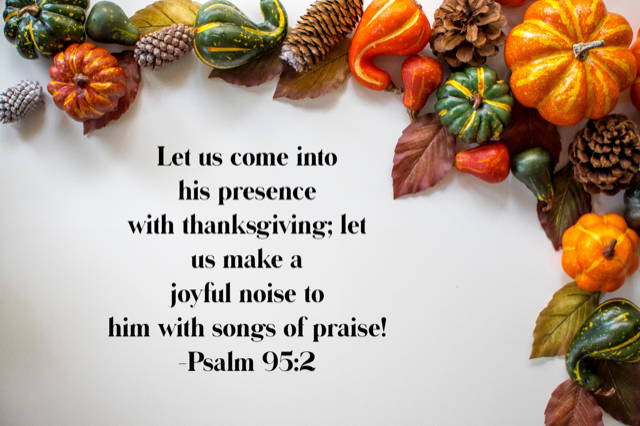
In Psalm 95:2, todah is the word translated thanksgiving: “Let us come into his presence with thanksgiving; let us make a joyful noise to him with songs of praise!”

Many of the psalms combine confession of sin, thankfulness for God’s grace, amazement at His greatness, and confession of His people’s personal experience of His provision, protection.

Psalm 145 is a beautiful example of this. Part of it says:

One generation shall commend your works to another,
    and shall declare your mighty acts.
On the glorious splendor of your majesty,
    and on your wondrous works, I will meditate.
They shall speak of the might of your awesome deeds,
    and I will declare your greatness.
They shall pour forth the fame of your abundant goodness
    and shall sing aloud of your righteousness.

The Lord is gracious and merciful,
    slow to anger and abounding in steadfast love.
The Lord is good to all,
    and his mercy is over all that he has made.

10 All your works shall give thanks to you, O Lord,
    and all your saints shall bless you!
11 They shall speak of the glory of your kingdom
    and tell of your power,
12 to make known to the children of man your mighty deeds,
    and the glorious splendor of your kingdom.
13 Your kingdom is an everlasting kingdom,
    and your dominion endures throughout all generations.

Psalm 65 does as well:

Praise is due to you, O God, in Zion,
    and to you shall vows be performed.
O you who hear prayer,
    to you shall all flesh come.
When iniquities prevail against me,
    you atone for our transgressions.
Blessed is the one you choose and bring near,
    to dwell in your courts!
We shall be satisfied with the goodness of your house,
    the holiness of your temple!

These thoughts brought to mind Ron and Shelly Hamilton’s song, “Worthy of Praise”:

My heart overflows with praise to the Lord
I will lift up my voice to the King
He brought me out of the pit of despair
And taught my heart to sing


Worthy of all my praise
You are worthy of all my praise
I bow at Your throne
And I worship You alone
Lord You are worthy
Worthy of praise

I wish you all a wonderful Thanksgiving filled with food, family, and praise for Him who is worthy.

(I often link up with some of these bloggers.)

Why Is the Resurrection of Jesus Christ Important?

Why is the resurrection of Jesus Christ important

Easter Day! Time for new, springy clothes, a ham dinner, brightly colored eggs, and chocolate bunnies.

And the celebration of Jesus’ resurrection.

I’m not against those other things. I enjoy them all. But I do fear that the resurrection gets lost in the shuffle except for a special church service and hymns.

Even as Christians, sometimes we’re so used to the resurrection, we forget how special, how life-changing, how dynamic it is.

Or we might be comforted by the resurrection when a loved one dies, but we don’t think it affects everyday life much.

So I thought I’d spend some time thinking about just why the resurrection of Christ is important.

The resurrection of Christ proves His deity.

Set apart for the gospel of God, which he promised beforehand through his prophets in the holy Scriptures, concerning his Son, who was descended from David according to the flesh and was declared to be the Son of God in power according to the Spirit of holiness by his resurrection from the dead, Jesus Christ our Lord (Romans 1:1b-4).

He has fixed a day on which he will judge the world in righteousness by a man whom he has appointed; and of this he has given assurance to all by raising him from the dead (Acts 17:31).

The resurrection of Christ validated what He said. He foretold many times that He would rise after three days in the grave. Here are just a few:

From that time Jesus began to show his disciples that he must go to Jerusalem and suffer many things from the elders and chief priests and scribes, and be killed, and on the third day be raised (Matthew 16:21).

As they were gathering in Galilee, Jesus said to them, “The Son of Man is about to be delivered into the hands of men, and they will kill him, and he will be raised on the third day.” And they were greatly distressed (Matthew 17:22-23).

And as they were coming down the mountain, he charged them to tell no one what they had seen, until the Son of Man had risen from the dead (Mark 9:9).

The resurrection is part of the gospel. When Paul spoke of sharing the gospel, the resurrection was an integral part of it.

Now I would remind you, brothers, of the gospel I preached to you, which you received, in which you stand, and by which you are being saved, if you hold fast to the word I preached to you—unless you believed in vain.

For I delivered to you as of first importance what I also received: that Christ died for our sins in accordance with the Scriptures, that he was buried, that he was raised on the third day in accordance with the Scriptures (1 Corinthians 15:1-4).

That is why his faith was “counted to him as righteousness.” But the words “it was counted to him” were not written for his sake alone, but for ours also. It will be counted to us who believe in him who raised from the dead Jesus our Lord, who was delivered up for our trespasses and raised for our justification (Romans 4:22-25).

Without the resurrection, we’re still in our sins.

And if Christ has not been raised, your faith is futile and you are still in your sins. Then those also who have fallen asleep in Christ have perished. If in Christ we have hope in this life only, we are of all people most to be pitied (1 Corinthians 15:17-19).

I’ve heard some say to the unsaved, “If I’m wrong and you’re right, I’ve lost nothing. But if I’m right and you’re wrong, you’ve lost everything.” But that’s not what the Bible says. “If in Christ we have hope in this life only, we are of all people most to be pitied.”

Since Christ was raised, we know we will be, too.

But in fact Christ has been raised from the dead, the firstfruits of those who have fallen asleep. For as by a man came death, by a man has come also the resurrection of the dead. For as in Adam all die, so also in Christ shall all be made alive (1 Corinthians 15:20-22).

For the Lord himself will descend from heaven with a cry of command, with the voice of an archangel, and with the sound of the trumpet of God. And the dead in Christ will rise first. Then we who are alive, who are left, will be caught up together with them in the clouds to meet the Lord in the air, and so we will always be with the Lord. Therefore encourage one another with these words (1 Thessalonians 4:16-18).

Jesus said to her, “I am the resurrection and the life. Whoever believes in me, though he die, yet shall he live” (John11:25).

Since we will all be raised, we will see our loved ones again.

But we do not want you to be uninformed, brothers, about those who are asleep, that you may not grieve as others do who have no hope. For since we believe that Jesus died and rose again, even so, through Jesus, God will bring with him those who have fallen asleep (1 Thessalonians 4:13-14).

The resurrection removes death’s sting. Death is still grievous. It is still an enemy (1 Corinthians 15:26). But knowing that we’ll live again afterward and can meet God forgiven, cleansed, and accepted takes away death’s sting.

When the perishable puts on the imperishable, and the mortal puts on immortality, then shall come to pass the saying that is written:

“Death is swallowed up in victory.”
“O death, where is your victory?
    O death, where is your sting?”

The sting of death is sin, and the power of sin is the law. But thanks be to God, who gives us the victory through our Lord Jesus Christ (1 Corinthians 15: 54-57).

Because Jesus died and rose again, Satan is defeated.

In him also you were circumcised with a circumcision made without hands, by putting off the body of the flesh, by the circumcision of Christ, having been buried with him in baptism, in which you were also raised with him through faith in the powerful working of God, who raised him from the dead. And you, who were dead in your trespasses and the uncircumcision of your flesh, God made alive together with him, having forgiven us all our trespasses, by canceling the record of debt that stood against us with its legal demands. This he set aside, nailing it to the cross. He disarmed the rulers and authorities and put them to open shame, by triumphing over them in him (Romans 11-15).

Since therefore the children share in flesh and blood, he himself likewise partook of the same things, that through death he might destroy the one who has the power of death, that is, the devil, and deliver all those who through fear of death were subject to lifelong slavery (Hebrews 2:14-15).

The “rulers and authorities” mentioned in the last verse are thought to refer to Satan and his minions, the unseen “rulers of darkness.”

God’s power in the resurrection is the same power with which He works on our behalf.

That you may know . . . what is the immeasurable greatness of his power toward us who believe, according to the working of his great might that he worked in Christ when he raised him from the dead and seated him at his right hand in the heavenly places, far above all rule and authority and power and dominion, and above every name that is named, not only in this age but also in the one to come. And he put all things under his feet and gave him as head over all things to the church, which is his body, the fullness of him who fills all in all. (Ephesians 1:19-23).

Because of the resurrection, we can walk in newness of life.

We were buried therefore with him by baptism into death, in order that, just as Christ was raised from the dead by the glory of the Father, we too might walk in newness of life (Romans 6:4).

For the death he died he died to sin, once for all, but the life he lives he lives to God. So you also must consider yourselves dead to sin and alive to God in Christ Jesus. Let not sin therefore reign in your mortal body, to make you obey its passions. Do not present your members to sin as instruments for unrighteousness, but present yourselves to God as those who have been brought from death to life, and your members to God as instruments for righteousness. For sin will have no dominion over you, since you are not under law but under grace (Romans 6:10-14).

Jesus’ resurrection gives hope and meaning to our suffering.

So we do not lose heart. Though our outer self is wasting away, our inner self is being renewed day by day. For this light momentary affliction is preparing for us an eternal weight of glory beyond all comparison, as we look not to the things that are seen but to the things that are unseen. For the things that are seen are transient, but the things that are unseen are eternal. (2 Corinthians 4:16-18).

For I consider that the sufferings of this present time are not worth comparing with the glory that is to be revealed to us (Romans 8:18).

Because He died and rose again, we come to a throne of grace.

Since then we have a great high priest who has passed through the heavens, Jesus, the Son of God, let us hold fast our confession. For we do not have a high priest who is unable to sympathize with our weaknesses, but one who in every respect has been tempted as we are, yet without sin. Let us then with confidence draw near to the throne of grace, that we may receive mercy and find grace to help in time of need (Hebrews 4: 14-16).

Because Jesus rose again, He is interceding for us.

Who is to condemn? Christ Jesus is the one who died—more than that, who was raised—who is at the right hand of God, who indeed is interceding for us (Romans 8:34).

Because of the resurrection, we can be steadfast. After spending 57 verses talking about the resurrection in 1 Corinthians 15, Paul says, “Therefore”—because of all that he said in those 57 verses—

Therefore, my beloved brothers, be steadfast, immovable, always abounding in the work of the Lord, knowing that in the Lord your labor is not in vain (1 Corinthians 15:58).

In Isobel Kuhn’s Nests Above the Abyss, she says the Lisu “have no hope beyond the grave.” She had heard their wail “for the dead and my heart could hardly stand the hopelessness of their agony.” One five-year-old child screamed incessantly when his beloved neighbor died and he understood death for the first time. When he became a young man, he admitted, “after that awful introduction to the fact of death, he could not come upon a grave on the mountainside without getting cold all over.” This, Isobel says, is “a typical scene.” Another “cried so hard and so long he was ill for days” upon learning about death. Some who bury loved ones “sometimes weep themselves blind, and some lose their minds.” Some harden themselves by trying to forget their dead loved one.

That first five-year-old boy grew up to become an evangelist. One time he related his story, then told how he heard one of the missionaries speak on John 11:25, where Jesus said, “I am the resurrection and the life. Whoever believes in me, though he die, yet shall he live.”

“As she explained that verse, suddenly the truth of it broke in on my understanding, and the fact of eternal life, a life after death, a hope beyond the grave, shone before me. I was thrilled through and through; faith and acceptance of the Saviour were born right then in my soul. It was that verse on the resurrection that brought me to Christ; and I have a feeling that I am not the only Lisu to become a believer because of this truth. All of you who were led to become Christians by the resurrection doctrine, hold up your hands.” Ans all over the building hands shot into the air and the glowing joy on their faces told its own story (pp. 16-18).

May those of us who have heard of the resurrection all our lives be impressed anew with its truth, its hope, its victory. May we come to love and appreciate it now more than ever. May the resurrection impact us not just at Easter, but every day.

And may those who have not yet believed do so soon.

(I often link up with some of these bloggers.)

Lamb of God

But he was pierced for our transgressions;
    he was crushed for our iniquities;
upon him was the chastisement that brought us peace,
    and with his wounds we are healed.
All we like sheep have gone astray;
    we have turned—every one—to his own way;
and the Lord has laid on him
    the iniquity of us all.

Isaiah 53:5-6

Years ago I heard a story about a guest preacher who was just getting ready to board his train after speaking at a church. A man hurried to him, saying he had been in the meeting and was anxious about his spiritual state. Could the preacher take time to talk to him?

The preacher’s train was the last of the night, and it was about to leave. All he had time to tell the man was to read Isaiah 53:6, and then to go in and the first “all” and come out at the last “all.”

The man was puzzled, but when he went home. he looked up Isaiah 53:6: “All we like sheep have gone astray; we have turned—every one—to his own way; and the Lord has laid on him the iniquity of us all.” As the man read the passage several times, understanding dawned. He was a sheep gone astray, stubbornly following his own way. But Jesus took his iniquity. If he trusted in Jesus, he would be saved and forgiven.

I don’t know if this is a true story, but the point it makes is true.

For Christ also suffered once for sins, the righteous for the unrighteous,
that he might bring us to God (1 Peter 3:18).

For God so loved the world, that he gave his only Son,
that whoever believes in him should not perish but have eternal life (John 3:16).

Stricken, smitten, and afflicted,
see him dying on the tree!
‘Tis the Christ, by man rejected;
yes, my soul, ’tis he, ’tis he.
‘Tis the long-expected Prophet,
David’s Son, yet David’s Lord;
proofs I see sufficient of it:
’tis the true and faithful Word.

Tell me, as you hear him groaning,
was there ever grief like his,
friends through fear his cause disowning,
foes insulting his distress?
Many hands were raised to wound him,
none would intervene to save;
but the deepest stroke that pierced him
was the stroke that justice gave.

If you think of sin but lightly
nor suppose the evil great,
here you see its nature rightly,
here its guilt may estimate.
Mark the sacrifice appointed,
see who bears the awful load;
’tis the Word, the Lord’s anointed,
Son of Man and Son of God.

Here we have a firm foundation,
here the refuge of the lost:
Christ, the Rock of our salvation,
is the name of which we boast;
Lamb of God, for sinners wounded,
sacrifice to cancel guilt!
None shall ever be confounded
who on him their hope have built.

Thomas Kelly, 1804

Isaiah 53:6

(I often link up with some of these bloggers.)

Happy Christmas!

Matthew 1:21, Christmas, Jesus our Savior

I wish all of you a wonderful Christmas resting in the greatest gift of all,
the Savior who provided for our salvation.

“She will bear a son, and you shall call his name Jesus,
for he will save his people from their sins.”

All this took place to fulfill what the Lord had spoken by the prophet:

“Behold, the virgin shall conceive and bear a son,
    and they shall call his name Immanuel”

(which means, God with us).

Matthew 1:21-23