Sure-Footed Confidence

Sure-footed confidence

The book of Habakkuk might seem an unlikely place to draw inspiration for Easter. But my study from Habakkuk last week gave me food for thought this Easter week.

Habakkuk is my favorite of the Old Testament “minor” prophets. His book is just three chapters long and seems to be a lot more understandable than some of the others.

First, Habakkuk laments the violence, destruction, iniquity, and injustice he sees around him. He asks God how long he’ll cry for help without God answering.

God answers that He is sending the “dreaded and fearsome” Chaldeans.

Habakkuk’s response in our day would sound something like, “Wait–what?!” He wonders how God in His holiness can send a wicked nation against His own people.

God’s answer is the longest part of the book, too long to delineate here. But He begins with “The righteous shall live by his faith” and ends with “But the Lord is in his holy temple; let all the earth keep silence before him.”

In other words, “I know what I am doing. Trust me.”

In-between those truths, He promises He will deal with the Chaldeans.

His answer satisfied Habakkuk, who praises Him and prays for revival. In what’s probably the most well-known part of the book, next to “The just shall live by His faith,” Habakkuk proclaims that, “Though the fig tree should not blossom, nor fruit be on the vines, the produce of the olive fail and the fields yield no food, the flock be cut off from the fold and there be no herd in the stalls”–

In other words, through economic collapse, need, everything going wrong–

“Yet I will rejoice in the Lord; I will take joy in the God of my salvation.”

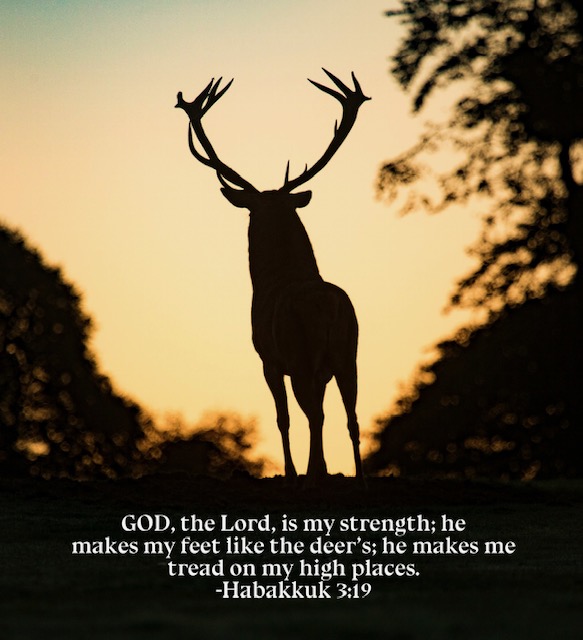
That passage has rebuked and inspired me many times. But what stood out to me on this reading was the next verse: “God, the Lord, is my strength; he makes my feet like the deer’s; he makes me tread on my high places.”

The ESV Study Bible notes say of this verse, “Habakkuk can have sure-footed confidence in God and can live on the heights even amid extreme circumstances.”

Have you ever seen deer or mountain goats walking and leaping in areas where it looks like they’ll take a tumble at any moment? They are much more sure-footed than I would be in their place.

Our day is not unlike Habakkuk’s. Violence, injustice, and iniquity abound. We know from later books in the Bible that things will get worse before the end.

But because Jesus came, lived a totally righteous life in our place, died for our sins, and rose again:

We can be forgiven.

  • “And you, who were dead in your trespasses and the uncircumcision of your flesh, God made alive together with him, having forgiven us all our trespasses, by canceling the record of debt that stood against us with its legal demands. This he set aside, nailing it to the cross. He disarmed the rulers and authorities and put them to open shame, by triumphing over them in him” (Colossians 2:13-15).

We can have everlasting life.

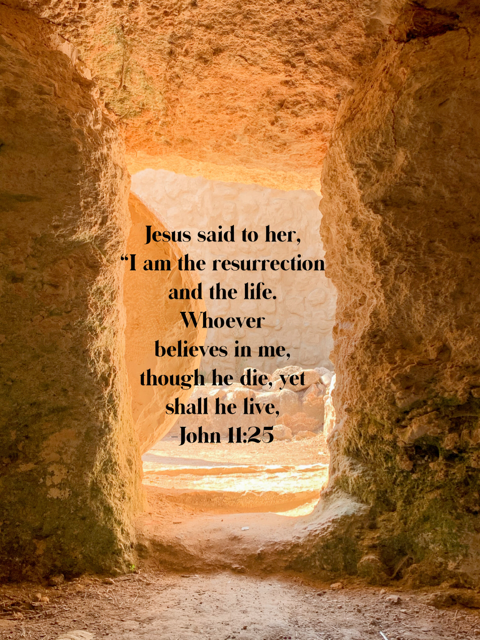
  • “I am the resurrection and the life.Whoever believes in me, though he die, yet shall he live, and everyone who lives and believes in me shall never die. Do you believe this?” (John 11:25).
  • “But our citizenship is in heaven, and from it we await a Savior, the Lord Jesus Christ” (Philippians 3:20).
  • “For we know that if the tent that is our earthly home is destroyed, we have a building from God, a house not made with hands, eternal in the heavens” (2 Corinthians 5:1).

Jesus lives within us.

  • “I have been crucified with Christ. It is no longer I who live, but Christ who lives in me. And the life I now live in the flesh I live by faith in the Son of God, who loved me and gave himself for me” (Galatians 2:20).
  • “To them God chose to make known how great among the Gentiles are the riches of the glory of this mystery, which is Christ in you, the hope of glory” (Colossians 1:27).

We have access to God.

  • “Therefore, since we have been justified by faith, we have peace with God through our Lord Jesus Christ. Through him we have also obtained access by faith into this grace in which we stand, and we rejoice in hope of the glory of God” (Romans 5:1-2).
  • “Since then we have a great high priest who has passed through the heavens, Jesus, the Son of God, let us hold fast our confession. For we do not have a high priest who is unable to sympathize with our weaknesses, but one who in every respect has been tempted as we are, yet without sin. Let us then with confidence draw near to the throne of grace, that we may receive mercy and find grace to help in time of need” (Hebrews 4: 14-16).

We don’t have to fear death.

  • “Since therefore the children share in flesh and blood, he himself likewise partook of the same things, that through death he might destroy the one who has the power of death, that is, the devil, and deliver all those who through fear of death were subject to lifelong slavery” (Hebrews 2:14-15).
  • “When the perishable puts on the imperishable, and the mortal puts on immortality, then shall come to pass the saying that is written: ‘Death is swallowed up in victory.’ ‘O death, where is your victory? O death, where is your sting?’ The sting of death is sin, and the power of sin is the law. But thanks be to God, who gives us the victory through our Lord Jesus Christ” (1 Corinthians 15:54-57).

We have comfort in sorrow.

  • “But we do not want you to be uninformed, brothers, about those who are asleep, that you may not grieve as others do who have no hope. For since we believe that Jesus died and rose again, even so, through Jesus, God will bring with him those who have fallen asleep. For this we declare to you by a word from the Lord, that we who are alive, who are left until the coming of the Lord, will not precede those who have fallen asleep. For the Lord himself will descend from heaven with a cry of command, with the voice of an archangel, and with the sound of the trumpet of God. And the dead in Christ will rise first. Then we who are alive, who are left, will be caught up together with them in the clouds to meet the Lord in the air, and so we will always be with the Lord. Therefore encourage one another with these words (1 Thessalonians 4:13-18).

We have meaning in our work.

  • After 57 verses about the resurrection, Paul writes, “Therefore, my beloved brothers, be steadfast, immovable, always abounding in the work of the Lord, knowing that in the Lord your labor is not in vain” (1 Corinthians 15:58).

We have perspective in our suffering.

  • “So we do not lose heart. Though our outer self is wasting away, our inner self is being renewed day by day. For this light momentary affliction is preparing for us an eternal weight of glory beyond all comparison” (2 Corinthians 4:16-17).
  • “For I consider that the sufferings of this present time are not worth comparing with the glory that is to be revealed to us” (Romans 8:18).

We have focus for our daily walk.

  • “We look not to the things that are seen but to the things that are unseen. For the things that are seen are transient, but the things that are unseen are eternal” (2 Corinthians 4:18).
  • “But one thing I do: forgetting what lies behind and straining forward to what lies ahead, I press on toward the goal for the prize of the upward call of God in Christ Jesus” (Philippians 3:13-14).
  • “We were buried therefore with him by baptism into death, in order that, just as Christ was raised from the dead by the glory of the Father, we too might walk in newness of life” (Romans 6:4).

God has graciously given us more Scripture than Habakkuk had. But the truth remains: “The righteous shall live by his faith” and “The Lord is in his holy temple; let all the earth keep silence before him.”

We don’t know how everything will work out before the Lord comes again. But we can have “sure-footed confidence in God” and “live on the heights even amid extreme circumstances.” Our souls can be stable even when our circumstances are not.
Habakkuk 3:19

(I often link up with some of these bloggers.)
Resurrection Hope Beyond Easter

We think of Easter as the joyful end of a long period of sadness. Even if we don’t formally practice Lent, we spend the time leading up to Easter contemplating the last week of Jesus’s life, His trial, and His crucifixion. We mourn over our sinfulness, which required such a price for atonement.

But then we burst forth into joy and praise on Easter Day. Christ is risen! He overcame death and the grave!

And then Monday we go back to our normal routine. We don’t think much about the resurrection again until next Easter or until someone dies. Then we’re encouraged that we’ll see our missing loved ones again.

But the resurrection changed everything. It touches our lives much more than one day a year.

Here are some ways resurrection hope affects our lives:

Testifies that Jesus is the Son of God. Jesus “was declared to be the Son of God in power according to the Spirit of holiness by his resurrection from the dead” (Romans 1:4).

Dismantles our fear of death. Hebrews 2:14-15 tells us, “Since therefore the children share in flesh and blood, he himself likewise partook of the same things, that through death he might destroy the one who has the power of death, that is, the devil, and deliver all those who through fear of death were subject to lifelong slavery.”

In Isobel Kuhn’s books, she cites that many Lisu people came to faith in Christ due to the resurrection. Their previous beliefs held no hope after the grave. They thought death was the end of the body, soul, and spirit. Some mourned inconsolably at a loved one’s grave or cowered in abject terror at the thought of their own end. Learning who Jesus was, the salvation He accomplished for their forgiveness, and the hope of eternal life transformed them.

Jesus told Martha, “I am the resurrection and the life. Whoever believes in me, though he die, yet shall he live, and everyone who lives and believes in me shall never die. Do you believe this?” (John 11:25).

Allows Christ to live in us. Paul said part of the ministry given to him was to preach “the riches of the glory of this mystery, which is Christ in you, the hope of glory” (Colossians 1:27). We not only have His fellowship, comfort, and so much more, we have His power to live. “I have been crucified with Christ. It is no longer I who live, but Christ who lives in me. And the life I now live in the flesh I live by faith in the Son of God, who loved me and gave himself for me” (Galatians 2:20).

Assures justice will be done. When the King comes to reign, everything will be as it should be.

Removes death’s sting. 1 Corinthians 15:54-57 says:

When the perishable puts on the imperishable, and the mortal puts on immortality, then shall come to pass the saying that is written:

“Death is swallowed up in victory.”
“O death, where is your victory?
    O death, where is your sting?”

The sting of death is sin, and the power of sin is the law. But thanks be to God, who gives us the victory through our Lord Jesus Christ.

Jesus’ death breaks the power of sin in our lives. We still have to fight the old nature and resist the devil, but they have no more authority over us.

Gives meaning to our labor. 1 Corinthians 15 is the great “resurrection chapter.” After 57 verses about the resurrection, Paul says, “Therefore, my beloved brothers“—because of all he had said about the resurrection up til now—“be steadfast, immovable, always abounding in the work of the Lord, knowing that in the Lord your labor is not in vain.” We can be steady in our labor for God, even if we don’t see any results. Galatians 6:9 puts it another way: “And let us not grow weary of doing good, for in due season we will reap, if we do not give up.”

Gives comfort and hope in our sorrow. Our grief when a loved one dies is tempered by the fact that we’ll see them again.

But we do not want you to be uninformed, brothers, about those who are asleep, that you may not grieve as others do who have no hope. For since we believe that Jesus died and rose again, even so, through Jesus, God will bring with him those who have fallen asleep. For this we declare to you by a word from the Lord, that we who are alive, who are left until the coming of the Lord, will not precede those who have fallen asleep. For the Lord himself will descend from heaven with a cry of command, with the voice of an archangel, and with the sound of the trumpet of God. And the dead in Christ will rise first. Then we who are alive, who are left, will be caught up together with them in the clouds to meet the Lord in the air, and so we will always be with the Lord. Therefore encourage one another with these words (1 Thessalonians 4:13-18).

We still grieve and miss them sorely, but we have great joy to look forward to.

Gives perspective to our sufferings. When we’re suffering, our pain can take over our minds and emotions. Suffering seems endless. It outweighs everything else. But as heavy as suffering is, in heaven, our time of suffering will seem “light” and “momentary.” “So we do not lose heart. Though our outer self is wasting away, our inner self is being renewed day by day. For this light momentary affliction is preparing for us an eternal weight of glory beyond all comparison” (2 Corinthians 4:16-17). Romans 8:18 puts it this way: “For I consider that the sufferings of this present time are not worth comparing with the glory that is to be revealed to us.”

Provides a new address. Philippians 3:20 tells us, “But our citizenship is in heaven, and from it we await a Savior, the Lord Jesus Christ.” Warren Wiersbe says in his commentary on Philippians, Be Joyful, “We look at earth from heaven’s point of view” (p. 95). Our time here is relatively brief, and eternity is long.

Promises reward for our service. The Bible speaks of crowns that will be rewarded to various believers. Jesus said that when we have a feast, we should not only invite friends and loved ones. We should gather in those who can’t repay us, “and you will be blessed, because they cannot repay you. For you will be repaid at the resurrection of the just” (Luke 14:14).

Shows forth God’s power. One of the things Paul prays that the Ephesians might know is “the immeasurable greatness of his power toward us who believe, according to the working of his great might that he worked in Christ when he raised him from the dead and seated him at his right hand in the heavenly places” (Ephesians 1:19-20). Paul’s burning desire was “that I may know him and the power of his resurrection, and may share his sufferings, becoming like him in his death, that by any means possible I may attain the resurrection from the dead” (Philippians 3:10-11).

Gives focus for our daily walk. 1 Corinthians 4:18 says, “as we look not to the things that are seen but to the things that are unseen. For the things that are seen are transient, but the things that are unseen are eternal.” Paul says, “But one thing I do: forgetting what lies behind and straining forward to what lies ahead, I press on toward the goal for the prize of the upward call of God in Christ Jesus” (Philippians 3:13-14).

Because of the resurrection, we know this life is not all there is. “If then you have been raised with Christ, seek the things that are above, where Christ is, seated at the right hand of God. Set your minds on things that are above, not on things that are on earth. For you have died, and your life is hidden with Christ in God. When Christ who is your life appears, then you also will appear with him in glory” (Colossians 3:1-4). One of our former pastors used to frequently quote from a little chorus by Al Smith, “May I do each day’s work for Jesus, With eternity’s values in view.”

I love this stanza in “I’ve Found a Friend” by James G. Small:

I’ve found a friend, O such a friend!
All power to Him is given,
To guard me on my onward course,
And bring me safe to Heaven.
The eternal glories gleam afar,
To nerve my faint endeavor;
So now to watch, to work, to war,
And then to rest forever.

May the “eternal glories” that “gleam afar” nerve our own “faint endeavors.” May we carry resurrection hope in our hearts every day.

(I often link up with some of these bloggers.)