Why Don’t Older Women Serve?

IMG_0211

A lady asked that question some years ago on a Christian message forum online. She was asking why older women didn’t serve within the organized church programs. I don’t remember what I answered in response then, but it is a question that has stayed with me, and I wanted to share a few thoughts.

First, I think we need to be careful of blanket statements. Maybe there truly were no older women serving at her particular church, depending on what she meant by “older,” but that’s not to say no older woman serves anywhere. I’ve known some wonderful older women serving in various capacities, even through daunting physical problems.

Secondly, not all ministry tales place within organized church programs. More on that in a moment. Christians are to live a life of ministry, but that may look different at different phases and among different personalities. There are many ways to mentor.

It is true that sometimes older people can have the mindset that, “I’ve served my time, let the younger people do it.” “Serving my time” sounds like a prison sentence, which is not the joyful service a Christian should exemplify. As “older” ladies (however you qualify that), we do need to remember that we are called to minister to others, to exercise the gifts God gave us, to live out the Biblical “one anothers,” and we’re specifically called to teach younger women certain things. God has a function for everyone in the body of Christ. There is no retirement from serving the Lord, though that service may change as life changes.

But it is true that some of those life changes may indeed affect how we serve. It may not involve standing in front of a class, leading a seminar, or any number of “public” ministries. Here are a few reasons why older women may not serve as they did in younger years:

Physical issues.

There is a wide range of what’s “normal” at various stages of aging. Many of us probably know globe-trotting octogenarians who seem as sharp mentally and almost as able physically as people half their age. But we also know people who are nearly disabled by age-related problems in their sixties.

But even beyond known physical problems, like diabetes, high blood pressure, arthritis, etc., there may be physical problems an older woman may not want to talk about, like bladder issues or a gradual loss of control of some bodily functions. Forgive me if this is too much information for some of you, but it’s a reality for many women. One dear lady in one of our former churches came to Sunday School and church, but if we tried to persuade her to come to any other kind of ladies’ meeting, she would say, “Oh, I would love to, but I have such problems with gas, I don’t dare.” We went away chuckling to ourselves, but years later when experiencing some of the same problems, it wasn’t so funny. It’s hard to stand in front of a group when you’re afraid you might have to make a mad dash to the restroom, Kegel exercises notwithstanding. I’ve wanted to tell pastors when they make comments about people sitting near the back of the church that some of us have good reasons for being there!

Menopause.

This might be considered a subset of physical issues, but it carries emotional overtones as well. Some women seem to have smooth sailing through menopausal waters while others experience severe storms, either physically or emotionally or both. For some, the years leading up to menopause can be worse than menopause itself. I could give you details…but I’ll spare you.

Diminished capacity.

As people age they generally lose a certain amount of “oomph,” physically and even emotionally. There is pressure in ministry, and some might get to a point where they can’t handle it as well as they once did. Stress can affect the physical and emotional problem mentioned earlier. A woman may feel she is too wobbly and unsteady to take care of babies in a nursery. I’ve also known women who drive less as they get older, first at night and then generally.

Family obligations.

Middle-aged women are often in that “sandwich generation” where they have a parent in declining years who needs increasing care while their children are going through their teens or college years or navigating life on their own or getting married and having babies. I know one older couple who retired partly because all of their adult married children as well as their aging parents lived in other cities, and they wanted to be able to go help their kids when new babies came and they needed to be available to go at a moment’s notice to help their parents.

One wife I knew had a husband who traveled frequently for meetings, and after the kids moved out, he wanted her to travel with him.

Serving in other ways.

One lady used to apologize to me frequently because she couldn’t come to monthly ladies’ meetings. She had an adult son who was disabled physically and mentally, a widowed mother who depended on her for almost everything that needed to be done around the house, and she seemed to be the “go-to” person for anyone in her extended family needing a baby-sitter. Her whole life was a ministry despite the fact that she couldn’t come to “official” ladies’ meetings.

Another older lady whom I’ve looked up to as an example retired from teaching in a Christian school and led a ladies’ Bible study. She did a wonderful job, but she stepped back after a year or two (I didn’t ask her reasons). But I noticed and admired many “behind the scenes” ways in which she served. She noticed a new lady sitting by herself in one church service, greeted her, and invited her to sit with her and her husband. This sparked a friendship which eventually led to both the woman and her husband becoming vital members of the church. She had ladies over to her house for lunch and fellowship, one or two at a time. She and another lady from church visited my mother-in-law and another woman in an assisted living facility almost every Friday for years. For whatever reason she did not participate in public or organized ministry programs other than teaching a children’s Sunday School class, but she had a vibrant ministry.

New opportunities.

As women face the “empty nest,” sometimes they have a new freedom (depending on their family situations, as mentioned above) since they no longer have the everyday care of their children. For some that means taking classes or traveling or doing things they haven’t been able to do for years.

The woman I mentioned in the first paragraph went on to say that she had seen some of the same women who had “dropped out” of serving go on to take craft classes and such, and it seemed to her that if they could take classes they could serve at church. If those women are in “retirement” mentality, letting the younger women serve because the older women have already, she’s right. But it may be they don’t feel they can handle some of the stress and pressure of organized ministry, yet they can be a testimony in a more relaxed setting like a craft class.

“Burnout.”

That’s not really a term that I like, but people do feel “burned out” in the Lord’s service sometimes. And this is another area where we can’t make blanket statements, but for me, anyway, and at least for some other people, we’re more apt to feel that way when: 1) We’ve taken on way more than we should, or 2) We don’t have adequate help, or 3) We’re serving in our own strength rather than the Lord’s. I would encourage pastors and ministry leaders to watch out for the first two. Sometimes we seem to heap more responsibilities on someone who is already serving because we see that they’re doing a good job until they have more than they can handle, and sometimes people do things on their own feeling heavily burdened but not seeking help because they don’t know who to ask or feel everyone else is either too busy or doesn’t have time or isn’t interested. I love our current church’s method of having ministry teams for most areas of service in the church rather than just one person in charge of different areas. The third area, serving in our own strength, is so easy to do: sometimes we start off leaning on the Lord but then get frantic and run out on our own. We need to acknowledge our weakness and appropriate His grace and strength daily, sometimes even moment by moment.

They may not feel wanted.

Some years ago a younger woman confided to me that she and others her age didn’t come to our monthly ladies’ meetings because it was all “older” women (though most of us there didn’t think we were that much older). That was the only church I have been a part of where that happened – in most, the ladies’ group was a joyful mix of ages and life situations and one of the best formats, in my opinion, for us to learn from each other. And, happily, even in that church things began to change: one or two new younger married women started coming (unaware of the prevailing sentiment, I guess), and eventually a handful of younger women started coming. I pray the trend continues. But I have to admit that hurt, and it has created in me a hesitancy sometimes to even interact with younger women because I feel they don’t want me to. Thankfully that’s not the case, and I feel I have some wonderful friendships with younger women, but I have to battle against a fear of rejection.

It may be time to minister to them.

My in-laws were very generous in helping their extended family when they could, but as they got older, my father-in-law retired and was on permanent disability due to injuries sustained at work, and their income diminished. As we noticed some family members still coming to them for help, my husband and I remarked that the family needed to come to realize that things were changing, that we needed to have the mindset of seeing how we could help them rather than expecting they were always going to be able to help us.

That’s true in the church family as well. Long before a “senior saint” goes to live in a nursing home or with family members, they might benefit from church ministrations. One year our church ladies’ group collected items for gift bags for some of the “shut-ins” and older women in church, then we divided up the gift bags and visited the ladies and delivered the bags. The visits meant more to them than the gifts, though they appreciated the gifts very much, and we were blessed in trying to bless them.

We had an older middle-aged lady in our neighborhood whose church came over and painted the outside of her home. It was something she couldn’t do herself and couldn’t afford to pay someone to do, and this was a tremendous help to her.

Even just visiting older neighbors and church members with some regularity might open up areas of ministry: they might need little things done like light bulbs changed that they can’t reach or overgrown bushes in the yard that need a trim. They might be hesitant to ask, they often don’t want to “be a bother,” but if you just happen to be there and notice, an offer to take care of such a problem would mean a lot.

If you’re a younger woman who would love to benefit from an older woman’s wisdom, first of all spend time with older ladies. Go where they are. Ask them questions. Invite them over, talk to them at church, etc. You can ask them if they’re willing to serve in some formal way – some are able and willing. But if they decline, and especially if they’re flustered, don’t press the matter. Pray about it and ask the Lord to change their mind if it is His will or to lay someone else on your heart to ask.

And as “older” ladies, we do have to be careful that we don’t let years of experience turn us into opinionated old biddies who are critical of new ideas and who consistently say, “Well, the way we always did it was…” Holding on to sound doctrine is something we’re called to do, but we can learn to adapt to new methods and styles.

We may or may not be able to do the same kinds of ministries we’ve always done, but we can seek God as to what exactly He would like for us to do. As long as the Lord has left us here on earth, He has something for us to do, some way for us to bless others. Sometimes we can be dismayed by our limitations, but as Elisabeth Elliot once said, limitations just define our ministry: “For it is with the equipment that I have been given that I am to glorify God. It is this job, not that one, that He gave me.”

Two glad services are ours,
Both the Master loves to bless.
First we serve with all our powers –
Then with all our feebleness.

Nothing else the soul uplifts
Save to serve Him night and day,
Serve Him when He gives His gifts –
Serve Him when He takes away.

C. A. Fox

This post will be linked to  Women Living Well.

Update: I followed this us with another post on Ways Older Women Can Serve.

Save

Book Review: Women’s Ministry in the Local Church

I finished Women’s Ministry in the Local Church by Ligon Duncan and Susan Hunt a few weeks ago, but it is hard to know how to condense everything I’d like to say about it. I typed out many of the quotes I marked so I could have them handy to refer to without flipping back and forth through the book, and just those quotes took up almost three pages, which is much too long for a blog post! So I think I’ll just give you a brief overview of the book and then mention a few things I really liked about it and a couple I didn’t like so much.

The authors first set out the need for such a book to help women to teach other women as Titus 2 instructs, to present the Biblical role of womanhood as opposed to the feminist view promoted by the world, and to promote the necessity and nobility of women’s roles. The authors had found resources teaching many aspects of a woman’s relationship to Christ and women’s groups a para-church organizations, but not one integrating the women’s ministry to the church ministry as a whole. Furthermore, in some churches which do have some type of women’s ministry, that ministry is “event-, task-, or personality-driven. An inherent danger is that any ministry that is not Biblically informed will eventually become competitive and divisive” (p. 31). Ligon Duncan has an excellent section on “Why a Church Needs a Women’s Ministry” in pages 37-42.

After discussing the need and motives of women’s ministry, the authors lay out the foundations and tasks of a healthy women’s ministry and the relationship of the women’s ministry to the rest of the church.

The authors promote a complementarian position, the view “that God created men and women equal in being but assigned different — but equally valuable — functions in His kingdom, and that this gender distinctiveness complements, or harmonizes, to fulfill His purpose” (p. 32), and part of that distinction is “male spiritual leadership in the home and believing community, the Church” (pp. 32-33). A couple of quotes I especially appreciated along these lines were:

Submission has nothing to do with status. Submission is about function. Equality of being and differentiation of function characterize the Trinity. The Persons of the Godhead are ‘the same in substance, equal in power and glory,” but each has a different function in the accomplishment of our salvation (p. 73).

Submission does not restrain women. Submission frees us to accomplish our kingdom purpose (p. 78).

Domestic duties are not a hindrance to sanctification; they are essentials of the common life. The family is a context in which to develop godly character that will qualify women for service beyond hearth and home. When love for Christ is the matrix of domesticity, those duties become an aroma of Christ, the fragrance of life (2 Corinthians 2:15-16) (p. 106).

Since I’ve started sharing quotes, let me see if I can pick out a few of the most pertinent from the three pages I gleaned:

When young women learn more about womanhood from TV, movies, magazines, and the Internet than they do from mature older women, they will often make unbiblical decisions. (p. 53)

Christ, not womanhood or the women’s ministry, must be the reference point. Unless a woman’s ministry is an overflow of the gospel, women will become hinderers and nor helpers in God’s Church. Those who plan for and implement a women’s ministry must be intentional in maintaining a gospel orientation in their hearts and lives (p. 58).

Paul put heavy emphasis on sound doctrine. Sound doctrine is the antidote for error. Sound, which is the key word in these letters, is translated from a Greek word that means whole or healthy. “Christian doctrine is healthy in the same way as the human body is healthy. For Christian doctrine resembles the human body. It is a coordinated system consisting of different parts which relate to one another and together constitute a harmonious whole. If therefore our theology is maimed (with bits missing) or diseased (with bits distorted) it is not ‘sound’ or ‘healthy'” (pp. 59-60).

Titus 2:3-5 instructs the pastor to equip older women to train younger women. If this mandate is disconnected from a biblical perspective of discipleship, it can easily become purely a relational model that magnifies relationship rather than God’s glory, or an academic model that elevates knowledge over the application of the gospel into life (p.60-61).

Without in any way discounting the regular pulpit ministry of the church, we should recognize that there are certain matters more aptly addressed and applied in the context of a specific discipleship of women, whether in large groups, in small groups, or in situations of confidentiality, as women minister to women (p. 84).

The goal is not to get every woman to participate in the women’s ministry, but for the women’s ministry to serve and encourage every woman in the church (p. 111.)

Commenting on Psalm 144:12b: “that our daughters may be as corner stones, polished after the similitude of a palace”: These corner pillars were both beautiful and functional. They gave grace and dignity to the structure even as they supported it. If these pillars weakened, the structure was in danger. David considered these corner pillars to be gifts from God…Unless corner pillars stand on a firm foundation, they will topple. p. 138.

At the end of each chapter is a short testimony from pastors or women about some aspect discussed in the previous chapter. One of the most interesting and enlightening to me were a couple from women in reference to being in a church that did not see the importance of a women’s ministry, or, in some cases, did not even seem to love women:

How are women to love the church when they feel unloved by the church? I have found the answer in Scripture’s admonition to women who are married to unbelieving or disobedient husbands. The failure or weakness of male leadership does not absolve us of our responsibility. We are to run to the Author and Perfecter of our faith with our hurts, wounds, and disappointments. We are to see this season as part of our individual and corporate sanctification offered by our sovereign God who loves us steadfastly. (p. 52-53).

When women are scorned and disrespected by the philosophies of ministry that denigrate the design, calling, and roles of women, we are tempted to react with militant defensiveness. Scripture calls us to remember that Jesus, the King of the Church, delights in us. We are not called to defend ourselves but to defend Christ’s Kingdom through prayer and service. (p. 53).

The “militant defensiveness” stood out to me because I know of a handful of women who have that exact tone in pointing out perceived errors in the church and their voices and tone have become so shrill and bitter that they are doing much more harm than good. If the church is a family, a body, then dealing with problems is not best handled by “militant defensiveness.” That doesn’t mean those problems don’t need to be addressed, but there are better, more restorative and Christ-honoring ways to do it.

There are appendices in the back discussing some practical aspects of women’s discipleship ministries and Bible studies.

There were just a few things I either did not agree with or care for.

  • On page 75 a quote from a Dr. George Knight that “”Eve…brought herself into transgression by abandoning her role and taking on that of the man.” I don’t think that was her sin or even what led to her sin necessarily: her sin was simply disobeying God’s clear command; her motives: the lust of the flesh, the lust of the eyes, the pride of life.
  • This one is perhaps a minor point, but on pages 102-103 there is a section about widows which interprets I Timothy 5:3-10 as referring to two different groups of widows, those who receive church help and those who are a group qualified to minister to others. I had never heard that before, but I don’t see a distinction between two groups there: I believe it is all one group of widows and the lists actions there show what they have done, what they are being honored for, not what they are signing up to do (not that older women should not keep ministering in some way as long as they are able, but that’s another post I am thinking about).
  • On page 140 the authors say, “Bible studies should equip women to pass on the legacy of biblical womanhood to the next generation and should offer opportunities for them to have hands-on experiences in discipling one another.” I agree, but I don’t think that means Bible studies among women can only cover these topics or the passages that relate directly to women. I think studying books or other topics can be covered and is part of the foundation on which women’s ministry rests, and principles of womanhood can be brought out. Later they warn against a “prideful pursuit of knowledge…that stops short of true discipleship that moves from knowledge to wisdom — to the application of truth into life. They have perfected some Bible study skills, but they do not know how to love as godly, chaste single women, or love their husbands, or care for the sick and oppressed, or support the male leadership of the church…” and more (pp. 140-141). I do think that’s a valid concern.
  • Related to the above point, there is a section where a pastor compliments the women’s Bible study ministry in his church for coordinating with the pulpit ministry. For instance, when he preached a series on “David: A Man After God’s Own Heart,” the ladies’ Bible study ministry did a study on “A Woman After God’s Own Heart.” I think that’s really neat when that kind of coordination occurs, but again, I don’t think the ladies’ Bible study should be restricted to that kind of coordination any more than the Sunday School classes or children’s ministry or men’s meetings should. Sometimes it’s helpful when every aspect of the church is focused on a particular truth, topic, or section of the Bible, but in most cases it is helpful when the different groups study different parts of Scripture: it’s part of studying the whole counsel of God and balancing the different parts of Scripture. I’ve found that helpful even in my own Bible study or reading: if I am in a particular “heavy” section, like Job or the prophets, it helps to read a Psalm or something from the epistles as well.
  • I was surprised to find little mention of hospitality in the book. It’s implied but not really discussed much. As I mentioned in Mentoring Women, I think it hospitality is a primary way women can disciple and minister to each other; I don’t know that Paul primarily had classroom instruction and retreats in mind when he penned those verses, though I think it’s fine to use those.
  • Susan’s writing can be a bit clinical sometimes. I felt this way in her chapters of Becoming God’s True Woman as well (which I thought I had reviewed, but looking back, I just referred to it a number of times.)
  • This last point is one I want to be the most careful with because I don’t want to cause offense. Let me say first that, though I am in my particular denomination because I feel it best represents my understanding of what Scripture teaches, I know no denomination is flawless, and I can get along fine with people from other denominations if we agree on the major points: the Deity of Christ, the inspiration of Scripture, salvation by grace through faith and not by works we do, etc. Many blogs and books I read are by people from other denominations than my own. I can understand that good people can differ on some areas of teaching and application and still do everything they do as unto the Lord and be in right standing with Him.

One of those differences in some denominations is looking at God’s dealings with people through either a covenantal or a dispensational lens. This post is too long already to explain those two views and you can easily find them elsewhere, so I won’t go into all the differences. I can actually see elements of both: there are covenants God made with people throughout history that affected people for years to come, and the New Testament does refer to God’s relating to us through a “new covenant.” But, though God is always the same and people have always been saved by faith, there are different times in the Bible God had different specific requirements for His people. For instance, in our day we don’t have the same command as Adam and Eve not to eat of a certain tree, or the same requirements Old Testament Israel did with the ceremonial law. So while I would probably lean toward a more dispensational view, I certainly don’t discount the covenants and can see Biblical history through that lens as well. I can read books and blogs with those differences without a problem at all.

But this book is very, very, very heavily covenantal. Susan uses the phrases “covenantal community” and “covenantal consciousness” multitudes of times throughout the book to refer to the relationship believers in a church should have with each other. Those phrases are probably infused with meaning to her, but to me they just leave me a little cold. Just taken at face value, a covenant is a binding agreement between people. So relating to each other based on an agreement just doesn’t carry the same meaning to me as the Scriptural metaphors of the church being a family and a body, with different parts and functions all working together in a harmonious whole. Those metaphors are mentioned but not emphasized in the book. Susan  urges women’s ministry leaders to use those phrases to remind and emphasize to women their covenant relationship with each other, but the overuse of them in this book seemed to me to be an irritant and a shoving of the concept down the throat. I wouldn’t have had as much of a problem with it if she simply stated her view of the church as a covenantal community at the beginning and then went on without using those phrases so very often.

The time and space to explain all of that might seem to give it more weight than intended: it’s not really a major objection and not even an objection, really: I just think the emphasis of the type of community and relationship we’re to have with each other as believers would be better served with the more Scriptural phrases of the church being a body than the denominational phrases of “covenant community” and “covenant consciousness.” I think Susan probably means the same thing by those phrases, but to someone outside a covenantal type of denomination, it just doesn’t come across the same. Her writing is so heavily denominational, it might be off-putting to those from different denominations, but there is much good to glean if you don’t let that phraseology bother you.

It might look like I objected to more than I agreed with, but that is not really the case: it just took a bit more to explain the disagreements, and I didn’t bring out every single point I did agree with. Overall I found the book to be a rich resource and agreed with the great majority of the teaching and application. I would recommend it to anyone contemplating women’s ministry in the church.

(This review will also be linked to Semicolon‘s Saturday Review of Books.)

Laudable Linkage and Cool Videos

I didn’t have quite as much time for web surfing this week, but here are a few noteworthy things I did see:

The Unsaved Christian. Someone on Facebook linked to this. At first I balked at the title because someone is not a Christian if unsaved, so this seemed like a misnomer, but the article explains what she means and gently but clearly sounds a needed warning.

Winning Your Friends to Christ, HT to Susan.

Grace Spots.

Responding to the Scandal. If you saw the recent 20/20 report on abuse within IFB churches, this is the best response I have seen, HT to my son, Jeremy. I’ve been thinking about writing a post about this issue, but this hasn’t been a week I could have extended thoughtful time at the computer. But Dr. Bauder says just about everything I would say and more, and much better.

Homemade Note Pads are presented as a Teacher Appreciation Gift, but they’d be good for anyone.

Styrofoam Wall Art. I forget where I saw the link to this. I’ve seen similar ideas using canvas, but this would be cheaper.

Timelapse Video of San Francisco-to-Paris flight Captures Aurora Borealis. Neat article and video.

This is pretty funny. I can see how they do some of it, but they do the change-out pretty fast!

Have a great Saturday! We had storms through the night and lost power this morning, but I am so glad it is back on now!

Friday’s Fave Five

Welcome to Friday’s Fave Five, hosted by Susanne at Living to Tell the Story, in which we can share five of our favorite things from the last week. This has been a wonderful exercise in looking for and appreciating the good things God blesses us with. Click on the button to learn more, then go to Susanne’s to read others’ faves and link up your own.

Here are some highlights of the last week:

1. A Ladies’ Birthday Party! We had an activity at church last Saturday celebrating all the ladies’ birthdays at once. We signed up under the month our birthday was in, and everyone in that month got together to decide on table settings and decorations to somehow reflect that month, and the tables would be judged in a contest. (Months with not as many people were combined together). People in the different months were designated to bring different foods (finger sandwiches, pasta salads, and fruit trays).

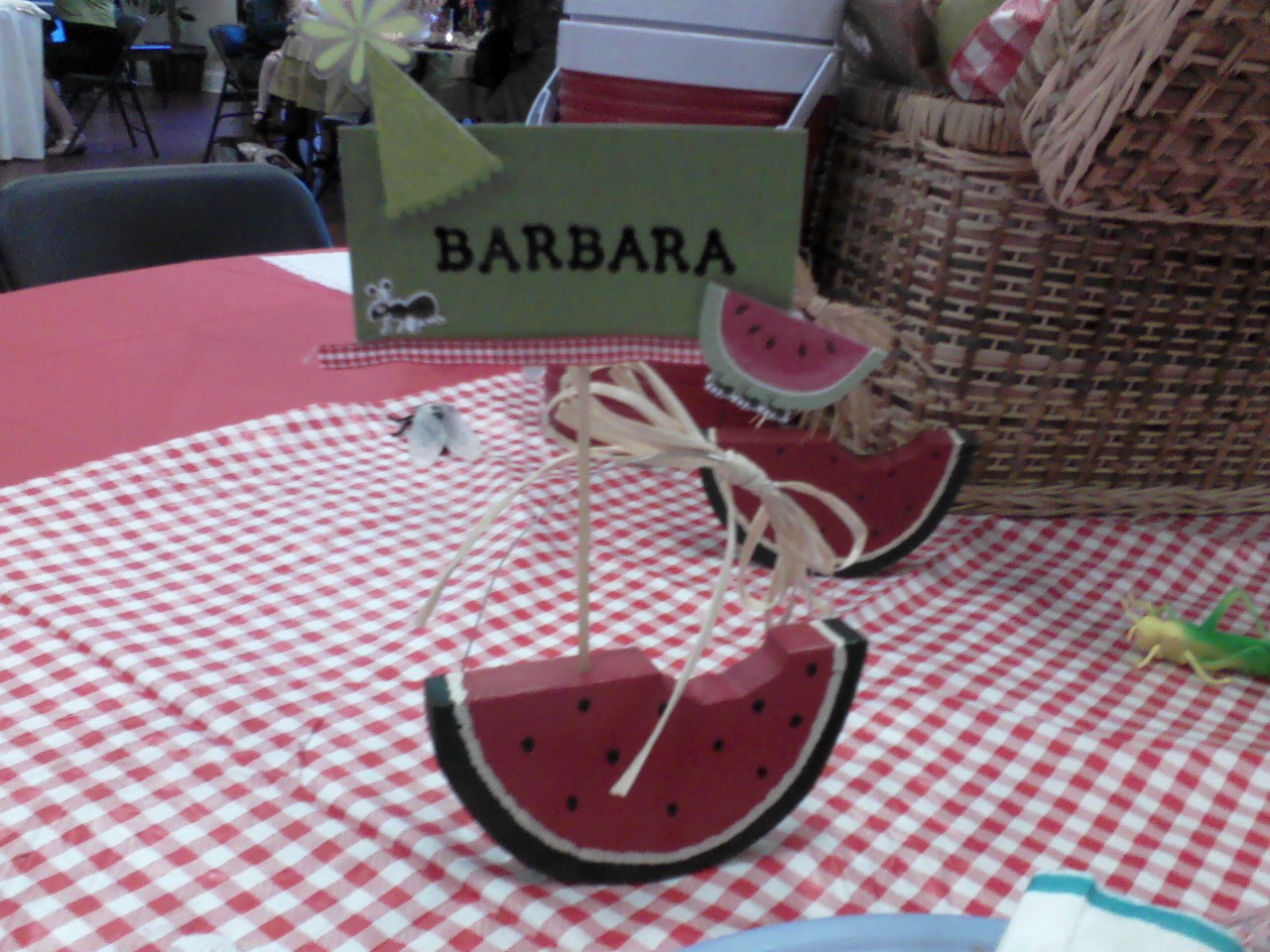
I didn’t think to bring a camera, but took a few shots with my cell phone. Our August table had a picnic theme:

One lady made these super-cute place cards:

I didn’t get a picture of every month — some were still working on their tables when I took pictures. But here is February:

And April:

And November:

So elegant! But I have to say, I was very glad at clean-up time that our table had used paper plates. 🙂

And the winning table was May — I’m sorry this one is so blurry!

Someone made this tree and had birds and fruit in it and verses about fruitfulness.

A very talented lady made cakes that looked like gifts:

We played a few games, sang happy birthday to each other, and then two ladies gave their testimonies of their spiritual birthdays when they came to know the Lord. They were from different backgrounds — one was a “good church kid” who was doing right for the wrong reasons (approval, etc.) but didn’t trust in Christ alone for salvation til her college years. The other was from an atheistic family in another country whose brother was saved, but the family wasn’t interested. But on an internship to the States she met other Christians and was given a Bible ad eventually came to believe. It was such a blessing to hear these two accounts! The whole event was very enjoyable.

2. ISI — which in my son’s youth group stands for Iron Sharpening Iron, what they call their occasional fellowships after Sunday evening services. And every now and then they invite parents. I hate to admit that at first I didn’t want to go — I wanted to go home and kick off my shoes and grab a book and get comfy. 🙂 But I am glad I did go — it was a very enjoyable time of singing, testimonies, and information about a summer mission trip.

3. Safety during the flash flooding we had earlier this week. Thank you, Lord!

4. Signs of spring. A tree outside my mother-in-law’s window is starting to bud, and a yard in the neighborhood has a row of daffodils across the front starting to blossom. The grass is getting greener. These little flowers are the first things I saw blooming at our house:

I don’t know if they’re violets or just weeds — but they brightened up the back yard!

5. This quote from a friend’s Facebook status:

Everything can change in the blink of an eye. But don’t worry; God never blinks.”

Have a great weekend! I’m getting ready for hubby’s birthday on Sunday!

Laudable Linkage

Here’s my weekly round-up of riveting recommendations from ’round the Web. 😀

How to Encourage Missionaries During the Holiday Season.

From It was the best of NaNo; it was the worst of NaNo by Johnnie at Kindred Heart Writers I saw a link to the 100 Best First Lines from Novels as listed by the American Book Review. It was pretty interesting — I wonder how long some of these writers had to work to craft a compelling first sentence. Some of them, though, weren’t so compelling to me. Johnnie notes that eight of them start out with “It was…” — considered a major no-no these days because of its passivity, but to me, if what comes just after “It was…” captures your interest and attention, it’s fine. Most of the “It was..” openers were intensely more interesting than the first line to Robinson Crusoe and a few of the others.

Another on writing from Kindred Heart Writers: Self-Editing Tips from Jerry Jenkins.

I must try Chewy Peanut Butter Brownies, recommended by a friend on Facebook. Sounds right up my ally.

How to transfer an image to fabric with gel medium from How About Orange.

Some fall decorating ideas:

How to make leaf trivets from Martha Stewart

Leaf motifs for table linens from Martha Stewart

Maple leaf coasters by the long thread.

And for Christmas, awesomely cute Festive Felt Christmas Trees from allsorts.

And this was sent to me by my oldest son and made me smile for a long time. You can only use a play like this once, though!

Have a great Saturday! I have some mending and cleaning to do.

The ministry of showers

No, not public cleaning type showers, but the events where honorees are showered with gifts from friends. Brides, moms-to-be, etc.

Is it just my imagination or does attendance seem to be falling off from these?

I know life can be incredibly busy and these things don’t always come at a convenient time, but I have always liked to honor the showeree with my presence as well as my presents as a show of support and a way of ministering to them. Not that I am exalting my presence as an honor, but people just feel more loved and cared for when people actually show up to these things (Have you ever planned a party and worried that no one would show up? Or been dismayed when few people actually did?)

I just recently heard of a baby shower where only three people came besides the young woman’s family. I dropped by another one a few months back for a young woman who had been gradually fading away from church attendance, and only one other lady from the church had come. How likely is that fading to continue when it seemed to her like no one cared? What an opportunity that would have been to show love and support and welcome to her, to show we cared and wanted her fellowship. It’s in these little ministries in people’s personal lives where they feel interested in and cared for, not just during the hand-shaking time at church.

Besides ministering to the honoree, I am ministered to during the devotional time. At most Christian showers, one of the ladies has been asked ahead of time to share something from the Word as an encouragement to the person being honored, whether having to do with marriage or mothering. It almost always helps everyone listening as well as the honoree. At one bridal shower I attended, the hostess, who was a younger wife, commented that it blessed her to see many ladies of every age nodding their heads during the devotional time. The devotional time usually either encourages us in our roles, cheers us on the way, or helps provide course correction.

Sometimes there is an opportunity for guests to share encouragements and advice with the honoree whether by verbal testimony or writing a note on a 4×6 card or some other creative way of sharing. At my baby shower several little notes were gathered that I was instructed to save until I was in labor, and it was nice to go through them. I felt in both marriage and motherhood that I needed all the help I could get! As an attendee I often go a little blank when asked to share something (it’s nice to be forewarned so guests can be thinking about it ahead of time), but almost always the Lord gives me something that I trust will minister to the honoree.

I also love fellowshipping with the other ladies there. If you feel you don’t really know many people at church well, attending this kind of activity can provide opportunities to get to know people better. It’s ironic that sometimes we’re reluctant to go because “I don’t know them very well” when going would help in that department (I know — having just moved to a new area and attending a new church, I’ve wrestled with these conflicting feelings myself).

Personally, I even love the silly little games when they have them. And I get to eat hors d’oeuvres and cake! I especially love brunch showers with all the neat breakfast casseroles and pastries.

Some showers are designated as “Drop-in,” where guests can pop in at any time during the event and stay as long or as short a time as they want to. But even at those showers which are not drop-in, usually the games, devotional, etc. occur at the beginning, and it is perfectly acceptable for someone to drop in during the second half when everyone is just eating fellowshipping, and  watching the honoree open presents if they can’t come for the whole event.

Speaking of opening presents, that reminded me of an article or post I saw somewhere, I can’t remember where, saying that shower honorees should not open gifts at the shower because it is boring for the guests and puts pressure on the honoree to act pleased at every gift when she may not like every gift. But I totally disagree. Most people I know enjoy oohing and aahing over the gifts, and I don’t know many brides or mothers-to-be who have to act like they like gifts they don’t want. If that were the case, I would agree that this is all a big waste of time.

On the other hand, occasionally a gift does not suit for whatever reason, even with the advent of registries for showers (which are an immense help, in my opinion) and it is thoughtful to include a gift receipt with the card. I feel that once I give a gift, it belongs to the other person to do what they want with it and I should not get my feelings hurt if they receive three toasters and return mine. I don’t always remember to do this, but sometimes I specifically pray for guidance as I buy a gift, to avoid wasted time and frustration and inconvenience.

My purpose in pouring out my heart on this topic is not to heap guilt on people whose lives are already piled up with a number of obligations. We all have days or even seasons of life like that when we cannot add even one more thing. But if you can possibly go, I encourage you to. It really is a blessing to the honoree and her family and the hostess. To me it is an expression of hospitality even if the event is not in your home: a hospitality of open-heartedness and welcome of other people and their cares and concerns.

In case he needs my prayers

I saw this at my friend, Emily‘s. I don’t know who the author is. I’ve read so many missionary stories in which someone felt led to pray for someone else and did so, only to find out later that was a time of unusual need. I try to pray for a need as soon as I hear about it, but I need to follow those unexpected thoughts about others with prayers, as well.

I can not tell why there should come to me
A thought of someone miles and years away,
In swift insistence on the memory,
Unless there is a need that I should pray.
We are too busy to spare thought
For days together of some friends away;
Perhaps God does it for us — and we ought
To read His signal as a sign to pray.
Perhaps just then my friend has fiercer fight,
A more appalling weakness, a decay
Of courage, darkness, some lost sense of right;
And so, in case he needs my prayers — I pray.

Laudable Linkage and Neat Photo

Just a few to share this week:

Do Your One Small Thing by Lisa Notes, about little things that minister to people.

Friendly Thorns by Chris Anderson, about how God can use a “thorn in the flesh” (II Corinthians 12:7-10).

I’ve been following Wrestling With an Angel for some time, a raw, honest, deep, thoughtful account of a father whose son is autistic, and I was glad to see that Tim Challies convinced the author to write a book.

I’ve mentioned before that my blog is more like visiting neighbors over the fence than a business, but 5 Minutes For Mom shares some good thoughts about When and What a Blogger Should Charge For Their Services for those considering that. Many of us get a slew of requests for free publicity, and this is a good guideline if you don’t want to be used in that way.

I think I may have shared this here before, but I came across it again recently, and I like it:

And this is really cool:

funny pictures of cats with captions
see more Lolcats and funny pictures

Have a great Saturday! I’m off to bake Jesse’s birthday cake.

Laudable Linkage

I saw some great things around the Internet the last couple of weeks. Let me know if you find any of them useful!

Supernatural Love at Femina. We all need it. This is a great delineation of what it looks like, how to apply I Cor. 13 in everyday life. It’s geared toward moms, but of course the chapter and many of the principles listed could be applied in multitudes of ways.

Strength For a Weary Mom at girltalk.

Defining Success as a Parent at The M.O.B. Society. I love this site! I wish there had been something like it when my guys were small.

Confession Is Not Propitiatory at My Two Cents. It’s not how hard we confess that appropriates our forgiveness. Amen.

Thinking About Immigration Missiologically at MissioMishmash.

Davis Bunn and Writer’s Conferences. Maybe some day…

And on the crafty front:

Gifts Bags From Newspapers.

And a neat idea for storing fabric (HT to Lizzie).

And a couple of funnies from icanhascheezburger.

funny pictures of cats with captions
see more Lolcats and funny pictures

funny pictures of cats with captions
see more Lolcats and funny pictures

Have a great Saturday!

A fond farewell from the ladies’ group

Monday night was my last night with our ladies’ group here at church before our move. I was pretty emotional right beforehand, but the Lord gave grace during the evening to handle it all well. I was really, really hoping not to cry in front of people. I know this will sound silly and vain, but one time when I was crying when I was little, I caught sight of myself in a mirror and was shocked. It wasn’t pretty. 🙂 Not that I am obsessed with being pretty, but it wasn’t the elegant crying you see on TV, the quiet dabbing at the corner of the eye with one’s handkerchief. It was red, screwed-up face, runny nose, blubbering, snorting, and gasping. And from that moment on I hoped to never cry in front of others. Even with that, the Lord gave grace to just not worry about it, that we’d just deal with whatever happened — but I am really glad He helped me not to cry. 🙂

OK, enough silliness about crying..

The ladies were incredibly generous to me. They gave me an arrangement of beautiful pink-edged roses…

And a copy of one of my favorite hymns done in calligraphy in different shades of pink by one of the ladies:

They also gave me a gift card from Michael’s to help decorate our new home and gift cards to Outback for an outing with the family. I joked with them that I should leave more often since it is so rewarding. 🙂 But probably the most treasured gift is a little booklet done in the style of the ladies’ booklet I have done for almost ten years with notes to me from several of the ladies as well as many of our missionaries and some scattered quotes and poems.

I was blessed reading over that Monday night when I got home and I know I will enjoy going over it again and again. It was gratifying to know that some of the goals I had for the group had been accomplished and a blessing to see that the Lord had used the ladies’ ministry in many ways.

I have to confess at first that I was incredibly nervous about being honored in front of people. I am often terribly self-conscious in groups, even to the point of not being able to raise my hand to answer a question, so the thought of having everyone’s attention directed toward me in that way was uncomfortable, to say the least. And then the thought of having what I do highlighted nearly sent me into a panic attck. It’s funny, if someone compliments my cooking or decorating, and I can just say “thank you” and move on, but if someone compliments something I do in the way of ministry, I had this strange idea that that was taking away from the Lord receiving glory for it, especially if I took pleasure in being complimented for it. I wrestled with that in one of my earliest posts here. But over the last week, the Lord helped me come to terms with that enough to be able face the evening graciously. I was going to devote a whole post to thinking through all of that, but there just hasn’t been time to write it out. But one thing that helped was this quote from C. S. Lewis in Mere Christianity:

Pleasure in being praised is not Pride. The child who is patted on the back for doing a lesson well, the woman whose beauty is praised by her lover, the saved soul to whom Christ says, “Well done,” are all pleased and ought to be. For here the pleasure lies not in what you are but in the fact that you have pleased someone you wanted (and rightly wanted) to please. The trouble begins when you pass from thinking, “I have pleased him; all is well,” to thinking, “What a fine person I must be to have done it.”

Then I wrote to my good friend Susan for some help in gaining the right perspective, and she encouraged me to just graciously accept it as an expression of love and the ladies desire to be a blessing to me.

I also remembered something a former pastor’s wife shared in an officer’s meeting for a ladies’ group — she was emphasizing the need to speak up when giving reports to the group, because it wasn’t doing anyone any good to stand up in front of people to say something if no one could hear you, and she made the statement that self-consciousness is consciousness of self, and we’re supposed to forget self (let me just say, lest anyone take that the wrong way out of context, she wasn’t talking about forgetting self to the point of becoming a doormat and never having a will or desires of your own, but she was making the point that self-consciousness is fed by too much focus on self.)

Then Monday morning, several of the verses from Daily Light spoke of not being afraid or dismayed, because the Lord was with me, and even though those verses were talking about vastly different circumstances, they were a help.

There is a balance between doing things “Not with eyeservice, as menpleasers; but as the servants of Christ, doing the will of God from the heart; With good will doing service, as to the Lord, and not to men” (Ephesians 6:6-7) and “[Letting] your light so shine before men, that they may see your good works, and glorify your Father which is in heaven” (Matthew 5:16). I hope I was able to justly point the glory for any good accomplished to the Lord. I tried to share I Peter 4: 10-11: “As every man hath received the gift, even so minister the same one to another, as good stewards of the manifold grace of God. If any man speak, let him speak as the oracles of God; if any man minister, let him do it as of the ability which God giveth: that God in all things may be glorified through Jesus Christ, to whom be praise and dominion for ever and ever. Amen.” both as a means of showing that anything I did was “as of the ability which God giveth” and to encourage whoever takes up the ladies’ ministry next that He will enable them, as well. I am blessed to know that God can use me in spite of my faults and flaws.

I want to write up some of the things involved with the ladies’ ministry for the next person — not that they have to do everything the way I did it, but just so they have some idea of what’s going on and why — but other than that, I am pretty much done with my responsibilities there. In some ways it is an incredible relief; in other ways I am missing it already. I know the Lord will have ministry for us in a new church, but my mind is also buzzing with ideas about some other writing possibilities and a web site for ladies’ ministry that I have been thinking about setting up. So, we’ll see how the Lord leads some time after the dust settles from moving!