Three Shall Be One

Francena Arnold was one of the first—if not the first—writers of Christian fiction. Her first book, Not My Will, was published in 1946 and became a classic. I read it at least twice and its sequel once. I wasn’t aware (or had forgotten) she had written other books until I saw her Three Shall Be One on a Kindle sale.

In this story, Linda and Tony are a young couple with two little ones. They don’t have much, but they’re happy—at least until Tony’s controlling mother comes for an extended visit and moves them into a nice place with better furniture.

Linda is furious, not only at her mother-in-law, but at her husband for not standing up to her. But Tony has learned through long years of experience that he never wins with his mother, and it’s easiest just to let her have her way.

Linda learns to be quiet for the most part when her mother-in-law is there, despite constant criticism. Occasionally Linda will let slip a sarcastic remark, exasperating Tony.

When Tony’s mother leaves, he and Linda have it out. Tony had thought couples argued when they no longer loved each other, and he is “troubled by the realization that ugly quarrels could come even when they loved.” But after a day apart, they regret their harsh words and make up.

Both Tony and Linda had rejected religion of any kind as a sign of weakness.

Life goes on much the same—until the next mother-in-law visit. An incident then sets off a chain of events none of them could have anticipated.

There are a couple of implausible plot twists in the book that take away from the story, but I can’t go into them here without revealing too much. And this book suffers from the same problem a lot of early Christian fiction had: the main character(s) come to a crisis which leads to their salvation, and then all their problems are solved. Of course, problems don’t go away when we become Christians, though at that point we do have His grace and help and wisdom for them.

If you can look past those issues, though, the book is a sweet, old-fashioned story. I liked that the book didn’t end with Linda’s salvation and showed some of her growth afterward. Also, Linda’s friends’ care for her was a great example. The author shows good understanding of the psychological factors involved in the couple’s troubles.

I looked at Amazon to see what other books they had by Francena Arnold. The Kindle versions of some of them are 99 cents as of this writing, including this title. I’m glad to see someone made them available for the Kindle app, though they are still available in paperback as well.

Have you read Francena Arnold? What did you think of her books?

(Sharing with Carole’s Books You Loved)

Remembering How God Has Led

I don’t know what triggered my trip down memory lane. I sat with my Daily Light open but unread, and began to pray for God to open my understanding and speak to my heart from His Word.

I thought back with wonder of the many different paths my life could have taken. Several events led to my salvation. What if one of them hadn’t happened?

There were different temptations, some of which I regret failing. I could have been done in by any of them.

My life could have followed any number of paths, not just theoretically, but due to influences at the time. I could have become an alcoholic. I had planned to get married right out of high school, not realizing I would be marrying the wrong person. I not only would have missed meeting my wonderful husband, but I would not have experienced all I learned both intellectually and spiritually at a Christian college.

I could have fallen for a television evangelist’s false doctrine (I actually called the number on the screen once). People are so vulnerable just before and after salvation, when their interest in the Lord is aroused but they have no discernment yet.

In 8th or 9th grade, we moved to a new town. The school I attended was the most cliquish place I had ever been. Well-defined groups didn’t allow for new members. My mom had to plead and almost push me out of the car at school in the mornings. I spent many lunch breaks walking around the grounds by myself in tears. Finally I became friends with another girl who was also, for some unknown reason, outside the school’s social circles. I discovered years later that it was the Lord’s mercy that kept me from getting involved with the popular crowd, as they were into a lot of unhealthy activities. What if I had gotten in with them? I probably would have gotten into some kind of trouble and possibly would have become proud and condescending.

Between my sophomore and junior year, my mother left my father and took my siblings and me to Houston. The break had been coming for years, but it still hurt when it finally happened. We moved from a very small town of less than 200 to the teeming metropolis of Houston. The culture shock was very real. In those days before the Internet, I had little contact with my friends from school. I had no opportunity to make new friends since school wouldn’t start for months yet. It was the loneliest time in my life. I remember lying on my bed clinging desperately to Romans 8:28: “And we know that for those who love God all things work together for good, for those who are called according to his purpose.” Looking back, I didn’t know fully what that verse meant. But I knew that, to the degree I knew how, I loved God, and I trusted Him to work things out for good. Though that was one of the lowest points in my life, it was also pivotal. It was through this move that God provided miraculously for me to go to a Christian school for two years, led me to a good church, helped me make sure of my salvation, and let me know about a Christian college.

Somehow God led me all the way.

My heart was tender thinking back over God’s working in my life. As I opened my Bible reading for the day, I came to Deuteronomy 8:2: “And you shall remember the whole way that the Lord your God has led you these forty years in the wilderness.” It’s amazing how God prepares me for what I am going to encounter in His Word. I thought my mental wanderings about my past were just daydreams and rabbit trails, but here He had led me to do just what the Scripture said.

Several times in Deuteronomy 8, Moses urged the Israelites to remember the Lord and not forget Him. Peter wanted “to stir you up by way of reminder” (2 Peter 1:13; 3:1). Jesus told the Ephesian church, “But I have this against you, that you have abandoned the love you had at first. Remember therefore from where you have fallen; repent, and do the works you did at first” (Revelation 2:4). As God called Israel, back to Himself, He said, “I remember the devotion of your youth, your love as a bride, how you followed me in the wilderness, in a land not sown” (Jeremiah 2:2).

This is what I most want my children, grandchildren, readers, and anyone with whom I have any influence to know, to remember: that Christianity is not just a culture, not just a set of doctrines, not just what we do and don’t do. It is the basis of all of those. But first of all it’s that personal relationship with the Lord.

Do you have that? Have there been times in your life you knew God was at work in you, drawing you to Himself? Do you have warm and tender moments where He met with you personally?

If you professed faith as a young child, you may not remember a definite “before” and “after” to your life of faith. But you can be grateful for God’s preventative work in your life and the scars and bad memories He kept you from. As you’ve walked with the Lord, I am sure you’ve found that the “big sins” are not always the dramatic ones that everyone sees. Inner wrestlings with pride and self-will are just as deadly. You’ve discovered that it takes as much of God’s grace to battle those as it does to defeat addiction. You’ve probably experienced times when God answered prayer or something in His Word met your need of the moment. It’s not the drama of one’s initial testimony that determines what kind of Christian life we have: it’s simple faith, not in our faith, but in Jesus Christ as Lord and Savior.

Nothing stirs up our love and gratitude towards the Lord like remembering how He saved us and led us. It’s a blessing to sometimes review the “Ebenezers,” those special times of help that we’ve experienced along the way. Then we can say along with the psalmist:

My soul will be satisfied as with fat and rich food,
    and my mouth will praise you with joyful lips,
 when I remember you upon my bed,
    and meditate on you in the watches of the night;
 for you have been my help,
    and in the shadow of your wings I will sing for joy.
 My soul clings to you;
    your right hand upholds me.
Psalm 63:5-8

(I often link up with some of these bloggers)

Laudable Linkage

A collection of good reading online

I found lots of good online reading this week:

What’s Next? 8 Questions to Get You Ready to Roll. Evaluating and preparing for post-pandemic life.

I came across two good posts about praying for lost loved ones: A Prayer for When They Don’t Believe and A Parent’s Prayer for an Unbelieving Child.

Coping with Publishing Conflict. Though written in the context of publishing, the advice is good for any area of conflict.

10 Ways God Desires to Set Apart His People. “The purpose in being set apart is to be set to something else. Biblically speaking, something else is desiring what God desires for us. It means desiring someone else—God. And not desiring the things of this world more.”

Stretching Application Beyond the Big Three. “It is good to be reminded to read the Bible, pray, and talk to our friends about Jesus, but that doesn’t mean these are the only applications we should draw from Scriptural truths.” Ryan provides some helpful tips and a worksheet for getting to the heart of a passage’s applications.

Who Will Roll the Stone Away? Good take-aways from the women who went to anoint Christ’s body that first Resurrection morning.

What Does Binding and Loosing Mean in Matthew 16:19? HT to Knowable Word. Probably the clearest explanation of this verse I can recall reading.

With Independence Day last weekend, there were some good posts about patriotism. Since patriotism isn’t just for the 4th of July, though, I’m including them now:

Why Younger Evangelicals May Feel Uneasy in a Patriotic Church Service. A good, balanced article about some of the positives and some of the problems of a patriotic church service.

How Can an Ordinary Citizen Begin to Practice a Radical Patriotism? “Viewing a flawed nation led by deeply flawed individuals, G.K. Chesterton asked:  ‘Can we hate it enough to change it, and yet love it enough to think it worth changing?'”

If you need a dose of cuteness, try this:

Happy Saturday

Friday’s Fave Five

It’s Friday, time to look back over the blessings of the week
with Susanne at Living to Tell the Story and other friends.

It’s the first full week of July, and summer has settled in. Here are some of the best parts of the last week.

1. A long weekend. Everyone had Monday off, but Jim took Thursday and Friday off as well. He worked on some things he had wanted to, but spent the better part of Saturday fishing, something he hadn’t done in a long time.

2. Donuts. There’s a new independent donut shop nearby we stopped at, but they were closed. We heard they usually sell out before noon. Jim went back Saturday morning and got some donuts and fritters. Those things were huge, but so good. They were too big to eat a whole donut in one sitting, so we cut pieces off the next few days.

3. Independence Day. Though our country has serious problems, I still believe it’s the best place in the world to live. I’m thankful for the freedoms we enjoy. We celebrated the 4th all together after church on Sunday. One nice thing about celebrating with adult children is divvying up the meal. Jim grilled burgers and sausage, I made French fries, Jesse made a cheesy hash brown casserole and shucked corn on the cob for me. Mittu made a wonderful cheesecake. Jason and Mittu found the festive paper products to make clean-up easier.

Favorite picture of the day:

4. Fireworks are illegal in our county—but the law doesn’t seem to be enforced unless something gets out of hand. From our yard, we saw several large displays of fireworks from at least six different places. Jason caught this photo of one, but we saw many fuller and higher than this one. It was fun to see fireworks without leaving the yard.

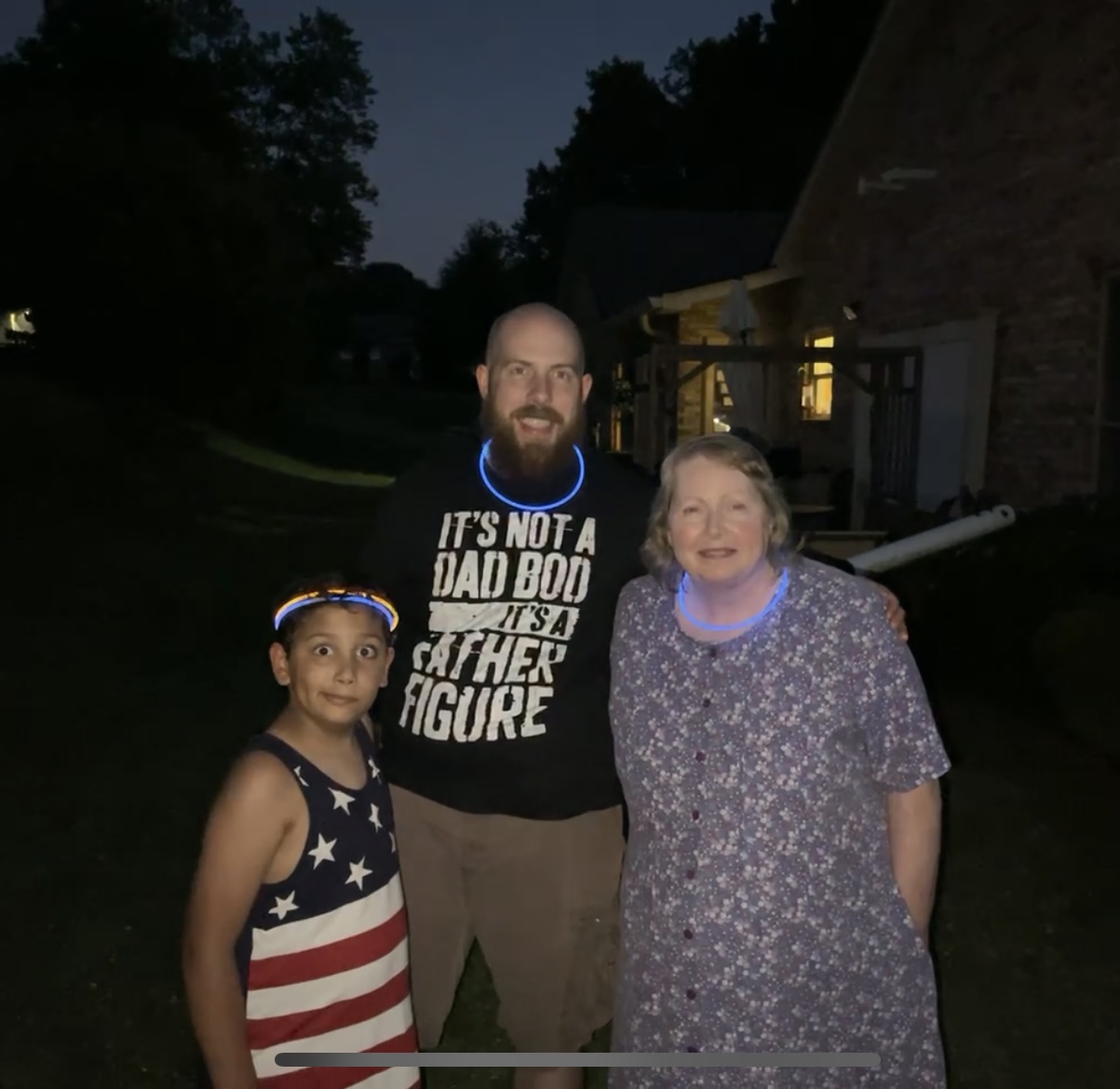
We didn’t have fireworks, but Jason and Mittu brought over glowsticks, pop-its (these little things that make a popping sound when you throw them on the ground), and these other devices that have strings you pull on, and they release confetti.

5. Family meal at a restaurant. Jason and Mittu invited us over Monday afternoon, and talk turned to going somewhere for dinner. We ended up going to one of my favorite restaurants on a river. And I didn’t even ask—Jim suggested it. 🙂 We called to see if Jesse wanted to meet us there. It was the first time we had eaten all together in a restaurant since before the pandemic.

All in all, a good week. I hope yours was as well!

Heaven Sent Rain

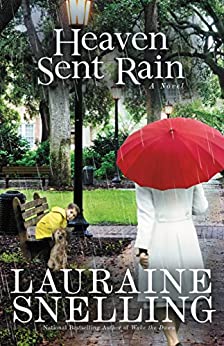
In the novel Heaven Sent Rain by Lauraine Snelling, Dinah Taylor is a scientist who started her own company of food supplements to improve health. Her job, her life, her all-white condo and wardrobe are perfectly ordered.

One day at her usual breakfast stop, she sees a small boy and his dog sitting out in front. They look shabby, but not dirty. Dinah offers to buy the boy, Jonah, breakfast, and he accepts. Then he’s at the same place the next day, and then every day thereafter. Dinah tries to find out his background, imagining everything from a drug-infested home to neglect. But Jonah evades her questions.

Then in the middle of one night, Dinah receives a frantic phone call. Jonah’s dog is badly injured. Can she help?

Dinah isn’t sure what she’s getting into, but she can’t refuse. Searching for an emergency vet clinic open that time of night, she takes Jonah and his dog in. They are met by veterinarian Garret Miller, who seems warm and kind toward Jonah and the dog, but icy toward Dinah.

As Dinah continues to help Jonah, she gets in over her head. As she, Jonah, and Garret interact, their lives change.

Most of the other books I’ve read by Lauraine were historical fiction about Norwegian immigrants. I didn’t think I had read any of her contemporary fiction, but then remembered I had read Someday Home a couple of years ago.

I loved the way Dinah’s story unfolded, with the author revealing just a bit at a time until the whole picture came into view. Garret is an enjoyable character, too, after getting past his initial standoffishness, which is explained later.

Dinah is not a Christian, having rejected her parents’ teaching and beliefs. The details of that situation are gradually revealed, too. Garret and Jonah are both believers, as is Dinah’s receptionist. But the faith element felt very natural and not forced.

I thought the ending wrapped up a bit too quickly, and I had a theological quibble with one sentence. But overall I really enjoyed the book.

(Sharing with Carole’s Books You Loved)

14 Reasons to Read the Old Testament

It’s safe to say most of us gravitate to the New Testament of the Bible. We enjoy the Old Testament stories, the practical wisdom of Proverbs, the emotional depth of the Psalms.

But Jesus fulfilled all the OT ceremonial law and the sacrificial requirements, so we’re not under obligation to practice those any more. And all that past history is . . .well. . . .past. The NT seems more practical.

So why bother to read the OT?

Well, there are several good reasons.

1. The whole Bible is inspired by God (2 Timothy 3:16). One of our former pastors used to say the Bible is divinely brief. Think of all the things an eternal God knows and could tell us. He chose the particular words in the Bible for specific reasons.

2. The whole Bible is beneficial. 2 Timothy goes on to say all Scripture is “beneficial for teaching, for rebuke, for correction, for training in righteousness; so that the man or woman of God may be fully capable, equipped for every good work” (3:16b-17, NASB).

3. The OT provides examples for us. “Now these things happened to them as an example, and they were written for our instruction, upon whom the ends of the ages have come” (1 Corinthians 10:11, NASB). The context of these verses talks about various things OT Israel did wrong. Then the passage warns the reader, “Therefore let the one who thinks he stands watch out that he does not fall” (verse 12).

4. The OT helps us appreciate what we have in Christ. Our  church recently studied Leviticus.

The tabernacle and temple system emphasized the distance between us and God. Only the priests could enter and only with the right sacrifices conducted the right way. When Jesus died, the veil of the temple was supernaturally torn in two, indicating the way to God was now open.

Hebrews 10:19-20 tells us, “We have confidence to enter the holy place by the blood of Jesus, by a new and living way which He inaugurated for us through the veil, that is, through His flesh.” Because He made a way for us and is our high priest, we’re encouraged to

  • approach God with a sincere heart in full assurance of faith
  • hold firmly to the confession of our hope without wavering
  • consider how to encourage one another in love and good deeds (verses 21-25).

5. The OT emphasizes holiness. A seminary professor taught a class on Leviticus. He asked his students to try to keep the regulations in Leviticus for a week and journal about the experience. One replied that the assignment had him evaluating everything in his life related to holiness all the time. The NT requires holiness, too. But we don’t often examine every area of our lives to see whether we measure up to God’s holy standards as they were required to in the OT. We’re free from the strictures of the OT ceremonial law, but we still need to submit our conscience and practice to God’s Holy Spirit.

6. The NT quotes or alludes to the OT over 880 times. The NT would not make sense without the OT foundation. [1]

7. Jesus quoted and believed in the Old Testament. Jesus told the Jews who opposed Him, “You search the Scriptures because you think that in them you have eternal life; and it is they that bear witness about me” (John 5:39, ESV). The Scriptures He referred to were the Old Testament writings. Many times He said, “Have you not read…?” and quoted something from the Old Testament, meaning that He expected them to know what it taught.

After His resurrection, when He walked along with two disciples on the road to Emmaus, “beginning with Moses and all the Prophets, he interpreted to them in all the Scriptures the things concerning himself” (Luke 24:27, ESV).

8. The OT instructs us and gives us hope. Paul tells us in Romans 15:4: “For whatever was written in earlier times was written for our instruction, so that through perseverance and the encouragement of the Scriptures we might have hope.” When we realize we are not that different from the complaining, disbelieving Israelites in the wilderness, we have hope that God will be faithful and longsuffering with us as He was with them. When we read of God helping His people through various trials and troubles in the Bible, we’re encouraged that He will take care of us as well.

9. The OT and NT tell us about the same God. Some have felt that the OT presents an angry, vengeful God while the NT shows us a merciful, loving God. But they are one and the same. God shows His grace and mercy and love to His people many times in the OT, even when they behaved the worst. And many places in the NT warn of God’s wrath against sin.

10. The Old Testament shows us our need and prepares us for the only One who can meet it. The laws and sacrificial system showed Israel the impossibility of keeping God’s law and the need for a Savior. The law was our “schoolmaster” to bring us to Christ (Galatians 3:24, KJV). The sinless lamb of the sacrifices points to the Lamb of God, the ultimate sacrifice for our sins. The OT sacrifices had to be repeated, but Jesus’s offering took care of our sins forever (Hebrews 10:14).

11. The Old Testament points to Christ, from the representation of the scapegoat, to the atonement, to Messianic prophecies. A former pastor, Dr. Mark Minnick, used to say that the Old Testament showed Israel’s need for a judge, a prophet, and a king. But even the best judges, prophets, and kings fell short. Jesus fulfills all those offices perfectly.

12. The Old Testament is part of our spiritual heritage. Romans 11:11-31 tells us we were grafted into the olive tree of the Jews.  The true Israel is by faith, not just lineage. Galatians 3:29 and Romans 9:6-8 say that those in Christ are children of Abraham:

Abraham “believed God, and it was accounted to him for righteousness.” Therefore know that only those who are of faith are sons of Abraham. And the Scripture, foreseeing that God would justify the Gentiles by faith, preached the gospel to Abraham beforehand, saying, “In you all the nations shall be blessed.” So then those who are of faith are blessed with believing Abraham (Galatians 3:6-9, NKJV).

13. The Old and New Testaments form a whole, with each part of the same overarching story. L. E. Maxwell, cofounder and eventual president of the Prairie Bible Institute, said in his book Crowded to Christ, “The New Testament is enfolded in the Old, and the Old Testament is unfolded in the New.” [2]

14. There are treasures in the OT. If you skipped the OT, you’d miss some of the greatest treasures of the Bible, like these:

Zephaniah 3:17: The Lord your God is in your midst, a mighty one who will save;
he will rejoice over you with gladness; he will quiet you by his love; he will exult over you with loud singing.

Isaiah 30:15a: For thus said the Lord God, the Holy One of Israel, “In returning and rest you shall be saved; in quietness and in trust shall be your strength.”

If the OT seemed dry or hard to understand in the past, a good study Bible helps. You can find a variety of sizes and types of commentaries and other study aids. This past year I have used Warren Wiersbe’s “Be” commentaries on different books of the Bible. They often show up on Kindle sales. They’re detailed enough to give insights, yet simple enough to understand.

If you’ve been avoiding the OT, I encourage you to read and study  it. You’ll find rich, meaningful treasure there.


[1] “O.T. Quotations Found in the N.T. – Study Resources.” Blue Letter Bible. Web. 15 Jun, 2021. <https://www.blueletterbible.org/study/pnt/pnt08.cfm&gt;.

[2] L. E. Maxwell, Crowded to Christ (Grand Rapids, MI: Eerdmans, 1950), p. 272.

Unless otherwise stated, all Bible verses are from the ESV.

(I often link up with some of these bloggers)

Laudable Linkage

IMG_0195

Here are some of the noteworthy reads discovered recently:

Why Do You Want to Be Happy? HT to Challies. “Sadly, Christ-followers routinely say things like, ‘God doesn’t want you to be happy; he wants you to be holy.’ But holiness and happiness are two sides of the same coin — we dare not pit them against each other.” Yes!

My Life as a Christian Under a Communist Regime, HT to Challies. “It may surprise you, but from my perspective the main suffering for Chinese Christians is not physical persecution or lack of religious liberty but bad theology, though the reason behind bad theology is the lack of freedom.”

The Ordinary War with Irritability, HT to Challies. “If your consistent response to testing circumstances or challenging people is to become annoyed or angry, then you are irritable. But I have good news for you. Because of Jesus, believers can have godly attitudes even when our patience is tried, and we don’t have to make self-justifying excuses when we don’t. We can confess our failure as sin, knowing Jesus forgives.”

The Unbelief in My Belief, HT to Challies. “I’ve thought about both of my seat companions several times since then and wondered why the words stick in my throat when there’s nothing more important to share than my hope in Christ. . . . But unbelief stood in my way. Not theirs, but mine.”

7 Ways Not to Provoke Your Children, HT to Challies. “Parents, trust in him alone for strength to make it through this journey without provoking your children. Keep praying that he will give you the grace required to raise godly children.”

Are Christian Parents Too Protective of Their Children? HT to Challies. We may be tempted to place our children inside a sanitized theological bubble, safe from all forms of intellectual contamination. But, just like germ-conscious parents, this may not be accomplishing what we think.”

Why Long Lines Are Good for Writers and Everyone Else. “I used to feel, when I first met someone, like I had to perform. Like being a contestant on American Idol, I was expected to entertain them, and they would then judge me. And I would be sure to fail again.”

I’ve only been in Costco once that I remember, so I guess I am in the first stage. 🙂

I hope you have a happy Independence Day weekend, for those here in the USA! Here are some Ideas for Celebrating July 4th, if you need any, HT to The Story Warren.

Friday’s Fave Five

It’s Friday, time to look back over the blessings of the week
with Susanne at Living to Tell the Story and other friends.

The first FFF of July! Here are some highlights of the week:

1. Retirement home ministry. Our church does this once a month—the place we visit rotates groups who hold services on Sunday afternoons. The people seem very attentive, and we all hang around and visit with them for a good while afterward. The lady we spent time with the first week looks for us now each week and even gave me a hug.

2. Impromptu lunch get-together. There wasn’t enough time to go home after church and come back for the retirement home service, so we stopped for lunch at McAlister’s Deli. There we ran into our pastor and his family, who were doing the same thing. We sat at adjacent tables and enjoyed the fellowship while we ate.

3. More time off from cooking. I mentioned last week that I hadn’t done any real cooking while Jim was out of town. Then my son and daughter-in-law invited us over both Friday and Saturday night. Then we went out for the lunch mentioned above on Sunday. That’s the first time in my adult life I’ve had a whole week off from cooking! Even though I could get used to that pretty easily, I did miss the things I make and missed having leftovers to reheat for lunch. So I was more or less ready to get back at it Monday.

4. A remade desk. I wish I had thought to take a “before” picture. An old one which shows a bit of the desk is here:

Old desk in old sewing room

More than anything else, I wanted to change out the old Colonial-style knobs and handles. But I wanted to lighten it up, too. I decided to keep the top stained–I figured that way we wouldn’t have to worry about paint chipping there. But Jim painted the rest of it white for me.

Desk makeover

I was originally thinking about glass knobs, but when I saw these vintage-looking ones, I loved them.

5. An uneventful cardiologist visit. I almost could have just phoned it in except for his needing to listen to my heart and run a EKG. Even though I’d just had an episode of afib last week, we pretty much just discussed increasing medicine if it happened again.

How was your week?

The Book Woman of Troublesome Creek

In Kim Michele Richardson’s novel, The Book Woman of Troublesome Creek, Cussy Mary Carter was one of the Pack Horse Librarians. A Works Progress Administration (WPA) initiative by FDR during the Depression employed librarians to bring books to people in the Appalachian mountains. Books were donated, and the Pack Horse Librarians sorted, distributed them, and made scrapbooks for residents which included recipes and tips. The librarians, mostly women, rode hundreds of miles.

Many of the residents were eager for books and magazines. Some were suspicious.

Cussy Mary had to fight more than the usual amount of suspicion and superstition because she was colored: blue.

A family line in Kentucky produced people with a blue tint to their skin due to a recessive gene, though the cause wasn’t known at the time. Some people treated the “blues” like anyone else, but negative reactions ranged from a desire to keep a distance to fear of disease to superstitions to hatred. “Blues” were included in “No coloreds allowed” signs and laws.

Kim Michele Richardson ties together the blue people of Kentucky and the Pack Horse Librarian initiative to create unusual and interesting historical fiction.

The story begins with Cussy Mary’s father trying to arrange courtship for her, though she doesn’t want to be married. He has worked in the mines all his life, and his lungs are affected. He wants to make sure Mary is provided for before he dies. But no one is interested until he offers the deed to his land. A disastrous wedding night leaves Mary a widow.

We follow along with Mary on her travels, meet her patrons, hear their stories, see her interactions with townspeople, encounter the dangers on the trail.

The town doctor has always wanted to take blood samples and study Mary and her father, but they’ve resisted—until the father has a secret he needs the doctor to keep. The only way the doctor will agree is if Mary’s dad will let him take her to the hospital in Lexington for tests. Against Mary’s will, she’s subjected to all kinds of indignities. When the doctor finds a temporary “cure” for Mary’s blue skin, she enjoys being white at first. But the side effects and the lack of change in how people treat her leave her wondering if the change is worth it. The author says in her notes that the study and treatment she described didn’t actually occur until about thirty years later.

Mary’s courage and determination shine throughout. She remembered being read to by her mother, who passed away. That hunger for learning stayed with Mary, and she wants to help those with the same hunger.

I first became aware of this book through reviews by Susan and Susanne.

There is a smattering of bad words, and Mary’s wedding night is told with more detail than I’d like.

But otherwise, this was a fascinating story.

I listened to the audiobook, which I was pleased to get for free–it was included with either my Audible subscription or Amazon Prime, I forget which. Katie Schorr did a wonderful job with the narration. I checked out the book from the library to read back matter not included with the audiobook, including a nice interview with the author.

Had you heard of blue people or the Pack Horse Librarians? Would you be willing to brave mountainous trails in the back woods on a mule to get books to people?

June Reflections

Even though we’ve only officially been in summer ten days, I think of the whole month of June as summer. We spent more time outside over spring, but it’s getting too hot and humid to be outside much until evening.

Family

Around the house, Jim painted the “guest room” (or spare oom) and a desk and put some shelves and decorations on the walls of the sewing room for me. I finally dug up an aggressive ivy from the front planters and planted a bunch of flowers that are flourishing nicely thanks to my husband remembering to water them. I’ve done some pockets of reorganization—I tend to do just a shelf or corner or box at a time.

Our two main celebrations were Timothy’s finishing first grade and Father’s Day. Everyone helped to bring over the queen-sized bed Jason and Mittu gave us and set it up in our new official guest room, then Mittu made dinner for us all. I had searched for bedspreads and placed the one I liked on Amazon’s wishlist. But when I went to order it, it was “currently unavailable,” and they had no idea when or if they might get more. So I had to start from scratch. The bed is bigger than I was thinking. I realized the futon we had in there before was a full size and therefore smaller. So I don’t think I’ll be able to get an extra chair in there like I wanted. But that’s okay.

Timothyisms

Timothy asked his parents when the next paycheck was coming. When they asked why, he said he was making a list of toys for the next paycheck.

Creating

I didn’t make a Father’s Day card for Jim this year. When I searched for ideas, I found an already-made card that was just perfect, so I got that instead of making one.

The card I made for my step-father draws on his love for a certain sci-fi franchise:

I found a Star Trek font online and then found a template for the badge and colored it in with a gold paint pen.

This was for Jason:

Reading

Since last time, I finished (titles link to my reviews):

  • The Sign Painter by Davis Bunn. A young mom fallen on hard times finally gets a job and a place to stay. But a situation in her place of employment puts her in a dangerous moral dilemma. Meanwhile, a former cop tries to help a church deal with a drug house nearby.
  • Saving Alice by David Lewis. A young man’s first love is killed in an accident. He eventually marries their mutual friend and has a comfortable life, until he has a falling out with his daughter. Trying to reconcile with his daughter brings a lot of things to light in his life.
  • The Orchard House by Heidi Chiavaroli. A time slip novel. One plot line involves Louisa May Alcott and a close friend. The modern story tells of an adopted girl betrayed by her sister who reconciles over the mystery some poems by a friend of Louisa’s discovered in Louisa’s old house.
  • Be Counted (Numbers): Living a Life That Counts for God by Warren Wiersbe. Commentary on Numbers.
  • Be Diligent (Mark): Serving Others as you Walk with the Master Servant by Warren Wiersbe, commentary on Mark.
  • How to Read a Book by Mortimer J. Adler and Charles Van Doren.
  • EPIC: An Around-the-World Journey Through Christian History by Tim Challies. A museum in a book! Lots of good information and inspiration.
  • A Room with a View by E. M. Forster (audiobook). While traveling in Italy, a girl in a conventional lifestyle meets a free-spirited brooding man who eventually changes her life.
  • The Adventures of Pinocchio by Carlo Collodi (audiobook). A little darker and more involved than the Disney version we’re used to. But a good moral illustration of what happens when boys don’t heed advice and instruction.
  • Our Town by Thornton Wilder. A play about treasuring ordinary life.
  • The House at the End of the Moor by Michelle Griep. A woman in hiding has to take in an injured man found on her property, and her anonymity and his safety is threatened.
  • The Book Woman of Troublesome Creek by Kim Michele Richardson (audiobook).

This includes the last few days of May–I had done that monthly round-up a few days early.

I’m currently reading:

  • Ten Words to Live By: Delighting in and Doing What God Commands by Jen Wilkin
  • Be Equipped (Deuteronomy): Acquiring the Tools for Spiritual Success by Warren Wiersbe
  • Three Shall Be One by Francena Arnold
  • The Secret War of Charles Fraser-Smith: The “Q” Gadget Wizard of World War II by Charles Fraser-Smith
  • Heaven Sent Rain by Lauraine Snelling (audiobook)

Blogging

Besides the weekly Friday’s Fave Fives and almost weekly Laudable Linkages and book reviews, I’ve shared these posts:

  • Is It Wrong to Be Right? We don’t have to set up a false dichotomy between being nice or right. We should strive to be right, but we can be nice about it.
  • Giving and Receiving God’s Word. Our hope and comfort come from the Bible, but sometimes we share it in a way that short-circuits its message.
  • What Are You Looking For? Nothing in this life will be perfect. Only as we look to God will we find perfect love, peace, justice, and so much more.
  • With Jesus in the Kitchen. How remembering Jesus’s ministry helped me when frazzled in the kitchen.
  • A Better Blade for Killing Sin. Even if we could cut off everything that leads us to sin, we’d still have trouble with our hearts. Only God’s Word pierces there.

As we turn the corner from June to July, we look forward to the Fourth of July weekend. We haven’t made sure plans yet, but they’ll definitely include family and burgers. We also look forward to my son, Jason’s, birthday this month. I hope to finish setting up the guest room in the next few weeks before Jeremy comes in August.

How was your June? Any fun plans for July?

(I often link up with some of these bloggers)