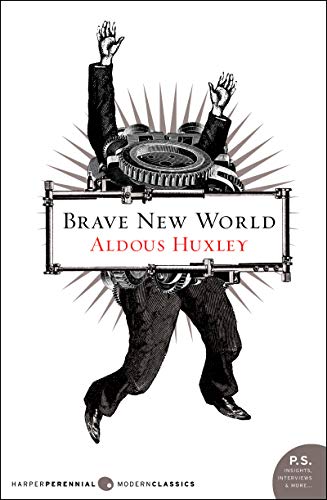
Brave New World

Brave New World by Aldous Huxley is a dystopian novel set in 2540 London. The book opens with the Director of Hatcheries and Conditioning explaining the institution’s processes to new students. Babies aren’t “born” any more: they’re “decanted.” In fact, the students are embarrassed when the director refers to the “old” way of conception and childbirth. Now ova and spermatozoa are joined in the lab and treated to become Alphas (the highest intelligence and functions), Betas, and so on, down to the nearly automaton Epsilons. Children are raised in the hatchery and conditioned against love of art or books or discomfort about death. The nuclear family is no more: the word “mother” is an obscenity.

The goal of the world controllers is that everyone be happy. Everyone works for the good of society. They spend their evenings in fun encounters and rarely are alone. Without the stresses of family and relationships, they’re free to just be . . . happy. If they’re not, there’s always soma—a drug that does anything from relax you a bit to keep you on a “holiday” for days.

Yet Bernard Marx isn’t happy. He’s in the highest caste for intelligence, but his physique is smaller than other Alphas. Rumor has it that alcohol was accidentally poured into his test tube, stunting his growth.

He feels inferior about his body, but he’s also out of step with a lot of society. He likes to be alone. He doesn’t like that men look at women like meat, and women seem to expect and like it. He has a crush on the popular Lenina, but is embarrassed when she wants to discuss plans for a date in an elevator full of other people.

Part of Bernard’s discomfiture stems from the fact that he’s a sleep-learning specialist. He helps program hypnopedia, the maxims and slogans that are repeated to the children in the hatchery while they sleep. So he knows much of society’s values come from this kind of conditioning.

Bernard and Lenina take a trip to a Native American-type reservation where some people have been allowed to live untouched by the new civilization. They live in family groups and their worship is an amalgam of religions. Bernard discovers a woman there who had come from the outside world several years earlier with a visiting group and gotten separated. They couldn’t find her and left her for dead, but in fact, she had been injured. She was also somehow pregnant, despite the measures society took to prevent such from happening. She was still an outsider on the reservation after all these years, partly because she was white, but mainly because her “everyone belongs to everyone” sexuality didn’t sit well with the tribe’s wives. Her son, John, is in his twenties and also an outsider. His mother had taught him to read, but their only books were a manual from her lab and a mouse-nibbled copy of Shakespeare.

John’s mother had told him of the world she came from, and now he would have an opportunity to go back with Bernard. He quotes Shakespeare’s The Tempest: “O wonder! How many goodly creatures are there here! How beauteous mankind is! O brave new world, That has such people in’t.”

However, John finds he doesn’t fit in the “brave new world,” either. He likes Lenina but can’t abide this civilization’s flippant attitude about sex. His mother has become addicted to soma to deal with her misery. He can’t function without time alone but can rarely find it.

People call him “the savage” or sometimes “Mr. Savage.” But the savage may be the most civilized person of all.

I had heard of this book but had no inclination to read it until I came across a quote comparing it to George Orwell’s 1984. I found out later the quote came from the introduction to Neil Postman’s Amusing Ourselves to Death: “What Orwell feared were those who would ban books. What Huxley feared was that there would be no reason to ban a book, for there would be no one who wanted to read one.” The quote went on to say, “Orwell feared those who would deprive us of information. Huxley feared those who would give us so much that we would be reduced to passivity and egoism. Orwell feared that the truth would be concealed from us. Huxley feared the truth would be drowned in a sea of irrelevance. Orwell feared we would become a captive culture. Huxley feared we would become a trivial culture. . . . In 1984, Huxley added, people are controlled by inflicting pain. In Brave New World, they are controlled by inflicting pleasure. In short, Orwell feared that what we hate will ruin us. Huxley feared that what we love will ruin us.”

Nearly thirty years later, Huxley wrote Brave New World Revisited, a nonfiction piece discussing how much of what he prredicted in the earlier book had come true.

Wikipedia goes into some of the influences behind the book. It started out as a parody of “utopia stories” popular at the time, but then he “got caught up in the excitement of [his] own ideas.” He was also influenced by a visit to the US where he “was outraged by the culture of youth, commercial cheeriness, and sexual promiscuity, and the inward-looking nature of many Americans.” He also came across Henry Ford’s My Life and Work and “he saw the book’s principles applied in everything he encountered after leaving San Francisco.” In fact, in Brave New World, time is measured not in BC and AD, but AF (After Ford).

The book got particularly interesting to me after John appeared. And it was intriguing to me to see the potential ramifications of a world filled with pleasure but not with meaning, as Huxley describes.

One of the main pleasures is sex, which is referred to a lot in this book. It’s not included to be titillating: it’s no more explicit than in Song of Solomon. It’s one of the main illustrations of pleasure with no meaning and probably meant to be disturbing. Still, it ‘s a lot.

Neither 1984 nor Brave New World portray a future that anyone would look forward to. But maybe, for the discerning, they can help us avoid some of the pitfalls they warn against.

I listened to the audiobook nicely read by Michael York. This book will count for my 20th century classic for the Back to the Classics Reading Challenge.
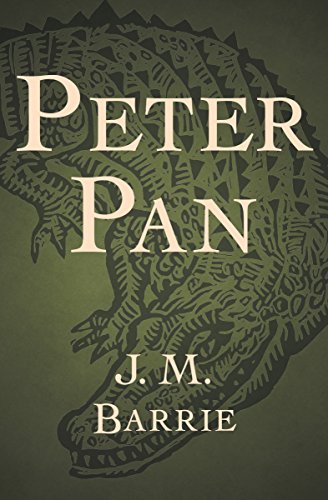
Peter Pan

I’ve seen several movie version of Peter Pan: the Disney cartoon, of course, a 2003 live-action version, and Hook. But I had never read the book by J. M. Barrie.

Peter was originally a character in Barrie’s book The Little White Bird. A few years later, the chapters about Peter were extracted and published separately as Peter Pan in Kensington Gardens. Later Barrie wrote a play with Peter as the central character, and later still he expanded the story into a novel, Peter Pan and Wendy, in 1911. These days it’s usually published as just Peter Pan.

Some think that inspiration for Peter came from Barrie’s older brother, who died young and was always thought of as still a boy. The name “Peter” came from the son of friends, the Llewelyn Davies. “Pan” was from Greek mythology.

You’re probably familiar with the story, but Peter lives in Neverland with Lost Boys. Occasionally he travels around. He lands outside the Darling family nursery and is captivated by the stories he hears there. He entices the daughter, Wendy Darling, to come to Neverland and be the Lost Boys’ mother. Wendy’s brothers, John and Michael, come, too. They have a lot of adventures with fairies and a Neverbird and Indians and pirates. The pirate captain is a man named Hook due to the prosthesis he had to wear after Pan was responsible for cutting off his arm in a fight.

Though Peter is portrayed as fearless, cunning, and skilled with a sword, he’s also selfish and thoughtless of others’ feelings. I’m glad Barrie portrayed the immature side of his childishness rather than just making him idyllic.

Barrie had tried different subtitles and settled on The Boy Who Couldn’t Grow Up. But a producer didn’t like that and suggested changing “Couldn’t” to “Wouldn’t.” I think “wouldn’t” is much more fitting. If he couldn’t grow up, we’d feel sorry for him. But since he wouldn’t, that adds a little bit of exasperation with him and explains why everyone else did grow up.

A few years after Peter Pan was published, Barrie wrote When Wendy Grew Up. An Afterthought. Peter returns after a absence of some years and is dismayed to find that Wendy has grown up and married. But then Wendy’s daughter, Jane, goes with Peter with her mother’s permission. This was sometimes published separately, but it was included at the end of the volume I read.

There has been some criticism in modern times of the way that Indians were portrayed. Wikipedia says, “Later screen adaptations have taken various approaches to these characters, sometimes presenting them as racial caricatures, omitting them, attempting to present them more authentically, or reframing them as another kind of ‘exotic’ people.” I don’t recall that they were portrayed negatively at all: they were respected even as enemies, and eventually became friends. But they were written rather stereotypically.

I was surprised that the book was darker in places than I remember the films being, though I admit it has been a long time since I have seen any of the films. It seems like in the Disney version, there was a lot of fighting but no bloodshed or real injuries except Hook’s hand. But in the book, people did die.

In the 2003 film, it didn’t dawn on me until fairly late that the same actor portrayed both the father and Hook. I read somewhere that the play usually does the same thing. Also, that film has something of a romance between Peter and Wendy, but in the book he always thinks of her as a mother.

I can’t say Peter Pan will be my favorite children’s classic, but I am glad to be acquainted with the original story now. I am counting it as my children’s classic for the Back to the Classics Reading Challenge.

(I often link up with some of these bloggers)

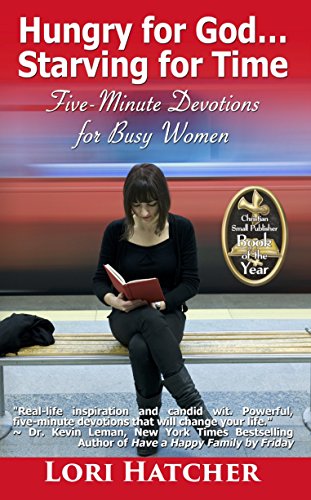
Hungry for God, Starving for Time

Lori Hatcher has to have one of the best titles ever in her book Hungry for God . . . Starving for Time.

Most of us can identify with what Lori says in her introduction: we don’t always have an hour to spend in the Bible, but “even when we can’t sit down to a five-course feast, even a quick nibble from God’s Word can nourish and sustain us” (p.16).

The devotions in this book each begin with a question to ask God, results of Lori’s own search for answers in the Bible since her early life as a Christian. The responses are designed to take about five minutes to read. They include experiences from Lori’s life and applicable insights from God’s Word.

Some entries are heavier: “The Day the Car Caught Fire” and “When This Sad, Sick World gets You Down.” Some are whimsical: “Bad Hair Days and the Kingdom of God,” “Sometimes I Wake Up Grumpy,” and “Caesar, the 115-Pound Lap Dog.”

One of my favorite chapters was “Distressed or Damaged?” Lori and her daughter were furniture shopping when Lori was amazed at the asking price for a chest of drawers with “dinks, scuffs, and chipped paint.” Her daughter explained that “distressed” furniture was considered highly valuable. Another piece, though, was actually damaged rather than distressed. Lori talks about how we can be distressed–shiny finish worn off, chipped surfaces as a result of encountering life. After discussing a few verses about God’s healing and help, Lori concludes: “God’s care reminds us that distressed and damaged is not discarded and defeated. Perhaps the designers have it right—distressed can be beautiful.” (p. 48).

If you’re eating on the run, it’s important to eat something substantial and healthy. Lori’s devotions are like a spiritual protein bar.

Lori’s not advocating that we never spend more than five minutes a day in the Bible. But on those days when we hardly have time to sit down, we can still have meaningful time in God’s Word.

In my case, our church is reading through Numbers. The book of Numbers has some dramatic moments, but it also has some dryer portions. Most of its chapters are fairly short as well. I enjoyed finishing my devotional time with a section from Lori’s book.

I had heard Lori speak at two of the writer’s conferences I attended, so I was sure I would enjoy her book. You can find her also at her blog, also named Hungry for God, Starving for Time, and her Facebook group by the same name.

(I often link up with some of these bloggers)

Trusting God for Our Children’s Safety

Except for the most abusive or negligent parents, we all want our children to be safe. When they are babies, we check their breathing at night. We buy outlet covers and baby gates in the early years, helmets and knee pads a few years later. We try to incorporate enough stranger danger warnings to make them alert without causing fear of everyone they don’t know. As much as we wish we could protect them from every physical harm, we wish we could bubble wrap their souls even more.

So I can understand the Israelites’ concern for their children in Numbers 13-14. After being miraculously led from Egypt, seeing God’s provision of food and water in the wilderness, receiving God’s law, and constructing the tabernacle, they were finally at the outskirts of the land long-promised to them by God.

But they didn’t want to go in.

A man from each tribe was sent to spy out the land. They came back with a mixed report. The land was good and fruitful. But the people in it were bigger, stronger, and more numerous than Israel.

Then the people “wept that night” and “grumbled against Moses and Aaron.” They feared they would be killed and their wives and children would become prey. Only Joshua and Caleb encouraged the people to go forward and trust God, who had already told them He’d given them the land. But the people responded by threatening to stone them.

God had enough. He is longsuffering and merciful. But these people had tried Him and refused to believe and obey Him ever since they left Egypt. God wanted to obliterate the people and start over with Moses.

Moses interceded for the people, and God pardoned them. But forgiveness doesn’t mean there won’t be consequences. All the generation that complained and would not enter the promised land would die in the wilderness over the next forty years. Only Joshua, Caleb, their families, and the children of the current generation would enter in. “Your children shall be shepherds in the wilderness forty years and shall suffer for your faithlessness.” But, ultimately, the children would be the recipients of the promise that the adults rejected.

In our church’s Bible study time in the passage last Sunday, my husband pointed out something I had never thought of. The population of Israel would have numbered over a million by this time—some say over two million. If you subtract an estimated number of children, that still leaves tens of thousands of people to die in the next forty years. Forty years of wilderness wandering, no promised land, just death and destruction ahead. How depressing! My husband commented that the weight of this may have fueled some of the rebellions that occurred in the next few chapters.

But rebellion would only make a bad situation worse. Suppose you’re a parent in this situation. You realize you failed big time in not believing God and obeying Him. But your children that you were so afraid for will go in. The best thing repentant parents could do would be to pour everything into the time they have left with their children, teach them God’s ways, and teach them how to some day get along without their parents.

In some ways, that’s what we all have to do, isn’t it? Pour our lives into our children, teach them God’s ways, teach them to be responsible adults and to stand on their own two feet without us.

In our early married days, I remember a woman sharing during prayer meeting a need for her children and how God answered. She commented, “It’s one thing to trust God for my needs—it’s another thing to trust Him for my children’s.” It’s true: we’d much rather struggle with a need or loss or illness ourselves than see our children do so. But it’s through such things that we all grow and learn dependence on God.

When Jonathan and Rosalind Goforth ministered as missionaries in China in the early twentieth century, the Chinese were intensely suspicious of what they called “foreign devils”—basically anyone who was not Chinese. Plus sanitation was nearly unknown and disease ran rampant. So when Jonathan proposed to Rosalind that they take their children on a ministry tour around the country, Rosalind refused. Four of her children had died already. She could maintain a level of cleanliness in her own home. But out there, not knowing where they would be staying or where they could get food from village to village? It was too risky, especially adding the possibility of persecution.

Jonathan begged Rosalind to reconsider:

Rose, I am so sure this plan is of God, that I fear for the children if you refuse to obey His call. The safest place for you and the children is the path of duty. You think you can keep your children safe in our comfortable home in Changte, but God may have to show you you cannot. But He can and will keep the children if you trust Him and step out in faith (Rosalind Goforth, Goforth of China, p. 157).

But she refused. So he left, alone.

The next day, their one-year-old baby became ill with dysentery, with no hope of recovery. She died a short while later.

Was God being vindictive? I don’t think so. In fact, Rosalind writes that as the baby was passing, Rosalind “seemed to apprehend in a strange and utterly new way the love of God—as a Father” (p. 159).

Humbled and softened, Rosalind determined to go with her husband. Years later, at a conference of women missionaries, some wives with similar fears to hers asked publicly if her children suffered as a result of their touring. She responded that none of them had picked up any infectious diseases or come to any harm while they toured. In fact, they’d had two more children during that time. She found she had more time to give them since she didn’t have her regular housework. “And, best of all, God has set His seal upon this plan of work by giving a harvest of souls everywhere we have gone” (Rosalind Goforth, Climbing, pp. 150-151).

Of course, we’re not guaranteed that our children won’t get sick or die while we’re following God. We all know of children who have died of cancer after years of prayer and treatment or teens who had died suddenly in car accidents or of unknown causes even though their parents were faithful followers. Sometimes God delivers by taking children on home to heaven. From our human perspective, that’s a loss. But from God’s viewpoint, He’s lovingly welcoming them home.

Missionary Timothy McKeown takes issue with the statement that the safest place is in God’s will:

After studying Scripture and ministering in this context for many years, I have felt compelled to modify this saying for my own use: “The most fulfilling, joyful, and peaceful place to be is in the center of God’s will.” But it is not necessarily the safest.

It seems to me that the Bible is full of examples of God’s people often—not occasionally—being placed in unsafe, uncomfortable, and dangerous situations. . . .

Most prayers in Scripture focus not on the personal safety and benefit of believers but on the power, majesty, testimony, and victory of God over his—and, of course, our—enemies. . . .

I do not advocate foolish and irresponsible “risk taking.” . . . However, biblical reality dictates that there are, indeed, times in which God will lead us into the valley of the shadow of death, where our prayer needs to be for faithfulness as reflections of his light and saltiness in this needy world.

I want to urge my fellow Christians to use extreme caution in allowing the infectious and deadly “health, wealth, prosperity, and personal comfort gospel” to become our motivator in seeking his will for our earthly lives. The Lord calls us to obedience in spite of the “costs”—not to personal comfort and safety! Oh, how I pray for the Lord of the Harvest to raise up more laborers to go into his fields no matter what the personal costs might be (Peace, If Not Safety).

Missionaries from one of our former church’s were once accused of child abuse for raising their kids in a primitive jungle setting. I loved their oldest daughter’s response here. “A mud hut does not an abusive environment make. . . . Yes, we missed out on many of the materialistic things this world has to offer. And for that we thank God often.”

God doesn’t promote recklessness. Parents and grandparents are supposed to try to keep children safe. But we have to admit that we are limited. We can’t lock them away in a tower for protection. We can’t raise them to be fearful of going forward. We can’t avoid God’s will due to possible risks. We have to do for our children as we do for ourselves: trust and obey. He has determined how long each person’s race will be. What matters most is not the length, but hearing His “Well done” at the end.

(I often link up with some of these bloggers)

Friday’s Fave Five

It’s Friday, time to look back over the blessings of the week
with Susanne at Living to Tell the Story and other friends.

It’s been a great week. Here are some of the best parts

1. Time with Timothy. Jason took Mittu out for a date lunch last Saturday, and Timothy stayed with us for the afternoon.

2. Mother’s Day. My family always goes the extra mile to make me feel special on Mother’s Day. Jim grilled his wonderful teriyaki chicken, Jesse made cheesy potatoes, Mittu made a salad, and Jason outdid himself with his first-ever Chocolate Pretzel Pie.

The pretty plates and napkins, flowers from Jason and Mittu, thoughtful gifts and sweet cards, games, and a FaceTime call with Jeremy in the evening made the day wonderful.

3. Energy. Monday and Tuesday, I kept falling asleep almost any time I sat down. On Monday I had just a mild case of chills and nausea, so maybe I had a little bug of some kind. Thankfully, symptoms didn’t get worse and I felt more energetic and awake later in the week.

4. A guest post. I mentioned this on Saturday’s Laudable Linkage, but wanted to share it with folks who might not have seen that post. I was able to submit a guest post to the Almost an Author site called Sculpting a Masterpiece. It’s exciting to submit something and have it accepted.

5. Take-out from a favorite Asian restaurant. You know I love take-out. Jim surprised me Thursday night by offering to pick up dinner from a place we hadn’t bought from in some time. It’s a little farther away than most restaurants we frequent, so we don’t get it often.

As a bonus, I’m thankful Jim found gas this week. All the stations had long lines, but he found a little place that people seemed to have forgotten about. Yesterday most stations had signs up that they were out of gas. I had an almost full tank, so we should be fine for a while. Most of the places we go are local. The long lines reminded me of the gas shortage in the 70s. So weird–you truly never know what a day will bring forth. But, thankfully, God does, and we can trust Him for our needs.

How was your week?

Faithful in Obscurity

Suppose you’re playing Jeopardy!, and you see this clue in the People in the Bible category:

Bartholomew, James the son of Alphaeus,
Thaddaeus, and Simon the Zealot

Would you know the right question?

“Who are some of Jesus’ disciples?”

If I were the host, I’d count that correct. But, more precisely, you could ask, “Who are the lesser-known disciples of Jesus?”

The names are a little different in the various lists of disciples (people often went by more than one name then.) But these usually appear near the bottom of the lists, right before Judas Iscariot. We don’t know much about them besides their names. We don’t have their words or actions recorded in the Bible other than in what the disciples did as a group.

Several years ago, our pastor at that time shared a series of messages about the disciples. Peter, as you can imagine, was the subject of more than one sermon. I think Judas may have gotten two; John, Phillip, and some of the others may have had one message devoted to each of them.

Our pastor grouped these last virtual unkowns all together. What can we possibly learn from them?

My pastor suggested the main thing they teach us is faithfulness in obscurity.

The lack of detail about them doesn’t mean they were inactive or lesser disciples. For His own reasons, God chose to emphasize certain aspects of other disciples in the Bible.

They heard the same messages as the others and ministered alongside them. There were people they preached to and helped and healed. I’m sure they made a difference in the lives they encountered. God probably used them in ways He could not have used Peter and John.

When they give an account before God, they’re not going to get a participation ribbon or an “I was one of twelve” tee shirt. If they served God faithfully, they’ll hear His “Well done.”

So will you. You may be a busy mom of little ones, a secretary stationed at her desk, a cashier at a counter, a caregiver tucked away in a lonely room, or in any number of occupations where you feel unnoticed. Don’t be concerned if you don’t get as much attention or response as other people. Don’t fret over whether your work seems “important.” Faithfully do what God has called you to do, for His honor and glory.

Sometimes obscurity is just for a time. Jesus was on earth a little over 33 years, with only the last three spent in active ministry. What was He doing those first thirty years? The Bible doesn’t tell us much except that after Mary and Joseph thought they’d lost Him and then found Him in a discussion in the temple, “he went down with them and came to Nazareth and was submissive to them. And his mother treasured up all these things in her heart. And Jesus increased in wisdom and in stature and in favor with God and man” (Luke 2:51-52). We can assume He learned carpentry alongside his stepfather and did all the things a normal Jewish family would do in those times. He probably engaged in acts of kindness and quiet ministry to others.

If we were arranging things, we might have Him manifest Himself as the Son of God much sooner. But that was not God’s way. Yet that quiet time in the background, walking righteously in everyday life, was just as much a part of His life as the rest. Just before His death, Jesus prayed, “I glorified you on earth, having accomplished the work that you gave me to do” (John 17:4).

That can be our purpose as well, whatever work we’re called to.

God may call people to the spotlight for a short time or for much of their lives. But many of us will live as 1 Thessalonians 4:11 says: “to aspire to live quietly, and to mind your own affairs, and to work with your hands, as we instructed you.” We can serve Him in ordinary, everyday ways, hardly noticed by the rest of the world. Yet doing that ordinary service in love as unto Him, filled with His Spirit, makes all the difference.

(I often link up with some of these bloggers)

Laudable Linkage

A collection of good reading online

I wanted to let you know that I have a guest post appearing at Almost an Author: Sculpting a Masterpiece. What does Michelangelo’s David have to do with writing? I invite you to take a look and find out.

And now, here are some great reads discovered this week, the first few related to Mother’s Day:

Prayer Warrior Challenge: You Don’t Have to Dread Mother’s Day this Year! “I remember clearly the momentous day when, deep in the weeds of Toddler Parenting, I realized I could do everything ‘right’ and still end up with a wayward child.”

Great Is His Faithfulness, HT to Challies. “My guess is that in this messy life, many are experiencing a measure of both joy and grief tangled up together this Mother’s Day week.”

How to Pray for Your Teen When You’ve Run Out of Words. “Handing our children over to God when they were infants was relatively easy compared with the task of entrusting them to God’s care now that they are jingling car keys in their pockets and making their first financial decisions.”

Training Children to Honor Their Parents by Honoring Our Own, HT to The Story Warren. “As I think about training my own children to honor their parents, I’m realizing how much is caught more than taught. The way I treat my parents will likely have a direct impact on the way my kids treat my husband and me.”

Beautiful Mother’s Day Gift Ideas Handmade with Love, if you need any last-minute gift inspiration. The Skip to My Lou site is a treasure trove of neat ideas.

The Childless Man or Woman, wise words from Elisabeth Elliot. “Children, God tells us, are a heritage from Him. Is the man or woman to whom He gives no children therefore disinherited? Surely not. The Lord gave portions of land to each tribe of Israel except one. ‘The tribe of Levi… received no holding; the Lord God of Israel is their portion, as he promised them’ (Joshua 13:14, NEB). Withholding what He granted to the rest, He gave to Levi a higher privilege. May we not see childlessness in the same light? I believe there is a special gift for those to whom God does not give the gift of physical fatherhood or motherhood.”

What God has Made Crooked. “Sometimes God makes our way crooked to slow us down. He has something beautiful to show us. He wants to be seen along the way. He has designed even the crooked ways with beauty.”

Aging Doesn’t Make You Faithful. Jesus Does, HT to Challies. “It is folly to expect to wake up more faithful to Christ twenty years from now if we’re not feeding our faithfulness today with the means of grace God has ordained for our growth. God has invited us into the process of spiritual growth.”

What Is Anxiety? HT to Challies. “Most of our sinful anxieties are tied to proper concerns. It is proper to do your job well, to support your family, to care for your children, to fulfill the duties that God has called you to do. We should be concerned with all of them. The question is, When do these proper concerns turn into sinful ones? When does godly care become godless worry?”

The Dull Conversation, HT to Challies. I’m sorry to admit I chafe during seemingly meaningless conversation. I recognize that’s unloving toward the person I am listening to. Ed Welch has some good ideas to discern “What is that person saying in the litany of information?”

I have to say, though, I disagree with this part of the last post: “With those who are closer to you, each day deserves these two questions: What was the best part of the day? What was the hardest part of your day?” My difficulty with superlative questions (best, worst, favorite) is the way my mind works. To figure out the best part of the day, I’d have to look back over all the events of the day, line them up, compare them to each other, weigh the two or three that rise to the top. It’s exhausting. So, instead, I usually reply something like, “Well, one good thing from the day was…” You might think that whatever floated to my mind first was the best. But later, as I think back over the conversation, some other part of the day with come to mind, and I’ll think, “Oh, I should have said that instead.” Am I the only one who overthinks like this?

Forgive me for that rabbit trail. 🙂

Finally, this is a cute video about mom superpowers:

Happy Mother’s Day tomorrow to those who mother in any way.

Friday’s Fave Five

It’s Friday, time to look back over the blessings of the week
with Susanne at Living to Tell the Story and other friends.

Let’s end the first week in May by thanking God for what He has provided.

1. A housewarming party. We had a family housewarming party for Jesse to congratulate him on his new apartment and give him some odds and ends he didn’t have yet. He even made dinner for us! Or the main dish, anyway. It was good! Mittu made a side and I made dessert. It was a fun evening. I told him getting excited over a new skillet was a sure sign of being an adult. 🙂

2. Jesse’s new coffee table. Jesse made this coffee table by finding a photo he liked and having it printed on wood at PhotoBarn. Then he and Jim built a frame for the legs to screw into, attached the legs, and Jesse got glass cut to fit the top. It turned out nicely.

3. Replacement parts. A couple of things I had ordered arrived damaged. Reporting the damage and arranging for replacement parts was relatively painless. One arrived today; the other should soon. I was also thankful they just sent a replacement part and not a whole new item, so I didn’t have to box up and send back the items.

4. Safety in the storm. We had some pretty heavy thunderstorms this week. Jim and Jason both had to be out, but were safe driving. Thankfully there was no rain when I had to go to the store, even though it was forecast. We didn’t lose power–it didn’t even blink.

One night the rain stopped, but clouds were still out. I noticed this one from the kitchen window, and called Jim to come and see. We went outside and watched it for several minutes. I don’t think I have ever seen so much lightening within one cloud formation. This isn’t even the worst of it.

5. A Hobby Lobby excursion with gift cards. This is only the second or third time I’ve been into Hobby Lobby, one of my favorite places, in the last year. I have several gift cards to the store and used part of one for some card supplies and items for the new guest room. Fun!

Hope your week was good.

Daughters of Northern Shores

Daughters of Northern Shores is the sequel to Joanne Bischof’s Sons of Blackbird Mountain (linked to my review).

Picking up in 1894, four years after the first book, youngest Norgaard brother Haakon has fled his family and gone to sea after betraying his family’s trust. He wrote just a brief note to them when he left and has not written since. They don’t have an address for him. He has lived far from the morals he was raised with. One particular woman who was only a good friend makes him wonder if life could be different for him, if he could settle down with a family. But first he must go home and face those he wronged.

Back on Blackbird Mountain in Virginia, Thor and Aven had married and are expecting their first child. Business has gone well since Thor decided to quit making hard cider with his apple orchard produce after his grueling battle with alcoholism. Aven and her sister-in-law make apple pie fillings, applesauce, and other items for the local grocer. But Thor has a nagging pain in his side that is growing stronger. He had watched his father succumb to liver disease after years of alcoholism, so he knows the signs. But he has been sober four years—he thought he staved off affecting his liver.

To add to their troubles, their former neighbors, the Sorrels, cruel former Rebel soldiers and Klansmen, are back for revenge after the Norgaard brothers routed them in the last book. The sheriff has searched for them without success, but the Sorrel men know how to hide. Thor and oldest brother, Jorgan, try to attend to business while keeping their families safe and watching out for a Sorrel ambush.

I loved the first book so much, I was eager to continue on with the Norgaard family. I enjoyed this book just as much. Haakon was not my favorite of the brothers due to his personality and wrong choices in both books. But his desire to come back and apologize to his family starts him on the right path, and I warmed up to him as he slowly learned and changed.

A couple of my favorite quotes:

While words were potent, a man’s caring ran through deeper waters. It dwelled right there in what he was willing to do.

She moved as though wood being forced to bend to wind rushing in.

Both the major and minor characters are so well-drawn, and Joanne weaves together the various threads of the plot so well. Parts of the book were touching; other parts were edge-of-your-seat suspenseful. I also enjoyed the author’s afterword about how this book was not planned at first, and then didn’t go the way she expected. Originally she was going to have Haakon die at the end of the first book. I’m glad God led this way instead. I’m sorry to leave the Norgaards behind.

I listened to this via the audiobook nicely read by Amy Rubinate. I kept forgetting, while reading the first book, that Aven was Irish rather than Norwegian. So Amy’s adding an Irish lilt to Aven’s voice was pleasant in itself, plus a reminder of her heritage. Then, since audiobooks don’t usually contain the back matter of a book, I got the library edition to read Joanne’s comments about the story.

. (I often link up with some of these bloggers)

The Laura Ingalls Wilder Companion

For several years, I hosted a Laura Ingalls Wilder Reading Challenge during the month of February. I often referred to Annette Whipple’s site, the Laura Ingalls Wilder Companion. Now Annette has written a book: The Laura Ingalls Wilder Companion: A Chapter-by-Chapter Guide.

A chapter is devoted to each book in the Little House series. Annette summarizes the plot, then, as the title suggests, she goes chapter by chapter sharing interesting background information, discussing life in Laura’s time, explaining concepts or situations that might be confusing, etc. Sidebars share even more information.

Laura had not written the Little House books as strict autobiographies. So some information is made up to smooth out the story. For instance, her nemesis, Nellie Olsen, was actually based on three different girls Laura knew. Annette’s “Fact or Fiction?” inserts discuss some of those made-up parts.

Next, each chapter shares instructions and illustrations for several Little-House-related activities. For instance, the first chapter, based on Little House in the Big Woods, tells how to make homemade butter, paper dolls, vinegar pie, snow pictures, pancake people, snow maple candy, and more–all activities that Laura’s family did in the books.

Each chapter ends with a “House Talk” section, several questions for thought and discussion. A few from the first chapter: what would you like and dislike about living in the Big Woods, what kind of work did Laura and Mary do to help their parents, how do you help your family, how did Charlie lie, why didn’t Pa shoot the deer at the end of the book?

Scattered throughout the book are photos of the Ingalls family, their various homes, news photos from the times (like a snowed-in train in The Long Winter chapter).

A final chapter tells “What Happened Next”—what ultimately happened with each of the Ingalls family members.

Annette didn’t shy away from or gloss over the difficulties in Laura’s book, like how African-Americans were depicted or the treatment and feelings towards the Indians.She points out what was wrong and how attitudes have changed today.

[Laura] didn’t tell readers how or what to believe. Instead, she let readers like you decide what to think.

We change and grow as a country and a people. When we do, we realize the ways people lived and thought in the past weren’t always right. We can learn from the past and make changes in ourselves (p. 42).

An extensive glossary defines unfamiliar terms, and a final section lists resources to explore.

This book is a great companion for exploring the Little House books personally, as a family, or as a class or home school. Highly recommended.

(Sharing with Carole’s Books You Loved, Booknificent, Senior Salon)