Laudable Linkage

Laudable Linkage

Some of the noteworthy posts found this week:

Your Fig Leaves Are Showing! Why Your Christian Home Is not as Close as it Should Be. Adam and Eve sewed fig leaves together to cover the shame they felt after they sinned. “That ancient impulse hasn’t changed. Sin still causes shame. Shame still creates barriers. And we still reach for fig leaves. Today, our fig leaves are more sophisticated.”

Transhumanism, Christian Productivity, and Why I Don’t Use the Term “Second Brain.” I’ve been concerned about the transcendence of AI affecting our ability to think and process. But I didn’t realize those behind it have a larger plan. “Forte’s ultimate vision for personal knowledge management is a digital Tower of Babel. This is the philosophy of transhumanism. And it might sound a little kooky at first until you realize he is far from the only one who thinks this way about technology and personal improvement.”

Everything Matters. “Just mark it down right now: the devil is a liar. He says our sin is so small that it won’t affect us, and our good works are so insignificant that they won’t impact anyone else. But there is no such thing as an action without a reaction. In God’s kingdom, everything matters. Here’s how…”

Did Abraham Get Away with Lying? I had never realized all these ramifications of Abraham’s lies.

Ansel Adams, AI, and the Essence of Creation, HT to Challies. “It seems to me that part of the essence of true creation is labor, striving, wrestling, and overcoming. It calls forth the virtue of courage to beat back the doubts and insecurities and fears, and surge up something fresh and true. It demands a presence in the world, a willingness to interact with creation and people, to touch things and be affected viscerally. This is true whether your creation is painting or photography or film or poetry or fiction or nonfiction. The human element matters.”

Singing Anyway, HT to Challies. “I do not doubt that each of the kids singing on stage had reasons not to sing. There were likely moms who forgot to make Easter baskets, dresses that felt too tight, shirt tags that itched, parents who were fighting in the kitchen that morning, and siblings who were annoying during the ride to the service. But they showed up anyway. They sang anyway. And because they decided to show up and sing, countless people were moved toward a posture of praise.”

Christian Cultural Bias in Missions is a Real Challenge. “Missionaries are tempted to recreate the church culture they admire back home. One reason this happens is that they have not taken the time to understand the differences between their cultural Christian experiences back home and what the Bible actually teaches. They don’t realize how much their idea of what a local church should look like comes from cultural expectations or simple habits (often unconscious).”

What’s Going On In Your Pastor’s Mind? “It is one of the strengths, or perhaps one of the weaknesses, of the human mind that it can have different “tracks” playing at the same time. Even as one series of words is emerging from a person’s mouth, an entirely different series of words may be flitting through his brain. He can have an entire monologue playing internally, even as another is playing externally.”

J. C. Ryle quote

What if God ruined your plans
so your plans wouldn’t ruin you?
J. C. Ryle

Friday’s Fave Five

Friday's Fave Five

Here we are in August already! I’m joining with Susanne and friends at Living to Tell the Story to share our blessings of the week.

1. A helpful neighbor. This happened last week, but I forgot to mention it. While we were celebrating Jason’s birthday, a neighbor noticed that Jesse’s brake lights were on and called us. Jesse went out to turn them off–but they remained on. Jim went out to look, and there was some problem with the fuse box. They removed the fuse–which meant having no brake lights for the drive home. But God kept him safe. We were so thankful for the neighbor, because at least we were able to keep Jesse’s battery from running down.

2. Car fixed. Jesse made arrangements to have his car worked on at a place near us. We loaned him one of our cars while his was being worked on. While it was in the shop, he asked them to change the oil and investigate a weird noise upon starting (a frayed fan belt) as well as replace the fuse switch. They got all that done in a day, so he came back the next day to get his car and return ours. It helps to know his car is in a safer condition than it was. Bonus: getting to visit a little with him both mornings. He lives farther away than Jason and Mittu and has a weird work schedule, so we don’t see him quite as often.

3. An impromptu visit. Jason, Mittu, and Timothy came over one afternoon.

4. The last boxes from the shed have been cleaned out! Out of three boxes, I only saved about a 7-inch stack of papers. Some of those will likely be tossed out as well, but I wanted to look at them a little further. There are some cabinets I need to go through out in the shed when we have a cool day. And we have a big trunk that one or the other of us used in college that Jim’s going to bring in to go through one day. Then he wants to finish the walls, put in shelving, and make it a more workable space.

5. Cardioversion scheduled. Atrial flutter began July 14. It took almost two weeks for the scheduler to call me about setting a date for a cardioversion. And then earliest time available is Aug. 22. :-/ That’s when Jeremy will be here from RI. I almost rescheduled it for after he leaves but figured I’d better go ahead and get it done. Atrial flutter can resolve on its own, and I am praying it will soon.

Thanks so much for your prayers and kind words about this the last two weeks.

July Reflections

July Reflections

July has been a hot and relatively quiet month. Regular readers know I was diagnosed with atrial flutter a couple of weeks ago. We’ve tried different medications without success. Then I was advised to have a cardioversion. But they don’t have any openings for that until late August. :-/

We’re trying to keep things low-stress to keep my heart rate down, so we’ve mostly stayed home.

But one productive quiet activity has been going through boxes from the shed. Jim has brought in about three at a time. It’s been fun to discover old notes and drawings from the kids, letters from our moms and my grandmother, high school and college notebooks. We’ve thrown a lot away. Part of me wanted to go through some of the notebooks in more detail, but that would take up so much time. And many of them were yucky with age and moisture and who knows what else. So I have to figure they accomplished their purposes. I’m sure most of the information in them is readily online now.

I’m at the age where I am trying to look at things as “Would I want my kids to have to deal with this when I am gone? Would they have any interest in it?” In most cases, the answer is no, except for personal things.

I’m kind of embarrassed and dismayed that we’ve dragged some of these boxes around for so many years! But at least we’re dealing with them now.

When the weather is cooler, we want to do the same thing with boxes in the attic. Cleaning out the whole attic sound overwhelming, but a few pieces at a time is doable.

I mentioned on a Friday’s Fave Five finding an old sock monkey I had as a child. It had been patched up even then but was in sad shape now. I soaked it in the washer a few times, but I think he, as well, has served his purpose and should go to his rest. 🙂

When I get sentimental about such things, I remember this old commercial from IKEA:

🙂

A couple of months ago, while culling some of Timothy’s old preschool toys, I rediscovered a couple of smaller sock monkeys. I thought at first that we had given them to him, but they have our names on them. So they must have given them to us in memory of my old one. It was neat to have some of his distant relatives. 🙂

sock monkeys

Also this month, we enjoyed burgers on July 4 and Jason’s birthday later in the month. One of my dearest friends from early married days stopped in for an overnight visit while traveling.

Creating

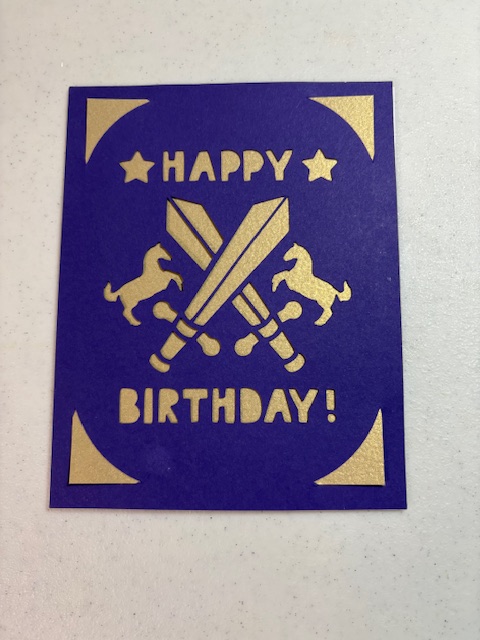
I made just one card this month, for Jason’s birthday, using the Cricut.

son birthday card

Watching

The Princess Bride is an old favorite of mine and was on regular TV one night this month. It’s not Jim’s cup of tea, but he watched it with me, remarking that this was the first time he stayed awake through the whole film. 🙂 A few days later I saw a “things you didn’t know about The Princess Bride” video on YouTube and enjoyed that.

We also saw a movie titled The Love Letter, about a man who buys an antique desk, discovers an old letter in it, and answers it–only to have the woman who owned the desk in Civil War times answer him back. The plot was implausible, and I can’t say this will go down as a favorite, but it was clean and not a bad way to spend an hour and a half.

We’ve been working our way through Heartland, a series set on a ranch in Canada. In the first episode, a teenage girl and her mom rescue an abused horse in a storm. On the way back to their ranch, the horse panics and kicks, causing their truck and trailer to go off the road and crash. The mom is killed. The girl has a long recovery. The older sister comes home from the city to help, but her take-charge ways offend the others. The grumpy but kindly grandpa tries to care for everyone. None of them knew that the mom had arranged for a troubled teenage boy to work on the ranch during his probation, so he’s in the mix. Throughout the first season, they all get used to their new situation and each other. The teen girl, Amy, finds healing and solace in working with the abused horse.

The show has eighteen seasons, so it will take us a while. Overall, it’s pretty good and emphasizes family values. I have a few issues with it. The characters could be a little more modest. There haven’t been any explicit scenes so far, but there are hints of things like the older sister going away for the weekend with her boyfriend. Native American spiritualism comes into a few episodes. In one, a young girl is trying to tell everyone’s futures with tarot cards–thankfully, those have not made a reappearance.

Reading

Since last time, I have completed (titles link to my reviews):

I’m currently reading:

  • Exalting Jesus in 1 & 2 Thessalonians (Christ-Centered Exposition Commentary) by Mark Howell
  • A Face Illumined by Edward Payson Roe
  • North! or Be Eaten, the second in the Wingfeather Saga by Andrew Peterson
  • Wildwood Creek by Lisa Wingate

Blogging

Besides the weekly Friday Fave Fives, Saturday Laudable Linkage, and book reviews, I’ve posted these since last time:

WordPress reminded me that June 27 was my 19th blogging anniversary. I had thought about doing something special for it ahead of time but then forgot about it when the time came. I’ll definitely have to come up with something for the 20th anniversary next year!

Thank YOU all so much for being here, for reading, and for your kind comments. I didn’t know when I started that I would make such good friends across the miles.

Review: Firefly Island

Firefly Island

Firefly Island is the third of four novels in Lisa Wingate’s Shores of Moses Lake series. This story doesn’t start there, however.

Mallory Hale is a congressional staffer in Washington, D. C. following in the footsteps of her lobbyist father, when she unexpectedly meets Daniel Webster Everson, a biochemist working for the USDA. After a whirlwind romance, Daniel is offered a job in tiny Moses Lake, Texas. He asks Mallory to marry him and move to Moses Lake with him and his four-year-old son, Nick.

Mallory agrees. She’s not sure kind of job a congressional staffer can find there, but she can’t live without Daniel and Nick.

A series of mishaps begins their married life in less than fairy-tale happily ever afters. The house provided with Daniel’s job has not been lived in and is infested with vermin. Daniel’s new boss, Jack, is taciturn and erratic. The small community seems to eye Jack warily.

Suddenly thrust into a new marriage, motherhood, and setting, Mallory struggles. She finds friendship with her cowgirl neighbor, Al, and a young teacher, Keren.

Mallory is suspicious of Jack. Rumors circulate about his possible involvement in the disappearance of his wife and son. He’s secretive to the point of paranoia about his business. When his politician older son, with whom he has not been involved with in years, comes to visit, more details don’t add up. Jacks’ old cabin on Firefly Island is supposedly deserted, yet there are strange boats moored there. Mallory’s search for information leads to tie-ins with her old job. Can Mallory find out what’s going on and bring it to light before a disaster happens?

If I had read this book first in the series, I probably would not have continued. It starts out like a romance novel with what seems to me a lot of silliness (does anyone say hubba hubba any more?) Though there are no explicit scenes, there are more references to the couple’s physical relationship than I care for. Then the plot seems to drag in the middle.

But the latter half of the novel comes together nicely with mystery and intrigue. I enjoyed the interactions with characters from the first two books.

Besides the adjustments with a new marriage and the mystery behind her husband’s boss, Mallory deals with interactions with the more disadvantaged section of Moses Lake. Mallory has been raised the sheltered youngest daughter of a comfortable family. When she takes Nick to a children’s activity and sees a lot of unkempt kids, she worries about lice and bad attitudes. But over time she gets to know the kids and their needs, sees them differently, and looks for ways to help. “Was I really so entrenched in the world I’d been raised in, so set in my ways that I couldn’t look beyond the surface of another person and see a human being? Was I that shallow?” (p. 214).

I also thought this was a sweet line after an encounter with Nick: “Watching him skitter away, I felt the process of loving and parting and holding on and letting go that would be our future together, his and mine” (p. 203).

So, while this wasn’t my favorite of Lisa’s books, I gained from it.

(Sharing with Bookish Bliss)

Review: Rembrandt Is in the Wind

Rembrandt Is In the Wind

I don’t remember being exposed to classical art or even going to a museum until I got to college. My alma mater had its own art museum at the time. I remember going on a guided tour and being fascinated as the guide brought out details I would never have noticed myself. I took Art Appreciation my senior year. But that was the limit of my art education.

I’ve visited a few museums with my family since then. But I haven’t gotten much beyond wandering around the gallery and noting what I liked and didn’t.

Russ Ramsey is an excellent guide in Rembrandt Is in the Wind: Learning to Love Art through the Eyes of Faith. Not only does he bring out unnoticed details, but he draws spiritual lessons from the lives of the artists as well.

Ramsey says we learn to understand God through truth, goodness, and beauty.

In my experience, many Christians in the West tend to pursue truth and goodness with the strongest intentionality, while beauty remains a distant third. Yet when we neglect beauty, we neglect one of the primary qualities of God. Why do we do that?

The pursuit of beauty requires the application of goodness and truth for the benefit of others. Beauty is what we make of goodness and truth. Beauty takes the pursuit of goodness past mere personal ethical conduct to the work of intentionally doing good to and for others (p. 8, Kindle version).

This is the gift of beauty from an artist to their community—to awaken our senses to the world as God made it and to awaken our senses to God himself (p. 14).

Ramsey focuses on an artist and/or a specific work of art in his remaining nine chapters, which he describes as “part art history, part biblical study, part philosophy, and part analysis of the human experience. But they are all story” (p. 15).

Ramsey includes a black and white image of the paintings he discusses at the beginning of each chapter, and then a small color print at the end of the book. But I found that if a painting had a Wikipedia entry, I could click once on the painting’s image and make it full-screen, then click on it again to zoom in further. 

One of the chapters features Rembrandt, especially his Christ in the Storm on the Sea of Galilee (pictured on the cover) one of my al-time favorite paintings. I didn’t know before that Rembrandt painted “himself into several biblical scenes. He did this not for vanity but for the sake of the story. He wanted to draw us in, capture our imaginations, instruct us on how we should relate to what was happening on the canvas, and bear witness to what he believed to be true about the world he painted and his place in it” (p. 73). He’s the one looking straight at the viewer, with one hand on the rope, the other on his hat. “By painting himself into the boat in The Storm on the Sea of Galilee, Rembrandt wants us to know that he believes his life will either be lost in a sea of chaos or preserved by the Son of God. Those are his only two options. And by peering through the storm and out of the frame to us, he asks if we are not in the same boat” (p. 75).

This painting was also part of one of the most infamous art heists in history–and it has never been recovered. Ramsey shares the details of the theft.

Some of the artists, like Caravaggio, perceived beauty, and their hearts were touched and drawn to Christ, yet still didn’t submit to Him.

This is the paradox of Caravaggio—he brought so much suffering on himself, with such bravado and acrimony, yet when he picked up his brush, the Christ he rendered was the Redeemer of the vulnerable. . . He knew what it was to have the ability to render beauty that could bring a person to tears and yet remain unable to live free from his own destructive behavior (pp. 60, 64).

The chapter on Vermeer was wonderfully layered with references to light: the light God created which would make visible His creation, art’s use of light, the “borrowed light” from one source to another and from others who “illuminate the places where we’re doing our own work, and then our work lights the way for others” (p. 96).

This chapter also led to quite an interesting lunchtime discussion with my husband. Rembrandt was thought to use some kind of optical lens as he painted, not to “[pull a trick] on his viewers, He was learning to see” (p. 106). “His use of a lens was not a shortcut, but rather an innovation–the kind that gave his work a mysterious quality” (p. 104).

Rembrandt’s neighbor, and the executor of his estate, was Antoni van Leeuwenhoek, the “father of microbiology” and inventor of a “single-lens microscope that intensified light and enhanced magnification through the use of a concave mirror” (p. 100) (another facet of the theme of light). I asked my husband if he knew of van Leeuwenhoek, and of course, he did. Being interested in microscopes himself, he has a replica of one of van Leeuwenhoek’s devices.  

This chapter also discusses the influence of technology on art–not only this lens, but the tin paint tube. Artists usually painted indoors because they often mixed their own paints and had everything at hand in their studios. But with the invention of the paint tube, they could paint anywhere. “Painting is not just an art, but a science. It is an achievement not only in beauty or emotion or color, but in math and geometry and light” (p. 104).

An artist I never heard of before, but enjoyed learning about, was Henry O. Tanner, whose The Banjo Lesson was the “first recognized genre painting of blacks by an African American artist” (p. 152). He often painted an older person teaching a younger person something. But, “Though race would always play an important role in Tanner’s art, in order to expand people’s view of race, he didn’t want to become a niche artist focused only on race. . . As a man of faith, Henry believed persuading one race to regard another with equity and love was a theological endeavor, one which required a biblical view of personhood—that all people are made in the image of God and therefore share an inherent dignity and worth that transcends any human construct” (p. 156).

The last chapter tells of Lilias Trotter, who lived during the time of van Gogh, was pursued by John Ruskin as a pupil, but put aside her artistic career to become a missionary to Algiers. I had read her inspiring story before, but it was good to be reminded of it again.

A few other favorite quotes:

On the other side of the veil is the tangible glory of unfailing perfection, but it is just out of our reach. So we have given ourselves to the pursuit of making copies from the dust of the earth, compressed by time, crafted by pressure, but conceived by something more than mere imagination. Our best attempts at achieving perfection this side of glory come from an innate awareness that it not only exists, but that we were made for it (p. 38).

Ruskin believed “the greatest thing a human soul ever does in this world is to see something and tell what it saw in a plain way . . . To see clearly is poetry, prophecy, and religion—all in one” (p. 197).

A like independence is the characteristic of the new flood of resurrection life that comes to our souls as we learn this fresh lesson of dying . . . the liberty of those who have nothing to lose, because they have nothing to keep. We can do without anything while we have God (Lilias Trotter( (p. 199).

Ramsey includes a few appendices: How to Visit an Art Museum, How to Look at a Work of Art, and an Overview of Western Art: Renaissance to Modern Selected Works.

This book will be one of my top ten of this year. I enjoyed it immensely.  

(Sharing with Bookish Bliss)

When You’re Not Number One

When You're Not Number One

Fans of ball games across the country shout, “We’re Number One!” from the stands.

In reality, everyone can’t be number one. Someone has to be the second banana, play the second fiddle, act as the sidekick.

Many of us have the sad experience of not even being second. We were the last ones chosen for any kind of physical game.

One of the most dramatic battles for first place occurred between twins Jacob and Esau. In Old Testament times, the oldest son received the most inheritance, a blessing from his father, and the chosen leadership of the family.

Esau was the oldest. But God chose Jacob for a special blessing. Jacob would someday become Israel, head of the family through whom God blessed the world.

Did God choose Jacob to show a distinction, a way of saying “I am doing something different here” so it would stand out? Or did he choose the younger child because he knew the oldest was not fit to carry out His will? I don’t know—there may be a number of reasons.

However, instead of waiting and trusting God to work out His purposes, Jacob’s mother, Rebekah, felt they had to “help” orchestrate the circumstances by deceit, which did not work out well. Jacob got what he wanted, but he had to flee from Esau’s life-threatening anger. Esau seemed to have mellowed out a bit when Jacob returned twenty years later, but the Edomites, Esau’s descendants, were Israel’s enemies for centuries.

Jacob had twelve sons. Instead of learning from the tragedy of his family’s favoritism, he perpetuated it by having a favorite son: Joseph. Joseph’s brothers hated him and took the first opportunity to get rid of him.

There were other factors in both these cases besides the chosen status of a younger brother, factors which caused understandable anger. But they caused me to think of others in the Bible who found they were not the chosen ones.

Bad examples from the Bible

Cain was angry God accepted Abel’s offering and not his. Instead of repenting and adjusting his ways, he killed Abel.

Miriam and Aaron were jealous of Moses’ position. So were the sons of Korah. Each suffered God’s wrath.

King Saul had been chosen by God to be Israel’s first king. But his pride and disobedience led God to set Saul aside for David. Saul responded in anger, jealousy, and further sin.

Ahithophel was a counselor to David who deserted him when David’s son, Absalom, revolted against his father and staged a coup (2 Samuel 16-17). When Ahithophel’s counsel was not taken, he set his affairs in order and killed himself.

Absalom tried to take the throne by force. He was killed despite his father’s wishes.

The apostle John warned about Diotrephes, who “likes to put himself first” and did not respect the apostles’ authority.

Good examples from the Bible

Jonathan was Saul’s son, next in line to become king. But when Jonathan recognized God’s hand and calling on David, he readily acquiesced and helped David escape Saul’s wrath.

David planned to build a temple for God, but God said no. David’s son was to build the temple instead. David didn’t complain. He rejoiced that God blessed his house and did everything he could to aid Solomon.

Barnabas was instrumental in introducing Paul to other Christians when they were afraid of him. But he didn’t seem to resent when Paul became the leading spokesperson.

Andrew was Simon Peter’s brother. He faithfully served, often pointing people to Jesus. Though the disciples sometimes argued over who was the greatest, by and large they did not seem to mind that Peter was their leader.

John the Baptist was not offended when his followers left to follow Jesus. He pointed them to Him and said, “He must increase, but I must decrease.”

Examples from history

Many people are familiar with D. L. Moody, a famous evangelist in the 1800s. What’s not as well-known is that Moody was led to the Lord by a faithful Sunday School teacher, Edward Kimball.

In fact, that visit set off a series of events. Under Moody’s preaching, a man named Wilbur Chapman was saved and became an evangelist. Under Chapman’s ministry, Billy Sunday was saved and also became an evangelist. Mordecai Ham was converted under Sunday’s influence. And Ham led Billy Graham to the Lord (sources here and here).

Many people know of Jim Elliot, one of five missionaries killed in 1956 when the tribe they were trying to reach speared them to death. The news went out across the globe. Jim’s wife, Elisabeth, told the men’s story in Through Gates of Splendor. Many books and articles have been written about the five men, their wives, and the tribespeople who eventually came to know the Lord. Many lives have been touched and surrendered to the Lord because of these events.

Jim had an older brother, Bert, who was a faithful missionary in Peru for some sixty years with his wife, Colleen. Bert told Randy Alcorn, “Jim and I both served Christ, but differently. Jim was a great meteor, streaking through the sky.” Randy described Bert as “a faint star that rose night after night, faithfully crossing the same path in the sky, to God’s glory.” Both were used by God, but He led them along different paths.

Sometimes God pushes people into the limelight who didn’t want to be there at first, like Moses and Gideon. He gives grace for that, but He also gives grace for the fainter stars, the lesser-known, who faithfully serve Him with the talents He has given.

Once when someone asked Edith Schaeffer, wife of Francis Schaeffer, founder of L’Abri, who the most influential Christian woman of the day was. Edith replied something like “Whoever she is, nobody knows her. She’ll be a woman whose calling is to be behind the scenes praying.” I’ve heard variations on this answer–another source quotes her as saying, “We don’t know her name. She is dying somewhere in a cancer ward or living in India.”

Whichever way Edith worded her answer, the principle is true: we don’t know who the most influential Christians are. That’s not our business. Our business is to keep our eyes on Him and serve Him with all our hearts.

No leader or CEO or head of anything can accomplish much without support staff. Christendom is the same: “Now there are varieties of gifts, but the same Spirit; and there are varieties of service, but the same Lord; and there are varieties of activities, but it is the same God who empowers them all in everyone. To each is given the manifestation of the Spirit for the common good” (1 Corinthians 12:4-7).

Elisha was said to pour water on the hands of Elijah (2 Kings 3:11), a way of saying he ministered to Elijah’s needs. Elisha became the primary prophet after Elijah’s death, but he served just as well in whatever capacity he was called to at the time.

Imagine if one person in the chain between D. L. Moody and Billy Graham hadn’t done their part. There are unseen connections like that in all of our lives. We don’t know when a kind word, a shared verse, or a prayer might be part of a long series of steps leading a person to meet the Lord or know Him better.

May God give us grace to serve Him in whatever way He wants us to, ministering to others in large or small ways, whether seen or unseen.

“As good stewards of the manifold grace of God, each of you should use whatever gift he has received to serve one another” (1 Peter 4:10, BSB).

1 Peter 4:10

(I often link up with some of these bloggers.)

Laudable Linkage

Laudable Linkage

Some of the good reads found this week:

The Power of a Courageous Word. “Sometimes it is the simplest of matters that bear the greatest fruit. A simple deed, a simple gift, a simple word can make all the difference. They can even begin a cascade that changes lives and changes the world.”

The Preacher’s Trust, HT to Challies. This article focuses on preachers, but I have found its principles true for writing and ministering for God in any way. Instead of being crushed by our inadequacies or inflated with self-reliance, we put our trust in God, who works through His Word and Spirit.

Protesting Well. This is the fourth in a series on protest, dealing particularly with what to do when you disagree with the authorities in your life.

Lessons from Nathan’s Rebuke: Effective Strategies for Christian Confrontation, HT to Challies. It’s not pleasant, but sometimes rebuke is called for when a professing Christian sins. This article draws principles for what to say based on Nathan’s rebuke of King David.

Please, Don’t Say These Things to Women Who Have Miscarried, HT to Challies. “When a couple experiences a miscarriage, there are tons of responses like these flung in their direction like darts. Those who say them don’t mean for their words to attack, but they often do. They bring into question not only the grief of the mother and father, but also the value of the baby who was lost.”

Explain Up, Don’t Dumb Down. “I’m a big advocate of using big words with little kids. Our tendency, of course, is to use very simple terminology with children. It seems to me like we do this out of two desires.”

Just and Gentle Parenting. “Dear dads and moms, don’t we long to embody Scripture’s perfect balance — to parent between the poles, to divinely blend grace and law, and so to image God and the gospel to our children? Gentle parenting is not one of only two options. Neither is it the best, most biblical option.”

Just Diagnosed: Questions Parents of Neurodivergent Kids Should Ask Next, HT to the Story Warren. “For years, we focused on ‘fixing’ his social skills, handwriting, and attention deficits so he’d be successful in school. We’re thankful these early interventions continue to bear fruit. Still, the best gift we gave our son came when we stopped emphasizing what was wrong and began to focus instead on God’s good purpose.”

Talmage quote

If your path had been smooth, you would have depended upon your own surefootedness; but God roughened the path, so you have to take hold of His hand. T. D. Talmage

Friday’s Fave Five

Friday's Fave Five

Well, I am still experiencing the atrial flutter I mentioned last week, with my heart rate bouncing from 110 to 123 beats per minute. We tried increasing the medicine I am already on, to no avail. I called the doctor’s office at the requested time, and they advised skipping the step of going off the current medicine and trying a new one. Instead, they thought I should go ahead and do the cardioversion. Their scheduler was supposed to get back with me. She didn’t. I called earlier this week and was told all the cardioversion slots in their schedule were filled. :/ I asked through the patient portal if I could go ahead and get on the schedule for next week, and received no response. So I guess we just wait.

I’m frustrated. But this is not as urgent a situation as many others the doctor’s office deals with. I feel okay and can function pretty well–I just feel like I am not operating at full capacity and need to rest after exertion. I’m praying that God will direct to the right time or even help my heart to go back to normal without the procedure.

Meanwhile, I’m sharing some of the blessings of the week with Susanne and friends at Living to Tell the Story.

1. Jason’s birthday was last week, but we celebrated on Sunday. It’s always a joy to celebrate my children. But it was a special blessing this time because, in an effort to keep life low-stress while my heart is acting up, we’ve pretty much stayed home. It almost felt to me like Covid isolation. So I especially appreciated the gathering. Jesse came over as well and we FaceTimed with Jeremy.

2. Wildflower bouquets. Mittu cut and arranged these from our wildflower patch. Then she cut some sunflowers to take home. It was good she did, because we had a strong storm the next day which did a number on the flowers outside.

Wildflower bouquet

3. Electricity. The power went out briefly during the storm, right as I was making dinner. We have a gas stove and oven, so the burners stayed on. But it would be hard to be without air conditioning this time of year. I was glad the power came back on soon.

4. Easy meals. Jim got several frozen heat-and-eat meals to make dinner prep easy this week. It’s not good to eat that way all the time, but I’m glad such options are available when needed.

5. Finishing a long book. Books are a favorite every day! I’ve been reading the third volume of the Collected Letters of C. S. Lewis for months now, and finally finished it this week. I enjoyed it a lot, but I am read to move on.

How was your week?

The Collected Letters of C. S. Lewis, Volume 3

Walter Hooper was an American who became something of a secretary to C. S. Lewis, or Jack, as he was known, in the latter’s final years. After Jack’s death, Hooper helped care for Warnie, Jack’s older brother, and tried to preserve some of Jack’s memorabilia. Many of Jack’s letters had been quoted by Warnie in an earlier book titled Letters of C. S. Lewis, but none is quoted in its entirety. Hooper scoured the various libraries where Jack’s papers were kept to present a comprehensive volume of his letters.

That volume ultimately became three. Volume 1 is titled Family Letters and covers 1905-1931. Volume 2 is titled Books, Broadcasts, and the War, from 1931-1949. The final volume is titled Narnia, Cambridge, and Joy, covering 1950-1963.

I chose to read the last volume first. I had read of Jack’s earlier life in Surprised by Joy and other books, but knew the least about his last several years. This book was a whopping 6,328 pages, so it has taken me a while to read it.

Lewis was a prolific letter-writer, corresponding by hand. Warnie helped him when he was home, then Hooper later. It’s obvious Jack enjoyed a great many of the letters he wrote, but answering correspondence also put pressure on him. He even asked some of his friends not to write in December, because he received so much extra mail then.

One question I had was where these letters came from. Lewis says in this volume that he did not keep copies of the letters he answered once he was done with them. He didn’t appear to use carbon copies. It’s understandable the letters to family members were kept by the recipients. But Hooper doesn’t explain how he obtained the letters written to so many people. I don’t know if he, or Warnie, or someone else put out a request to Jack’s correspondents asking for any of his letters, which were then included in various collections.

Some of the letters are lengthy and thoughtful. Some are short notes. I think some of the short notes about where to meet someone for dinner or when they were coming to visit could have been left out. But even some of these have funny or interesting spots. He writes to lifelong friend Arthur Greeves of their travel plans that since Arthur was a light sleeper and Jack “an unreasonably early riser,” they should ask at the places where they were staying to “be put in rooms not adjacent. (This is not meant as a joke!)”

Some letters were news between friends. Others were answers to questions about his writings or philosophical or spiritual queries. Some gave requested writing advice like that “wh. old Macan gave me long ago ‘Don’t put off writing until you know everything or you’ll be too old to write decently.'”

Some of his letters provided critiques requested by his correspondent of their writing. He didn’t pull any punches! But he was not unkind.

By this time, he refused most of the requests for forewords or prefaces to other people’s books. He just didn’t have time. We forget that, with all his writing, he had a full-time job teaching. He writes to one friend, “I am so busy marking examination papers that I can hardly breath! The very good ones and the very bad ones are no trouble, but the in-between ones takes ages.” Plus, he said to most of these authors that his reputation was such that he didn’t think his name in their books would be a help to them.

I thought it a little odd that no letters to Joy were here. Of course, their main correspondence would have occurred before she moved to England. Perhaps she didn’t bring those letters over, or maybe she or Jack destroyed them. They may have been too personal, concerning her own soul-searching plus problems with her first husband.

It was funny to read how he described her when she visited, though. Evidently she liked to talk a lot. He wrote one friend: “I am completely circumvented by a guest, asked for one week but staying three, who talks from morning till night.” To another he said, “Perpetual conversation is a most exhausting thing.” (I agree!)

Jack said he never appreciated parents before–her two boys were good kids, he said, but whirlwinds that left the “two old bachelors” exhausted by the end of the day.

But he tells through various letters of his developing relationship with Joy, their marriage of convenience so she could remain in England, her illness, a “real” marriage ceremony (the first was legal, but when they began to care for each other, they found a minister who would marry them in her hospital room), her miraculous recovery, and a few good years they had until she began to decline again. He writes near the end of her life, “May it please the Lord that, whatever is His will for the body, the minds of both of us may remain unharmed; that faith unimpaired may strengthen us, contrition soften us and peace make us joyful.”

Jack’s letters are filled with literary references. Hooper painstakingly annotated these, sharing the source, the location within the source, and the full quote Lewis cited.

It’s fun to see humor laced through many of the notes. He asked one friend, “What is a ‘rumpus room’? Rumpus with us means a loud noise, or row, or ‘shindy’. Do you have a special room for shouting in? (I’ve known houses where it wd. be convenient!) To another: “There’s no news at all about Cambridge cats. I never see one. No news and no mews.”

One of the great sorrows of his life was his brother Warnie’s alcoholism. Warnie would go off on benders and then go to a place to dry out, then come home, only to repeat the process later. Jack would let close friends know what was going on, but would tell others that Warnie was sick or in the hospital.

It was sad to read of Jack’s final days, knowing when he was going to die. He was to have one last trip with his friend, Arthur. But they had to cancel due to illness on both their parts. Lewis writes that he is comfortable, “But, oh, Arthur, never to see you again! . . .”

As you can imagine, I have multitudes of quotes highlighted. Here are some that stood out to me:

Of course we differ in temperament. Some (like you–and me) find it more natural to approach God in solitude: but we must go to church as well. Others find it easier to approach Him thro’ the services: but they must practice private prayer & reading as well. For the Church is not a human society of people united by their natural affinities but the Body of Christ in which all members however different (and He rejoices in their differences & by no means wishes to iron them out) must share the common life, complementing and helping and receiving one another precisely by their differences.

God loves us: not because we are lovable but because He is love, not because He needs to receive but because He delights to give.

I am going to be (if I live long enough) one of those men who was a famous writer in his forties and dies unknown–

I don’t wonder that you got fogged in Pilgrim’s Regress. It was my first religious book and I didn’t then know how to make things easy.

[On Queen Elisabeth’s coronation] Over here people did not get that fairy-tale feeling about the coronation. What impressed most who saw it was the fact that the Queen herself appeared to be quite overwhelmed by the sacramental side of it. Hence, in the spectators, a feeling of (one hardly knows how to describe it)–awe–pity–pathos–mystery. The pressing of that huge, heavy crown on that small, young head becomes a sort of symbol of the situation of humanity itself: humanity called by God to be His vice-regent and high priest on earth, yet feeling so inadequate. As if He said ‘In my inexorable love I shall lay upon the dust that you are glories and dangers and responsibilities beyond your understanding.’

How little they know of Christianity who think that the story ends with conversion: novelties we never dreamed of may await us at every turn of the road.

As long as we have the itch of self-regard we shall want the pleasure of self-approval: but the happiest moments are those when we forget our precious selves and have neither, but have everything else (God, our fellow-humans, animals, the garden & the sky) instead.

If only people (including myself: I also have fears) were still brought up with the idea that life is a battle where death and wounds await us at every moment, so that courage is the first and most necessary of virtues, things wd. be easier. As it is, fears are all the harder to combat because they disappoint expectations bred on modern poppycock in which unbroken security is regarded as somehow ‘normal’ and the touch of reality as anomalous.

We should mind humiliation less if [we] were humbler.

I’m so pleased about the Abolition of Man, for it is almost my favourite among my books but in general has been almost totally ignored by the public.

At the end of this volume, Hooper included a series of letters between Lewis and his friend, Owen Barfield, called “the Great War” in which Lewis tries to “dissuade Barfield from his belief in anthroposophy,” a “system of theosophy . . . based on the premise that the human soul can, of its own power, contact the spiritual world.” The timing of these belonged to one of the earlier volumes, but Hooper didn’t receive them until he was working on this one. I didn’t read these, because they were quite long and I couldn’t follow the reasoning. I scanned some of them.

Hooper also includes extensive biographies in the back of Jack’s regular correspondents as well as interesting details about them or their interactions with Jack (which, along with the index, makes up some of the lengthy page count). I did not read all of these, either.

I very much enjoyed reading these letters and getting to know Lewis a little better. Someday I’ll get back to the other two volumes.

(Sharing with Bookish Bliss)

How to Find Good Christian Fiction

How to find good Christian fiction

Someone asked me recently how to find good Christian fiction. I thought I’d expand on that conversation here.

I wince when people say there is no good Christian fiction. I’ve been reading Christian fiction for around 45 years. Yes, there’s good and bad, just as there is in any genre. But for the most part, my life has been enriched and edified by my Christian fiction reading.

I wrote a very long post here about reasons to read Christian fiction. On top of all the other reasons to read generally–to learn, grow, expand our horizons, gain empathy by seeing other people’s situations and viewpoints, and so much more–Christian fiction contains the missing element: learning to look to God for help, to conform our lives to His will.

The best way to find good Christian fiction is to ask recommendations from someone you trust. I think my early forays into Christian fiction were from books loaned to me by friends. I remember one older lady in the church we attended when we were first married who was a big fan of Christian fiction and loaned out her books.

Another helpful source is Christian book bloggers. This isn’t foolproof: I’ve been burned a few times by such recommendations. But by trial and error, you can find some whose tastes are similar to yours.

Book reviews on Amazon, GoodReads, or Christian blogs are helpful. Reviews can be somewhat confusing, because I’ve seen rave reviews for books I hated and scathing reviews of books I’ve loved. But if you look at what people praise and criticize about the book, that can give you clues.

If I am looking into a new author, I look at the one- and two-star reviews of their books. If there’s some kind of problem, it’s usually mentioned there.

Another good source is the library. Our library happens to have a good section of Christian fiction. They don’t always have the latest releases, but they have more than enough to keep me busy. You can take a few books to a table and leaf through them, or check them out to try at home. Then you haven’t invested money that you’ll regret if the books aren’t to your liking.

Kindle sales are also a good way to try a new author. I don’t mind taking a chance for a dollar or two. I haven’t returned enough Kindle books to know what Amazon’s policy for returning books is for sure, but I think they have a window of time where you can return an ebook if you don’t like it.

If by “good Christian fiction” you mean something totally in line with all your beliefs and preferences, that’s going to be a little harder. You’re going to run into different preferences among Christians, among your friends, in your church, anywhere where you interact with other people. The key is to know what you believe and why and then exercise discernment.

For instance, say you don’t believe in Christians drinking alcohol, but the characters in your book do. There are probably people in your church who do as well. You would likely still interact with them and be friends with them, unless they really pushed the issue and tried to get you to drink.

I’ve handled different preferences in Christian books the same way. I can overlook the difference–unless the author seems to be making a point of emphasizing whatever the difference is.

One of the highlights of my college experience was a lecture by Dr. Ron Horton in Literary Criticism class on Objectionable Elements in Literature. One point he brought out was to look at how the element was handled.

For instance, most would agree that adultery is wrong. Some would not read a book in which a character committed adultery. But we see people who committed adultery in the Bible.

What’s essential is how the author handles adultery. Is it presented as acceptable or written in a way that promotes lust? Or, like the story of David and Bathsheba, are we spared sordid details and shown clear consequences.

Or take the whole issue of violence. War stories, murder mysteries, police dramas, and such are all going to contain violence. The Bible has a lot of violent, even gory scenes, too. But the Bible never presents violence as gratuitous. It’s not written to promote or feed into someone’s lust for violence.

Some of us are going to be sensitive to various areas, and we shouldn’t violate our conscience. For instance, I don’t want anything to do with horror or the occult, even if the “good guys” win in the end. I read a Christian fiction book once that contained extensive detail of an occult ritual. The author was not promoting the occult: he was warning against it. But that scene bothered me immensely. I didn’t need to know the details involved in those rituals. When the Bible mentions these things, it doesn’t go into enough detail to pique curiosity.

Likewise, I pretty much don’t want to know anything about a character’s sexual life. Yes, God created sex and it’s a wonderful part of life. But it’s not a spectator sport. I don’t want to know the details of a character’s intimate life any more than my friends’ or neighbors’. Most Christian fiction authors are not going to be explicit in this area, but there are a few I don’t read because I felt they crossed the line.

I hope this has been of some help. You can search in the box at the upper right hand corner above for particular books and authors I might have reviewed. Or you can email me if you have a question about one, and I’ll be glad to help if I can.

Do you have any other tips for finding good Christian fiction?
_____
Other posts here about Christian fiction:

(I often link up with some of these bloggers.)