Book Review: Off the Clock

Laura Vanderkam’s subtitle for her book, Off the Clock, aptly sums up the book’s takeaway: Feel Less Busy While Getting More Done.

The title comes from that euphoric feeling we get when we clock out from work.

Laura’s curiosity was piqued when she started a phone interview with a busy executive with the promise that she wouldn’t take much of her time. Her interviewee responded that she had all the time in the world. Most people aren’t so open-ended or relaxed about other people’s requests for their time.

Laura conducted a time-perception study, asking people to keep records of how they spend their time and then asking them questions about how they felt about the time in question. The book refers back to these studies, pulls from other time management experts, and shares examples from the lives of everyday people “with full lives who nonetheless see time as abundant” (p. 16). Laura has not filled the pages with excessive, minute, rigid rules for a particular system: she groups her findings under seven broad categories.

The first is “Tend your garden.” Here she does ask readers to keep track of their time for two weeks (which I confess I have not done yet…).

Being off the clock implies time freedom, yet time freedom stems from time discipline. You must know where the time goes in order to transcend the ceaseless ticking (p. 4).

Such a record opens our eyes up how we really use our time as opposed to how we think we do. Laura thought she worked 50 hours a week. Her records showed that her work week was closer to 40 hours most of the time. So she had to figure out what happened to that other ten hours. Some tasks, like loading the dishwasher, seemed to take great chunks of time but actually only took a few minutes, relieving her dread of that task. As the title of this chapter implies, once we’re aware of how we actually use our time, we can make decisions and weed out anything not useful.

A second principle is “Make life memorable.” The days that feel lost are those where we do the same routines over and over. Vacations or special days make time seem fuller. We can’t vacation every day, so Laura encourages small steps to make memorable moments in our days: taking a different route to work, visiting an anticipated exhibit, talking to a new coworker or neighbor, etc. One interesting fact here is that our “anticipating self” and “remembering self” focus on the memorable aspects of our plans. The “experiencing self” in the present is the one to see the obstacles and talk itself out of anything new: It’s raining; The kids are fighting; I’d rather go home and watch TV.

Conscious fun takes effort. This seeming paradox—Why should fun be work?—stops us in our tracks. So we overindulge in effortless fun (scrolling through Instagram . . .) It is the effortful fun that makes today different, and makes today land in memory. You don’t say “Where did the time go?” when you remember where the time went (p. 75).

Principle three is “Don’t fill time.” Allow for some white space. “With every activity ask this question: What is my purpose here?” (p. 96). See what you can eliminate or consolidate.

Strategizing boosts efficiency; planning your toughest work for the time when you have the most energy means a task might take one hour instead of two (p. 93).

Four: “Linger.” “Find ways to savor the savor of time where [you] currently are” (p. 119). “Consciously lingering in a pleasurable downtime reminds us that we have downtime. And that can make us feel like we have more time than when we let it slip through our hands” (p. 134).

Five: “Invest in your happiness,” time, resources, and when possible, finances. That may mean moving closer to work to avoid a commute you hate, hiring a lawn service (or neighbor boy) if you don’t like yard work, etc. Treat yourself—not extravagantly, but with a few set-side moments to read a book, savoring your favorite beverage while watching the sunrise, etc. Do what’s most important first.

Feeling harried and rushed is associated with feeling like you lack the time for the things you want to do. Doing what matters first opens up the time (p. 150).

I’ll just mention the last two: “Let it go”—when your schedule doesn’t work out like you want, just do the best with what you have (neat story about an artist here) and “People are a good use of time.” That last statement is what attracted me most to the book and made me want to read it.

Laura expands on and illustrates these principles from real life. Besides benefiting from the quotes and principles mentioned, I appreciated that Laura dealt in common-sense broad principles rather than a rigid system and that her examples came from home and family as well as work and career. This is a great book for learning how to “feel less busy while getting more done.” Highly recommended.

(Sharing with Booknificent, Grace and Truth, Global Blogging, Senior Salon,
Hearth and Home, Literary Musing Monday, Happy Now, Carole’s Books You Loved)
More songs about God’s way

When I wrote about wanting my own way yesterday, the old hymn, “Have Thine Own Way,” seemed a fitting ending. But the last day or two that I was working on my rough draft, other songs on the topic drifted to mind. Here are a few:

Let Him Have His Way With Thee” by Cyrus S. Nusbaum is one we used to sing often, but I haven’t heard it in a while. The chorus goes:

His pow’r can make you what you ought to be;
His blood can cleanse your heart and make you free;
His love can fill your soul, and you will see
’Twas best for Him to have His way with thee.

I have not heard these two in years.

Thy Way, Not Mine

Thy way, not mine, O Lord,
however dark it be;
lead me by thine own hand,
choose out the path for me.

Smooth let it be or rough,
it will be still the best;
winding or straight, it leads
right onward to thy rest.

I dare not choose my lot;
I would not if I might:
choose thou for me, my God,
so shall I walk aright.

The kingdom that I seek
is thine, so let the way
that leads to it be thine,
else I must surely stray.

Take thou my cup, and it
with joy or sorrow fill,
as best to thee may seem;
choose thou my good and ill.

Choose thou for me my friends,
my sickness or my health;
choose thou my cares for me,
my poverty or wealth.

Not mine, not mine, the choice
in things or great or small;
be thou my guide, my strength,
my wisdom, and my all.

~ Horatio Bonar, 1857

In looking for this song on YouTube, I found it to several tunes I had never heard before. I don’t know these folks, but this is the melody I am familiar with.

Submission

The path that I have trod,
Has brought me nearer God,
Though oft it led through sorrow’s gates .
Though not the way I choose,
In my way I might lose
The joy that yet for me awaits.

(Refrain)
Not what I wish to be,
Nor where I wish to go,
For who am I that I should choose my way?
The Lord shall choose for me,
‘Tis better far, I know,
So let him bid me go, or stay.

The cross that I must bear,
If I a crown would wear,
Is not the cross that I should take;
But since on me ’tis laid,
I’ll take it unafraid,
And bear it for the Master’s sake.

Submission to the will
Of him who guides me still
Is surety of His love revealed;
My soul shall rise above
This world in which I move,
I conquer only when I yield.

~ Charles Austin Miles (1868-1946)

I especially love the last line. Again, I don’t know this singer, but this is the melody I know for this song:

His Way Is Perfect” by Betsy Kistler is newer (1997). We used to sing this often in choir, and I heard it numerous times as solos. I always wished I knew the story behind it. It’s cast a bit sadder than the others, but that’s often when we most need to reassurance, as the last line repeats, that His way is best.

Scripture-soaked hymns and songs help us meditate on truths of God’s Word. May these be a blessing to you.

Are you familiar with these? Are there other songs that encourage you to yield to God’s will?


Wanting My Own Way

We’re born wanting our own way.

Babies, of course, don’t know any better than to demand that their universe revolves around their needs. That’s all they know at first.

But even when children make their first conscious, deliberate choices, they demonstrate a “me first” mentality. If they want a toy another child is holding, they grab it. If they don’t want their food, they spit it out or throw the plate on the floor. They scream or cry at any displeasure.

We recognize such responses as immaturity and understand why God gave kids parents. We try to patiently teach them that the universe does not revolve around them, they have to sometimes acquiesce to others, it’s rude to grab things from away from people, they sometimes have to do things they don’t like to do (and can’t do things they would like to do). As they get older, we teach the concept of taking turns, negotiation, and compromise. It’s a sign of growth and maturity when they can take the next steps to give sacrificially: to let someone else play with the toy they want, to give someone else the last cookie, to let someone else choose what movie to watch.

Even as adults, we note and dislike signs of selfishness in others and in ourselves.

Yet we’re still prone to want our own way.

Wanting our own will isn’t always bad. I think God gives us certain innate desires and tendencies that guide our futures. Someone who hates math will probably not be an accountant. Sometimes God nudges us out of our comfort zones, even out of our natural gifting, to cause us to depend on Him more and to show that the results could only have come from Him.

The problem comes when what we want conflicts with what He wants.

For the flesh desires what is against the Spirit, and the Spirit desires what is against the flesh; these are opposed to each other, so that you don’t do what you want (Galatians 5:17, CSB).

Some years ago, I did a study of phrases like “own way,” “own thoughts,” own heart,” etc., in order to find plenty of fuel to remind me that my way is not usually best. I ended up with four pages of types verses. Here are just a few:

All we like sheep have gone astray; we have turned every one to his own way; and the LORD hath laid on him the iniquity of us all (Isaiah 53:6).

Every way of a man is right in his own eyes: but the LORD pondereth the hearts (Proverbs 21:2).

Therefore shall they eat of the fruit of their own way, and be filled with their own devices (Proverbs 1:31).

What’s so wrong with wanting our own way? Sometimes nothing. But if our will clashes with God’s, then guess Who is right?

What? know ye not that your body is the temple of the Holy Ghost which is in you, which ye have of God, and ye are not your own? (I Corinthians 6:19).

For they got not the land in possession by their own sword, neither did their own arm save them: but thy right hand, and thine arm, and the light of thy countenance, because thou hadst a favour unto them (Psalm 44:3).

One of the worst things God can do to us is give us up to our own ways.

Hear, O my people, while I admonish you! O Israel, if you would but listen to me! … But my people did not listen to my voice; Israel would not submit to me. So I gave them over to their stubborn hearts, to follow their own counsels (Psalm 81:8, 11-12, ESV).

Because they hated knowledge and did not choose the fear of the Lord, would have none of my counsel and despised all my reproof, therefore they shall eat the fruit of their way, and have their fill of their own devices (Proverbs 1:29-31, ESV)

Wherefore God also gave them up to uncleanness through the lusts of their own hearts, to dishonour their own bodies between themselves (Romans 1:24).

And he gave them their request; but sent leanness into their soul (Psalm 106:15).

When I struggle with wanting my own way, I try to remember these things:

God has a right to call the shots.

He’s the creator. He made me; He made this world. Everything I have, my life, my breath, even my righteousness, is from Him. “And be found in him, not having mine own righteousness, which is of the law, but that which is through the faith of Christ, the righteousness which is of God by faith” (Philippians 3:9).

He is wise. He knows best.

He is kind. He is loving.

If He allows bumps in the road, delays, frustrations, unpleasantness, and even outright pain, He has a purpose. He promised His “grace to help in time of need” (Hebrews 4:16).

Therefore, I should:

Trust in the Lord with all your heart,
    and do not lean on your own understanding.
In
all your ways acknowledge him,

    and he will make straight your paths.
Be not wise in your own eyes;
    fear the Lord, and turn away from evil.
It will be healing to your flesh
    and refreshment to your bones. (Proverbs 3:5-8, ESV)

Neither yield ye your members as instruments of unrighteousness unto sin: but yield yourselves unto God, as those that are alive from the dead, and your members as instruments of righteousness unto God (Romans 6:13).

Elisabeth Elliot said, “To pray, ‘Thy will be done,’ I must be willing, if the answer requires it, that my will be undone.” That’s not always easy.

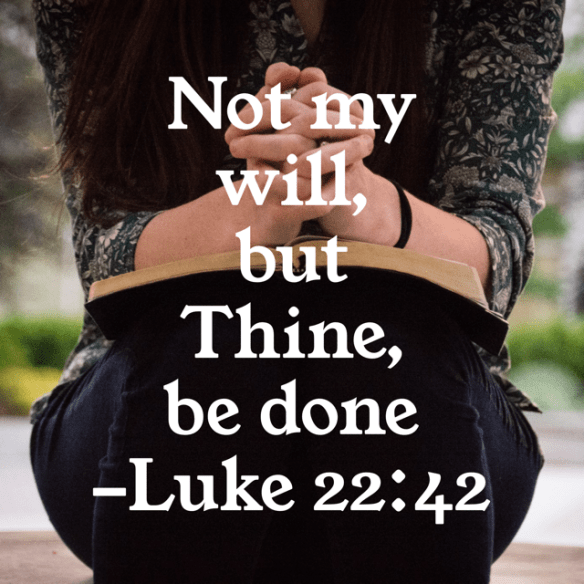
But I am heartened that our Lord Jesus, in His human nature, prayed in Gethsemane, “Father, if thou be willing, remove this cup from me: nevertheless not my will, but thine, be done” (Luke 22:42).

He taught His disciples, and practiced Himself: “If any man will come after me, let him deny himself, and take up his cross daily, and follow me. For whosoever will save his life shall lose it: but whosoever will lose his life for my sake, the same shall save it” (Luke 9:23-24).

And what was the result when He yielded to His Fathers will? Besides obeying, pleasing, and glorifying His Father, He accomplished what was needed to save multitudes of people.

It’s one of those seeming paradoxes of Scripture that “Whosoever shall seek to save his life shall lose it; and whosoever shall lose his life shall preserve it” (Luke 17:33). Whatever we want to hold onto for ourselves we will eventually lose. What we yield to Christ He will keep for us and give back so much more.

Love is patient and kind; love does not envy or boast; it is not arrogant or rude. It does not insist on its own way; it is not irritable or resentful…(1 Corinthians 13:4-5, ESV)

Have thine own way, Lord! Have thine own way!
Thou art the potter, I am the clay.
Mold me and make me after thy will,
while I am waiting, yielded and still.

Have thine own way, Lord! Have thine own way!
Search me and try me, Master, today!
Whiter than snow, Lord, wash me just now,
as in thy presence humbly I bow.

Have thine own way, Lord! Have thine own way!
Wounded and weary, help me I pray!
Power, all power, surely is thine!
Touch me and heal me, Savior divine!

Have thine own way, Lord! Have thine own way!
Hold o’er my being absolute sway.
Fill with thy Spirit till all shall see
Christ only, always, living in me!

Adelaide A. Pollard (1906)

I was blessed by more songs about God’s way here.

(Sharing with Inspire Me Monday, Global Blogging,
Senior Salon, Hearth and Home, Purposeful Faith,
Tell His Story, Happy Now, InstaEncouragement,
Anchored Abode, Recharge Wednesday,
Worth Beyond Rubies, Share a Link Wednesday,
Literary Musing Monday, Let’s Have Coffee,
Heart Encouragement, Grace and Truth,
Faith on Fire, Blogger Voices Network.
Links do not imply 100% agreement)

Laudable Linkage

I don’t usually do these on Sunday. But yesterday kicked off the Last Laura Ingalls Wilder Reading Challenge, and I didn’t want to save these for next week and end up with an overly long list then. So if you have some leisure, you might find some of these interesting.

The Almighty Bean. Our country’s addiction to coffee is used as an example of how something harmless and pleasurable can soon become too important to us.

The Spirit of Sabbath and One Woman’s Struggle With It, HT to Maree. I’ve always believed in a one-day-in-seven rest, but Jamie brings out some aspects I hadn’t considered before.

Dear Church—Don’t Overlook and Undervalue the Elderly, HT to HT to Challies. “Many young church leaders put a great deal of emphasis on attracting millennials and specific demographics that do not have gray hair or need assistance getting from their car into the building on the Lord’s Day without stumbling. When a church overlooks the elderly, it can cause several big problems within the church family.”

Modern Feminism’s Hated Enemy: Womanhood, HT to Challies. “Feminism can only survive if women continue to hate the very elements of their nature that differentiate them from men.”

The Extraordinary WW2 Sketchbook of Victor Lundy, HT to Challies.

And finally, a good song that came up in my listening this morning:

Happy Sunday!

The Last Laura Ingalls Wilder Reading Challenge Sign-up Post

This is our ninth year to celebrate the life and writing of Laura Ingalls Wilder by reading books by and about her. February seems a fitting month for this challenge since her birth and death both occurred in February.

Last year I shared why I thought Laura Ingalls Wilder was still worth reading.

If you’re looking for something other than the Little House books, I posted a Laura-related book list here. Some have also incorporated some LIW activities during that month. It’s not required, but I love to see and hear about it if you do. Annette at Little House Companion has some activities and other resources (By the way, keep an eye out for Annette’s upcoming book: The Laura Ingalls Wilder Companion due out in July!)

I don’t have many hard and fast rules about the challenge. Just sign up in the comments to let us know if you’re joining in. If you know what you’re going to read, we’d love to know: you can either share in the comments or share a link back to a post on your blog. Having a blog isn’t required.

Then, on Feb. 29, I’ll have a wrap-up post for the challenge where I’d love to hear what you read, what you thought, any corresponding activities you did. About a week later, to give people time to finish and comment, I’ll draw a name from those who participated to win their choice of a prize:

The Little House Cookbook compiled by Barbara M. Walker

OR

Laura’s Album: A Remembrance Scrapbook of Laura Ingalls Wilder by William Anderson

OR

Little House Coloring Book, which contains art and quotes from the books. It’s not designed as an “adult” coloring book, but adults could certainly use it. 🙂

If none of those suits you, I can substitute a similarly-priced Laura book of your choice. Unfortunately, I can only send physical books to US addresses due to shipping costs.

I mentioned earlier that this will be the last LIW reading challenge here. I’ve enjoyed hosting this challenge since 2012. I’ve thought about ending it the last couple of years due to waning participation and coming to an end of Laura-related things I wanted to read. But each year I’d come across another interesting book or two and decide to keep on. Now, however, I believe it’s time for me to draw this challenge to a close. If someone else would like to take it up next year, I’d be happy for you to do so.

As for this last year, I am planning to read The Mother-Daughter Book Club by Heather Vogel Frederick. It’s one of a series of novels about modern moms and middle-school daughters reading classic books. I don’t remember who recommended it to me. Modern fiction is often disappointing to me, but I have high hopes for this. I have one other title I might get to if I have time, but I am still conflicted about it. So we’ll see.

I’m looking forward to seeing what you are going to read!

Friday’s Fave Five

It’s Friday, time to count the blessings of the week
with Susanne and other friends at Living to Tell the Story.

Here we are at the end of January—one-twelfth of the way through 2020 already! I enjoy these little pauses on Friday to savor big and small good things. Here are a few from this week:

1. Cake. My husband had to have a work-related dinner out this week. He bought home a piece of chocolate cake for me. Yum.

2. More cake! A while back at the store I saw this little mix for a six-inch, one-layer cake. I got one and made it this week. It was good! It’s a nice size for just the three of us. If I have a 9×13 cake in the house, I tend to cut little slivers off and on through the day. So I try to avoid a full-sized cake except for birthdays, when there are multiple people to eat it.

Then later in the week, Mittu brought over a similar gluten-free version: a Godiva Flourless Chocolate Torte. It was good as well.

3. Not cooking. If you’ve read here long, you know I love a night out of the kitchen. I think I set a record this week: I only made dinner twice! Jason and Mittu brought Chick-Fil-A over last Friday night and made dinner here Wednesday night. One time we were out on errands and ended rather late, so we stopped nearby to eat. One night Jim gave in to my craving for hamburgers (Saturday—which I might not have asked for if I had known I’d have so many other nights off). Monday Jim was out-of-town, so Jesse picked up pizza on his way home from work. Surprise offers of dinner are always welcome, but it’s especially nice to know earlier in the day that I don’t have to cook: somehow I get so much done in that extra hour or so.

4. Fingerless gloves. For some reason, my hands have started getting cold when I am at the computer for long. My youngest son has some of these gloves, so I decided to get my own pair to try. I’m still getting used to them. The wrist is tighter than I’d like. But they do keep my hands warm while allowing me to type.

5. Timothy and jokes. Timothy has been able to “get” jokes for a while now. His originals don’t always make sense, but he’s getting there. I had previously shared with him what few I remembered from my kids’ childhood. This week he was telling knock-knock jokes. I searched for kids’ knock-knock jokes on my phone and entertained him with several. It’s so fun to see and hear him giggle at them.

And that’s my week so far! If you haven’t seen it yet, I am giving away a copy of The Shop Keepers by Nancy Moser—click and comment here if you are interested. Also, tomorrow begins the Laura Ingalls Wilder Reading Challenge here.

How was your week?

January Reflections

For many years, I thought January was a gloomy month. After the excitement of Christmas, it was sad to take down the lights and decorations and deal with the rest of the cold, dark winter.

Though I still don’t like the cold, darkness, and bare landscape, I do like the respite that January brings. For our family, there are no major events in January after everyone goes back to work. Much as I love all that’s connected with the holidays, I love having January to reset for the new year.

After a bit of resting, I’ve felt almost driven to get a number of tasks done this month. Some were organizational, some involved cleaning and mending. In my early married years, Sandra Felton’s Messies Manual and newsletters helped me reign in a lot of clutter and bad habits. One of her mottoes was “Scratch where it itches”—take care of whatever is bugging you now. That’s how I felt when I saw my bathroom curtains, shower curtains, and bedroom window all desperately needed attention. Why put that off for spring cleaning? It felt good to take care of those things, both in getting them done and having the time to do so (now the rest of the windows will have to wait. 🙂 ).

An added bonus to getting so much done early in the month is that I didn’t have anything I had to do this week beyond the usual laundry, meals, grocery shopping, etc. There’s always stuff that could be done, but I had nothing that had to be done. So I have been able to delve back into my writing. I hadn’t touched the book I am working on since probably early December. I got a few good revising sessions with it this week plus wrote the rough drafts for two potential articles.

I revised my “About Me” section of the blog (I thought I had done that once or twice since 2006, but it didn’t look like it!). I added a Writing page and tab at the top. I’ve also been removing some older, silly posts, like a “What kind of cookie are you?” quiz. I’m working on the latter partly to free up more space: I’m about to max out on the allowable space for a free blog with WordPress. It’s only taken me thirteen years to do so. I am probably going to switch to the paid version soon, both to access more storage and to eliminate the ads that WP puts on free blogs. I don’t think the ads show up as much on a computer, but they are pretty heavy on devices. And one is at the bottom of the email version of the blog posts.

Family

We did have one major event at the beginning of January: my husband and I belatedly celebrated our 40th anniversary with a quick, fun, refreshing get-away to Gatlinburg. We stayed in a cozy lodge and visited the Titanic museum.

We haven’t had many other family doings this month besides eating together once or twice a week, playing games, and chatting. We had a fun FaceTime tour of my oldest son’s new condo after he got settled in and decorated it. My youngest son started a new job in early December and is enjoying it.

Timothyisms

I know for some of you, my little grandson’s sayings are your favorite part of my monthly musings. Unfortunately, I don’t have any written down. I mentioned before that he likes texting, usually gifs and emojis. But now he’s picked up that the iPhone will offer up word prompts. That has led to texts like this:

Thanks 🙏 I the way we are we can yeah hey there are we doing a little shopping 🛒 is

And

Ghffjf us is to much to do so she has the same problem ho I ghosted and my phone 📱

He has also taken to writing us “notes.”

He’s doing well with home school. For one project, they had to make a timeline with key events from his short life illustrated with his drawings. For his birth, he drew a baby in a box. I don’t know if he thought babies arrived, like everything else, in Amazon packages, or if he remembers pictures of himself in the NICU incubator.

Watching

I finished When Calls the Heart while riding my exercise bike, at least all they had. I don’t know when to expect the latest season of it on Netflix. I’ve enjoyed it, even knowing it is different from Janette Oke’s books. I know the faith element isn’t brought out as much in the series as it was in the books, though they do sometimes quote the Bible or spiritual principles or pray. But they’ve also had some “off” sayings: “Follow your heart,” God doesn’t give you more than you can handle,” “the man upstairs,” “We’re born under a star. Maybe ours was lucky.”

We all enjoyed the second season of Lost in Space. So good, but so intense! Unfortunately, we’ll probably have to wait a year for new episodes since this season just came out.

I found a delightful four-episode series on Amazon Prime videos called Doctor Thorne, based on the novel of the same name by Anthony Trollope (whom I have never read). It doesn’t have a ground-breaking plot: a young man from an aristocratic family in the 1800s falls in love with a poor girl of questionable birth. The young man is urged by his mother and aunt to “marry money” to save the estate from its debts. It was quite enjoyable and satisfying, even though the ending was predictable. The script was written by Julian Fellowes of Downton Abbey fame, and he introduces and closes each episode. I’m not sure why it was rated TV-14: there’s nothing really objectionable in it, except two characters are alcoholics. One dies after an accident, and there’s blood, but it’s not that traumatic a scene.

I’ve discovered another Amazon prime series called Home Fires, about the British Women’s Institute during WWII. I’m only on the second episode, but it’s good so far.

We enjoyed watching the old animated 101 Dalmatians with all the family.

Reading

So far this year I have completed (titles link to my reviews):

One I finished in December but didn’t get to review til this month was Seasons of the Heart: A Year of Devotions From One Generation to Another compiled by Donna Kelderman. She draws from writings of ladies like Susannah Spurgeon and Frances Ridley Havergal and transforms them into one-page devotionals for the book.

I’m currently reading:

  • Good Tidings of Great Joy: A Collection of Christmas Sermons by Charles Spurgeon
  • Off the Clock: Feel Less Busy While Getting More Done by Laura Vanderkam
  • The Last Castle: The Epic Story of Love, Loss, and American Royalty in the Nation’s Largest Home by Denise Kiernan about the Biltmore House.
  • Hard Times by Charles Dickens (audiobook)

February marks the last Laura Ingalls Wilder Reading Challenge . I’ll have the first post for it up on Saturday. (Update: The sign-up post is here.)

Blogging

Besides the updating and book reviews I mentioned earlier and weekly Friday’s Fave Fives, I’ve posted:

I’m a bit conflicted abut whether to continue the end-of-month musings. I enjoy them. But I wonder if they are too much repetition, too much sharing things you’ve already seen. I do include some things not posted before, but a lot of it is recap. I’d love it if you would let me know honestly whether you enjoy these monthly wrap-ups or pass them by.

How has your January been? Let me know in the comments.

(Sharing with Grace and Truth, Global Blogging, Senior Salon, Shannan, InstaEncouragement, Worth Beyond Rubies)

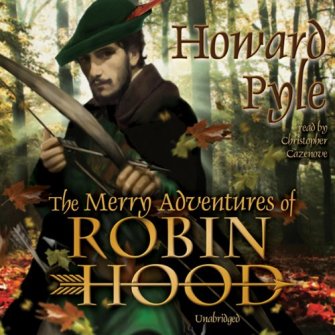
Book Review: The Merry Adventures of Robin Hood

Legends of Robin Hood have been floating around since the 14th century. Scholars debate whether early ballads and stories were based on a real person. In his earliest versions, Robin was just a crook, sometimes short-tempered, according to Wikipedia. He did not rob from the poor, but he didn’t give to them, either. Some of the aspects we know of Robin survived from the earliest stories; others were added or adapted over the years. Wikipedia details Robin’s history and variations.

The Merry Adventures of Robin Hood was the first version written specifically for children by Howard Pyle in 1883. This is the version many films and later aspects of the story are based on.

In this story, Robin is a yeoman, which seems to be a type of middle class between peasants and aristocrats (other versions cast Robin as a nobleman). He first becomes an outlaw by shooting an arrow at someone who shot at him first, subsequently killing the man. This man happened to be related to the Sheriff of Nottingham, who thenceforth became Robin’s enemy.

As Robin hid out in Sherwood Forest, others soon came to join him. Some who were poor and hungry had killed the king’s deer and fled the law. Others had goods and land confiscated by the king and had nowhere else to go.

To support themselves, Robin and his “merry men” stopped rich travelers and “invited” them to feast in Sherwood Forest, then demanded payment of them. In some cases, Robin divided up the money gathered in this way into thirds, keeping a third for his men, a third for charity, and giving a third back. Robin justified this theft because he figured those he robbed had either gotten their gain unfairly or, like wealthy clergymen, were keeping for themselves what they should be giving to others.

The poor loved Robin because he helped many of them. The classes that Robin robbed from, obviously, did not.

This book details many of the well-known stories about Robin—his first bout with Little John, his altercation of Friar Tuck (someone not in the earliest legends), the archery match in Nottingham where Robin went in disguise. Maid Marian in mentioned but never appears. Other stories I had not heard of were included as well, like how Robin met and helped Allen-a-dale to free his beloved from an arranged marriage, Robin’s deadly run-in with villain Guy of Gisborne, the recruitment of Midge, the Miller’s Son, and other tales.

The book came to a very satisfying end, until it got to the epilogue, where Robin’s death by betrayal is told.

There is an odd mention of “Cain’s wife had never opened the pottle that held misfortunes and let them forth like a cloud of flies to pester us.” That sounds like a convoluted version of Pandora’s box. And I chuckled at his phrase because a former pastor used to say it, and I didn’t know it came from this book: “There is many a slip betwixt the cup and the lip,” meaning plans don’t always work out like we hoped. Maybe it was a common saying that Pyle incorporated.

As I first started listening to the audiobook, I wished I had known of and read this book to my boys. The more I heard, though, the more I wrestled with whether that would have been a good idea or not. There’s something appealing about this version of Robin, “honest … in his own way”: someone who stands up for the little guy, who “never harmed harmless man,”  rights wrongs, bests the foolish and evil. But I could never condone vigilantism, for many reasons. And many differences in the book are solved by fighting. Plus there are copious amounts ale, beer, and the like consumed. If we had read the book as a family, we would have had to stop and discuss a lot of issues along the way. Setting aside those objections, though, the rest was fun.

There are many film version of Robin, but the only one I ever saw was the animated Disney one. I’ve seen the character in some shows like Once Upon a Time and Shrek.

I listened to the audiobook superbly read by Christopher Cazenove in a voice and accent perfect for this type of tale. Project Gutenberg has a version online here.

I read/listened to this book for the Back to the Classics challenge, but I am not sure which category to place it in yet. It would fit in two or three. I’ll wait til I read some others and then see where to place this one.

Have you ever read this version of Robin Hood? What did you think?

(Sharing with Carole’s Books You Loved, Booknificent)

Book Review and Giveaway: The Shop Keepers

The Shop Keepers by Nancy Moser is the third book in her Pattern Artist series. The first two books, The Pattern Artist and The Fashion Designer, tell the story of Annie Wood, who came from a difficult family background to become a maid to the Summerfield family of Nancy’s Manor House series. (Annie’s backstory in included in Christmas Stitches.) In the first two books, Annie had a knack for sewing and designing, but the other women in charge of that work took credit for hers. On a trip to America, Annie left her position and found a job first at Macy’s Department Store, then at the Butterick Pattern Company, then in her own dress shop. She met, fell in love, and married Sean Culver.

This third book takes place in New York in 1919, just after the first World War. Annie has two young daughters by now, but her husband has not returned from the war. He’s missing. Her shop, Unruffled, is not doing well. People had to buckle down during the war, and no one felt like buying fashionable yet practical clothes. The country is still in recovery mode. Most of the shop is decked out in black mourning dresses. One of Annie’s partners suggests they go into wedding dresses to help those who had been waiting for sweethearts to return. The prospect raises hope not only for new business but for a brighter shop and outlook.

At just the right time, a salesman from a local fabric shop offers them beautiful fabrics just right for weddings at deep discounts. Full of charm, he tempts the customers in Annie’s shop with his samples. This boon helps set the shop on a new, welcome trajectory. But something about this man bothers Annie, especially when he turns his charm her direction.

Henrietta, Annie’s bookkeeper and long-time friend. feel fortunate that her husband has returned home from the war. But he doesn’t seem totally back. He spends most of the day sitting in a chair looking out the window at the sky. She can’t seem to interest him in herself, their sons, or life in general.

Maude, who had been with Annie since her Butterick days, had married widower Antonio Ricci in the last book. Maude could not have children of her own, but welcomed Antonio’s two children. Now the oldest, Gela, is an independent-minded teenager who finds an unexpected talent. Maude is concerned where Gela’s gifts will take her in her naivete, especially when an unsavory character from Maude’s past comes on the scene.

It took me just a little bit to remember who the characters were and their backgrounds. This book could be read as a stand-alone, but I think it would be a much richer experience for those who have read the first two books.

I enjoyed this book for several reasons. I’ve often read books set during the world wars, but the time of adjustment after after WWI is a fascinating era that few focus on. There were threads of intrigue with the salesman, the man from Maude’s past, and a seeming presence in the shop workroom. Henrietta’s husband’s condition, Annie’s missing husband, and Maude’s concerns lent strands of pathos. Those were woven together with needs for forgiveness, patience, hope. I always enjoy Nancy’s afterwords with details that went her story, historical elements that were true, etc. And I love the book cover.

Once again, I found myself with both a paperback and Kindle copy of this book. I read the Kindle version, and I’d like to give the paper copy away to one of you. Just leave a comment on this post if you are interested in being part of the drawing for this book. (I’ll take all comments on this post as entries unless you let me know you’re not interested.) I’ll draw a name a week from today. I’m sorry, due to shipping costs I can only send the book to US addresses.

Have you read much from the post-WWI era?

(Sharing with Worth Beyond Rubies, Carole’s Books You Loved, Booknificent)

The giveaway is closed: the winner is Linda!

Biblical Self-Talk

I once heard a preacher say that sometimes he had to sit himself down and have a talk with himself. Have you ever felt that way?

For years after I had transverse myelitis, I struggled with panic attacks and extreme fears. I didn’t realize until fairly recently that, just as I had to recover from the physical effects of the disease, I also had to recover emotionally and mentally from the trauma of the disease itself.

We all know anything can happen any time. We’re not guaranteed our next breath. But then when something catastrophic does happen, it can throw us for a loop. Our foundations are shaken, our security is threatened. Looking back now, it’s no wonder I had panic attacks. Unfortunately, some of the things I feared were psychiatrists and psychiatric drugs, so I didn’t tell anyone what I was going through. I was given Xanax for a while in the hospital, but no one explained why. I heard it was addictive, so I didn’t take it when I got home. I even wondered if they thought my symptoms were in my head.

If I had it to do over again, I’d talk to my neurologist, who was primarily in charge of my care at the time. I’d ask why I was given Xanax, explain what was going on, see what he had to say, and evaluate the options. That’s what I would advise anyone else to do.

Instead, I read what I could about anxiety and panic attacks. I learned that breathing in slowly through my nose and out through my mouth had a calming effect. I would think through or sing through hymns to get my thoughts on another track. And I would remind myself of truth and common sense, which I later learned was self-talk.

For instance, on our way to the church we attended at the time, we almost always got caught at a red light on an overpass. This overpass was one that trembled when an 18-wheeler passed, which happened often. When a visiting speaker’s wife mentioned that this overpass scared her, my own fears escalated. We knew no other way to get to church than this route. So I would tell myself, “Seriously, how often do you hear of these things falling down? Not very often. It’s more likely not to happen than to happen. If it does happen, there’s nothing you can do about it. You’ll either go straight on to heaven, or God will help you through whatever happens just as He did with TM. Don’t ruin or waste your day by worrying about something that is not likely to happen.” Then I’d sing hymns to myself not only to guide my thoughts away from scary things, but also to remind myself of God’s care and promises.

That helped with things not likely to happen. But what about things that could very well happen? TM was a one-time occurrence with lasting ramifications. But one form of it did cause repeat occurrences. And sometimes what was thought was TM was actually found to be MS when repeated attacks occurred. My TM had started with one hand feeling a little funny, like I had slept on it wrong. Within three hours, my whole left arm and both legs were numb and I couldn’t walk on my own. So every time a limb fell sleep, every time I had a funny, not-quite-right feeling, every time symptoms flared up, so did the fears of a repeat attack. I had to remind myself that this probably was not another attack, but just a flare-up. If it was another attack, God would help me just as He did the first time. Eventually, after multitudes of flare-ups without another full-fledged attack, and after a significant amount of healing, I learned to just roll with the symptoms and eventually to hardly notice them.

Sometimes we have to talk to ourselves over spiritual issues, too, don’t we? A tragedy occurs, and we feel like maybe God doesn’t love us like we thought He did. We remind ourselves that God loves us “with an everlasting love” (Jeremiah 31:3), that He loved us even when we were His enemies. Or we feel worthless and remind ourselves we are accepted in the Beloved.

We have several instances of Scriptural self-talk in the psalms. The psalmist asks himself three times, “Why are you cast down, O my soul, and why are you in turmoil within me?” (Psalm 42:5, 11; 43:5, ESV). Then he answers himself, “Hope in God; for I shall again praise him, my salvation and my God.” David tells himself to “Bless the Lord, O my soul”  in Psalm 103 and then reminds himself why he could do so. He reminds himself about God’s character, what He had done for Israel in the past, what He had done for David himself.In Psalm 57, David is hiding in a cave from Saul. After pleading for God’s mercy and reminding himself of God’s power, love, and faithfulness, David tells himself to wake up and praise God:

My heart, O God, is steadfast, my heart is steadfast; I will sing and make music. Awake, my soul!  Awake, harp and lyre! I will awaken the dawn. (Psalm 57:7-8, NIV).

Other psalms don’t employ that exact language, but they show the writer coming to God with a problem or an issue: Where are you? Why are you not acting? The wicked are faring better than Your people. I’m hurting here. People are persecuting me for no reason.

And then the writer reminds himself of truths about his God: He’s here. He loves us. He cares. The wicked will face their consequences some day if they don’t repent. God will strengthen me and help me.

I shared this quote before from David Martyn-Lloyd Jones in Spiritual Depression, but I love it:

Have you realized that most of your unhappiness in life is due to the fact that you are listening to yourself instead of talking to yourself? Take those thoughts that come to you the moment you wake up in the morning. You have not originated them but they are talking to you, they bring back the problems of yesterday, etc. Somebody is talking. Who is talking to you? Your self is talking to you. Now this man’s treatment [in Psalm 42] was this: instead of allowing this self to talk to him, he starts talking to himself. “Why art thou cast down, O my soul?” he asks. His soul had been depressing him, crushing him. So he stands up and says, “Self, listen for moment, I will speak to you.”

Instead of being at the mercy of our thoughts, we challenge them and correct them. We need to take our thoughts captive (2 Corinthians 10:5). We set aside wrong thoughts and actively pursue truth. We steady our souls with God’s truth. We fill our minds with God’s Word so the Holy Spirit can remind us of it.

Have you ever had to give yourself a good talking-to?

(Sharing with Inspire Me Monday, Global Blogging, Senior Salon, Hearth and Soul, Purposeful Faith, Tell His Story, Happy Now, InstaEncouragement, Anchored Abode, Recharge Wednesday, Worth Beyond Rubies, Share a Link Wednesday,
Let’s Have Coffee, Heart Encouragement, Faith on Fire, Grace and Truth,
Blogger Voices Network, Literary Musing Monday)