Friday’s Fave Five

It’s Friday, time to look back over the blessings of the week
with Susanne and other friends at Living to Tell the Story .

The first Friday of August! Our family has a lot to look forward to this month. But first, let’s take a moment to look back and appreciate good things from the last week.

1. A gift of meat. Jason and Mittu bought some Balsamic Rosemary Beef Steak Tips from Trader Joe’s, then noticed the seasonings had gluten, which Mittu and Timothy can’t have. They asked us if we wanted it. Sure! We enjoyed it with some potatoes and carrots and salad.

2. A productive week. Some days–even weeks–it feels like I am constantly busy, yet never get ahead. This week I got to dig into some stuff and felt really good about it.

3. The Friend Finder app. Jim’s been on the road a lot this week, and this app onΒ  the phone helps me see where he is and calculate when he’ll be home, so I know when to start making dinner. Sometimes he’ll call or text me his ETA, but that can vary with traffic and stops.

4. Slushy orange juice. Once I had some punch at a shower that was made by freezing citrusy juices, then thawing them out just until slushy and adding ginger ale. It was so good and refreshing. Since then, sometimes in the summer I’ll put a glass of orange juice in the freezer while my oatmeal is cooking. By the time the rest of my breakfast is ready, my juice has ice crystals in it. I’ll pour in a little ginger ale, and voila!

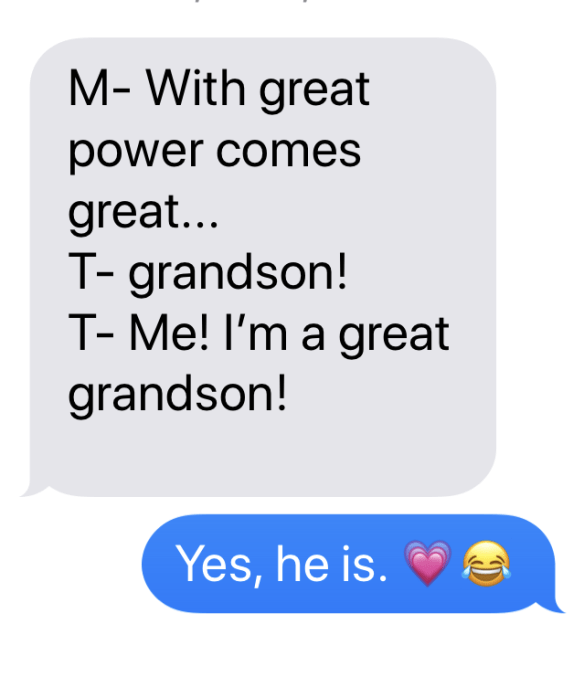
5. Texts about Timothy. I mentioned this in my end-of-July post, but this text from my son about my grandson cracked me up:

I know that feeling. πŸ™‚

Speaking of my end-of-July post, I also acknowledged my blog anniversary and am holding a giveaway to celebrate it there. I invite you to enter for the giveaway drawing on that post.

Happy Friday!

End-of-July Musings and a Blog Anniversary Giveaway

Although technically summer runs from June 21 to September 23 this year. I always think of summer as June, July, and August. And according to that reckoning, summer is 2/3 of the way over.

When my kids were younger, this would be about the time we’d start thinking about school supplies, checking out backpacks and lunchboxes to see whether they’d serve for another year. Although I enjoyed the more laid-back summer schedule (or lack thereof), around this time of year I started looking forward to more structure and cooler days of fall.

But with all of our kids officially out of school now, the only major change from this month to next is looking forward to my oldest son visiting for ten days in August to celebrate his and my birthdays. My husband takes that time off, too, so it’s something like a stay-cation. Jesse has neither work nor school this time, which is nice. Since he’s hunting for full-time work now, this might be the last time he’s available for all ten days. Jason still has to work, but he and Mittu and Timothy come over as much as they can, and we go to their house and have some outings.

Family happenings

But back to July. The month started, of course, with Independence Day celebrations. We enjoyed the traditional July 4th cookout and the freedom to celebrate without fear or pressure, thanks to those who fought for our nation’s independence and safety.

We observed Jim’s mom’s birthday early in the month, the first since she passed away in January. She was so incapacitated for so long, and she was so ready to go to heaven, I don’t know if I’d say we mourned for her. We’re happy she’s released to be reunited with her loved ones in heaven. But there was a pang of sadness that day. A couple of thoughtful friends remembered and sent sweet messages.

We enjoyed celebrating Jason’s birthday over at their house. Timothy is always fun at celebrations. πŸ™‚

Jim painted our bathroom walls, cabinets, and light fixture and I found some just-right bath mats, so we’re enjoying the new look there.

Mishaps

We’ve had some odd occurrences this month:

1. This one actually happened before this month, but I don’t think I mentioned it here. I reached for my curling iron, then noticed something black sticking out from the top. I thought maybe a piece of plastic was sticking up and went to pull it off. Upon closer inspection, I saw this:

An earwig had nestled down into where the screw went. Ew! One friend on Facebook said, “You wanted to curl your hair — that would have curled mine!”

2. We went to a park one Saturday morning, and I had to stop at the port-o-pottie before heading home. As I was trying to keep my clothes and my skin from touching anything icky, and trying not to breath the hot, fetid air, I noticed a spider on the wall and tried to kill it. When I stepped out, I realized my glasses were not in my pocket. I looked back and — yes, they had fallen into the toilet. Jim offered to fish them out for me. No, thanks! They were just little W-Mart readers, and I had some extras on hand at home.

3. That same day, Jesse headed out to join us for lunch at a nearby Mexican food restaurant. He stopped to get gas on the way. When he opened the covering to the gas cap, he found hornets had built a nest there. The gas station was in front of a grocery store, so he ran in to get bug spray and had to take care of the hornets before getting gas. Thankfully he wasn’t stung, but he was a little rattled when he came to lunch.

4. I was making barbecue ribs in the instant pot for a church potluck. I’ve made them a few times before with no problem. But I had the pot fuller than ever before. When I vented the steam, it was full of sauce and sprayed all over the counter, including Jim’s tablet and the covered, labeled, ready-to-go dessert for the potluck. So we had to clean all that up. Then a couple of days later I saw some had even gotten on the ceiling. Thankfully my husband took care of that for me.

These were all disconcerting at the time, but they made for funny stories afterward!

Timothyisms

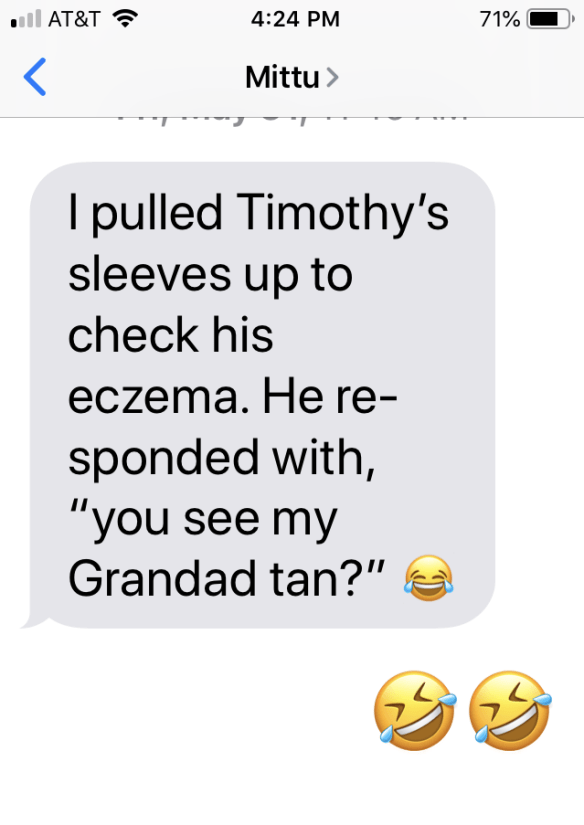
From some texts about my five-year-old grandson:
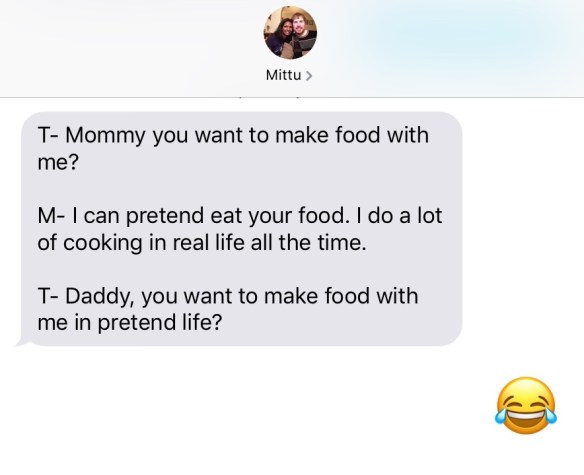
The last is a reference to what some call a “farmer’s tan” — from the elbows down πŸ™‚

And my favorite, from earlier this week:
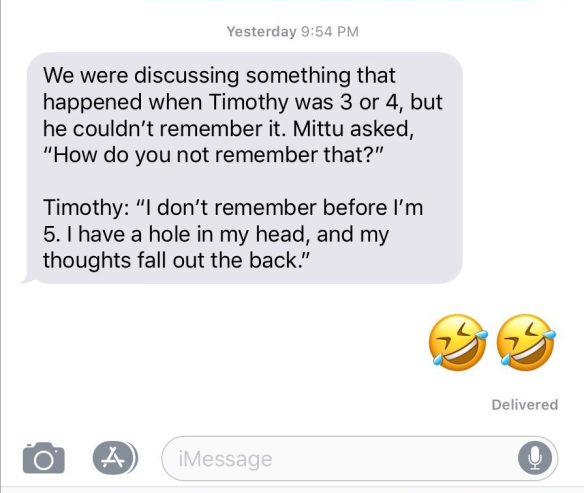
I know that feeling . . .

We were also pretty impressed with Timothy’s engineering capacities. He loves lawn mowing with his granddad, and for his last birthday we got him a battery operated toy mower. But he rigged up a couple for inside use. He took his toy shopping cart and put his toy checkout register on top, and ran the conveyor belt on the register for the motor sound. The he took the Operation game, put it on top of an indoor riding toy, and clipped the tool for it to one of the operation sites so it makes the buzzing sound for a motor.

Creating

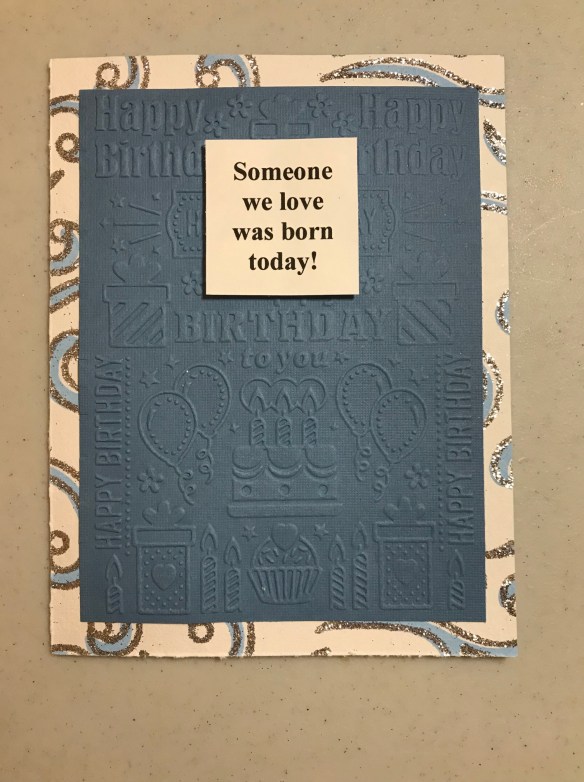
Nothing much this month except for the card I made for Jason’s birthday:
Writing

I mentioned the last few months that I was having a hard time getting into the editing stage of my book’s rough draft. It was just hard to find the time, plus it seemed overwhelming. But, thankfully, I’ve had several substantial editing sessions this month. When I am planning to work on my manuscript, I keep dragging my feet and finding other things to do. But once I get into it, I enjoy it and wish I had more hours in the day to work on it. If you’ve prayed about that with me, thank you!

Reading

Reading is a highlight of every month to me. This month I’ve finished (titles link back to my reviews):

  • A Place Called Morning by Ann Tatlock. A five-year-old grandson dies while under his grandmother’s care, and she can’t forgive herself. She withdraws from everything except her relationship with a mentally-disabled man, and later learns some surprising secrets about her history. Wonderful book about forgiveness and relationships.
  • Every Secret Thing by Ann Tatlock. twenty years after graduating from a prep school, Elizabeth Gunnar finds herself back as a teacher. A secret kept between her group of friends years back nags at her until she seeks to find answers. Wonderful redemptive story.
  • Sweet Mercy by Ann Tatlock. A teenage girl moving away from a crime-ridden area finds that there is no Paradise on earth and she needs mercy as much as the gangsters and bums she looks down on. Excellent.
  • Rorey’s Secret by Leisha Kelly. A fire breaks out in a barn, burning it and crops to the ground during the Depression. But the one person who knows what happened isn’t coming forward.
  • The Mill on the Floss by George Eliot, primarily about a brother and sister with opposite personalities. The sister, Maggie, is said to be somewhat based on Eliot herself. Not my favorite of hers, but still good.
  • Suffering Is Never For Nothing by Elisabeth Elliot, based on a series of talks she gave at a conference. Excellent.

I’m currently reading:

  • Anna Karenina by Leo Tolstoy
  • 84, Charing Cross Road by Helene Hanff
  • Loving People: How to Love and Be Loved by John Townsend. Still chipping away at this one.
  • Kill Order by Adam Blumer, due out next month. Very good so far!

Blogging

Around the blog this month, besides my usual book reviews, Friday’s Fave Fives, and Laudable Linkage:

If you’ve read this far, give yourself a hearty pat on the back.

One last thing before we wrap up June: I had completely forgotten about my 13th blogging anniversary this month until WordPress sent me a notice:

One reason I am glad they reminded me is that some months back I picked up a couple of items that I thought would make nice prizes:

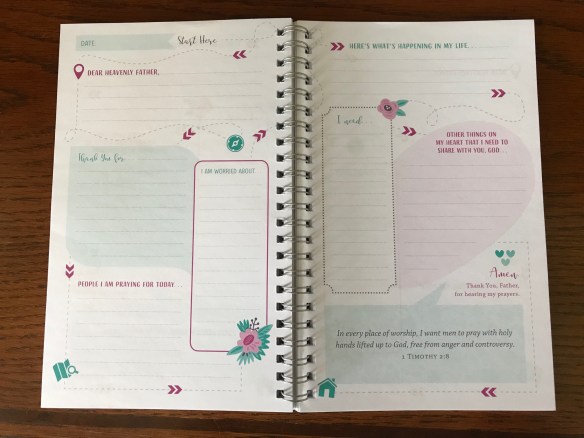
On the right, as the package says, are some cute magnetic page markers. The prayer journal on the left looks like this on the inside:
One of the main joys of blogging is you. I have made some great friends here over the years, and I so appreciate your taking time to read and comment! So as a thank you, in one week I’ll draw a name from the comments on this post and ship both of these items to the winner. If you’re reading from Facebook or some other means and would like to enter for the giveaway, please click through and comment on this post. I apologize, due to shipping costs I can only send to US addresses. I’ll count all comments here as entries unless you let me know you’re not interested or too far away. And please leave me some way to contact you. If I can’t figure out how to let you know you won, I’ll choose another name.

Whew! Good-bye, July! Hello, August!

(Sharing with Let’s Have Coffee, Porch Stories,
Share a Link Wednesday, Linda’s Loose Ends,
Grace and Truth, Shannan’s What I’m Into)

Update: The giveaway is now closed, and the winner is Wendi! Congratulations, Wendi!

 

Book Review: Sweet Mercy

In the novel Sweet Mercy by Ann Tatlock, seventeen-year-old Eve Marryat is glad her family has to leave St. Paul, Minnesota in 1931. The city had become a haven for gangsters and crime: Eve had even witnessed a man being killed.

Her father, newly laid-off from the Ford Motor Company, is taking the family back to where he grew up in Mercy, Ohio. His family owns the Marryat Island Ballroom and Lodge right on the beach, and Eve and her parents will help out in various capacities. Eve has idyllic memories of her family’s previous visits to the hotel and beach.

Before long, Eve learns that things and people aren’t always what they seem. She learns she has an albino cousin she never knew of before. At first he seems curmudgeonly, she assumes because of what he looks like and how other treat him. She soon finds out he harbors deep pain. She’s surprised to find that a bum who comes for an occasional handout meal has attended college and has ambitions. A boy she meets and starts a relationship with seems good and kind, until she finds out he’s a part of a crime network. And then she learns of nefarious goings-on right there in her uncle’s hotel.

Eve has a hard time with everyone else’s wrongdoing until she’s put into a position she has to cover up.

All I knew for sure was there wasn’t a place in the world that matched my dreams. For as long as I lived I would never stop pining for Paradise, but the gates had been shut and bolted long before I was born. I knew that now. The heartsickness of life outside of Eden was everyone’s lot, including mine

Her guilt and need for mercy open her eyes to her judgmentalness and everyone else’s need for mercy as well.

When I first read the description of this book, I thought the gangster side of it an odd topic. But I loved the way Ann showed us Eve’s character and opened her eyes as well as ours. I enjoyed Ann’s creative phrasing, like “A small steel bridge, humped like the back of a frightened cat” and “The day hobbled along on wounded feet.” I loved the many layers of the title’s meaning. This is another winner.

(Sharing with Carole’s Books You Loved, Booknificent, Literary Musing Monday)

Longsuffering Is Hard

A former pastor, an older, distinguished Southern gentleman with a deep bass voice, used to pronounce longsuffering with an extended “o”: looooooooooongsuffering. His point was, of course, to illustrate that longsuffering is suffering long.

Newer Bible translations render this word “endurance” or “patience,” and both of those are perfectly accurate. But I like the old word, longsuffering, because it’s a reminder that suffering of whatever nature is hard.

That last thought was a bit of a revelation for me (more like a “duh” moment, actually). I realized I’d been thinking that if I endured something hard for a while, then it wouldn’t “feel” hard any more. Longsuffering would give way to sweetness and ease. When whatever I was enduring still felt hard, I wondered what was wrong with me.

But “longsuffering” indicates it is still hard. And we still need grace to endure. Praying for it doesn’t make it easy, but bearable.

Like long-term physical issues. Or caregiving. Or trying neighbors or coworkers. Or difficult circumstances with no resolution in sight. Or extended loneliness.

Or even our own selfishness. Does anybody else get discouraged by the thought that our selfish nature will always be with us and we’ll have to keep fighting it until we get to heaven?

Sometimes my worst reactions are to little things hardly worth the name of “suffering” and certainly not long. Amy Carmichael once wrote:

The hardest thing is to keep cheerful (and loving) under little things that come from uncongenial surroundings, the very insignificance of which adds to their power to annoy, because they must be wrestled with, and overcome, as in the case of larger hurts. Some disagreeable habit in one to whom we may owe respect and duty, and which is a constant irritation or our sense of the fitness of things, may demand of us a greater moral force to keep the spirit serene than an absolute wrong committed against us. (1)

Thankfully, God is longsuffering with us.

The Lord God, merciful and gracious, longsuffering, and abundant in goodness and truth (Exodus 34:6).

Thankfully, we can pray for His longsuffering in us:

For this cause we also, since the day we heard it, do not cease to pray for you, and to desire that ye might be filled with the knowledge of his will in all wisdom and spiritual understanding; That ye might walk worthy of the Lord unto all pleasing, being fruitful in every good work, and increasing in the knowledge of God; Strengthened with all might, according to his glorious power, unto all patience and longsuffering with joyfulness (Colossians 1:9-11).

Longsuffering with joyfulness, it says. Yes, there will be great joy when whatever we’re suffering is over. But God gives joy in it as well. Maybe not joy for whatever it is in itself, but joy that God is with us, helping us, teaching us through it. “We rejoice in our sufferings, knowing that suffering produces endurance, and endurance produces character, and character produces hope” (Romans 5:3-4).

Wait a minute, you might say. Didn’t Jesus say His yoke was easy and His burden light? Yes, He did, in Matthew 11:28-30. One aspect of His yoke being easy is that the Pharisees had added on or expounded upon the Old Testament law, making it extremely burdensome. People couldn’t keep the OT law as it was. Jesus’s yoke was easy in the sense that He kept the law in our place and took the punishment for our sin upon Himself. Another aspect of His yoke being easy is that He helps us bear whatever He allows. He calls us to cast all our cares on Him and come to Him for help. Those who don’t know Him don’t have that help.

But He never indicated the Christian life is a bed of roses.

There are several reasons in Scripture why God allows suffering of various kinds. And it’s okay to say it hurts or it’s hard. But “His divine power has granted to us all things that pertain to life and godliness, through the knowledge of him who called us to his own glory and excellence, by which he has granted to us his precious and very great promises” (2 Peter 1:3-4a). All things.Through the knowledge of Him. Get to know ever better our great high priest who “sympathize[s] with our weaknesses . . .who in every respect has been tempted as we are, yet without sin. Let us then with confidence draw near to the throne of grace, that we may receive mercy and find grace to help in time of need” (Hebrews 4: 15-16).

I count all things to be loss in view of the surpassing value of knowing Christ Jesus my Lord, for whom I have suffered the loss of all things, and count them but rubbish so that I may gain Christ, and may be found in Him, not having a righteousness of my own derived from the Law, but that which is through faith in Christ, the righteousness which comes from God on the basis of faith, that I may know Him and the power of His resurrection and the fellowship of His sufferings, being conformed to His death; in order that I may attain to the resurrection from the dead. (Philippians 3:8-11, NASB)

___________
(1) Houghton, Frank. Amy Carmichael of Dohnavur. (Fort Washington, PA: Christian Literature Crusade, 1983), 86-87.

All Bible references are from the ESV unless otherwise noted.

(Sharing with Inspire Me Monday, Purposeful Faith, Let’s Have Coffee, Recharge Wednesdays, Share a Link Wednesday, Grace and Truth)

Laudable Linkage

IMG_0195

Here are the latest, greatest reads I’ve found:

For My Angry Friends, Part 7: Foundation II. This is a continuation of a link I posted last time.

A Different Kind of Humble Pie. I like this idea! And it would help us avoid having to eat the other kind.

I’m So Glad Our Vows Kept Us, HT to Challies. β€œGod has not given you your love to protect your vows, but he’s given you your vows to protect your love.”

Don’t Squander the Little Years, HT to Story Warren. “The endless demands of parenting little ones can feel heightened by the fact that this is often the very season of lifeβ€”late 20s through the 30sβ€”when budding careers are most demanding and precarious. The need to be tirelessly devoted outside the home can tempt young parents to be less devoted inside the home.”

How Parenting Exposes Our Need for Faith. “Like nothing else in my following life, mothering has taken me to the edge of what I know for sure about God and how to follow him well.”

What Is the Aim of Christian Writing? HT to Challies. If you are at all into writing as a Christian, I encourage you to read this. “Writing is an attempt to take the truth of God’s Word and apply it to the crevices of life.”

Elderly Couples’ Photos. A professional photographer asked several older couple to pose for engagement-style photos. So sweet and beautiful.

It Is What It Is”…but God IS Bigger.” I’ve followed Carol at Blessed But Stressed for many years now. A few years ago, her son fought leukemia, and God graciously healed him. Now he’s facing serious surgery on his eye. Would you join in prayer for as much healing as possible in God’s perfect will?

I don’t know the origin of this graphic, but it looks like something Little Birdie Blessings might do. But I like what it says.

Happy Saturday!

Friday’s Fave Five

It’s Friday, time to look back over the blessings of the week
with Susanne and other friends at Living to Tell the Story .

The last Friday of July! For several days the humidity was way high, and we felt too drained to do much. It was down to a welcome 32% yesterday, but today it’s back up to 76%.

I don’t know where the rest of the month went. But here are five highlights from the last week.

1. Church potluck. After a stressful morning where every other thing went wrong, we actually made it to church on time. And we enjoyed the service and fellowship afterward. Even though we’re a small church, we still manage to sit with someone different almost every time. A good opportunity to get to know folks better.

2. Allergy-friendly recipes. Almost every family at church has a member with serious food allergies. I know their families bring food they can eat, so every dish at a potluck doesn’t have to be allergen-free. But I like to try to make what I bring as accessible as possible. I made a mini version of these apple cider donuts that were gluten-free, egg-free, and nut-free — and tasty!

3. A dinner invitation. Friends invited us to their house for dinner, and we had such a good time.

4. A sponge and scrubbie holder. I was using a soap dish left behind by the previous occupants. But it was glass and broke when accidentally knocked into the sink. I love this holder because it keeps the two scrubbing tools separate, so they dry out better.

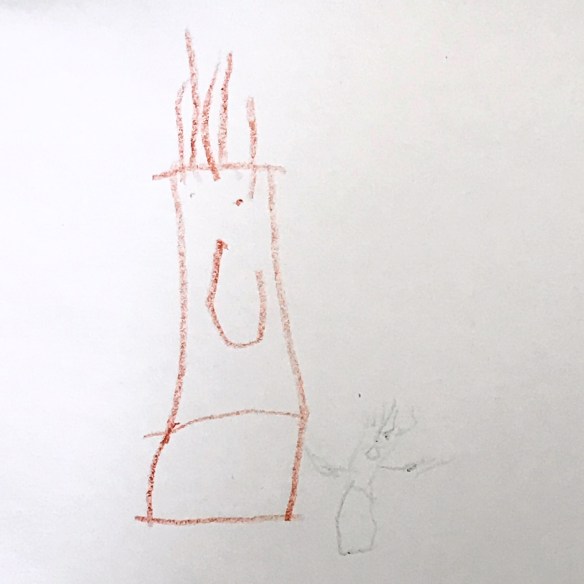
5. Timothy’s balloon man. My grandson loves those tall, floppy air-filled contraptions often seen at car lots. We learned they are called air dancers. But he calls them balloon men. My son and daughter-in-law found a mini one Timothy could play with.

Then Jason sent me this drawing Timothy made of a “Big balloon man and baby balloon man.”

Happy Friday!


Book Review: Rorey’s Secret

Rorey’s Secret is the fourth of Leisha Kelly’s series about the Wortham family, set duringΒ  and just after the Depression. The fourth through sixth books are called the Country Road Chronicles and take place a few years after the first three, when the Wortham children are teenagers.

This book begins with mom Julia Wortham in the kitchen preparing a birthday dinner for one of their neighbor boys. The Hammond family lost their mother at the beginning of the second book. Their father, George, had not coped well at first, but seemed stable now. Several of the Hammond’s ten children are over visiting the Worthams at any given time. The youngest is trying to help Julia fry chicken, and making a mess. Just as another Hammond child tries to bring newborn kittens in the house, the oldest drives up with his wife in labor and very active toddler diving in Julia’s cabinets because he likes the bang all the pans make as they fall out. As Julia’s husband and son come in from working, Julia sends them off for the doctor.

But the doctor can’t be reached, and Julia reluctantly plays midwife. Somehow after several hours, the baby is born, everyone’s fed, and several of the Hammond family go home.

As Julia and her husband, Samuel, prepare to drop into bed, they notice a strange glow in the distance: a fire over at the Hammonds’. Sam and his son and daughter drive over to help: Julia stays behind because the new mother and baby are still at her house for the night.

Sarah, the Wortham’s daughter, tries to keep the younger Hammond children safely away from the barn’s flames, but ten-year-old Bertie dashes away into the barn out of concern for the calves. Sarah alerts her father, who runs after Bertie to bring him out. Then the roof caves in.

Both Bertie and Sam are pulled to safety, but both are injured, Sam seriously. His son takes both of them back to the Wortham’s house and goes to try to find the doctor again. Julia, worried sick, tries to help them the best she can.

Inexplicably, several of the Hammonds blame middle son Franky for the fire. In the previous books there has been a subplot involving him. He seems to have a learning disability: he can’t learn to read no matter how much he wants to. He can do math in his head, but not on paper. Of course, not much was known about such then, and his schoolmates and even his father think he’s stupid. Franky is also the most dreamy, sensitive, and spiritual of the bunch. If he had started the fire, he’d be the first to own up to it. There also seems to be some tension between Franky and his teenage sister, Rorey, but neither will open up about it.

Rorey, for her part, is being cagey and aloof. The bulk of the book focuses on the tension between Rorey, Franky, and the rest of the two families as the cope with the aftermath of the fire. When Rorey tells a part of her secret to Sarah, then Sarah’s in a quandary as to whether to keep her promise not to tell.

The point of view rotates from chapter to chapter between Julia, Sarah, and Franky. I could identify a lot with Julia, worrying about her husband, feeling overwhelmed with all the people and issues, wanting to set things straight between Franky and his father. She struggles to trust God and seek wisdom. But she makes a good point here:

Somewhere I’d heard that the first time a young person does something really bad, a significant bit of their future and the choices they make rest upon the kind of response they get. I prayed our response to Rorey would be what she needed (p. 229).

I loved the first couple of books in the series. All the chaos in the beginning of this one nearly made my head spin. Still, life is like that sometimes, and that’s one of the hardest times to maintain trust in the Lord. I liked the way this one worked out in the end and what everyone learned along the way.

(Sharing with Carole’s Books You Loved, Booknificent)

Book Review: Suffering Is Never for Nothing

Suffering Is Never for Nothing by Elisabeth Elliot is “a very slight adaptation” of a series of talks Elisabeth gave at a conference. Someone had given a set of the conference CDs to Jennifer Lyell. She was so blessed, she gave copies to others. Finally she met and befriended Elisabeth and her husband, Lars, when Elisabeth could no longer speak. Later she obtained permission to transcribe the talks and have them published.

Though this volume wasn’t published in Elisabeth’s lifetime, if you’ve read her books, listened to her radio program, or heard her speak, you’ll hear familiar themes.

Just a bit of background for those who might not be familiar with Elisabeth: she and her husband were missionaries to an Indian tribe in Ecuador when several of the missionary couples were burdened to try to reach a tribe then known as Aucas ( later it was discovered they called themselves Waorani). The Aucas were thought to be a savage tribe: their every encounter with any from outside their world ended badly. After several seemingly friendly encounters, the men thought the time had come to try to meet the tribe in person. The first visit went well, but then the Aucas speared all five of the men to death. A few years later Elisabeth, her young daughter, Valerie, and Rachel Saint, sister to another of the men, Nate Saint, went to live with the Auca/Waorani. Elisabeth shared that story in Through Gates of Splendor. In later years, Elisabeth remarried, but her second husband died of cancer. Before that marriage, Elisabeth lost almost the entire body of the translation work she had painstakingly labored over in the jungle. Along with these major losses in her life, she’s dealt with the everyday ones we all face.

I don’t know if Elisabeth intended to start a writing career when she published her first book: she was still a missionary in the jungle at the time. But God led her to write several more. I was one of many who considered her a mentor from afar, appreciating her no-nonsense, straightforward style and firm foundation on the Word of God.

To come back to this book, after naming several examples of suffering, Elisabeth boiled it down to this definition: “Suffering is having what you don’t want or wanting what you don’t have” (p. 9). That’s well and good, but what do we do about it? Elisabeth says, “I’m convinced that there are a good many things in this life that we really can’t do anything about, but that God wants us to do something with” (p. 8).

Probably our biggest struggle concerning suffering is wondering where God is in it and why He allows it. Verse after verse assures us that God is right there with us in suffering. And some passages give us a few ideas of why He might allow it. Elisabeth says, “The deepest things that I have learned in my own life have come from the deepest suffering. And out of the deepest waters and hottest fires have come the deepest things I know about God . . . The greatest gifts of my life have also entailed the greatest suffering” (p. 9).

Still, “There would be no intellectual satisfaction on this side of Heaven to that age-old question, why. Although I have not found intellectual satisfaction, I have found peace. The answer I say to you is not an explanation but a person, Jesus Christ, my Lord and my God” (p. 12). She shares that when she first heard the news that her first husband was missing, she didn’t hear anything more about his condition or whereabouts for five days. God brought to her mind Isaiah 43:2-3: “When thou passest through the waters, I will be with thee; and through the rivers, they shall not overflow thee: when thou walkest through the fire, thou shalt not be burned; neither shall the flame kindle upon thee. For I am the Lord thy God, the Holy One of Israel, thy Saviour.” She realized God wasn’t promising anything about her husband, but He promised to be with her.

“The questions remains, is God paying attention? If so, why doesn’t He do something? I say He has, He did, He is doing something, and He will do something” (p. 13).

She discusses the perspective of the cross and the two different kingdoms, the one on this world and the kingdom of God.

It’s He who was the Word before the foundation of the world, suffering as a lamb slain. And He has a lot up His sleeve that you and I haven’t the slightest idea about now. He’s told us enough so that we know suffering is never for nothing (p. 16).

We are not adrift in chaos. To me that is the most fortifying, the most stabilizing, the most peace-giving thing that I know about anything in the universe. Every time that things have seemingly fallen apart in my life, I have gone back to those things that do not change. Nothing in the universe can ever change those facts. He loves me. I am not at the mercy of chance (p. 43).

Faith is not a feeling. Faith is willed obedience in action (p. 45).

She then discusses our response: acceptance, gratitude, offering whatever it is back to God, and the transfiguration He works in us, with a chapter devoted to each of those.

Now if I had had a faith that was determined God had to give me a particular kind of answer to my particular prayers, that faith would have disintegrated. But my faith had to be founded on the character of God Himself. And so, what looked like a contradiction in terms: God loves me; God lets this awful thing happen to me. What looked like a contradiction in terms, I had to leave in God’s hands and say okay, Lord. I don’t understand it. I don’t like it. But I only had two choices. He is either God or He’s not. I am either held in the Everlasting Arms or I’m at the mercy of chance and I have to trust Him or deny Him. Is there any middle ground? I don’t think so (pp. 26-27).

Many years ago I read a different book by Elisabeth on this topic, A Path Through Suffering. At first I thought this was a republication of that book by a different name. It’s not, though. Some of the information probably overlaps, but they are two different books, both worthy to be read and extremely helpful.

I enjoyed reading this book over the last few weeks with the True Woman Summer Book Club and looking through the comments and study questions there.

(Sharing with Grace and Truth, Carole’s Books You Loved, Booknificent)

Writer Newsletter Survey Results

A couple of weeks ago I invited you to participate in a survey I was conducting about writers’ newsletters.

Some of you subscribe to my blog via email. Someone asked me privately if that was what I meant by a newsletter. No, when you subscribe to the blog, you get an email from WordPress each time I post with that post’s content. A newsletter is something in addition to that, with additional news or thoughts not posted on the blog (though it may contain links back to the blog as well.)

I’ve been told that some publishers put great stock in the size of one’s newsletter list. As a reader, I don’t subscribe to very many newsletters myself, from either bloggers or authors. So I wanted to discern how other readers felt about them in order to know whether I should start one as I finish my book.

31 people responded to my survey. Here are my questions and their answers:

1. Do you subscribe to newsletters from authors or bloggers? How many?

    • Yes, a few: 17
    • Yes, several: 5
    • No: 8

2. If you don’t subscribe to any, why?

    • I don’t want any more email: 12
    • I already follow their blog or other social media: 8
    • Not interested: 4
    • Other: 4

3. What’s the ideal frequency of newsletters?

    • Weekly: 5
    • Monthly: 10
    • Quarterly: 5
    • A couple of times a year: 1
    • Only when a new book is coming out: 6
    • Other (please specify): 4 responses:
      • not daily, only if you have a new book on sale. Weekly or whatever makes sense to you.
      • whenever the author feels the need
      • None thank you
      • Bi monthly

4. What do you like to see in newsletters? Check all that apply.

    • News about upcoming publications: 16
    • Chatty news about the author (family, travel, hobbies, activities, etc.): 12
    • Interesting background information related to book: 16
    • Sales: 3
    • Bonus material: 11
    • Quotes or reviews from other readers: 2
    • Upcoming events (speaking events, book signings, etc.): 9
    • What books the author is reading or recommends: 11
    • None – would rather read this on blog: 10
    • Other (please specify): 5 reader responses:
      • I am glad to see this blog with info about your book/s as they happen.
      • Summaries with links to make it easy to choose what you want to read.
      • Material relevant to my interests. I don’t have time for a bunch of fluff.
      • I subscribe to a few newsletters from bloggers who have “subscriber freebies”, mostly homeschool materials. But I don’t generally read the email except to find the password to the subscriber page. I generally dislike getting extra email and prefer to read content from blogs I can subscribe to in Feedly.
      • Giveaways (there should be some sort of perk for the reader)

5. What don’t you like about newsletters? Check all that apply.

    • Too frequent: 20
    • Too long: 15
    • Too repetitive (sharing information already seen on blog or other media): 17
    • Not enough information: 3
    • Other (Please specify): 8
      • dull colors; find some other color than gray for your background
      • I don’t want to read a blogpost – I’d rather have the feeling of being an “insider” into their real life.
      • Repeated items for sale. I don’t mind sales, but I don’t like to keep getting it in my inbox over and over. That’s annoying. Perhaps just a reminder that it is there if you want it, but not being pushy about it.
      • Always trying to say me something (perhaps “sell” was meant?)
      • I find them presumptuous.
      • When they are interesting I want to share them, it’s more difficult than sharing a blog post
      • I don’t like a cluttered inbox. I prefer to control what I read.
      • Too much bragging in general

6. Have you ever bought an author or blogger’s product directly from their newsletter or as a result of their newsletter?

    • Frequently: 1
    • Occasionally: 16
    • Never: 14

7: What is your preferred way to hear from a blogger or author? Check all that apply.

    • Newsletter: 11
    • Blog: 24
    • Facebook: 11
    • Twitter: 4
    • Instagram: 5
    • Other (please specify): 2
      • I use all of the above πŸ™‚
      • their website

8. How do you feel about a writer’s offer of free downloads, booklets, printables, prayer guides, etc., on their blog or newsletter?

    • Great! I download lots: 4
    • It depends on what it is. I download occasionally: 20
    • Not interested: 5
    • Other (please specify): 2
      • I like downloads as do others. But the danger for you is that people like free things and just because they take your free things, doesn’t mean they will pay for stuff. And if you give too much free too often, then there isn’t a reason to for me to buy your book.
      • I don’t prefer them. I feel they are gimmicky and I cringe at them.

9. Have you ever subscribed to a newsletter just to enter a contest and unsubscribed later?

    • Yes, frequently: 5
    • Yes, occasionally: 14
    • No: 12

10. If your favorite writer has a blog and a newsletter, do you read both?

    • Yes, I do for several writers: 3
    • Yes, I do for a few: 15
    • No, I only read their blog: 9
    • No, I only read their newsletter: 3

First of all, thank you so much to those who responded! Your feedback is helpful and I really appreciate it! The survey was set up so that I have no idea who took it or who shared what responses, but I appreciate each one.

As you can see, opinions vary. People are pretty much agreed that they don’t want just sales flyers, a lot of repetition, or an excess of mail. Of course, if a writer has followers across several outlets, some of those followers will only follow on one. So some repetition is inevitable. That’s why I generally just choose one way to follow each writer.

But other preferences differ. Each blogger or author will have to experiment to see what his or her particular readers like, what they have time for as writers, etc.

My thoughts:

I probably should have put more distinction between newsletters of bloggers and authors. But these days most publishers want authors to have a platform before submitting a manuscript, so a lot of book authors started out as bloggers.

I only subscribe to one blogger’s newsletter, because it’s part of a reading challenge. I prefer to keep email for correspondence. With email, there’s an understated urgency to handle or answer whatever it is. I prefer reading blogs through Feedly. Plus, so many bloggers’ newsletter share a list of their blog posts from the last week or month, which I’ve already seen.

I don’t subscribe to many authors’ newsletters, and I have unsubscribed to those that have arrived weekly or monthly. One that I subscribe to comes out quarterly. Most of the rest are occasional, just whenever there is an update (which is my preference.)

My favorite author blog has maybe ten authors, so each only posts once every other week. I read a few of them, so when the other authors that I don’t read post, I often still skim over their writing. This is where I find a lot of newsy posts, background information about books, personal details, etc.

So as a general rule, as a reader, I prefer blogs to newsletters. One respondent mentioned web sites: I should have included that as an option. I was equating blogs with web sites, but usually a blog is one part of an author’s web site. I only follow a couple on Facebook because the information there generally comes too often for me.

As a writer, well, I am still trying to decide what to do. I’ve thought about starting a newsletter with information about what I am writing, where I am in the process, how you can pray, if you’re so inclined. It would probably come out no more than quarterly unless there’s exciting news (like landing a contract! πŸ™‚ ). On the other hand, I could just put that information on the blog.

Some good posts I’ve found on the subject:

I’d love to hear your thoughts about writer newsletters, either as a reader or a writer — or both! Please share in the comments.

Literary vs. Biblical Redemption

I watched the last episode of a long TV series while riding my exercise bike. The villain of many years had made several attempts to change his ways. Most often he’d fallen back into familiar esponses. But the last couple of years, he had made faltering, but increasing steps in the right direction. In the finale, he sacrificed himself for the good of others, expecting no rewards or good outcomes for himself — and in that final act, finally found his happy ending.

When my children were little, I called this the Curious George philosophy of redemption. The content of the little monkey’s cartoons has changed since then, but 30 years ago the George books and shows mostly ran by a similar formula. George would do something wrong. Sometimes he was naughty; most times he was just a curious little monkey. But inevitably, he’d cause trouble. Something would fall and crash, someone would lose something, a big mess would be made. People would be upset with George, and he’d feel bad. Then George would notice a need that only he could take care of, and everyone would be happy with him again. The good seemingly canceled out the bad.

Daniel Boscaljon says in The Oxford Handbook of English Literature and Theology, in a chapter called “Possibilities of Redemption Through the Novel”:

Redemption is a powerful and uplifting theme that acknowledges the human potential to succeed after having failed. Theological understandings of it focus on how humans can restore their relationships with God despite having fallen from grace into sin. Literature takes the same theme of brokenness and renewal and places it in the context of life on earth, thus including understandings of redemption that may stray from those theologically defined. In this way, even β€˜secular’ literatures can be seen as doing β€˜theological’ work.

In literary redemption, the character has a transformation of some sort. He changes his ways, either suddenly or gradually. He had been selfish, but now he acts in another’s best interest even at the cost of his own welfare. Literary redemption can provide balance to the plot in sometimes beautiful ways.

A supernatural, unlikely, or convenient ending in literature is called Deus ex machina, a Latin phrase meaning “god from the machine.” In ancient Greek plays, actors playing gods would be brought to the stage in some kind of machine to save the day and set things right. In more modern literature, the rescue may not be from a god: it may be from an act of nature or someone outside the story who swoops in at the last minute. Though sometimes this outside rescue can be used to great effect, usually it’s criticized as contrived.

In real life, though, there’s no hope without outside help from God. God does not weigh our good and bad deeds to determine our fate. Good deeds don’t make up for or cancel the bad. The Bible states many times over in many ways that we’re bound in sin with no way to save ourselves. Jesus Christ, who is both God and the only totally sinless, righteous human, gave Himself in our place to satisfy God’s just demands for holiness and to take the punishment for our sins. It’s His sacrifice that redeems, not ours. Repentance is a change of mind that leads to a change of action, a turning away from sin and our own ways of achieving righteousness to God and His mercy and grace. That change inside us works out into our everyday lives.

To be sure, there’s sacrifice in Christian life. We’re often called upon not to serve self and to sacrifice for the good of others. But this sacrifice isn’t from a desire to rack up enough good points to outweigh our bad ones: it flows from our thankfulness at God’s redeeming us and our love for Him and our fellow humans.

To me, two examples of literary redemption that come closest to the the biblical are Jean ValJean in Les Miserables and Sidney Carton in A Tale of Two Cities, two of my favorite books. Valjean stole a loaf of bread to feed his sister’s starving family and was caught and imprisoned. Escape attempts increased his sentence to 19 years. Prison life and the ill treatment he received when he finally got out turned him into a man so hard that he stole from a bishop and a child. But an unexpected, undeserved act of grace from the bishop undid him and caused him to turn to God. The good acts he did the rest of his life flowed from that one turnaround in his life. I saw an article in some forgotten source years ago quoting an actor who played Valjean in the Broadway musical as saying that it was the greatest act of self-redemption in literature. And I thought, “No, no, no! How can you sing those beautiful songs night after night and miss the fact that God changed him?”

Sydney Carton was a dissolute lawyer in Tale of Two Cities who helped defend Charles Darnay. Sydney’s promising talents have all but drowned in drink. He fell in love with Darnays wife, Lucie, but he knew she could never return his love. She was fully in love with her husband. But, out of love for her, Sydney did the one thing that would help her most. (Spoiler alert.) He looked enough like Darnay to be mistaken for him, so he smuggled himself in and Darnay out of prison. Darnay joined Lucie and escaped Paris: Sydney went to the guillotine. What keeps this from being just a literary redemption is that Sydney finds faith: all through the night before his final act, he walks through Paris reciting to himself John 11:25-26: “I am the resurrection and the life, saith the Lord: he that believeth in me, though he were dead, yet shall he live: and whosoever liveth and believeth in me, shall never die.” One note I read said this quotation showed Sydney was thinking his death would give life to others. That’s true in a sense, but the verse talks about faith in God providing for eternal life. I think Sydney was encouraging himself that God would resurrect him in the end.

I’m thankful we don’t have to provide our own redemption. We never could. Even our most righteousness acts are tainted and soiled compared to God’s perfect righteousness. No many how many we rack up, it would never be enough. But “how much more will the blood of Christ, who through the eternal Spirit offered himself without blemish to God, purify our conscience from dead works to serve the living God” (Hebrews 9:14).

For we ourselves were once foolish, disobedient, led astray, slaves to various passions and pleasures, passing our days in malice and envy, hated by others and hating one another. But when the goodness and loving kindness of God our Savior appeared, he saved us, not because of works done by us in righteousness, but according to his own mercy, by the washing of regeneration and renewal of the Holy Spirit, whom he poured out on us richly through Jesus Christ our Savior, so that being justified by his grace we might become heirs according to the hope of eternal life. Titus 3:3-7

But he was pierced for our transgressions; he was crushed for our iniquities; upon him was the chastisement that brought us peace, and with his wounds we are healed. All we like sheep have gone astray; we have turnedβ€”every oneβ€”to his own way; and the Lord has laid on him the iniquity of us all. Isaiah 53:5-6

I once heard a story that a traveling preacher was accosted by a man wanting to know how to be saved just as the last call came for the preacher’s train to be boarded. Not having time to go into the gospel message as much as he would have liked, the preacher quoted Isaiah 53:6 above: “All we like sheep have gone astray; we have turnedβ€”every oneβ€”to his own way; and the Lord has laid on him the iniquity of us all.” Then he told the man, “Go in at the first ‘all,’ and come out at the last one.”

(Sharing with Inspire Me Monday, Tell His Story, Purposeful Faith,
Let’s Have Coffee, Anchored Abode, Share a Link Wednesday,
Stories of Hope, Grace and Truth, Fresh Market Friday)