Book Review: The Wind in the Willows

I never read The Wind in the Willows by Kenneth Grahame as I was growing up: I don’t think I had even heard of it. I didn’t read it to my children, but we did watch a video of it which I thoroughly could not stand. It mainly focused on Toad’s misadventures with his car, and Toad just irritated me to no end.

But reading some of C. S. Lewis’s books over the last couple of years, particularly On Stories, I saw that he mentioned it quite a lot, and some of his comments spurred me to give it a try.

It begins with Mole getting exasperated by his spring cleaning and escaping out into the forest, running about to his heart’s content, until he comes to a river, which he has never seen before. Delighted by the sight, he notices the Water Rat, who invites him into his boat for a ride. Mole has never been in a boat and is thrilled. He ends up not only having a picnic with Rat, but going to stay at his house for a time and meeting Otter, Badger, and eventually Toad.

Otter is more of a secondary character, but Mole, Rat, Badger and Toad become fast friends. Badger is introverted and doesn’t come into society much, but is friendly when he does. He was an old friend of Toad’s father and is very wise. Rat loves his boat, believes “there is nothing – absolutely nothing – half so much worth doing as simply messing about in boats,” and likes to write poetry and songs. Mole is an all-around good fellow but gets into trouble by extending himself past his experience and ability a couple of times, until near the end, when his doing so saves the day. Toad is rich, pompous, conceited, undisciplined, and goes full-bore into whatever his current interests are (and I still don’t like him very much. 🙂 ) When he discovers motor cars, he’s almost a lost cause.

There are almost two stories intertwined in the book: the raucous Toad’s pursuit of cars, wrecks, theft of one, imprisonment, disguise, escape, wild journey back home, and defense of his home from the weasels and stoats who overtook it while he was away, and then the quieter, gentler, homier experiences of the other animals. I like the second much better, but I understand that a book especially for children needs some action.

If I had to try to sum up what the book was about overall, the theme that comes to me is friendship. Each of the friends extends himself for the others at various points (except Toad, unless you want to count his final trying to rein himself in after several false repentances as an effort for his friends’ sake). They often inconvenience themselves greatly for each other, are kind to his others’ foibles, encourage and look out for each other.

There is one odd little section where Mole and Rat are helping to search for Otter’s lost little one and come upon the god Pan playing his pipes and watching over the little Otter. There reaction personifies reverence:

Then suddenly the Mole felt a great Awe fall upon him, an awe that turned his muscles to water, bowed his head, and rooted his feet to the ground. It was no panic terror—indeed he felt wonderfully at peace and happy—but it was an awe that smote and held him and, without seeing, he knew it could only mean that some august Presence was very, very near. With difficulty he turned to look for his friend and saw him at his side cowed, stricken, and trembling violently…

Perhaps he would never have dared to raise his eyes, but that, though the piping was now hushed, the call and the summons seemed still dominant and imperious. He might not refuse, were Death himself waiting to strike him instantly, once he had looked with mortal eye on things rightly kept hidden. Trembling he obeyed, and raised his humble head; and then, in that utter clearness of the imminent dawn, while Nature, flushed with fullness of incredible colour, seemed to hold her breath for the event, he looked in the very eyes of the Friend and Helper; saw the backward sweep of the curved horns, gleaming in the growing daylight; saw the stern, hooked nose between the kindly eyes that were looking down on them humourously…

‘Rat!’ he found breath to whisper, shaking. ‘Are you afraid?’

‘Afraid?’ murmured the Rat, his eyes shining with unutterable love. ‘Afraid! Of HIM? O, never, never! And yet—and yet—O, Mole, I am afraid!’

Then the two animals, crouching to the earth, bowed their heads and did worship.

I was curious to know what Grahame might have meant by it, especially since one of his previous books is titled Pagan Papers. I found a variety of opinions about it: one professing pagan fully embraced it as pagan worship and called Pan his favorite god; one thought it was a representation of Christ, as Aslan was in the Narnia books (and was taken to task in the comments); one thought it was a personification of nature. I still don’t know Grahame’s intention, though. I know C. S. Lewis used the mythic gods as something almost like superheroes, maybe just above or below the angels but definitely above man, yet in service to the one true God. I did read that some newer editions leave out this section, and I wasn’t the only reader that thought it was anomalous. But one of the posts I read – I forget which one – pointed out that though Pan made an appearance in person, his influence was all throughout the book. And when I went back and reread the first few pages, I thought that might be true: the way nature is spoken of is the same there as it is in the section with Pan. So I am a little wary: if I was reading this to my children, we’d have to have a discussion about it.

I went back and skimmed through the couple of books by C. S. Lewis looking for one quote in particular that most influenced me to read the book, and, frustratingly, I could not find it. If my memory is correct, I thought it had to do with dealing with ridiculous people (Toad in this case), and it helped me in regarding a ridiculous person or two in my acquaintance. But here are a few other quotes from Lewis about Wind in the Willows:

Does anyone believe that Kenneth Grahame made an arbitrary choice when he gave his principal character the form of a toad, or that a stag, a pigeon, a lion would have done as well? The choice is based on the fact that the real toad’s face has a grotesque resemblance to a certain kind of human face–a rather apoplectic face with a fatuous grin on it. This is, no doubt, an accident in the sense that all the lines which suggest the resemblance are really there for quite different biological reasons. The ludicrous quasi-human expression is therefore changeless: the toad cannot stop grinning because its ‘grin’ is not really a grin at all. Looking at the creature we thus see, isolated and fixed, an aspect of human vanity in its funniest and most pardonable form; following that hint Grahame creates Mr. Toad–an ultra-Jonsonian ‘humour’ (On Stories, p. 13).

It might be expected that such a book would unfit us for the harshness of reality and send us back to our daily lives unsettled and discontented. I do not find that it does so. The happiness which it presents to us is in fact full of the simplest and most attainable things–food, sleep, exercise, friendship, the face of nature, even (in a sense) religion. That ‘simple but sustaining meal’ of ‘bacon and broad beans and a macaroni pudding’ which Rat gave to his friends has, I doubt not, helped down many a real nursery dinner. And in the same way the whole story, paradoxically enough, strengthens our relish for real life. This excursion into the preposterous sends us back with renewed pleasure to the actual (On Stories, p. 14. Incidentally, the paragraph just after this one contains the quote, “No book is really worth reading at the age of ten which is not equally (and often far more) worth reading at the age of fifty–except, of course, books of information.”)

The Hobbit escapes the danger of degenerating into mere plot and excitement by a very curious shift of tone. As the humour and homeliness of the early chapters, the sheer ‘Hobbitry’, dies away we pass insensibly into the world of epic. It is as if the battle of Toad Hall had become a serious heimsókn and Badger had begun to talk like Njal (On Stories, p. 18).

I never met The Wind in the Willows or the Bastable books till I was in my late twenties, and I do not think I have enjoyed them any the less on that account. I am almost inclined to set it up as a canon that a children’s story which is enjoyed only by children is a bad children’s story. The good ones last (On Stories, essay “On Three Ways of Writing For Children,” p. 33).

Consider Mr Badger… that extraordinary amalgam of high rank, coarse manners, gruffness, shyness and goodness. The child who has once met Mr Badger has ever afterwards, in its bones, a knowledge of humanity and of English social history which it could not get in any other way (On Stories, “On Three Ways of Writing For Children,” (p. 37).

If you subtract any one member, you have not simply reduced the family in number; you have inflicted an injury on its structure. Its unity is a unity of unlikes, almost of incommensurables…A dim perception of the richness inherent in this kind of unity is one reason why we enjoy a book like The Wind in the Willows; a trio such as Rat, Mole, and Badger symbolises the extreme differentiation of persons in harmonious union, which we know intuitively to be our true refuge both from solitude and from the collective (The Weight of Glory, essay “Membership,” p. 165).

That last one may have been the one I was searching for initially, because I remembered it had to do with unity among different kinds of people. But I had thought the quote I had in mind mentioned Toad specifically and had the word “ridiculous” in it, so maybe not.

I’ve been giving Toad a hard time, but some people do find him lovable and funny despite his foibles.

Now, for a few favorite quotes from the book itself:

He thought his happiness was complete when, as he meandered aimlessly along, suddenly he stood by the edge of a full-fed river. Never in his life had he seen a river before—this sleek, sinuous, full-bodied animal, chasing and chuckling, gripping things with a gurgle and leaving them with a laugh, to fling itself on fresh playmates that shook themselves free, and were caught and held again. All was a-shake and a-shiver—glints and gleams and sparkles, rustle and swirl, chatter and bubble.

They braced themselves for the last long stretch, the home stretch, the stretch that we know is bound to end, some time, in the rattle of the door-latch, the sudden firelight, and the sight of familiar things greeting us as long-absent travellers from far over-sea…

We others, who have long lost the more subtle of the physical senses, have not even proper terms to express an animal’s inter-communications with his surroundings, living or otherwise, and have only the word ‘smell,’ for instance, to include the whole range of delicate thrills which murmur in the nose of the animal night and day, summoning, warning, inciting, repelling. It was one of these mysterious fairy calls from out the void that suddenly reached Mole in the darkness, making him tingle through and through with its very familiar appeal, even while yet he could not clearly remember what it was. He stopped dead in his tracks, his nose searching hither and thither in its efforts to recapture the fine filament, the telegraphic current, that had so strongly moved him. A moment, and he had caught it again; and with it this time came recollection in fullest flood.

Home! That was what they meant, those caressing appeals, those soft touches wafted through the air, those invisible little hands pulling and tugging, all one way! Why, it must be quite close by him at that moment, his old home that he had hurriedly forsaken and never sought again, that day when he first found the river! And now it was sending out its scouts and its messengers to capture him and bring him in. Since his escape on that bright morning he had hardly given it a thought, so absorbed had he been in his new life, in all its pleasures, its surprises, its fresh and captivating experiences. Now, with a rush of old memories, how clearly it stood up before him, in the darkness! Shabby indeed, and small and poorly furnished, and yet his, the home he had made for himself, the home he had been so happy to get back to after his day’s work. And the home had been happy with him, too, evidently, and was missing him, and wanted him back, and was telling him so, through his nose, sorrowfully, reproachfully, but with no bitterness or anger; only with plaintive reminder that it was there, and wanted him.

The smell of that buttered toast simply spoke to Toad, and with no uncertain voice; talked of warm kitchens, of breakfasts on bright frosty mornings, of cozy parlour firesides on winter evenings, when one’s ramble was over and slippered feet were propped on the fender; of the purring of contented cats, and the twitter of sleepy canaries.

Take the Adventure, heed the call, now ere the irrevocable moment passes!’ ‘Tis but a banging of the door behind you, a blithesome step forward, and you are out of the old life and into the new! Then some day, some day long hence, jog home here if you will, when the cup has been drained and the play has been played, and sit down by your quiet river with a store of goodly memories for company.

Another theme in the book seems to be the contrast between going on adventures – usually fun and enlightening – and coming home, even more delightful.

I did not find a lot of biographical information about Grahame online or in the sketches in the books I looked at, but they all said this book grew out of stories he used to tell to his only son, Alastair. The son seemed to have a number of problems, and Toad was based on his personality. Sadly, Alastair took his own life as a young adult.

I listened to an audiobook version, and sampled several narrations before choosing the one I initially did. Unfortunately I had not listened far enough to catch the character voices, and that narrator’s voice for Mole was like fingernails on a chalkboard. Thankfully Audible allows returns, so I exchanged that one for this one narrated by Michael Hordern, and found it much more cozy and not at all grating.

WillowsAnd though I very much enjoyed the audiobook, I felt this book might best be enjoyed in a full-color illustrated version. I tried this Kindle one, but the pictures were very small. The only copy I could find in our nearby branch library just had line drawings by Ernest Shepard rather than color illustrations, but after I got over their not being in color, the drawings did enhance the story a lot. I had not thought of Toad as comical (though he is supposed to be) until seeing Shepherd’s illustrations, especially of Toad’s disguise as a washerwoman. Shepard includes a nice introduction about showing his drawings to Grahame.

IMG_1714

I hope you’ll forgive the length of this review. It’s more than a review, really: I like to try to note my thoughts and reactions for my own benefit and memory rather than just writing a shorter and more focused review like you’d find on Amazon or Goodreads, but that means some of it might be extraneous to my readers.

Except for the odd bit about Pan, I thoroughly enjoyed the book and understand why it is a classic. I am glad I finally read it and imagine I will turn to it again some time.

(Sharing at Semicolon‘s Saturday Review of Books)
Save

Friday’s Fave Five

 friday fave five spring

It’s Friday, time to look back over the blessings of the week with Susanne at Living to Tell the Story and other friends.

It’s been a great week! Here are the highlights:

1. A long weekend. My husband was off Monday and took Friday off as well.

2. Lunch at my son and daughter-in-law‘s on Saturday. With my m-i-l here, we don’t get out much together, and it was nice to do so.

3. Memorial Day was just a perfect day all the way around. The night before I watched a moving Memorial Day concert on the PBS station. Monday morning was a slow, peaceful start, then my husband grilled burgers, hot dogs, and sausage for lunch. He made a water slide that Timothy just loved and went up and down multiple times. We had a nap in the afternoon, leftovers for dinner, and a game of Settlers of Catan that evening.

4. Good eating! Jason grilled for the first time on Saturday, chicken marinated in a sweet onion and bacon marinade (I think they got it at Trader Joe’s). It was wonderful. Then we got take-out barbecue for dinner that evening, grilled ham on Sunday, and then had all the goodies on Memorial Day – and leftovers for several days afterward! Also had some good desserts: key lime pie (store bought and frozen. It’s not my favorite, but I enjoyed this one) and an angel food cake, cheery pie filling, cream cheese and Cool Whip dessert Mittu made.

5. A whole day at home is hard to come by any more. I go out to the gym as many mornings as I can, and the days that I don’t are usually days I have other appointments or errands. Thursday I didn’t go to the gym because I had a few errands to run, but decided instead to focus on something I was doing at home. Wow, I got so much done plus felt so much more rested! I still have to tuck the errands in somewhere, and I do value (and need) the gym, but I am thinking I might try to work more of these totally-at-home days in more often.

Happy Friday!

Save

What’s On Your Nightstand: May 2016

What's On Your NightstandThe folks at 5 Minutes For Books host What’s On Your Nightstand? the last Tuesday of each month in which we can share about the books we have been reading and/or plan to read.

This is my favorite time for a What’s On Your Nightstand post – when the last Tuesday of the month is the actual last day of the month! Since we have all 31 days of May plus a few more since April’s Nightstand, it will probably look like I got more reading in than usual.

Since last time I have completed:

Beyond Stateliest Marble: The Passionate Femininity of Anne Bradstreet by Douglas Wilson, reviewed here. Didn’t like it as much as I expected I would, but it is still valuable in many respects.

The Renewing of the Mind Project by Barb Raveling, reviewed here. Excellent!

The Hardest Peace: Expecting Grace in the Midst of Life’s Hard by Kara Tippetts, reviewed here. Hard (the subject matter, not the reading), but good.

Robinson Crusoe by Daniel Defoe, audiobook, reviewed here. Glad to have finally worked through this classic. Enjoyed it!

Pride, Prejudice, and Cheese Grits by Mary Jane Hathaway, reviewed here.

The Book Thief by Markus Zusak, audiobook, reviewed here. Too much bad language, but otherwise an excellent book.

One Perfect Spring by Irene Hannon, reviewed here. Overall a good story though with some odd tendencies in the writing.

Be Ready: Living in Light of Christ’s Return (NT Commentary: 1 & 2 Thessalonians) by Warren W. Wiersbe, not reviewed.

I had to lay aside one book of short stories by Ernest Hemingway. I had wanted to read more of his writings since I finished The Old Man and the Sea, but summaries of his other books either didn’t sound interesting to me or sounded like they’d have elements I object to. I thought I’d try a book of his short stories, but the language and blatant immorality got to me in the first couple of stories, and when he got graphic about a sexual encounter in the third, that was the last straw for me. Thankfully Audible allowed me to return it.

I’m currently reading:

Pioneer Girl: The Annotated Autobiography by Laura Ingalls Wilder and Pamela Smith Hill. I really am actually currently reading it this time. 🙂 I had started it a long time ago, but had not picked it up in a while.

The Wind in the Willows by Kenneth Grahame, audiobook.

Don’t Let the Goats Eat the Loquat Trees: The Adventures of an American Surgeon in Nepal by Thomas Hale

Be Faithful (1 & 2 Timothy, Titus, Philemon): It’s Always Too Soon to Quit! by Warren W. Wiersbe

Up Next:

Ten Fingers For God: The Life and Work of Dr. Paul Brand by Paul Brand. This will be a reread: I first read this in my 20s or early 30s.

Home to Chicory Lane by Deborah Raney

Are you looking forward to some summer reading?

Laudable Linkage

It’s been a few weeks since I’ve been able to share noteworthy reads recently found around the Web. Hope you’ll find some of them interesting as well.

How the Lonely, Invisible, and Unnoticed Can Glorify God.

Taking the Risk With Christian Community.

Ten Reasons Why the Church Gathers.

Don’t Always Follow Your Conscience.

The Bare Essentials: What I Tell My Daughters About Modesty.

The Story of a Male-identifying Little Girl Who Didn’t Transition. “When we begin to tell boys that they must act ‘this’ way, and that girls should act ‘that’ way, and that if they don’t, they are transgender;  we put children in these tiny boxes that create confusion, frustration, and sometimes, lifelong psychological and emotional damage.”

Me, the Lord, Pizza, and Celiac Disease.

A Call For Plodding Bloggers.

The Backside Blessings of Blogging.

Brown Sugar Toast, a new-to-me blog by Christa Threlfall, has been running a series titled Dwelling Richly: An Interview Series on Studying the Bible in which she interviews various women about their time with the Word of God. I’ve just come into it recently, but I have enjoyed catching up with a few from women I know (Claudia Barba) or know of (Mardi Collier, Pat Berg, Jen Wilkin) as well as others I don’t know.

Alicia Reagan, the friend of a friend, shared this video of the new movie “Me Before You,” the trailer of which looks pretty cute, but the ending is horrible and a step backwards for disabled people. Sherry discussed the book here.

And finally, I thought this was really cute: a day in the life of a panda zookeeper. I guess it doesn’t pay to rake leaves with pandas around. 🙂 Love how roly-poly they are.

Friday’s Fave Five

friday fave five spring

It’s Friday, time to look back over the blessings of the week with Susanne at Living to Tell the Story and other friends.

This has been a fairly uneventful week. Which is nice, because uneventful weeks are relatively more peaceful. But now I am trying to remember what happened that I can comment on. 🙂

1. Progress on the fence. Last week my husband had two panels up: as of Thursday afternoon, he had finished eight. Due to some rain and other responsibilities, he wasn’t able to work on it much Saturday, so most of that has been done in the evenings after he gets off work. I’m not sure how many there are all together. So thankful for my hard-working husband.

IMG_1704

I mentioned last week that he had found this (or at least, the pieces of it) on Craig’s list. When he first went out to look at them, he told me that they were tan. I had only seen vinyl fencing in white before and was afraid tan might make them look old. But they were such a good deal, we decided to get them and then we could paint them later if we wanted to. They turned out to be kind of a sandy, just off-white color. I really like that, because sometimes the sun hits it in full force, and I think the white would be blinding – or at least glaring. At some point we want to put some bushes and plants at intervals.

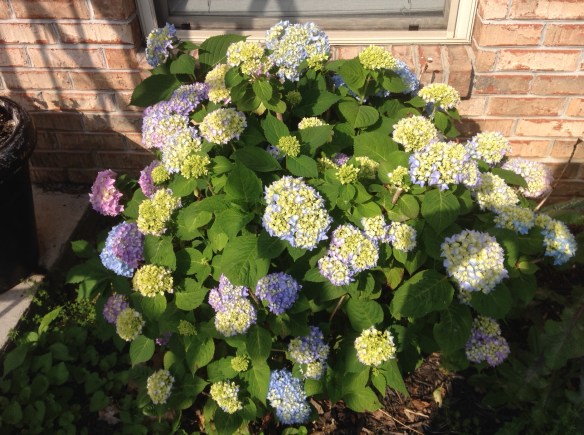
2. My hydrangea bush has never put out this many blossoms before. Lovely! And I like that they are different colors.

IMG_1702

3. Time with my little grandson. I know I have said that before. 🙂 But time spent with him makes up my favorite parts of every week. Those who know me well will appreciate that I especially love when he climbs up beside me and says, “Book! Book!”

4. A family open to experimental recipes. I tried cabbage rolls for the first time this week (this recipe), and they were ok, but a little bland. That one was nice in that it was a stovetop recipe. I’d like to try this one which has some different flavorings, but it will have to wait til cooler weather – it’s already too hot to have the oven on for 75 minutes. Somewhere I saw a crockpot version that I might have to try as well. My son wasn’t sure if he’d like the cabbage, but he gave it a try and did.

5. Take-out meals. I know, I have mentioned them several times as well. But I love the combination of not having to decide what’s for dinner, having someone else cook it, and not having clean-up. We got take-out from my husband’s favorite Asian place Saturday evening, which almost always has enough for leftovers for lunch another day – another favorite of take-out. And then, this isn’t take-out exactly, but it was made by someone else: my son and daughter-in-law brought over some homemade enchiladas left from a dinner they had hosted the night before to us for lunch on Saturday – yummy! Better than take-out!

Happy Friday!

Book Review: The Renewing of the Mind Project

Renewing the MindI first became aware of The Renewing of the Mind Project by Barb Raveling through my friend Kim’s blog. She had also introduced me to two of Barb’s other books which I reviewed together last year: I Deserve a Donut (And Other Lies That Make You Eat) and Taste For Truth: A 30 Day Weight Loss Bible Study.

Barb begins with her testimony of the joy she found when she became a believer in Christ and the changes He worked in her heart and life. After a while, though, she “left her first love” and began skipping her quiet times with her Bible and prayer. She’d make resolutions and minor changes, but the same bad habits kept resurfacing. She knew only God could change her, and she prayed for that and waited, but nothing really happened. Finally she realized Romans 12:1-2 about being “transformed by the renewing of your mind” had an expectation for her. It is God who does the changing, not our self-will or self efforts, but He does expect us to learn the truth He has given us in His Word and apply it.

She expands on this in Chapter 3, “Just Say ‘No’ to Sin?” She brings up God’s commands to the Israelites to walk around the walls of Jericho a certain number of times for a certain number of days. She points out that it was definitely God who brought the walls down, yet He required this action and obedience on their part. She notes that though Jesus won the “ultimate victory…conquered sin through His death and resurrection, and we’re already new creatures if we’re His children through faith (2 Corinthians 5:15-21, Romans 6:4-11),” there are still things He “tells us to do after we’re saved, if we want to be transformed” (p. 13). Things like “Fight with spiritual weapons (Ephesians 6:10-18); “Take your thoughts captive to the truth” (2 Corinthians 10:3-5);  Abide in Jesus (John 15:1-5); Abide in God’s Word (John 8:31-32); Walk by the Spirit (Galatians 5:16-25)” (p. 13), among others.

Do you see what an active role God asks us to play in the transformation process?…[This] list requires all kinds of effort. But there is a problem: the word effort is a no-no in the church today. People mistakenly think that if we talk about effort, suddenly we’re not believing in salvation by grace through faith, and we’re going all legalistic. Nothing could be further from the truth (p. 13).

Barb shares a couple of clarifications:

Don’t make the mistake of thinking [transformation] is the easy three-step plan to fix up your life. It’s not. Instead, it’s a way of life. A continual taking off lies and putting on truth in order to break free from our sins, bad habits, and negative emotions so we can love God and others better (p. 6)

We’re not starting from a point of having to measure up to be acceptable to God. We’re starting from a point of already being accepted by God if we’re His children through faith (Ephesians 2:4-9). This gives us a secure foundation. We can rest in His love and walk hand in hand with Him, working on this project together (p. 7).

[God] sees things right now in your life that He’d like to change. Not because He’s a demanding perfectionist who’s disgusted with you. But because He’s a loving Father who cares about you and also about the people you interact with each day. So as you look at your weaknesses, look at them from the comfort and safety of your Father’s arms. knowing that He’s looking at them with you, but through eyes of grace and love and a desire to help (p. 8).

She shares another motive for transformation: God wants us to “lay down our lives to love God and others well. The more we stay stuck in our sins and negative emotions like worry, anger, and insecurity, the harder it is to do that” (p. 14).

Some years ago, after being distressed with an angry response of mine, I looked up several verses on anger, typed them up in a neat list, and saved them to a file. That helped while I was working on them, but making lists in themselves doesn’t renew my mind. Barb describes the process like this: “The renewing of the mind is an active time of fellowship with God…but [it] is more than just reading the Word. It’s mulling over the Word, meditating on the Word, memorizing the Word, and allowing the Word to transform us” (pp. 15-16). It is “to put off your old self, which belongs to your former manner of life and is corrupt through deceitful desires, and to be renewed in the spirit of your minds, and to put on the new self, created after the likeness of God in true righteousness and holiness” (Ephesians 4:22-24).

When we’re in the midst of temptation, everything within us is screaming to just give in and do it! We’re believing lies right and left–so many lies that there’s no way we can say no to temptation in our own strength. We desperately need to go to God for help so we can see the situation from His perspective. Because when we see it from His point of view, we’ll actually want to obey Him. The truth is, Satan and the lies of this world are so convincing that unless we go to God again and again to discuss life with Him, we won’t have much of a chance of living the way He asks us to live. If we want to be victorious over our habits and emotions, we need to take time to renew our minds (p. 17).

Barb goes on to discuss ways to meditate on the Scripture, using it in fighting sin and in prayer, and a concept she calls truth journaling, a way of putting out your thoughts one by one and then applying truth to them. Sometimes it is easier to evaluate our thoughts when we can take them out of their swirl in our brain and get them down in black and white, and applying the truth to them in that way helps to reinforce truth. She walks the reader through renewing our minds to deal with negative emotions, stop a bad habit, start a good one, or accomplish a goal.

The rest of the book is divided into different headings (emotions, stopping a habit, etc.) and then subdivided into specific areas (loneliness, insecurity, entitlement, failure, pride, frustration, stress, “I’ll start tomorrow,” and many, many more.) Under each specific emotion, habit, or thought, she has a list of questions, things you might need to accept or confess, Bible verses, and tips. For instance, some questions under the Entitlement heading are:

Why do feel like you deserve your habit in this particular situation?

Do you think God agrees? Why or why not?

What usually happens when you live by your rights and feelings in this area of your life?

Would your life be better if you gave up your rights and held life and your habit with open hands?

Are boundaries easy to follow or do you usually have to give up something to follow them?

What will your life look like in a few months if you consistently follow your boundaries?

Then she lists several Bible verses applicable to this subject. She ends with these tips:

It’s hard to break free from our habits because we hear the message everywhere we go: Life should be fair. You shouldn’t have to suffer. You deserve the good life. So when something bad or unfair is going on in our lives, we automatically reach for our habits.

The best way to break free from entitlement habiting is to adopt a biblical perspective of life. God never said, “You deserve the good life.” Instead, He said, “If you want to follow me, you have to give up everything” (Matthew 19:16-22, Matthew 16:21-28).

When we hold our habits tightly with clenched fists, we’re basically saying, “I deserve this, God, and I am not willing to give it up!”

God replies, “Your habit will never make you happy. Come to me and I’ll give you the abundant life.”

The more we hold our habits with open hands, willing to give up all things for God, the more content we’ll be. If you want to gain victory over entitlement habiting, learn to hold your habits–and your “right to the good life”–with open hands (pp. 186-187).

Of course, Barb isn’t saying that if you just answer these questions, read or even memorize the verses, and read the tips, then, Voila! You’re done! You’ve conquered! You’ll no longer have trouble with that habit! No, as she said in an earlier quote, it’s a way of life. When we’re tempted, when we’ve failed, when we think we have pretty good reasons for what we want to do or feel, when we’re going into a situation where we know we’ll have trouble – these are all situations, among others, where we need to go to God’s Word and renew our minds to think like He does.

A few more quotes that stood out to me:

[Boundaries] cramp our style, but you know what? Our style needs to be cramped. Because there are consequences to doing “what we want when we want” with our habits. Just think of your own habit. What happens when you do it as much as you want to do it? Do you live a wonderful, peace-filled life, thanking God every day for your habits? Or do you live a stressful, regretful life, full of the consequences of too much habit? (pp 60-61).

Is God enough to satisfy you even if you don’t get what you want? (p. 131).

Will breaking your boundaries make you feel better?…Will it solve your problems? Will it create new problems or make the situation worse in some way? What do your boundaries protect you from? Do you need that protection today? (p. 183).

The key to gaining victory over reward habiting is to remember that boundaries make our lives better, not worse. And if boundaries makes our lives better, then breaking them is a punishment — not a reward (p. 206).

Her mention of boundaries in these quotes refers to whatever specific guidelines we set up to curb a habit – say, for instance, we’re not going to eat sweets after dinner, or open Facebook until we’ve had devotions, or whatever. “The minute we set boundaries, our first impulse is to break them. Since we feel guilty about breaking them, our minds frantically (and secretly) try to come up with some justification of why in this situation, it’s okay to break our boundaries” (p. 202). There may be some times to legitimately break our boundaries, but we need to be honest with ourselves and not just make excuses and remember why we set the boundary in the first place.

As you can surmise, I found this book immensely helpful, hopeful, and encouraging. I love Barb’s direct, practical, straightforward style and her emphasis on the power of the Word of God and not a “formula” to help us change to be more like our God. She has a website here: the “Renewing of the Mind tools” tab expands on some of the principles in the book.

(Sharing at Semicolon‘s Saturday Review of Books)

Book Review: Pride, Prejudice, and Cheese Grits

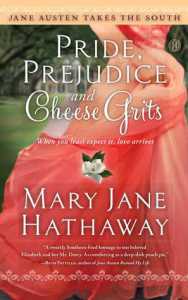
PP&CGPride, Prejudice, and Cheese Grits by Mary Jane Hathaway might sound like a Southern version of Jane Austen’s novel, and indeed it is. Set in the present-day South, it is not a point for point retelling – there are a few differences in characters and plot. But if you’re thinking of P&P while reading it, you’ll recognize a number of plot points and people. This book is the first in Hathaway’s “Jane Austen Takes the South” series. I had read the second book, Emma, Mr. Knightly, and Chili Slaw Dogs, first and then backtracked to read this one.

In this story, Shelby Roswell appreciates history, from old houses to old diaries. In fact, she is a professor of history specializing in the Civil War era working to become tenured. She had written a book with hopes of it propelling her toward her goal, but eminent Civil War expert and writer Ransom Fielding wrote a scathing review of it for a national magazine. And now he’s a visiting guest professor at her college for an entire year. She hopes to avoid him, but at their first meeting, they clash big time, and publicly at that. They each push all the wrong buttons in the other, yet find qualities attractive in each other.

Ransom is, of course, devastatingly handsome, sure of himself, and seemingly a little stuffy at first. He lost both a wife and child, leaving him bitter against God and determined to guard his heart from ever loving another woman.

Of course, following P&P, you know where this is going to go, but it is fun to see how it gets there. Jane from P&P is replaced by Shelby’s roommate, Rebecca, English professor and Jane Austen expert. Ransom’s aunt Margaret Greathouse represents the formidable Lady Catherine de Bourgh. Shelby’s family represents Elizabeth’s in a laid-back father, marriage-minded mother, and silly sisters. Mr. Collins and Wickham are combined in a David Bishop.

I’ve seen a couple of reviewers refer to this volume as more preachy than the second book, but I’d have to ask what they mean by “preachy.” To me, a preachy Christian fiction book is more a “lesson” thinly veiled as a story and may entail finger-wagging and implied “You ought…” advice to the reader. I saw none of that here. As I wrote in Why Read Christian Fiction?, you’d expect in this genre to see professing Christian characters doing Christian things like reading their Bibles and trying to figure out how to apply their faith to everyday life. I do find that here in a natural, uncontrived way, such as when Shelby, after a heated encounter with Ransom, wonders why she has a hard time with putting into practice the verse she had read that morning about being swift to hear, slow to speak, and slow to wrath when she is around him (though actually it’s not just around him – she tends to blurt things out before speaking to nearly everyone) and, when they finally talk about his wife and child, and she advises him in ways to deal with it. That’s perfectly normal. The author seemed to go the other way in the second book – I remember wondering why it was called Christian fiction when there wasn’t really anything distinctly Christian in it that I could recall. Perhaps she did so in response to criticism in this book, but I’d rather have Christianity displayed as it is here rather than being so subtle it is unobservable.

There were a couple of plot points that didn’t quite make sense to me, but overall the writing was fine. There were a couple of sections I felt didn’t need to be there: for instance, when Shelby is holding her cousin’s baby while talking to Ransom, the baby keeps putting its fist in her cleavage. Sure, babies do things like that, but in a book there was really no reason to draw attention (ours or Ransom’s) to her cleavage. And one character is framed with a fake video of a fake sexual encounter. Sure, there is scandal in P&P when Lizzie’s sister runs off with Wickham, but we are told very little about it. This book doesn’t go into all the specifics of the tape but mentions more than necessary – and I felt the conflict and tension this incident was supposed to create could have been handled in a different way. I’ve seen a couple of reviewers mention a swear word in the book, but I don’t remember any, and I am usually sensitive to that.

But I thought the theme that “love changes us” was nicely brought out, and I enjoyed the ways it changed Ransom and Shelby. And the Austen connections were fun, too.

(Sharing at Semicolon‘s Saturday Review of Books)

Fleeting Pleasures, Eternal Joys

As Jenny’s parents drove her to her birthday celebration at Disney World, she sat in her car seat bouncing a helium balloon. Her uncle had stopped by that morning to tell her happy birthday and surprise her with a balloon, and she insisting on bringing it to the theme park. Her parents had looked at each other, shrugged “Why not?” and consented. Jenny talked to her balloon, giggled, tapped it against the window, the seat beside her, and anything she could reach.

Her dad pulled into the parking lot and maneuvered the car into a spot. Her mom turned around and said, “Jenny, if you let go of your balloon, it will float up into the sky and we won’t be able to get it back. It will be too hard to hold it for a long time, so we’ll tie it around your wrist, okay? If you get tired of it, we can tie it to the stroller.” Jenny nodded enthusiastically.

She sat very still as her mother tied the balloon ribbon loosely around her wrist. Her parents allowed her to walk rather than sit in her stroller, knowing that soon enough she’d be tired and want to ride. As Jenny’s mother took her hand, she bounced her other hand up and down to make the balloon dance. But she couldn’t see it up so high and control it as well as when she held it, so she pulled her hand from her mother’s grasp and started fumbling with the balloon ribbon to get it off her wrist and hold the balloon herself. Her mother saw what she was doing, plus they had a rule about holding mommy’s hand in parking lots. “Jenny, you need to take my hand. And don’t pull the string off or the balloon will float…” Before she could even finish, Jenny had gotten the ribbon off her wrist, but didn’t have enough of a grasp of it to keep it from sliding between her fingers. The balloon floated out of her reach, and she cried, “Balloon! Balloon!” Her dad tried to catch it, but he couldn’t quite reach it. The three of them watched despondently as the balloon caught the breeze and floated farther and farther up and away. Jenny’s mother knelt down beside her daughter. “I’m so sorry, honey. But that’s what balloons do. Next time we’ll figure out a better way to hold it.” Her mother thought to herself, next time we won’t bring a balloon on an outing. To try to distract Jenny from her loss, her mom began talking about the party and pleasures to come. “Jenny, let’s go on in to Disney World. Your friends are waiting, we have birthday cake and presents, and then rides, and maybe we’ll even see Minnie Mouse!” But Jenny was too distraught. With all the thrills of the theme park and a birthday party ahead, she sat down in the parking lot, crying for her lost balloon.

___

The above is a fictional story, but I think it somewhat displays a spiritual truth. There are many good gifts from God in this life, and there is nothing wrong with enjoying them. But we get too caught up in them, grasping them, distracted by them, and forget that they were always meant to be momentary. We’re saddened when we experience loss or when something in life no longer satisfies. That’s normal. But it’s a reminder that this life is not all there is. Eternal life, for those who know the Lord, will be so much more than anything we have here, even anything we can imagine.

“Heaven is not here, it’s There. If we were given all we wanted here, our hearts would settle for this world rather than the next. God is forever luring us up and away from this one, wooing us to Himself and His still invisible Kingdom, where we will certainly find what we so keenly long for.” ~ Elisabeth Elliot

IMG_1700

(Sharing with Inspire Me Mondays, Woman to Woman, Testimony Tuesday, Telling His Story, Works For Me Wednesdays, Wise Woman, Thought-Provoking Thursday)

Save

Friday’s Fave Five

friday fave five spring

It’s Friday, time to look back over the blessings of the week with Susanne at Living to Tell the Story and other friends.

After a busy weekend, the rest of the week hasn’t been quite as productive as I had hoped, but it has been a good one. Here are some of the best parts:

1. Lunch with a friend last Friday. Enjoyed a great conversation and time away.

2. Bagels. I’d only had one bagel in my life before, and I was not impressed: it was on an airplane, and the outside of it was so hard, I couldn’t bite into it. I had to pull out the soft bread inside of it to eat it. Jason told me not to judge all bagels by an airplane bagel. So when my friend wanted to meet at Einstein Bros Bagels, I wasn’t so sure at first, but then decided this would be a good opportunity to give bagels another try. I ordered pizza bagels, thinking that if the crust was a little firm, it wouldn’t be too bad. But they were very soft and very good! Nice to have a new food option!

3. Fencing. I’ve mentioned before having to take down a row of diseased trees bordering the back of our property. We wanted to replace them with a fence, and my husband found a great deal on fencing on Craig’s list and picked it up last Saturday. He has two panels up already.

4. Delicious weather. It’s been my favorite kind of weather most of this week – sunny and cool. I’m treasuring up the coolness, knowing before long it will be hot and humid out there.

5. A productive Saturday. I had a marathon grocery shopping expedition in the morning and then spent the afternoon catching up on “Amazing Race” episodes on the Tivo while ironing. While ironing and grocery shopping aren’t favorite things to do, there is a sense of satisfaction getting them done.

Happy Friday!