Book Review: The Problem of Pain

Problem of PainIn The Problem of Pain, C. S. Lewis sets out truths and speculations about why a wise, loving, kind, and omnipotent God would allow so much evil, suffering and pain in the world. It’s a question that troubles believers and unbelievers alike and one which was a major hindrance to Lewis’s own conversion.

Chapter 1, “Introductory,” traces three threads through human philosophy and development that lead to religion: an awe or dread of unseen beings, which Lewis calls the Numinous; a sense of some kind of morality; and the connection between the Numinous and morality. The Numinous is either “a mere twist in the human mind…or else it is a direct experience of the really supernatural, to which the name Revelation might properly be given” (p. 10). In Christianity there is one more thread: the historical event of the death and resurrection of Christ. Either Christ was “a raving lunatic of an unusually abominable type, or else He was, and is, precisely what He said. There is no middle way” (p. 13).

To ask whether the universe as we see it looks more like the work of a wise and good Creator or the work of chance, indifference, or malevolence, is to omit from the outset all the relevant factors in the religious problem. Christianity is not the conclusion of a philosophical debate on the origins of the universe: it is a catastrophic historical event following on the long spiritual preparation of humanity which I have described. It is not a system into which we have to fit the awkward fact of pain: it is itself one of the awkward facts which have to be fitted into any system we make. In a sense, it creates, rather than solves, the problem of pain, for pain would be no problem unless, side by side with our daily experience of this painful world, we had received what we think a good assurance that ultimate reality is righteous and loving (p. 14).

Mankind tends to think that “If God were good, He would wish to make His creatures perfectly happy, and if God were almighty He would be able to do what He wished. But the creatures are not happy. Therefore God lacks either goodness, or power, or both” (p. 16). Lewis spends the next couple of chapters talking about God’s omnipotence and goodness. Some pain is inherent in nature: fire warms when used rightly but burns when one gets too close to it. Some pain arises when individual beings assert their own wills which then clash with each other. God in His omnipotence could have made it impossible for people to sin against each other, but He made man with a free will and the ability to choose his actions.

You may attribute miracles to Him, but not nonsense. This is no limit to His power. If you choose to say ‘God can give a creature free will and at the same time withhold free will from it’, you have not succeeded in saying anything about God: meaningless combinations of words do not suddenly acquire meaning simply because we prefix to them the two other words ‘God can’. It remains true that all things are possible with God: the intrinsic impossibilities are not things but nonentities. It is no more possible for God than for the weakest of His creatures to carry out both of two mutually exclusive alternatives; not because His power meets an obstacle, but because nonsense remains nonsense even when we talk it about God (p. 18).

But “if the universe must, from the outset, admit the possibility of suffering, then” wouldn’t “absolute goodness…have left the universe uncreated”? Lewis “warn[s] the reader that I shall not attempt to prove that to create was better than not to create: I am aware of no human scales in which such a portentous question can be weighed” (p. 27). But he goes on to offer some thoughts about “how, perceiving a suffering world, and being assured, on quite different grounds, that God is good, we are to conceive that goodness and that suffering without contradiction” (p. 27).

What we mean by goodness is not always what true goodness actually is:

By the goodness of God we mean nowadays almost exclusively His lovingness; and in this we may be right. And by Love, in this context, most of us mean kindness – the desire to see others than the self happy; not happy in this way or in that, but just happy. What would really satisfy us would be a God who said of anything we happened to like doing, ‘What does it matter so long as they are contented?’ We want, in fact, not so much a Father in Heaven as a grandfather in heaven – a senile benevolence who, as they say, ‘liked to see young people enjoying themselves’, and whose plan for the universe was simply that it might be truly said at the end of each day, ‘a good time was had by all’. Not many people, I admit, would formulate a theology in precisely those terms: but a conception not very different lurks at the back of many minds. I do not claim to be an exception: I should very much like to live in a universe which was governed on such lines. But since it is abundantly clear that I don’t, and since I have reason to believe, nevertheless, that God is Love, I conclude that my conception of love needs correction (pp. 31-32).

Even humans don’t want friends and loved ones to continue in a course that makes them happy but is hurtful or destructive to themselves and others, so we can understand that Divine love, so much above ours, will need to correct, halt, or discipline individuals and attempt to bring them to repentance, which will involve some degree of pain.

“We are, not metaphorically but in very truth, a Divine work of art, something that God is making, and therefore something with which He will not be satisfied until it has a certain character.” As an artist erases and reworks a drawing until it becomes as perfect as possible, “One can imagine a sentient picture, after being rubbed and scraped and recommenced for the tenth time, wishing that it were only a thumbnail sketch whose making was over in a minute. In the same way, it is natural for us to wish that God had designed for us a less glorious and less arduous destiny; but then we are wishing not for more love but for less” (pp. 34-35).

Similarly, when a man has a dog, “man interferes with the dog and makes it more lovable than it was in mere nature. In it’s state of nature it has a smell, and habit’s, which frustrate man’s love: he washes it, house-trains it, teaches it not to steal, and is so enabled to love it completely. To the puppy the whole proceeding would seem, if it were a theologian, to cast grave doubts on the ‘goodness’ of man: but the full-grown and full-trained dog, larger, healthier, and longer-lived than the wild dog, and admitted, as it were by Grace, to a whole world of affections, loyalties, interests, and comforts entirely beyond it’s animal destiny, would have no such doubts” (p. 36). Man cares for animals he loves: he “does not house-train the earwig or give baths to centipedes. We may wish, indeed, that we were of so little account to God that He left us alone to follow our natural impulses – that He would give over trying to train us into something so unlike our natural selves: but once again, we are asking not for more love, but for less” (p. 36).

The parent-child analogy is a closer one to spiritual truth than man and art or man and dog, but no loving father says, “I love my son but don’t care how great a blackguard he is provided he has a good time” (p. 37).

When we want to be something other than the thing God wants us to be, we must be wanting what, in fact, will not make us happy. Those Divine demands which sound to our natural ears most like those of a despot and least like those of a lover, in fact marshal us where we should want to go if we knew what we wanted. He demands our worship, our obedience, our prostration. Do we suppose that they can do Him any good, or fear, like the chorus in Milton, that human irreverence can bring about ‘His glory’s diminution’? A man can no more diminish God’s glory by refusing to worship Him than a lunatic can put out the sun by scribbling the word ‘darkness’ on the walls of his cell. But God wills our good, and our good is to love Him (with that responsive love proper to creatures) and to love Him we must know Him: and if we know Him, we shall in fact fall on our faces (p. 46).

Lewis then goes on to explain why mankind needs such alteration in the first place. He asserts this is necessary because in his time there was not so much a sense of sin as people would have had in the times when the Bible was written, against which the gospel appeared as very good news indeed. He gives various reasons for that to show that “Christianity now has to preach the diagnosis – in itself very bad news – before it can win a hearing for the cure” (p. 48) and then goes on to show how pervasive and deceptive sin is in our hearts.

It’s when he discusses how man became sinful in the first place in his chapter on the fall of man that I have my first serious problems. He regards the first few books of the Bible (at least, maybe more of it) as mythic. He believes in the evolutionary view of man’s development and as such believes that the “first man” could not have sinned as Adam did because he would not have had the intelligence, self-awareness, or conscience to, since he was what we commonly think of as a prehistoric cave man. At some point in man’s continued evolution, mankind as whole sinned against God by somehow preferring its own way rather than His, of somehow rejecting His reign, and thus the rest of human race was born in sin. He rejects the idea that we are responsible or accountable for or being punished for Adam’s sin. He has problems coming to terms with the statement that “as in Adam all die, even so in Christ shall all be made alive” (1 Corinthians 15:22). Now, I don’t believe that believing in evolution disqualifies a man from salvation or heaven, but I think taking a great deal of the Bible as mythic is not only wrong, but creates new problems. It makes more sense to me that since Adam sinned and was corrupted, every ancestor of his was also corrupted, and thus we are all born sinners, than to try to imagine that the sin of a group of people somehow plunged the entire human race ever after into sin. I think it is quite dangerous to take plain statements of Scripture as mythic and symbolic. I have X marks (which I sometimes put next to statements I disagree with in a book) and question marks all through this chapter and can’t take the time or space here to delineate them all. I do understand that Lewis was speaking from the intellectual viewpoint of his day. He’s not afraid to contradict prevailing viewpoints with Scriptural truth where he see it clearly, but I assume he must not have heard a convincing argument in regard to creation and a literal interpretation of Genesis. He comes out at the right place in the end: “that man, as a species, spoiled himself, and that good, to us in our present state, must therefore mean primarily a remedial or corrective good” (p. 85), but the way he gets there is convoluted.

The next two chapters on human pain are the best, in my opinion. Lewis proposes that about four-fifths of the pain in the world arises from our own sinfulness, our bent as people created with choice and free will to use that will to sin against others.

“We are not merely imperfect creatures who must be improved: we are, as Newman said, rebels who must lay down our arms” (p. 88).

But there are other kinds of pain that do not come directly from other people’s sins against us.

The first answer, then, to the question why our cure should be painful, is that to render back the will which we have so long claimed for our own, is in itself, wherever and however it is done, a grievous pain… to surrender a self-will inflamed and swollen with years of usurpation is a kind of death (p. 89).

Hence the necessity to die daily: however often we think we have broken the rebellious self we shall still find it alive. That this process cannot be without pain is sufficiently witnessed by the very history of the word ‘Mortification’ (p. 89).

The human spirit will not even begin to try to surrender self-will as long as all seems to be well with it (p. 90).

If the first and lowest operation of pain shatters the illusion that all is well, the second shatters the illusion that what we have, whether good or bad in itself, is our own and enough for us. Everyone has noticed how hard it is to turn our thoughts to God when everything is going well with us. We ‘have all we want’ is a terrible saying when ‘all’ does not include God. We find God an interruption. As St Augustine says somewhere, ‘God wants to give us something, but cannot, because our hands are full – there’s nowhere for Him to put it.’ Or as a friend of mine said, ‘We regard God as an airman regards his parachute; it’s there for emergencies but he hopes he’ll never have to use it.’ Now God, who has made us, knows what we are and that our happiness lies in Him. Yet we will not seek it in Him as long as He leaves us any other resort where it can even plausibly be looked for. While what we call ‘our own life’ remains agreeable we will not surrender it to Him. What then can God do in our interests but make ‘our own life’ less agreeable to us, and take away the plausible source of false happiness? It is just here, where God’s providence seems at first to be most cruel, that the Divine humility, the stooping down of the Highest, most deserves praise (p. 94).

God, who made these deserving people, may really be right when He thinks that their modest prosperity and the happiness of their children are not enough to make them blessed: that all this must fall from them in the end, and that if they have not learned to know Him they will be wretched. And therefore He troubles them, warning them in advance of an insufficiency that one day they will have to discover. The life to themselves and their families stands between them and the recognition of their need; He makes that life less sweet to them. I call this a Divine humility because it is a poor thing to strike our colours to God when the ship is going down under us; a poor thing to come to Him as a last resort, to offer up ‘our own’ when it is no longer worth keeping. If God were proud He would hardly have us on such terms: but He is not proud, He stoops to conquer, He will have us even though we have shown that we prefer everything else to Him, and come to Him because there is ‘nothing better’ now to be had. The same humility is shown by all those Divine appeals to our fears which trouble high-minded readers of Scripture. It is hardly complimentary to God that we should choose Him as an alternative to Hell: yet even this He accepts. The creature’s illusion of self-sufficiency must, for the creature’s sake, be shattered; and by trouble or fear of trouble on earth, by crude fear of the eternal flames, God shatters it ‘unmindful of His glory’s diminution’ (pp 95-96).

Sometimes pain also serves as a reminder that this world is not all there is and isn’t meant to satisfy: when something painful happens – illness, bad news, etc. – “At first I am overwhelmed, and all my little happinesses look like broken toys. Then, slowly and reluctantly, bit by bit, I try to bring myself into the frame of mind that I should be in at all times. I remind myself that all these toys were never intended to possess my heart, that my true good is in another world and my only real treasure is Christ” (pp. 106-107). “Our Father refreshes us on the journey with some pleasant inns, but will not encourage us to mistake them for home” (p. 116).

And though he doesn’t mention Romans 5:3-5 (“And not only so, but we glory in tribulations also: knowing that tribulation worketh patience; And patience, experience; and experience, hope: And hope maketh not ashamed; because the love of God is shed abroad in our hearts by the Holy Ghost which is given unto us”), he does discuss the principle that suffering develops these things in us.

Lewis said near the beginning that he was writing merely to explain the problem of pain, not to necessarily tell how to deal with it. Yet he does say, “If pain sometimes shatters the creature’s false self-sufficiency, yet in supreme ‘Trial’ or ‘Sacrifice’ it teaches him the self-sufficiency which really ought to be his – the ‘strength, which, if Heaven gave it, may be called his own’: for then, in the absence of all merely natural motives and supports, he acts in that strength, and that alone, which God confers upon him through his subjected will. Human will becomes truly creative and truly our own when it is wholly God’s, and this is one of the many senses in which he that loses his soul shall find it.”

He discusses the moral objection to hell in another chapter and makes several good points. I’ll just share this one:

In the long run the answer to all those who object to the doctrine of hell, is itself a question: ‘What are you asking God to do?’ To wipe out their past sins and, at all costs, to give them a fresh start, smoothing every difficulty and offering every miraculous help? But He has done so, on Calvary. To forgive them? They will not be forgiven. To leave them alone? Alas, I am afraid that is what He does (p. 130).

Lewis has a chapter on animal pain, which he confesses is primarily speculation since the Bible says nothing about what animals feel and they can’t tell us. But here is another place where his evolutionary thought comes in and contradicts clear Biblical truth. He says earlier generations felt that suffering of animals and all creation came about as a result of Adam’s fall. We get that from a few places, among them that Genesis 3:17-19, where God said told Adam: “cursed is the ground for thy sake; in sorrow shalt thou eat of it all the days of thy life; Thorns also and thistles shall it bring forth to thee; and thou shalt eat the herb of the field; In the sweat of thy face shalt thou eat bread, till thou return unto the ground; for out of it wast thou taken: for dust thou art, and unto dust shalt thou return.” So apparently before this time there were no thorns and thistles and it wasn’t hard work to get something to eat. Then in the millennial kingdom, when Christ rules the earth, it is prophesied in Isaiah 11 that in that time:

The wolf also shall dwell with the lamb, and the leopard shall lie down with the kid; and the calf and the young lion and the fatling together; and a little child shall lead them.

And the cow and the bear shall feed; their young ones shall lie down together: and the lion shall eat straw like the ox.

And the sucking child shall play on the hole of the asp, and the weaned child shall put his hand on the cockatrice’ den.

They shall not hurt nor destroy in all my holy mountain: for the earth shall be full of the knowledge of the Lord, as the waters cover the sea.

So we assume from this that the harmful behaviors which shall no longer be were a part of the original fall and not part of animal’s original creation, since they are set right here. But Lewis says this “is now impossible, for we have good reason to believe that animals existed long before man. Carnivorousness, with all that it entails, is older than humanity (p. 137). I have an X by that statement as well as a few others in this chapter.

Even more alarming to me is his thought that “it might be argued that when He emptied Himself of His glory He also humbled Himself to share, as man, the current superstitions of His time. And I certainly think that Christ, in the flesh, was not omniscient – if only because a human brain could not, presumably, be the vehicle of omniscient consciousness, and to say that Our Lord’s thinking was not really conditioned by the size and shape of His brain might be to deny the real incarnation and become a Docetist. Thus, if Our Lord had committed Himself to any scientific or historical statement which we knew to be untrue, this would not disturb my faith in His deity” (p. 137). It would disturb mine, and I don’t believe for a moment that Christ believed “superstitions of His time”! There were multiple incidences of His displaying omniscience even while in human form. I just discussed this recently in a chapter from J. I. Packer’s book Knowing God in this post.

Lewis closes with a short chapter on pain which is mostly speculative but does include the theme present in The Last Battle in the Narnia series, that it’s the place we’ve been longing for our whole lives.

If you’ve read this far, you deserve a pat on the back. I am sorry this is so long, but when I write about a book, I want to convey not only a glimpse of what it is about to those reading, but I want to record the salient points as well as my own thoughts and impressions to remind myself of in the future.

I was a bit frustrated that Lewis didn’t go into more of the Biblical reasons for suffering, but then I reminded myself that it wasn’t his purpose to write such a treatise: he was merely wanting to address the problem of pain from a philosophical viewpoint couched mostly in Scripture. I remember reading somewhere which I can’t trace now that someone who read this book then approached Lewis about making the talks which eventually became Mere Christianity.

There are a lot of really good nuggets in this book. But there are enough questionable things that this would not be my first choice to recommend to someone on this topic. That would be When God Weeps by Joni Eareckson Tada and Steve Estes. But I would still recommend this with caution about some of the problem areas.

(This review will also be linked to Semicolon‘s Saturday Review of Books.)

What’s On Your Nightstand: September 2015

What's On Your NightstandThe folks at 5 Minutes For Books host What’s On Your Nightstand? the fourth Tuesday of each month in which we can share about the books we have been reading and/or plan to read.

I don’t know where this month has gone. Well, there is still a week of it left, so I guess I don’t have to lament its passing already. 🙂 But the fourth Tuesday is the day set aside for talking about what we’re reading. (Update: Or not….looks like the site has switched the Nightstand posts to next week. I don’t know if this is a permanent change to the last rather than fourth Tuesday of the month (which I would prefer) or if it just happened that way this time. But I am leaving this up since it has already been posted).

Since last time I have completed:

Everyday Grace: Infusing All Your Relationships With the Love of Jesus by Jessica Thompson, reviewed here. Very helpful.

Through Waters Deep by Sarah Sundin, reviewed here. Enjoyed it quite a lot!

Quo Vadis: A Narrative of the Time of Nero by Henryk Sienkiewicz, reviewed here. Epic.

The Problem of Pain by C. S. Lewis. Just finished it over the weekend: hope to review it in the next day or two. Honestly, this is my least favorite Lewis book so far, which is not what I had expected to say about it. Reviewed here.

I’m currently reading:

Knowing God by J. I. Packer along with Tim Challies’ Reading Classics Together Series. I’ve been sharing impressions of a couple of chapters at a time here. I can see why it is considered a classic.

The Screwtape Letters by C.S. Lewis for Carrie‘s Reading to Know Classics Book Club for this month. Should finish this soon.

The Girls of Atomic City: The Untold Story of the Women Who Helped Win World War II by Denise Kiernan, a true story set nearby during WWII. Pretty interesting!

Things We Once Held Dear by Ann Tatlock. Haven’t made much progress with this – I think I have had too many books going at the same time.

To Whisper Her Name by Tamera Alexander, my first by this author. Just started the audiobook.

Next Up:

Child of Mine by Beverly Lewis

Unlimited by David Bunn

I Dared to Call Him Father: The Miraculous Story of a Muslim Woman’s Encounter with God by Bilquis Sheikh

The Dead Secret by Wilkie Collins, the last of my classics challenge books.

In addition I have finished my TBR Challenge, am almost finished with my Back to the Classics Challenge, and shared some bookish questions.

What’s on your reading plate…er, nightstand these days?

Book Review: Quo Vadis

Quo VadisWhen I posted my reading plans for the year, a friend suggested that Henryk Sienkiewicz’s With Fire and Sword: An Historical Novel of Poland and Russia would fill the Forgotten, Long, or Translated classic categories of the Back to the Classics Challenge. I was looking over descriptions and reviews of the book and decided to look into for next year’s challenge, but noticed along the way that Sienkiewicz had also written Quo Vadis: A Narrative of the Time of Nero. That’s a title I have heard of for years but never read, and I was looking to replace the classic I had originally chosen for a translated one, so I started listening to this via audiobook. Then I got the free Kindle version to reread or look more closely into various sections.

The Latin phrase quo vadis means “Where are you going?” and is usually connected with a legend that says Peter was fleeing from Roman persecution when, outside the city, he saw Jesus with His cross coming into the city. When Peter asked where He was going, Jesus supposedly replied, “I am going to Rome to be crucified again.” I had thought perhaps the title might be a metaphor for the various characters, especially Marcus Vinicius, and it may be, but the author includes the legend as a scene near the end of the book as well.

Vinicius is a Roman tribune who falls in love with a beautiful young woman who is the ward of a general. Her name is Callina, though she goes by Ligea throughout most of the book because her people were known as Ligeans. They were conquered by Rome, and technically she is a hostage. Somehow she came to the house of Aulus Plautius and his wife, Pomponia Graecina, but she has become like a daughter to them. Marcus’s attraction at first is primarily lustful: she’s beautiful and he desires her, so his uncle, the influential Petronius, suggests that, since she is a hostage, they can have Caesar take her from her home, bring her to the palace, and then give her to Marcus. Marcus doesn’t understand why this does not go over well with Ligea (duh), but while at the palace where they participate in a feast which turns into a drunken orgy, Marcus realizes that one of the things he loves about Ligea is that she’s not like other women, and to either take her by force or subject her to such an atmosphere would not only violate her personally but would change everything he loves about her.

At one time Ligea drew a fish in the sand, but Marcus did not know it had any special meaning. Ligea escapes the palace with her servant and the help of a number of other Christians. In trying to find her, Marcus learns that the fish is symbolic of Christianity. He and Petronius are surprised that Ligea is a Christian, as there are a number of odd rumors going around about Christians, such as that they poison wells and fountains, worship an ass’s head, murder babies, and “give themselves up to dissoluteness.” But since Ligea and the one or two other professing Christians they know are not like that, then the rumors, they reason, must be wrong. Marcus doesn’t care, as he is willing to set up an altar to Christ and add Him to the other gods he worships, if he can only find Ligea and make her his.

Marcus does find the Christian community, and as he spends time with them, he realizes that being a Christian is not just a side religion for them, but rather affects everything they do. Furthermore, it is an obstacle between himself and Ligea, because, though he senses she loves him, she could not be his mistress, because it would violate her religion, and she could not marry him because he is not a believer. Thus he is in an agony.

The context of their story plays out in the backdrop of the Roman civilization of the time. Though many covet the favor of Nero’s court, it’s an uncertain place to be, as Nero’s favor can change on a whim or the merest displeasure. When Marcus reminds Petronius that he is “playing with death” by his verbal jousts, Petronius replies that “That is my arena, and the feeling that I am the best gladiator in it amuses me.” The excess, frivolity, self-gratification, depravity, and cruelty of the Romans, particularly the patrician class, is contrasted with the poverty, simplicity, sincerity, and goodness of the Christians. Many of the major characters come to their own fork in the road and have to decide which way they are going.

And all at once he saw before him a precipice, as it were without bottom. He was a patrician, a military tribune, a powerful man; but above every power of that world to which he belonged was a madman whose will and malignity it was impossible to foresee. Only such people as the Christians might cease to reckon with Nero or fear him, people for whom this whole world, with its separations and sufferings, was as nothing; people for whom death itself was as nothing. All others had to tremble before him. The terrors of the time in which they lived showed themselves to Vinicius in all their monstrous extent. He could not return Lygia to Aulus and Pomponia, then, through fear that the monster would remember her, and turn on her his anger; for the very same reason, if he should take her as wife, he might expose her, himself, and Aulus. A moment of ill-humor was enough to ruin all. Vinicius felt, for the first time in life, that either the world must change and be transformed, or life would become impossible altogether. He understood also this, which a moment before had been dark to him, that in such times only Christians could be happy.

The author has Nero and Peter coming face to face at one point, which probably did not really happen, but of the meeting he says:

For a while those two men looked at each other. It occurred to no one in that brilliant retinue, and to no one in that immense throng, that at that moment two powers of the earth were looking at each other, one of which would vanish quickly as a bloody dream, and the other, dressed in simple garments, would seize in eternal possession the world and the city.

Even Petronius, though not at all tempted by the Christian religion, acknowledges “that a society resting on superior force, on cruelty of which even barbarians had no conception, on crimes and mad profligacy, could not endure. Rome ruled the world, but was also its ulcer.”

There is a definite Catholic flavor to much of the Christianity in the book, perhaps most noticeable when the author has Peter saying that God will build His capital in Rome rather than Jerusalem (not something the Bible ever intimates) and calls Peter the “vice-regent” of Christ. But there is also a surprising amount of truth in a lot of the characters’ grappling with what Christianity would mean to them. The author portrays many of the Romans as not really believing in the gods, much less loving them, though they felt compelled to placate them with offerings for good measure. But the Christians had “found a God whom they could love, they had found that which the society of the time could not give any one –happiness and love.”

“What kind of God is this, what kind of religion is this, and what kind of people are these?” All that he had just heard could not find place in his head simply. For him all was an unheard-of medley of ideas. He felt that if he wished, for example, to follow that teaching, he would have to place on a burning pile all his thoughts, habits, and character, his whole nature up to that moment, burn them into ashes, and then fill himself with a life altogether different, and an entirely new soul.

Since the book was written in 1895 and translated in 1896, of course it reads like an older work – more telling than showing, a little dragged out in places. Peter and Paul are highly idealized. I had to smile at a description of Marcus’s handsomeness remarking about his “brows joining above the nose.” Perhaps a unibrow was considered handsome then. 🙂 But the descriptive passages of the famous Roman fire and the persecutions in the arena were quite well done. Of course, given the setting, we know that someone among the main characters will end up in the arena, but it didn’t happen in any of the ways I had thought it might, and there is quite a bit of intrigue about whether that person can be saved before their time in the arena comes.

The author is said to have done quite extensive research before starting this book, and he weaves historical details in fairly seamlessly. I am not well versed in that segment of history, so I am not sure how much is factual and how much is fictional except that he did include some actual historical figures, though of course their conversations are fictional.

I have to commend him, too, that some of the scenes portraying the profligacy of the people left one feeling disgusted and sick at their actions without the descriptions getting too gratuitous. I wish modern authors would take a note from this. He does include a few details I would prefer to have been left out (too many mentions of “heaving bosoms”), but considering what could have been said about what was going on, particularly at Nero’s feast, he showed much restraint. I’ve often said “less is more” with these kinds of details, and this book illustrates that.

The book left me with several thoughts to ponder, among them: the cost of following Christ, something we don’t take into account in our day in many places in the world; the thought that whatever persecution or disfavor we think Christians are facing now, we really haven’t seen anything yet in most places; the testimony of the Christians that belied the rumors about them (“For so is the will of God, that with well doing ye may put to silence the ignorance of foolish men” – I Peter 2:15); the thought in an above quote, that in such times only Christians could be truly happy, for this world is not the end for them.

I listened to the audiobook narrated by Frederick Davidson, and honestly, it was hard to follow at first. That’s one reason I got the Kindle version as well. I am not sure if it was due to the opening of the book itself or the narrator’s voice. He did some characters very well, particularly Petronius, Chilo (a wily investigator employed by Marcus), and Nero, but other times he spoke in a monotone. Once I got well into the book and invested in the characters, however, the less his narration bothered me.

There are a number of film versions, notable a 1951 film starring Deborah Kerr and Robert Taylor, that I would like to see but haven’t yet. It would be interesting to see how they condense the 22 hours of the book to the 2 hours or so of a movie. I was very surprised it was not on Netflix.

Though it was not a flawless book, overall it was a good read and I enjoyed it.

(This review will also be linked to Semicolon‘s Saturday Review of Books.)

Laudable Linkage

It has again been a little while since I have been able to share good reading I’ve found on the web. I try to do them about every other week so there’s not such a long list, but life doesn’t always work out that way. But here they are, and maybe you’ll find something of interest among them:

The First Cut Is the Deepest: Self-Harmers in the Church.

When We Are the Ones Who Persecute.

Back to School: Helping Kids Stay in the Word.

The Best Day of the Week. “Lord’s Day worship isn’t a burden to endure, but a joyful offering from God to receive. Christians don’t put aside their earthly cares each week to earn God’s favor, but to enjoy worshiping the God whose favor has already been granted in Jesus Christ. It is a true delight to forego even the best worldly endeavors for the day, without feeling any sense of guilt for being lazy or uncaring, to revel in the heavenly things of God which are the truest and greatest treasure for any Christian (Matthew 6:19-21).”

Dear Moms: You Do More Than You Know.

Your Children Are Your Neighbor. This is excellent. There is one difference in that parents are authorities over their children and supposed to correct them, while they are not with neighbors, but even still, authority can be handled with grace and not authoritarianism.

Five Boys’ Reaction to One Being Bullied.

5 Ways to Ruin a Perfectly Good Dating Relationship.

An Open Letter to Ann Coulter about the use of the word “retard”. We need to scourge that noun from our vocabulary.

How Making Time For Books Made Me Fell Less Busy, HT to Challies

Easy Tips to Add Text to Photos.

Here are a few about writing:

Why I Write.

How to Evoke Powerful Images in Your Reader’s Mind.

How to Write a Devotional: The Definitive Guide.

Saw this going around Facebook:

Open Bible

And this is adorable and made me laugh: a little baby fakes out her dad when he tries to cut her fingernails:

Happy Saturday!

Friday’s Fave Five

  FFF tamara'sIt’s Friday, time to look back over the blessings of the week with Susanne at Living to Tell the Story and other friends.

Jim was out of town half the week and his mom’s caregiver was out sick a couple of days, so I had the full care of Great-Grandma for a while. That made for rather a long week. But even though my own plans were thwarted and I got weary, God placed some blessings along the way. Here are a few:

1. Grandparent’s Day – Jason and Mittu came over and made lunch for us on Sunday.

2. Safety, for my husband while traveling, for us while he was gone, for my oldest son when his car was rear-ended, but neither he nor his car were hurt.

3. My kids helping and checking on me. Jesse went to the store for me one day when I couldn’t get out, and Jason texted me to see how things were going and if I needed anything.

4. Jesse’s birthday was this week, though we’re not celebrating it all together until Saturday due to conflicting work schedules. But it was nice to acknowledge his day and see the well-wishing on Facebook,  and we got take-out from a nearby restaurant for the two of us to celebrate.

5. Decluttering and sorting. I don’t know why the mood to do that comes all of a sudden, but I try to go with it when it does. 🙂 I started cleaning out one bathroom drawer yesterday after getting ready for the day and then ended up doing all of them. There are some jobs like that that are big and messy and you have to wait for a free day to do it, but other times you can get a great deal done in a few minutes between other tasks and feel like you’ve accomplished something when the rest of the day doesn’t seem like it.

Bonus: My husband made breakfast on Saturday and made my pancakes in the shape of a heart and arrow.

heart pancakeAnd another bonus would be the delicious weather we’ve had all week. Love this time of year when it’s a little on the cool side but not cold yet (to me).

Happy Friday!

Knowing God, Chapters 9 and 10: God’s Wisdom and Ours

Knowing GodWe’re continuing to read Knowing God by J. I. Packer along with Tim Challies’ Reading Classics Together Series. This week we are in chapters 9 and 10, which present different aspects of wisdom.

Chapter 9, “God Only Wise,” discusses what the Bible means when it says that God is wise and acknowledges that Biblical wisdom is not merely intellect, knowledge, or cleverness but also includes a moral quality. “Wisdom is the power to see, and the inclination to choose, the best and highest goal, together with the surest means of attaining it. Wisdom is, in fact, the practical side of moral goodness. As such, it is found in its fullness only in God. He alone is naturally and entirely and invariably wise” (p. 90). But His wisdom doesn’t guarantee a comfortable, trouble-free life: “He has other ends in view for life in the world than simply to make it easy for everyone” (p. 92).

God’s wisdom cannot be thwarted as human wisdom can “because it is allied to omnipotence…Omniscience governing omnipotence, infinite power ruled by infinite wisdom, is a basic biblical description of the divine character” (p. 91). “Wisdom without power would be pathetic, a broken reed; power without wisdom would be merely frightening; but in God boundless wisdom and endless power are united, and this makes him utterly worthy of our fullest trust” (p. 91).

After discussing God’s purposes or goals for us, part of which is to draw us into a loving relationship with Himself which involves faith in Him and deliverance from sin, manifesting His grace through our lives, Packer traces that wisdom in God’s dealing with three Biblical figures: Abraham, Jacob, and Joseph. I won’t list everything he skillfully brings out about them, but I loved this section, and his descriptions reinforced in me the need to not just read the facts, but to notice what is going on with the people in the Bible and how they change. Packer then briefly discusses how we can trust that same wisdom to be working through the perplexities in our lives.

Chapter 10 is “God’s Wisdom and Ours” and discusses what the Bible means when it says we are to be wise. It doesn’t mean that we know everything God knows or what His purposes are in what happens in the world and our lives. There is much that doesn’t make sense in life, and Packer brings out some truths in Ecclesiastes to illustrate that but also to show that ultimately we can trust God no matter what is happening or what sense it does or doesn’t make to us. He emphasizes the need for realism in our view of life and compares it to driving: we may not know why certain roads are laid out the way they are or why other drivers are acting they way they are, but we “simply try to see and do the right thing in the actual situation that presents itself. The effect of divine wisdom is to enable you and me to do just that in the actual situations of everyday life” (p. 103).

That wisdom is gained first by reverencing God (“The fear of the LORD is the beginning of wisdom” – Psalm 111:10; Proverbs 9:10, and others) and then by receiving His Word (Psalm 119:98-99, Colossians 3:16).

[Wisdom] is not a sharing in all his knowledge, but a disposition to confess that he is wise, and to cleave to him and live for him in the light of his Word through thick and thin.

Thus the effect of his gift of wisdom is to make us more humble, more joyful, more godly, more quick-sighted as to his will, more resolute in the doing of it and less troubled (not less sensitive, but less bewildered) than we were at the dark and painful things of which our life in the fallen world is full. The New Testament tells us that the fruit of wisdom is Christlikeness–peace, and humility, and love (James 3:17)–and the root of it is faith in Christ (1 Cor. 3:18; 2 Tim. 3:15) as the manifested wisdom of God (1 Cor. 1:24, 30).

Thus the kind of wisdom that God waits to give those who ask him is a wisdom that will bind us to himself, a wisdom that will find expression in a spirit of faith and a life of faithfulness (p. 108).


Crafty Organization

I mentioned last week that I had been able to do a bit of reorganizing in the craft/sewing room, so I thought I’d give you a peek.

My dear husband very generously gave me a Cricut machine some years ago. It took up a good deal of space on my work table, so a couple of years ago I told about painting an inexpensive TV cabinet on wheels that would fit under the table and keeping the Cricut there. The only problem was that when I did start to make cards, I didn’t want to take the time to pull the Cricut out and plug it in and set it up. Plus all my cartridges were in a file box, which was ok, but not the best solution.

CIMG5824

Former location of Cricut cabinet

Cartridges in file box

Cartridges in file box

Finally somehow a light bulb went off over my head, and I pulled the cabinet out and placed it against an empty space on the wall. I put the cartridges on one shelf and the other things on the bottom shelf.

Newly organized cabinet in new location

Newly organized cabinet in new location

IMG_1358

Now the Cricut itself plus the cartridges are more accessible, so hopefully I’ll use them more. I feel guilty for having all this stuff and not using it. I’ve started making cards this year since even the basic ones at Wal-Mart have gotten up to$5 and $6 and since I do have stuff to make cards.

I feel like I need to say, too, that a lot of what is in this room has been bought with gift cards given by my family on various occasions and often on sale or with coupons. Plus this is the accumulation of 35+ years.

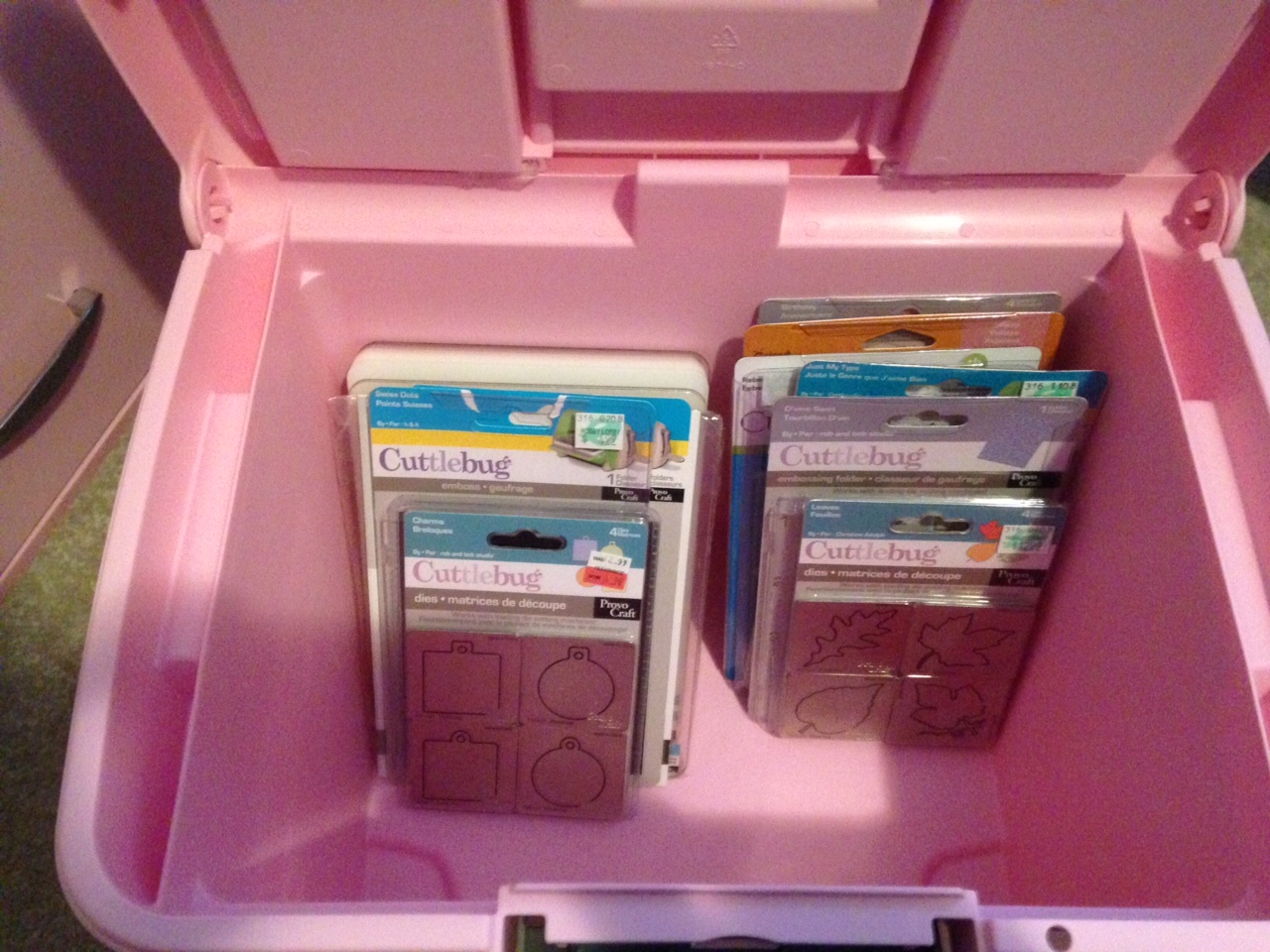
Also, I had my Cuttlebug embossing folders in a file box, but they didn’t need all that space.

Cuttlebug folders in file box

Cuttlebug folders in file box

I had this cute little plastic box I’d found at Target but hadn’t found a use for it yet, and they fit perfectly. Now they are much easier to flip through.

New Cuttlebug box

New Cuttlebug box

As you can see in one of the above pictures, the Cuttlebug, box of folders, and laminator all occupy the bottom shelf of the TV cabinet.

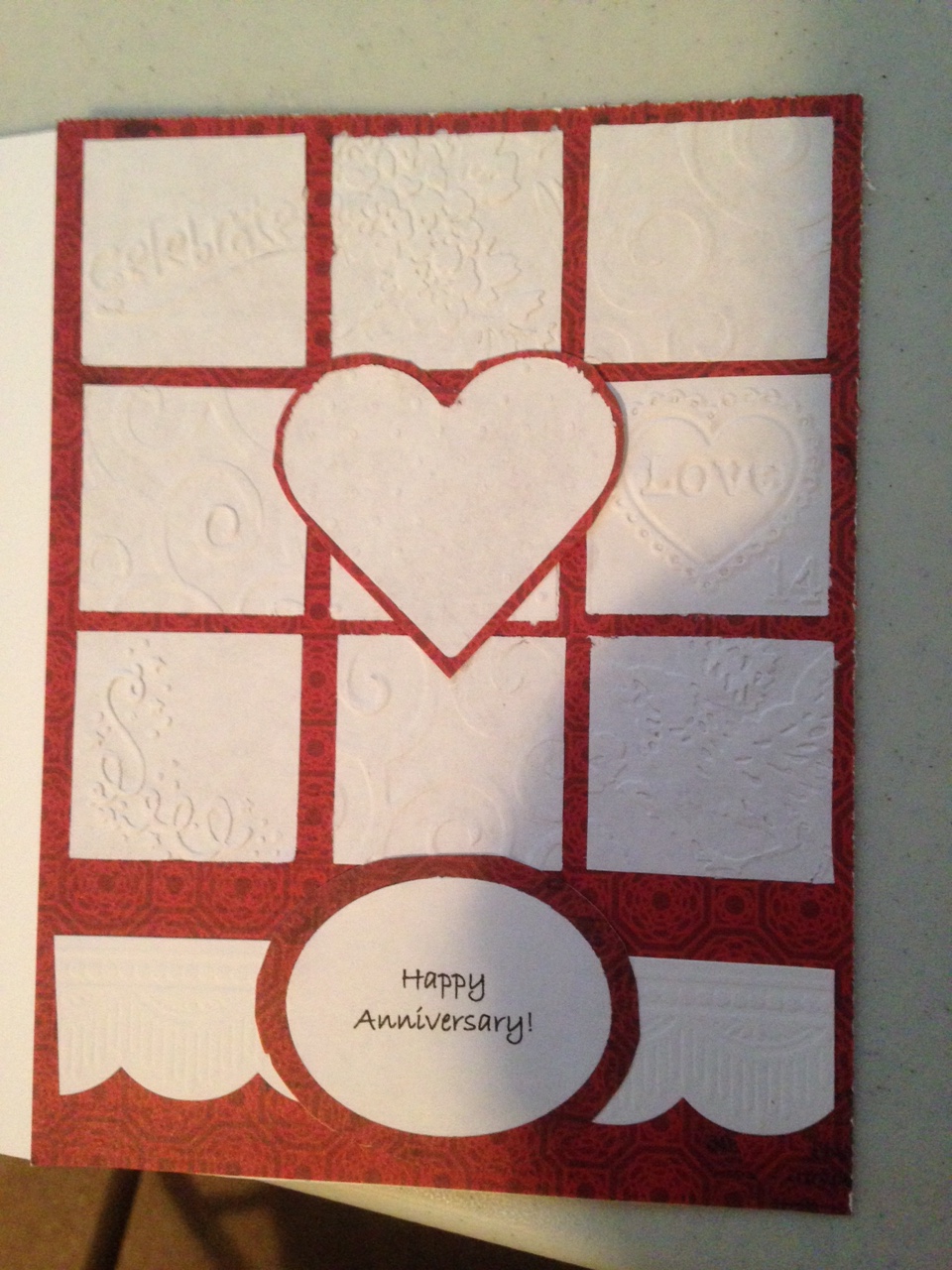
By the way, does anyone know what happened to Cuttlebugs? I don’t see them in craft shops any more. I guess they probably got replaced by some new machine that I don’t know about. But I love the Cuttlebug. I used it on this card for my son and daughter-in-law:

IMG_1304

I still like the idea of a storage cabinet under the table. though. They still have these cabinets at Wal-Mart, but only in black, and I am not fond of the idea of painting black cabinets white again. I’ve looked at kitchen carts (usually too tall) and other ideas, but everything else is either too expensive or doesn’t fit the space. So I’ll have to think about that a while.

Also, I didn’t think to take a “before” picture, but I did some work in the closet as well. I had a corner cabinet in there that was tipping forward because the stuff I had one it was too big and heavy. Jesse helped me put some pieces of cardboard under the front corner so it wouldn’t tip forward, and I traded all the smaller things that were in the middle bookshelf onto the corner shelf and put the big photo albums and such that I’d had on the corner shelf onto the middle bookshelf (one of those, “Duh, why didn’t I think of that before?” moments). Then I just had a bunch of stuff piled into the right corner. It just recently occurred to me that I could get another corner shelf for the right side (another “Duh!” moment!) I couldn’t find one like I already had on the left, but I found this one on Amazon and was able to get it free with accumulated cash-back points from the credit card. So picture the before photo with a mess in both corners, and now (I ended up having to take two “after” pictures because I couldn’t get both sides in the frame):

IMG_1355

Left closet corner

The pink plastic drawers on the left are two stacked on top of each other. I wasn’t sure if that would work or if they’d topple every time I opened a drawer, but they have worked wonderfully. I did think about them for that under-the-table space, but I was wanting more open shelves there. But they might work – still thinking. 🙂

IMG_1356

Right closet corner

I’m delighted that those corner shelves have really made the best use of that space.

Also, for good measure, I thought I’d show you this:

IMG_1357

All of those boxes on the left-hand shelves hold photos that, hopefully some day before I die, will make it into some of the albums I’ve accumulated through the years. That was before photos went digital.

So — getting things spiffed up in there is inspiring me to spend more time in there – if only I could!!! But getting it more organized will make it easier to do things in there when I do have time.

I am linking up with Tori‘s To-Do Tuesday.

todotuesdy

Some Bookish Questions

Photo courtesy of winnond at FreeDigitalPhotos.net

Photo courtesy of winnond at FreeDigitalPhotos.net

Sherry at Semicolon posted a few bookish questions a while back, and I have been waiting for an opportunity to borrow them. I am almost always up for talking about books 🙂

1. What propelled your love affair with books — any particular title or a moment?

Learning to read in first grade (kindergarten was not required then). I don’t remember if my mom read to me or if I had books before that – probably she did and I did. But learning to read opened up a whole new world to me and I have loved it ever since.

2. Which fictional character would you like to be friends with and why?

Elinor Dashwood of Austen’s Sense and Sensibility. I think we’re similar personalities, though she is more patient than I am.

3. Do you write your name on your books or use bookplates?

Neither unless I am loaning them and want them back. Then I often just right my name on the front flyleaf, but sometimes I put an address label there.

4. What was your favorite book read this year?

Probably Out of a Far Country: A Gay Son’s Journey to God. A Broken Mother’s Search for Hope by Christopher and Angela Yuan, a prodigal son and mother. The mom had as much to learn as the son. Wonderful to see God work in lives that we might consider the hardest cases. Nothing is impossible with Him!

5. If you could read in another language, which language would you choose?

Agree with Sherry here: Hebrew or Greek, to read the Bible in the original languages.

6. Name a book that made you both laugh and cry.

Oh my – there have been many, but I will go with the most recent one: Little Dorrit by Dickens.

7. Share with us your favorite poem?

That would be hard to narrow down. I love Robert Frosts’s meditativeness (is that a word?) in “Stopping By Woods on a Snowy Evening ” and “The Road Not Taken,” Richard Armour‘s lighthearted verse, Robert Burn’s thoughtfulness in “To a Mouse”  and other poems, Poe’s capabilities in rhythm and setting a scene in “Annabelle Lee” and “The Raven,” “October’s Party” by George Cooper, “The Blue Robe” by Wendell Berry, “To A Waterfowl” by William Cullen Bryant, much of Elizabeth Barret Browning and Christina Rossetti’s work. But I think I’ll mention here Anne Bradstreet‘s “By Night While Others Soundly Slept”:

By night when others soundly slept
And hath at once both ease and Rest,
My waking eyes were open kept
And so to lie I found it best.

I sought him whom my Soul did Love,
With tears I sought him earnestly.
He bow’d his ear down from Above.
In vain I did not seek or cry.

My hungry Soul he fill’d with Good;
He in his Bottle put my tears,
My smarting wounds washt in his blood,
And banisht thence my Doubts and fears.

What to my Saviour shall I give
Who freely hath done this for me?
I’ll serve him here whilst I shall live
And Loue him to Eternity.

I’d love to hear your answers to any of these questions!

Safely Through Another Week

Safely through another week God has brought us on our way;
Let us now a blessing seek, on th’approaching Sabbath day;
Day of all the week the best, emblem of eternal rest,
Day of all the week the best, emblem of eternal rest.

Mercies multiplied each hour through the week our praise demand;
Guarded by almighty power, fed and guided by His hand;
Though ungrateful we have been, only made returns of sin,
Though ungrateful we have been, only made returns of sin.

While we pray for pardoning grace, through the dear Redeemer’s Name,
Show Thy reconciled face, shine away our sin and shame;
From our worldly cares set free, may we rest this night with Thee,
From our worldly cares set free, may we rest this night with Thee.

Here we come Thy Name to praise, let us feel Thy presence near,
May Thy glory meet our eyes, while we in Thy house appear:
Here afford us, Lord, a taste of our everlasting feast,
Here afford us, Lord, a taste of our everlasting feast.

When the morn shall bid us rise, may we feel Thy presence near:
May Thy glory meet our eyes, when we in Thy house appear:
There afford us, Lord, a taste of our everlasting feast,
There afford us, Lord, a taste of our everlasting feast.

May Thy Gospel’s joyful sound conquer sinners, comfort saints;
May the fruits of grace abound, bring relief for all complaints;
Thus may all our Sabbaths prove till we join the church above,
Thus may all our Sabbaths prove till we join the church above!

By John Newton, 1774

Graphics courtesy of Creative Ladies Ministry

(I know that Christians meet on the Lord’s Day and not the Sabbath, but I still feel the text is appropriate for us to meditate on when we meet one day a week to worship God together.)

Friday’s Fave Five

 FFF tamara's

It’s Friday, time to look back over the blessings of the week with Susanne at Living to Tell the Story and other friends. Here are some highlights from this week:

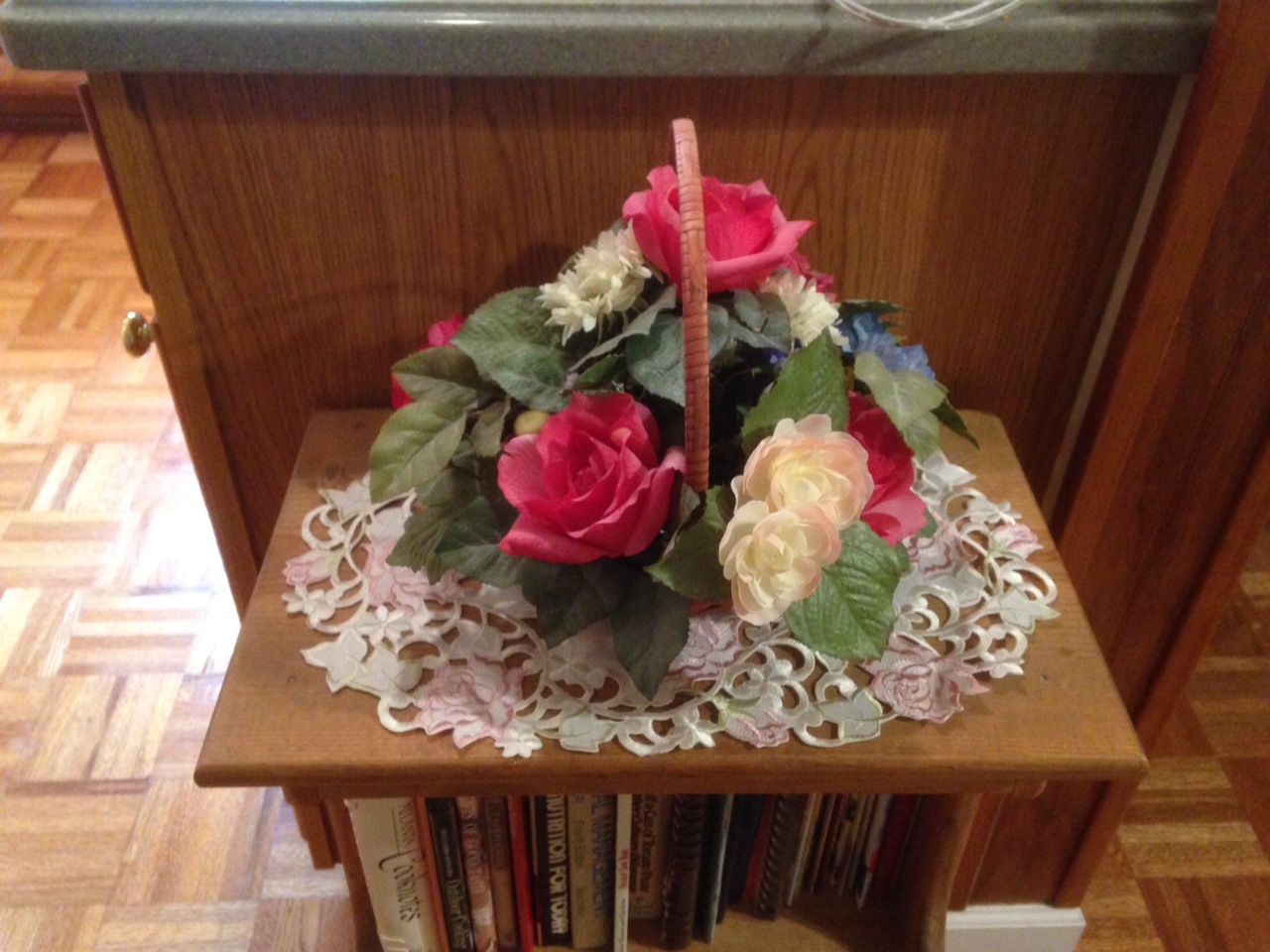
1. A belated birthday present. One of the things I had suggested for a birthday idea was this doily. I had forgotten about it, but it arrived this week. I think it is so pretty, and it fits this space so well.

IMG_1350

IMG_1351

2. A three-day weekend is always a nice thing. It was pretty quiet as all but Jesse were away, but we still did the traditional Labor Day burger grilling. 🙂

3. A good blend of rest and getting things done both Saturday and Monday. I love when it works out that way. Some weekends are more restful, needed some times, but I feel guilty if I don’t get something done. But full-blown, non-stop busy weekends are exhausting. It’s nice when there is a balance.

4. Some organizing in the craft/sewing room. I may show you next week. It’s nice when a better idea for how to set something up pops in one’s head unexpectedly. And then having time to actually implement it is a plus!

5. Taking some first steps towards fitness and losing 2 lbs already!

A nice week overall, and a pleasant day today (Thursday) as I am writing, with some cooler temperatures and gentle rainfall off and one. Hope your week has been good as well.

I can’t let this day go back without remembrance of the events of 9/11 and those suffered most by losing a loved one or suffering harm physically, emotionally, or mentally. My prayers are with them and our nation.