It has been quite a while since I have been able to do one of these, but here are some posts I’ve found interesting the last few weeks. Maybe you’ll enjoy one or two of them as well:
It’s Friday, time to look back over the blessings of the week with Susanne at Living to Tell the Story and other friends.
This has been a full week. On Monday I was supposed to have a procedure to correct a misfiring nerve in my heart that caused rapid and irregular heartbeats. After hours of their attempts to stimulate my heart into the abnormal rhythm in the OR, most of which I had to be awake for, they found that the trouble was in a different area than they thought and required a longer and riskier procedure, so they were not able to do anything that day. I am supposed to see the doctor in a few weeks to discuss treatment options, which will probably include a new medication. It was tremendously disappointing, after finally deciding to have this surgery after 15+ years of putting it off, going through all the mental preparation for it, and looking forward to finally being done with, to find I not only wasn’t done with it but had something else to deal with. But still, there were good things about the week:
1. Peace that passes understanding. I had written before the surgery of several concerns I had, and usually any kind of medical appointment has my nerves stretched pretty taut. But none of the things I was concerned about were a problem, and God gave me a calmness that floored me and could only have come from Him.
2. Kind people. I mentioned in my post after the surgery that there were several kind people along the way, some of whom I only interacted with for a few moments, who were a great blessing. I loved Susan’s comment about letting that inspire her to see and be kind to people. A good reminder to me as well.
3. My wonderful family. My son and daughter-in-law brought dinner over Sunday and then spent Monday afternoon at our house making dinner for both Monday and Tuesday and cookies. Plus they brought me pink roses in this gorgeous vase:
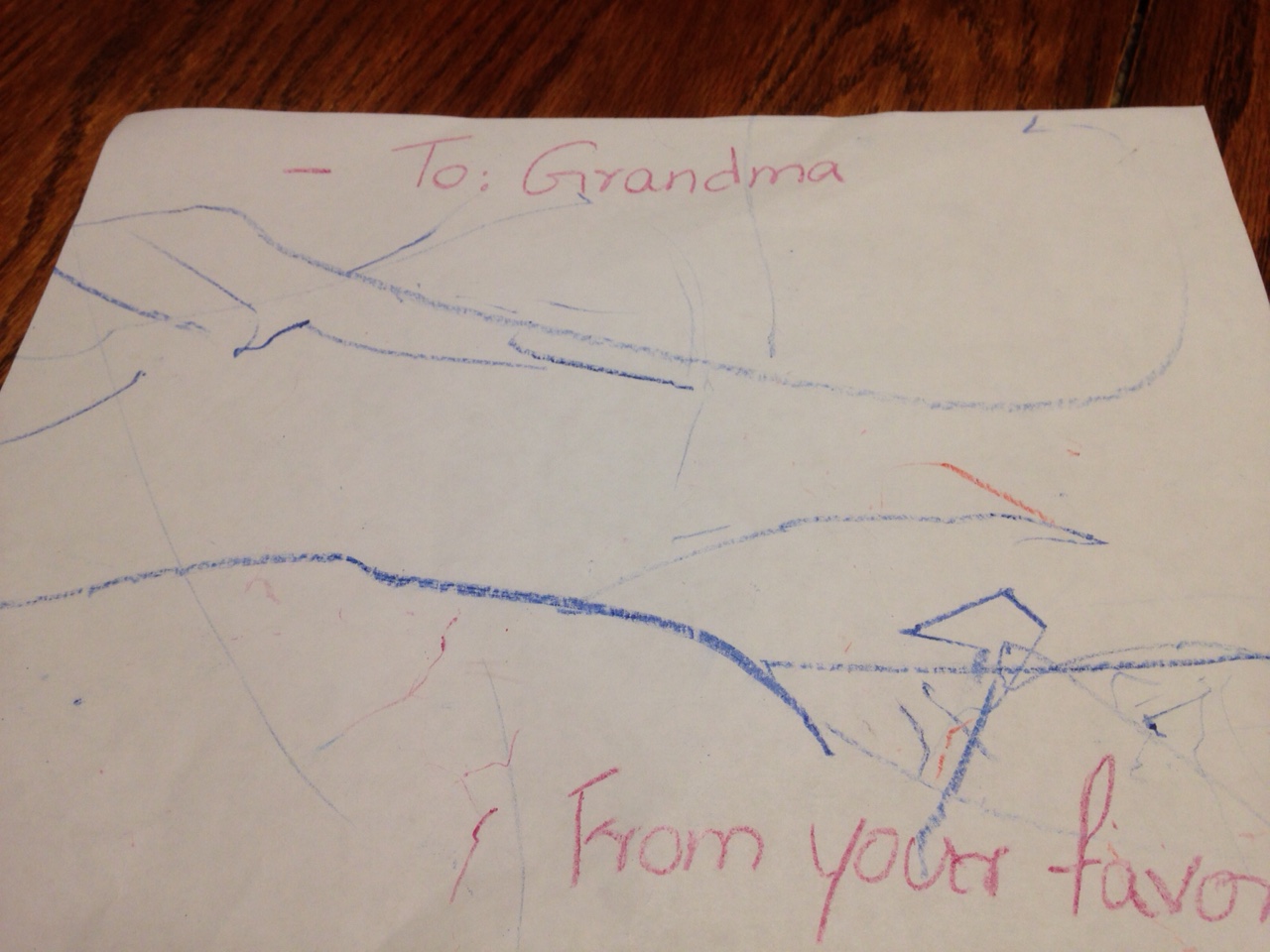
Timothy colored my first ever picture from him. 🙂
Jesse accompanied me to the store and has been doing things around the house requiring any heavy lifting, since I am not supposed to do that for a few days. And my dear husband patiently put up with my fears beforehand and my tears afterward, put Benadryl on my back where I had an allergic reaction to some adhesive, and has been doing a great job taking care of me in various ways. It was good to FaceTime with my oldest son, too, after getting home that night.
4. Timing. I didn’t set the date for this procedure–the doctor’s office did — but it was perfect timing. We had Jason’s birthday and move in the last couple of weeks and my oldest son’s coming for a visit and his birthday in the next couple of weeks, but this week there is nothing going on, so it has been a good time to take things a little easier.
5. My first ever chicken and dumplings. I don’t think I had ever made them before. A lady in one of our former churches used to make a great version and often brought them to potlucks and for meals when someone was sick. I think I was afraid mine would never live up to hers and I was afraid of the dumplings ending up totally mushy. But somehow this dish was just what I was in the mood for one night, and this recipe looked simple enough. I used frozen chicken tenderloins (love that I can cook them straight from the freezer), so that eliminated the tedious task of picking meat off bones. I thought it turned out pretty well, and husband and son seemed to like it ok. It hit that craving spot for me and was fairly easy as well.
My 9th blogging anniversary was at the end of July, but with everything going on, I didn’t really observe it except as a passing thought. Usually I do a giveaway or something on that day, but we’ll save it for next year’s 10th anniversary! Thank YOU for being a part of my blogging experience! Your kind comments have meant a great deal to me.
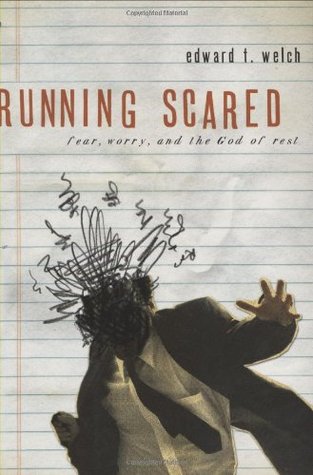
Edward T. Welch aims Running Scared: Fear, Worry, and the God of Rest primarily at himself as a “fear specialist,” but thankfully he lets us in on what he has learned. He notes that “Fear not” is the most often repeated command in the Bible and can be taken either as “a judicial warning, which has a threatening overtone” or as a “parental encouragement, which aims to comfort.” He says, “Luke places the accent on parental encouragement,” and Welch does as well. The thirty meditations are not an outline or in linear form — there’s a bit of overlap — but reading a chapter a day is doable and helps build on the principles he discusses.
The first couple of chapters set the scene, and, if you didn’t think you were fearful or had anything to worry about, these will convince you! One problem with dealing with fears in a conventional way is that they don’t usually submit to logic, and some techniques for dealing with them are only temporary and don’t get to the heart of the matter.
The heart of the matter, Welch asserts, is that our fears and worries reveal something to us about ourselves. Most of them focus on not getting something we think we need, or fearing something that might happen. Both involve a fear of not being in control and reveal what we value. So he encourages us to “Rather than minimize your fears, find more of them. Expose them to the light of day because the more you find, the more blessed you will be when you hear words of peace and comfort.”
“Worriers are visionaries without the optimism.” Most worriers would qualify as false prophets because our predictions don’t come true more often than not.
“The sheer number of times He speaks to your fears says that He cares much more than you know…The way He repeats Himself suggests that He understands how intractable fears and anxieties can be. He knows that a simple word will not banish our fears.”
“Search Scripture and find that our fears are not trivial to God. ‘Do not be afraid’ are not the words of a flesh-and-blood friend, a mere human like yourself. They are not the words of a fellow passenger on a sinking ship, who had no experience in shipwrecks, can’t swim, and has no plan. These words are more like those of captain who says, ‘Don’t be afraid. I know what to do.’ When the right person speaks these words you might be comforted.”
There is so much that is helpful in this book and so many places I have highlighted that it’s hard to know which ones to share without quoting half the book here. I’ll try to just share some of the things that were most helpful to me.
One was the “manna principle,” lessons drawn from God’s providing Israel with manna in the wilderness. One lesson was that the Israelites weren’t really models of prayer in that instance. They were complaining. That doesn’t give us the right to complain, but it does highlight the fact that God answers because of His grace, not because of “the quality of our prayers.” Another I shared earlier is that the Israelites were to gather what they needed for each day. If they tried to hoard enough to last, the excess would rot. So for us, we depend on God’s grace for each day’s needs. Most worry is about what is going to happen in the future, but Jesus said, “Therefore do not be anxious about tomorrow, for tomorrow will be anxious for itself. Sufficient for the day is its own trouble” (Matthew 6:34). That doesn’t mean we never plan ahead — there are Scripture verses about that, too — but we don’t worry or become anxious about them, trusting God will provide what is needed when the time comes. We won’t have grace for a future event because we don’t need it yet. Another was that the principle of Sabbath rest was built into their system and served, among other things, as a test of faith and a way to honor God and acknowledge His control. Just as they had to trust that the manna would be there every morning, they had to trust that when they gathered enough on Friday to last through the Sabbath, it wouldn’t rot like it usually did when they gathered extra. This is a principle largely lost on modern Christians. True, we’re not under the specific Sabbath restrictions that Israel was, but a Sabbath rest was exemplified by God in the first week of creation. Businesses feel they can’t afford to lose the business that they would if they were closed on Sundays, and individuals feel they can’t possibly get everything done they need to do if they take a day of rest. We don’t realize what we’re missing out on.
Another chapter, “The God of Suspense,” deals with the fact that sometimes God delivers before we even know we have a need, sometimes He seems to deliver at the last minute, and sometimes He delivers after the fact, “after hope dies,” as with the death of Lazarus and the widow’s son. In those cases. God had a greater purpose in mind: to show people that Christ had power over even death. He cites some cases in which the very thing someone feared came upon them (as Job said), and God didn’t deliver in the way hoped for, yet He did something greater in drawing the person closer to Himself and helping them know Him in ways they would not have otherwise. He cites many Biblical examples that God does not shield us from every hardship, but “If the difficulty you anticipate comes upon you, you will receive grace” to deal with it.
He talks a great deal about the Sermon on the Mount and being taken up with God’s kingdom:
Are you worried? Jesus says there is nothing to worry about. It isn’t our kingdom, it’s God’s. We take our cue from the King, and the King is not fretting over anything. He is in complete control.
When you know that the Kingdom is God’s alone (though He gives it to us), that is the only thing that can lead to peace and rest. Owners are the ones who do all the worrying; stewards simply listen to the owner’s desires and work to implement them. Owners are responsible for the outcome; stewards strive to be faithful.
A few more favorite quotes:
“Worry is focused inward. It prefers self-protection over trust…It can reveal that you love something more than Jesus. It crowds Jesus out of your life.” It can even “choke the word” of God in our lives (Mark 4:19), so it is nothing to be ignored or treated lightly. “Anxiety and worry are wake-up calls that must be handled by spiritual means.”
“Worry’s magnetic attraction can only be broken by a stronger attraction, and David is saying [in Psalm 27] we can only find that attraction in God Himself.”
“When you call out, you might feel like He isn’t present or easily found. That is the nature of pain. The worse it is, the more alone you feel. But this is a time when the words of God must override your feelings. There are times when we listen to our feelings and times when we don’t. This is a time when we don’t. Instead, whenever there is a clash between our sensory experience and the promises of God, the promises of God win. The one who says, ‘verily, verily’ can be trusted. Call out and He will be found when you need Him.”
Welch deals with not only the anxiety and worry over physical needs, like money and provision, but with personal needs like approval and love, fear of death and judgment. He discusses prayer and what it means to have died in Christ and what freedom that can bring us. He points to our need to find and focus on our calling from God, what God’s peace, or shalom, means, and His instructions to be peacemakers. In short, I think he pretty much covers every base he can think of that might be related to anxiety and worry and points us to Christ in each instance.
There were a few places I disagreed with him about some particular, but I don’t fell the need to delineate all of that here. Overall I found this one of the most helpful books I have ever read. I mentioned before that I had bought it as a Kindle sale and forgotten about it, then came across it about a month before my recent surgery and decided to read it in the days leading up to the procedure. Combined with the prayer of friends, it helped me keep my mind on God and off the “what ifs,” and I know I will return to it often in the future.
(This review will also be linked to Semicolon‘s Saturday Review of Books.)
Pygmalion by George Bernard Shaw wasn’t really on my radar, but one of the categories for the Back to the Classics Challenge was a play. At first all I could think of was Shakespeare, and I wasn’t quite up to him just now. Then, perusing a list of classic play titles, I saw Pygmalion. Perfect!
The play opens with a number of people in front of Covent Garden late on a rainy night. All different classes of people are represented here. Someone trying to find a cab runs into a flower girl and knocks her basket out of her hand, spilling her wares and thus ruining her income for the night. In trying to sell her flowers, someone points out a man taking notes. She fears he is with the police and starts protesting her innocence and right to be there. As it turns out, he is not with the police. He is Henry Higgens, a professor of phonetics who can tell everyone where they are from by their accent. One of the crowd is a Colonel Pickering, who, as a student of Sanskrit, had just come from India to confer with Higgens. In their conversation, Higgens remarks offhandedly that he could take the flower girl’s “depressing and disgusting sounds” that would “keep her in the gutter to the end of her days,” and within three months’ time pass her off as a duchess.
To his surprise and consternation, the flower girl. Eliza Doolittle, shows up at his house the next day to take him up on what she perceived as an offer. She’d like to work in a flower shop instead of on the streets, and needs to know how to talk better to do so. Pickering encourages Higgens to take her on, saying that if he can teach her to pass for a refined member of society by an ambassador’s garden party, he’ll pay for her lessons. Despite the protests of his housekeeper that “You can’t take a girl up like that as if you were picking up a pebble on the beach,” Higgens agrees.
Thus begins their work, with much clashing of wills and opinions, triumphs and not-quite triumphs. A couple of my favorites of the Professor’s instructions:
Remember that you are a human being with a soul and the divine gift of articulate speech: that your native language is the language of Shakespeare and Milton and The Bible; and don’t sit there crooning like a bilious pigeon.
Remember: that’s your handkerchief; and that’s your sleeve. Don’t mistake the one for the other if you wish to become a lady.
If you’ve ever seen the musical My Fair Lady, you may know that it is based on Pygmalion. The ending is vastly different, and the actual scene of Eliza’s ultimate test is shown in the film whereas it is only referred to in the book, but otherwise for the most part it follows the play pretty closely (at least as far as I can remember – I haven’t seen the musical in a long time). Pygmalion is based in turn on a Greek mythological character of the same name who falls in love with a statue he created and gets his wish for it to come to life.
The end of My Fair Lady has Eliza and Higgens falling in love: Pygmalion does not. In fact, the end of Pygmalion seems a little unsatisfying at first. I thought that was just because I was used to My Fair Lady’s ending, but according to a number of sources I read, many who produced or directed the play varied the end slightly to at least hint that Eliza and Higgens came to some understanding. Shaw got so disgusted that he wrote a very long afterward explaining why they could not possibly have married, whom she does marry, and what happens to the major characters after the end of the play. Though this Pygmalion does not fall in love with his creation, he does “bring her to life.” In one of their final scenes together, when they’re arguing over what’s to become of her now, she shows she has gone from simpering and whining about it to having a plan, even if it means standing up to Higgens. He replies, “It’s better than snivelling; better than fetching slippers and finding spectacles, isn’t it? By George, Eliza, I said I’d make a woman of you; and I have. I like you like this.” So if we can set aside the desire to see a “romantic” ending, it is a conclusive ending in that now his “creation” is truly complete. Cliff notes says:
Consequently, with the conflict clearly stated for Higgins, the essence of human life is through mutual improvement; for Eliza, it is through human loving and commitment — then only the most sloppy, sentimental reader could ever think that their relationship will ever change.
In Shaw’s afterward he says, “The rest of the story need not be shown in action, and indeed, would hardly need telling if our imaginations were not so enfeebled by their lazy dependence on the ready-makes and reach-me-downs of the ragshop in which Romance keeps its stock of ‘happy endings’ to misfit all stories.” SparkNotes suggests Shaw was trying to deconstruct the typical fairy tale. If he was, he did a good job. Henry Higgens is no Prince Charming. He’s gruff, conceited, ill-mannered and self-centered. Though Eliza is transformed, she’s not exactly a Cinderella. And their ending, if not “happily ever after,” is probably more realistic (“What is Eliza fairly sure to do when she is placed between Freddy and Higgins? Will she look forward to a lifetime of fetching Higgins’s slippers or to a lifetime of Freddy fetching hers?”)
Other sources say Pygmalion is a satire of the social classes, and I can see that angle, too, especially in the subplot with Eliza’s father. And though each class is shown to be ridiculous in some ways, Shaw makes some poignant observations as well. Eliza tells Colonel Pickering:
Your calling me Miss Doolittle…That was the beginning of self-respect for me. And there were a hundred little things you never noticed, because they came naturally to you. Things like standing up and taking off your hat and opening doors — yes, things that showed you thought and felt about me as if I were something better than a scullery maid…
The difference between a lady and a flower girl is not how she behaves, but how she’s treated. I shall always be a flower girl to Professor Higgens, because he always treats me as a flower girl, and always will; but I know I can be a lady to you, because you always treat me as a lady, and always will.
Shaw says in his preface, though, that it is primarily about speaking English and based on well-known phonetics specialists. He says, “The English have no respect for their language, and will not teach their children to speak it. They spell it so abominably that no man can teach himself what it sounds like…German and Spanish are accessible to foreigners: English is not accessible even to Englishmen. The reformer England needs today is an energetic phonetic enthusiast: that is why I have made such a one the hero of a popular play.” He says later:
I wish to boast that Pygmalion has been an extremely successful play all over Europe and North America as well as at home. It is so intensely and deliberately didactic, and its subject is esteemed so dry, that I delight in throwing it at the heads of the wiseacres who repeat the parrot cry that art should never be didactic. It goes to prove my contention that art should never be anything else.
As I said earlier, I had no thoughts of reading this play until I saw the title and thought it would be good for the Back to the Classics play category, and indeed it was. It was nice to have lighter fare after some longer and heavier works. Though I missed the musical numbers, I did enjoy finding out what the original story was like. I enjoyed listening to the audiobook delightfully read by a full cast but also got the free Kindle version to go back over some parts more thoroughly.
Some readers will want to know that it has a smattering of “damns” in it.
And even though these are not part of the original play, especially the last two, they’re on my mind after finishing the story, so I will share them here:
Thanks you so much for praying for the procedure that was scheduled yesterday, an ablation which was to correct supraventricular tachycardia. Unfortunately, they were not able to perform the ablation – as my oldest son said, they did everything for the procedure but that.
Before they can do the ablation, they have to “map” the heart and then try to stimulate it into an SVT rhythm. They did a number of things to try to do that, but it never would convert over. That was the worst part of the day because I had to be awake for it, and it was quite uncomfortable. They did send it into fast heartbeats and irregularities, but not an SVT. They had to shock my heart to set it back to a right rhythm, but thankfully they put me to sleep for that. The doctor did see that the problems were in the atrium, not the ventricle, which is a whole different set of risk factors, procedures, and treatment options. He said we’ll discuss those next time I see him, which, unfortunately, isn’t for about a month.
As you can imagine, I was profoundly disappointed. In fact, when they wheeled me back to a room, I was a blubbering mess, and the lady helping me told my husband I would be emotional for a while. I’m sure that was mainly disappointment, but the pent-up emotion of the day probably contributed, and I can’t help but think that emotion might be an aftermath of all that happened in the OR as well.
We’re left with more questions than answers now, like why did all those ER EKGs for years show SVTs if the problem was in the atrium? Do I have both, or were those wrong? I was Googling atrial tachycardia last night and found several places that said it was a type of SVT, which I don’t quite understand if the tachycardia is in the atrium and SVTs are ventricular. I’m not sure why they couldn’t go ahead and deal with that while they were in there, but he did say it was a different kind of surgery where I would be sedated the whole time. He told my husband they don’t usually do that surgery unless there were 3 risk factors: being female, having diabetes, and having high blood pressure. Of those, I only have one risk – being female. So hopefully we’ll get more answers when we talk with the doctor. I’m trying to write down my questions between now and then.
After all of that I had to lay on my back in a hospital room for 4 hours to make sure the areas where they inserted the catheters into the blood vessels weren’t going to start bleeding again. I ended up not getting home until about 9 p.m.
There were a few really nice people we met along the way. After we parked the car in the hospital parking lot, an open shuttle was right there, the driver asking if we wanted a ride to the entrance and wishing us well when he dropped us off. The man who came to take me to the OR was kind and kept cracking jokes. You have to be careful about that because some people in that situation would not be in the mood, but he kept saying unexpected things that cracked me up. The man who wheeled me out to the car was very kind. Unfortunately, in the OR everyone talked over me and to each other (about recipes, sound systems, etc.) rather than to me except one lady who was in charge of the different things that were put into the IV, and she explained things to me, answered questions, kept asking how I was doing, offered to scratch my nose if needed since I wasn’t supposed to move. I wished I’d had a chance to tell her how much I appreciated all she did. But it was just another reminder that even the seemingly small jobs, like driving a shuttle or transporting a patient, can make a big difference in someone’s day if done kindly and graciously and thoughtfully.
As to my other “issues” I asked you to pray about, I didn’t have any low blood sugar issues even though I didn’t eat for about 10 hours. I consider that something of a miracle! I had an IBS flare-up on Saturday, but nothing Monday. God gave me such a calm, I was in awe. It could only have come from Him. I am so thankful for His grace and the prayers of His people.
Another thing that helped was reading Running Scared: Fear, Worry, and the God of Rest by Edward T. Welch, which I mentioned before. I had finished it on Friday and Saturday and spent some time Saturday and Sunday going through and jotting notes from the chapters, and then Monday before leaving I spent some time looking through the passages I highlighted. In some ways it was mostly nothing new, though there were a couple of new ways to think about a couple of things. But going over and over those Scriptural principles helped me take my thoughts captive and keep my focus on the Lord and not on all the other things that could cause alarm. I am looking forward to reviewing it hopefully in the next few days.
My wonderful daughter-in-law and son brought dinner over Sunday and then made dinner for Monday and Tuesday while at our house on Monday. They stayed til we got back Monday night. I received my first picture from Timothy. 🙂
I have a few little restrictions over the next couple of days but after that should be back to “normal.”
Thanks so much for your prayers, your care, your comments on my previous post about the surgery. They meant much more than you can know.
It’s Friday, time to look back over the blessings of the week with Susanne at Living to Tell the Story and other friends. Here are some favorite parts of the last week:
1. Visit with friends. Some dear friends from where we used to live were in TN to celebrate their anniversary and asked if they could come visit our church Sunday morning and then have lunch with us. It was so good to see them again and fellowship over McAlister’s Deli wares.
2. Garden bounty. We don’t have a garden, but our neighbors have been bringing us some of their overflow. Most of what we haven’t been able to use we’ve passed on to my son and daughter-in-law and Great-Grandma’s caregiver.
3. Getting my son and daughter-in-law moved in to their new home. So far they are really enjoying the new place! I kept Timothy at our house while everyone else did the hard work. 🙂 He mostly did well. He wanted to be held while I made Great-Grandma’s breakfast – he had just been dropped off and was probably feeling a little insecure – and I did as much as I could while holding his 27 lbs. with one arm, but finally had to put him down and let him cry while I finished up. He cried again when I put him in the pack-and-play when I dashed off to the restroom, but other than that we had a great time.
4. Visiting with my daughter-in-law and grandson. I went to keep them company while some repairmen were there and enjoyed visiting and lunch.
5. A couple of days at home. I can’t seem to get grocery-shopping and other errand-running down to less than twice a week, but it was nice to have a couple of days to just enjoy being home and getting some things done.
Some of you who have been reading here for a while might remember that I’ve been having trouble off and on for years with something SVTs or supraventricular tachycardia. It’s when a nerve in the heart misfires and causes it to beat irregularly and fast (180-200 beats per minute) and sometimes requires a ER visit to reset it. It’s caused by a nerve in the heart misfiring.
The first time it happened severely enough to go to the ER, they sent me to a heart doctor for tests, and he told me about a procedure called an ablation, in which they go up through a blood vessel in the groin to the heart and “zap” the offending nerve with a laser.
But since I wasn’t having these attacks all that often, and the dr. said they weren’t life-threatening, I decided to wait. A few years after the initial attack, my general practice doctor started me on a medication to try to keep it in check. But now they are happening more often – several times a week. The medicine they have me on usually keeps it from going into a full-blown episode, but I finally decided enough was enough and I needed to go ahead and have this done. I’m kicking myself now for not doing it years ago, but can’t help that now.
They tell me this has nothing to do with heart disease or blockage – it’s just a problem with the electrical part of the heart. The ablation is an outpatient procedure, so I should be home that night, but they told me to bring an overnight bag just in case. One risk is if they “zap” too much or in certain areas, they might have to put in a pacemaker, but they said that happens in less than 5% of cases. It’s usually a safe and effective procedure, though there are risks with anything like that.
I have a few specific concerns. First, I have to go off the medications I am on for SVTs this week, so I am hoping I don’t have any flare-ups between now and the procedure. Secondly, the day of the procedure I don’t even go in til 11 a.m., which means the actual surgery probably won’t be til a couple of hours later. I don’t have diabetes, but I do have episodes of low blood sugar. Usually I can’t go past 10 or so without eating or else I experience dizziness, lightheadedness, shakiness, etc. So I am concerned that might be an issue that day. On the other hand, sometimes when there are other things going on with my body, it tends to suppress that (for instance, it wasn’t an issue when I went in for my colonoscopy). Third, I haven’t been officially diagnosed, but my doctor has told me I probably have irritable bowel syndrome caused by “situational stress.” Basically, when I get nervous about anything, my body decides it needs to empty itself. That’s one of the reasons I don’t like to travel. I have to take more than the recommended amount of anti-diarrhea medicine even to go to a regular office visit at the doctor’s or a cleaning at the dentist’s. So far that’s been the only treatment discussed – just taking anti-diarrhea medicine when it happens or when I anticipate it might happen (like before a trip). I know that being anxious about it feeds into it and increases the problem. But it’s not just being worried about what “might” happen: it’s a legitimate concern because it has happened in situations a lot less nerve-wracking than this one. And fourth, during the procedure itself I have to stay awake at first because they have to stimulate the heart to go into SVT so they can find which nerve is misfiring. So my prayer for that is that my heart will go into SVT then so they can find and zap the right nerve and all this time and angst will not have been wasted. And then, of course, there are concerns for the procedure itself, that it will accomplish what it needs to but that there won’t be any complications.
So – if you feel led to, I would certainly appreciate your prayers for everything involved.
As I understand it, this is one of the least troublesome types of arrhythmias and least complicated surgeries for them – there are other types which can cause strokes and require a longer and more intricate surgery. So I am thankful that, if I had to have a heart rhythm problem, it’s this one and not one of the others.
I’ve been reading Running Scared: Fear, Worry, and the God of Rest by Edward T. Welch. It’s been in my Kindle for a while, and a few weeks ago I saw it while perusing titles there and thought it would be perfect to read in the weeks leading up to this procedure. It has indeed been very helpful. One chapter talks about the manna principle – lessons learned from the Israelites’ wilderness experience with God’s provision of manna. One part of that is that God provides what you need for the current day. The Israelites were to gather what they needed for each day and not gather ahead except for the Sabbath. Jesus said, “Therefore do not be anxious about tomorrow, for tomorrow will be anxious for itself. Sufficient for the day is its own trouble” (Matthew 6:34). So when I start thinking about all this, I remind myself the “manna” for that will come when it’s needed, not before. I’m endeavoring to “Cast all [my] care upon him; for he careth for [me]” (I Peter 5:7).
The surgery is early next week. Jim’s mom’s caregiver will be able to stay with her all that day and evening, thankfully. I’ll try to post an update after it’s all over.
The folks at 5 Minutes For Books host What’s On Your Nightstand? the fourth Tuesday of each month in which we can share about the books we have been reading and/or plan to read.
I love when the Nightstand posts occur actually near the end of the month, as they do this time. It’s been a busy month, but let’s see what’s been accomplished on the reading front.
In addition, last time I had finished The Little Prince by Antoine de Saint-Exupéry but hadn’t reviewed it yet. That review is here. Ended up liking it quite a lot, though I thought it was odd at first.
I also started two books that I set aside due to language. I haven’t decided yet whether to finish them or lay them aside permanently. One was a classic, one was a modern true story that I had really wanted to read.
If I finish those I have a stack of unread books on the bookshelf in my bedroom as well as a lengthy TBR list and a multitude of Kindle books to choose from.
In The Narnian, Alan Jacobs wanted to write a biography of C. S. Lewis, but not one that brought out a lot of extraneous details of his life. He wanted to concentrate mainly on what made him “the Narnian” – the intellectual, imaginative, and spiritual developments in Lewis’s life that led to his creating Narnia.
He begins with Lewis’s early life and family: the death of his mother and the fact that afterward “all settled happiness, all that was tranquil and reliable, disappeared from my life”; the imaginary worlds he created with his brother (separately first, then they joined them together), his problems with his father, the solitary days playing alone in his home after his brother went to boarding school. When Lewis’s own turn came for boarding school he didn’t get on very well socially and eventually thrived under a private tutor. Jacobs then progresses through Lewis’s time in the military, in academia, His conversion from atheism, his apologetic writing, his fame as a defender of the faith, and his turning from that genre to children’s stories, and closes soon after telling of the end of Lewis’s life.
Along the way he pulls up information from Lewis’s published writings, letters, diaries, and other people’s letters, diaries, comments, and a few other people’s biographies of him.
I didn’t “discover” Lewis until in my early 40s (I know, how did that happen? My education was definitely deficient!) Some time after my first reading of The Lion, the Witch, and the Wardrobe, I read a biography of Lewis, but I don’t remember which one. I’m thinking it must have been one geared to children, because his childhood is what I mostly remembered from it, but then maybe that’s just due to a faulty memory. At any rate, I enjoyed being reminded of elements I knew and then learning new details of his older life.
I liked the way Jacobs juxtaposed elements of Lewis’s life with the Narnia books, quoting some of the sections about schooling along with talking about Lewis’s schooling, doing the same with his early childhood and military service. There is not much more than basic information about Lewis’s time in the military – he seems to have kept thoughts about it close to his vest – but some of the passages in the Narnia books about having to fight, particularly from Peter’s viewpoint, probably grew from his own experiences. Digory Kirke was based on Lewis’s private Professor Kirkpatrick (sometimes called Kirk), though Kirk was a staunch unbeliever (“Digory Kirke is a picture of what William T. Kirkpatrick might have been – had he ever found a way into Narnia.”) Of course, Jacobs isn’t saying that everything in the books is based on something from Lewis’s life explicitly. Much in the stories came from his imagination, but that’s going to be based on his own experiences as well as those he had read about.
I especially appreciated his defense or explanation of where Lewis was coming from in a couple of areas where some are critical of him. He has been called a misogynist because of his views on women, particularly in regard to teaching that the man is the woman’s head in a relationship, and racist because the Calormen people, the “bad guys” in Narnia, are dark-skinned. Tolkien was also accused of racism in LOTR, and Jacobs explains:
The imaginations of those two men were shaped before the great wars of the twentieth century: they belonged indeed to an Old Western culture to which the chief threat, for hundreds of years, had been the Ottoman Empire. The Calormenes and the Haradrim are but slightly disguised versions of the ravaging Turk who filled the nightmares of European children for more than half a millennium — but whose “exotic” culture (manifested in images of elegant carpets, strong sweet coffee, slippers with turned-up toes, and elaborate story-telling traditions) had also been an endless source of fascinated delight.
Jacobs asserts, and I agree, that most readers “can tell the difference between, on the one hand, an intentionally hostile depiction of some alien culture and, on the other, the use of cultural differences as a mere plot device,” and he puts Lewis’s comments on both topics within the context of the culture of his time and his own upbringing.
What I strongly disliked about this book was Jacobs’ frequent arguing with Lewis’s own reasons for saying certain things. For instance, Lewis asserted that his having prayed for his mother to be cured and not receiving the answer he sought did not influence his eventual conversion one way or the other. He had thought of praying not so much as a religious exercise but as a formula in those days and assumed he didn’t have the right formula or it hadn’t worked. Her death affected him in many ways, but it wasn’t a particular factor in that decision. Jacobs is incredulous and posits that perhaps Lewis’s “insistence must be his attempt to uphold a set of beliefs about what Christianity really is, or really should be” or he had “a great resistance to anything like a ‘Freudian’ explanation of his spiritual history – and in the Freudian account, childhood experiences are usually definitive for later life.” On another subject Lewis “seemed to think that [certain experiences] were not related; I have a sense that they may be.” Jacobs finds it “rather difficult to believe that Lewis’s description of [his first meeting with his tutor] is wholly accurate.” He feels Lewis’s claim that his wartime experiences “‘show rarely and faintly in memory’ – is either something less than fully honest or something less than fully self-knowing.” He quotes Lewis as saying those experiences “haunted my dreams for years” as proof, but Lewis says for years, not for the rest of his life, so at the time he said they were only rare and faint memories, that could have indeed been the case at the time of that writing. He questions Lewis’s account of his conversion and what stage of belief he was in at what point. He questions his relationship with Janie Moore, the mother of a friend who died in WWI. He and this friend had promised each other that if anything happened to one of them, the other would care for the dead one’s parent. This man did die, and Lewis took care of his mother for the rest of her life. He often refers to her as “the woman I call my mother.” But Jacobs insists that the relationship was romantic and even sexual at first (he is not alone in that view, but I am not convinced). When Lewis asserted that he had no “romantic feelings” at first for Joy Davidman Gresham, whom he married in a civil ceremony so she could stay in the country, Jacobs notes that his other biographers “take his word for it” and exclaims, “This seems crazy to me,” and explains why. (Lewis did come to love her, but who is to know at one point that happened.” About a third of the way into the book, Jacobs says as an aside, “Autobiography is, of course, often suspected.” I don’t think that’s the best way to look at autobiography, as if as a reader or researcher one has to disbelieve or suspect or prove what is written. Sure, the viewpoint of an autobiography may be limited: I feel it’s the best source for learning what is going on in the author’s head, what his motives and concerns were, etc., yet it can only show his own point of view. I’m sure there are autobiographies where the material is deliberately slanted, but I don’t think it’s healthy to have a suspectful view of autobiographies in general.
Mr. Jacobs not only disagreed with Lewis’s own views about his life, he also disagreed with some of his biographers, some of whom knew Lewis personally. In one of my snarkier moments I felt that an apt subtitle to his book could have been, “Why I Am Right About C. S. Lewis and Everyone Else Is Wrong, Including Lewis.”
But though this seeming attitude or perspective of Jacobs really bugged me, I did enjoy the book overall and enjoyed getting a fuller picture of the “The Life and Imagination of C. S. Lewis.”
I’ll close with one of my favorite quotes from Lewis in the book:
“We may ignore, but we can nowhere evade the presence of God. The world is crowded with Him. He walks everywhere incognito. And the incognito is not always hard to penetrate. The real labor is to remember, to attend. In fact, to come awake. Still more, to remain awake.”
It’s Friday, time to look back over the blessings of the week with Susanne at Living to Tell the Story and other friends. Here are some favorite parts of the last week:
1. Jason’s birthday. My middle son’s birthday was last Saturday, and we enjoyed celebrating him.
2. A phone call from a friend back in SC – a nice time to catch up a bit, plus to make plans to get together when she and her husband travel nearby. Can’t wait!
3. A new house – no, not for us. We had been looking for something to buy for Jason and Mittu to rent so they could get out of the higher rent apartment plus have more room. We closed on a cute little house yesterday. Whenever they feel like they need to move on (which might not be for 20 years or so – no rush. 🙂 ), we’ll probably either sell it, or, if we’re needing to downsize then, we might move into it. But that’s all way down the road – right now we’re excited for them to have a place that’s both bigger and less expensive.
4. Jim’s mom’s caregiver happily put in some extra hours so we could take care of closing on the house.
5. Safety knob covers for the oven. Timothy has gotten tall enough and curious enough to reach them, so I am glad someone invented these things.
Hope you had a great week! The next few are going to be super-busy for us, and then it’s hard to believe the summer will be over! It’s going too fast!









 Stray Thoughts