Booking Through Thursday: Rereading

btt  button Booking Through Thursday is a weekly meme which poses a question or a thought for participants to discuss centering on the subject of books or reading.

Today’s question has to do with rereading:

I’ve asked before if you re-read your books (feel free to recap), but right now I want to know if that habit has changed? Did you, for example, reread more as a child and your access to new books was limited by how often you could convince your mother to take you to the library? Has the economy affected your access so that you’re forced to reread more often now? Have you grown to look at old books as old friends so that you’re happy to spend time with them rather than rushing the next new thing?

I don’t remember whether I reread much as a child, though I imagine I did with a few favorite books. I don’t think the economy has had much effect on rereading: if I couldn’t afford new books, there are hundreds through the library. But I do reread some books, for several reasons:

1. It is like a visit with an old friend, much like listening to the same music, rewatching a movie, telling the same stories at family gatherings. It’s cozy, comfortable, and familiar.

2. It’s hard to get everything from most books the first time through. To me the best books are those I can revisit many times and still gain something from.

3. It’s hard to remember everything we got from the first read, especially (for me) with nonfiction.

4. It reinforces what I learned from the book before.

5. I identify with different characters or parts of the book differently at different stages. Little Women is a classic example: I identified with different ones of the girls as a child and young teenager; as a young wife I identified with Meg; as an older mom I saw Marmee through new eyes (and the girls, too, for that matter, looking on them from a mother’s point of view rather than as friends.)

6. It can be just plain fun to revisit a story.

The problem is that there are so many enticing new books to choose from that it is hard to make the decision to reread an old one. Sometimes with nonfiction I choose to reread because I need those lessons or that information again. But with fiction, audiobooks are a great way to revisit books. Although I do listen to new books that way, I can tend to miss something from them if I can’t hit the replay button (like when I am driving or cooking). But that’s not so much an issue with a familiar book. Plus by listening I don’t feel like the old book, especially if it is an old, longer classic, is monopolizing so much of my reading time. And hearing it read can bring out facets I may have missed in my own reading.

Here is a list I made a few years ago of books I have reread and would like to reread. I’m happy to say I have reread many from the latter list since then, most via audiobook.

Book Review: Walking From East to West: God in the Shadows

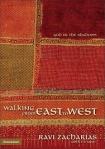
Walking From East to WestWalking From East to West: God in the Shadows by Ravi Zacharias first came to my attention when Sherry recommended it to me. I had heard Ravi speak on the radio several times and appreciated his ministry and his way of thinking, and I generally like biographies and memoirs, so I was glad to pick this up.

The book came about when his publishers asked him to write his memoirs “in the simplest terms, with your heart on your sleeve.” In the beginning of the book, Ravi shares these lines from James Russell Lowell’s “The Present Crisis“:

Truth forever on the scaffold, Wrong forever on the throne,—
Yet that scaffold sways the future, and, behind the dim unknown,
Standeth God within the shadow, keeping watch above his own.

Ravi shapes his story by pointing out God “in the shadows,” God at work throughout his life even when he did not perceive Him.

Ravi’s story begins in the East, in Chennai (formerly Madras) in India. His earliest religious associations were bound by fear but also by the rich heritage of the cultural stories, myths, and celebrations. His mother was spiritual but also superstitious. They even had an astrologist do readings of the family once, revealing a “cultural mix of religion, superstition, and ‘cover all bases’ mentality with regard to the supernatural.” A couple of Jehovah’s Witnesses were allowed to teach the children to read, especially the Bible, and the children were awed until they got to their teaching that only 144,000 were going to make it to Paradise. When Ravi realized that there were more than 144,000 Jehovah’s Witnesses worldwide, so that not even all of their people were going to make it, much less the people they were teaching, he rejected their study as well as Christianity. He didn’t know then that there were differences between different sects, and between sects and cults.

His father had a powerful position in the government, and his siblings all seemed to have leadership personalities. Being successful professionally and influentially was one of the highest values of his culture. For various reasons, Ravi’s father did not seem to have the same esteem for him that he did his other children. He had names of endearment for the others, but not for Ravi, and Ravi was “consistently on the receiving end of his rather violent temper.” This, of course, made him even more hesitant around his father than he already was naturally, and made his father react against him further. His father told Ravi he was a failure and repeatedly told him in so many words that he would never amount to anything. Ravi felt the same way: even the astrologer mentioned gave him a disappointing reading. He felt an intense loneliness and inferiority even with friends, because they were all “either rich or brilliant, and I was neither. While they were always at the top of the class, I never did well in studies.” They always had money to spend, and he didn’t: he could only participate in what they did if they paid his way. No one “bared their heartaches or inner struggles” in his culture, so he kept it all inside.

He found something of an escape in sports, where he did excel, especially in cricket, though his father never came to any of his matches. He thought about playing professionally, but even the professional cricket players could not make a living at it and worked at other jobs. Ravi had been so poor at his studies that by his teens, when he was supposed to be finding his way in life, he had no idea what to do, and his father’s consistent belittling and his increasing sense of loneliness were all coming to a head.

About this time his sister started attending Youth For Christ rallies and invited him along. He was bored at first but came again when his sister was singing with a group that night. Then he heard a message on John 3:16 that spoke to his heart, and he responded to the invitation and prayed to receive Christ. Things were still vague and fuzzy for him for a long while.

Ravi went on to college but fell into his old habits of not studying and began to fail. His lack of purpose and sense of shame and failure finally led him to attempt to take his own life. As he recovered in the hospital over several days, a Youth For Christ leader brought his mother a Bible with a passage marked for Ravi. This leader had not known of the suicide attempt (no one did), but the passage he marked was John 14:19: “Because I live, you will also live.” When Ravi was well enough to receive it, “the words hit [him] like a ton of bricks.” He grasped at the hope in it and prayed that if God would get him well, he “would leave no stone unturned in [his] pursuit of truth.”

God continued to work in his heart, and he began to attend Youth For Christ functions more  often. He had never been a reader, but now he began to devour Christian biographies and Bible commentaries. “For the first time, I felt my mind being stretched – and I loved it. I realized that thinking could be fun, and with that simple realization I was sent headlong into the lifelong discipline of reading.”

A friend of his father’s was a hotel manager and great chef, and Ravi admired him and decided he wanted to follow in his footsteps. His father pulled some strings to get him into the Institute of Hotel Management. He excelled and now felt he had a purpose, both life and in a profession.

As he continued to grow spiritually, reading, attending Youth For Christ and a new church, eventually he went with a team to a Youth Congress, part of which was a preaching contest. His friend who was designated to preach could not due to a conflict, so Ravi was asked to fill in with only three hours notice. Some of the men in that assembly recognized God’s hand on him and encouraged him. He still didn’t think that was what God was calling him to do, but he went on more preaching ministries and teams with Youth For Christ.

His family moved to Canada after his father’s retirement, and God continued to lead Ravi to people, churches, and organizations that helped him grow, and where he met his future wife. He continued studying and working in hotel management, but began to sense that “[his] priorities and [his] ‘heartbeat’ were changing toward other things.”

One thing that stood out to me was the encouragement from older Christians that God used in his life. He writes, “I don’t think older Christians can ever fully know what an important role they play in the affirmation of younger believers. When you’re just a youth, it means so much to have someone who’s farther along the road say to you, ‘I see something in you, and I want you to be encouraged in it.'”
As he continued preaching as opportunities came, many people told him they felt he was gifted with evangelism. He was encouraged but didn’t know the difference then between being an evangelist and “just preaching.” But he knew that “a special sensation rose up in me as I preached. I had an intense urge to persuade….I knew I wanted to preach to people who were on a quest, people whose minds were challenging what they saw around them, who were hurting on the inside, and who needed someone to speak to those issues.”

Eventually God led him to become a full-time preacher, to overseas opportunities to preach, and eventually into apologetics. Of the last, he said that people talk about truth having to get from the head to the heart for one to be converted, and that was true, but after he was converted, the truth traveled from his heart back to his head again, and he developed a “hunger to know the great depths of truth behind my faith.” He wanted to understand all the whys and wherefores of the faith, and his reading and study helped him find answers. “Most of the preaching in evangelism was geared to the ‘unhappy pagan.’ What about the ‘happy pagan, I thought, ‘the one who has no qualms about his life?’ Life was about to change for me in my heartfelt desire to preach to the skeptic” and intellectuals.

Eventually God led him (and provided in a miraculous way!) to form “a ministry that would communicate the gospel effectively within the context of the prevailing skepticism. It would seek to reach the thinker and to clear all obstacles in his path so that he or she could see the cross, clearly and unhindered…I wanted to address those struggling people – the Thomases of the world –  who saw life as not making sense. If the church didn’t place a value on a person’s questioning, then we were effectively absolving ourselves of any responsibility to that person. At the same time, if the skeptic’s questions weren’t honest, we had to address them in ways that exposed his or her dishonesty. Apologetics had to be about much more than answering questions – it had to focus on questioning the questions and clarifying truth claims.” “It is up to the thinking Christian to train the mind, take seriously the questioner, and respond with intelligence and relevance.”

I know some people demean apologetics, since it’s not the gospel, which is the power of God unto salvation (Romans 1:16), but I’ve always agreed with Ravi’s thought here that it can help prepare the way for the gospel plus it can help clarify truth for the believer as well.

The ministry borne out of all this was Ravi Zacharias International Ministries (RZIM). Ravi had another name in mind, but the others involved felt the ministry should have his name and “stand up behind your integrity, or fall with the lack of it,” a scary proposition indeed.

Regarding some of the dangers that came about in his ministry (including death threats), he says, “You have to learn that you cannot claim a path just because it is less intimidating. You must keep in mind that God does have an appointment with you, that there is a cost to serving Him. At the same time, you have to be wise and not careless. To deny the reality that there are some places where you cannot go is to play the fool. More important, if you have not learned to pay the smaller prices of following Christ in your daily life, you will not be prepared to pay the ultimate price in God’s calling.”

A few more quotes that stood out:

“Successes are hollow if you do not know the author of life and His purpose.”

After telling the United Nations that there are four absolutes that we all agree to, love, justice, evil, and forgiveness: “Only on the cross of Jesus do love, justice, evil, and forgiveness converge. Evil, in the heart of man, shown in the crucifixion; love, in the heart of God who gave His Son; forgiveness, because of the grace of Christ; and justice, because of the law of God revealed.”

“There are some wonderful things from your painful past, things with a beauty you may not have realized at the time.”

“Caution laced with wisdom and commitment must always be the key to the onward step.”

“Jesus wasn’t just the best option to me; He was the only option. He provided the skin of reason to the flesh and bones of reality. His answers to life’s questions were both unique and true. No one else answered the deepest questions of the soul the way He did.”

“Sometimes in the shadows of one’s self lie the problems, and in the shadows of one’s shaping lie the answers.”

A lot of the explanation behind the differences in Eastern vs. Western thinking was quite interesting.  There is a plethora of fascinating information here, including various testimonies of God at work (including Ravi’s own father’s salvation) and how we led in Ravi’s personal life, family, and ministry.

I know some of my readers would wonder, so I’ll have to say here that, no, I wouldn’t endorse every single person and ministry mentioned in the book, but there is no denying the hand of God in the life and ministry of Ravi Zacharias. I loved reading this book and highly recommend it to you.

(This will also be linked to Semicolon‘s Saturday Review of Books.)

Reading Challenge Update

2014tbrbuttonRoof Beam Reader, who hosts the 2014 TBR Pile Challenge, has check-in points around the 15th of each month so we can summarize how we’re doing.

Of the 12 books I’ve listed here, since last month I’ve finished Made to CraveSatisfying Your Deepest Desire with God, Not Food by Lisa TerKeurst, The House Is Quiet, Now WhatRediscovering Life and Adventure As a Empty Nester by Janice Hanna and Kathleen Y’Barbo, both linked to my reviews, and just this morning I finished Walking From East to West: God in the Shadows by Ravi Zacharias. Reviewing it is next on my agenda. Combined with the one I finished last time, Ida Scudder, I’ve completed 4 out of the 12, so I am pretty much on target for this point in the year. I’m more than halfway through Crowded to Christ, reading a chapter a day 4 or 5 days a week.

classics2014For the Back to the Classics Challenge, I’ve completed The Woman in White and Farmer Boy. That brings to completion 3 of the 6 required categories and 2 of the 5 optional categories. I’m over halfway through Bleak House, so I’m feeling pretty good about this list as well.

Crowded to Christ is also part of the The Cloud of Witnesses Challenge. And Crowded to Christ, Made to Crave, Ida Scudder, The House Is Quiet, Now What? and Walking From East to West are all eligible for the Nonfiction Reading Challenge in which I am aiming to read 11-15  nonfiction books.

So I am pretty much on target all around, thankfully. Yay!

Laudable Linkage

Here is a round-up of interesting reads from the last couple of weeks:

I am afraid of this indisputable pro-choice argument. You can tell by his tone and answers that he is not. Some thought it sarcastic, but I felt he was just trying to be ironic.

They’ll Be Dead by Morning (What Difference Will It Make?)

A good series on rethinking short-term missions:

Don’t Be the Team that Refuses to Shower (can you imagine?!)
The Limo From Beverly Hills in Your Neighborhood.
How to Make Sure They Love You on the Other Side.
Don’t Be So Predictable.

7 Mistakes We Make in Women’s Bible Study.

What You Really Need in Marriage, HT to Challies.

Why Do Teenagers Rebel? Thoughts From a 19-Year-Old Who Didn’t.

Pray For Your Missionaries. HT to Kim.

Unhappy Meals.

The Gap. For writers, your first efforts are not usually your best, but they’re necessary to get to your best.

The BBC believe most people have only read 6 of these 100 classics. I gt 25, but may have read more – some I couldn’t remember if I had read the books or just seen the films. For what it’s worth, I made my own list of Books to Read Before You Die and 98 Books That Have Enriched My Life. I’d probably have 100+ now if I updated it.

And this made me smile:

DST

Happy Saturday!

Friday’s Fave Five

FFF birds on a wire

 It’s Friday, time to look back over the blessings of the week with Susanne at Living to Tell the Story and other friends. I’m so sorry I missed last week – it was just a whirlwind kind of week with not as much time at the computer. But I am glad to be back this week! Here are some of my “faves” from the last week or so.

1. Celebrating my husband’s birthday.

2. Spring break. Even though my youngest is in college and I’m not as directly involved in his schooling, and even though he only has a couple of early mornings this semester anyway, the week of spring break still has more of a relaxed feel to it for me (as well as for him!)

3. Springlike weather. It turned cold again the last couple of days, but the weather was just glorious there for a while.

4. The first daffodils are popping up in the neighborhood. While they’re not my favorite flowers overall, I do love that they’re a sure sign that spring is indeed coming!

5. A game night with the family playing carrom, new to us since Mittu’s birthday, and Settlers of Catan.

Happy Friday!

Strong Women

Several days ago I was discussing with a friend the two half-sisters in The Woman in White by Wilkie Collins. Marian Halcombe is gracious, smart, strong, and capable, but ugly. Laura Fairlie is pretty and sweet, but somewhat weak and fragile. You can guess which one gets the guy. 🙂

That led to a discussion about the Victorian ideal woman and “damsel in distress” literature. I am not a feminist by any means, but I do like to see a female protagonist who does have some umph to her, who adds more to the story than a pretty face.

Being strong is not an unfeminine trait. In fact, Proverbs 31 says of the virtuous woman, “She girdeth her loins with strength, and strengtheneth her arms,” and “Strength and honour are her clothing.”

She is strong in character: excellent, or virtuous in some versions (verse 10), trustworthy (verse 11), does her husband good (verse 12), kind and compassionate (verses 20, 26), characterized by honor (or dignity in some versions) (verse 25), praiseworthy (28-31).

She is strong in industriousness and initiative: She “works with willing hands” (verse 13), she gets up early to start work and serve others (verse 15) – she’s not still in bed late in the morning waiting on someone to serve her (except maybe on special occasions 🙂 ), she weaves and knows her products are good (verse 18-19), she works into the evening (verse 18), she makes nice clothing (verse 21-22, 24), she makes products to sell (verse 24), she looks well to the ways of her household and is not idle (verse 27).

She is strong physically (verses 17, 25): she plants (verse 16),

She is strong mentally and intellectually: she seeks good products and prices (verses 13, 14, 16), she plans ahead for bad weather (verse 21), she is wise (verse 26).

She is strong spiritually: she fears the Lord (verse 30).

We can sometimes get discouraged looking at her, but as I like to say, she didn’t do all of that in a single day. 🙂 And I don’t think we have to take up weaving, plant a vineyard, or have a home business to become virtuous women. But taken as a whole, the tenor of her life is that of strength, industry, and honor. She is definitely not a “damsel in distress,” but she doesn’t need to assert her strength by challenging her husband or stepping into his role.

Admittedly there will be times of weakness, when she is sick, pregnant, or just tired and weary. And there is nothing wrong with a husband helping and serving his wife: if he loves as Christ loves the church, Christ helps and serves us in many ways. And admittedly there are times she needs “rescue.” I’ve so appreciated the times my husband has come to my rescue when I’ve gotten stuck or over my head in a project, behind in getting ready for company, overwhelmed with a ministry activity, etc. As a family we all pitch in and help wherever needed rather than standing back and saying, “That’s your responsibility, not mine.” But I did have to struggle in early marriage with wanting my husband to help me in every little thing and having to remember that I am supposed to be a help meet for him. We are supposed to depend on our husbands in many ways, but he needs us to be able to stand strong in the Lord’s strength in many ways as well.

Back to literary examples, I think of Dora, the first love of David Copperfield. She was pretty, sweet, and charming, but childish and totally inept as a household manager. She even told him to think of her as a “child wife.” Her husband had to just accept and love her as she was. But Agnes, his friend whom he later came to love, was steady, capable, strong, and mature, and they could support and help each other. Lucie Manette from A Tale of Two Cities came up in the aforementioned discussion as a weak Victorian ideal, but I disagreed: I think she had to be very strong to take in a father she thought had been dead and nurse him back to health in the mental state he was in after so many years locked up unjustly in the Bastille and then to go to France at the height of the French Revolution to find out what had happened to her husband when she feared he was in danger. Elinor Dashwood in Sense and Sensibility is another strong literary woman. She was steady, had to manage the household frugally even when the rest of the family complained, had to reign in her emotions to do the honorable thing, as opposed to her sister, Marianne, who gave free reign to her emotions and whims. Ma Ingalls is another: I honestly don’t know how she dealt with the sheer hard work of her life as well as the loneliness of being away from other people so much.

Besides literary examples, we have a plethora of strong women in the Bible. How could Mary, the mother of Jesus, endure all she did without His strength? There is Deborah, a judge who went to battle; Hannah, in grief over her barrenness, yet knowing to whom to turn; Priscilla, who helped her husband in business and in discipling; Mary and Martha, strong in different ways; Joanna and the other women who ministered to Jesus’s needs, and so many more.

We don’t usually step up to the brink of adulthood or marriage strong in all the ways we need to be. Strength of character has to be developed just as physical strength does. When you first start exercising physically, the first thing you notice is how weak and out of shape you really are, but starting to exercise even in weakness is the first step to developing strength. Often God develops strength in us by putting us in situations where we are totally weak. I could not have endured my husband’s many travels without learning to lean on the Lord for strength, but I was pretty much a basket case at first. I can remember the dismay of realizing as a young mother that I couldn’t just take to my bed when I was sick when I had little ones to take care of. I was probably overly dependent on my husband at first, but had to learn how to make decisions and take care of things while he was at work and out of reach.

In Climbing, Rosalind Goforth wrote:

It was while I had a large family of little children about me and mission work was pressing heavily upon me, while feeling burdened and that strength was insufficient, I sought to find in God’s Word whether there were any conditions to be fulfilled for the receiving of divine strength. The result of this study was a surprise and joy to me, and later a blessing and help to many to whom I passed it on, for every condition the weakest could fulfill!

Conditions of receiving strength

1. Weaknesses. II Cor. 12:9-10
2. No might. Isa. 40:29
3. Sitting still. Isa. 30:7
4. Waiting on God. Isa. 40:31
5. Quietness. Isa. 30:15
6. Confidence. Isa. 30:15
7. Joy in the Lord. Neh. 8:10
8. Poor. Isa. 25:4
9. Needy. Isa. 25:4
10 Dependence on Christ. Phil. 4:13

The key is in Hebrew 11:32-34: “And what shall I more say? for the time would fail me to tell of Gedeon, and of Barak, and of Samson, and of Jephthae; of David also, and Samuel, and of the prophets: Who through faith subdued kingdoms, wrought righteousness, obtained promises, stopped the mouths of lions, Quenched the violence of fire, escaped the edge of the sword, out of weakness were made strong, waxed valiant in fight, turned to flight the armies of the aliens.”

Jesus said, “My grace is sufficient for thee: for my strength is made perfect in weakness” (II Cor. 12:9-10).

The song “I Could Not Do Without Thee” by Francis Ridley Havergal says it well:

I could not do without Thee,
I cannot stand alone,
I have no strength or goodness,
No wisdom of my own;
But Thou, beloved Savior,
Art all in all to me,
And weakness will be power
If leaning hard on Thee.

May you “be strong in the Lord, and in the power of his might” (Ephesians 6:10) today.

Can We Let God Down?

I was listening to a video yesterday when one of the speakers mentioned a fear of “letting God down” by failing in the endeavor being discussed. The other speaker, a pastor, said, “You can’t let God down. You weren’t holding Him up in the first place.”

And I thought…..seriously? You’re going to use a cutesy catchy comeback to answer someone’s wrestling over whether they can be victorious in a path they’re walking before the Lord? Although what he said was true, it just seemed a flippant response that didn’t really address the person’s concern.

According to Dictionary.com, the verb phrase “let down” can mean “to disappoint; fail; to betray.”

Can we disappoint, fail, and betray God?

Of COURSE we can. And it is no surprise to Him: “As a father shows compassion to his children, so the Lord shows compassion to those who fear him. For he knows our frame;he remembers that we are dust” (Psalm 103:13-14).

What should we do if that happens?

If it involves sin, we can confess it to God. I John 1:9 says, “If we confess our sins, he is faithful and just to forgive us our sins and to cleanse us from all unrighteousness.”

We can ask for wisdom to know what to do and to learn from our mistakes. James 1:5 says, “If any of you lacks wisdom, let him ask God, who gives generously to all without reproach, and it will be given him.”

We can let it be a reminder of our weakness and our need for God’s strength. II Corinthians 12:9-10 say, “But he said to me, ‘My grace is sufficient for you, for my power is made perfect in weakness.’ Therefore I will boast all the more gladly of my weaknesses, so that the power of Christ may rest upon me. For the sake of Christ, then, I am content with weaknesses, insults, hardships, persecutions, and calamities. For when I am weak, then I am strong.”

We can “come boldly unto the throne of grace, that we may obtain mercy, and find grace to help in time of need.” Hebrews 4:16.

Romans 8:1 tells us “There is therefore now no condemnation for those who are in Christ Jesus.” Our faults and failures will never affect our standing with Christ or His love for us. When we become God’s children by repentance and believing on Jesus Christ as Lord and Savior, He will never cast us out or disown us or disinherit us or remove us from the family. Our standing with Him is based on Christ’s righteousness, not our own, and that will never fail. We can rest secure in His love.

But there will be times when we fail, and He has to bring chastening as any loving parent would. This isn’t punishment but rather discipline which leads to holiness.

Should we let a fear of failure choke any endeavors for God? No.

Don’t be afraid to fail. Don’t waste energy trying to cover up failure. Learn from your failures and go on to the next challenge. It’s OK. If you’re not failing, you’re not growing.-H. Stanley Judd

God does tell us to “walk circumspectly” (carefully) and to “work out your own salvation with fear and trembling,” but that doesn’t mean He wants us cowering in a corner, afraid to take any step lest it be a wrong one or lest we fail somewhere along the way. He promises “grace to help in time of need.” Without Him we can do nothing, but through Him we can do all things.

Be strong and of a good courage; be not afraid, neither be thou dismayed: for the Lord thy God is with thee whithersoever thou goest. Joshua 1:9

Book Review: The House Is Quiet, Now What?

House Is QuietI came across The House Is Quiet, Now What? Rediscovering Life and Adventure As a Empty Nester by Janice Hanna and Kathleen Y’Barbo a few years ago on a clearance table at a Christian bookstore. My “nest” wasn’t quite empty yet, and still isn’t, but I thought it would be worthwhile to look ahead.

For what it’s worth, I haven’t been worried about that time: I have a lot of interests and won’t have any problem finding things to do with myself. The hardest part of the empty nest, I think, is just missing those people who have been an everyday part of your life for 20+ years. I had a taste of that when we first moved to TN 3 1/2 years ago. My oldest son was still living with us until then and decided it was time for him to step out on his own. My middle son was married and out of the house but lived close by, and we saw them often. They stayed behind in SC at first when we moved, so it felt like 2/3 of the kids left at once, and that was hard. The intensity does lessen over time – being able to keep in touch frequently via Facebook, texts, and Skype or Face Time has helped, as opposed to the time when I left home and we could only afford long distance phone calls once a month or so.

Plus I haven’t really mourned that that part of my life is almost over. Maybe it will hit when my youngest leaves. 🙂 There was a bit of that with menopause, but it was also mixed with relief (I had friends who had babies during middle age and didn’t think I was quite up for that, though I knew God would give grace if that’s what He allowed. So, there was some relief that I didn’t have to think about any surprise pregnancies any more). I actually thought about or dreaded the empty nest more when everyone was home. There were pangs when my middle son started packing up his room before his marriage (he had been away for summers working at a camp or for mission trips, but this packing-up was much more permanent!), when we left SC with only one son, when I made my last high school lunch, etc. But I was also looking a bit forward to a more relaxed schedule, more quiet, less housework, more free time to pursue interests that had been on the back burner.

So starting this book with that mindset, I found it to offer a little more hand-holding than I personally needed, but then again, some women do go through deep depression during that time, so I understand the author’s tone (and I may have appreciated it a bit more if I had read the book that first summer after my oldest two moved out.)

This book did make a lot of good helpful points: that there is a lot you can do, from traveling to taking lessons to starting a new career (they list several women’s achievements occurring after age 40); that God will help you; that you need to find balance so as not to be overcomitted, etc. There were some good thoughts about still being a mom to adult kids yet letting them be adults and make their own decisions (and when to advise if their decisions appear to be taking them in a wrong direction) as well as things to consider if the kids move back home or if you have to move in with them. The chapter that was probably the most helpful to me at this time was the one on the “sandwich generation,” when one has nearly grown kids and then has a parent who needs care. When the kids move out, we can look forward to having some “me time,” only to have a parent then move in. But the authors pointed out that there have always been “sandwich generations”: this is not a new phenomenon. And I have learned over and over that looking for and feeling I “deserve” “me time” only makes me feel contentious, but trusting God to provide it when He knows I need it allows me to go on and accomplish what He wants me to. This is my ministry for this time in my life, and if God wants me to do anything else, He will open up the way.

All in all I’d say it is a pretty useful book. There were definitely things about it that rubbed me the wrong way, but they were more a matter of personality rather than right vs. wrong. It was excessively perky and bubble (and I am not. 🙂 But I know that would appeal to some readers), and there was a lot of repetition. It was overly thematic. I like themes in decorating, parties, and even books, but one can go overboard. Calling the reader “Mama Bird” often and having a number of avian illustrations got irritating after a while. The chapters were divided up into sections titled “Bye-bye, Birdie,” which discussed the main subject matter of the chapter, “Flight Patterns” with stories of several women in relation to the chapter, “Spreading Your Wings,” a list of issues to consider, “Liftoff,” which discussed the list from “Spreading Your Wings” in more detail (which, in my opinion, rendered the list section unnecessary), and “Smooth Sailing,” which focused on a few Scripture verses connected with the chapter subject matter. The different sections not only overdid the bird theme, but they also incorporated some of the excess repetition. I think the book would have been more cohesive and provided a sharper focus without the cutesy theme, but, again, that may not bother anyone but me.

I was also a little surprised that with all of the things they suggested a woman with an empty nest could do, they only mentioned the one thing the Bible gives older women to do (Titus 2:3-5) in one poem (other than saying that she could get involved in and teach a Bible study).

Despite my nitpicking, I do think the book had a lot of good advice to offer and good food for thought.

Related:

Why Don’t Older Women Serve?
How Older Women Can Serve.
Mentoring Women.

(This will also be linked to Semicolon‘s Saturday Review of Books.)

Checking in…

Wow, last week was a crazy one. I feel like I’ve been pretty scarce around here even though I posted more than I thought I would.

First, Jim’s mom’s caregiver left before lunchtime on Monday due to some sleet and snow, so I had care of Grandma that afternoon. I think her caregiver has been pretty antsy about the weather since her accident during our big snowfall a few weeks ago, understandably. Then one day I just HAD to catch up on some neglected housecleaning and wasn’t on the computer much at all that day. Then Jim had to go out of town, and this was the first time since we’d brought Grandma home that he had been away overnight, so I slept in her room to turn her at intervals. I don’t know how he does that and still works the next day – I felt like I was in a zombie state until I got a nap in the afternoon. Then his birthday was Thursday, but since he was out of town we put off celebrating til Saturday, and there was shopping and ordering and cake-baking and present-wrapping to get ready for that. Not complaining about any of the above – that’s just life, which takes precedence over blogging. It was a good week though a busy one. But some days I didn’t get to the computer much or was too fuzzy-brained to write much.

So far I am not aware of anything “extra” on the calendar this week, so I hope to be able to sit down and think through some things. I seem to do that best when I’m writing – maybe there’s something about seeing words in black and white that makes them easier to process than when they’re swirling around intangibly. 🙂

Laura Ingalls Wilder Reading Challenge Winner

Laura Ingalls Wilder Reading Challenge

As promised last week, today I am drawing a name from among the participants of the Laura Ingalls Wilder Reading Challenge to win a copy of The Little House Cookbook, compiled by Barbara M. Walker and illustrated by Garth Williams (the same illustrator for my set of Little House books). (If you already have this book, I can substitute a similarly-priced Laura book of your choice.) I used random.org to choose a name, and the winner is……Susan!

If you haven’t yet, I encourage you to visit the posts of those who participated (links are here): there is some interesting reading! I learned about two sets of books I hadn’t known about and read of one person’s grandfather’s similar history to the Ingalls’ and one person’s trip to Laura’s home.

Thanks to all who participated, and I hope you’ll join us again for next year’s challenge!