
I used Random.org to draw a winner for The Fruitful Wife giveaway, and the winner is…..
Janet!
Thanks to all who entered!

I used Random.org to draw a winner for The Fruitful Wife giveaway, and the winner is…..
Janet!
Thanks to all who entered!

Jesse’s first birthday
As of today, I have no more teenagers. My youngest turns 20! The end of an era! But mostly a pleasant era.
Though in one sense nothing changes – he is still at home and going to college – in another sense it is one of those milestones marking the all-too swift passage of time.
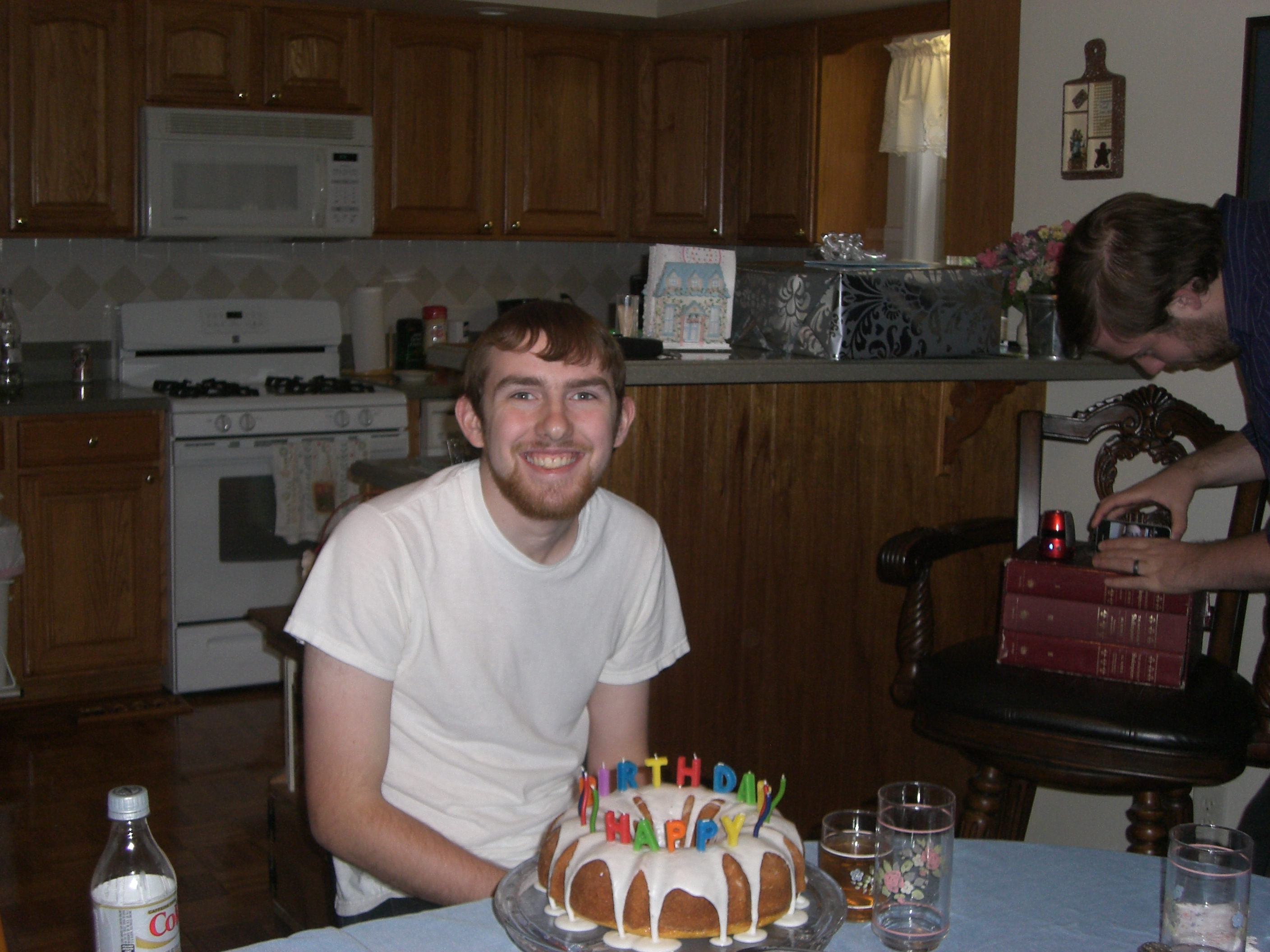
Hope you have a wonderful birthday, Jesse!
Here are some noteworthy reads from the last couple of weeks:
Two pieces on the historicity of the first Adam, a current hot topic: Our Make-Believe Parents: When Adam Becomes More Fiction Than Fact and 19 Resources on the Historicity of Adam.
Grace Incognito. “I may like the idea of portraying the strong Christian woman weathering adversity with a brave face, but I don’t get to choose the scene of my martyrdom that will show off my good side. But what if the point isn’t sprinting across the finish line in record time, but knowing God in every halting, baby step along the way?”
One Step. “One step — one cross-shaped, trusting step of faith in a loving, good, and sovereign God — gives purpose to pain, turns mourning into dancing, and transforms everything (yes, everything) into a gift…And I have a visual of grace that I will never, ever forget.”
Savor “Every” Moment? This humorous piece reminds us that young moms in the trenches need more from us than the admonition to savor every moment because it all passes so quickly. They need to know we remember the trenches and survived them.
Distinguishing Between Truth and the Bearer of Truth. This kind of goes along with the one above. I’ve had a possible blog post percolating in the back of my mind along these lines, but no time to write it out.
A Concerned Mother’s Letter to Teen-age Girls.
Thinking Evangelically About Tim Tebow. “I fear that the Tebow-mania is just another manifestation of the way evangelicals think cultural cache and celebrity influence is vital to the cause of Christ. When I read the Bible, I see the opposite, actually, how God uses the low, the weak, the despised, the cultural cast-offs to further his kingdom. I am not against Christians in the entertainment or athletic spotlights, of course, but I am against the idolization of these people, which I think much of our fandom becomes. To be clear: The cause of Christ is not dependent on Tim Tebow’s success in the NFL. And, by the way, neither is his witness!”
Can Oyster, the “Netflix For Books,” Be Successful?
Hope you have a great Saturday!

Friday’s Fave Five is hosted by Susanne at Living to Tell the Story, who invites us to share five of our favorite things from the last week. It’s a wonderful exercise in looking for and appreciating the good things God blesses us with. Click on the button to learn more, then go to Susanne’s to read others’ faves and link up your own.
Here are some highlights of the last week:
1. Feeling better after feeling pretty awful over the weekend and the first few days of this week. It’s amazing how “just a cold” can wipe you out. It’s good to have some energy again.
2. Light meals. As in light energy required. I’m glad my family is ok with them some nights. 🙂
3. Low-key projects. I have a few tasks that are aren’t urgent, therefore they tend to stay on the to-do list. But they were just right for this week when my energy wasn’t up to par, and it felt good to be productive. I got a desk cleaned out, some computer files tidied up, and some recipes that had been pulled from magazines organized. Those last two still need some work, but it helped to put a dent in them, at least.
4. Triple A. Both my mother-in-law’s caregiver and my oldest son needed their services this week. It’s nice such things are available.
5. Tiny Texas Sheet Cakes. I’m pretty sure I have mentioned them before. I LOVE this cake, but it normally makes a cookie-sheet sized cake, and it would be too much temptation (and too many calories!) for me. I was delighted to find this smaller-sized recipe a few years ago that only makes four servings. With three of us in the house, that automatically keeps me from devouring the whole thing. I’ve been craving it for a while now and splurged on it last night.
Happy Friday!
(WordPress is placing ads on blogs that do not pay to be ad-free, If you saw an inappropriate ad, please report it to support@wordpress.com. Please include the address of the site (e.g., http://example.wordpress.com), the date/time the ad appeared, and a screenshot of the ad.)
 The Boy in the Striped Pajamas by John Boyne is told from the viewpoint of 9 year old Bruno, who comes to his lovely home in Berlin one day to find everyone packing up the house. Father has gotten a promotion, “the Fury” has big plans for him, and the family has to move. Bruno doesn’t want to move and leave his “three best friends for life,” his grandparents, or his home, but he has no choice.
The new destination at what Bruno understands to be “Out-with” does nothing to change his mind. The house isn’t nearly as nice: Bruno wonders if perhaps Father got punished for something by being sent here. Worse, there is no nice neighborhood nor are there children to play with. But out his window he can see a lot of small buildings with a number of people milling about, all wearing the same striped pajamas.
One day Bruno goes exploring, and after walking a long way along a fence, he meets one of the boys in striped pajamas, alone quite a way from the buildings. They begin to talk, and eventually they become friends and continue to talk almost every day, with Bruno sometimes bringing food, until..
Well, I can’t tell you much more than that without spoiling the story. Out-with, if you haven’t guessed, is Auschwitz, and, knowing that, you know this tale will be sad and somewhat disturbing. It ended as I thought it would when I first heard of it, but along the way I did think of other possible endings.
Why write and read a story like this? Because even though Bruno’s part is fictional, Auschwitz was a real place, and the horrible things that happened there really happened. And horrible things happen in some places in the world even now.
The story being told from Bruno’s vantage point allows for a contrast between the evil of Naziism and the innocence of childhood. As Bruno finds out that the people in the pajamas are Jews and that no one seems to like them, he can’t understand why. His new friend seems fine.
I’ve read some criticism that Bruno seems excessively naive, but I think in that day children weren’t as streetwise as they are today. Plus at the time there were even adults who did not pick up on what was happening, so we can hardly expect an inexperienced nine year old boy to have figured it out.
Despite the sadness and starkness, their is a certain charm in Boyne’s prose. There are a number of recurring phrases in Bruno’s world that bring a smile: he inwardly calls his sister “a hopeless case,” his father’s office is “Out of Bounds at All Times and No Exceptions.” “‘Heil Hitler,’ …he presumed, was another way of saying, ‘Well, goodbye for now, have a pleasant afternoon,’” since everyone said it as they parted.
Boyne’s simple and sparse narrative fits the story well. He has a nice way of suggesting things without spelling them out. I did see the film version after reading the book, and though the basic structure is the same and some scenes are the same, many details have been changed (unnecessarily, in my opinion), and the filmmakers seemed to want to intensify the drama. The drama is pretty intense on its own, and some things are more dramatic when left to the imagination.
I listened to the audiobook version narrated by Michael Maloney, who did a wonderful job matching the elements of the story with his tone. There is an interesting interview with Boyne at the end of the book that was also included in the audiobook.
Only the victims and survivors can truly comprehend the awfulness of that time and place; the rest of us live on the other side of the fence, staring through from our own comfortable place, trying in our own clumsy way to make sense of it all. (From the Author’s Note).
(This will also be linked to Semicolon‘s Saturday Review of Books.)

Have you had the experience of having a book on your shelf for months, perhaps years, then feeling an urge to pick it up and finding it was just what you needed at that very moment? I have, many times, and The Fruitful Wife: Cultivating a Love Only God Can Produce by Hayley DiMarco was the latest instance. I first saw the book mentioned about a year ago at Carrie’s review, and, in fact, won a copy from her. But it had been sitting on my desk ever since.
Last year while reading through The Discipline of Grace by Jerry Bridges with Challies’ “Reading Classics Together” group, I was convicted when Bridges pointed out that we spend a lot of time thinking about the negative character qualities we need forgiveness and victory over but not enough of the positive ones that we need to incorporate in our lives. The Bible tells us not only to forsake and flee some things but to follow after others, not only to put off the old man, but to put on the new. So, because of that prompting and because of the lack of it in my life, at the beginning of this year I thought I might do a word study on each aspect of the fruit of the Spirit. But I think I was daunted by the massive amount of material in the Bible on the first one, love, and I never got started on it. Some ladies at church even went through Beth Moore’s study on this earlier in the year, which I thought was timely and would be beneficial, but for various reasons I ended up not participating. Then I noticed again The Fruitful Wife book on my desk and had a light bulb moment. 🙂 Here would be my “guided tour” through the fruit of the Spirit.
That’s exactly what Hayley does: she explores each of the nine facets of the fruit of the Spirit listed in Galatians 5 and applies its truths particularly to marriage. In some ways I wish this had been called The Fruitful Woman rather than just focusing on wives, because its truths are applicable in any relationship, and single women might not read it. But I understand that that’s probably the main relationship where our true self in all its flaws is seen and where we tend to let down our guard, so seeking to cultivate the fruit of the Spirit here will overflow into other areas. I would recommend this to single ladies: not only would the study be beneficial, but it might be eye-opening in regard to marriage in general.
In the introduction, Hayley points out that the fruit of the Spirit does not come naturally: naturally we react from the flesh. But when we believe on the Lord Jesus Christ for salvation and His Spirit enters our hearts, then He begins to work to cultivate that fruit into our lives. We do still have our flesh, though, and still react too often from it: the flesh and the Spirit are in almost constant conflict. But by abiding in Christ and yielding to the Holy Spirit, more of His fruit can be cultivated in our lives. She also points out that growing fruit isn’t just for our own self-indulgence: fruit is meant to feed people. “Your fruit is meant to serve the hungry, to prove the goodness of the Spirit from which it comes to those who would partake of it” (p. 16).
Then each following chapter focuses on one of each of the nine parts of the fruit of the Spirit. I can’t summarize each one, but I’ll share a sampling of the lines that most spoke to me:
“Love is less about how I feel, but more about what I do. It isn’t about getting, but giving. It isn’t about reward, but sacrifice. And it isn’t about excitement, but endurance” (p. 20).
“We are able to love those the world finds difficult because of God’s great and all-encompassing love for us” (p. 22).
Love must first be understood as dependant on His love for us, and our response to love must be action, not reliance on feeling good” (p. 22).
Love is not about responding to how others make us feel, but about the Holy Spirit’s promptings in our souls” (p. 23).
“We have to understand that to rejoice is to do something, not to feel something” (p. 44).
It’s through the Spirit that you can believe against all odds, find joy against all belief, and trust against all doubt that He is who He says He is and that your life is firmly in His hands” (p. 51).
“Once I took my eyes off of my lack and put them on His abundance, I found the joy I was lacking” (p. 55).
“To sit and wait for joy to arrive without turning your mind to the things of Christ is like expecting the Holy Spirit to take 15 pounds off your body while [you are] sitting on the couch eating ice cream” (p. 57).
“Peace comes from an absence of conflict, not external conflict but internal conflict…Peace comes from your acceptance of suffering, not your exemption from it…It is a calm knowing and a restful understanding of the ways of a world held in the hand of a perfect God” (p. 68).
God desires my patience over my deadline, my calm heart over my hurried schedule, my genuine love over my preferred plans for those I love. When we see God over the difficulty, we find the patience over the impatience (p. 94).
“See any minor disruptions to our comfort as potentially essential to our righteousness and perfection” (p. 96).
“When we make our kindness about Him and not about us, then we will find it comes so much more easily” (p. 120).
“It isn’t the kindness we experience in response to the way others make us feel but the kindness we give in spite of the way others make us feel, that truly exhibits the fruit of the Spirit” (p. 120).
“It isn’t your obedience that makes you good, but His goodness and love that make you obedient, and it’s this goodness that reveals our faith in Him” (p. 126).
“Faithfulness isn’t just about not cheating on someone but about living a life of truth in our depths – truth that permeates all of our thoughts, words, and actions” (p. 148).
“Remember that while He walked this earth, Christ didn’t micromanage the lives of people around Him. He wasn’t controlling in His demands of their obedience. He didn’t run after the rich young ruler who wouldn’t sell all he had to follow Him. Jesus didn’t chase him down and demand compliance. If then, being so perfect and wise, He can allow people to fail, why do we believe it our job to micromanage the life of our husband? Can we trust God to speak to him, teach him, and lead him?” (p. 168).
“Women who want to involve themselves in other people’s business and attempt to fix them, change them, or somehow micromanage their lives are meddlesome, and this is not a character trait of gentleness. It is harshness that interjects itself into the lives of others uninvited, and so the fruit of the Spirit doesn’t serve this end. The busybody or meddlesome woman isn’t walking in quiet gentleness, but in the harshness of control and micromanaging. But gentleness allows God to do what God does best – take care of everything, be in control, and manage the lives of His children” (pp. 168-169.)
“We must never, through our resistance to the idea of self-control, make our confession a pillow for our sin” (p. 193).
“Only the presence of life can grow fruit” (p. 197).
“Even though a farmer works hard at tending his crops, he can’t do anything to create the fruit. Only the vine has in it what is necessary for life. And so it is for us. It is because of the vine that we can grow any fruit at all. So then, why was all the paper wasted in printing this book, if it all rests on the vine? Because there exists for man a role to play, and that isn’t a passive role whereby we sit quietly by as God changes us without our participation. It is an active role that begins as we turn our thoughts toward the vine. Thus setting of your mind on the Spirit isn’t something you do only once; it is something that must continually be done. Each time our minds wander into areas of the flesh, into areas of darkness, they need to be redirected and brought back to the light. And in the light they will find just what they need for nurturing the fruit the way the farmer does as he waters and cares for his crops” (pp. 197-198).
“To continue to allow the flesh a voice in our lives is to subdue the voice of the Spirit and to reject His will as secondary to our own” (p. 200).
Hayley doesn’t write from the standpoint of a super-Christian who has it all down pat and worked out perfectly. No, she is very honest and straightforward about her own failings and where the Lord has taken her as she has sought to abide in Him. That lends an authenticity and a relatability that would be lacking in a book written from someone’s lofty perch of supposed perfection. But she also pulls no punches with her readers: if we are not honest and real with our faults and sins, we won’t get victory over them.
I read this book as quickly as I could at first, because I knew I needed it all. But I felt I had hardly grasped a fraction of it, so I reread and outlined it. I came to realize, though, that reading a book and doing word studies aren’t going to get me to the place where I can say, “I’ve got it!” and never have to sort through these truths again. No, as Hayley said in a quote above, I will need to remind myself of them often, and I can add to my understanding over time and continue to grow. I probably will reread this book at intervals. I have started those word studies and have a good base, but I am going to add to them over time as I read the Bible rather than sorting through and organizing hundreds of verses but missing their impact.
There are just a very few spots that were a little weak, in my opinion. For instance, in the first half or so of the chapter on goodness, instead of delving into what the word “goodness” means in Galatians 5:22-23 and bringing out verses about it, as she does in most of the other chapters, she kind of philosophizes that “good” is relative to what pleases us (chocolate ice cream is good to her, but bratwursts are good to her husband), therefore, since God is inherently good, whatever pleases God is good. That’s true, in a sense, but as I said, seemed weaker to me than getting into verses about goodness (which she does later in the chapter and which approach she does use in most of the chapters).
Overall the book is chock full of wisdom, and I am happy to recommend it. In fact, I think it is so beneficial that I am going to give away a copy. Not my copy – it is all marked up and has sticky tabs poking out of it. 🙂 But I’ll send one person your own brand new copy of the book. If you’d like to enter the giveaway, leave a comment below and I will choose one name from among the comments a week from today. (I will just use each name once, so multiple comments won’t count more). The drawing is closed. The winner is Janet! Congratulations!
(This will also be linked to Semicolon‘s Saturday Review of Books.)
Lord, with glowing heart I’d praise Thee,
For the bliss Thy love bestows,
For the pardoning grace that saves me,
And the peace that from it flows:
Help, O God, my weak endeavor;
This dull soul to rapture raise:
Thou must light the flame, or never
Can my love be warmed to praise.
Praise, my soul, the God that sought thee,
Wretched wanderer, far astray;
Found thee lost, and kindly brought thee
From the paths of death away;
Praise, with love’s devoutest feeling,
Him Who saw thy guilt-born fear,
And the light of hope revealing,
Bade the blood-stained cross appear.
Praise thy Savior God that drew thee
To that cross, new life to give,
Held a blood sealed pardon to thee,
Bade thee look to Him and live.
Praise the grace whose threats alarmed thee,
Roused thee from thy fatal ease;
Praise the grace whose promise warmed thee,
Praise the grace that whispered peace.
~ Francis Scott Key
~ Excerpted from the entire hymn here.
Friday’s Fave Five is hosted by Susanne at Living to Tell the Story, who invites us to share five of our favorite things from the last week. It’s a wonderful exercise in looking for and appreciating the good things God blesses us with. Click on the button to learn more, then go to Susanne’s to read others’ faves and link up your own.
I’m running late once again! Here are some highlights of the last week:
1. A visit from a friend of my son and daughter-in-law’s. He stayed with them last weekend and they all came here for dinner after church Sunday. I have this tendency to second-guess myself, and I was thinking maybe going to “the parents'” seemed obligatory and he would rather have spent the time with them at their place, but when he saw us at church he gave me a spontaneous hug and seemed glad to see us, so I was reassured. 🙂
2. A three-day weekend. Labor Day is one of those low-key holidays – not much expectation besides a cook-out (another fave! Grilled burgers!). We even brought Grandma out to the patio for dinner and she seemed to enjoy it though she tuckered out pretty quickly.
3. A relatively quiet week after a few busy ones…although this seemed busy in it’s own way as well and I didn’t get nearly as much done as planned. But at least there weren’t a bunch of deadlines or appointments, etc.
4. Take-out dinner. My dear husband indulged me in a requested night off from the kitchen and brought home take-out Chinese food. He actually didn’t get my text til after he got home, so he had to go back out again to pick it up, poor guy. 🙂
5. Disability aids. I often amazed when we encounter some snag in Grandma’s care and think of what would help, search the Internet, and lo and behold, someone has made it and someone else sells it. 🙂 The latest need was a safety belt for a shower chair. We had been using a gait belt, but it was just short enough to be difficult to attach and didn’t seem very secure. We used the one designed for the shower chair this morning, and it worked perfectly.
Hope you have a great weekend!
Daniel Deronda is a young man of uncertain parentage brought up to be an English gentleman as the ward of kind-hearted Sir Hugo Malinger in England in the 1870s. The pain and shame of the possibility of being illegitimate and the lack of knowing his family has worked in him a tender heart and an inclination to help and rescue others in need. He is uncertain about what to do with his life, dropping out of university and resistant to Sir Hugo’s urging that he take up politics. “To make a little difference for the better was what he was not contented to live without; but how to make it?”
But though he is the title character, he appears silently in the first chapter and then not again until about the 15th. Those intervening chapters and the intertwining storyline are taken up with Gwendolen Harleth, a beautiful, vain, self-centered, seemingly heartless young woman. Used to getting everything she wants, her world is shaken when her family loses its fortune and the only option they can find is to move and for her to “take a situation” as a governess. To escape that fate she goes against her conscience to marry Henley Grandcourt. She knows he has a shameful secret, but she doesn’t know he knows she knows, and his knowledge gives him power over her. She was initially attracted to him because he didn’t fawn and act “ridiculous” around her like the other smitten young men in her wake, and he was rich and seemed to indulge her. But after the marriage, the niceties are off and he turns out to be a cold and cruel man whose main source of pleasure is in mastering others.
Daniel had crossed her path in the first chapter, and when they meet again, her misery in her marriage and her tormented conscience draw her to him almost as an alternate conscience and confessor.
Meanwhile Daniel finds Mirah Lapidoth at the lowest point in her life and undertakes to help her as much as he can. She is a young Jewess who was taken from her mother and brother and forced to work on the stage, but she escaped and returned to try to find them again. In Daniel’s search through the Jewish quarter of town for Mirah’s family, he meets a young zealous Jew named Mordecai, who is dying and thinks Daniel is the answer to his prayers for a successor and future leader of his people. Daniel can’t help him in that aspect because he is not Jewish, but Mordecai insists he could be since he doesn’t know his own parentage. Though Daniel continues to resist him, they do become friends and Daniel learns more about Jewish culture.
The rest of the book is taken up with the intersection and development of these lives and Daniel’s ultimately finding his identity and purpose. In fact, identity could be an overarching theme of the book: Daniel searches for his, Gwendolen wrestles with hers, Grandcourt hides his, Mirah and Mordecai are guided by theirs.
This is the first of George Eliot’s books that I’ve ever read, though I heard a performance of Silas Marner (and want to read it as well as Middlemarch some time). I enjoyed the psychology of her writing, the way she delved into and displayed each character’s pysche. Though, as with many older classics, there is a lot more explaining than there is in modern work, the author still tucks in neat scenes that expose a lot about the characters without further explanation, like the one where Grandcourt shows his cruelty by baiting one dog and then rejecting it.
Since Eliot is a “a writer who, for many, embodies the ideals of the liberal, secular humanism of the Victorian age,” according to Wikipedia, obviously the book is written from that standpoint, and though there are Biblical allusions, grace and forgiveness are largely and sadly missing: e.g., when Gwendolen confesses to having hateful thoughts and is stricken by her conscience, she is urged to try to live a better life, serve a purpose outside herself, etc., rather than to confess to God and seek His help. That’s not surprising when you read a bit about Eliot and find that she either missed or resisted that grace in her own life as well.There are also some weird mystical allusions in regard to Mordecai, who thinks his soul will be reincarnated in Daniel.
The Wikipedia article on Daniel Deronda also goes into the influences leading to the Jewish elements in the book in a time when society was rather anti-Semitic. I thought these lines from the book were telling:
Deronda, like his neighbors, had regarded Judaism as a sort of eccentric fossilized form which an accomplished man might dispense with studying, and leave to specialists. But Mirah, with her terrified flight from one parent, and her yearning after the other, had flashed on him the hitherto neglected reality that Judaism was something still throbbing in human lives, still making for them the only conceivable vesture of the world…This awakening of a new interest–this passing from the supposition that we hold the right opinions on a subject we are careless about, to a sudden care for it, and a sense that our opinions were ignorance–is an effectual remedy for ennui, which, unhappily, cannot be secured on a physician’s prescription.
I first became acquainted with this novel when I saw the BBC film several years ago starring Hugh Dancy as Daniel, Romola Garai as Gwendolen, and Hugh Bonneville (currently of Downton Abbey fame) as Grandcourt. I think it was one of the first period dramas I ever saw, and except for too many shots of Gwendolen’s cleavage, I was enamored with movie. I just watched it again this week on Netflix and I was less so. The filmmakers were attentive to many details, such as Daniel’s tendency to grasp his coat high near the collar and Grandcourt’s to keep a thumb and forefinger in one pocket, and many lines and scenes are taken straight from the book. But they turned Daniel and Gwendolen’s relationship into more of a romance, almost an adulterous one, and changed some scenes and lines in others (such as Gwendolen’s visit to Mirah). I still enjoyed the film, though not as much as I would have without the changes, and it does follow the overall structure of the book, but of course it condenses it.
I listened to much of the book via audiobook, and Nadia May’s reading and accents were delightful. But some of the philosophical parts were harder to comprehend without pondering the words in print, so I referred often to the free (at this time) e-book version as well.
I’m thankful to Heather at Do Not Let This Universe Forget You for choosing Daniel Deronda for Carrie’s Reading to Know Book Club for August. I enjoyed the journey!
(This will also be linked to Semicolon‘s Saturday Review of Books.)
Here are some noteworthy reads from the last week:
I Weep for Miley and some follow-up thoughts on comments and criticisms of the post.
What Would Jesus Say to Miley Cyrus? I don’t agree with every little point here, but the majority of it is very good.
Make the Bible Your Native Tongue.
Mom vs. Mom: The War I didn’t See Coming. Excellent post.
I have been very happy to see a number of posts lately on preaching and teaching relative to how to do one’s secular work as unto the Lord and to find value in in for His sake. For years the only thing I heard about vocation in church was the urge to surrender to “full-time Christian service,” and that is indeed a noble calling, but it is not everyone’s calling, though we are all called into full-time Christian service in a sense. Anyway – off the soapbox for now. 🙂 Here are a couple of posts along these lines. The second one was especially good I thought.
5 Ways Pastors Can Affirm Faith, Calling, and Vocation.
Oh Sweet Lorraine and Missing Hope. A man in his 90s wrote a song for his wife, who had passed away, and sent it into a song contest. It didn’t fit the parameters of the contest, but the company involved had the song professionally recorded for him. So sweet to see his reaction to hearing it. But Challies points out that, touching as it it, there is no mention of the hope that can comfort and sustain us in our losses, and I hope this dear man finds that.
Knowing vs Feeling in Worship.
Cultivating the Habit of Prayer. Great tips.
When You Feel Resentful About Homemaking.
Compelling Conversion, thoughts on the book The Secret Thoughts of an Unlikely Convert. I reviewed it here, but he includes some points that also spoke to me but I didn’t articulate.
School Is No Place For a Reader. If this kind of thing is going on nation-wide, it’s really sad and doesn’t bode well for our country.
And for a smile, or several: 19 Photos of Hilarious Home Improvement Fails.
Have a great weekend!
 Stray Thoughts