Come Holy Spirit

I was listening the the music shuffling through my iPhone this morning and this song came on via Brian Pinner’s CD, Cantate Domino (he has it there as “Breathing After the Holy Spirit.”) I love this melody. I hadn’t heard it in years, but it spoke to my heart this morning. I believe it is taken from or inspired by Romans 5:5 (NKJV): “Now hope does not disappoint, because the love of God has been poured out in our hearts by the Holy Spirit who was given to us.”

Come, Holy Spirit, heavenly Dove,
With all Thy quick’ning powers;
Kindle a flame of sacred love
In these cold hearts of ours.

Look how we grovel here below,
Fond of these trifling toys;
Our souls can neither fly nor go
To reach eternal joys.

In vain we tune our formal songs,
In vain we strive to rise;
Hosannas languish on our tongues,
And our devotion dies.

Dear Lord! and shall we ever live
At this poor dying rate?
Our love so faint, so cold to Thee,
And Thine to us so great!

Come, Holy Spirit, heavenly Dove,
With all Thy quick’ning powers;
Come, shed abroad the Savior’s love
And that shall kindle ours.

~ Isaac Watts, 1707

Laudable Linkage

I have a question for those of you who have me on Google Reader: on some blogs I have there I see what looks like separate posts with the blogger’s links from Delicious in between their regular posts. Do you see that with mine? I was thinking if they show up there it is kind of redundant to put them here on Saturdays.

Also, a few weeks ago I had a link to vote for my assistant pastor to win a handicap-accessible van. Thanks to those who voted. Unfortunately he did not win but is trusting God to supply some other way.

Here is my weekly round-up of interesting things seen round the Web:

Steve Saint, author of End of the Spear and son of Nate Saint who was killed with Jim Elliot and three other missionaries by the Indian tribe they were trying to reach in the late 50s or early 60s, was paralyzed in a serious accident last week. Here is his testimony just six days later:

I Was Confronted For Being Immodest. I really appreciate Courtney’s response here, even though the woman who confronted her did not go about it in the best way. It’s a reminder that sometimes women who wear something less than modest don’t realize it’s a problem and they’re not doing so on purpose. A gracious follow-up to that was My Feelings About the Woman Who Confronted Me.

Should We Lead Someone to Pray the Sinner’s Prayer? Thought-provoking.

Queen Elizabeth Gives away 450,000 New Testaments to Celebrate Her Diamond Jubilee, HT to Lizzie.

A neat idea for baby showers about half-way down this post: an invitation to bring a child’s book rather than a card, with a cute poem.

Neat ideas for finger foods.

Free audiobooks. Author Adam Blumer had a link to this on his Facebook page. Evidently they put up a different book for free every week or so — this week’s is Sense and Sensibility!

At the moment Joni Eareckson Tada’s book A Place of Healing is free for the Kindle.

Seen around Facebook:

It took me a minute to get this one (for those not Star Trek fans, the character’s name is Worf.):

Friday’s Fave Five

Welcome to Friday’s Fave Five, hosted by Susanne at Living to Tell the Story, in which we can share five of our favorite things from the last week, a wonderful exercise in looking for and appreciating the good things God blesses us with. Click on the button to learn more, then go to Susanne’s to read others’ faves and link up your own.

Another busy week…I was wishing we could have a week, or even two in a row, with nothing at all scheduled. Looks like it might be a few weeks before that’s a possibility! But they haven’t been bad weeks for all that. Here are some of the highlights of the last week:

1. Father’s Day. It’s nice to have a time set aside to honor Dads, even though of course we honor them in our hearts all year. The family pitched in to make dinner: Jason and Mittu grilled hamburgers instead of Dad doing so, and Jesse shucked corn and set the table. I try to give one or two fun “nerdy” gifts as well as practical ones, and found some good ones this year (a little tank controlled by an iPhone and a caliper pen) that he liked. We got to FaceTime with Jeremy during the present opening. Grandma was in rare form (though somehow she thought it was her hundredth birthday — she turns 84 next month). All in all it was a good day.

2. The passing of the longest day of the year. The Summer Equinox was Wednesday, I believe. Even though I like having more daylight much better than all the darkness during winter, it has been staying light so late that it’s hard to wind down and get ready to go to sleep at an appropriate time.

3. An inspiration to clean earlier in the week….when I didn’t know I’d be having unexpected company over the weekend. It helped a lot to have a great portion of the cleaning already done.

4. Completing my Spring Reading Thing Goals. I haven’t checked to see how often that has happened, but I think I’ve missed it more often than not.

5. A new CD: By Faith by the Galkin Evangelistic Team. I’ve been wearing it out, especially the song “The Perfect Wisdom.”

Bonus: My Mother’s Day roses are flourishing!

Happy Friday! Have a good weekend!

Book Review: Raising Real Men

I first became aware of this book through the M.O.B (Mothers of Boys) Society web site.* I enjoy Hal and Melanie’s occasional columns there, usually full of wisdom and practical insight, as they are raising six boys themselves.

The premise of Raising Real Men: Surviving, Teaching, and Appreciating Boys by Hal and Melanie Young is that what society and moms find negative about boys is part of what defines them as men and should be trained rather than squelched. For instance, a natural bent toward leadership in a pint-sized immature young boy with a sin nature will look bossy and controlling. Risk-taking in a young guy will look like recklessness. The goal is to develop those qualities in a right way rather than just squashing them. And moms in particular, who prefer peaceful, docile children, need to understand that boys act, think, and respond differently. That doesn’t mean we let them run rampant: too often destructive behavior is excused  with a “That’s just the way boys are” attitude. But we pray for them, teach them, train them, lead them to the Lord, and help them, with God’s help, to become mature young men.

The Youngs discuss various aspects of this training, from acceptable risk-taking, competition, heroes, dealing with violence, purity, money matters, work ethics and experience, differences in learning, chivalry, gender roles, household duties, preparing for marriage and careers, and transitions as boys mature.

Here are a few quotes from the book that stood out to me:

God has placed in our boys a desire to be in charge, because one day they will be in charge. Today’s boys will be the fathers, and bosses, and elders, and statesmen of tomorrow. We’ve got to teach them how to submit to authority without destroying their leadership (p. 24).

Adults sometimes equate a desire for adventure with immaturity and recklessness. The Bible makes a distinction and so should we. The desire to conquer, to win against the odds, to do great things — these can be admirable ambitions. The willingness to pit one’s nerve against an unsettling foe is frequently called for in Scripture…On the other hand, overconfidence and rashness is soundly criticized (p. 48).

Our boys should be active and adventurous, but careful of themselves at the ultimate extreme, understanding that life is a gift and their bodies are the temple of the Holy Spirit. To risk life meaninglessly is foolishness; note that God’s gifts of boldness and courage are not for self-fulfillment or entertainment but for greater service to Him (p. 53).

Every family has some way they can teach their sons to be faithfully independent in a step-by-step way….It doesn’t seem fair to keep sons under constant instruction and supervision, with no chance to stand on their own, then give them complete responsibility and freedom when they come of age…Think of it like teaching a baby to walk — first you hold their hands, then you stand just a bit away, then farther away. If they stumble, you can catch them — to a point (p. 63).

When God asked Adam and Eve [questions], He wasn’t looking for information; He was forcing them to confront their fall from innocence (pp. 89-90).

This is the difficultly with “time-out” punishments that focus on exclusion from the fellowship of the family. Exclusionary punishments send the child away from the love and wisdom of his parents to brood in a corner, feeling angry and sorry for themselves in the lack of discipline and teaching. The fear of abandonment and rejection is deep in a small child. How much better to correct the sin and heal the broken fellowship quickly! (p. 91).

It was especially gratifying to read someone else saying that about “time-outs.” I had always felt that they weren’t the best way to discipline. There were some times we sent a child to his room to wait while we got our emotions under control (and gave them time to do the same) or prayed or thought about what to do. If they were sometimes in a bad mood that wouldn’t be rectified (boys have their “moods” as well as girls), we’d say something like, “If you want to be in a bad mood, that’s up to you, but you’re not going to inflict it on the rest of the family. You can go to your room til you’re feeling more sociable.” Usually it didn’t take long for a change in attitude to come. But where definite disciple is needed, it’s so much better to deal with it effectively and get it over with.

To me the heart and summation of the book came at the end:

Our boys need to be comfortable in their own skins. Not all men are athletes just like not all are intellectuals. Manliness is much more than brute force, it’s a heart attitude of confidence and boldness to accomplish the mission given by God (p. 243).

There were maybe a couple of minor things I disagreed with: one equated shyness with selfishness. I believe shyness is a personalty characteristic and not intrinsically selfish, but it can manifest itself in selfishness. Being an intensely shy person myself, the realization that my responses could hurt or offend people or curb ministry to them helped me a great deal in opening up and reaching out when I’d naturally feel more comfortable pulling back and remaining quiet.

The book almost assumes its readers are home-schoolers, but that is probably because the Youngs home school and are writing from their experience, and much of the book came from talks given to home school associations and such. But one does not have to home school to benefit from the book.

When I was growing up, fathers were quite authoritarian: nowadays the pendulum has swung to the other extreme and fathers are portrayed on TV as bumbling fools and “manhood” is looked down upon. As a mom of three grown boys, I am glad to recommend this balanced treatment on the topic with its encouragement to raise real, godly men to authentic Biblical manhood.

___________
*Disclaimer: While I recommend the M.O.B. Society web site, I do not agree with every little thing every writer there says nor with every ad there.

(This review will also be linked to Semicolon‘s Saturday Review of Books.)

Together on Tuesdays Introduction

Annette at This Simple Home and Dorie at These Grace Filled Days have teamed up to create Together on Tuesdays as “a casual way to meet and connect with other women” over the summer. They’ve created a schedule of topics to discuss in order to get to know one another better, and the topic for this first week is introductions.

We’re encouraged to be a little creative in our intros, so I’ll share the top ten things that I would say characterize me.

1. My name is Barbara.I go by “Barbara H.” around the Internet because when I first started blogging there were a number of Barbaras. Please don’t call me Barb.

2. I’ve been married to a wonderful man named Jim for 32 years.

3. We have three boys….really young men now. The oldest two have “left the nest,” one of them is married, and the youngest just graduated from high school.

4. I’ve been privileged to be a stay-at-home-Mom since my first pregnancy.

5. I was a Home Economics Education major not because I was proficient in that area but because I needed all the help I could get. I had always wanted to major in English but at the time Home Ec. seemed more practical.

6. I’m naturally very shy and introverted, but God has helped me to get beyond my comfort zone.

7. I like reading, writing, and some amount of crafting when I have time.

8. I love pink roses and heart-shaped things. I like pastels, especially pink, slate blue, and sage green. I don’t like orange, peach, red, or yellow (except on fall leaves. 🙂 )

9. One major life-affecting and life-altering event in my life was having transverse myelitis almost sixteen years ago. It’s an auto0immune reaction that occurs when a virus attacks the spine, causing one’s body to attack the spine as well as the virus. It was pretty rough the first few years, but now I can function about as well as I need to despite some residual symptoms. I am so thankful for the recovery God has allowed (some do not gain back what they lost at the beginning of TM) and what He taught me through it.

10. The most important thing about me is that Jesus Christ is my Lord and Savior. He graciously led me to Himself when I was 17: you can read more about how that happened here. I am forever grateful.

There is probably much more than you’d ever want to know about me in the 100 Things About Me post I that I did on my one year blogging anniversary and 7 Quirky, Random, Little-Known Facts About Me.

I hope you can join in on at least some of the Together on Tuesday posts! I’m looking forward to getting to know you better.

Book Review: Feminine Appeal

Feminine Appeal by Carolyn Mahaney came about when several people heard her teach through Titus 2 and urged her to put her talks into book form.

In the first chapter she shares her early wife and mothering years of wishing she had someone to come alongside and teach, guide, ask questions of, etc., and then explains that’s exactly what Titus 2 calls us to do.

I appreciate that instead of pulling these verses out to stand on their own, she brings out them out in the context of the rest of the chapter. The purposes for godly women mentoring younger women goes beyond our individual homes and families: the larger purpose is that such teaching “becomes” (KJV) or “accords with” (ESV) “sound doctrine” (verse 1), “that the word of God be not blasphemed” (verse 5), “that he that is of the contrary part may be ashamed, having no evil thing to say of you”, (verse 8), and “that they may adorn the doctrine of God our Saviour in all things” (verse 10). She explains that “To ‘adorn’ means to put something beautiful or attractive on display — like placing a flawless gemstone in a setting that uniquely shows off its brilliance” (p. 27). By our actions and conduct, even how we minster to our homes and families, we can display the gospel of Christ.

She then delineates the teaching of Titus 2:3-5 into seven virtues, giving each of them their own chapter:

  • The Delight of Loving My Husband
  • The Blessings of Loving My Children
  • The Safety of Self-Control
  • The Pleasure of Purity
  • The Honor of Working at Home
  • The Rewards of Kindness
  • The Beauty of Submission

Though much of the book is directed to married women, Carolyn encourages single women to read along, too, both because much of this instruction is to all women, and because it will help prepare them if God does lead them to marriage, and it will help them as they mentor and encourage other women as well.

There was much that spoke to me in this book, but a few highlights particularly stood out. One was a reminder that “While the salvation of our children is our highest aim, our tender love is not sufficient for this task. Only the Holy Spirit is able to reveal the truth of the gospel. However, our tender love can be an instrument in God’s hands” (p. 61).

Another came from the chapter on self-control.

“Self-control doesn’t just happen. We can’t adopt the indifferent attitude ‘let go and let God’ and expect magically to become self-controlled. Self-control requires effort. However, development of this quality is not solely dependent on us. We cannot acquire this virtue by our own strength. It is only as we cooperate with the power of the Holy Spirit that we will achieve self-control, Our growth will take place as it did with Paul who said, ‘For this I toil, struggling with all his energy that he powerfully works within me’ (Col. 1:29). Notice that Paul did toil and struggle, but his effort was initiated and sustained by the Holy Spirit.”

I wrote recently about the struggle between grace and obedience, and this caps those thoughts off perfectly.

I hadn’t heard the word the KJV uses here, “sober,” interpreted as self-control before, but other versions use that word, and the original Greek word does convey that idea.

Another highlight was a quote from Dorothy Patterson’s book Where’s Mom?:

“Much of the world would agree that being a housekeeper is acceptable as long as you are not caring for your own home; treating men with attentive devotion would also be right as long as the man is the boss in the office and not your husband; caring for children would even be deemed heroic service for which presidential awards could be given as long as the children are someone else’s and not your own” (p. 102).

Absurd, isn’t it? I was thinking recently that most everyone appreciates good marriages, well-behaved polite and kind children, and walking into a well-ordered home, yet how ironic that society devalues the efforts of those dedicated to them.

Another quote from the same book says:

Homemaking — being a full-time wife and mother — is not a destructive drought of uselessness but an overflowing oasis of opportunity; it is not a dreary cell to contain one’s talents and skills but a brilliant catalyst to channel creativity and energies into meaningful work” (p. 109).

After receiving many of the truths in this book multiple times over the years through godly teaching and preaching, good books, and my own studies, there wasn’t much that was new to me here, and perhaps anticipation of that is what kept this book on my nightstand for ages before I finally determined to include it in my spring reading plans. But it’s good to remind ourselves from time to time of truths we already know. We can get discouraged in our duties or sway one way or another, pulled off-balance by differing opinions and philosophies. Reading such a book as this provides both encouragement and course correction.

Whether you need encouragement or reminding, or you’ve never received such instruction as this, or you need help knowing how to mentor others, I recommend this book to you.

(This review will also be linked to Semicolon‘s Saturday Review of Books.)

Dad’s Job Description

Subject: JOB DESCRIPTION
Position: DAD

Long-term team players needed for challenging permanent work in an often chaotic environment. Candidates must possess excellent communication and organizational skills and be willing to work variable hours, which will include evenings and weekends and frequent 24 hour shifts on call. Some overnight travel required, including trips to primitive camping sites on rainy weekends and endless sports tournaments in faraway cities. Travel expenses not reimbursed. Extensive courier duties also required.

RESPONSIBILITIES

~ Must provide on-site training in basic life skills, such as nose blowing. Must have strong skills in negotiating, conflict resolution and crisis management. Ability to suture flesh wounds a plus.

~ Must be able to think out of the box but not lose track of the box, because you most likely will need it for a school project.

~ Must reconcile petty cash disbursements and be proficient in managing budgets and resources fairly, unless you want to hear, “He got more than me!” for the rest of your life.

~ Must be able to drive motor vehicles safely under loud and adverse conditions while simultaneously practicing above mentioned skills in conflict resolution.

~ Must be able to choose your battles wisely and then stick to your guns.

~ Must be able to withstand criticism, such as “You don’t know anything.”

~ Must be willing to be hated at least temporarily, until someone needs $5 to go skating.

~ Must be willing to bite tongue repeatedly.

~ Must possess the physical stamina of a pack mule and be able to go from zero to 60 mph in three seconds flat, in case this time the screams from the backyard are not someone just crying wolf.

~ Must be willing to face stimulating technical challenges, such as small gadget repair, mysteriously sluggish toilets and stuck zippers.

~ Must handle assembly and product safety testing of a half million cheap, plastic toys and battery-operated devices.

~ Must be willing to be indispensable one minute, an embarrassment the next.

~ Must have a highly energetic entrepreneurial spirit, because fund-raiser will be your middle name.

~ Must have a diverse knowledge base, so as to answer questions on the fly such as “What makes the wind move?” or “Why can’t we just stop all wars?”

~ Must always hope for the best but be prepared for the worst.

~ Must assume final, complete accountability for the quality of the end product.

~ Other responsibilities include floor maintenance and janitorial work throughout the facility.

POSSIBILITY FOR ADVANCEMENT AND PROMOTION

Virtually none. Your job is to remain in the same position for years, without complaining, constantly retraining and updating your skills, so that those in your charge can ultimately surpass you. One possible promotion is to “Grandpa,” but that’s really a totally different job.

PREVIOUS EXPERIENCE

None required, unfortunately. On-the-job training offered on a continually exhausting basis.

WAGES AND COMPENSATION

You pay them, offering frequent raises and bonuses. A balloon payment is due when they turn 18 because of the assumption that college will help them become financially independent. When you die, you give them whatever is left. The oddest thing about this reverse-salary scheme is that you actually enjoy it and wish you could only do more.

BENEFITS

While no health or dental insurance, no pension, no tuition reimbursement, no paid holidays and no stock options are offered, the job supplies limitless opportunities for personal growth and free hugs for life, if you play your cards right.

(Author Unknown)

Thanks to my father, step-father, and husband who took on the challenge!

Happy Father’s Day to them and all the dads out there!

Laudable Linkage, Pictures, and Videos

Here are some interesting and edifying things seen around the Web this week:

101 Blog Post Ideas.

Vain Conceit.

Do Familial Curses Still Exist?

What’s It Like to Be an Introverted Woman in Church Circles? Enlightening comments.

20 Free Gooseberry Patch Recipes.

Turning a Bed Sheet Into a N0-Sew Curtain.

Laundry Room Organization. I especially like the curtain!

20 Quick Fixes for Boneless Chicken Breasts.

A few things seen on Pinterest:

Should Christian Women Wear Bikinis? Based on a Princeton study:

Bill Cosby on Father’s Day. 🙂

Have a good weekend!

Friday’s Fave Five

Welcome to Friday’s Fave Five, hosted by Susanne at Living to Tell the Story, in which we can share five of our favorite things from the last week, a wonderful exercise in looking for and appreciating the good things God blesses us with. Click on the button to learn more, then go to Susanne’s to read others’ faves and link up your own.

OK, so what happened to the slower, lazy, laid-back days of summer? 🙂 They seem to be too fast and too busy, but here are some of the highlights of the last week:

1. A replaced gift card. Almost two years ago when we moved one week and then went back to SC to help Jeremy move, I had a birthday in there, and my main gift was a sizable gift card. Somewhere in all the shuffling, it got lost. I knew I had put it back in the birthday card and assumed I’d find it as I continued unpacking, but didn’t. After some months I told my husband about it. We still had the receipt, so he was going to see if they would replace it. But here that store isn’t near us, so we just kept forgetting about it. We had to go somewhere the week before last that was near that place and finally took care of it, and after taking the information and checking their records, they sent us a replacement. They didn’t even take any off the balance — Jim said it was illegal to do so now. So that’s a relief, and now I can plan a shopping excursion. 🙂

2. Touring a local community college. They seemed really on top of things, everyone was very helpful,  and we were impressed.They have ties with several universities, so after getting a two-year associates degree he can go on to a university and have his credits transfer. And he gets plunged into his major courses right away, so he can find out early on whether the major he is interested in in one that he likes and can handle.

3. Good talks. If Jesse goes to the above college, which seems likely at this point, he’ll be the first of my children not to go to a Christian college. That makes me both sad and apprehensive, but we had a good talk about ways to handle that. A couple of kids from his high school are going there, he’ll be living at home and going to the same church, so hopefully he will stay grounded. Of course, ultimately, whether in a Christian or secular place, one’s own relationship with the Lord needs to be maintained and one needs to walk closely with Him.

4. Mexican food! We went to a Mexican food place for lunch after the tour Monday and then had enchiladas last night.

5. Finishing books. Books are always a favorite. but I was bogged down in a long one for a while, so it was nice to complete that and get on to some others.

I keep thinking the next week will be slower and less busy, but it hasn’t happened so far. Maybe this will be the week that comes true! 🙂

Book Review: It Is Not Death to Die: A New Biography of Hudson Taylor

(I hope you’ll forgive me for talking mostly about books the last two weeks. 🙂 I happened to finish several recently and I’m trying to finish off my spring reading plans.)

I’ve mentioned before the importance of reading missionary biographies, for our own growth and inspiration and to keep before us those names in church history that need to be remembered just like Washington, Lincoln, and others need to be remembered in our secular history.

Hudson Taylor is one of those names for several reasons. He was a pioneer missionary to China in the 1800s during a time when China was especially hostile and suspicious of foreigners. He wanted to convert people to Christ in their own culture rather than converting them to Western culture. He dressed as a Chinaman, much to the dismay and criticism of the overseas European community and even other missionaries, simply because he found that the most effective way to work with the Chinese. A missionary coming into a town dressed as a European was likely to be attacked and cause a riot. He suffered much hardship uncomplainingly and purposefully lived as simple a life as possible. He did not set out to start a mission agency, but the agency which sent him out failed miserably: they failed to advise or prepare him, failed to forward funds and communicate with him when he was on the field, causing other mission agencies to step in and help him and others, and then they had the gall to criticize other mission agencies in the periodicals of the day. The necessity of a mission agency attuned to the needs in China and resp0nsible in its habits led to Hudson beginning the China Inland Mission. There were a few missionaries in the bigger cities, but China wanted to go inland where the gospel had not been preached. Probably the most notable aspects of Hudson, however, were his simple childlike (but not childish) faith and his unswerving obedience to what he perceived God wanted him to do.
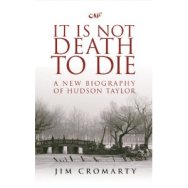
For these reasons I was very glad to see It Is Not Death to Die: A New Biography of Hudson Taylor by Jim Cromarty. There are two older well-known biographies of Hudson Taylor. One is a two-volume set, Hudson Taylor in Early Years: The Growth of a Soul and Hudson Taylor and the China Inland Mission: The Growth of a Work of God by his daughter and son-in-law, Dr. and Mrs. Howard Taylor, first published in 1911. But the first volume is over 500 pages and the second well over 600, which can be quite daunting and they can sometimes be hard to find (Amazon only had used copies but I found them on sale just now here.) These are excellent and easily readable though they were written over a hundred years ago. The other well-known biography of Taylor is Hudson Taylor’s Spiritual Secret, also written by his daughter and son-in-law, but much more compact at 272 pages and still printed regularly today.

I had high hopes that this new biography by Cromarty would bridge the gap between these two and bring Hudson’s life before a modern audience that might not seek out the older books. And while it is a faithful representation with much research evidently behind it and I can recommend it, I wish it were more dynamically written. It’s a good reference book for people who want to know more about Taylor, but I don’t know if it would draw in those who are unfamiliar with him or those who do not like to read biographies.

Biographers do have it a little rough: they can write in a story form, which is more interesting but tends to be less accurate as the biographer has to invent conversations and situations to bring out the points he needs to; or they can right a factual version which can tend to be more encyclopedic and accurate, but which doesn’t appeal to the average modern reader. This one is in the style of the latter. I think it could have been much more condensed: there are many descriptions of various CIM missionaries’ travels which could have been left out or at least summarized. The book is 481 pages, not including indexes and end notes, and I have to admit I got bogged down in places.

But I do recommend the book. If you persevere, you will find great nuggets about Taylor’s character. He was not unflawed: he was very human and he would never have wanted people to think he was some super-Christian. But he loved and followed the Lord in an exemplary and humble way.

I marked way too many places to share, especially in a review that is long already:

But here are a few places that stood out to me:

His health, as he described it, could “not be called robust” (p. 49), but I hadn’t realized he struggled so much with his health through the years, including regular bouts of dysentery.

Before he went to China, the girl he had planned to marry refused his proposal because she did not want to go to China. He wrote to his mother, “Trusting God does not deprive one of feelings or deaden our natural sensibilities, but it enables us to compare our trials with our mercies and to say, ‘Yet notwithstanding, I will rejoice in the Lord, I will joy in the God of my salvation'” (p. 55).

Once during a storm on the way to China in a ship, he took off a life jacket because he felt he was trusting in it rather than the Lord. Later he realized that was wrong thinking and wrote, “The use of means ought not to lessen our faith in God; and our faith in God ought not to hinder whatever means He has given us for the accomplishment of His own purposes…When in medical or surgical charge of any case, I have never thought of neglecting to ask God’s guidance and blessing in the use of appropriate means…to me it would appear presumptuous  and wrong to neglect the use of those measures which He Himself has put within our reach, as to neglect to take daily food, and suppose that life and health might be maintained by prayer alone” (p. 99). He was later said to be “a man of prayer, but it was prayer associated with action…’He prayed about things as if everything depended upon the praying…but he worked also, as if everything depended upon the working'” (p. 329).

To live in inland China at that time meant giving up what would be considered as Western luxuries, and Hudson tried hard to give a real picture of the mission field before new missionaries came over. “The only persons wanted here are those who will rejoice to work — really to labour — not to dream their lives away; to deny themselves; to suffer in order to save.” (p. 294). He wrote to applicants, “If you want hard work, and little appreciation of it; value God’s approbation more than you fear man’s disapprobation; are prepared, if need be, to seal your testimony with your blood and perhaps oftentimes to take joyfully the spoiling of your goods…you may count on a harvest of souls here, and a crown of glory that does not fade away, and the Master’s ‘Well done’…it is no question of ‘making the best of both worlds’ — the men who will be happy with us are those who have this world under their feet” (p. 303).

At one time he said. “My soul yearns, oh how intently for the evangelization of these 180 millions of the nine unoccupied provinces. Oh that I had a hundred lives to give or spend for their good…Better to have pecuniary and other outward trials and perplexities, and blessing in the work itself, souls being saved, and the name of the Lord Jesus being magnified, than any measure of external prosperity without it” (p. 297).

He was known to be a humble and unassuming man. Many meeting him for the first time were surprised that he didn’t “stand out,” but looked at first like a regular Chinaman. Spurgeon wrote of him, “Mr. Taylor…is not in outward appearance an individual who would be selected among others as the leader of a gigantic enterprise; in fact, he is lame in gait, and little in stature; but…his spirit is quiet and meek, yet strong and intense; there is not an atom of self-assertion about him, but a firm confidence in God” (p. 329). Many times he quietly and unassumingly helped and ministered to others, especially new arrivals. Once when a group he was with had to spend a night on a boat with a leper, and someone complained about the stench of his bedding, Hudson spent the night in his cabin uncomplainingly and bought him new bedding the next day. Another time when an exhausted group of travelers fell into bed without eating, Hudson prepared omelets for them all. Once when he knew of a paper that was critical of him, almost derogatory, he said, “That is a very just criticism, for it is all true. I have often thought that God made me little in order that He might show what a great God He is” (p. 400).

In one meeting, Hudson said, “What we give up for Christ we gain, and what we keep back is our real loss…Let us make earth a little less homelike, and souls more precious. Jesus is coming again, and so soon! Will He really find us obeying His last command?” (p. 383).

I had thought that the title of this book came from the hymn, “It is Not Death to Die,” originally written in 1832 and recently updated. But in writing of Hudson’s death, Cromarty cites the Banner of Truth 1977 publication of Pilgrim’s Progress, at the section where Mr. Valiant-For-Truth dies, and the line “It Is Not Death to Die” is in the passage he quotes but I have not found it in the online versions of Pilgrim’s Progress. Nevertheless, the sentiment is true. Dying to self and living for Christ, which Hudson Taylor exemplified, is true life, just as dying to this body makes way for heaven for those who have trusted Christ as Savior.

(For a more positive review that brings out some different things about Cromarty’s book and Taylor’s life, see my friend Debbie’s review here.)

(This review will also be linked to Semicolon‘s Saturday Review of Books.)