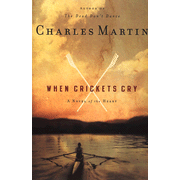
Book Review: When Crickets Cry

I don’t usually quote from the backs of books when reviewing them but in the case of When Crickets Cry by Charles Martin, this says it much more succinctly and much better than I could.

A man with a painful past. A child with a doubtful future. And a shared journey toward healing for both their hearts.

It begins on the shaded town square in a sleepy Southern town. A spirited seven-year-old has a brisk business at her lemonade stand. But the little girl’s pretty yellow dress can’t quite hide the ugly scar on her chest.

Her latest customer, a bearded stranger, drains his cup and heads to his car, his mind on a boat he’s restoring at a nearby lake. The stranger understands more about the scar than he wants to admit. And the beat-up bread truck careening around the corner with its radio blaring is about to change the trajectory of both their lives.

Before it’s over, they’ll both know there are painful reasons why crickets cry . . . and that miracles lurk around unexpected corners.

It’s obvious from the beginning that the man, Reese, is hiding somewhat from someone or something, and his background and reasons for doing so are skilfully unfolded through the course of the book. That he recognizes the scar on Annie’s chest and knows what to do at the accident indicates he has either been a patient with the same ailment she has, or he is in the medical field.

There is not much more I can say about the plot of the book without seriously spoiling the discovery for others, but the journey towards the different kinds of healing they each need is  beautifully, touchingly, skilfully written.

There were a couple of things that keep me from giving it a whole-hearted endorsement, however. There is brief mention throughout of things like lovers skinny-dipping, a guy ogling a girl’s chest, the outline of a naked woman on a sign, etc. They are no more explicit than that, and I know those things occur in real life, but I didn’t really need them mentioned or need my thoughts pulled in those directions, although I did appreciate the reasons given to one character as to why he shouldn’t be looking at the wrong kind of magazines.

One real oddity to me in the book is a bar “disguised as a billboard for God” with verses on the cocktail napkins, mixed drinks named after the apostles, the Ten Commandments and Sermon on the Mount on chalkboards, gospel music in the jukebox (though the selections are listed as rock titles, so when someone thinks they are paying for and playing one song, the gospel version actually plays). Davis, the owner, cook, and bartender, has a degree in theology, though he doesn’t advertise that fact, and does sell alcohol, though he mixes it with a nonalcoholic version when he thinks it best. He’s motivated by the fact that the people who most need the Lord don’t come to church, so he goes to them, and “if it means titillating people’s sin senses and hoodwinking them on their beer, he’s comfortable before God and telling Him he did it that way.” There is a naked woman weather vane on top of the building and “adult” signs, though there is no nakedness or “adult” activity in the bar. “Bottom line, Davis is not interested in the people who aren’t attracted to the promise of big bosoms, cold beer, and the possibility of having both. And for that reason he’s targeting the folks who think they can’t live without them.”

This is all really disturbing to me. It’s good and admirable to want to reach those who wouldn’t normally come to church if invited and to go out of one’s way to do so, to go out to them, but to “titillate people’s sin senses” to do so goes a step beyond “being like the world to win the world,” which is not what we’re called to do.

One character experiences a “disconnect” between what he hears and what he came in for. “Well, no wonder,” I thought. I come from a non-Christian family, my father was an alcoholic and my sisters go to bars, and they would find this an incongruous as I do.

The character of Reese, who describes this place, doesn’t necessarily endorse it and doesn’t suggest “that the end justifies the means,” but he does point to Davis’s well-attended Bible study.

I’m not sure if the author is justifying this or just creating an eccentric character, but though his writing makes me want to read more of him, this whole scenario makes me wary of him. This isn’t really a major part of the book, taking up only a few paragraphs, and I am glad I read the rest of the story. I hope he doesn’t muddy his other stories with this kind of thing. I’d like to read more of his work, but if it is all like this I won’t be able to.

(This review will also be linked to Semicolon‘s Saturday Review of Books.)

Book Review: Infinitely More by Alex Krutov

Alexander Krutov was born December 6, 1977 in St. Petersburg, Russia. When his teen-aged mother left the hospital three days later, she discarded him in a nearby dumpster. Thankfully God allowed someone to hear his crying, and since he still had his hospital bracelet on, they returned him to the hospital.

He spent the rest of his growing-up years in various orphanages. His humor shines through when he mentions Orphanage Number 9 and comments, “Though the Russians have written some of the greatest works of literature and music, our creativity apparently does not extend to naming orphanages.”

He describes growing up in the orphanages, the general lack of individual attention and care except by a few, the physical lacks (no hot water or shower, only a bucket of water once a week) the lack of individuality (three sets of new clothes once a year that looked exactly like everyone else’s). Yet there were bright lights along the way in a few close friendships and a special caretaker named Melana. He was adopted at one time, but it was a horrid experience resulting in his running away several times until a couple found him asleep in a park, intervened for him, and the orphanage took him back.

He had some experiences with the Russian Orthodox Church, even rising to a level of leadership, but found after a crisis that “my religion had nothing to offer me when I needed it most, and I in turn had nothing to offer the others. I turned my back on the Russian Orthodox Church that day, and accelerated my journey into darkness, despair, and hopelessness.”

The collapse of the Soviet Union 1991 brought many changes to the orphanages, some good and some not so good. But one significant difference was that missionaries were allowed to come into the country. Several encounters with short-term missionaries planted seeds in Alex’s life. Though at first he was not convinced that there was a God who cared about him, he did see a difference in the lives of these people and felt drawn to them. Some missionaries from the Navigators came, and Alex was able to spend much time with them and go to church with them and began reading the Bible on his own. When he was 16 he accepted Christ as his Lord and Savior. His faith was still fragile at first, but gradually it grew and became firm. He had a teachable spirit when the American Christians had to talk to him at times about wrong attitudes.

The Soviet system did not really prepare orphans for any kind of productive life when they became adults. Alex says in one place “the Russian society honestly believed it would be better for everyone if they just died.”

Eventually God led Alex to help in the formation of a ministry to help prepare older orphans for life as responsible adults and tell them of Christ, and it is my understanding that he is still involved with that ministry today in his 30s.

I don’t know if I am doing this book justice, but it was a wonderful read. It was hard in places, seeing what Alex and other orphans went through, but there were so many times the grace of God was manifested in his life, protecting him and bringing him to Himself. I highly recommend it, five stars and two thumbs up!

(This review will also be linked to Semicolon‘s Saturday Review of Books.)

No, Not Despairingly

I had not heard this song in years, but a friend posted the lyrics on Facebook recently, reminding me of them. In fact, the only time I have heard this song was when the music pastor of the church we attended when we were first married sang them. But it is a rich old hymn. The tune I am familiar with is not the same one listed here.

No, not despairingly come I to Thee;
No, not distrustingly bend I the knee:
Sin hath gone over me, yet is this still my plea,
Jesus hath died.

Ah! mine iniquity crimson hath been,
Infinite, infinite—sin upon sin:
Sin of not loving Thee, sin of not trusting Thee—
Infinite sin.

Lord, I confess to Thee sadly my sin;
All I am tell I Thee, all I have been:
Purge Thou my sin away, wash Thou my soul this day;
Lord, make me clean.

Faithful and just art Thou, forgiving all;
Loving and kind art Thou when poor ones call:
Lord, let the cleansing blood, blood of the Lamb of God,
Pass o’er my soul.

Then all is peace and light this soul within;
Thus shall I walk with Thee, the loved Unseen;
Leaning on Thee, my God, guided along the road,
Nothing between.

~ Horatious Bonar, 1866

Friday’s Fave Five

Welcome to Friday’s Fave Five, hosted by Susanne at Living to Tell the Story, in which we can share five of our favorite things from the last week, a wonderful exercise in looking for and appreciating the good things God blesses us with. Click on the button to learn more, then go to Susanne’s to read others’ faves and link up your own.

Can you believe we’re almost a third of the way through June already?!

Here are a few favorites from the last week:

1. We closed on our old house Wednesday! You can’t really count on closing til it’s over and done and everyone has signed everything — once with a previous house we went to the closing only to have the buyers bring up some issues and show they weren’t ready financially (after we had driven three hours to be there!) But thankfully everything went through. I was a lot more emotional than I thought I’d be going through the house for the last time. But the family buying it is a young couple with 2 children who have been living in a 2 BR apartment, so they are really looking forward to having more space. I hope they have as many happy memories there as we did!

2. Watching Wives and Daughters via Netflix after finishing the book.

3. Single-sized servings of cake. I was hankering for something chocolate but did not want the temptation of a whole cake in my house. The grocery store has single-serving slices of cake in the bakery, and I enjoyed one slice of Double Chocolate. Now if they only had single servings of chocolate pie. I’ve seen other kinds of pie in single servings in the freezer section, but not chocolate.

4. A new gas oven and range. That’s not something I had been yearning for, but the heating element and igniter went out, and it would have cost about as much to fix it as it was to get a new one. We went appliance shopping over the weekend, and it was delivered and installed Tuesday. It’s always fun to have a brand new shiny appliance. 🙂 I especially like the display panel: the one on the previous oven was very hard to read, and this one is much bigger and easier to see.

5. Roasted squash and zucchini. Tried this last night and it was really good except that I cooked it just a smidgen too long.

I hope you’ve had a great week as well! Have a good weekend!

Book Review: Wives and Daughters

Wives and Daughters by Elizabeth Gaskell follows the story of Molly Gibson, the young daughter of a widowed country doctor in 19th century England. In the first chapter Molly is a young girl going to her first “open house” of the town’s Earl and family, held once a year at what the townsfolk call “The Great House.” She doesn’t have the best experience there and never attends another.

Some years later she’s a young lady, and one of the pupils her father has taken on has decided he is in love with her. Molly knows nothing of this, but her father feels she is too young for such things and sends her to Hamley Hall in hopes that his young protege’s ardor will cool. Mrs. Hamley has been one of his patients for years, not quite an invalid, but not very active, and for some time she has wanted Molly to come and visit. Through their time together they become quite close, and the Hamleys regard Molly as close as a daughter.

The Hamleys are landed gentry but have fallen on hard times. They have two sons away at Cambridge: Osbourne carries the family’s hopes, handsome, charming, fashionable, and expected to do brilliantly, and Roger is a man of science, plainer, but steady as a rock. Squire Hamley loves Molly as well and regards her father as a dear friend but strongly feels that marrying Molly would be beneath either of his boys because her father is a “professional” man.

While Molly is away her father contemplates his situation. Molly is at the age where it is awkward for him to keep taking young men as pupils, as his pupils live with him. He hadn’t really thought of remarrying, but begins to think it would be good for Molly if he did. Circumstances bring him into contact with Miss Claire, former governess at the Great House, and in pretty short order he proposes.

Molly is not happy. She feels the loss of having her father all to herself, and her earlier encounter with Miss Claire makes her unexcited about having her for a step-mother. But she tries to make the best of it.

Claire, or Hyacinth, as she prefers to be called after her engagement, married primarily to escape the pressure and tedium of having to support herself and her daughter Cynthia, near Molly’s age, who is at school in France. She speaks great flowing sweet words, but something always seems a little off in what she says. She’s not an evil stepmother, but she is totally self-centered. For instance, when her daughter Cynthia is due to come home, Claire, now Mrs. Gibson, wants to redecorate the girls’ rooms just alike even though Molly begs her not to. Molly’s room is furnished with her mother’s things. But Mrs. Gibson doesn’t want people to think she favored her own daughter by decorating only her room, so she insists that both girls’ rooms are alike.

Cynthia comes home, and the girls become fast friends, though Cynthia is the kind of girl that draws all eyes to herself when she enters a room. She’s beautiful, charming, and worldly-wise while Molly is more plain and naive.

The rest of the book follows the interactions of these and a few others. It’s not an action-packed plot, but it had me smiling in places and in tears in others.

Gaskell did a marvelous job with characterization. Cynthia and Molly, Osbourne and Roger are studies in contrasts, and it’s clear which of each pair is regarded as “good,” yet the others have some good qualities and invite our sympathy. None of her characters are caricatures: each has layers. Squire Hamley is gruff and blustery but not as unfeeling as he seems at times. Dr. Gibson is wise but has a keen wit and some of the best humorous lines. For instance, when his wife is envying someone with more than herself and consoles herself by saying, “But riches are a great snare,” her husband answers, “Be thankful you are spared temptation, my dear.” When Mrs. Gibson goes away for a week and Molly is looking forward to going back to some of their old habits, Dr. Gibson’s “eyes twinkled, but the rest of his face was perfectly grave. ‘I’m not going to be corrupted. With toil and labour I have reached a very fair height of refinement. I won’t be pulled down again.'”

It’s hard to say what the theme of the book is, if there is one. It definitely shows the complications of secrets, the devastating harm of gossip, the disappointment of misplaced expectations. Yet perhaps the focus is just on remaining steady and doing the right thing in the face of all of that.

Unfortunately Mrs. Gaskell died before the book’s last chapter was finished, but a Frederick Greenwood concludes the book with what was known of Mrs. Gaskell’s intentions.

I loved this book, and when it ended I was sorry that I wouldn’t be able to spend any more time with these characters.

Audible.com includes a little sample of the reading of their books, and I listened to several before choosing this one read by Nadia May. She was the most expressive, and she did a wonderful job with the different characters’ voices and inflections, from older men to young girls, and one character with a Scottish accent and another who was French.

I also indulged in the BBC-produced film of Wives and Daughters via Netflix (in four parts of about an hour and 15 minutes or so each), and it was remarkably well done. There were some little changes here and there, naturally, some scenes left out and others squished together, a greater liberty taken with the ending, but overall it was faithfully done and much of the dialogue was taken straight from the book.

Here is a trailer from the film — it’s making me want to watch it all over again:

(This review will also be linked to Semicolon‘s Saturday Review of Books.)

When you’re married to a scientist…

…sometimes dinner has to wait for those once-every-hundred-years’ occurrences in the sky…

Or, when he sprays non-stick spray on the frying pan after turning the gas flame on underneath a little high, and some of the spray falls onto the flame and catches fire for just a second and then goes out, while my reaction was a loud gasp, his was, “That was cool!” (Kids, don’t try this at home!!!!)

Book Review: When Christ Was Here

I’ve been privileged and blessed to hear Claudia Barba speak a few times, so when I saw she had written a book called When Christ Was Here: a Woman’s Bible Study, I was happy to order it. I was just finishing the gospels in my reading through the Bible, so the book was timely for me.

Claudia opens with the importance of studying the doctrine of Christ’s incarnation, because “every false religion is an open denial or some sort of distortion of this doctrine” (p. 1). The first chapters study the claims and testimony in Scripture about Jesus’s deity, then one chapter is devoted to His humanity. The remaining chapters focus on Jesus and different types of people (His earthly family, the self-righteous, social and moral outcasts, people in pain, people who fail, the discouraged) and different situations (trials and temptation), because, she points out, “You need to know how He lived on earth because you are commanded to live as He lived. “He that saith he abideth in him ought himself also so to walk, even as he walked.” (I John 2:6).

Much of the book was familiar territory (I had forgotten until halfway through the book that Claudia’s father, Dr. Otis Holmes, had been the professor for my Life of Christ class in college! Though I can’t remember specifics from the class, I am sure its truths became a part of my thinking.)  But it was good to go over it again: we’re instructed often in Scripture to remember what we’ve been taught, and if we don’t, all too often we can veer off the straight path of Scripture.

Some thoughts were new to me, though, or opened my understanding a bit more.

For instance, in John 5:19, Jesus said, “Then answered Jesus and said unto them, Verily, verily, I say unto you, The Son can do nothing of himself, but what he seeth the Father do: for what things soever he doeth, these also doeth the Son likewise.” Claudia comments, “He was not saying that He did not have adequate power alone but that because of their essential union, He could not act independently of His Father” (p. 15).

A particularly interesting chapter was the one on Jesus’s earthly family. “Doesn’t it seem strange that those who lived so closely with Jesus did not believe on Him? Even His example of perfect holiness in daily living was not enough to bring belief to their hearts. Their rejection says nothing at all about Him but everything about them” (p. 40). This should be enlightening in considering “lifestyle evangelism,” the thought of just being a witness by our godly lifestyles without verbally witnessing: even a perfect lifestyle does not convert people (though our lives must back up what we believe). I am sure Jesus spoke truth to His family as well as living it, and thankfully some of them did come to believe on Him after the resurrection, and I am sure His godly life as well as the words He had spoken had new meaning to them then.

Another eye-opening section to me in the chapter on moral outcasts had to do with Simon and the woman known as a sinner who washed His feet with her tears, dried them with her hair, and anointed them with ointment from an alabaster box (from Luke 7).

Simon had thought that Jesus didn’t recognize the real sinner in the room. But He did, of course. It just wasn’t the one Simon thought it was! (p. 74).

There’s irony here, for the sinner is praised as a saint, and the “saint” is exposed as the real sinner (p. 74).

Simon loved little, not because he had fewer sins, but because he thought he didn’t need forgiveness (p. 75).

This was the first time it dawned on me that when Jesus said, “Her sins, which are many, are forgiven; for she loved much: but to whom little is forgiven, the same loveth little” (Luke 7:47), the point was not just her great sin which had been forgiven: it was also that Simon had great sin as well, but he just didn’t realize it. It’s not that her sins were big and his were little: it was that she loved much because hers were forgiven, but he didn’t love much (he didn’t even extend the common courtesies of the day to Jesus) because his sins weren’t forgiven because he had not acknowledged them.

In “Jesus and People in Pain,” part of the chapter deals with Mary and Martha when their brother Lazarus died, and Jesus had not come to them when they sent word that Lazarus was sick. “[Jesus] doesn’t delay because He doesn’t know, doesn’t love, or doesn’t care. His delays are for our good. They are designed to accomplish much greater purposes’ (p. 82).

In “Jesus and People Who Fail”:

Jesus allowed Peter to be sifted as wheat (Luke 22:31). This is not the sort of sifting of flour you are familiar with. It’s a winnowing process, the tossing of grain in a bowl that allows the breeze to blow away the chaff (hulls, dust), and leave behind only the good grain. The Lord let Satan “shake up” Peter through this failure, and as a result, much fleshly self-reliance was filtered from his character. (p. 99)

If you have failed, don’t despair. Repent and begin again! But never forget what you are capable of, and use your experience to help others (p. 101).

That phrase “never forget what you are capable of” is most sobering to me. That is one good thing that comes out of failure, though: the reminder of what we’re capable of when we lean on our own strength instead of His, the reminder of how we need to stay every close to Him and in His Word and to rely on Him to keep us.

From “Jesus and Temptation”:

Temptation is not designed to make you fail or give you an excuse to sin. Instead, it is an opportunity for you to find the way of escape, to glorify God by defeating Satan. (p. 130).

If you are looking for a rich, meaty Bible study, if you feel the need to “turn your eyes upon Jesus,” this book is for you.

(This review will also be linked to Semicolon‘s Saturday Review of Books.)

Laudable Linkage

Here is a short (turned out to be not so short!) list of very good reads discovered this week:

How to Thrive in College, HT to Lisa Notes.

The next four are from a new-to-me blog called The Good Life. I’ve been reading the Ink Slinger for a while now, and this is his mom.

When the Call For Grace Means the Gagging of Discernment. Excellent. Grace and discernment come from the hand of the same God and are not enemies.

Eleven Ways to Hurt Your Local Church.

How Can I Love My Local Church? Let Me Count the Ways.

11 Ways God Uses Church Conflict to Sanctify Us.

The Other Edge of the Sword. We need love plus truth, love founded and backed up by truth, not love that obscures truth.

Mothering Amnesia.Yes, I suffer from it. 🙂

You Are Equipped for Motherhood. I don’t know a mom who hasn’t doubted this, and this is great encouragement.

Preventing Bullying: Children With Special Needs. Sadly, “Our society does not value the lives of people with special needs as highly as it values lives of people without disabilities.”

What’s Your Thing? We each have different gifts.

If you are familiar with Star Trek beyond the original series, you might get a smile from this:

This is from the Galkin team. The Galkins, as well as the former youth pastor from our church and a few other families, are planning to move to Salt Lake City later this year to plant a Baptist Church there. The young man who first starts singing here was in our older two sons’ youth group in SC. It’s exciting to see how the Lord is opening the way for them!

Friday’s Fave Five

Welcome to Friday’s Fave Five, hosted by Susanne at Living to Tell the Story, in which we can share five of our favorite things from the last week, a wonderful exercise in looking for and appreciating the good things God blesses us with. Click on the button to learn more, then go to Susanne’s to read others’ faves and link up your own.

The weeks just keep a-flyin’. I don’t know when the laid-back part of summer will get here! But here are some favorite parts of the last week:

1. A graduation — no, not Jesse’s, but the class he had been a part of from K-5 through 10th grade in SC. Since he has many good friends in that class, we went down to see their graduation and stay for the reception afterward. I thought I would feel very emotional — sometimes when we’d see on Facebook that this class had done certain things (senior trip, Junior-Senior banquet,etc.), I’d feel pangs about Jesse not being a part of it. It’s not that I don’t feel our move wasn’t God’s will, but there was still sadness that he’d had to pull up stakes. But this time, it was all right: I felt assured that this wasn’t home any more, though there are folks we’ll always love and I hope always be friends with there, and he’s had many good experiences and developed many friendships here as well.

2. Catching up with old friends both at the graduation above and a dear friend’s daughter’s graduation party the next day.

3. A contract on our old house. We combined the visiting portion of the trip with a few tasks on the old house that needed to be done before the final inspection. We hope to close on it soon!

4. A new iPhone case. A belated Mother’s Day present just arrived in the mail this week. Isn’t it cute?

5. Memorial Day with the family. I’m not sure how Memorial Day came to be associated with grilling, but I loved my husband’s grilled burgers, hot dogs, and sausages! Plus time with the family and a three-day weekend — and the ability to celebrate these things and our freedoms because of those who fought for them. It was especially nice having Monday off after our busy weekend trip.

Hope you have a great weekend!

If I were to write a book…

btt  button Booking Through Thursday is a weekly meme which poses a question or a thought for participants to discuss centering on the subject of books or reading.

I haven’t done a Booking Through Thursday for a very long time, but today’s question piqued my interest:

Cathy De Los Santos asks: If you could write a book, what would it be about, and why? (Though, of course, some of you already HAVE.)

I’ve thought about it.

One book I’ve given thought to writing is a devotional book for pre-teen and teen boys, because I haven’t really found anything I liked along those lines when I’ve read them with my youngest. I’ve seen some good books and Bible studies for them, but not a short devotional — they all tend to try to be too trendy or “hip,” and that kind of approach sadly fails, in my opinion. And others are a little off in their theology. Having raised three boys, there is a lot I’d love to say to guys, and there are things I hope my own have picked up along the way. But then I ask myself, why would any teen guy care what a middle-aged mom he doesn’t know has to say?

I’ve also thought of writing missionary biographies. Personally, I’d rather read and point people to the old ones, but some people don’t want to labor through the older language or the ponderous details and history of them. This desire has been renewed since picking up a new biography I had high hopes for but am a little disappointed in — the language is updated but the writing style does not draw one in at all (more on that when I finish and review it). The story of one of my favorite missionaries is spread out over several of her books, and I’ve often thought someone should blend them into one — and I’ve given thought to giving that a try or trying to write a new biography of her.

I’ve also thought of writing Christian fiction, but I have very little idea of what to write. For years I’ve had in mind a couple of characters: a teen girl who moves to a new place with her family, reluctantly does something for an elderly neighbor, strikes up a friendship with her, and the older woman becomes something of an unofficial mentor to her. But that’s about all I’ve got, even though, as I said, I’ve had them in mind for years. I’m not sure where to go with them, where to take them. I’m not a very decisive person , and there are multitudes of decisions to make when writing fiction. With non-fiction, especially biography, your source material is there: you just have to decide how to present it and organize it, what to include and what to leave out, etc. But with fiction, you’re making everything up as you go, and you can go any number of directions!

So far there hasn’t really been time to delve much into any of these, but maybe now that my youngest has graduated……..we’ll see how the Lord leads!

I know a couple of my blog friends have written books, one published and one on its way! I may be coming to you for advice if/when I follow in your footsteps.

What would you write if you were to write a book?