Laudable Linkage

Laudable Linkage

I have not done as much blog reading this week with family here, but I have found a few thought-provoking posts:

How Can Christians Fight the War on Lies, HT to Challies. “This post-truth age poses profound challenges for Jesus followers. How does the church proclaim the gospel in a world where all truth claims are viewed with suspicion? How do we engage in meaningful dialogue when emotional resonance often trumps logical argument? And perhaps most critically, how do we maintain the integrity of our witness when the very concept of objective truth is under assault?”

Is Modern Tolerance an Aspect of Love? “What is the role of government? According to scripture, it is to protect us from evil, not protect evil.”

Impossibly, Gradually, Miraculously Changed, HT to Challies. “The apostle Paul talked about our slow path to holiness. We are, he said, being transformed (that’s the certain part) from one degree of glory to another (that’s the slow part) into the image of the Lord (that’s the beautiful part). More miraculous than an ocean of polished shell and glass, more changed than a river full of rocks is the transformation of a human heart by the Holy Spirit.”

Don’t Forget to Remember: Lessons from a King and the Pride That Hides. “Asa didn’t fall into overt, obvious pride. The Scripture doesn’t say anything about his rebellion or foolishness, arrogance or selfishness. His was a sin harder to detect: the pride that hides. It hides behind Bible readings and worship songs, formal prayers and spiritual disciplines.”

Seven Encouragements for Parents of Prodigals, HT to Challies. “I don’t think we or anybody has ever gotten to the bottom of it and its amazing portrait of the gracious heart of God.”

I Do Not Know This Year, Lord, HT to Challies. This poem about trusting God for the year ahead was apropos for me since my birthday is coming up next week.

Better a brief warfare and eternal rest, than false peace and everlasting torment. C. H. Spurgeon

Better a brief warfare and eternal rest, than false peace and everlasting torment.
C. H. Spurgeon

Friday’s Fave Five

Friday's Fave Five

It’s Friday again, when I pause with Susanne and friends at Living to Tell the Story to reflect on the good things from the week.

1. My oldest son is home. He came in last Friday from RI. It’s been a low-key week so far—Mittu has had a horrible respiratory infection (tested negative for Covid, flu, and strep), and Jim, Jason, and I have had touches of various things through the week. But we’ve enjoyed being together and talking, and we hope to get out to do some things later on.

2. Clingman’s Dome is the highest point in TN. There’s an observation tower with a great view of the surrounding area. Jim and Jeremy hiked the trail to the tower Monday and enjoyed it the scenery.

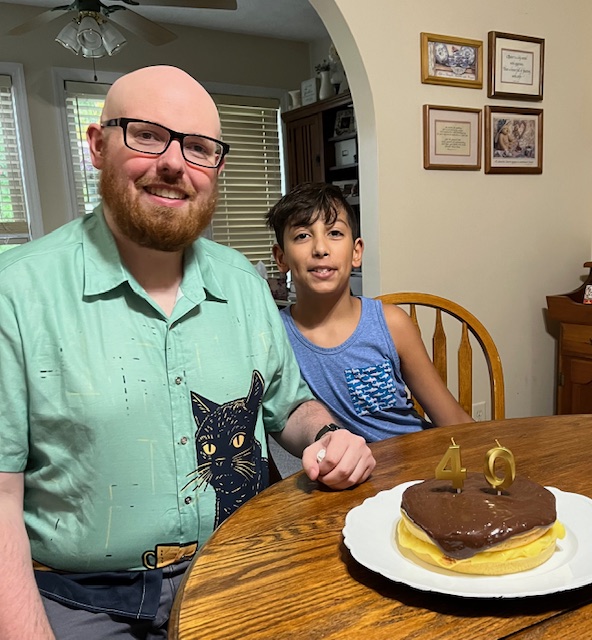
3. Jeremy’s birthday. I’m glad he could be here to celebrate it!

4. An easy fix. I was having trouble with my most-used outlet in our bathroom working intermittently and then not at all. Jim took his tester in there, thinking he might have to replace the outlet. After he unscrewed and tested it, he found an inner screw was loose. That took care of the problem!

5. A revitalized hair dryer. In the course of trying to fix the above problem, we thought at first my hair dryer might be having trouble. It was what worked the least in the outlet before it went kaput. Jim opened it up and cleaned out the lint and dust. Now it blows better than it has in a long time!

That’s our week! How was yours?

Review: A Boy’s War

A Boy's War by David Michell

David Michell was the tender age of six when he was sent to the Chefoo School, a Protestant boarding school for missionary children in what is now known as Yantai. He and his parents had no idea they would not see each other for six years because the Japanese captured the school during WWII.

David tells his story in A Boy’s War. His parents moved from Australia to be missionaries to China with China Inland Mission, originally founded by Hudson Taylor, in 1930. David was born in China and lived with his parents and older sister until they were later joined by a younger sister. When it came time for school:

In the China of those years the only way for most children of missionaries to get a good education in English was to go away to boarding school. Chefoo offered this opportunity. At Chefoo children of missionaries and a few sons and daughters of business people lived and studied together at the preparatory school, the Boys’ School, and the Girls’ School, getting a truly Christian education for body, mind, and spirit. So good was that education, in fact, that others, non-CIMers, wanted to take advantage of it, too (Location 59, Kindle version.

Some of the school’s famous graduates were Henry Luce of Time Magazine and Thornton Wilder.

On a side note, when I first read in missionary biographies of parents sending their children away to school so young, I was horrified. But home schooling materials were not as available then as now. Plus the British boarding school system had been in place for ages. Parents wanted their older children to have the credentials for college. And in some cases, the environment was such that children were more vulnerable to some of the horrific practices of the parents’ mission field, so parents felt they were safer away at school. These days, many mission boards work with parents to teach their children at home, especially in the younger years.

David tells of his trip to school (“two thousand miles and a six-week journey away,” Location 145) and early days of adjustments. Though he missed his parents and younger sister and had some homesickness and struggles, for the most part he settled in fairly easily.

Many of the teachers had been Chefoo students themselves. Outside the classroom, “housekeepers” helped the children write letters home, mended their clothes, and generally helped where needed. I was touched to see that many of these women were widows who now “mothered” these children.

As early as 1940, the school’s headmaster conferred with the British Embassy about what they should do in the face of the conflict between Japan and China. They decided to keep the school open. However, many children could not travel home at Christmas break due to the dangers, so a larger number than usual were at the school over the holidays. The staff provided a memorable Christmas for them.

They were used to seeing Japanese soldiers in the area, but the military didn’t bother anyone at the school. That changed after Japan attacked the US at Pearl Harbor the following year. Now British and Americans were the enemies. Immediately, Japanese soldiers arrested the headmaster for a month and took over the campus.

Classes and activities were allowed to continue under the watchful eye of the Japanese, but supplies ran low and freedoms were curtailed.

In November, 1942, the whole campus was sent on foot to an abandoned Presbyterian mission at Temple Hill, where conditions were even more crowded and supplies were even fewer.

Then in September 1943, the school was sent on a longer journey to the Weihsien interment camp, where they remained until the end of the war. There they joined some 1,500 other people from all walks of life and several nationalities held by the Japanese.

One of the detainees was Olympic medalist Eric Liddell. He had become a missionary to China after his Olympic feats. He had sent his pregnant wife and two children home, planning to join them later. But the Japanese took over before he could. One chapter of the book is a mini-biography of Liddell. He took an active part in teaching the children, who all called him Uncle Eric. He drew pictures of chemistry equipment they didn’t have so older students could be prepared for their Oxford exams. He arranged races and athletic activities and was generally thought of as a man “whose humble life combined with muscular Christianity with radiant godliness” (Location 1516). Sadly, he died of a brain tumor while at Weihsien.

Another detainee was Herbert Taylor, oldest son of Hudson Taylor, in his eighties, having been a missionary in China for over sixty years.

Though their years in camp were fraught with hardships, the children managed to have adventures as well.

David describes the joy of seeing six American soldiers parachute nearby and the Japanese surrendered.

Then came the scramble to get everyone home and taken care of.

Though David exulted in freedom, he found some aspects hard to adjust to.

In the last chapter of the book, David described going back to Weihsien with a few of his friends from there and their sons on the fortieth anniversary of their rescue. 

I had read this book some decades ago but had forgotten much of it. Reading a frictional account of the Chefoo school’s captivity in When We Were Young and Brave by Hazel Gaynor made me want to revisit this book. I am so glad I did. Hazel’s book may have more emotion, but it’s imagined emotion. David’s book is more factual. While he doesn’t downplay the hardships, he doesn’t go into great detail about them, either. I appreciated what he had to say here:

A situation like Weihsien is fertile soil for producing people of exceptional character. In our eyes, for instance, our teachers were heroes in the way they absorbed the hardships and fears themselves and tried to make life as normal as possible for us.

In fact, I think at times all of us in camp considered ourselves as heroes. We were surviving, some would say even thriving, in the midst of war. By dint of hard work, ingenuity, faith, prayer and perseverance we had transformed a compound that was a hopeless mess into a habitable and in some rare corners, almost an attractive living place (Location 1333).

Someone in the camp, Hugh Hubbard, wrote this of Eric Liddell after his death, but I think it was true of them all:

Weihsien—the test—whether a man’s happiness depends on what he has or what he is; on outer circumstances or inner heart; on life’s experiences—good or bad—or on what he makes out of the materials those experiences provide (Location 1504).

You can read a couple of testimonies of David Michell here and here.

I’m thankful to have reread this book, and for God’s sustaining grace of His people through the hardest of times.

Review: Be Decisive (Jeremiah)

Be Decisive commentary on Jeremiah

Pastor and Bible teacher Warren Wiersbe shared his thoughts and insights on the book of Jeremiah in Be Decisive (Jeremiah): Taking a Stand for the Truth.

Jeremiah had a tough job. God’s people had worshiped idols for decades. They hadn’t obeyed His laws. They had also gone to other nations for help instead of God, in spite of the fact that He had provided for them and delivered them time and again. He sent prophets at various times to point them back to Him. But they refused.

The time came that God had to deal with them more severely. He was sending punishment in the form of the Babylonians, who would conquer their nation, destroy their temple, and take most of the population back to Babylon.

God would not annihilate them completely. He would preserve a remnant. He would keep His promises to maintain David’s lineage and bring forth the promised Messiah. “The purpose of chastening is that we might seek the Lord, confess our sins, and draw near to Him (Heb. 12: 3–13)” (p. 140). But for now, they were to go to Babylon, make their homes there, and settle in for seventy years.

God called Jeremiah to give this message to His people. They didn’t listen any better than they had before.

The false prophets preached what the people wanted to hear, but Jeremiah preached what the people needed to hear (p. 134).

The civil and religious leaders of Judah preferred the pleasant messages of the false prophets to the strong words of God’s true servant, because the human heart wants to rest, not repent. It wants peace, but it wants it without having to deal with the basic cause of unrest—unbelief (p. 211).

Further, Jeremiah’s instruction to actually submit to Babylon sounded like treason.

Jeremiah is sometimes called the “weeping prophet.” Though he had to point out the people’s sins in order to try to bring them to repentance, and though he knew they deserved what was coming, he still had compassion on them.

At least sixty-six times the word heart is found in the book of Jeremiah, for he is preeminently the prophet of the heart (p. 16).

We call Jeremiah “the weeping prophet,” and he was (9: 1), but he was also a courageous man who faced many dangers and trials and remained true to the Lord (p. 22).

Like many of us, Jeremiah balked at first at God’s calling.

Jeremiah hesitated as he looked at the work before him and the wickedness around him, and when he looked at the weakness within himself, Jeremiah was certain that he wasn’t the man for the job.

When it comes to serving the Lord, there’s a sense in which nobody is adequate. “And who is sufficient for these things?” (2 Cor. 2: 16) asked the great apostle Paul as he pondered the responsibilities of ministry. Paul then answered his own question: “Not that we are sufficient of ourselves to think any thing as of ourselves; but our sufficiency is of God” (3: 5).

When God calls us, however, He isn’t making a mistake, and for us to hesitate or refuse to obey is to act on the basis of unbelief and not faith (p. 20).

At the end of Jeremiah’s ministry, it may not have looked like he accomplished much.

By today’s human standards of ministry, Jeremiah was a dismal failure. He preached to the same people for over forty years, and yet few of them believed him or obeyed his message. He had few friends who stood with him and encouraged him. The nation he tried to save from ruin abandoned their God and plunged headlong into disaster (p. 213).

Jeremiah may have thought he had failed, but God saw him as a faithful servant, and that’s all that really counts (p. 213).

Jeremiah is one of Scripture’s greatest examples of faithfulness and decisive action in the face of physical danger and national decay (p. 20).

Some other quotes that stood out to me:

Any theology that minimizes God’s holiness and tolerates people’s deliberate sinfulness is a false theology (p. 52).

That on which I center my attention and affection and for which I am willing to sacrifice is my god, and if it isn’t Jesus Christ, then it’s an idol. “Little children, keep yourselves from idols” (1 John 5: 21) (p. 60).

The remedy for idolatry is for us to get caught up in the majesty and grandeur of God, the true God, the living God, the everlasting King. An idol is a substitute, and you would never want a substitute once you have experienced the love and power of the Lord God Almighty (p. 60).

That, however, is what faith is all about: obeying God in spite of what we see, how we feel, and what may happen. It’s well been said that faith is not believing in spite of evidence but obeying in spite of consequence” (p. 153).

Lamentations, the book that follows Jeremiah in the Old Testament, is thought by some to also be authored by Jeremiah. Whether it is or not, I thought it would be included with this commentary, because its author laments the devastation that has come to Jerusalem after the Babylonian invasion. I looked at the table of contents of Wiersbe’s “Be” books on the minor prophets and later historical books, thinking his commentary on Lamentations might have been included with other books. But I couldn’t find it anywhere

The middle of the Lamentations contains some of the most hopeful verses. In the midst of sorrow over deserved chastening, the prophet said:

But this I call to mind,
    and therefore I have hope:
The steadfast love of the Lord never ceases,
    his mercies never come to an end;
they are new every morning;
    great is your faithfulness.
“The Lord is my portion,” says my soul,
    “therefore I will hope in him.”

The Lord is good to those who wait for him,
    to the soul who seeks him.
It is good that one should wait quietly
    for the salvation of the Lord.

For the Lord will not
    cast off forever,
but, though he cause grief, he will have compassion
    according to the abundance of his steadfast love;
for he does not afflict from his heart
    or grieve the children of men.

Let us test and examine our ways,
    and return to the Lord!
Let us lift up our hearts and hands
    to God in heaven.

Lamentations 3:21-27, 31-33, 40-41

Most of the prophets did that: issued warnings, pointed out sins, yes, but also shared God’s love, compassion, and willingness to forgive.

I benefited from reading Jeremiah again, and Dr. Wiersbe’s insights were a great help.

Christianity Is More Than Getting My Needs Met

Christianity is more than getting my needs met

God, as a good Father, delights to meet the needs of His children. “He fulfills the desire of those who fear him; he also hears their cry and saves them.” (Psalm 145:19).

He knows what we need before we ask. But He wants us to come to Him with our needs. He instructed us to pray even for our daily bread.

He promises “my God will supply every need of yours according to his riches in glory in Christ Jesus” (Philippians 4:19).

John Newton captured some of these thoughts in his hymn, “Come, My Soul, Thy Suit Prepare“:

Come, my soul, thy suit prepare,
Jesus loves to answer prayer.
He Himself has bid thee pray,
Rise and ask without delay.

Thou art coming to a King,
Large petitions with thee bring;
For His grace and power are such,
None can ever ask too much.

But the Christian life isn’t only about getting our needs met and our problems fixed. God is not a cosmic vending machine where we insert prayers, make our choices, and receive everything we ask for.

You’ve often heard that Christianity is a relationship with God. That’s true. John 17:3 says, “And this is eternal life, that they know you, the only true God, and Jesus Christ whom you have sent.”

But even within that relationship, the focus of the Christian life isn’t on us: it’s on God. We acknowledge that He is Lord. We bring our thoughts in line with His. We submit our wills to His.

God created us for His glory: “Everyone who is called by my name, whom I created for my glorywhom I formed and made” (Isaiah 43:7). He tells us to do all to His glory and to “Let your light so shine among men that they may see your good deeds and give glory to your Father in heaven” (Matthew 5:16).

That might sound strange to us. If we heard a man proclaiming his own glory or asking people to glorify him, we’d wonder who he thought he was.

The difference is, God is the only one who deserves glory. He created the world, the sky, the stars, everything from the tallest mountain to the smallest cell to the farthest celestial body.

He’s not only powerful, He is intrinsically good. He’s not an egomaniac.

He doesn’t need our glory. He has been self-sufficient for all of eternity. He doesn’t need anything from us.

So then, why does He want us to glorify Him? Someone has said that God doesn’t need our glory, but we need to give it to Him. 

There are probably a multitude of reasons God wants us to glorify Him, but here are a few:

To give Him His due. He deserves glory, as we said earlier. He’s God. No one can do what He does. ““Worthy are you, our Lord and God, to receive glory and honor and power, for you created all things, and by your will they existed and were created” (Revelation 4:11).

To express gratefulness. If we were rescued from a burning building by a firefighter, we’d sing his praises for the rest of our lives. How much more should we sing God’s praises for all He rescued us from and all He has done for us?

“You were ransomed from the futile ways inherited from your forefathers, not with perishable things such as silver or gold, but with the precious blood of Christ, like that of a lamb without blemish or spot” (1 Peter 1:18-19).

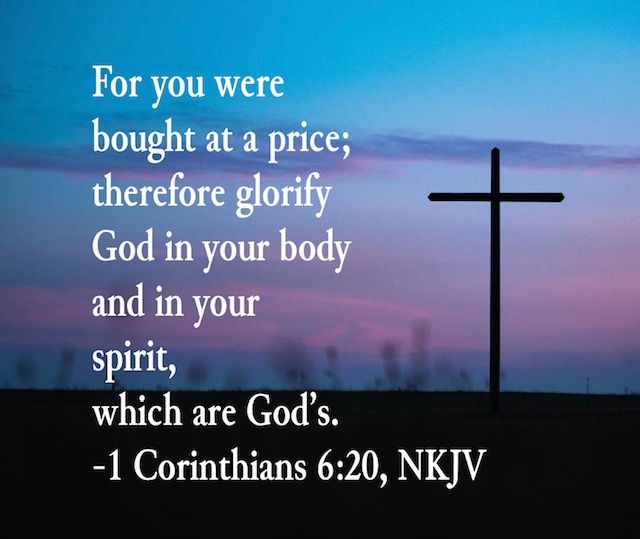
For you were bought at a price; therefore glorify God in your body and in your spirit, which are God’s” (1 Corinthians 6:20, NKJV).

To avoid false worship. If we’re glorifying someone or something else, we’ll be led astray. Nothing else is God. Nothing else can help us.

To be transformed. We’re changed by beholding His glory. “And we all, with unveiled face, beholding the glory of the Lord, are being transformed into the same image from one degree of glory to another” (2 Corinthians 3:18). Sometimes we try to change in every way except by looking to Him.

This doesn’t mean that we glorify Him for selfish reasons. But the better we know Him, the more we won’t be able to help glorifying, thanking, and praising Him.

To help others know Him. “They shall speak of the glory of your kingdom and tell of your power, to make known to the children of man your mighty deeds, and the glorious splendor of your kingdom” (Psalm 145:11-12).

To keep a right perspective. Even when doing things for God and relying on His grace and power, we can be tempted to feel proud of ourselves rather than give glory to Him. Two passages that help me with that are Psalm 115:1 (“Not to us, O Lord, not to us, but to your name give glory, for the sake of your steadfast love and your faithfulness!) and Matthew 5:16: “Let your light shine before others, so that they may see your good works and give glory to your Father who is in heaven.”

How do we glorify Him? Once again, there are many ways, but some are:

Acknowledge God for who He is. Romans 1 details the sad decline when people “ exchanged the glory of the immortal God” for lesser things.

Praise. “Whoever offers praise glorifies Me” (Psalm 50:23, NKJV).

Pray in Jesus’ name. “Whatever you ask in my name, this I will do, that the Father may be glorified in the Son” (John 14:13).

Live honorably. “Keep your conduct among the Gentiles honorable, so that when they speak against you as evildoers, they may see your good deeds and glorify God on the day of visitation” (1 Peter 2:12).

Grow spiritual fruit. “By this my Father is glorified, that you bear much fruit and so prove to be my disciples” (John 15:8). Verse 4 says this is done as we “Abide in me, and I in you. As the branch cannot bear fruit by itself, unless it abides in the vine, neither can you, unless you abide in me.”

Sexual purity. “Flee from sexual immorality. Every other sin a person commits is outside the body, but the sexually immoral person sins against his own body. Or do you not know that your body is a temple of the Holy Spirit within you, whom you have from God? You are not your own, for you were bought with a price. So glorify God in your body” (1 Corinthians 6:18-20).

Give cheerfully and generously. 2 Corinthians 9:6-15 tells of bountiful giving to others’ needs which results in their glorifying God.

Suffer in His name. 1 Peter 4:12-19 tells us not to be surprised when trials come, to rejoice when trials come, to trust their souls to a faithful Creator. Verse 16 says, “Yet if anyone suffers as a Christian, let him not be ashamed, but let him glorify God in that name.”

Honor God with our choices. 1 Corinthians 10 shares considerations to take into account when Christians differ over what’s right or wrong in areas not clearly spelled out in the Bible (specifically eating meat offered to idols, but the principles apply to various situations). Instead of clinging to our “rights,” we’re to consider others’ consciences and good. Paul concludes with “So, whether you eat or drink, or whatever you do, do all to the glory of God” (verse 31).

The glory of God is a subject too big to fit within one blog post, but these truths help me keep my interactions with God from being lopsided towards self.

Which of these reasons for glorifying God most resonates with you? Are there other reasons you can think of, or other ways the Bible tells us to glorify Him?

1 Corinthians 6:20

(I often link up with some of these bloggers.)

Laudable Linkage

Laudable Linkage

Here are some of the good reads found this week:

Everything Short of Hell Is a Mercy, HT to Challies. “Everything short of hell is mercy. This one truth should change the way we view our hardships and frustrations, no matter how terrible they may be. If we, as sinners, are not facing the wrath of the infinitely Holy God at this moment, our life is better than we deserve. That is true for every Christian and non-Christian alive right now.”

What to Say to Dave About Regular Bible Reading, HT to Challies. “Few of us have it fully sorted, and so we don’t feel qualified to tell others what they should be doing. I certainly don’t feel like I can speak from anything other than the wisdom that comes from regular failure. But failure is a good teacher, even if I’m not a good student, so here are five tips I might give to Dave.”

Should You Send Your Kids to Catholic School? HT to Challies. Some considerations.

In a Day’s Work: God’s Pattern for Productivity. “I’ve been studying the book of Genesis in depth, and something struck me recently about how God structured the days of creation. I think there may be something in this pattern that we can imitate in our own work.”

How Vocational Stewardship Leads to Human Flourishing, HT to Redeeming Productivity. “By ‘vocational stewardship,’ I mean the intentional and strategic use of one’s vocational power (skills, knowledge, network, position, platform) to advance human flourishing.” I would add that those things can be done on a smaller scale with neighbors, relatives, and church members.

The Porcelain Room. “Do I worry so much that I’ll forget to give them something they’ll need that I forget to point them toward the Lord who knows what they’ll need—and who will make sure they have it? Am I so preoccupied with the thorns and thistles of life that I allow them to crowd out the good growth of the gospel in our family?”

The Best a Man Can Get, HT to Challies. I enjoyed watching the American men’s gymnastics team win their bronze medal, the first US men’s team to medal in some time. This article about the team was great, too. “It’s a quintessentially American success story about a quintessentially American team, made up of distinct, memorable characters. The phrase ‘Diversity is our strength’ has become a cheap leftist nothing, but there are times and places when it actually means something, and the Olympics is one of them.”

The Curse of Knowledge, HT to Redeeming Productivity. “Have you ever had a teacher who was very smart but terrible at teaching? An expert who used so much jargon you could not follow their explanation? This is called the ‘curse of knowledge.'” The author shares ways to bridge the gap.

The Quiet Grief of Caregiving: Four Balms for the Overburdened, HT to Challies. “I forced a smile, swallowed down the tightness in my throat, and struggled against the tide of grief that’s become as familiar and worn as a tattered coat. It’s a mantle common to many who walk beside the hurting — the heaviness that presses upon the heart when we’ve witnessed others’ suffering over and over and over.”

Church Skills: Use Them or Lose Them, HT to Challies. “You might not think you have church skills, but you almost certainly do. You will have developed ways of making conversation, showing interest in people, caring for them, serving in all sorts of ways and lots of other such things. But as with anything we have learnt to do, if you don’t keep using it, you will lose it.”

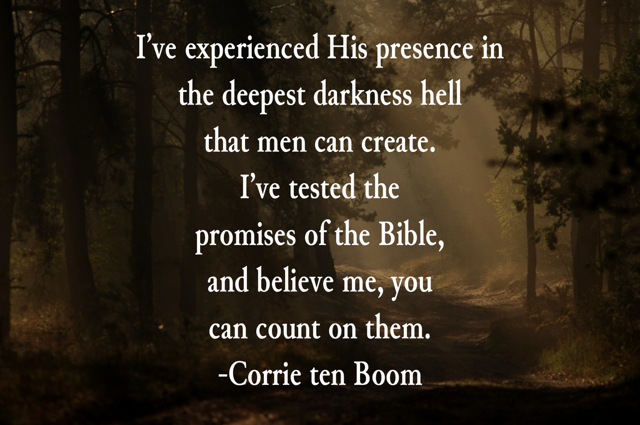
I’ve experienced His presence in the deepest darkness hell that men can create. I’ve tested the promises of the Bible, and believe me, you can count on them.” — Corrie ten Boom, survivor of Ravensbruck concentration camp after helping hide Jewish people during WWII

Friday’s Fave Five

Friday's Fave Five

The first full week of August has been a hot and busy one. I’m pausing with Susanne and friends at Living to Tell the Story to deliberately look and be thankful for the good things of the week lest we overlook them.

1. A baby shower for a family at church. This is the first one I’ve been to at this church–actually, the first one in a long time. It’s fun to get together with ladies outside of church and oooh and aaaah over all the baby things.

2. A new handrail. One day this week as I stepped out onto the ramp from our house into the garage, I almost fell. I didn’t trip or stumble–I just started sliding like Tarzan’s tree surfing in the animated movie (though without his style). Jim heard me yelp, and I told him what happened. We’ve had that ramp since we moved his mother here over ten years ago, and that has never happened before.

The next day I opened the same door and found Jim installing a handrail alongside the ramp. ❤

3. Lunch with Melanie at Cracker Barrel. We always enjoy both the meal and the talk.

4. Ruby Tuesday’s rewards. We don’t get take-out from there often, but every now and then we want something besides fast food. When Jim suggested it, I looked through my e-mails from them and found a buy one entree, get another for $3 offer.

5. Jim’s help. My oldest son is coming in this weekend, so we’ve been in flurry of cleaning. He’s lived in my less-than-spotless house and even helped clean it for company. But someone coming in provides a good time to get to some of the housecleaning tasks I don’t do every week. (The problem is . . . I still have all the regular weekly things to do. 🙂 ) Jim surprised me by cleaning all the bathrooms, and did a much more through job than I could have (he’s got a scrubber thing that he uses with his drill–the showers have never been so clean!) Then I asked him if he would clean the ceiling fans–my little Swiffer wasn’t getting all the dust off. So he did that and went to the store for me as well.

Bonus: Jason and Mittu celebrated their 15th wedding anniversary this week!

That’s my week. How was yours/

Review: Shadowed Loyalty

Shadowed Loyalty by Roseanna M. White is set during the Roaring Twenties. Sabina Mancari is the daughter of Chicago’s mob boss, but she never thought much about what he did. She’s engaged to Lorenzo Capecce, the son of her father’s lieutenant.

Lorenzo, known as Enzo,was one of the few in their families who took his faith seriously. Everyone thought he’d become a priest. But he chose law. He told Manny, Sabina’s father, that he didn’t want to go into the family business, and Manny agreed.

Lorenzo had seemed distant to Sabina for the last couple of years. So when another man, Roman, showed her some attention, she readily fell for him—until he led her into a gunfight and threatened her father with her life if she didn’t surrender. As it turned out, Roman was with the Prohibition Bureau and had just been using Sabina to get to her father.

Sabina called Lorenzo to help her father, putting him in a difficult position. Manny had agreed not to involve Enzo in their cases, but Sabina didn’t know that. Enzo couldn’t refuse her, so he took on Manny’s case, to the detriment of his own reputation.

Then Sabina and Enzo had to work out the situation between them. Did he still love her? Could he forgive her indiscretions with Roman? Did she still want to be engaged to him?

I’ve only read a couple of books from this era, and I don’t think any of them had to do with the mob. It was an interesting consideration—as Sabina’s conscience awakens, she becomes conflicted about what her father did. Yet she loved him as her papa, and didn’t know how to reconcile her feelings.

Unfortunately, this is the first book of Roseanna’s that I was a bit disappointed in. Usually her stories and characters grab me right off the bat, but that wasn’t the case this time. The writing was such that I thought this must be one of her earlier books, but it was published in 2022.

Some of the theology was a little wonky.

With this book dealing with a mob family, obviously they’d be involved in some gritty pastimes. I accepted that as part of the story. I didn’t mind that a couple of prostitutes were characters—prostitutes figure in a couple of Bible stories, as well. But there was one scene that went a little too far for my tastes, though nothing explicit was shown.

So, I have mixed feelings about this one. It’s still a good story overall, but I’d recommend discernment.

God’s Solutions Are Better

God's solutions are better

A man who had been an invalid for thirty-eight years laid beside a pool in Bethesda. An angel was said to come down and stir the waters occasionally, and whoever stepped into the pool first was made well. This man had tried several times to get to the pool, but someone always got in ahead of him. But still he came, or was brought, to wait beside the pool.

One day a stranger approached him and asked if he wanted to be well. He explained that he hadn’t been able to make it to the pool in time. Perhaps he thought this stranger would help him get there.

Instead, the stranger said, “Rise, take up your bed and walk.”

From a human standpoint, we wouldn’t have been surprised if the sick man said, “But, sir, that’s exactly what I cannot do.” Instead, before those thoughts could even form, the man found that he could stand. Not only that, he could carry a load. No physical therapy, no reawakening atrophied muscles, just instant, complete healing.

This story, as you probably know, is from John 5. I had read it many times over the years before something stood out to me.

The lame man was fixated on one solution to his problem, and had been for a very long time. His one focus was to get into that pool, and he kept trying despite repeated failed attempts. He didn’t recognize that the stranger standing in front of him could provide another solution, much less be a better solution. And the invalid did not even realize that the healing of his body was not his primary need. When Jesus found the former invalid later, Jesus told the man to “Sin no more.”

We have a tendency to fixate on our own solutions, too, don’t we? If we can just marry that guy, land this job, get that loan, treatment, or whatever, life will be perfect. We’ve looked at the situation from every angle, and, yes, this is what we need. And we overlook Jesus in the process.

Too, while we’re so focused on that one area of desire, we can miss the greater need: the need of our hearts for forgiveness and a closer walk with Jesus.

There may be nothing at all wrong with what we want. It may, in fact, even be the Lord’s will to provide us with that very outcome. But it might be God’s will to bring that answer about in a different way than we had planned, or to provide a different (and better) outcome, or to withhold the answer we wanted while providing grace to deal with it.

There’s nothing wrong with planning and seeking solutions. In fact, the Bible often commends planning. But instead of presenting our agenda to God for His stamp of approval, God’s Word encourages us to seek Him, His guidance, and His direction.

Come now, you who say, “Today or tomorrow we will go into such and such a town and spend a year there and trade and make a profit”— yet you do not know what tomorrow will bring. What is your life? For you are a mist that appears for a little time and then vanishes. Instead you ought to say, “If the Lord wills, we will live and do this or that”(James 4:13-15).

Trust in the Lord with all your heart, and do not lean on your own understanding. In all your ways acknowledge him, and he will make straight your paths (Proverbs 3:5-6).

But seek first the kingdom of God and his righteousness, and all these things will be added to you (Matthew 6:33).

And then sometimes we feel like Jehoshaphat when he faced a bigger army than his own. He confessed, “We do not know what to do, but our eyes are on you.

God sees the big picture. He knows what’s ahead. He knows all the ramifications of all our choices. His ways and thoughts are higher than ours. He knows what we need more than we do. And He is “able to do far more abundantly than all that we ask or think” (Ephesians 3:20).

The “cares of this life” can choke the seed of God’s Word. By God’s grace, let’s not overlook the Lord in our desperation to get our needs met. Let’s not neglect our spiritual needs while trying to fulfill our desires. Let’s seek Him first.

Psalm 43:3

(Revised from the archives)

(I often link up with some of these bloggers.)

Laudable Linkage

Laudable Linkage

It turned out to be a busy week, but here are a few good reads I saw online:

How Can a Writer Survive When Chaos Is All Around? “Some days I’m not certain living unruffled is a possibility for someone as flawed as me. Anytime life throws me a curve, I begin reacting to the busyness instead of concentrating on walking with God through the chaos.” Good thoughts, not just for writers.

The World Tells Us How It Really Feels. “What should we say, then, to the world which so regularly mocks Christianity, blasphemes Christ, and hates Christians, especially if they dare preach the gospel?”

Driven by Fear to the God Who Casts Out Fear. “Whether it’s a career goal, a desire for a child, or an avenue of service to God, it’s easy to allow the sheer size of the dream to overwhelm us with fear. By grace, may we let our fear drive us to the One who casts out all fear.”

The False Identity of Vanity, HT to Challies. “Vanity is often defined as someone who has an excessive love of themself—an over-the-top, prideful attitude that thinks, “I am the fairest.” Vanity is certainly not less than this. There are many who live in self-admiration of the way they look or in excessive pride over their gifts and talents. . . . But there is another aspect to vanity that is equally harmful.”

The Crooked Apple Tree, HT to Challies. “There’s no way that tree could ever hide the fact that it has seen terrible trouble. And yet, for all that, the tree still fills up with apples every year. The old crooked apple tree beside my friend’s home in a restored ruin encourages me. Living in this broken world brings trouble to humans, too.”

Words That are Fitting, HT to the Story Warren. “Suffering is uncomfortable—certainly for the person enduring it, but also for those who witness it. We can feel uncomfortable with a friend’s expressions of grief or anger or agony, so we may say things to her to cheer her up or calm her down that does the opposite of what we intend—our words hurt rather than heal. We may even say things that are ultimately true but said at the wrong time.”

Seasons of a Reading Life, HT to the Story Warren. “In some seasons, reading happens as easily as breathing. It is the thing I will prioritize and order my free time around. In other seasons, reading is more work. I find myself giving way to other demands on my time, to other things that take higher precedence.”

The Issue of Wealth in the Bible, HT to Challies. “We examined every case in the Bible where an individual was identified as having substantial material possessions and the means of acquiring these goods was disclosed. We found that in the twenty-one cases meeting these criteria, the means of acquisition was a reliable indicator of whether a person received approval or disapproval”

Mom, Will You Hold This? Just as kids ask us to hold their stuff while they play, so we hold their imaginations. Sarah Dixon Young shares ways to both guard and foster children’s imaginations.

My quote for today is longer than usual, but it was so good, I wanted to share it. I heard it on Chuck Swindoll’s Insight for Living program on BBN Radio on August 1. I had trouble getting such a large quote to fit with the program I use (WordSwag).

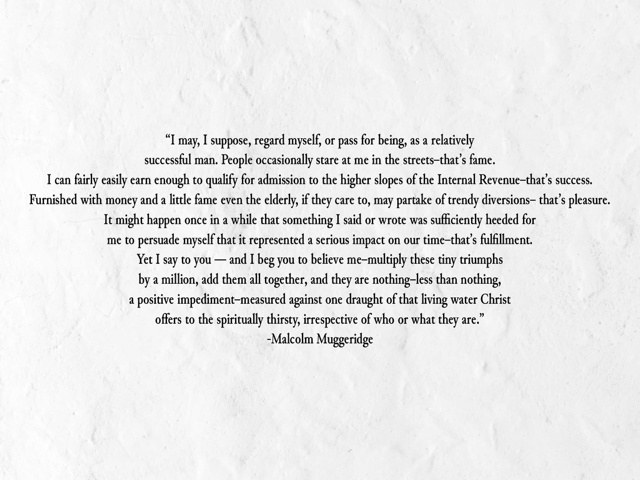
 “I may, I suppose, regard myself, or pass for being, as a relatively successful man.
People occasionally stare at me in the streets–that’s fame. I can fairly easily earn enough to qualify for admission to the higher slopes of the Internal Revenue–that’s success.
Furnished with money and a little fame even the elderly, if they care to,
may partake of trendy diversions– that’s pleasure.
It might happen once in a while that something I said or wrote was sufficiently heeded for me to persuade myself that it represented a serious impact on our time–that’s fulfillment.
Yet I say to you — and I beg you to believe me–multiply these tiny triumphs by a million, add them all together, and they are nothing–less than nothing, a positive impediment–measured against one draught of that living water Christ offers to the spiritually thirsty,
irrespective of who or what they are.”
– Malcolm Muggeridge