Laudable Linkage

Laudable Linkage

Here are some of the good reads found this week:

Contentment Isn’t Only for Hard Times, HT to Challies. “I was about as happy as a person could be. I say ‘about’ because one unwelcome thought intruded: It’s not going to last. I was only visiting for a couple of weeks, and then I’d be back to the daily grind of work and responsibilities. In that moment, amid deep joy, the grace of contentment was just as essential as it is when my life is falling apart. I need contentment to receive God’s immense blessings gratefully, even knowing they’re temporary.”

It’s OK to Be OK, HT to Challies. “We need to fight two battles at once. We need to keep telling people that life is hard, the world is fallen, and we all fall short in sin. It’s OK to struggle, and when we do, we need to ask for help . . . However, we don’t need to equate authenticity with struggle. We need to leave room for people to be authentically happy—for life to go well sometimes.”

On Magic. “What is magic, in essence? It’s an attempt to get the gods to do what you want. And that is to turn the universe upside down and inside out. God is not our servant; he is not here to do what we want. We are here to do what he wants. If I do this or this or that, God will do what I want. That’s, ironically, godless thinking.”

Don’t Be Proud of What You Had No Say In, HT to Challies. “Many of the things that people tend to be proud of are things that we have no say in at all,” like height, natural beauty and abilities. “There is a difference between a gift and a talent. A gift is something you receive that you did not earn. A talent is something that you have developed over time, often based on a gift you have received.”

15 Resolves for Maintaining Spiritual Balance in Severe Interpersonal Conflicts, HT to Challies. I’d add one that has been a help to me: remembering the other person is beloved by God, and God wants the highest and best for that person, too.

Beware the Instagram Bible. I think I shared this a few years ago, but I needed to look it up again this week. “Beware the Instagram Bible, my daughters—those filtered frames festooned with feathered verses, adorned in all manner of loops and tails, bedecked with blossoms, saturated with sunsets, culled and curated just for you. Beware lest it become for you your source of daily bread. It’s telling a partial truth.”

When You Can’t Forgive Yourself After an Abortion, HT to Challies. Although the context is about abortion, the truths here are good for anyone who feels they can’t forgive themselves for something they have done.

Updated to add: I stay away from politics here on the blog, but I wanted to say I was saddened and shocked by the events of last weekend. Violence is not the answer no matter what party one is in.

D. L. Moody quote about what God can do with a nobody

Moses spent 40 years thinking he was somebody; 40 years learning he was nobody,
and 40 discovering what God can do with a nobody. — D.L. Moody

Friday’s Fave Five

Friday's Fave Five

I’m pausing for a moment with Susanne and friends at Living to Tell the Story to look back at the good things of the week.

1. Freezer organization. We have a side-by-side freezer and refrigerator. I keep the frozen items I use most often in this freezer and save the bigger or lesser-used frozen foods for the chest freezer in the garage. The one in the kitchen was full of bagged things that probably save space, but slide around. Plus I couldn’t see what was in the very back and bottom. So on Saturday, I dragged the table over, put most of the freezer contents on it, and put like things together. I got rid of a couple of things. Jim unstuck the bottom drawer for me, and I pulled it out out to clean it. It felt good to get reacquainted with what was there and have things in better order.

2. Surprise sausage. One of the freezer items I hadn’t realized I had was a partial roll of ground sausage. I’m not sure what it was doing there—I don’t get it often, and I usually brown it all at once when I do have it. I thawed it out, browned it, used some for these crescent sausage rolls for dinner, some for a breakfast burrito the next day, and sprinkled some on a couple of pieces of leftover pizza. And I still have some left!

3. Trying something new. After church on Sunday, Timothy suggested going out to a restaurant. 🙂 We hadn’t done that in a while–often their care group or ours meets for Sunday lunch. But none of us had anything scheduled that day. Our first choice of restaurant was crowded, with a line extending out the door. So they suggested a nearby Mexican restaurant we hadn’t been to before. The menu didn’t have my usual Mexican food entree choices, but something called Cozumel Rice caught my eye–grilled shrimp with Mexican rice, topped with cheese sauce. It was so good.

4. A good visit. Mittu’s aunt and uncle from OK were traveling nearby in TN and stopped to spend a few hours at Jason and Mittu’s house. J&M invited us over as well. We enjoyed the time visiting with them–we hadn’t seen them since Jason and Mittu’s wedding.

5. Lindor Lindt Milk Chocolate Truffles, my favorite candy. Jim saw them on sale at the grocery store and brought back a couple of bags. I try to keep consummation of them under control by rationing one or occasionally two a day.

Bonus: We had much-needed soaking rain yesterday.

Any special blessings from your week?

Review: The Story of the Trapp Family Singers

Several weeks ago, we watched The von Trapp Family: A Life of Music, the story of the family from The Sound of Music, from the viewpoint of Agathe, the oldest daughter (Liesel from the film). There were quite a few differences between the two films, though the basic story line was the same. I remembered I had a book in my Kindle app about the family written by Maria, so I thought it was high time I got around to reading it.

I had wondered which came first: did the book inspire the movie, or was the movie made first and then the book written to “set the record straight.” The book was published in 1949, and a musical based on it began in 1959. The movie we all know came out in 1965.

Maria was training to be a nun when she was asked to tutor Captain von Trapp’s daughter, also named Maria, who had been ill. Eventually she began helping with the other six children as well.

The book doesn’t mention any animosity between Maria and the children at the beginning. There also didn’t seem to be any distance between the children and their father as the film suggests. Later Maria write in passing that they had their share of normal family squabbles.

The Captain fell in love with Maria over time. She had never given any thought to marriage, so she went back to the convent to ask what to do. She was told it was God’s will to marry the Captain. She loved the children like a mother, but it took her a while to love their father. They went on to have three more children together but also experienced several miscarriages due to a kidney condition of Maria’s.

The family loved to sing together in the evenings. Once while singing outdoors, a well-known soprano heard them and encouraged them to sing publicly, saying “You must not keep that for yourselves . . You have to share this with the people” (p. 121, Kindle version). The Captain was mortified at first, but eventually decided they wouldn’t be doing anything wrong. Then they were invited to sing on the radio, then someone heard them and wanted to sign them up for some concerts, and one thing led to another.

A bank failure led to the loss of most of the family’s cash. As the children took everything well and pitched in to help, Maria thought it lucky that they had lost the money. “How would we ever have found out what fine fellows the children are?” (p. 115). She was happy to find out that “we were not really rich, we just happened to have a lot of money. That’s why we can never be poor” (p. 115).

They took in boarders to supplement heir income, but eventually their singing hobby had to become their profession.

The Nazis invaded Austria, something Hitler had promised not to do. When the Chancellor announced on the radio that he was “yielding to force” and the next voice on the radio proclaimed Austria was dead and the Reich was in control, the Captain tearfully said, “Austria, you are not dead. You will live on in our hearts. This is only a sleep. We promise you to do all we can to help you wake up again” (p. 130).

The family found themselves unable to comply with several demands of the new regime. They knew that would not be tolerated for long, so they looked for a way to leave the country. Someone in America had invited them to come and give some concerts, loaning them the money to do so.

Their adjustments to American customs bewildered them but also provided a lot of humor. For instance, they put their shoes outside their hotel doors at night so they could be shined, like they always had. They were informed that not only would their shoes not be shined, but they might disappear. They were confused when a couple of them found they could get their shoes shined in the barber shop, of all places.

Maria applied logic to learning English: if the past tense of freeze was frozen, then it followed that the past tense of squeeze should be squozen and sneeze/snozen. If a drunkard was someone who drank too much, then a thunkard was someone who thought too much (p. 162). Unfortunately for them, English is not that logical.

Someone had taught her what to say in various instances–“If you want someone to leave the room quickly, just say . . . scram” (p. 168). When she and a Bishop caused a traffic jam, wanting him to go first, she told him to please scram. His entourage was “petrified,” but thankfully he laughed (p. 168).

They experienced adventures and trials along the way til they eventually were allowed to become US citizens and settled in Vermont, which they found to be much like Austria.

They had a penchant—or at least Maria did—for getting into ventures that were over their heads and having to figure things out as they went.

It was interesting and touching to read of the last years that were unmentioned in both films.

Some parts of the family’s story were more exciting than others—which I suppose could be said of anyone. It was a little disappointing that some parts of the movie weren’t true to life. I disagreed with much of the theology in the book. But overall, I enjoyed learning what happened to the real Trapp family.

The blurb of the book on Amazon says it contains pictures, and there’s even a copyright notification in the book for pictures—but, sadly, there are no pictures in the Kindle version I have except for the cover. However, I found several online.

This is a cute interchange between Julie Andrews, who played Maria in the film, and the real Maria:

Be Careful of Your Strengths

Be careful of your strengths

I don’t consider myself to be good at public speaking. Even in a few interviews I’ve done, when I’m responding and not talking by myself, I don’t feel I do well. I don’t think quickly “on my feet.” It takes me a moment to process and respond (which is one reason I like writing better).

The nerves usually calm down exponentially once I get started. But for days afterward, I think of things I should have said or could have said better.

But I want to be faithful with opportunities the Lord gives me. So when they come, I spend time in prayer while I prepare. It comforts me that Paul told the Corinthians that he had been with them “in weakness and in fear and much trembling” (1 Corinthians 2:3), though it probably wasn’t public speaking itself that made him feel that way.

Hopefully, these skills will improve over time.

I told someone recently that these things would be so much easier if I could turn off the nervousness. But then I realized those nerves probably keep me dependent on the Lord, so ultimately they’re good.

When we’re asked to do something that we’re not sure we can do, that feels too big for us, that isn’t in an area where we feel gifted, it’s almost instinctive to run to the Lord.

When we attempt something that we failed at before, we plead for and depend on the Lord’s help.

When we know we might be facing a big temptation in an area where we’re weak, we fortify ourselves with prayer and Scripture.

But what about the areas where we feel strong, where we feel our best gifts are, where we feel we can function well? Those things that we do without even thinking to pray?

It’s not that we can’t approach some tasks with confidence or the assurance that comes from experience. But we often forget we need God’s help in those areas, too. Whatever gifts we have, He gave them to us. We don’t hold them in perfection yet: we’re still growing and learning. Jesus said, “I am the vine; you are the branches. Whoever abides in me and I in him, he it is that bears much fruit, for apart from me you can do nothing” (John 15:5).

One of the most chilling Scripture passages to me is the story of Uzziah in 2 Chronicles 26. He began to reign in Judah at the age of sixteen. “And he did what was right in the eyes of the Lord, according to all that his father Amaziah had done. He set himself to seek God in the days of Zechariah, who instructed him in the fear of God, and as long as he sought the Lord, God made him prosper” (verses 4 and 5).

The next several verses tell about Uzziah’s victory in battle, his buildings, herds, crops, army, and machines. He was skilled in many areas. “And his fame spread far, for he was marvelously helped, till he was strong” (verse 15).

But when he was strong, he grew proud, to his destruction. For he was unfaithful to the Lord his God and entered the temple of the Lord to burn incense on the altar of incense” (verse 16).

It’s sadly possible to receive God’s grace and help for a task and then get puffed up as if we accomplished what He wanted us to do on our own.

He forgot where his strength, gifts, and skills came from. His pride led to presumption. Only the priests were consecrated to burn incense in the temple. They withstood him. He got angry.

Then leprosy broke out on his forehead. In that era, leprosy required quarantine. He lived the rest of his days in a separate house, and his son reigned in his stead.

His situation reminds me a bit of Samson, who took his gifts casually and flirted with the wrong kind of woman who tried to find the secret of his strength in order to tell his enemies. When she told him the Philistines were coming for him, “he awoke from his sleep and said, ‘I will go out as at other times and shake myself free.’ But he did not know that the Lord had left him” (Judges 16:20).

Jerry Bridges said in The Discipline of Grace, “Your worst days are never so bad that you are beyond the reach of God’s grace. And your best days are never so good that you are beyond the need of God’s grace.”

Jeremiah 9:23-24 tells us, “Thus says the Lord: ‘Let not the wise man boast in his wisdom, let not the mighty man boast in his might, let not the rich man boast in his riches, but let him who boasts boast in this, that he understands and knows me, that I am the Lord who practices steadfast love, justice, and righteousness in the earth. For in these things I delight,’ declares the Lord.”

I don’t want to go about my tasks without God’s power. I want to remember that I don’t have anything except what I have received from Him. I want to be just as dependent on Him when I feel sure of myself as when I feel overwhelmed. I want to remember that every good gift comes from Him and is to be used for Him.

The prayer in the song “O Great God” is what I want to express for myself. The last stanza talks about living a life dependent on His grace, for His glory:

2 Chronicles 26:15-16a

Some additional songs that help my thinking:

(I often link up with some of these bloggers.)

Laudable Linkage

Laudable Linkage

I have just a short list to share with you today:

The Living and Abiding Word of God, HT to Challies. “A farmer doesn’t cause seeds to grow but faithfully plants and waters them. Despite his careful tending, the seeds he sows sometimes lay dormant for a long time—which is Peter’s point. It’s not our cleverly devised arguments or our life’s example that brings about new life but the powerful life-producing work of God’s imperishable and never-fading Word.”

Look Up In Faith, HT to the Story Warren. “On my way to school, I drove with my eyes fixed on the road, praying I would be ready to meet my twenty-six early morning students in just a few minutes. And then I saw it, a pinkish orange hue highlighting a sky full of cotton puffs. I couldn’t believe it. How many years had I been making this drive and I just now noticed? If I’m honest, I’ve always had a hard time looking up.”

Does the Bible Blame Women for Rape? HT to Challies. Wendy Alsup thinks through a difficult passage in Deuteronomy.

Why Is Proverbs So Negative About Women? “So a fairly new believer asked me a simple question afterward. ‘Why is the Bible so hard on women?’ I am glad she felt the freedom to ask the question. I would much rather get it out in the open than have women wonder silently. Let’s tackle the question for a moment.”

How to Identify a Great Deacon, HT to Challies. Churches have different ways of choosing deacons: some appoint them, others have the congregation vote on them. If you’re in the position of nominating or voting on deacons, this article has great points to consider.

J. C. Ryle quote

Before you use God’s Word as a sword, use it first as a mirror.
J. C. Ryle

Friday’s Fave Five

Friday's Fave Five

Friday is here again, time to pause with Susanne and friends at Living to Tell the Story and count the week’s blessings. Mine are mostly simple pleasures this week.

1. A grocery delivery snafu that worked out. On Saturday, I stopped to look out the front door window, and noticed a bunch of groceries on our front porch. We hadn’t ordered any. The name on the bags wasn’t anyone we knew. I called the store, but they said we could keep them–even if they came to pick them back up, they couldn’t deliver them to the original customer after the goods had been out of the store’s hands. They said they’d send the customer a refund.

Before we brought the groceries in, though, we decided to call one neighbor who knows everyone on the next three streets to see if she knew the name on the bags. While we were doing that, someone pulled up and said she thought the groceries were hers. She turned out to be the granddaughter of one of our neighbors. I’m glad it all worked out okay and she got her stuff without having to order them all over again.

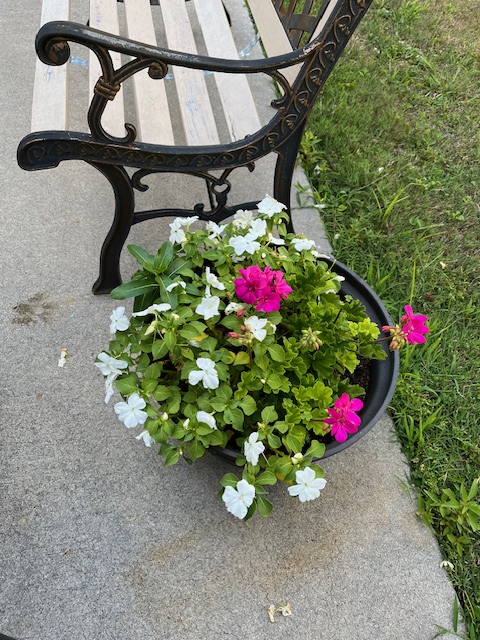
2. Flowers. We had planted wildflowers from seeds, and they are really taking off now! It’s so pretty to see them from the kitchen window.

Wildflowers

As they were coming up, we weren’t sure what was flower and what was weed until they started blooming. So I think some weeds are mixed in there. 🙂 I’m not sure what that tall feathery thing is.

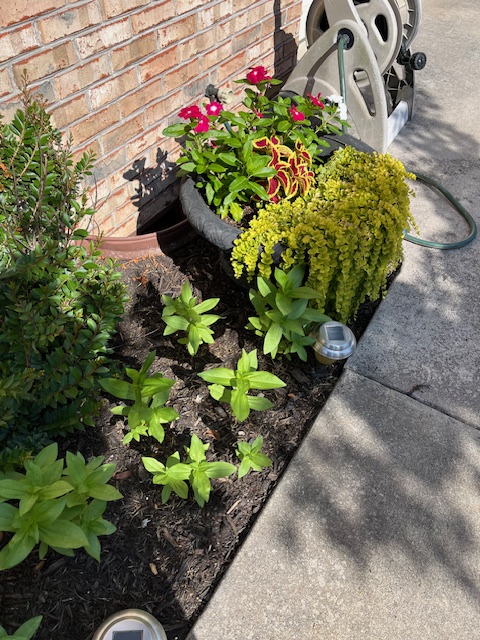
In addition, the planters are filling out nicely. We had planted zinnias from seeds for the first time, and they’re coming up well, too, though they haven’t bloomed yet.

flowers
planter

I’m thankful my husband faithfully keeps everything watered

3. Our first squash. We haven’t planted vegetables in many years, but my husband planted yellow squash and tomatoes this year. Both are coming along, and he brought in our first squash today (Thursday).

4. Hummingbirds. We didn’t see any even though I put the feeder out several weeks ago. I decided to make a new batch and have seen several now. The wildflowers we planted are supposed to be the kind that attracts them, so hopefully we’ll see more.

5. An Apple gift card. I’d had one for some time, but hadn’t loaded into my account so it wouldn’t get frittered away. I wish Apple and Amazon would let us adjust settings so they don’t automatically use gift cards as the first payment option. The Apple gift card can be used for iTunes, and I was able to buy a few songs this week.

How was your week?

Assorted Stray Thoughts

Stray Thoughts

Occasionally I have several thoughts I want to share, but each is not enough for a blog post. Some are lighthearted, others are more serious.

First of all, I want to apologize if you see a pop-up box when you comment asking you to subscribe. I *hate* when a pop-up comes up in the middle of the screen and you can’t read any further without dealing with it. I have not seen this on my own blog, but I have on other WordPress blogs, so I assume it happens on mine as well. I just spent some time scouting around to see if there was a way to turn this off, and I couldn’t find it (if you know of a way, please let me know).

I also dislike when I follow someone’s link to a blog or article where I am asked first thing to create an account (even a free account) in order to read further. Honestly, if the first thing I encounter on any blog is a pop-up, whether it’s for subscribing, creating an account, buying a book, getting a free download, or turning off ads, I’m likely to just close the site and move on. How do I know if I want to subscribe or create an account when I have not even had a chance to read anything there yet?

For sites that want you to pay to subscribe, I think those site owners are wise who allow a certain number of free reads per month. I might be more likely to subscribe if I read there and find a lot I like. But not if I can never get past the first pop-up.
____

From the time I first learned what an introvert was, I knew I was one. Reading about introversion, like Susan Cain’s Quiet: The Power of Introverts in a World That Can’t Stop Talking, helped me understand myself a great deal.

I’ve run across some Instagram accounts for introverts, but I find I can’t read them regularly. Reading them occasionally, I’ll nod my head and appreciate that someone else knows how I think and feel. Some have comics that are funny and apt. But if I read them all the time, I find myself resenting the demands of life that draw me out of my introversion. I think the point of learning about introversion (or extroversion, if that’s you) is not to make the people who know us or the world around us conform to our preferences. Every source I’ve read on introversion says we need to step out of our comfort zone sometimes. Understanding my bent and needs helps me do that. But if I was constantly filling my head with cute memes about wanting alone time, that would be my focus.
_____

Sometimes I’ll read that blogging is considered dead (often, ironically, in a blog post). I have not found that to be the case. There are scores of good blogs out there that I would like to keep up with but can’t.
_____

Sometimes I see a writer attribute our tendency to be over-busy as pride–as if that’s how we “keep up with the Joneses” these days, or as if it’s the trendy thing to talk about how busy we are. But I don’t know anyone who truly feels that way. Most super-busy people that I know would desperately like not to be that way, but they don’t know what to cut out. As we’ve developed labor- and time-saving devices, we’ve added more and more things to be done.
_____

I have not seen any Christmas items in stores yet (though I have seen Halloween things), but they seem to be displayed earlier each year. Early last fall I stopped by Cracker Barrel because I had seen something in the beachy section that I decided I wanted to get. But when I went back, the whole beachy section was gone and Christmas items were out. I wonder if retailers ever consider that they might lose sales because their Christmas decor edges out other things a shopper would be more likely to buy in the late summer or early fall.

I also wonder if anyone really buys Christmas stuff in August? I admit, if I needed something, I might look early in order to benefit from a greater selection. I like to buy Christmas cards early, but otherwise I try to avoid the temptation of the Christmas aisles. I have more Christmas decorations than I have room for–I don’t need to add any more.

One exception was when our church used to send presents to our overseas missionaries by way of surface mail. We’d have to send packages to some countries in October in order for them to arrive by Christmas. So it was nice to get wrapping paper and such then. After the Post Office did away with that rate, it was too expensive to send packages, so we just sent cash offerings to the missionaries’ accounts. That was more efficient, but I missed the personalized packages.
_____

Do you ever do this? A while back, I was intrigued with the word “adorn” in Titus 2:10, which speaks of adorning the doctrine of God our Savior. I pondered how we do that. Isn’t God’s doctrine perfect as is? How do we adorn it? As I began to study and thought about writing a post about the topic, I found I already had. 🙂
_____

I’ve gotten frustrated lately with Facebook removing a couple of my posts. I’ll receive a notification that they removed a post with a note to “Click here to see why.” I’ve clicked there, but then I am taken to a page that says everything looks good with no problems. There’s no explanation and nothing to click to appeal. One post had photos of teenagers I wasn’t related to, so perhaps that was a privacy protection thing. But the other contained two reviews of study books on Isaiah. All I can figure is that their sensor bot picked up on the name of a certain country not popular in the news media (which I am avoiding naming in case that was the problem), even though the subject was thousands of years ago.

I wouldn’t mind so much if there was an explanation and an opportunity to appeal. They really need to not let these things be done by AI.
_____

Since my husband retired at the end of last year, we went on Medicare in January. I am not a fan so far. For one thing, a blood thinner I am on for atrial fibrillation (since afib can cause blood clots) jumped from $10 for a 90-day supply to over $500. What sense does that make, that when your income goes down, your prescriptions go up? I talked to the cardiologist about alternatives, and we found one that was *only* $150 for 90 days–and it’s at a different pharmacy than we usually use because it’s cheaper there.
_____

Since I’ve been sharing some frustrations, I’ll end with some things that made me smile recently:

Our gastroenterologist’s office was decorated for summer in a luau theme, with this sign on the bathroom door:

High tides, good vibes

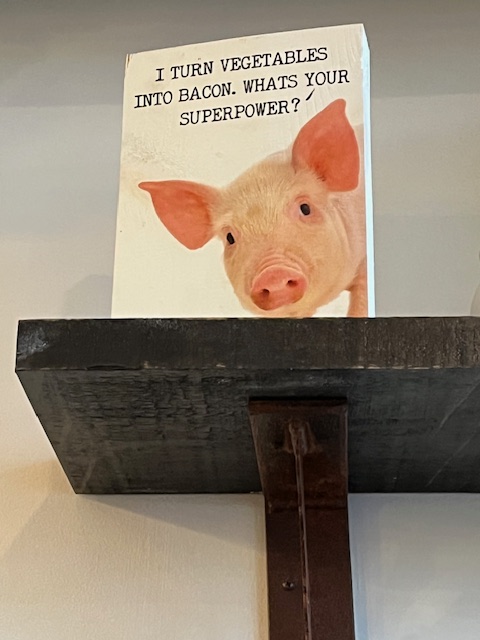
This was from a restaurant we went to a few months ago:

Turning vegetables into bacon

I was looking at the evening reading of Daily Light on the Daily Path a while back, and thought it ironic to see an ad about cremation after a verse about being made from dust . . .

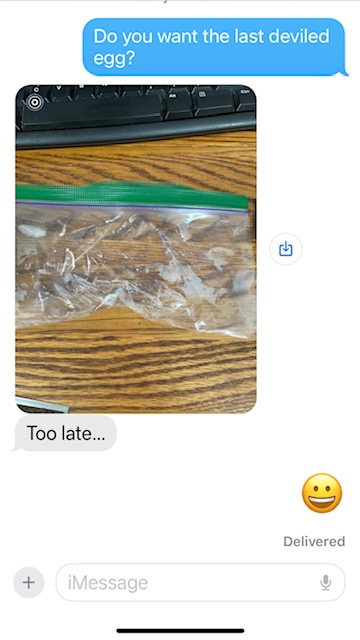
And lastly, this text exchange with my husband:

Text with Jim

To be fair, there were only two left, and I had one the night before. So technically this one was his. But I thought it was still in the refrigerator and he might not want it. 🙂

And yes, sometimes we do text each other from different rooms in the house . . . 🙂

And that’s probably enough stray thoughts for one day.

Review: Dombey and Son

Dombey and Son

Mr. Dombey of Charles Dickens’ Dombey and Son was originally the son of the establishment by that name. Now he’s the father, his only son having just been born. Already he has plans and dreams for when his son is old enough to go into the family shipping business with him.

The Dombeys had a girl six years before, “But what was a girl to Dombey and Son! In the capital of the House’s name and dignity, such a child was merely a piece of base coin that couldn’t be invested” (p. 8, Kindle version).

Mr. Dombey’s wife, however, weakens fast and dies before the baby, little Paul, is a day old.

A wet nurse is hired, and Paul grows, but he’s never very strong. He and Florence are sent to Brighton to be aided by the sea air. Paul does so well that he stays there for school, with Florence helping him with his studies.

But Paul dies at age six.

Mr. Dombey does not open his heart to grieve with Florence. He’s barely aware of her.

Some years later, on a vacation with a friend, Mr. Dombey meets a widowed Mrs. Edith Granger, who is beautiful but proud and cold—just his type. Her mother and his friend connive to get the two together. Eventually they marry.

But once again, Mr. Dombey is disappointed. He had thought his wife’s pride would be blended with his own and transferred to his reputation, standing, and business. But proud people do not usually blend their pride with others. Thus the Dombey establishment is set for conflict.

In one brief scene, we see the reason behind Edith’s demeanor. For all her coldness to everyone else, the new Mrs. Dombey loves Florence. Yet Mr. Dombey is jealous that Florence receives the attention and warmth he doesn’t, and he takes it out on her.

Aside from his dysfunctional household, Dombey has a conniving, obsequious assistant named Mr. James Carker. We know Mr. Carker is up to no good, despite his flattery, but it takes a while before we find just what he is planning.

As always, Dickens weaves together many subplots into his narrative.

A young boy named Walter Gay works for Dombey. His uncle runs a shop where he makes and sells shipping instruments. One day when Florence is separated from the children’s nurse and lost, she runs into Walter, who sees her safely home. Though Mr. Dombey appreciates the effort, he doesn’t like him. When he misunderstands an action of Walter’s, he sends him to Barbados. But the ship is not heard of again, and Walter’s uncle goes to look for him.

A creepy, avaricious elderly woman named Mrs. Brown finds Florence when she is lost and makes her change her fine clothes and shoes for rags so she could sell them. Later, Mrs. Brown’s daughter returns from prison nursing a hatred for Mr. Carker, who had some part in sending her there. These two appear at intervals through the book.

Mr. Toots is a kind-hearted but weak-minded fellow student at Paul’s school who loves Florence and also turns up at intervals.

Mr. Carker’s brother, John, was guilty of wrongdoing in the firm some years earlier, but is repentant, humbled, and reformed. James continually belittles and argues with him. Their sister, Harriet, went to help John in his trouble, causing James to cut off relations with her. A mysterious stranger shows up later to John and Harriet’s home to offer help when they need it.

Besides these, there are a number of colorful characters, some comic and some cruel.

I love how Dickens phrases some things:

Son lay tucked up warm in a little basket bedstead, carefully disposed on a low settee immediately in front of the fire and close to it, as if his constitution were analogous to that of a muffin, and it was essential to toast him brown while he was very new (page 7, Kindle version).

Time and his brother Care had set some marks, as on a tree that was to come down in good time—remorseless twins they are for striding through their human forests, notching as they go (p. 7).

. . . the nurse, a simpering piece of faded gentility (p. 8).

He was a slow, quiet-spoken, thoughtful old fellow, with eyes as red as if they had been small suns looking at you through a fog (p. 27).

Snails were constantly discovered holding on to the street doors, and other public places they were not expected to ornament, with the tenacity of cupping-glasses (p. 70).

It being part of Mrs. Pipchin’s system not to encourage a child’s mind to develop and expand itself like a young flower, but to open it by force like an oyster . . . (p. 71).

There was never a man who stood by a friend more staunchly than the Major, when in puffing him, he puffed himself (p. 185).

Sometimes she tried to think if there were any kind of knowledge that would bespeak his interest more readily than another. Always: at her books, her music, and her work: in her morning walks, and in her nightly prayers: she had her engrossing aim in view. Strange study for a child, to learn the road to a hard parent’s heart!  (p. 208).

Harriet complied and read—read the eternal book for all the weary and the heavy-laden; for all the wretched, fallen, and neglected of this earth—read the blessed history, in which the blind lame palsied beggar, the criminal, the woman stained with shame, the shunned of all our dainty clay, has each a portion, that no human pride, indifference, or sophistry, through all the ages that this world shall last, can take away, or by the thousandth atom of a grain reduce—read the ministry of Him who, through the round of human life, and all its hopes and griefs, from birth to death, from infancy to age, had sweet compassion for, and interest in, its every scene and stage, its every suffering and sorrow (pp. 520-521).

I think I can say the story is redemptive without giving away the ending. And though this is a sad story in many ways, Dickens sprinkles many choice comic moments throughout.

I wanted to read this book partly because I’ve purposed to read the Dickens books I’ve not read yet, and partly because this book played a significant part in The British Booksellers by Kristy Cambron, which I recently read. I wondered if there was some connection between the stories or whether it was included because it would have been popular at the time.

I listened to the audiobook superbly read by David Timson. His voice characterizations and inflections added so much to my enjoyment of the book. When I look for my next Dickens’ book, I am going to see if I can find one narrated by Timson. That may be soon, as this book reminded me how much I love Dickens.

“All Sunshine Makes a Desert”

"All sunshine makes a desert."

Rain can be awfully inconvenient.

Outdoor activities planned months in advance can be ruined, or at least need to be rearranged, when an unforeseen rainstorm blows in. Grocery shopping becomes a big mess when we have to cart our bags in and out in the rain. Rain makes roads slick, creating driving hazards.

Rain can also be gloomy when we haven’t seen the sun for days.

One of my worst rain experiences came when I was driving home alone. The rain fell so heavily, my windshield wipers couldn’t keep up. I literally could not see anything around me except the faint glow of other headlights. I somehow made it to the parking lot of a convenience store and waited til the showers abated, hoping no one would run into me.

And then there are thunderstorms with the potential to down power lines, send limbs crashing from trees, or strike lightning.

Yet, we need rain.

Rain softens the ground, making it easier to plant seeds. Then those seeds transform into flowers or food with more rain and sunshine.

Rain relieves the scorching heat of summer.

Rain provides water to drink and replenishes water tables for future needs.

Rain washed impurities out of the air.

F. B. Meyer wrote:

We all love the sunshine, but the Arabs have a proverb that ‘all sunshine makes the desert’; and it is a matter for common observation that the graces of Christian living are more often apparent in the case of those who have passed through great tribulation. God desires to get as rich crops as possible from the soil of our natures. There are certain plants of the Christian life, such as meekness, gentleness, kindness, humility, which cannot come to perfection if the sun of prosperity always shines. (1)

That’s true, isn’t it?

Just as I don’t like rain to interrupt my plans or make my tasks harder, I don’t like when trials and problems come up. They’re hard, painful, and sometimes costly. They take time and thought and energy from things I’d rather do.

But they have a good purpose.

When life is going well, we can get complacent. People who get everything they want and have everything just the way they like it sometimes start to feel entitled.

Though we know we need God’s grace and help in every circumstance, we feel our need of Him more during trials.

Trials soften us by humbling us. They show us our lack of strength and our need for His. They help us depend on Him more.

Trials help us grow. “We rejoice in our sufferings, knowing that suffering produces endurance, and endurance produces character, and character produces hope, and hope does not put us to shame, because God’s love has been poured into our hearts through the Holy Spirit who has been given to us” (Romans 5:3-5).

Trials help us to be grateful for what we have.

Trials can help wash impurities out as we search our hearts and confess wrong thoughts, deeds, and attitudes to God. Trials don’t always come because of sin, but when they do, they have a cleansing effect.

Trials point us to those unseen resources I mentioned last week. Hidden water tables of grace sustain us during dry periods.

God’s Word refreshes us with His promises:

And I will make them and the places all around my hill a blessing, and I will send down the showers in their season; they shall be showers of blessing (Ezekiel 34:26).

Sow for yourselves righteousness; reap steadfast love; break up your fallow ground, for it is the time to seek the Lord, that he may come and rain righteousness upon you (Hosea 10:12).

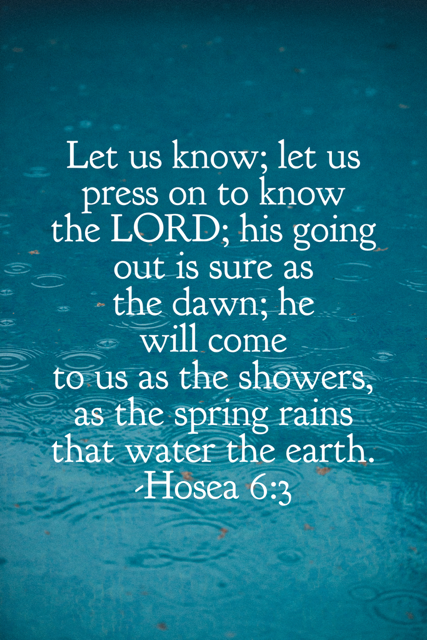
Let us know; let us press on to know the Lord; his going out is sure as the dawn; he will come to us as the showers, as the spring rains that water the earth (Hosea 6:3).

He did good by giving you rains from heaven and fruitful seasons, satisfying your hearts with food and gladness (Acts 14:17b).

One of my favorite childhood memories involves rain. My mom let us put on our bathing suits to go outside and play in a mild rain shower. I don’t know what time of year it was, but it had to have been during warm enough weather to get wet outside. Perhaps the rain was cooling on a hot summer’s day.

There was no thought of mess or inconvenience or disrupted plans. Instead, there was pure joy at the opportunity to do something so different and refreshing.

I can’t honestly say I dance for joy when trials come. But I am trying to learn to “Count it all joy, my brothers, when you meet trials of various kinds, for you know that the testing of your faith produces steadfastness. And let steadfastness have its full effect, that you may be perfect and complete, lacking in nothing (James 3:2-4). God has good purposes in trials and sends them in love and faithfulness.

Rain can be inconvenient, but also refreshing. All sunshine, as the saying goes, makes a desert. God keeps us from desert hardness and barrenness by sending trials our way. As William Cowper says in his hymn, “God Moves in a Mysterious Way“:

Ye fearful saints, fresh courage take;
the clouds ye so much dread
are big with mercy and shall break
in blessings on your head.

Hosea 6:3

(I often link up with some of these bloggers.)

________

(1) This quote comes from Our Daily Homily by F. B. Meyer. I’ve not read this book, but I have seen the quote in Warren Wiersbe’s book Be Satisfied as well as other places.

Laudable Linkage

Laudable Linkage

Here’s my latest round of good blogging links:

Why Can’t an Unbeliever’s Good Works Please God? HT to Challies. “But when people find it difficult to grasp why God doesn’t accept their good deeds, I like to offer a few illustrations to help them better understand their standing with God and the nature of the good works. One illustration I like to use involves an estranged neighbor and my front lawn.”

Read the Bible a Lot, HT to Knowable Word. “One sure sign that someone hasn’t read their Bible for very long, is that they are arrogant. That might seem surprising, but it is almost universally true that someone who has spent a little time in God’s word always seems to have the answer for any situation.”

Taking a Hard Look, HT to Challies. Commenting on Paul’s telling people to imitate him in Philippians 3:17: “It’s not that I think Paul’s being arrogant. He’s not saying, ‘You don’t need to imitate Jesus; just imitate me.’ He’s imitating Jesus, so if they imitating him, they are imitating Jesus. This passage makes me twitchy because how can you possibly feel comfortable telling people to imitate you? But Paul did. So why don’t I?” Very convicting!

Beauty Is Found In the Most Unexpected Places, HT to Challies. “The stars shine brightest against the blackened sky. Oak trees gain their stability and strength by enduring fierce storms. Pearls are found hidden within the depths of the sea. Diamonds are formed under intense pressure and heat under the earth’s crust. In God’s world, beauty is often found in the most unexpected places. And our faith often deepens and flourishes when everything is against us.”

Dear Little One, HT to Challies. This is a sweet letter from an aunt to her toddler nephew. It echoes what many parents and grandparent feel.

Made to Rest, HT to Challies. “Two kinds of rest—physical and spiritual — are critical for human flourishing and survival. We often conflate the two, but they are very different.” This is probably one of the best explanations of spiritual rest that I have read.

Why Did the Purity Movement Die? I don’t agree with every detail or characterization here, but overall the article shares many reasons why a movement that meant well ultimately died out.

Learning to Embrace the Counsel of Godly Older Women. “I’ve realized just how much my heart craves this kind of input—input that is quite priceless and rare today. From my study of Scripture, I’ve gained a deep conviction that I long for it because we’re supposed to have teaching from godly older women. Their counsel increases our wisdom and discernment—when we’re willing to heed it.”

Completely Unsolicited, Totally Anecdotal, But Perhaps Marginally Helpful Thoughts on Being a Christian Writer, HT to Challies. “For better or worse, I have a unique angle on this conversation. I’ve spent the last 7 years in the Christian publishing industry. Last year I published my first trade book. And the whole time, I’ve been as active as I know how to be in Christian shortform, maintaining a blog/newsletter for several years and writing articles for a variety of other places. This doesn’t make me wise, just experienced. So what I’d like to do in this post is offer a fistful of thoughts on the craft and business of Christian writing.”

We must allow the Word of God to correct us the same way we allow it to encourage us.
A. W. Tozer